Rays of sunshine – J. M. W Turner

Rays of sunshine are not too plentiful this weekend—neither in the weather, because it is persistently drizzling (just enough to soak you after a while,) nor in the absolutely horrendous news. And I do hope none of you has been indulging in a sunny holiday in Dubai, ha ha (sorry about the graveyard humour.)

However, sunshine is to be found in the wonderful paintings of J. M. W Turner, at the joint exhibition with John Constable at Tate Britain.
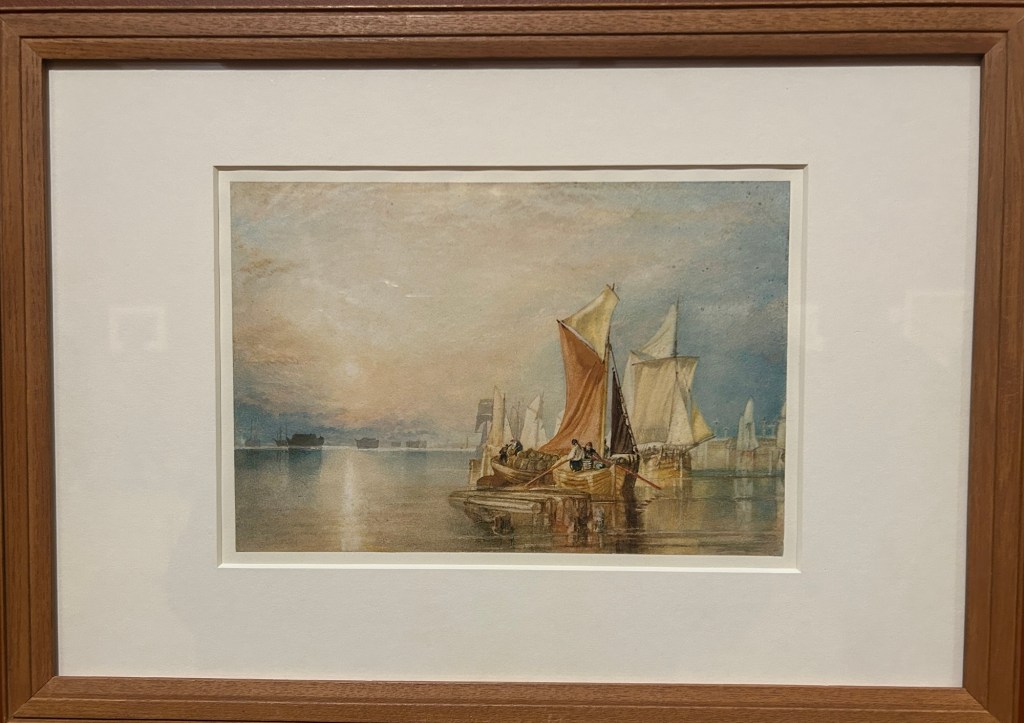
Stangate Creek, 1823-1824, watercolour on paper

Born within a year of each other – Turner in 1775, Constable in 1776 – and both trying to transform landscape painting, the two were great rivals, rather than friends.

Raised in the gritty heart of Georgian London, Turner quickly became a rising star of the art world, beginning his formal training at the Royal Academy Schools aged just 14 and exhibiting there soon after—whereas Constable, the son of a wealthy Suffolk merchant, faced a longer, more arduous rise to acclaim.

I think Constable was a very accomplished, solid artist who funded his life by painting portraits of wealthy people in order to be able to indulge in his great love, landscape painting. The combination of known faces and beloved places makes for an evocative and precious portrait of life in Regency England.

The juxtaposition of these two artists is certainly an interesting one, but may I say at once that in my mind Constable loses by the comparison. The curators cleverly did not place their works next to each other, but gave separate rooms to each.
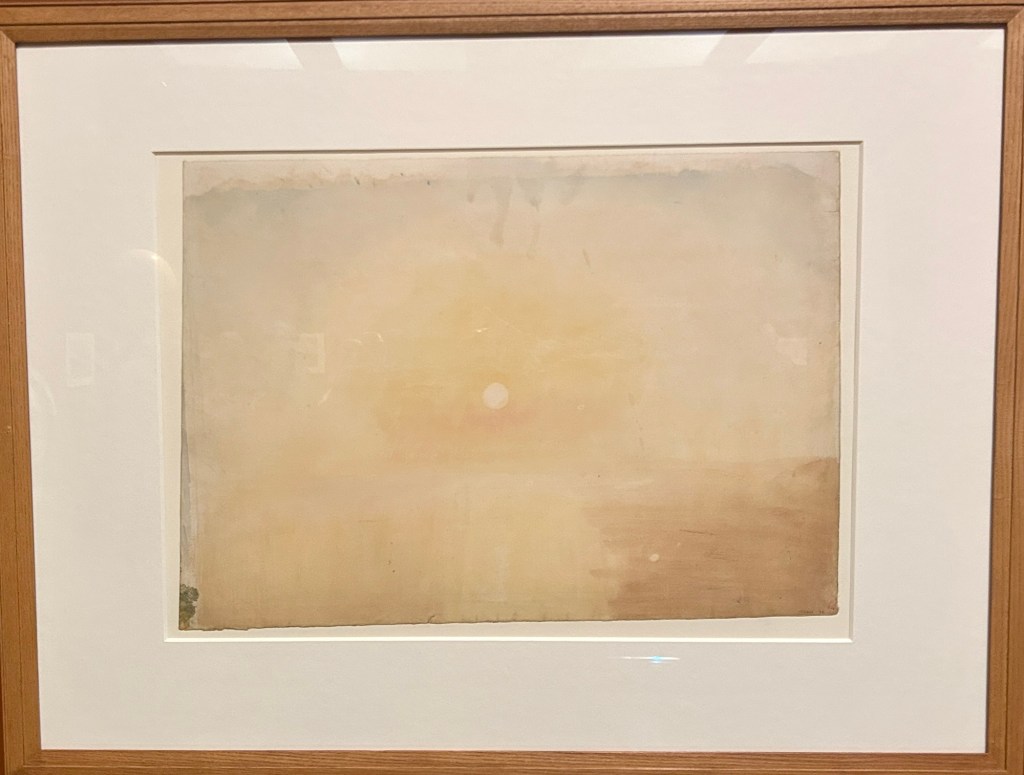
The sun rising over water, 1825-30, watercolour on paper

At the time they were exhibiting, Constable had a solid following and favourable reviews, whereas Turner was thought a genius by some, but deranged by others. In our modern consciousness and wider knowledge and appreciation of art, Turner’s paintings are mind-blowing. His treatment of the natural elements, wind, rain, water, clouds, sunrises and sunsets—in fact, all aspects of light and its effects, are unique. Especially the watercolours—the way he moved paint around and scraped paint off in places to achieve the translucent quality of the air around him is astonishing. Watercolour is a very delicate and elusive medium, and mistakes are dearly paid for; but he found it convenient and easy to transport so that he could capture the effects of light on nature live.
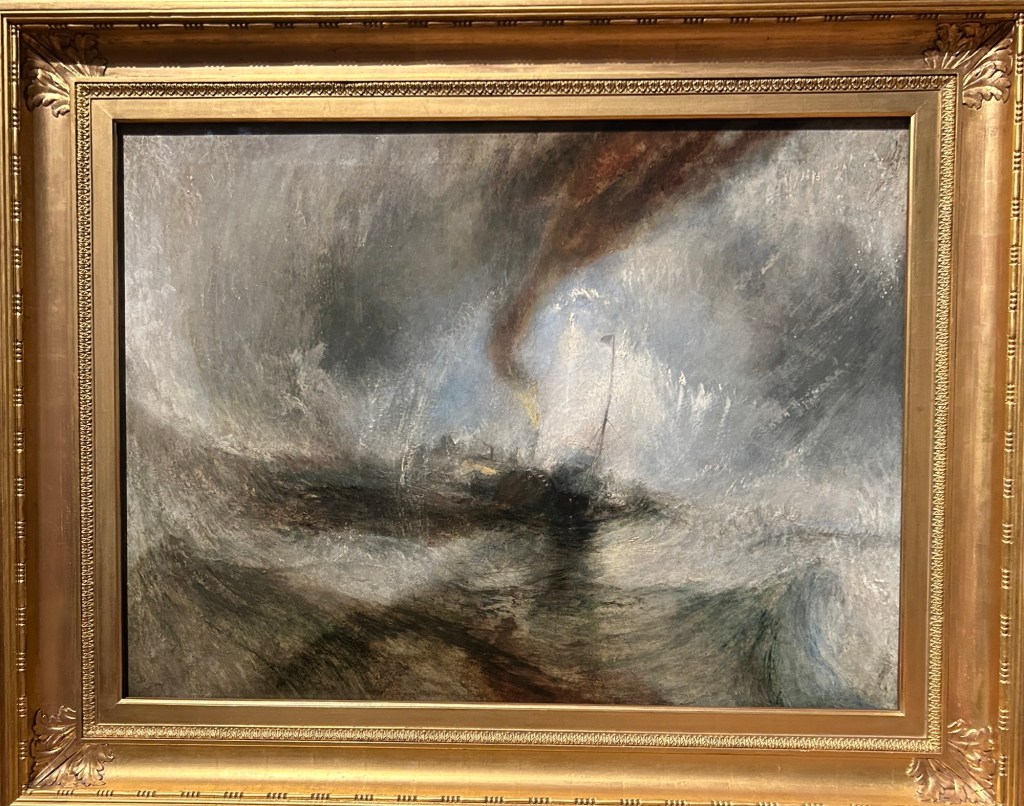
Snow storm – steam boat off a harbour’s mouth. Oil on canvas. This is one of Turner’s most daring paintings.

Many of the works in the exhibition are from private collections, so the opportunity to see them in person, and in close proximity, was a rare treat.
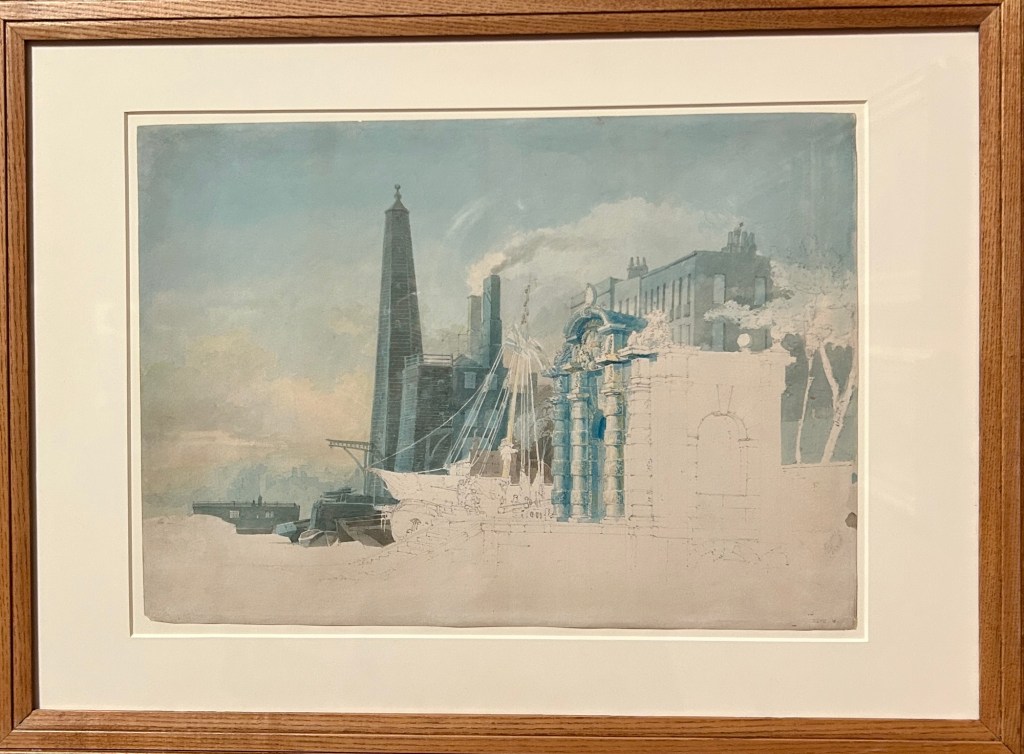
York House watergate, Westminster, London. Graphite and watercolour on paper.

The joy of beautiful prose

Being a bookworm from a young age, I read as the mood takes me, across a wide variety of genres: literary fiction, memoir, historical fiction and non-fiction, travel books, short stories, thrillers and crime. I have now arrived at an age where, if a book does not draw me in, I abandon it. So many books, so little time…And it has long ago ceased being homework. I read to be entertained, but also to be drawn into different worlds.

Into this last category come atmospheric books, such as the Booker Prize shortlisted Stone Yard Devotional, set in a religious community, or the winner, Orbital, set in space. The pace can be slow, but it is a delight to find oneself in a place one will never visit. The opposite of a thriller or police procedural, where you are waiting with bated breath to find out whodunnit.

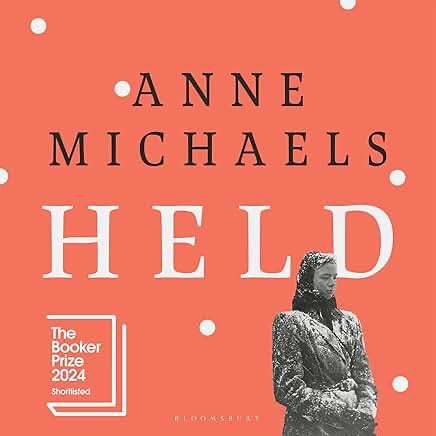
Occasionally, though, I come across a book where the plot does not matter, because the writing itself is so beautiful that I relish every sentence. I have lately, by coincidence, read two books of that calibre: Held, by Anne Michaels and Light Years, by James Salter.

Anne Michaels is an award-winning poet, which is perceptible in this fragmented tale of four generations of women. It explores the trauma of loss and the impact of love, shifting between times and viewpoints. You get submerged in the power of language, which is simply exquisite—lyrical and vivid. Like poetry, like music.

The second book is the story of a marriage, between two people who have privilege, charm but also flaws.

It describes the brittleness of happiness, the chinks in the perfect facade, the pull between contentment and desire. The inability to enjoy what one has, the longing to escape, the lure of something different. Restlessness, unfocused dissatisfaction. Voices heard, details of clothing, music, food. Flashes of landscape, the beauty of nature, subtle thoughts and feelings. The prose is lucid, the style is impressionistic, flawless.

Neither of these books have much of a plot, and ultimately perhaps this is not enough. A few of the reviewers complain about this and of course, liking a book or not is entirely subjective. It also much depends on one’s mood. Occasionally, however, it is a joy to luxuriate in wonderful language, where every sentence is a asks to be re-read. I loved both books and highly recommend them.