My days, darkened by the quasi-permanent absence of sunlight, were unexpectedly lit up by the discovery I had somehow missed reading a couple of Penelope Fitzgerald’s books, although she has long been one of my favourite writers.
Penelope Fitzgerald died in 2000 aged 83. In 2008 The Times listed her among “the 50 greatest British writers since 1945”. The Observer in 2012 placed her final novel, The Blue Flower, among “the ten best historical novels”, and A.S. Byatt called her, “Jane Austen’s nearest heir for precision and invention.”

Fitzgerald’s books are short, but within a few pages her prodigious powers of imagination create whole worlds. In The Beginning of Spring, she manages to describe the minutiae of life in pre-Revolutionary Russia as if she had been born there. But the research is worn so lightly it is imperceptible.
The Blue Flower, about the poet Novallis, has always been one of my favourite books. Based on the life of Friedrich von Hardenberg (1772–1801) it describes the time when, aged 22, before he became famous under the name Novallis, he became mystically attracted to the 12-year-old Sophie Von Kühn, an unlikely choice for an intellectual of noble birth given Sophie’s age and lack of education and culture, as well as her physical plainness and negligible material prospects. The couple became engaged a year later but never married as Sophie died of consumption a few days after her 15th birthday. The book is sad, subtle and romantic.
One of the books I had not read yet is The Golden Child, which is actually a murder mystery (she did not include it in her novels) with such a biting sense of humour that I found myself laughing out loud. The book is set in a museum, where “Even in total silence one could sense the ferocious efforts of the highly cultured staff trying to ascend the narrow ladder of promotion.” A perfect phrase if there ever was one. Or the description of the characters, even their names: “Hawthorne-Mannering, the Keeper of Funerary Art, was an exceedingly thin, well-dressed, disquieting person, pale, with movements full of graceful suffering, like the mermaid who was doomed to walk upon knives. Born related, or nearly related, to all the great families of England (who wondered why, if he was so keen on art, he didn’t take up a sensible job at Sotheby’s), and seconded to the Museum from the Courtauld, he was deeply pained by almost everything he saw about him.”
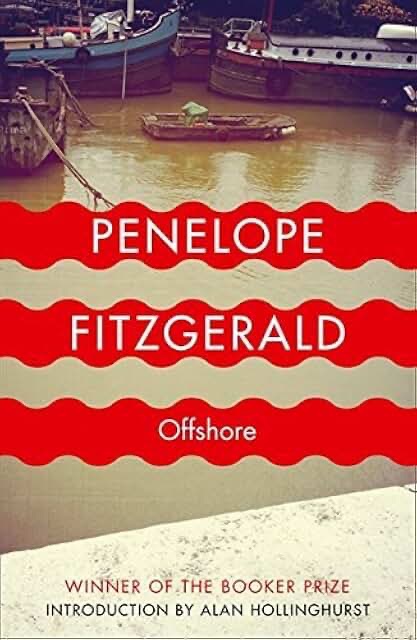
Her third novel, Offshore, won the Booker Prize in 1979. Based on her own years of living on an old sailing barge moored at Battersea Reach, it is about the mixed emotions of houseboat dwellers who live between the water and the land, fully belonging to neither.
Although she launched her literary career late, at the age of 58, Fitzgerald wrote nine novels, plus several biographies, short stories and articles. She had a hard life because due to her husband’s alcoholism she faced poverty, living for years in a houseboat which sank twice, and in public housing. She taught until the age of 70. Would she have been as good if she’d had an easy life? I think probably yes, because she was born in a scholarly family: she was the daughter of Edmund Knox, later editor of Punch, and Christina, daughter of Edward Hicks, Bishop of Lincoln and one of the first female students at Oxford. She was a niece of the theologian and crime writer Ronald Kox, the cryptographer Dillwyn Knox, the Bible scholarWilfred Knox, and the novelist and biographer Winifred Peck. She obviously also had great inherent talent.

She remains a unique, luminous voice in the literary firmament. I highly recommend her to anyone wanting to immerse themselves in her world.
Share this:


 Letters from Athens
I’ve not come across Penelope Fitzgerald before. It sounds as if she should be better known.
LikeLike
In total curiosity, may I say ‘thank you’ – a quick trip to my very favourite local bookseller seems to be in order . . .
LikeLike
You will love her ❤️
LikeLiked by 1 person
Thanks for the reminder–I read “The Golden Child” long ago, but remember liking it a lot. Now I must look for more. (K)
LikeLike
A lovely celebration of a wonderful writer! The Golden Child is delightful, isn’t it? Fitzgerald was so skilled at capturing the idiosyncrasies and petty jealousies at play in these institutions and insular communities. You’re making me want to re-read her. 🙂
LikeLike
A fine advocacy
LikeLike
She had a great prose style
LikeLike
I am embarrassed to say that I have never heard of her, so I have to thank you for the introduction, Marina.
Best wishes, Pete.
LikeLike