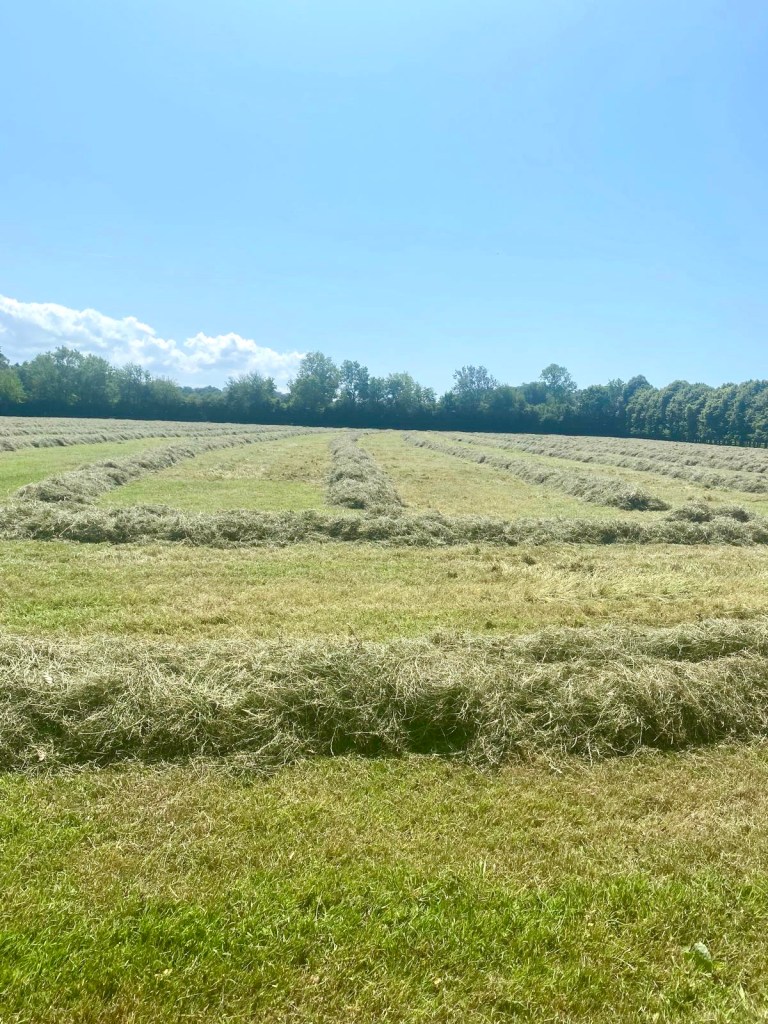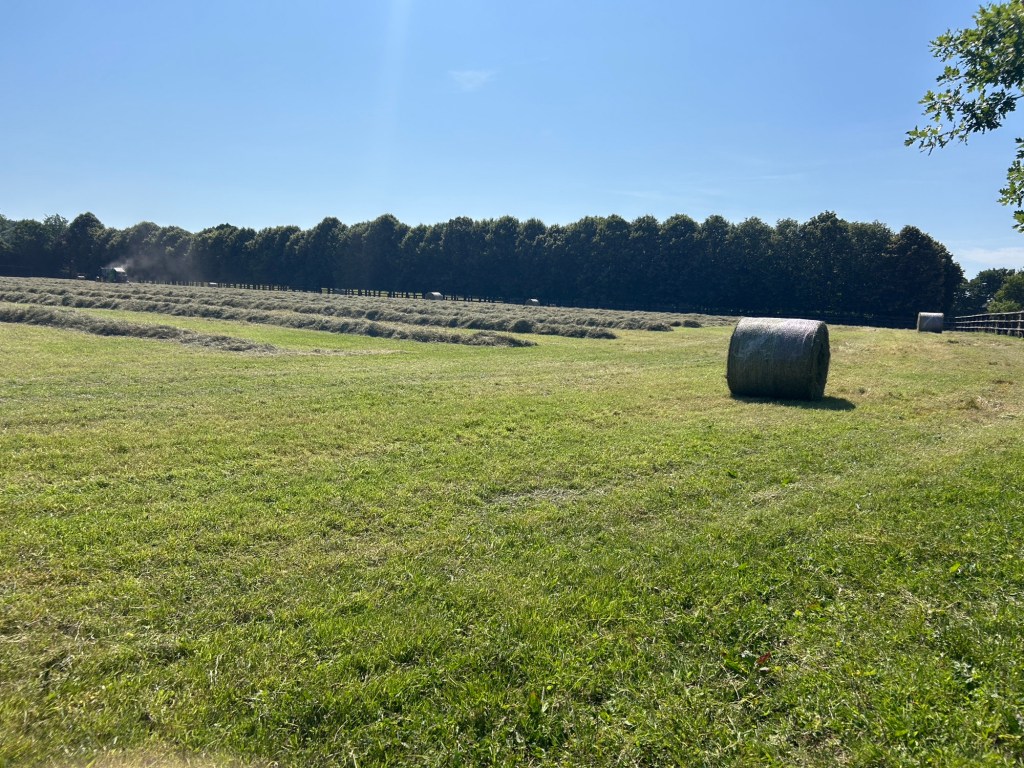
Making hay

I must be in a poetic mood lately, because a countryside walk reminded me of this poem by James Cochran:


“Make hay while the sun shines” they say,
and we do, circling the field while swallows

dive and swoop to feast on insects we kick up,
inhaling the mingled sweetness of diesel fuel
and honeysuckle. We cut, rake, and bale

till the sun goes down and the dew settles on the fields,
then start again next morning once the dew burns off,

almost finishing as dark clouds build on the horizon

and fat drops of rain cut the dust on the Baler.

That’s the part no one says…
Make hay while the sun shines,

but stop when it starts to rain.

Full confession: I only remembered the first bit, then looked up the rest. It is very evocative.

Is there anything more summer-like than the smell of cut grass? Sadly it cannot be conveyed to the page.

In older times, haymaking was done by hand and was backbreaking work. Everyone pitched in from dawn to dusk. Hay has to be brought in quickly, before the weather turns. But it has to be dry enough to stack or bale—it’s a tricky business.

Nowadays machines do the heavy lifting. They suck up the hay, roll it up, and spit out a bale.

It is mesmerising to watch.

Around here, the farmers who drive the harvesters are hired by neighbours as well, so they also work at night. It is fascinating watching them going up and down the field with their headlights on. This year the weather cooperated, so all is well.

All photos by LM

Hope is the thing with feathers

“Hope” is the thing with feathers –

That perches in the soul –

And sings the tune without the words –

And never stops – at all –

*

And sweetest – in the Gale – is heard –

And sore must be the storm –

That could abash the little Bird

That kept so many warm –

*

I’ve heard it in the chillest land –

And on the strangest Sea –

Yet – never – in Extremity,

It asked a crumb – of me.

By Emily Dickinson

A poem to read after watching the news or reading the papers.

Humans are really a race of hawks and warmongers—they have an inherent need to exterminate each other. History has taught us nothing—we have achieved huge improvements in technology, but none in human nature. Anyone who doubts that should read Herodotus’s Histories.

Of course not everyone fits into that category—humans are also capable of great feats of invention, creativity and cooperation. Sadly, the warmongers will usually prevail, since they are prepared to go to lengths peacemakers won’t. It is amazing how excessive power and wealth will corrupt almost everybody.

We are constantly bombarded with too much information, most of it of a disagreeable or horrifying nature. Corpses, ruins, starving children, shootings and stabbings, unspeakable politicians. I read the headlines, but avoid watching the news on television. One cannot take the whole world’s misery on one’s shoulders, and it is useless to worry about things one can do nothing about. But of course I do worry—it is impossible not to be anxious about the world we are leaving our descendants.

However, there is still so much beauty on this earth, it is good to seek it out as much as possible. Being lucky enough to live in the country, I revel in nature’s bounty. At this time of year, life is bursting out everywhere. Bees buzz, birds sing, cherries ripen on the trees.

Will Saint Catherine’s Monastery survive?

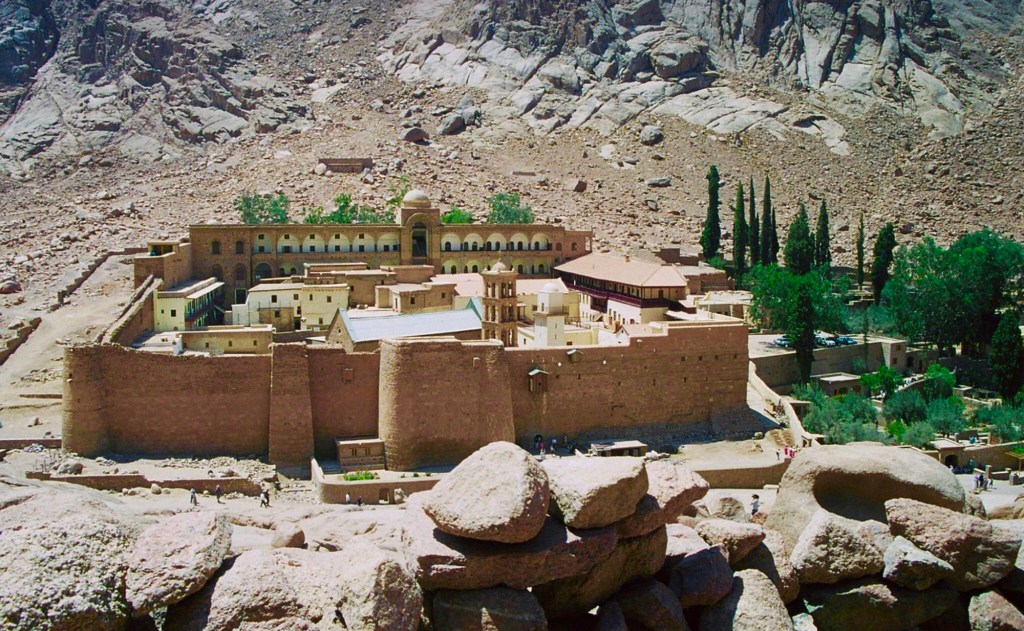
There is great alarm in the Greek Orthodox Church about the fate of Saint Catherine’s Monastery, which is situated at the foot of Mount Sinai, in Egypt.

The monastery, built in the 6th century by the order of the Byzantine Emperor Justinian the First, is the oldest monastery in Christendom. Continually inhabited by monks, it contains what is thought to be the Burning Bush seen by Moses and possesses numerous rare works, such as the Codex Sinaiticus and the Syriac Sinaiticus, as well as a wonderful collection of early Christian Icons and illuminated manuscripts.

The site is considered sacred by the three major Abrahamic religions: Judaism, Christianity and Islam. It became a World Heritage site in 2002.

Last week an Egyptian court ruling decided the lands around the monastery should revert to Egypt, and there were even rumours that Egypt intends to turn the monastery into a museum. These rumours were swiftly denied, however the uncertainty about the monastery’s status quo remains.

A delegation from Greece has met with their Egyptian counterparts and discussions are under way, which are delicate due to the many legal complications as well as the interests involved. The Church obviously wants to preserve the status quo, but the Greek government (heavily criticised by the opposition for delays in solving the issue which has been looming for a while) also wishes to preserve good relations with Egypt.

If the ruling stands, the monastery risks losing the lands around it which are essential to its daily functioning and, ultimately, its survival, including gardens with water springs, orchards and olive groves. Unfortunately, these lands are coveted for touristic expansion.

As in all such cases which have to deal with geopolitical issues as well as financial interests, much politicking will be going on, with each side trying to gain as many advantages as possible.

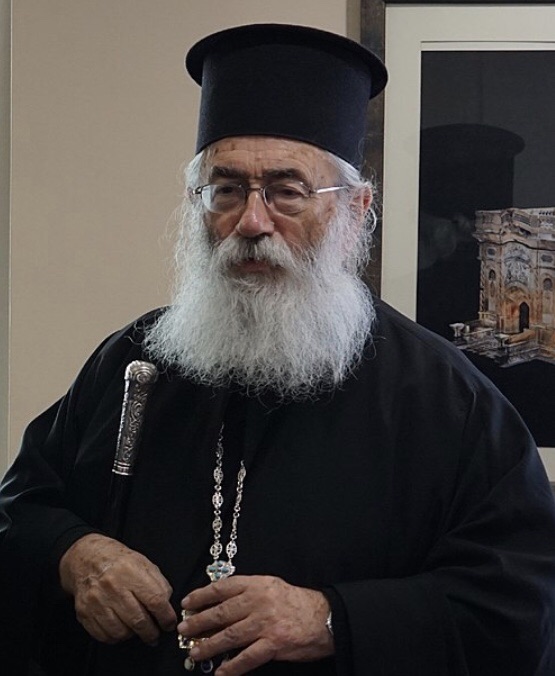
The hegoumen of Saint Catherine’s, Archbishop Damianos, has been very active in his leadership of the monastery, including organising a digital archive of the monastery’s manuscripts, establishing the first Greek University in Egypt, fostering interfaith dialogue and preserving the monastery’s rich spiritual and cultural traditions.

Archbishop Damianos (b. 1973)

In 2004, the Benaki Museum in Athens organised a wonderful exhibition of masterpieces from the monastery, including icons, mosaics and manuscripts. These were also later shown at the Metropolitan Museum in New York. After the opening of the exhibition, there was a small diner in an Athenian restaurant, where I had the honour to be seated next to Archbishop Damianos.

I have to confess I was a little overwhelmed at first. An Orthodox priest—long black robes, long black beard, long black hair tied in a bun, embroidered vestments and a gold cross. What on Earth would we find to talk about for the next two hours? Well, I soon changed my mind. He was the most wily, charming, educated, well-travelled and well-read man, as well as a superb raconteur. A dinner I will never forget. I hope he gets to keep his monastery.

Preaching to fish

Noted by his contemporaries for his powerful preaching, expert knowledge of scripture, and undying love and devotion to the poor and the sick, Saint Anthony of Padua (1195-1231) was one of the most quickly canonized saints in church history, being canonized less than a year after his death.

Born in Portugal of wealthy and noble parents, Anthony joined the Church early on and ended up in Italy after his ship was blown off course on a return journey from Morocco.

Although he died at 35, Anthony led a busy and varied life, preached in many places in Italy and France and performed many miracles. One can easily read about his life (there is a lengthy Wikipedia entry) but the reason I am writing about him is that I came, entirely by chance, upon this weird and wonderful detail of a mural in the Basilica di Sant’Antonio da Padova, of him preaching to a bunch of fish.

Just look at the expressions on those fish faces. Priceless

The story of Anthony “preaching to the fish” originated in Rimini, where he had gone to preach. When the Cathar  heretics there treated him with contempt, Anthony was said to have gone to the shoreline, where he began to preach at the water’s edge until a great crowd of fish was seen gathered before him. The people of the town and even heretics flocked to see this marvelous thing and were moved to listen to Anthony’s preaching.

There are other paintings of this event, but this one has a special flavour to it.

Trouville then and now

There is an interesting exhibition on at the moment close to us in Trouville, at the Villa Montebello, a small museum housed in an old villa built in 1865 by the Comtesse de Montebello. After a chequered past, it was acquired by the city of Trouville and became a museum in 1972.

The exhibition is mainly devoted to the artist Charles Mozin (1806-1862), who was a Parisian but built a house and settled in Trouville in 1939.

He was one of many artists who left Paris (a polluted and stinking, overpopulated city) to seek cleaner skies and beautiful landscapes in Normandy. Why Normandy, and why Trouville? Well, it was close to Paris, a mere 4 days by the diligence (stagecoach) and there were beautiful beaches, wonderful light and fresh fish.

In the early 19th century, sea bathing became fashionable, starting in Dieppe, which had old ties with England where this activity began. And then Trouville was discovered, at the time a small, simple fishing village.

Early painting by Eugène Isabey

Around 1820, artists such as Eugène Isabey, Charles Mozin, Camille Corot and Richard Parkes Bonnington came to Normandy to paint and then exposed their works in grand Parisian exhibitions. People saw, were enchanted and came to visit. Rapid development followed and Trouville became a busy port as well as a station balnéaire. In the painting below, by Pierre Duval le Camus, one can see the juxtaposition of the old way of life with the new: a group of fishermen’s wives and their children are gathered on the beach, in a pause of their daily activities. It was a rough life—while the men were at sea, the women, aided by the children as soon as they were old enough, gathered mussels and sprats, mended nets, sold the fish their men caught in the market. They were hardworking and poor.

Pierre Duval le Camus, Trouville, Les Bains de Mer, 1851

Behind them to the right, one can glimpse bathers—people of a higher social class and better means, the tourists of the day.

Detail

On the left, the buildings are not fishermen’s cottages, but vacation homes. The one on the right still exists, albeit in a very different setting.

Charles Mozin was the artist who best captured the progress of this development, about which he had very mixed feelings. He shunned society and much preferred the old, simple way of life. He was a very clever draughtsman, who captured details in his many sketchbooks and then went back to his studio in Paris to work on the large paintings.

In the background between the ships one can see the lights of the market, still busy at nightfall

A beautiful view of the Touque by moonlight. La Touque is the river which flows to the sea at Trouville. Ships sailed up the Touque to the port.

Above is an example of Mozin’s accurate and very detailed sketches.

Two ships entering the port

This huge painting shows how much sea traffic there was, and the difficulty of entering the port, especially in rough seas. The vessel on the left is a passenger ship, which sailed regularly from Le Havre and was the main way of reaching Trouville. On the right a fishing boat is trying to manoeuvre in the narrow passage. Sometimes there were accidents, and there is a story of a ship which, encountering strong winds and currents, floundered and sank, drowning everyone on board, despite people rushing to the rescue in small boats. Only a dog survived and, when it was fished out of the sea, it was found to have in its mouth its master’s jacket.

In this painting, also by Mozin, one can see the new bridge connecting Trouville with what was going to become Deauville. At the time the land was marshy, and the Trouvillais used to ford the river before the bridge was built to graze their cattle on the près salés (salt meadows). The small building on the right was a customs house.

Below is a photo of the view from the Villa Montebello

And finally, a view of Trouville today, at low tide. A lovely place, well worth visiting.

Happy Easter everyone!

This year, everyone celebrates Easter together.

Due to complicated calculations concerning the Vernal Equinox, the split between the Roman and Byzantine Empires and their different calendars and the division of the Christian Church into Orthodox and Catholic (look it up, people, I can’t be bothered to explain further) usually there are two Easters, one for each church. Sometimes, though, they coincide—and this year they do (the last time was in 2017).

Therefore I am in the happy position to wish you all a Happy Easter, wether you smash red eggs or wait for the Easter Bunny. Enjoy your lamb on the spit, your Hot Cross buns, your Easter Bonnet Parade (is that still a thing?), your egg hunts and your indigestion. Or anything else in your local or family traditions.

A result of the new tariffs

And the winner is…

Orbital, the book about six astronauts in space I recently reviewed, has won the Booker Prize.

I admit I have not read the other books on the short list—or rather, I am in the process of reading Rachel Kusk’s Creation Lake. I like her writing, and loved The Mars Room, but I’m finding this one slow going. Some of the others are tempting, though, and I will get to them eventually.

Photo: bdnews24.com

Nevertheless, even though I lack comparison, I think this book is a very worthy winner, being at once original, lovely to read and beautiful in every way.

Samantha Harvey nearly gave up writing the book at some point, because she felt like an impostor, never having been in space. But then she took it up again, during the pandemic, and watched hours and hours of streaming video from the International Space Station while writing. Thus she could observe Earth from space, actually completing whole orbits and describing what she saw. The result is nothing short of miraculous.

In her acceptance speech, Harvey said she wanted to dedicate the prize “to everybody who does speak for and not against the Earth; for and not against the dignity of other humans, other life; and all the humans who speak for and call for and work for peace.”

Harvey, 49, is the author of four previous novels, including “The Wilderness,” about a man with Alzheimer’s, which was longlisted for the 2009 Booker Prize, and 2018’s “The Western Wind,” about the mysterious death of a village’s wealthiest resident in medieval England. She also wrote “The Shapeless Unease: A Year of Not Sleeping,” a 2020 memoir about her struggles with insomnia.I’m tempted to try one or two.

Of course, a few people thought it a good idea to publish articles panning Orbital in comparison to the other books on the short list. Although of course everyone is entitled to their opinion—and all art appreciation is subjective—I thought it was in poor taste to do so today. It smacks of sour grapes. Let the woman enjoy her day of glory—they are hard enough to come by. So, congratulations, Samantha Harvey!

Going into winter

It is not cold yet, but the days are drawing short, and when I take the puppy out at 7.30 a.m. I wear a jacket and sometimes a woolly hat. The leaves are turning and some days there is mist on the ground.

We do get some brilliand days, though, and the beach is magic.

There are still flowers in the garden, and a few tomatoes. The crab apples are red, and the apples are ripening also.

The summer went by too fast, as usual, and the weather was not very inspiring—however, we did not get heatwaves, or a water shortage, or forest fires, as in Greece or other southern countries.

The puppy likes crab apples

We are fortunate to live near Deauville, which is a beautiful and lively town, with plenty going on at all times. Racing, polo, film festivals, exhibitions and more. We have lately acquired a cultutal center called Les Franciscaines, the conversion of an old nunnery, and there is always something on.

Back in March they put on an exhibition by the abstract artist Zao Wou Ki. It was a real treat to be able to see some of his paintings within 15’ of my house. I’ve written about him before. Here: https://athensletters.com/2018/09/25/awed-by-the-abstract/)

One of the highlights of the summer was an exquisite concert by the Japanese neoclassical composer Koki Nakano. I did not know what to expect, having never heard of him before, and in fact had never heard anything like it before—immersive soundscapes somehow combined with melody. In the La Chappelle, the small theatre placed in the former nunnery’s chapel, a grand piano was the only thing on the stage, its lid open and adorned with electronic devices. It was flanked by an electric keyboard.

Nakano played his own compositions, a mixture of electric and acoustic piano and I can honestly say one was more beautiful that the previous. The concert was called Oceanic Feeling. Sometimes he was accompanied by a dancer, the wonderful Tess Voelker from Chicago, since he is fascinatedby the relation between music and the human body.

This is the clip he had made of his music

The simplicity of the setup, the magical lighting, the elegant musician himself who addressed the audience between the pieces and even spoke in French, all made for a truly memorable evening.

Tokei(Tokyo) by Akira Yamagoshi. An aerial view with enchanting details. Zoom in to enjoy.

At the same time the centre put on an exhibition relating how the impressionists were inspired by Japanese art, which contained a few treasures.

Micro Fuji by Tiger Tateishi (1941-1998)

To finish off, sadly we could not see the northern lights which appeared over Europe. I have seen them once, in Iceland, and they were mostly green and yellow, whereas these were quite pink. So for your enjoyment I am posting a wonderful photograph by Deborah M. Zajak on her lovely blog Circadian Reflections (https://circadianreflections.com/2024/10/13/something-for-sunday-northern-lights/#respond) I urge you to take a look, she posts great photographs of birds and other stuff.