Can one have a horrible life, punctuated by difficulties and tragedies and ending in extermination at Auschwitz, yet leave behind work that, despite its disturbing themes, is poignant, breathtaking and uplifting in its luminosity and colour?

This is the case of Charlotte Salomon, the only Jewish artist who died in the Holocaust to leave behind such a large body of work. It consists of 769 works painted between 1941 and 1943—a mere two years—while she was hiding from the Nazis in the South of France. In October of that year, 5-months-pregnant Salomon was captured and deported to Auschwitz where she was immediately killed.

Born to a prosperous and well-assimilated Jewish family in Berlin, Charlotte was 16 when the Nazis came to power. By 1938 it became too dangerous for her to continue her studies, so she left the art school she was attending, and after Kristallnacht she was sent to live with her grandparents in Nice; her father had been interned and, when her stepmother succeeded in freeing him, they left for Amsterdam. Her mother, suffering from depression, had committed suicide when she was eight.

After several attempts, her grandmother also succeeded in killing herself and Charlotte remained with her grandfather, who it appears was abusive. To escape him, she went to Saint-Jean-Cap-Ferrat where—in order to recover her mental sanity—she started painting; stating that she was driven by the question, “whether to take her own life or undertake something wildly unusual”.
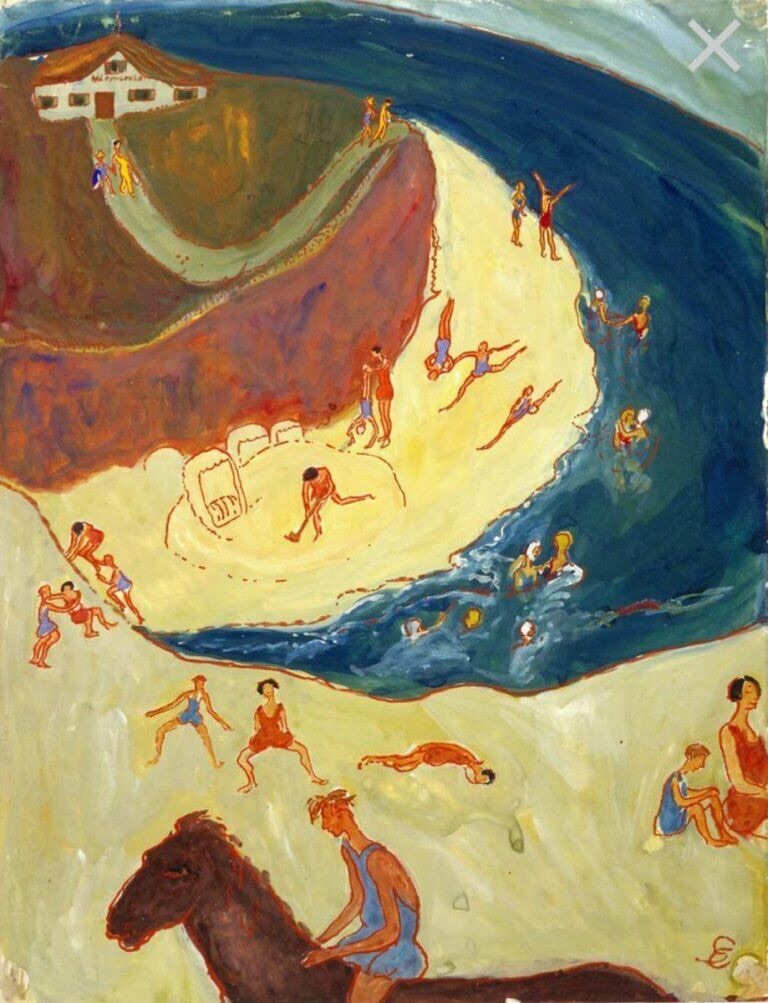
Painting obsessively, in less than two years she produced more than 1.300 gouaches, amongst which she chose the 769 which she numbered and edited, adding text, captions and transparent overlays, to make a kind of autobiography outlining the main events of her life—speaking of herself in the third person, altering all the names and adding elements of imagination.

In 1942 she was obliged, due to her residence permit, to join her grandfather in Nice. Shockingly, shortly after, she poisoned him with a Veronal omelette, then drew him as he lay dead (the drawing exists). She made a 35-page confession which she sent to a former lover who, however, never received it; it remained a secret until much later.
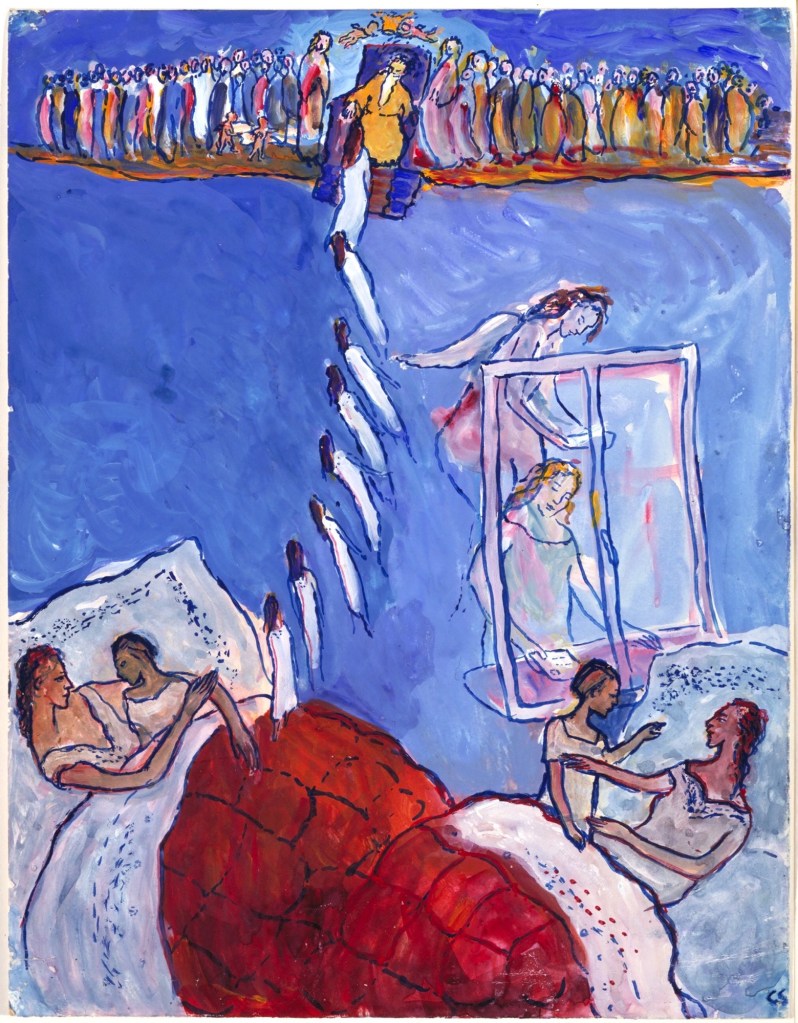
In 1943, as the Nazis closed in, she packed up her paintings and gave them to a local doctor with instructions to forward them to Otillie Moore, a wealthy American who was her protector and sponsor. At war’s end, the package found its way to her remaining family.

In 1943, Charlotte had married Alaxander Nagler, another German Jew refugee, with whom she had been confined in Otillie Moore’s house for a while. Soon after their marriage, they were both deported and murdered.

I find it beyond me to talk about her work, which is based on film-making techniques and is extremely layered and complex; and one must also follow the narrative, in its dream-like dimension. It is, in some ways, a precursor to the graphic novel as we know it today. Although Salomon has always been classed as a Holocaust artist, her work—save for very few drawings—is not about the Holocaust: it is about her childhood, her very disfunctional family, her life and her loves. In the final pages of her book, two sentences stand out. She writes, ‘And with dream-awakened eyes she saw all the beauty around her, saw the sea, felt the sun, and knew; she had to vanish for a while from the human plane and make every sacrifice in order to create her world anew out of the depths.’
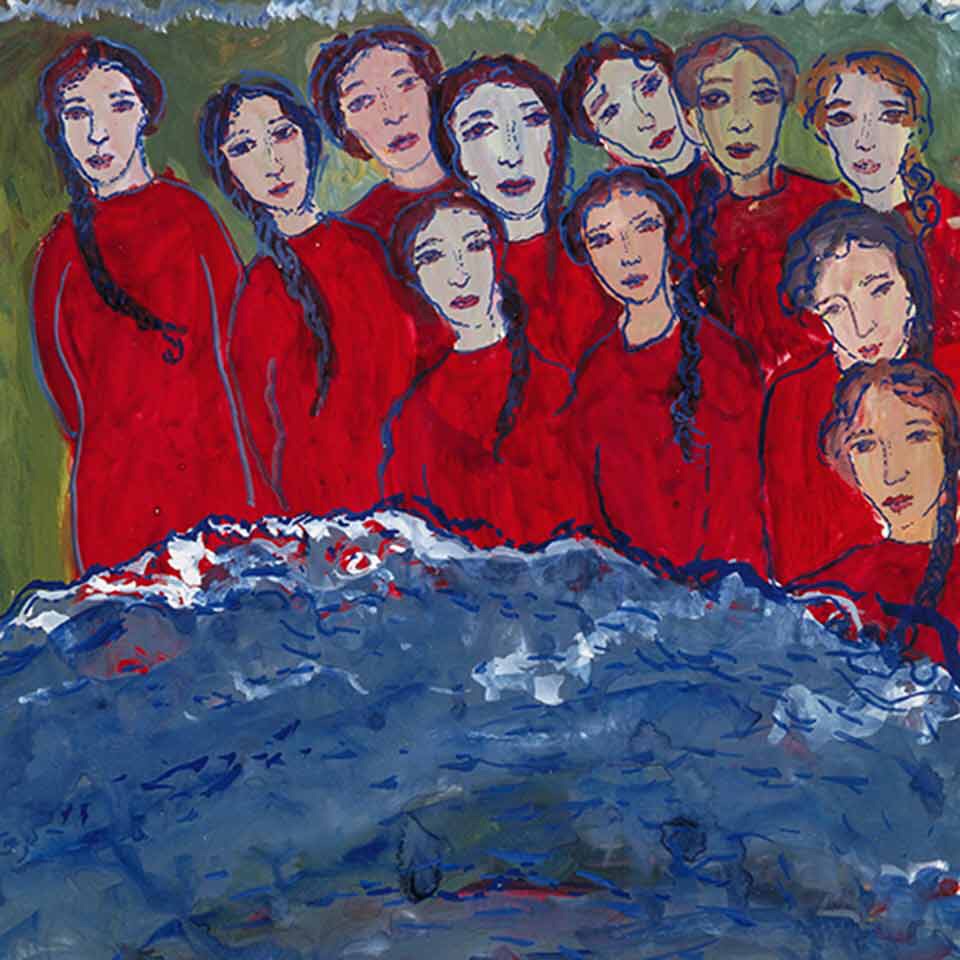
I have seen her paintings live in a couple of exhibitions, and they are simply wonderful. I have a book published by the Royal Academy of Arts, with colour reproductions, which I highly recommend.
More information:
Charlotte is a biography by David Foekinos, which I have not read yet, but which has excellent reviews. This is the Amazon link to the English version (the original is French).
Also there is a very interesting article in the New Yorker with more information than I have given on both her life and her work, and great images. Link below:

Share this:


 Letters from Athens
I knew nothing of Salomon before reading this. What an amazing woman, and to produce so much in such a short time is incredible.
LikeLike
Incredible. And so sad. She died at 26…
LikeLiked by 1 person
This is an amazing artist, and your wonderful write up does her true Justice!
LikeLike
Thank you!
LikeLike
This is an incredible story. Her art is wonderful, and her life tragic. Thank goodness she left behind a legacy.
LikeLiked by 1 person
Thank you for bringing alive one story from a tragic background . . . you have kept matters we should all know a little longer . . .
LikeLiked by 1 person
I think she’s very interesting as an artist. So vibrant
LikeLike
What powerful work–especially that dream painting with the red bedcover. I could look at that for months and see something new each time. Thank you for this.
LikeLike
The New Yorker article has more photos. You will love them.
LikeLiked by 1 person
Thanks. I’ll look for it. I read the New Yorker regularly but missed a handful of issues a while back–apparently including that one.
LikeLike
I have never come across her before. There is something of Chagall about her work, I think. But very vibrant, very South of France.
LikeLike
Chagall, yes! It’s what i thought, too
LikeLiked by 1 person
What a wonderful post. Such a life, and to create such beauty in the face of it beggars belief
LikeLiked by 1 person
What a fascinating story of a tragic life, Marina. The paintings are indeed remarkable.
Best wishes, Pete.
LikeLiked by 1 person
Fascinating. I’d love to see an exhibit of her work!
LikeLike
This is so interesting. I’d not heard of Charlotte Salomon. Some people have so much tragedy in their life. I reflect on her suffering, her triumphs, her ultimate end.
LikeLike
bot
LikeLike
Oh, why did that say im anonymous?
This is so interesting. I’d not heard of Charlotte Salomon. Some people have so much tragedy in their life. I reflect on her suffering, her triumphs, her ultimate end.
LikeLike