The big picture

“It is never too late to be what you might have been.”
― George Eliot
image

A sigh of relief? An all-night marathon ended in ‘white smoke,’ as Greece and its creditors managed to reach an agreement that secures the country’s place in the Eurozone. From Grexit to ‘Greekment’, as Donald Tusk, head of the European Council, dubbed it.

Of course, a lot of work remains to be done, since Greece has an obligation to immediately implement draconian reforms. There is political uncertainty because this implementation depends on the cooperation of all parties. For the Greek people, more hard times are ahead.

There is a feeling, abroad as well as in Greece, that the terms of the deal are punitively harsh. Nobody is celebrating. However, I think one must remain positive. Catastrophe has been averted, given that it appears the government had no plan B in case of a return to the drachma.
I hope Greece will take this chance to put its affairs in order, something which is long overdue. It’s sad and humiliating to accept, but maybe the political system will finally be obliged to break out of the vicious circle they’ve been in for so long, and bring about a real change in mentality.
Let’s hope this will be the making of a modern, self-sufficient new Greece.

At the same time, this crisis has shaken the foundations of Europe considerably, and exposed its flaws. There is an immediate need to look at the bigger picture. Today Europe is faced with huge problems, starting with its failure to alleviate the poverty of many of its citizens.
Amongst other things, it has to cope with wave upon wave of immigrants seeking a better life within its borders. It has to deal with the threat of terrorism. And it has to compete with emerging markets where labor is still both cheaper and willing to work much longer hours.
Europe has shown it is not united, nor has it found a way to accommodate the differences, cultural or other, between its members. Changes are needed; rifts must be healed and hard questions answered if the European machinery is to keep moving forward smoothly in future.


It ain’t over yet…

How better to start the day than with an ironic take on events by one of my favourite cartoonists, Matt.

image imageOn to the news:

In a turbulent all-night session, Greek PM Mr. Tsipras managed to get Parliament to ratify austerity terms previously rejected by his government, in a desperate bid to secure the country’s future in the Eurozone.

Mr. Tsipras explained his about-face by saying he did not get a mandate from the people to take Greece out of the Eurozone, confirming his pre-referendum assertion that a NO vote was not a vote against Europe. He has recognized that the pain of capital controls and economic collapse is too much to bear. Mr. Tsipras had promised voters a miracle which he was unable to deliver – the only way he can now redeem himself is if at least he achieves some restructuring (or what Mrs. Merkel calls re-profiling) of the debt.
He got 251 votes, bolstered by opposition parties, but lost the majority within his own party. The left faction of SYRIZA voted against, which is understandable from their point of view. They have been against all along. They accuse the ECB of using ‘liquidity asphyxiation’ to bring a rebel democracy to its knees. And they accuse the PM for not having a Plan B if Europe did not give in to his demands.

Major architect of the whole fiasco, ex Finance Minister Varoufakis, did not vote. He left for his holiday home on the island of Aegina, citing ‘personal reasons’ – a bizarre turn of events that was widely condemned by all parties. Readers’ comments in the press have vilified him as a rat leaving a sinking ship which he himself helped scuttle.

New Finance Minister Mr. Tsakalotos admitted that the measures proposed will reinforce austerity, but insisted we had to look at the big picture and promised to aid the weaker members of society.

However, Mr. Tsipras warned that the battle is not won yet, since it is far from certain the new proposals will be accepted by the lenders.

Conclusion: We will – should? – be happy if we manage to achieve a new agreement which will be similar to, and tougher than, the one we nearly got before the referendum.

To end on a lighter note, yesterday farmers in Thessaloniki rolled up image
with truckloads of watermelons which they proceeded to distribute to the pensioners waiting in line in the heat outside banks to get their money. They thought they could do with some refreshment.

The day after

image

A quick roundup of today’s events:

Maverick finance minister Yanis Varoufakis resigns (to the relief of many in Europe). His place is taken by Euclid Tsakalotos, an Oxford-educated economist.

All party chiefs meet to prepare a ‘new’ proposal, which they will co-sign before submitting it for negotiation in Brussels.

The package under discussion is similar to the one proposed by Mr. Junker.[Statement from Washington: The referendum happened, and the situation remains the same.]
The question is: If we’re to go back to the same point we were at before the referendum, why was all this necessary, only with Greece now in a weaker position, with the previous program having expired, and a full-blown bank crisis going on?
Was it just a complicated piece of political maneuvering?

The government is trying to distil an air of optimism and presents an agreement as a foregone conclusion, to the contrary of the messages coming in from Europe, where the consensus seems to be dissatisfaction with the referendum result.
Tomorrow, the Eurogroup meets. Will the Greek team bring back an agreement? It appears difficult, and the terms will most probably be worse than before. And if they don’t succeed, what then?

“NO”

The country has voted: it’s a landslide for NO. No to more austerity, no to the disastrous economic policies of the Troika. It was also made clear that people are sick of the old political system, which bears a lot of responsibility for the situation in which we find ourselves. It is time for a real change. As I was writing this, the chief of the opposition, New Democracy leader Mr. Samaras, announced his resignation.

The European institutions have warned that this would be a step towards a Grexit.

The Greek PM however, has insisted that the NO vote would just be a show of support that would give him greater powers of negotiation and help him achieve a better deal. He has promised to deliver within 48 hours. Godspeed – I don’t think a single Greek, whatever they voted for, does not wish him well.

He is facing a mammoth task. The hard facts are the following:

The banks are shut, and likely to remain so for a while. Panic rumors are going around that there will be a haircut of deposits and that the contents of safe deposit boxes will be confiscated.

Most ATM machines are empty and the rest only give each person €50 instead of the €60 allowed since they have run out of €20 and €10 notes.

The tourist season is in ruins. Most Greeks cannot afford a holiday and there are multiple cancelations from abroad. Hotels will run out of supplies in ten days. Hospitals already lack basic necessities and medicines. Many small businesses will close because they need cash to function on a day to day basis. Their business will be taken over by multinationals who can afford to remain unpaid for a while. A lot of people will be laid off.

50% of children in the Athens region go to school without breakfast. More than 60% of young people are unemployed. Many thousands have committed suicide. A few hundred thousand have been obliged to emigrate.

And the elephant in the room: what will happen to the hundreds of destitute immigrants arriving on our shores every day? Who will feed them? Where will they go?

We hear the Italians are expressing solidarity. The Germans are intransigent: they think it’s time we went. These are the messages we’ve got so far.

It is my sincerest wish both sides will see their way forward to an agreement that will allow Greece to survive, recover and, in the future, thrive. The next few days and weeks are vital. It will be hard, but let’s hope the difficulties can be overcome. The alternative is a leap into the unknown.

cropped-image16.jpg

For the moment, I feel we are like jellyfish pushed around by the currents.

What next?

image

Well, tomorrow is D-Day. Or R for Referendum day. Today we are in limbo. I quickly note down a few observations.

The rift in the population between YES and NO has widened, although it is very unclear what each outcome will bring. This is extremely sad as well as very dangerous. The two sides are neck and neck at the moment, with a prevalence of NO.

Talk, which is what Greeks love best, is rife. Every politician, celebrity or otherwise ‘prominent’ Greek seems to be on television, declaring his convictions.

A theory is circulating that there is a strong drachma lobby, and that many people in high places (I heard some names but will not repeat since unverified), stand to make huge amounts of money if it goes through.

There is also fear of result tampering, since there is only one ballot, and people are being warned that they need to put a cross against their choice, not an X or a check, for the ballot to be valid.

Reports, also unverified, are going around that the banks will stay shut for a long time, that there will be food and petrol rationing, that people will get paid in government-issued coupons instead of money. Far-fetched though this scenario might seem, it’s not so improbable given that a change in currency cannot be instantaneous, especially when the coffers are empty.

Some of the things said on national television, by politicians, are so preposterous one has trouble believing one’s ears. No explanations are given by them about what awaits the public. No specific plan for the day after.

Friends from abroad call and email, worried about us.

Tourism has already taken a big hit.

Hospitals report a lack of basic necessities. But even as long as a month ago, an acquaintance went in for a routine operation and was asked to bring her own sheets and food.

And so on.

I firmly believe everyone’s entitled to their opinion, but personally I fail to see how a NO vote will strengthen the government’s bargaining power, how it is possible for them to promise, in so many words, that they will have a deal in 48 hours, and how people are not scared by the potential chaos if this fails.

Between Scylla and Charibdis

Sooner or later, everything refers back to ancient myth.

The Greek people today feel like Odysseus, forced to navigate between Scylla and Charibdis, two monsters guarding the straits of Messina. They were only an arrow’s throw from each other, so sailors found it almost impossible to escape them. image We have to vote in a referendum on Sunday.

Vote YES, and we face having to crawl back to our creditors, begging for a deal probably much worse than the one we had before. Greece will struggle along for years, unable to climb out of recession.

Vote NO, and we sail into unknown waters. Will we be forced out of the euro, maybe out of the EU? How will this exit be organized, and by whom? The way ahead is dark, and full of eddies and reefs.

What’s more, almost everything is still unclear.

This is what they’re saying:

The YES vote say they are voting for Europe.

The NO vote say they do not accept anymore to be threatened and blackmailed (by Europe).

The PM, Mr. Tsipras, says that a NO win does not mean Greece will leave Europe or even the euro, just that it will increase his bargaining power.

The President of the European Commission Mr. Junker disagrees, and, only this morning, warned Greece against a NO vote (which must have angered NO voters even more). He said: “If the Greeks vote NO, the Greek position is dramatically weakened.”

Mr. Varoufakis, the Greek Finance minister, said today a new deal was in the offing.

Mr. Junker denies this.

This morning SYRIZA Minister and chief negotiator Mr. Tsakalotos declared on a televised interview that the PM called the referendum because the deal offered “would never have been ratified by Parliament and would have brought down the government.”

As we speak, there are two demonstrations starting in Athens, one for YES and one for NO. People in their thousands are standing around, waving flags. Whatever happens, Mr. Tsipras cannot be proud that he’s managed to divide the Greek people. He cannot be proud of the scenes playing over and over on the television, of elderly people standing in line for hours, jostling and pushing, and in some cases in tears. image Odysseus managed in the end to escape both Scylla and Charibdis and survive. Let’s hope we can do the same.

Breaking News

Regarding the referendum he has declared for Sunday, late last night Greek PM Alexis Tsipras gave an interview on national television. He said the process of democracy should not be impeded and that Greeks had a right to vote on their future (Yes, we do.) Then he explained that a NO vote would give him greater bargaining powers and that our interlocutors had no choice but to find a solution because Greece, due to its history, geopolitical importance etc., could not possibly be kicked out of Europe.

He’s still expecting someone else to blink, then.

Not so sure….

Today, Mr. Tsipras left for Brussels with a new proposal, which seems already to have been rejected without discussion. The Germans have refused to discuss anything before the results of the referendum. However, by midnight, Greece will probably have been declared bankrupt. Everything’s on the boil.

One must realize that, historically, this is the first time since the war that a European country will be officially bankrupt. The elderly have been queuing all day outside closed banks trying to withdraw their pensions from ATM machines. Unbelievable scenes for our century.

It is by now obvious that the economic program foisted on Greece by the ‘troika’ (the European Commission, European Central Bank, and the IMF) has been abysmally disastrous. Of course, they have consistently refused to acknowledge this, or learn from their mistakes. Whatever the faults of the Greeks and their governments, surely they do not deserve this. Let him who casts the first stone, etc… Even the Germans were not left to rot after the war, and we haven’t exactly been going around killing people.

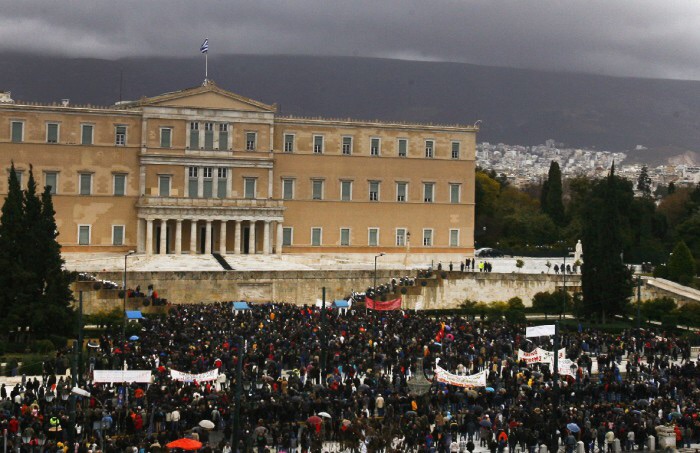
In spite of all this, people in their thousands have flooded into Syntagma Square in front of the House of Parliament, demonstrating for Europe. And the Euro. Whatever their political affiliation, these people are planning to vote YES on Sunday.

image

As you can see in the photograph, the sky is dark. As we speak, rain is pouring down. A sign from Zeus? But what does it all mean? Even the Oracle of Delphi, obscure at the best of times, could not make a prediction about what will happen now.