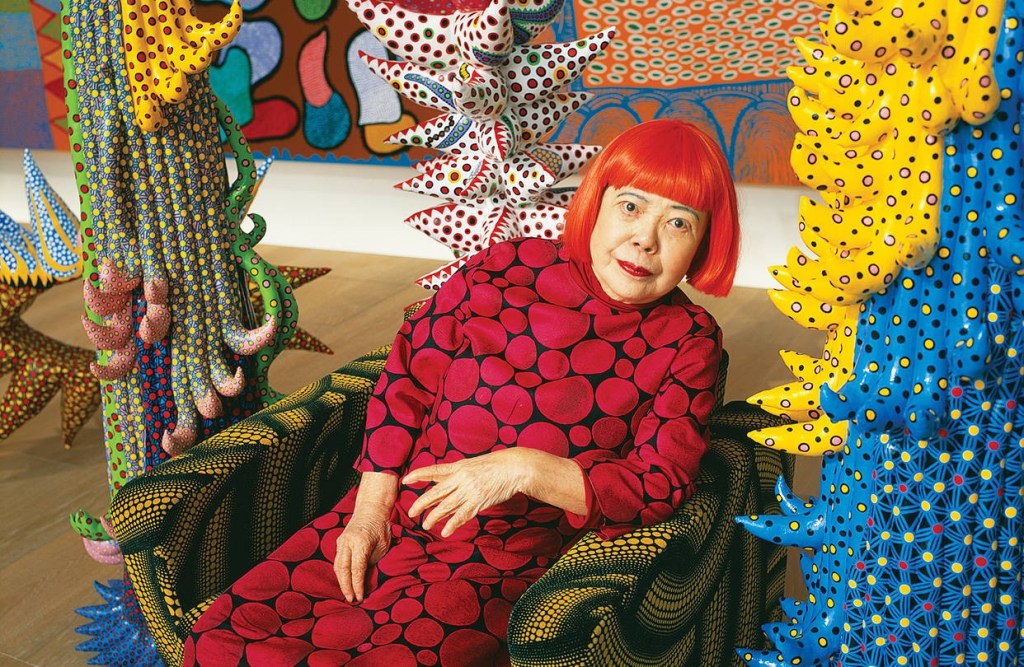
Regular readers will remember I have written about the artist Yayoi Kusama, who has died aged 97 in Tokyo, a few times: Here, Here, Here, and Here. I had actually forgotten how many times before looking them up.
I thought she was intriguing both as an artist and as a personality, although I suspect that she was exploited by the art world in her old age… Still, I wanted to honour her passing.
Today I came upon this article in the New York Times which I think is interesting, giving a concise view of her work.
Today I would like to present the Homer Awards, celebrating thriller writers, indie authors, and everyone writing about Greece who deserved recognition and never got it.
The idea for the awards started with the Imagine Greece retreats. Rania Stone and Jonas Saul, who founded and run these, bring readers, writers, and wellness seekers to Greece — for experiences built around real authors and real places. They invited internationally bestselling, famous authors over to Greece, and eventually they noticed how much love there was for Greece from foreign authors—so many writers were actually setting their novels there. They realised many Greeks had no idea about that, and this incredible literary connection wasn’t being acknowledged or celebrated.
There will be nine awards for books set in Greece, mostly for thrillers, since both co-founders are authors of thrillers, but also for comedy, historical fiction and romance, as well as an award for the best unpublished manuscript.
The Odyssey Award, named for the greatest journey in literature, is for the Best Thriller of the Year. The book that kept you turning pages all the way home.
The Circe Award is for the best psychological thriller.
The Athena Award is for the best debut thriller.
The Hermes Award is for the best Indie thriller.
The Aristophanes Award is for the best Comedy.
The Herodotus Award is for the best Historical Fiction.
The Aphrodite Award is for the best Romance.
The Penelope Award is for the best unpublished thriller
And finally, for Literary Service to Greece, the Markos SynodinosAward. He was the beloved father of Rania Stone, who has always wanted to honour him, and will choose the recipient herself. The category is wide because Markos Synodinos was wide. Any writer — published or not, thriller or literary, Greek or international — whose work demonstrates that quality is eligible.
Markos Synodinos was born in 1933 on Amorgos. Poet, writer, and man of letters. Honored by the Society of Greek Writers and the Panhellenic Union of Writers, he passed away in March 2021 at the age of 88. He was a writer whose work demonstrates a profound, earned engagement with Greece.
You can find out much more about the awards here: Homer Awards
You can also join BOOKfest Greece for six days of reading, conversation, and Greece — followed by the night of the Homer Awards gala ceremony. As the brochure says: BOOKfest Greece is not a conference. It is not a workshop. It is a week spent in one of the most beautiful corners of the Peloponnese, reading alongside published authors, walking through ancient theatres and Bronze Age tombs, exploring the islands, and ending with the most memorable evening in the literary calendar. The awards mean more when you have spent the week with the people who wrote the books.
Finally, some of you might be interested in the retreats themselves for a future trip to the magical country that is Greece. They do sound very tempting.
Long before he lived in Giverny and painted waterlilies, Claude Monet started sketching the landscape and people around him. He was a very precocious young man, and it is fascinating to see his beginnings.
We live not far from Le Havre, so I never miss an exhibition at the lovely MuMa museum, built by the sea. The latest of these was to mark the centenary of Monet’s death by presenting an exploration of his youth.
Claude Monet’s parents moved to Le Havre when he was five. There he took his first steps as an artist, filling sketchbooks with drawings from life, and mischievously caricaturing people around him by the age of 15. These caricatures became so popular that he made brisk business selling them.
The meadow lined with trees circa 1868
At Le Havre he met Eugène Boudin, who became his mentor, as did Johan Jongkind. He absorbed the teachings of his masters and composed his first still lifes. As he oscillated between the city where he grew up and Paris, where he associated with the future Impressionists, his gaze was gradually formed and his ambition confirmed.
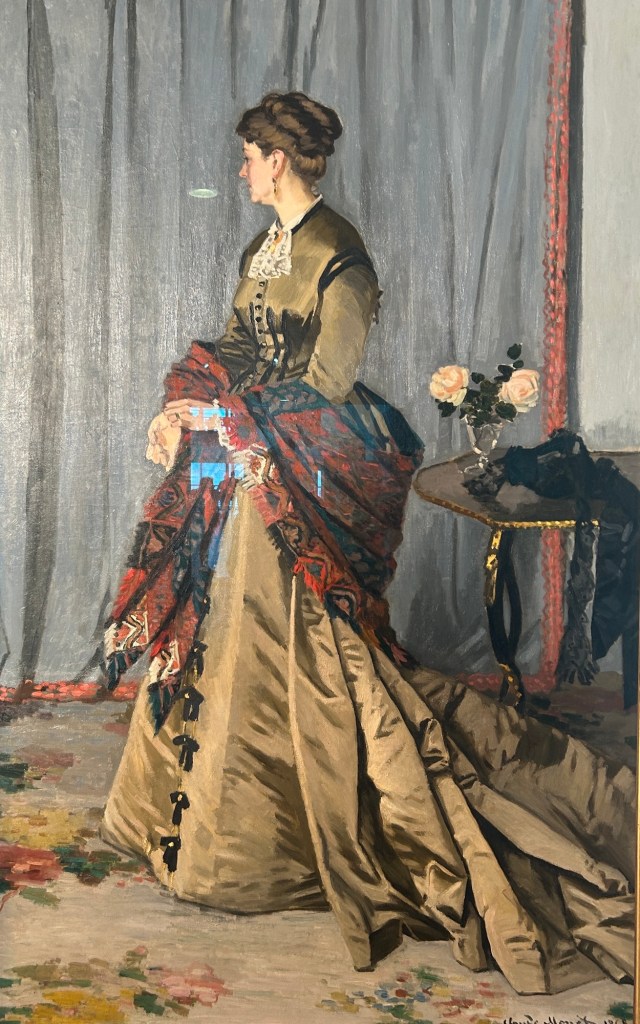
His was a family of merchants who—his father in particular—took a dim view of his artistic ambitions. However, his brother Léon encouraged him; and the Gaudibert family became his earliest patrons, regularly buying his work. See below a painting of Mme Gaudibert. I don’t think Monet was a particularly excellent portrait painter, his interest lay elsewhere. But I love the portrait of Mme Gaudibert—her face, partially turned away, showing her discreet character, the texture of her clothes, rich and interesting, but not showy
Madame Louis Joachim Gaudibert 1868. Oil on canvas
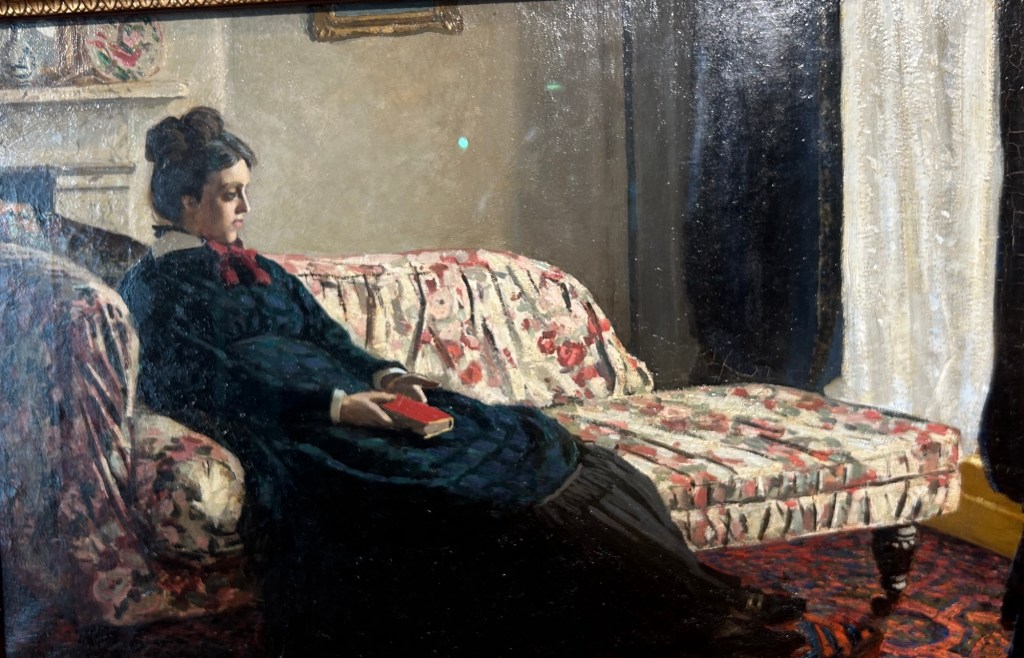
I also like this portrait of his mother. Very good attitude and composition, and I love the patterns on the sofa and carpet, contrasting with her plain dress.
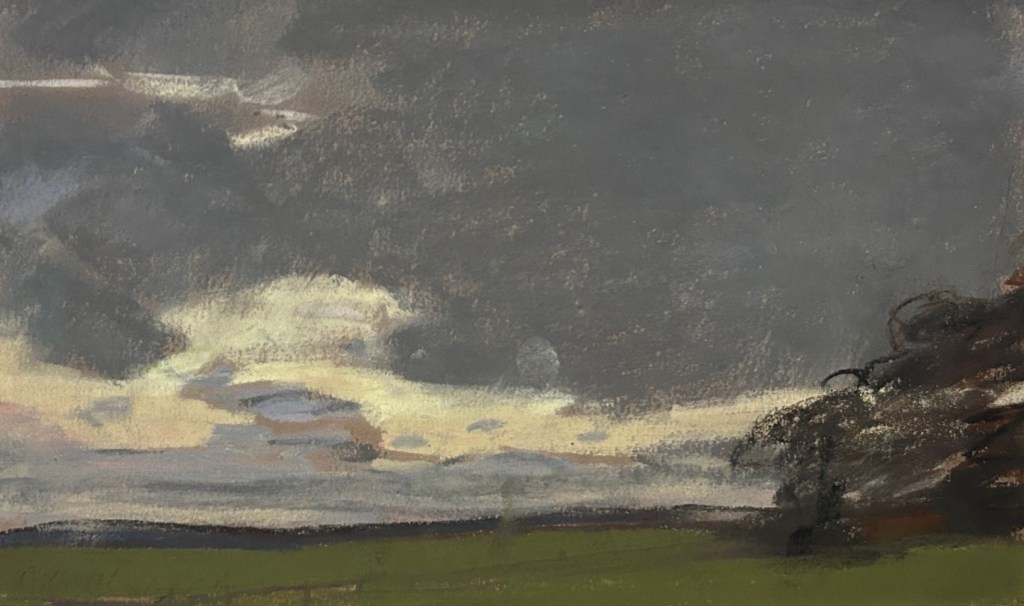
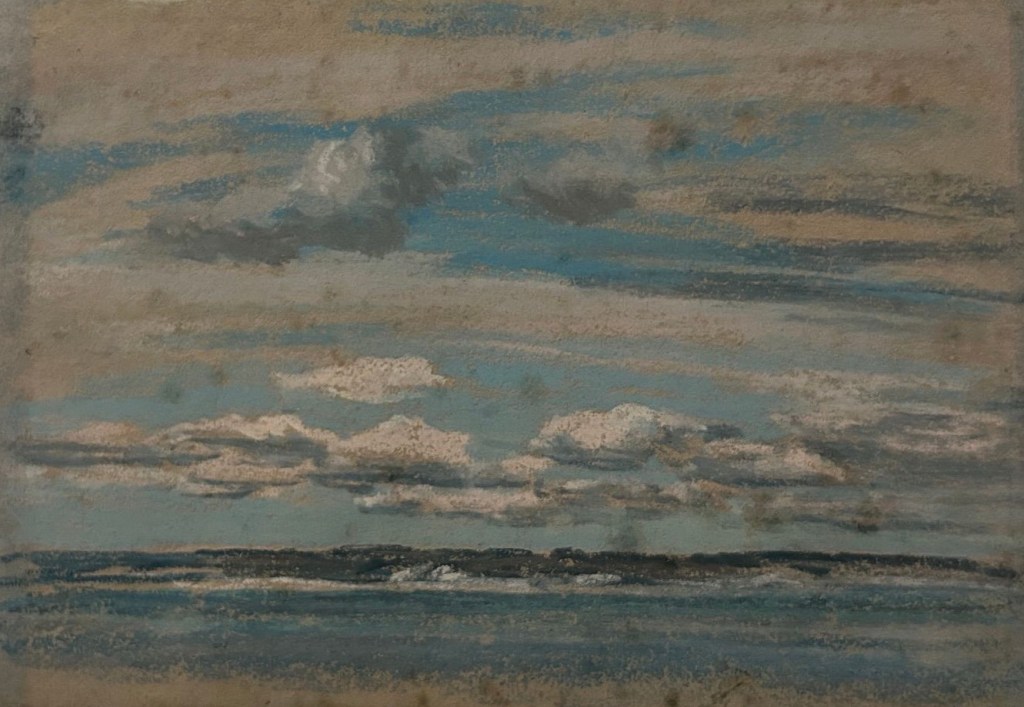
I also admired the simple pastel landscapes, brilliantly conveying weather in just a few lines. Food for inspiration.
I cropped out the frames so the details are more prominent.
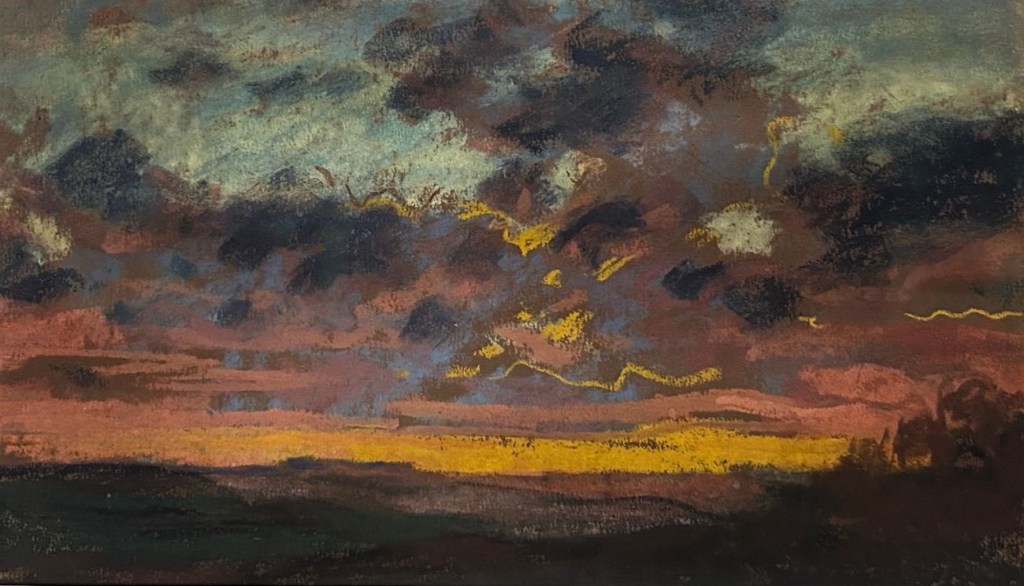
A dramatic sunset below:
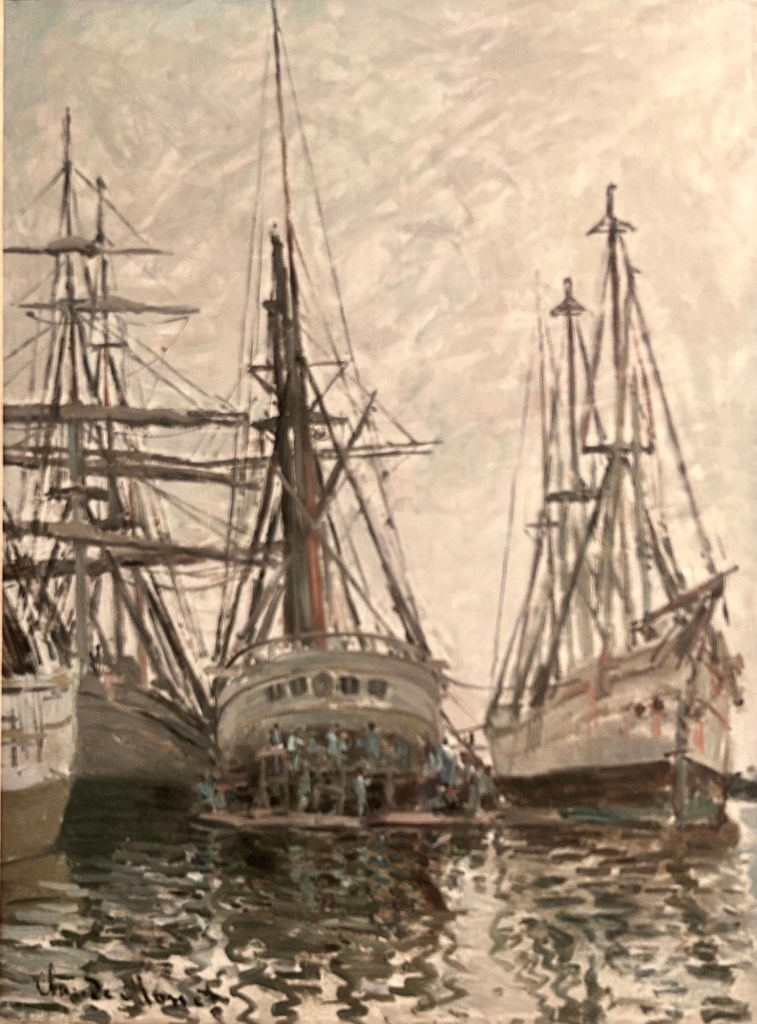
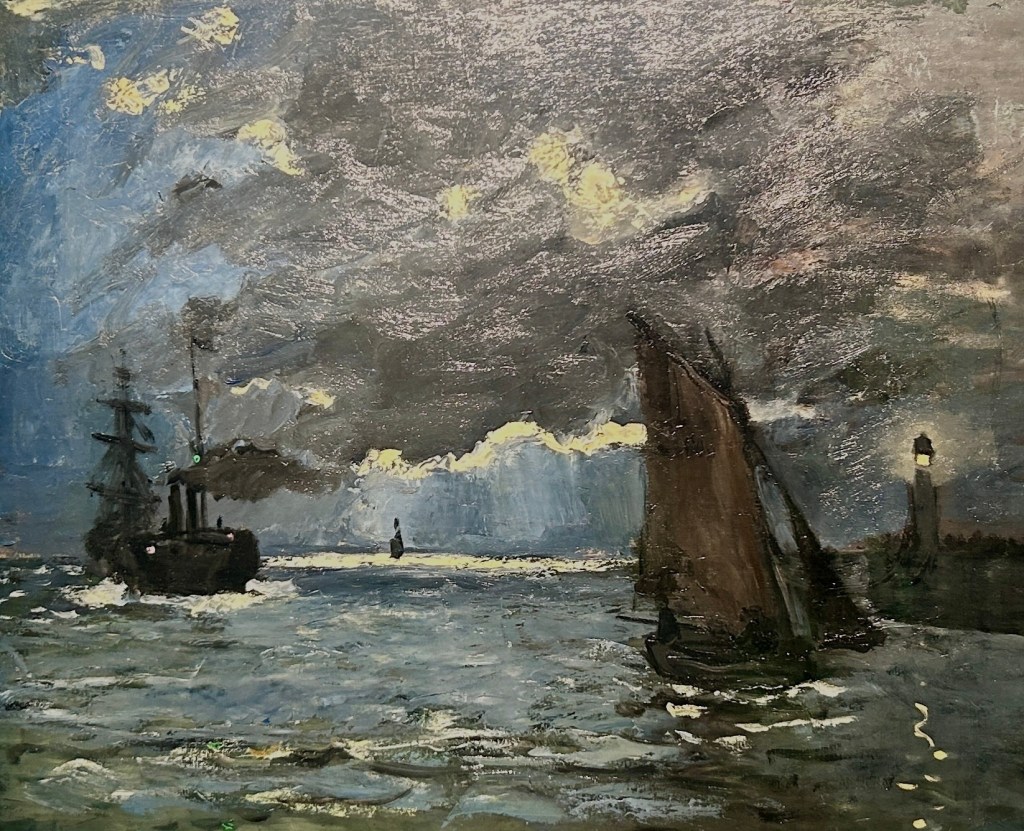
And of course, living in a port inspired him to paint the sea, and boats.
This was difficult to photograph, because of the glare on the glass. It was a lot more impressive live. As is most art, however good the photo.
One gripe was that all these paintings were behind glass, even the oil paintings. This together with the lighting, detracted from the viewing. And all due to activists who think it’s effective to douse masterpieces in ketchup. Sigh…
AI is widely reviled for many reasons—it devours energy, is bad for the environment, helps students cheat, destroys jobs. All that is true, but progress cannot be stopped and, like everything else, it is a double-edged sword. There are always good sides to it and its benefits can be utilised for the good.
AI will lighten tasks, and is invaluable in diagnostics and many types of research. But it can also be used to creative purposes, and a great example of this is the work of Kelly Boesch.
Kelly Boesch is a visual artist and designer who sees AI as a powerful collaborator, pushing creative boundaries at the intersection of human creativity and cutting-edge technology.
She worked for several years for a fashion company running a design studio and using a CAD design computer and spent 17 years at IMAX in film production and marketing. This helped her imagination evolve from abstract painting in acrylics and mixed media to developing a new visual language. Her arresting content boasts more than two million followers.
She is also a music lover, and jumped at the chance to use AI tools like Suno to make cool music to go with her videos. In her own words: The ability to make your own video content just blows my mind. I used to have to go out and shoot things or buy stock videos. Now I can create anything I want sitting on my couch. It’s mind blowing.
Boesch likes variety: I’m a bit of a creative sponge—whether it’s painting, jewelry design, or now AI, I’m always looking for new ways to tell stories visually.
Her love of animals, fashion, music and colour immediately pops up. Some of her videos are strange, some perhaps not to my taste, and some are plain wonderful. But see what you think for yourselves.
Another post, another obituary. But this time it is a celebration of a life well lived—David Hockney did the thing he loved to do most, paint, to the very end. Not a bad way to go. He was 88, and his health had been failing for some time.
David Hockney was born in 1939 into a working-class family in the small industrial city of Bradford, Yorkshire, one of five children. His father was a self-employed restorer of baby carriages and a crusader against nuclear arms. His mother, Laura, to whom he was especially close, was a frequent subject of his portraits. David Hockney maintained close ties to his parents, returning yearly to spend Christmas with them until the end of their lives.
Conservative in his art, since it was figurative and narrative in an era when abstraction was favoured, he was nevertheless avant-garde as one of the first widely popular artists of his time to make work with undisguised gay content.
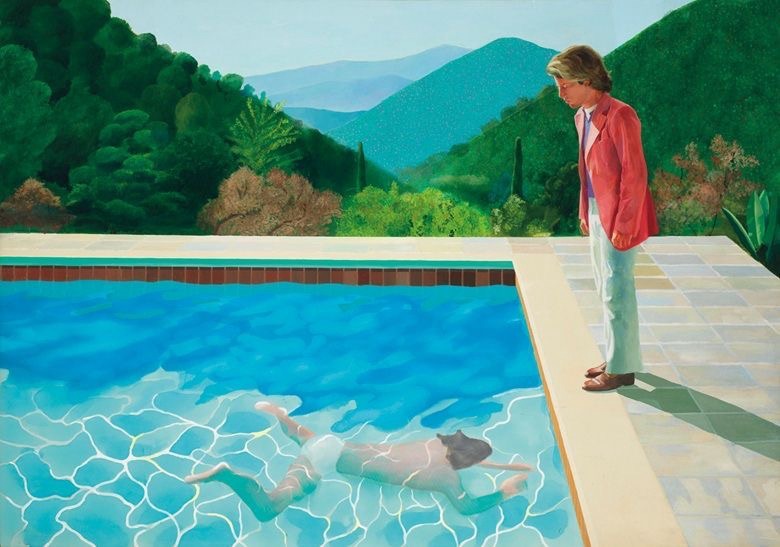
Hockney travelled widely in search of inspiration and spent many years in America, in New York and especially Los Angeles, where he made a lot of his best-known paintings, many including images of swimming pools. These identified him as the quintessential artist of Southern California’s nouveau riche leisure life.
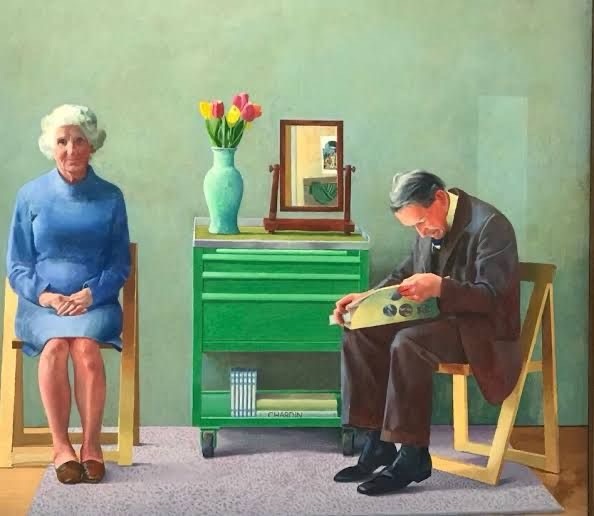
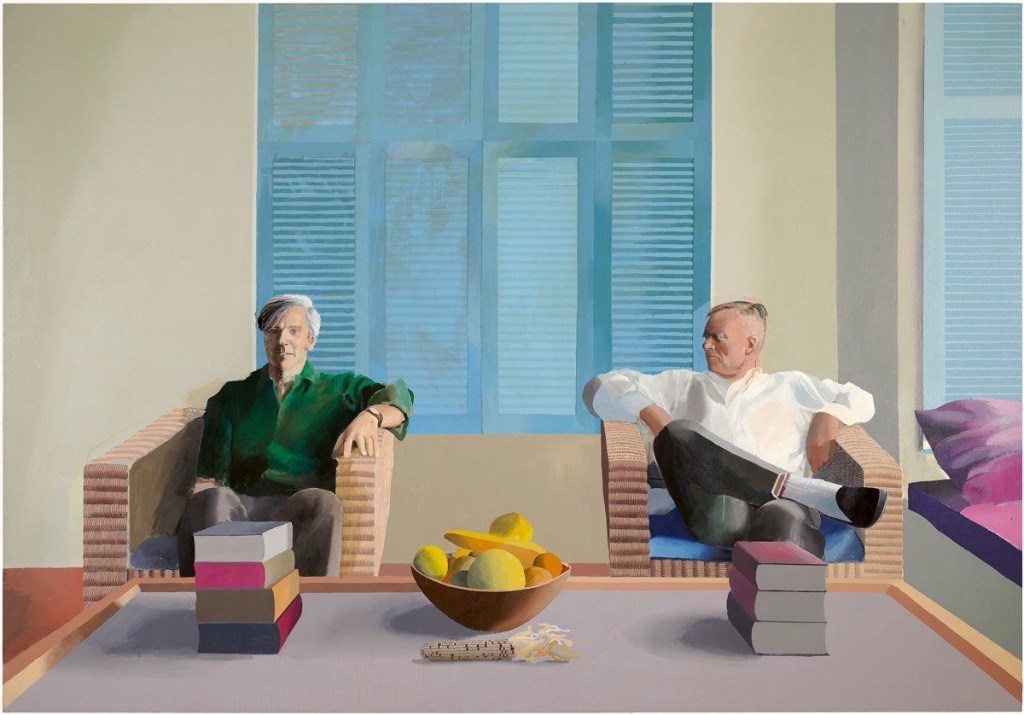
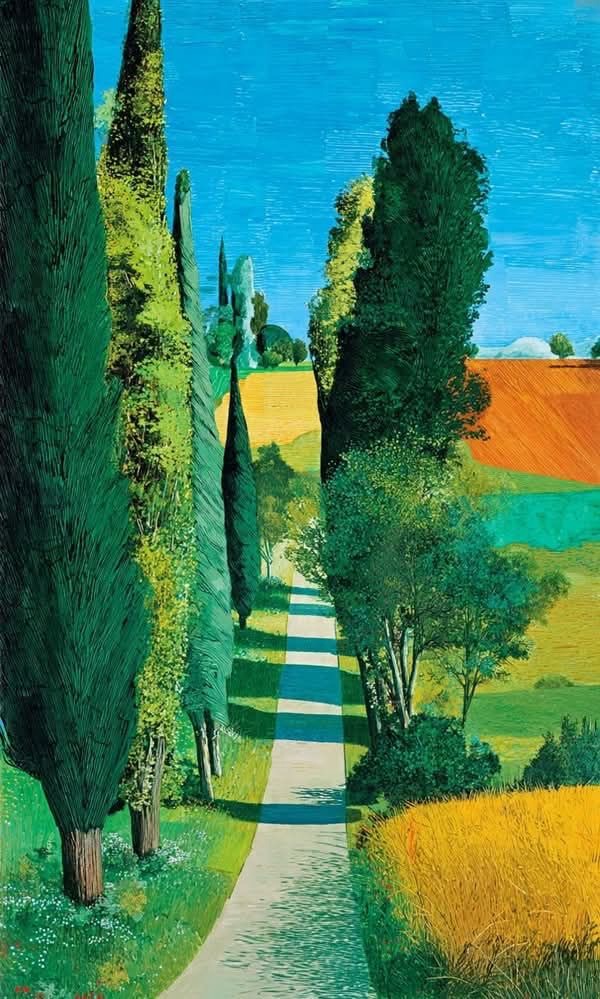
He painted the people around him, his family, lovers and friends, and made a series of evocative double portraits (the one above is a particularly favourite of mine.) He also painted vivid landscapes, some huge, filled with light and colour.
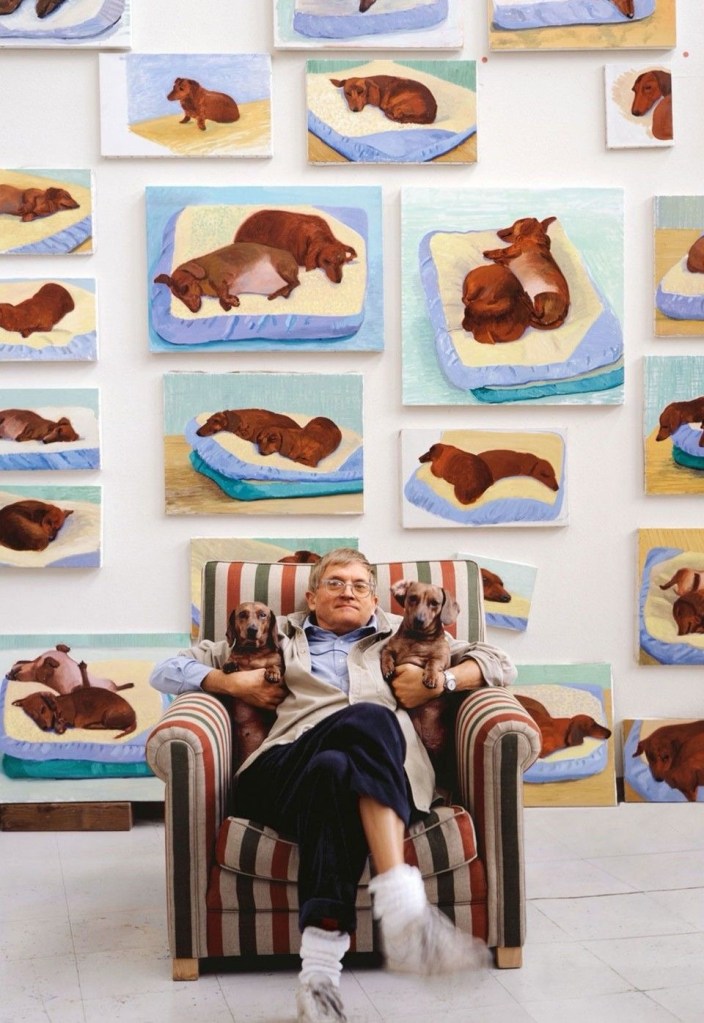
Hockney was a visually striking man, with a high-color wardrobe of plaid suits, striped soccer jerseys and mismatched colored socks, owlish glasses and bleached blond hair. A gregarious personality, he surrounded himself with people and made many friends, until late in life, when deafness isolated him slightly. He compensated by surrounding himself with his beloved pet dachshunds.
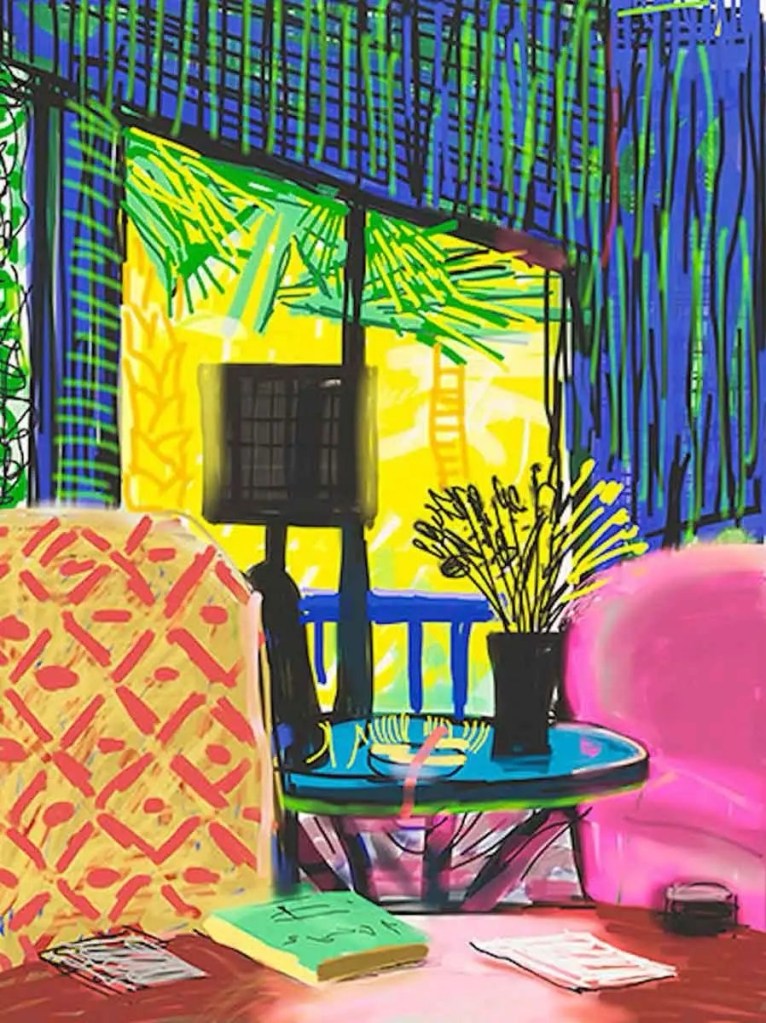
Made on iPad with Procreate
Later on he used technology in his art, making collages of photographs and iPad art. In fact during his long career he tried his hand at many different techniques, such as theatre sets and stained glass windows. He loved to experiment with various methods. Nevertheless, his appetite for technology was unexpected because, as The Washington Post put it: “There is no living art star less in need of a machine… Hockney can draw water. Hockney can draw smog. He can draw the bleaching sunlight… in Los Angeles. He can draw the chilling damp of Bradford… He can draw the glow of friendship.”
The photo is from an invitation to an exhibition at the Museum Boijmans Van Beuningen in Rottredam, 1995.
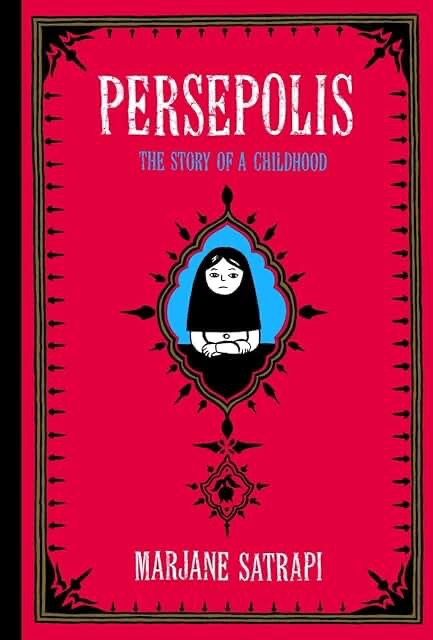
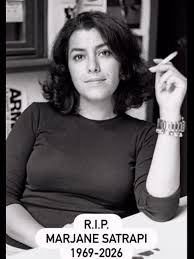
I was saddened to read that Marjane Satrapi, the Iranian-French author whose graphic novel series “Persepolis” documented the struggles of ordinary Iranians during the turbulent years around the Islamic Revolution, has died at 56 years old.
Apparently the cause of death was sadness stemming from the premature death of her beloved husband, Matthias Ripa. The couple did not have children.
Ms. Satrapi was a troubled but extremely talented and influential person—writer, artist, director. With the publication of the semi-autobiographical “Persepolis” in the early 2000s, Ms. Satrapi became one of the major exponents of a form of graphic novel — influenced by Art Spiegelman’s “Maus” — that combined political history and memoir.
Her heroine, Marji, is a girl living through some of the most difficult years of Iranian history, just as Ms. Satrapi did. Both she and her character were born in Iran in 1969, and were about 10 when the Shah was overthrown. They both lived through the rise of the clerics and the horror of the Iran-Iraq War, and left the country at 14 to study in Austria. For Satrapi, the Viennese experience was a disaster and she moved back home after four years.
Here is an excerpt from her obituary in the NYT:
‘Marjane Satrapi was born on Nov. 22, 1969, in Rasht, near the Caspian Sea, and grew up in Tehran. She had aristocratic ancestors, and her parents were cosmopolitan leftists; her father was an engineer and her mother designed dresses.
Marjane bridled against the new restrictions on dress and behavior. When she was 14, she hit a school principal who had tried to confiscate her jewelry, and her parents, worried for her safety, sent her to live with an Iranian family in Austria. There, she was overwhelmed by the experience of a very different world.
They opposed the Shah and protested against his government, but were disillusioned by the political and cultural crackdown that followed the revolution and the end of his rule. Marjane’s uncle was accused of being a Soviet spy, jailed and executed.
“At her nadir,” Simon Hattenstone wrote in The Guardian in 2008, “she was peddling drugs, homeless, and she almost died from bronchitis. After four years in Vienna, she admitted defeat, put on her veil and returned home.”
Back in Iran in 1989, she studied art in Tehran and had an early marriage that ended in divorce, then returned to Europe.’
In 1994, Ms. Satrapi moved to Paris, where she wrote the “Persepolis” series in French. It was later translated into English and other languages and has been read by millions of readers. The books have also become popular as school assignments. The series was adapted into a 2007 film that was nominated for an Academy Award for best animated feature.
Some years later, Ms. Satrapi documented another tumultuous moment in Iranian history: the unrest in 2022 that followed the death, in police custody, of a 22-year-old Kurdish woman, Mahsa Amini, who had been accused of violating a law requiring women to wear the hijab in public.
In protest, women across Iran tore off their veils, in one of the most significant cultural and political moments in the country since the 1979 revolution.
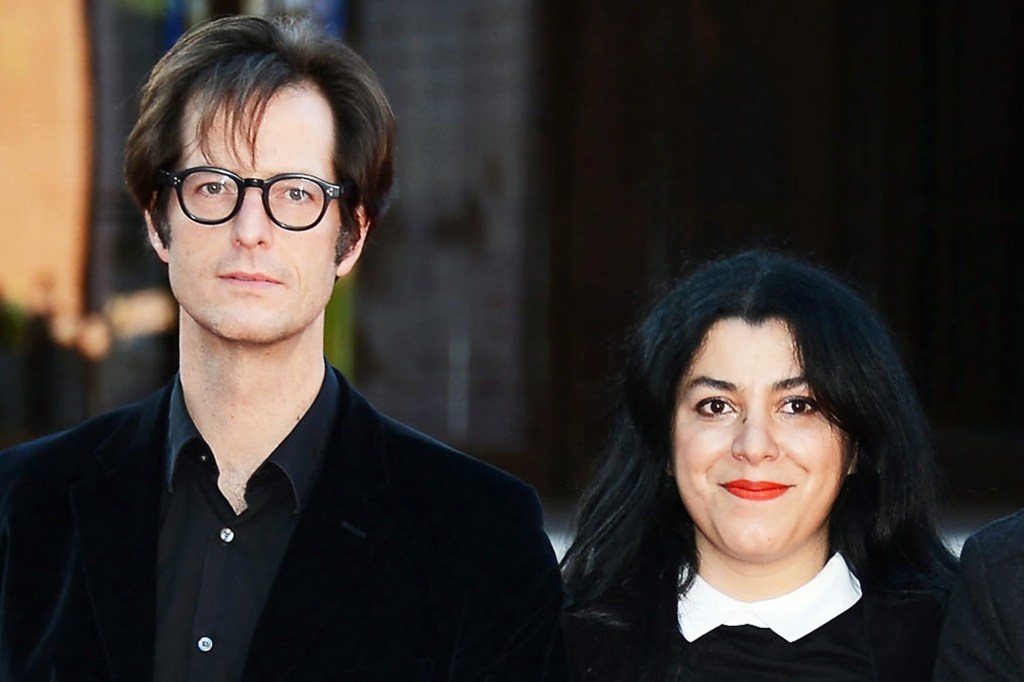
Marjane Satrapi with her husband Mattias Ripa in 2012.Venturelli/WireImage
Ms. Satrapi wrote several children’s books and other graphic novels, including “Chicken With Plums,” the story of the death of her great-uncle, which was also turned into a film. Another of her works, “Embroideries,” depicted Iranian women discussing love, sex and men over afternoon tea.
She directed several feature films, including “The Voices” (2014), with Ryan Reynolds, and “Radioactive” (2019), starring Rosamund Pike as Marie Curie.
She also won acclaim as a painter and was elected in 2024 to the Académie des Beaux-Arts, one of the highest honors in the French art world.
She wrote frequently about her perpetual sense of dislocation — living away from her home country, but thinking constantly of it.
“I call Iran home because no matter how long I live in France, and despite the fact that I feel also French after all these years, to me the word ‘home’ has only one meaning: Iran,” Ms. Satrapi wrote in a 2009 essay for The Times.
“No matter how much I am in love with Paris and its indescribable beauty,” she said, “Tehran with all its ugliness will in my eyes forever be the ‘bride’ of all cities around the world.”
I advise anyone who has not read ‘Persepolis’ to try it, even if graphic novels are not your cup of tea. Just as you should read ‘Maus.’
Also below you can find a trailer for the Persepolis animated movie.
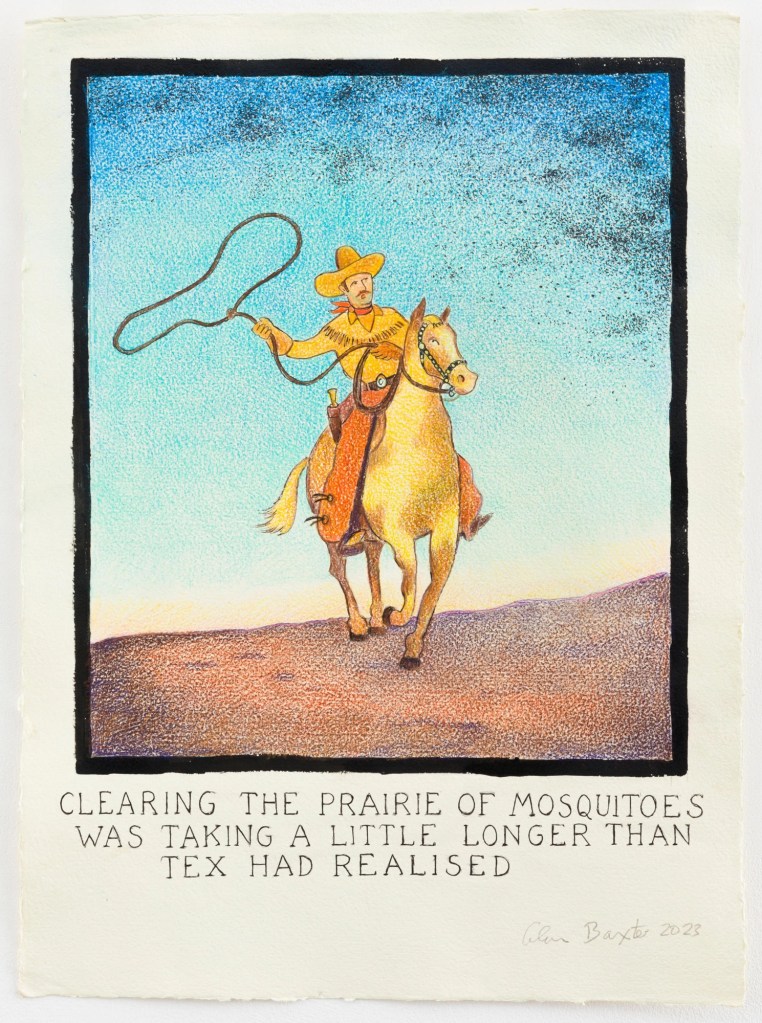
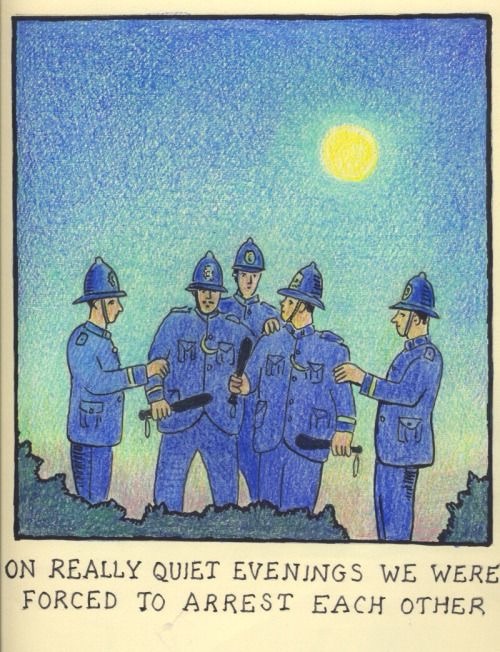
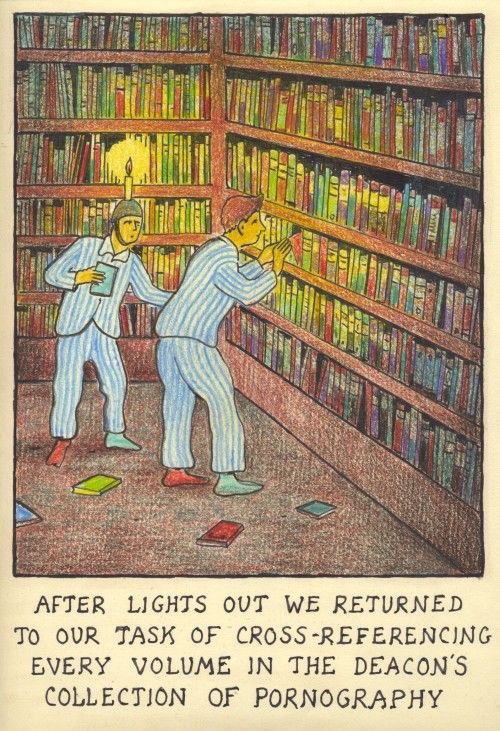
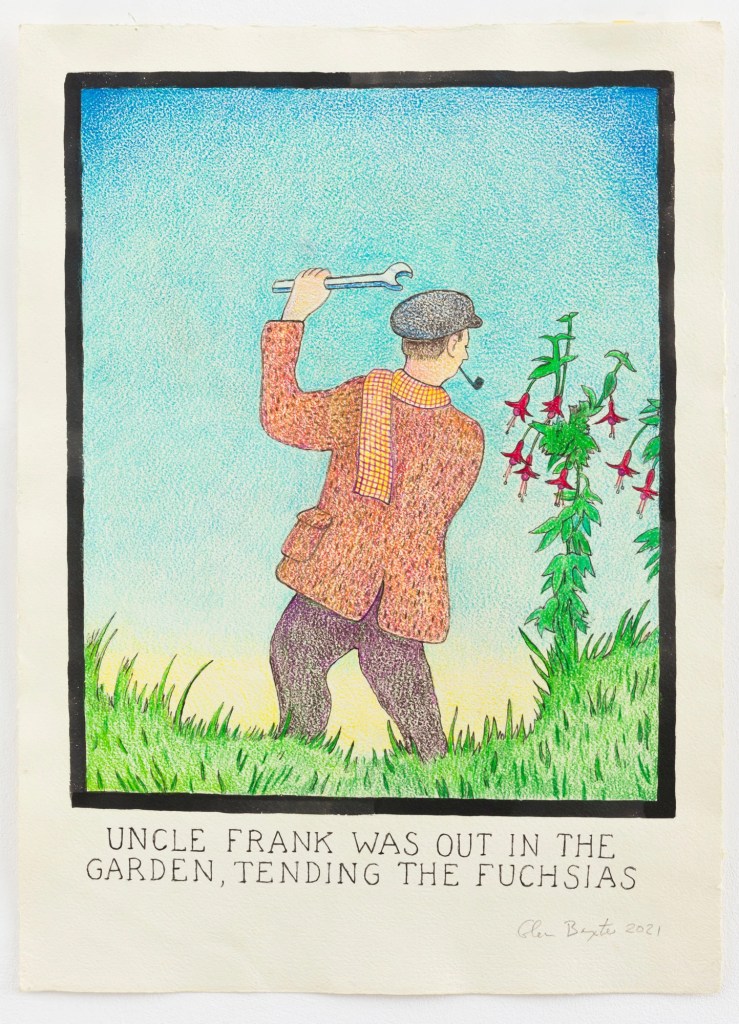
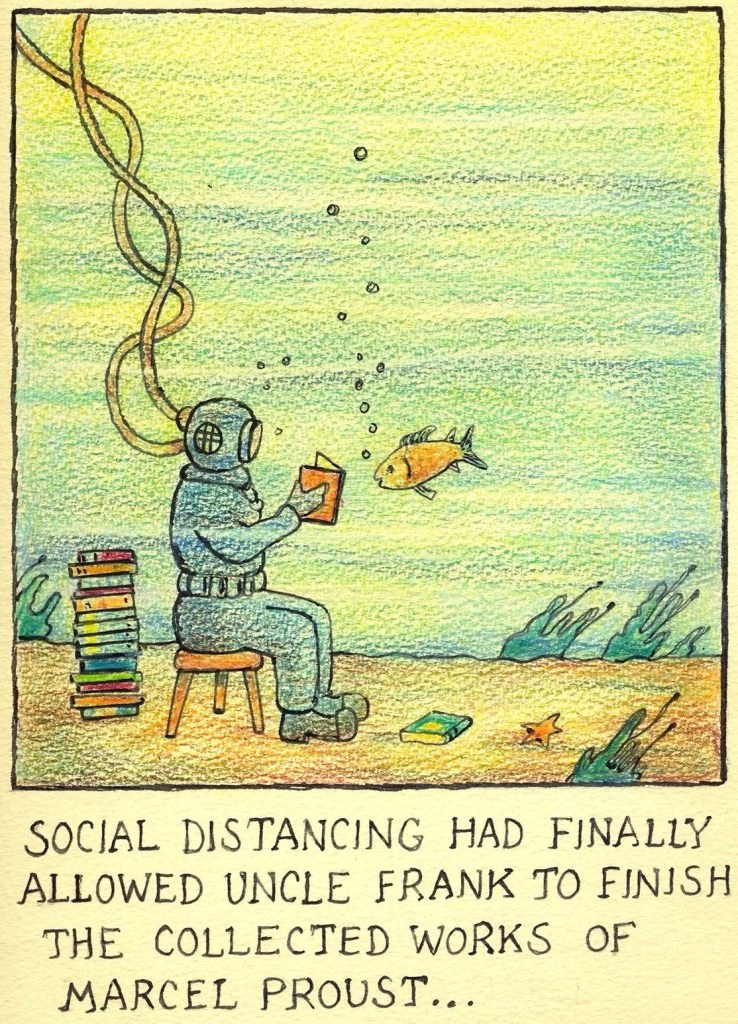
I am a huge fan of cartoons and comic strips and Glen Baxter, who passed away aged 82, was a big favourite.
Glen Baxter created a surreal artistic universe populated by erudite cowboys, tweed-clad empire-builders and malevolent Boy Scouts. His fame was higher outside England where he was considered a modern Surrealist Master. At home he sadly often fell into the funny greeting-cards category.
His drawings relied for their offbeat humour as much on their absurd deadpan captions as on the artfully simplistic drawings.
Often the drawings themselves were offbeat, such as the one featuring a man sawing off his own leg in front of two children, with the caption “Uncle Frank would keep us amused for hours”
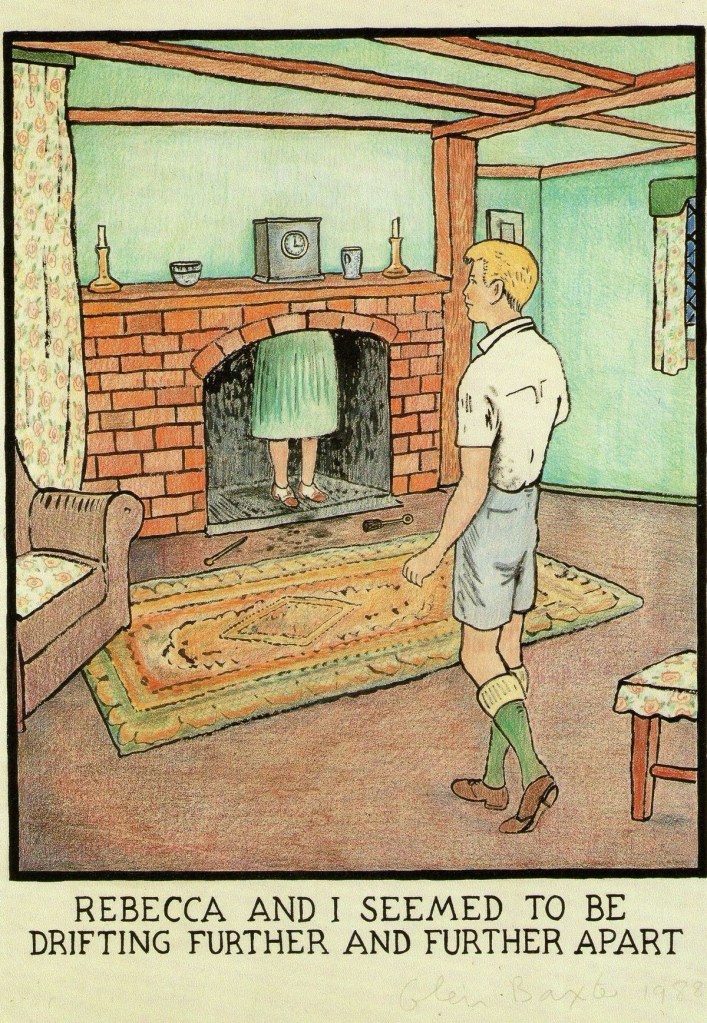
Look at the image above: the bottom half of the lady inside the chimney suggests she is stolidly middle-aged, while the ‘husband’ looks like a teenager in his shorts. Can’t you imagine Baxter sitting at his work table thinking up all this nonsense? Not a bad day job…
Some images would depend for their effect wholly on the caption: two co-habitees glowering at each other: “The tension at No 83 had been almost unbearable ever since Eric had deliberately swallowed Toby’s anorak.”
Baxter was inspired by pulp fiction and old adventure comics which he combined with literary nonsense. The delightfully old-fashioned pictures depict incongruous characters such as cowboys, explorers and Boy Scouts uttering intellectual statements regarding art and philosophy.
This is probably not to everyone’s taste, but I love his work. And for those interested, here is a fun interview about his life and aspirations.
On February 17, 2026, we officially entered the Year of the Fire Horse. In Chinese astrology, because the elements rotate alongside the animal signs of the Zodiac, the same combination returns only every 60 years. The Fire Horse is associated with intense momentum, restlessness and catalytic change. Well, one only has to read the news to realise that.
In honour of this, and to give it a more positive dimension, I decided to write about the horse in art. The horse has carried human civilisation upon its back: it has provided transport and entertainment, been a vehicle of agriculture and battle, a beloved and trusted companion, a spiritual presence and a symbol. As such, it has been depicted in art throughout the ages, in almost every culture.
It would take many volumes to include all, or most, representations of the horse in art. I will restrain myself, therefore, to some of my favourites, starting in prehistoric times.
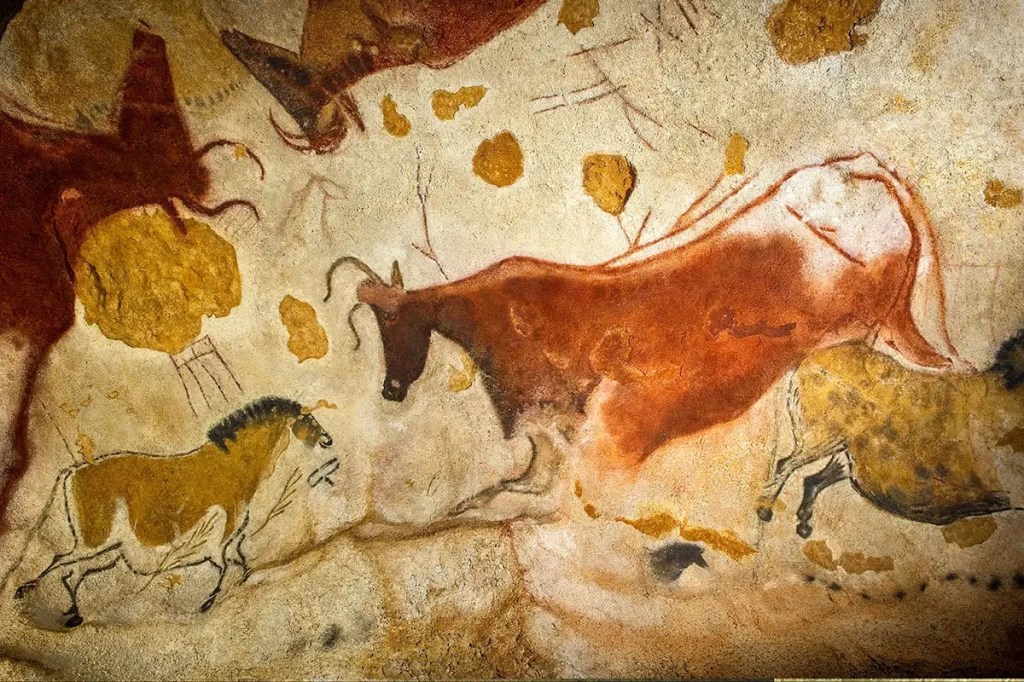
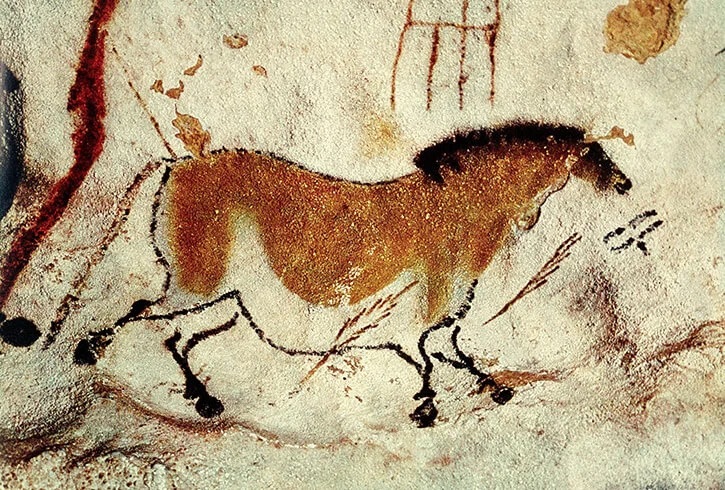
Stone Age occupants of Europe had a strange fixation on horses. Almost one in every three animals they depicted on cave walls was a horse. However, the reason why the horse loomed so large in ancient minds may remain forever a mystery.
Some of the most famous cave paintings (but there are many, all over the world) are the those in the Lascaux network of caves in the Dordogne region of France. They are estimated to be roughly 17,000 years old.
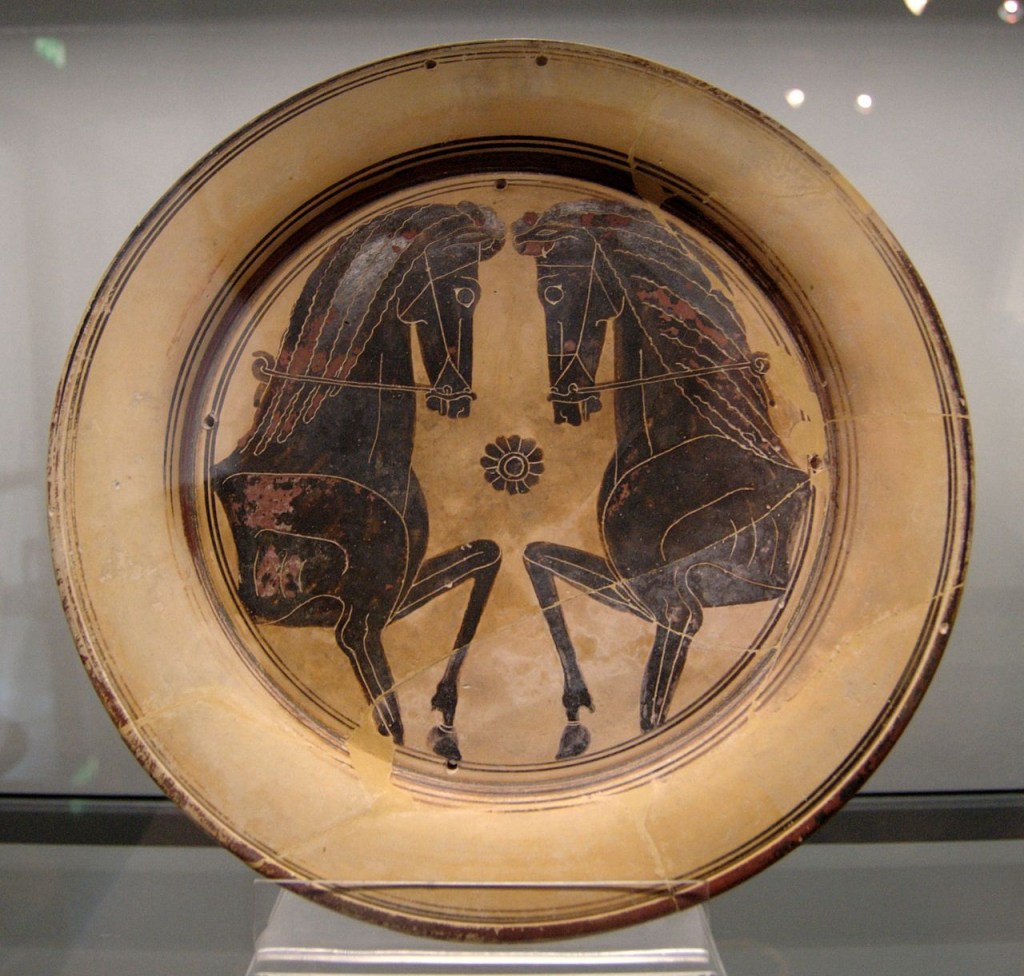
Of course, horses could not be absent from Ancient Greek art, since they play a prominent part in mythology and history, from the flying horse, Pegasus, to Bucephalus, the beloved mount and companion of Alexander the Great. They figured in vases and plates, like the one below:
Horses’ heads, Corinthian black-figure plate, 600-575 BC
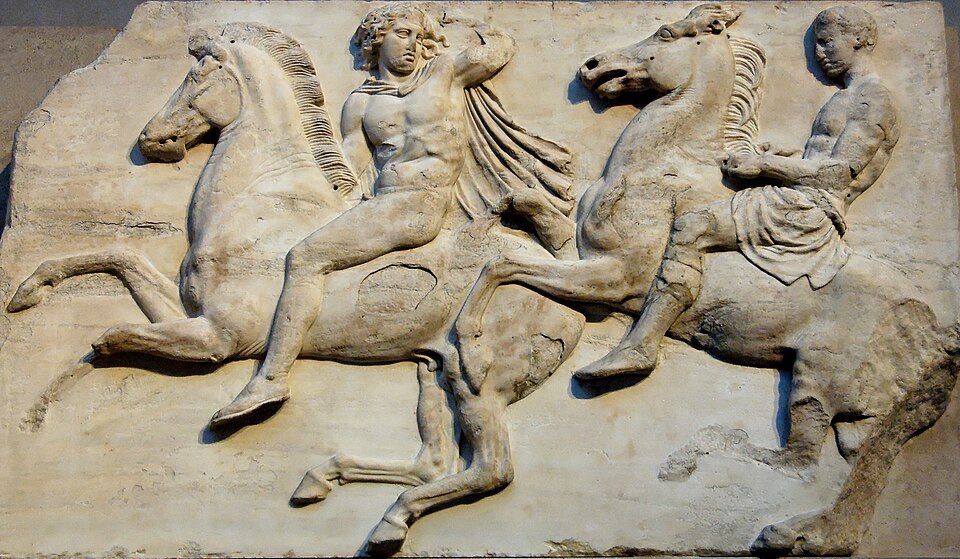
As well as in sculpture and bas-relief, such as the famous Parthenon frieze.
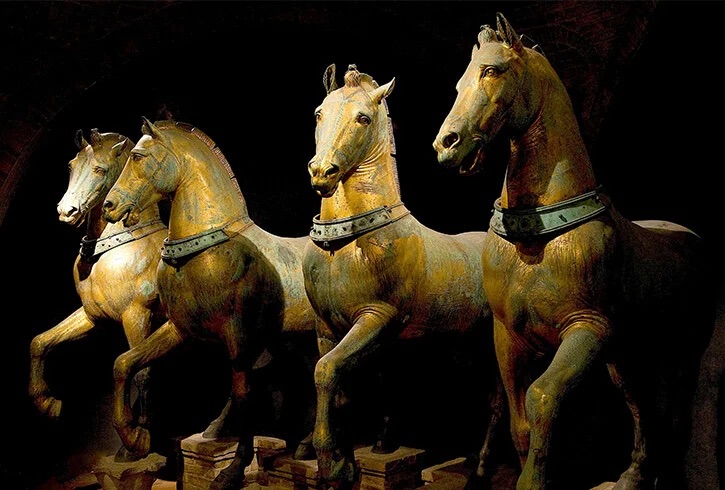
The other famous horses that date from classical antiquity, perhaps originally from Constantinople, where they were displayed for many years, are the Horses of Saint Mark.
Situated atop the Loggia of Saint Mark’s Basilica in Venice, these were originally part of a monument depicting a ‘quadriga’ – a four-horse carriage used for chariot racing in antiquity, used in the ancient Olympic games or depicted as the ‘Chariot of the Gods’ ridden by Apollo across the heavens.
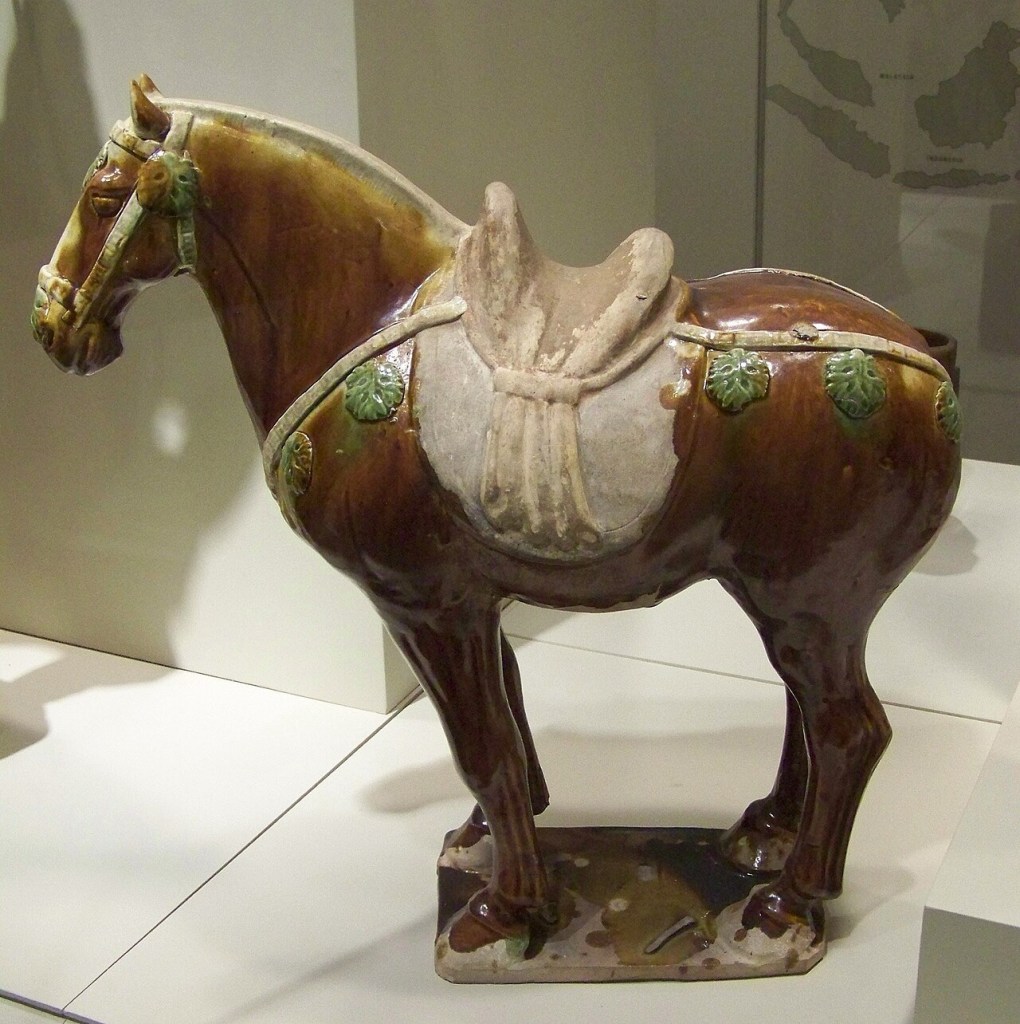
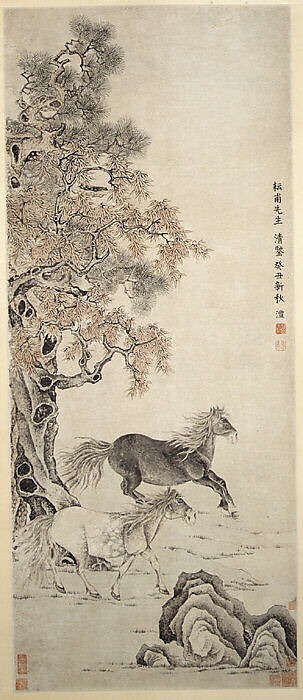
The horse was also revered and commemorated in China, in pottery and glazed statues as well as scrolls.
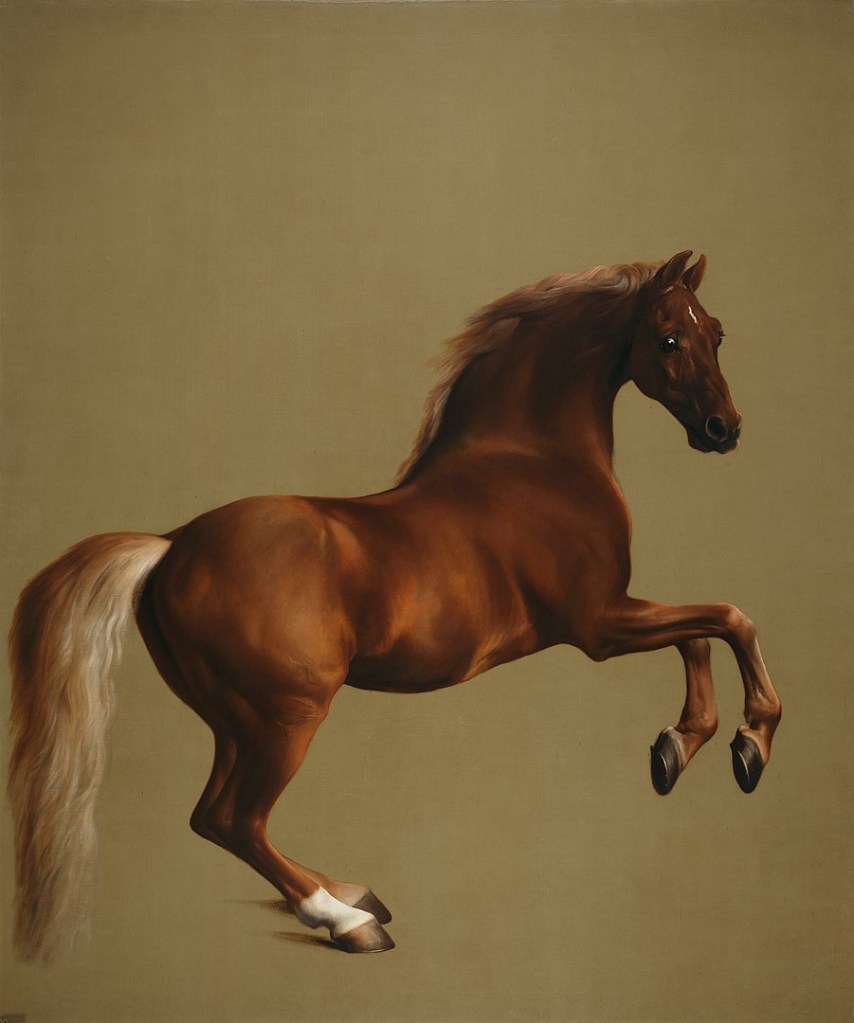
Coming to modern times, one of the most famous equestrian artists is certainly George Stubbs (1724-1806). He was self-taught and had an obsessive interest in anatomy.
In 1758, Stubbs rented a farmhouse in Lincolnshire and spent 18 months studying dead horses. Gruesomely stringing the carcasses up on a system of pulleys, he injected their veins with wax to give them a lifelike appearance and proceeded to systematically study them in different positions, stripping off each layer of the body.
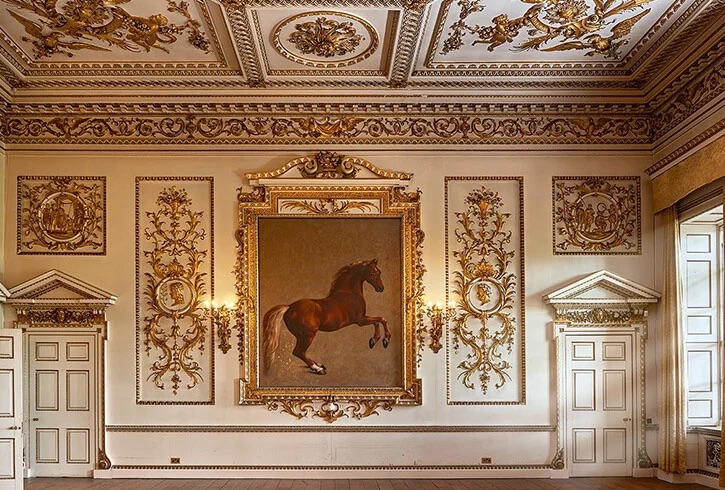
Stubbs made many wonderful paintings, but arguably his masterpiece is a life-size portrait of the horse Whistlejacket, (c. 1762), commissioned by his owner, the Marquess of Rockinham.
George Stubbs, Whistlejacket, c. 1762, National Gallery, London, UK.
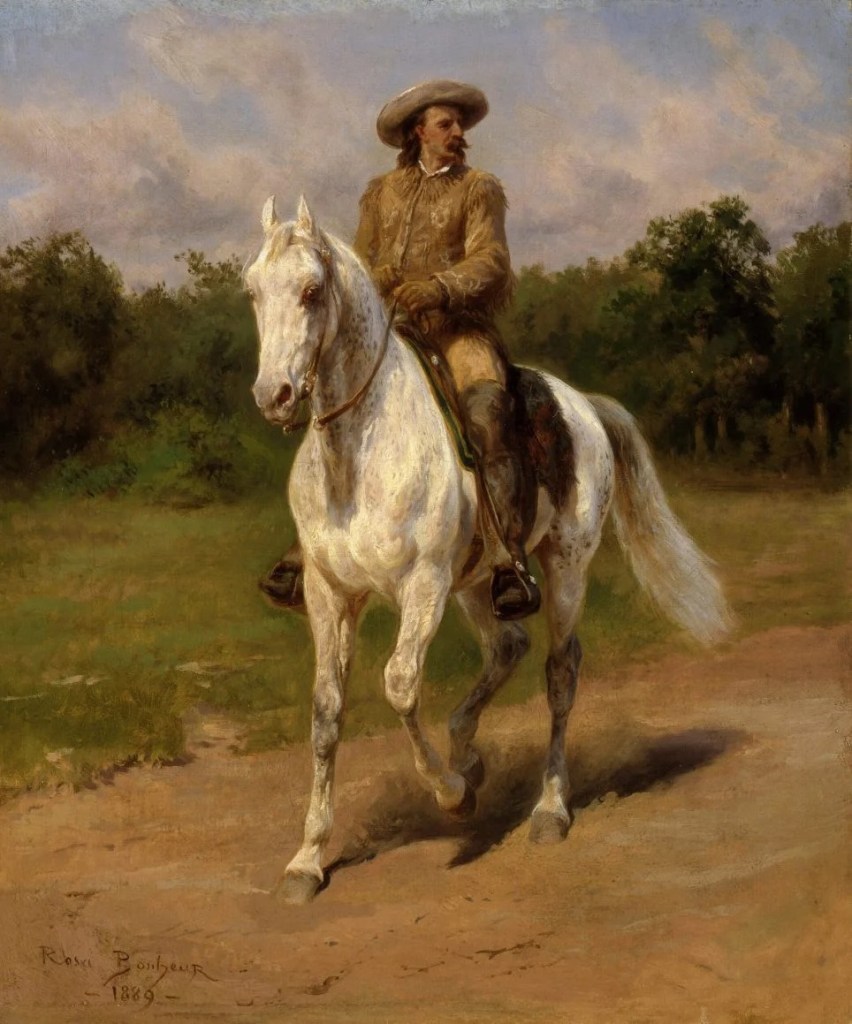
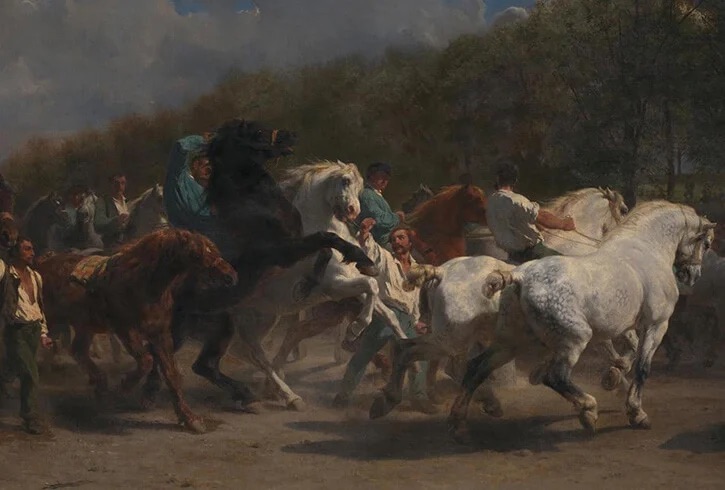
Another wonderful painter of animals was Rosa Bonheur, who was inspired by George Stubbs and Eugène Delacroix but also by Ancient Greek sculpture. Her most famous work is The Horse Fair, but I love the portrait below, of William F. Cody, alias Buffalo Bill, whom she met and befriended at his Wild Est Show, held on the lawns of Neuilly during the Exposition Universelle.
To paint the Horse Fair, which shows the horse market held on the Boulevard de l’Hôpital, Paris, Bonheur sketched there twice a week for a year and a half.
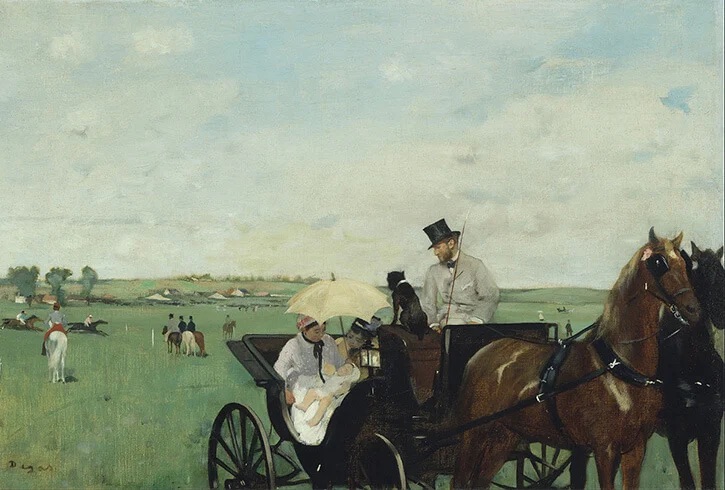
Another of my favourite paintings is At the Races in the Countryside (1869) by Edgar Degas, which focuses on a young, upper-class family at the races. It is a wonderful offset composition, relegating the race itself to the background.
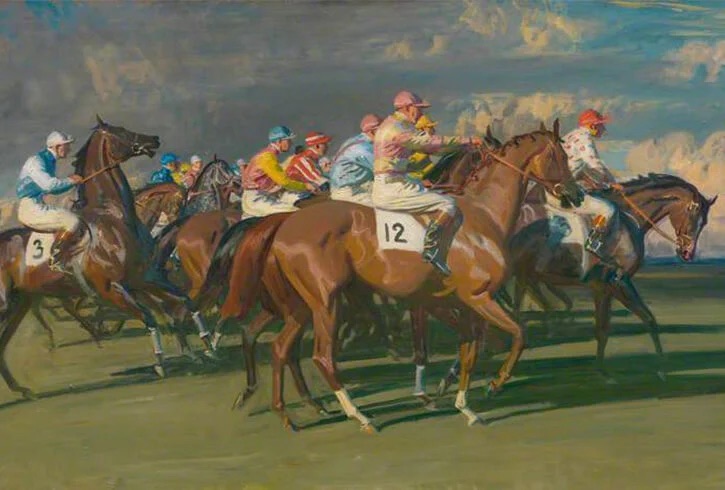
And of course I cannot fail to mention Alfred Munnings, who was enraptured by horse racing for his entire career. The painting below, brimming with excitement and anticipation, is titled Start at Newmarket: Study No. 4, c. 1947
I could go on forever, and might go on in another post, but this is a little taste to celebrate the start of the year of the Fire Horse. Which is your favourite?
Rays of sunshine are not too plentiful this weekend—neither in the weather, because it is persistently drizzling (just enough to soak you after a while,) nor in the absolutely horrendous news. And I do hope none of you has been indulging in a sunny holiday in Dubai, ha ha (sorry about the graveyard humour.)
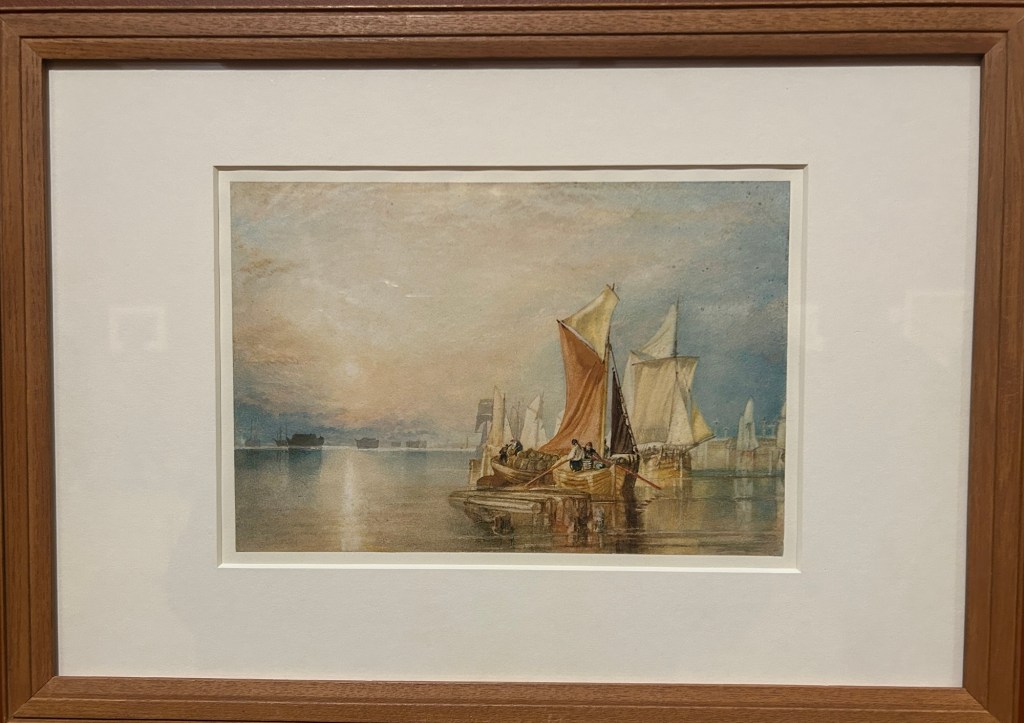
However, sunshine is to be found in the wonderful paintings of J. M. W Turner, at the joint exhibition with John Constable at Tate Britain.
Stangate Creek, 1823-1824, watercolour on paper
Born within a year of each other – Turner in 1775, Constable in 1776 – and both trying to transform landscape painting, the two were great rivals, rather than friends.
Raised in the gritty heart of Georgian London, Turner quickly became a rising star of the art world, beginning his formal training at the Royal Academy Schools aged just 14 and exhibiting there soon after—whereas Constable, the son of a wealthy Suffolk merchant, faced a longer, more arduous rise to acclaim.
I think Constable was a very accomplished, solid artist who funded his life by painting portraits of wealthy people in order to be able to indulge in his great love, landscape painting. The combination of known faces and beloved places makes for an evocative and precious portrait of life in Regency England.
The juxtaposition of these two artists is certainly an interesting one, but may I say at once that in my mind Constable loses by the comparison. The curators cleverly did not place their works next to each other, but gave separate rooms to each.
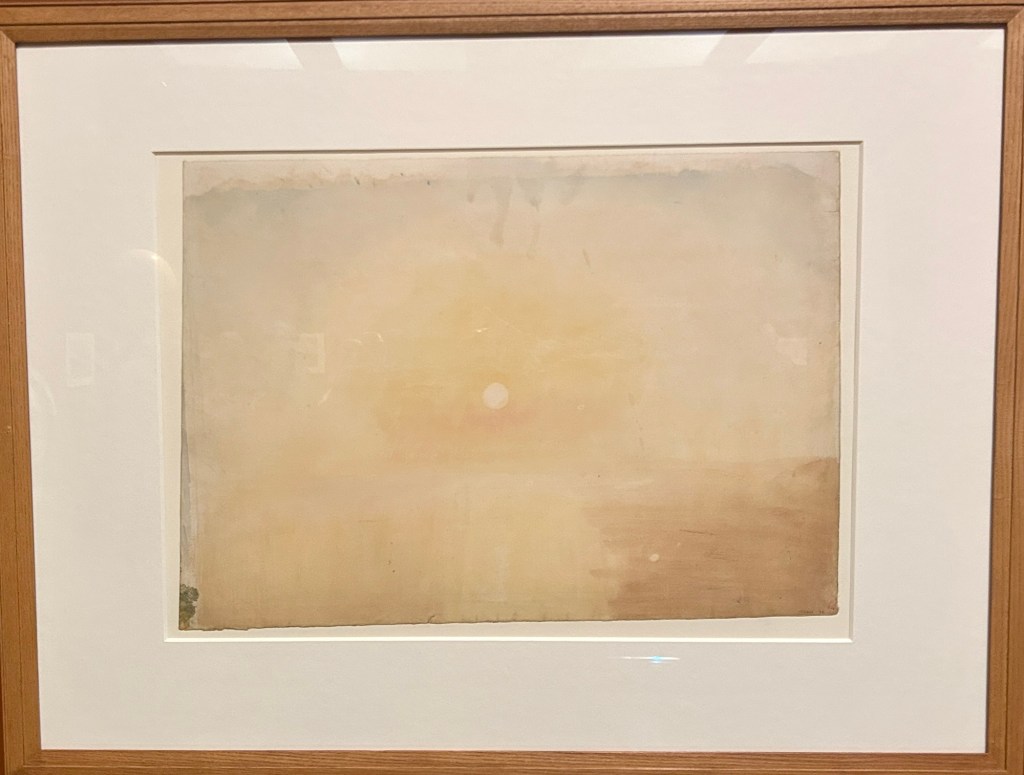
The sun rising over water, 1825-30, watercolour on paper
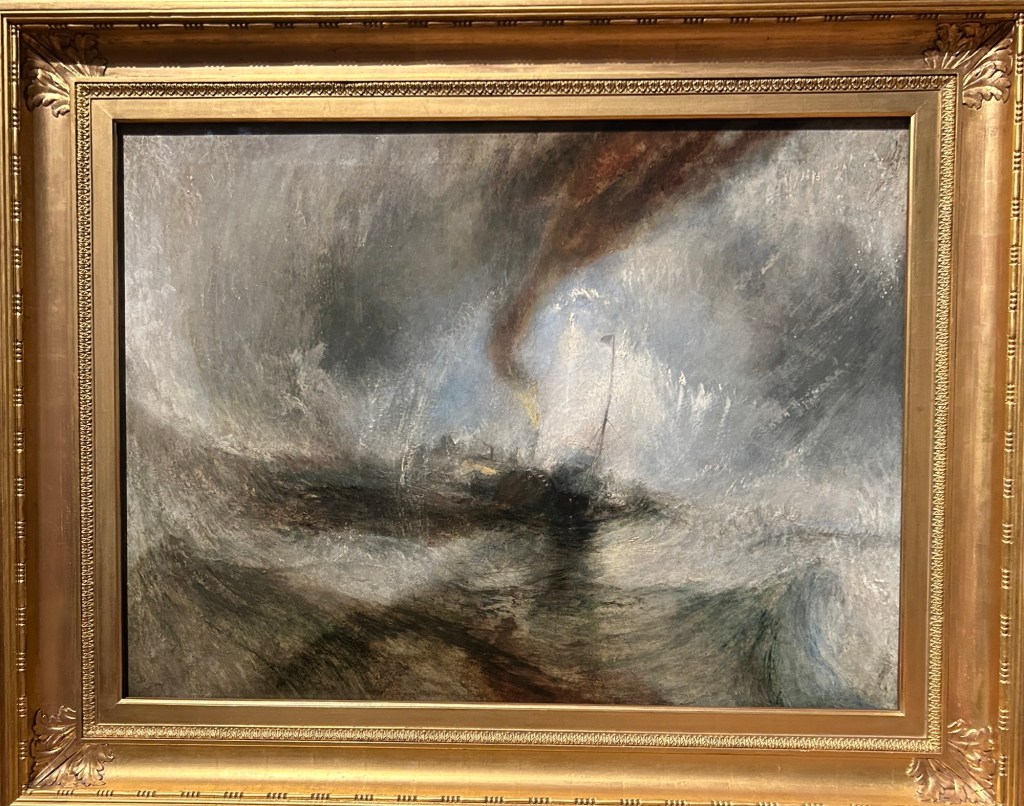
At the time they were exhibiting, Constable had a solid following and favourable reviews, whereas Turner was thought a genius by some, but deranged by others. In our modern consciousness and wider knowledge and appreciation of art, Turner’s paintings are mind-blowing. His treatment of the natural elements, wind, rain, water, clouds, sunrises and sunsets—in fact, all aspects of light and its effects, are unique. Especially the watercolours—the way he moved paint around and scraped paint off in places to achieve the translucent quality of the air around him is astonishing. Watercolour is a very delicate and elusive medium, and mistakes are dearly paid for; but he found it convenient and easy to transport so that he could capture the effects of light on nature live.
Snow storm – steam boat off a harbour’s mouth. Oil on canvas. This is one of Turner’s most daring paintings.
Many of the works in the exhibition are from private collections, so the opportunity to see them in person, and in close proximity, was a rare treat.
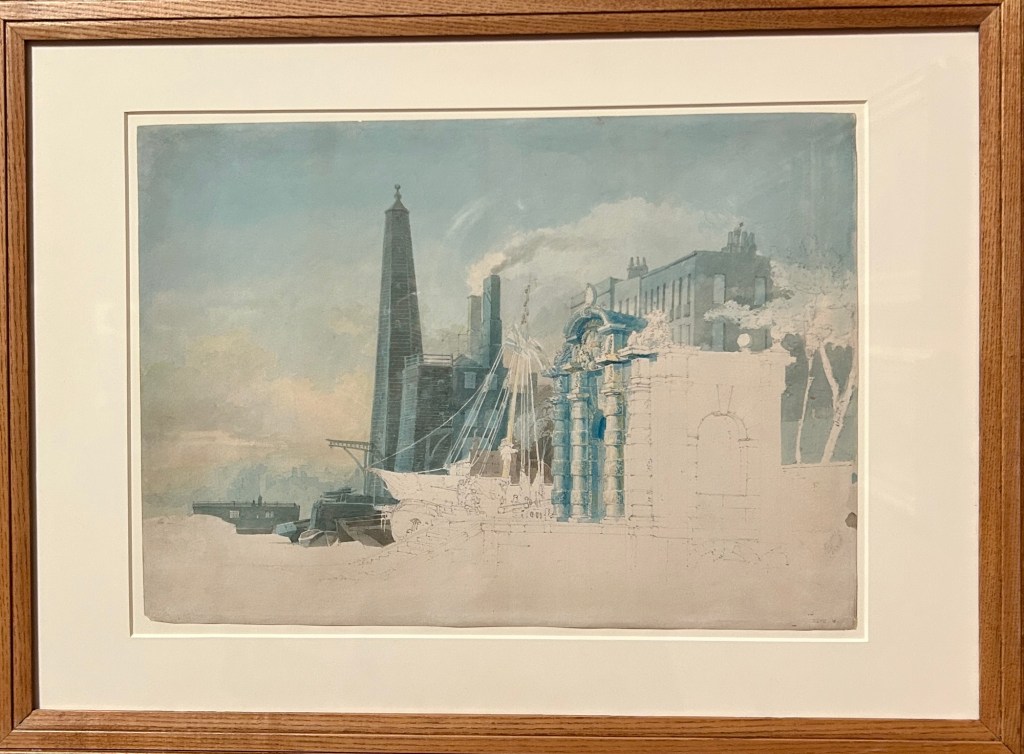
York House watergate, Westminster, London. Graphite and watercolour on paper.
While sorting out my camera roll I came upon various photos that I had saved out of interest. I thought I might share some of them.
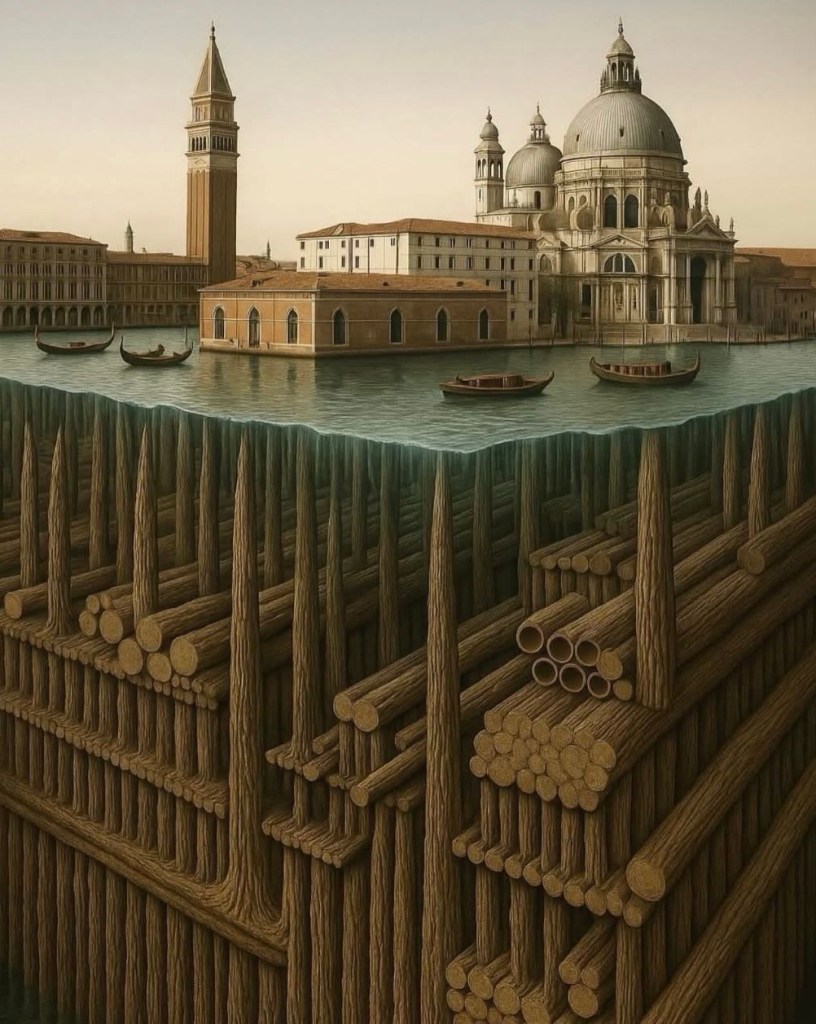
Although this print is reproduced on many sites about Venice, I could not find out where to credit it…
This one in particular fascinated me, especially after our recent trip to Venice.
It shows how the millions of wooden poles upon which the city was built were placed. The wood was transported from surrounding forests via the rivers. It does not rot but, when it comes into contact with the clay mud at the bottom of the lagoon, becomes petrified. The construction process itself is awesome.
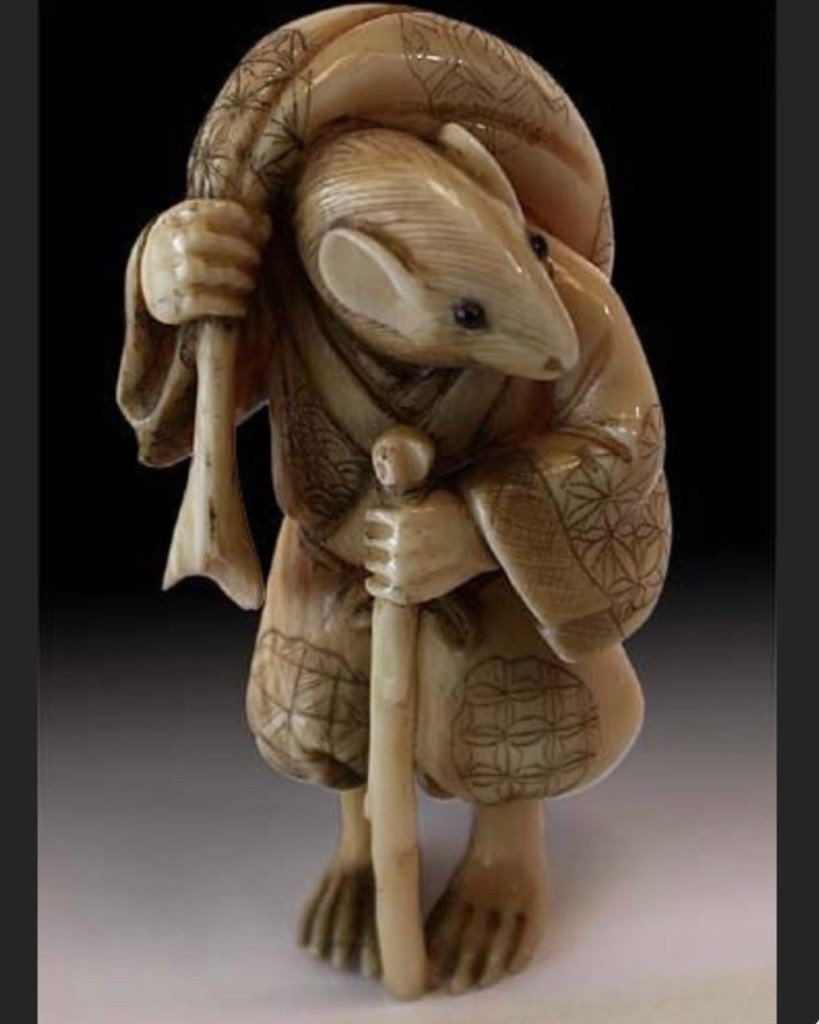
19th century carved ivory netsuke depicting a mouse traveller. Netsuke originated in the 17th century, starting as useful accessories for fastening a pouch to a kimono, for example, but evolving into an art form. This one is attributed to Giyokuseki.
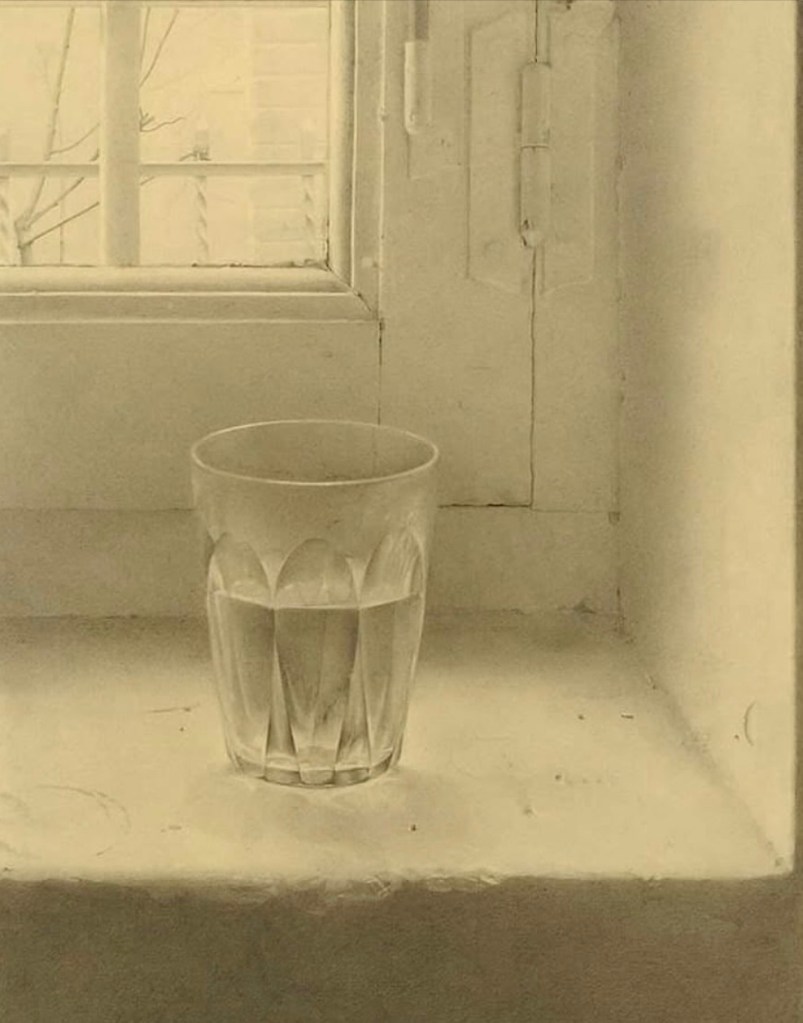
I am in awe of this simple drawing of a glass (pencil on paper). By the Spanish artist Isabel Quintanilla (1938-2017)
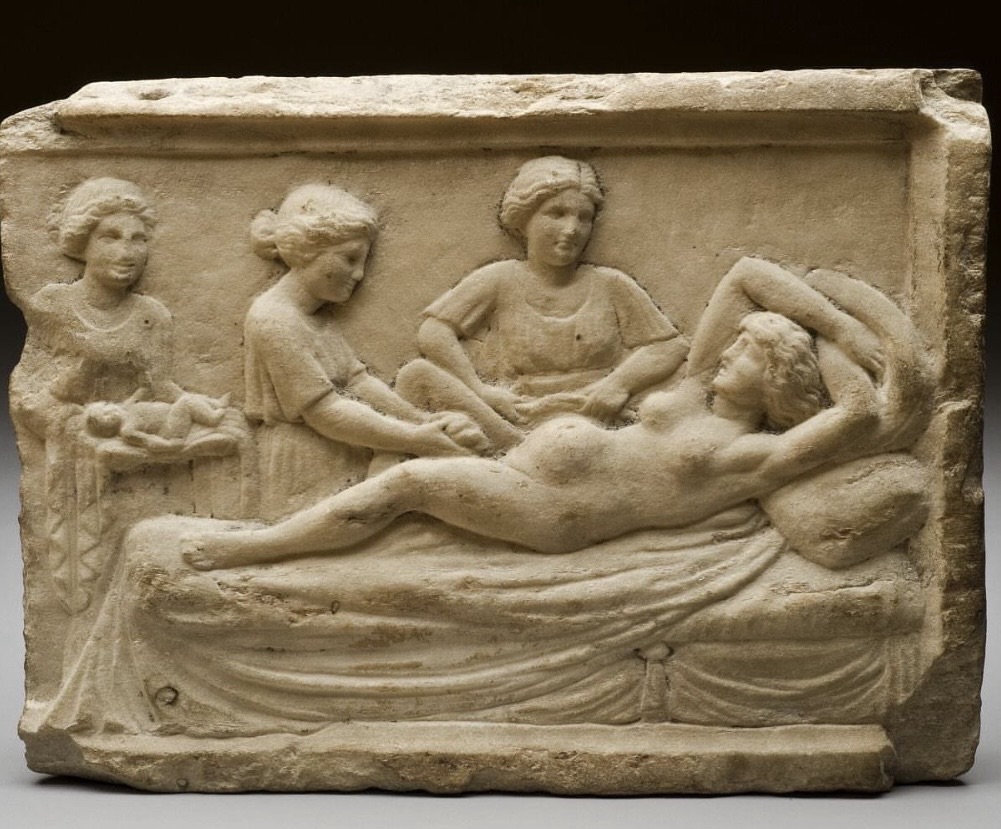
An astonishing Roman marble bas-relief, depicting a midwife assisting a woman having a baby. I have never seen anything like it before, and I think it is lovely. What a feat, to convey such an atmosphere of serenity in stone.
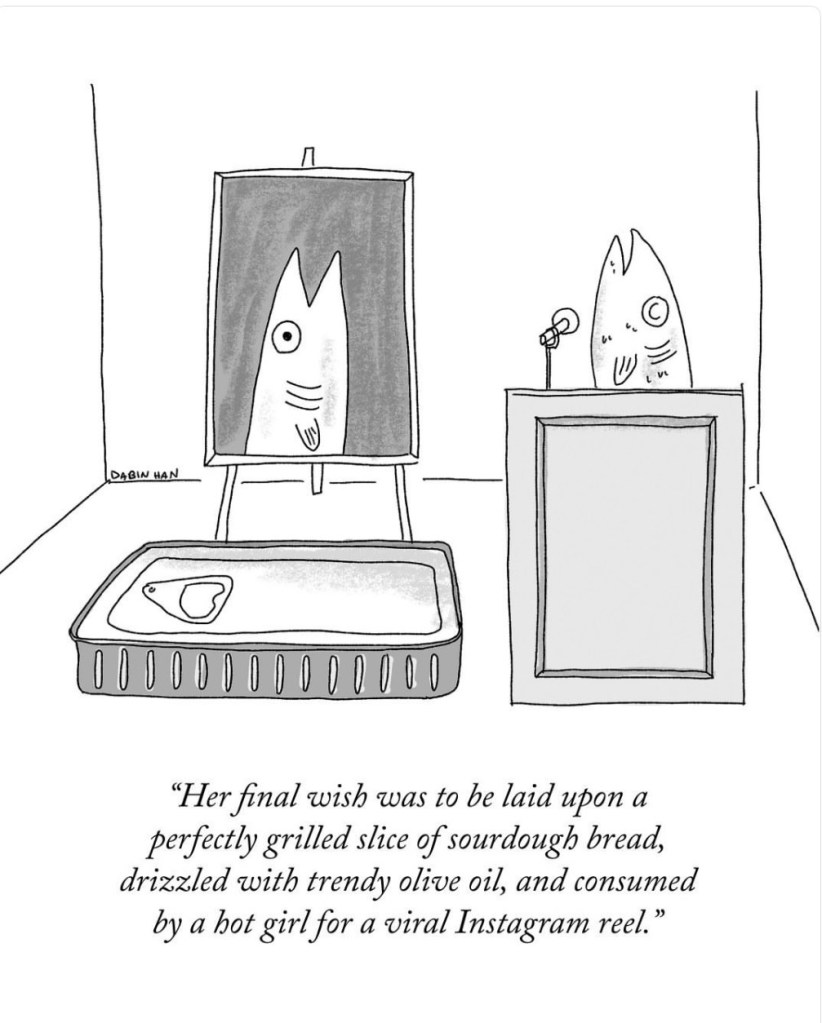
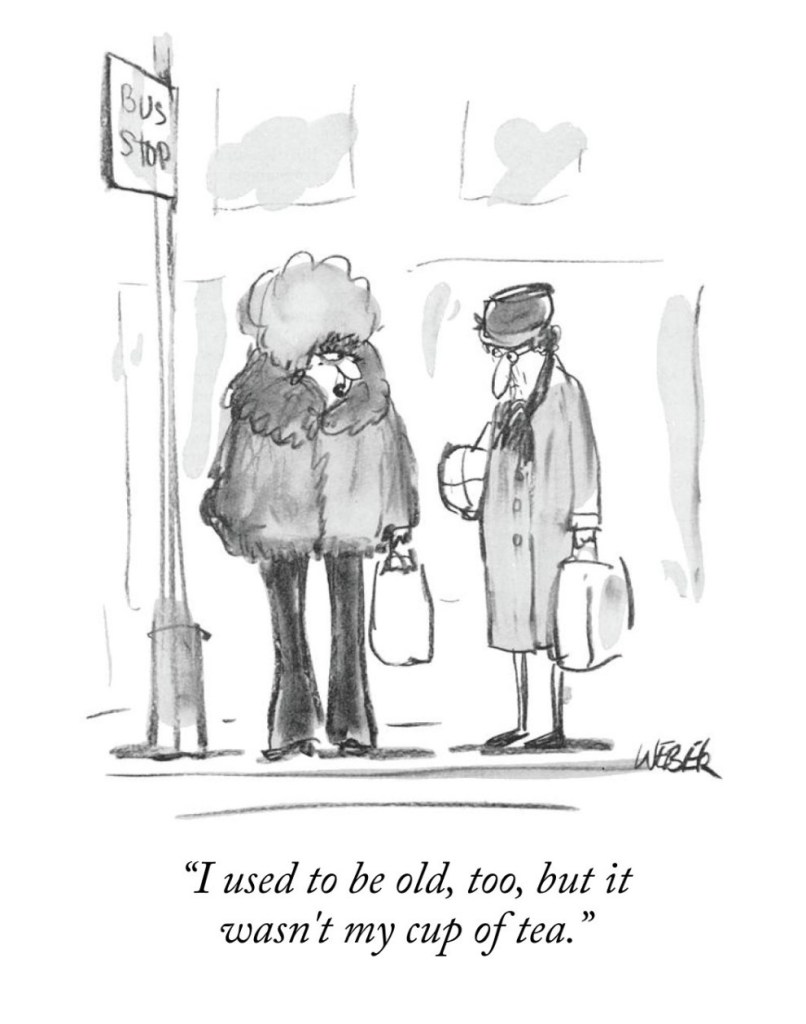
I could not resist adding a couple of cartoons I had also saved, because what’s life worth without a good laugh? The one below is from the New Yorker.