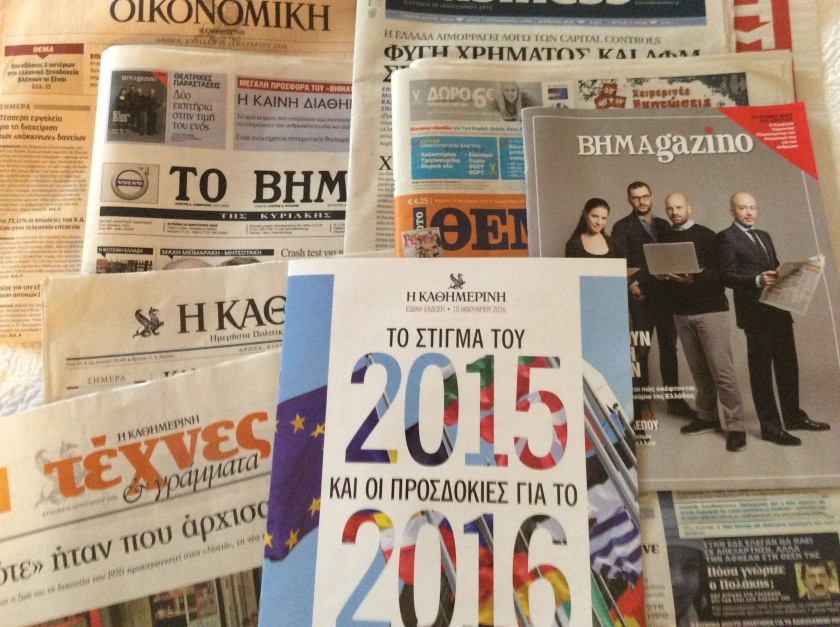
The Sunday Papers

Today is the second Sunday of the new year. Time for stocktaking – what are the prospects before us?

I took a look at the main Sunday papers. Although of different political persuasions, the themes they deal with are the same.

THE ECONOMY

The problematic state pension scheme, the constantly increasing taxes, and the difficult measures that have to be taken in order to satisfy our lenders. Depressing, to say the least!

THE NEW DEMOCRACY ELECTIONS

The second round of voting to choose a leader for the New Democracy party (the main opposition party) takes place today. It is between Mr. Meimarakis, a member of the old guard, and Mr. Mitsotakis, much younger and more modern, but a member of an old political – and often controversial – family. Is there, in actual fact and despite what they’re proclaiming, much to choose between the two? Voters who turned out in decent numbers for the first round are, so far today, exhibiting election exhaustion.
 

image


THE REFUGEE ISSUE

European countries are complaining about the number of refugees allowed into Europe but, let’s not forget, most of those are still in Greece (to say nothing of the vast numbers stuck in Turkey). It is clear the situation is totally out of control. Today the articles were about increasing instances of fights amongst the refugees themselves, especially between groups with different religions; abuse of women and children; cases of women selling themselves in order to pay the traffickers; extortion; black markeering in cellphones, fake documents and other goods.

In a horrifying statistic given out by the organization “Missing Children Europe“, 50% of unaccompanied children arriving at one of the refugee centers disappear within 48 hours never to be found again.

Very few of the refugees are actually in the centers – the rest are wandering around, penniless, hungry, hounded by the police.

Meanwhile, the trafficking business is thriving, starting from Syria itself, where allegedly there are special ‘schools’ coaching people how to reach Europe.

In Bulgaria, the police has issued a warning to hunters to be careful what they shoot at in the woods, in case the prey is not a wild boar but some refugee hiding from the authorities.

However, in a different article, there are glowing reports from various workers from the NGOs working on the island of Lesbos. This is close to the Turkish coast and has received huge numbers of refugees. The NGOs are doing a great job, but they’re also full of praise for the islanders, who have been welcoming the refugees to the best of their ability. People collect food, prepare formula for babies, grandmothers are even knitting little sweaters. Many volunteers from all over the world have also arrived, some giving up their vacation to help, others declaring their willingness to stay ‘until the war ends in Syria.’

Another, more curious, article deals with the refugees who have arrived with their pets. As a general rule, this has been well received by the Greeks, who think it a very human touch. In some other countries, however, (apparently Slovenia is one,) the refugees’ pets have become an object of political pressure, as well as a business: border controls confiscate cats and dogs, even those with passports, microchips and the correct vaccinations, and put them in quarantine,  demanding for their keep and release exorbitant amounts (up to €2000). Otherwise the animals are euthanized…

FOOD

The Sunday supplements have the usual restaurant reviews: a new Italian in Kolonaki, an Asian street food bar, a tacos place. And two great salad recipes, to detox after the festive overeating. My favorite? A rocket salad with roasted beetroot, walnuts and orange.

The political situation remains unstable, and thing are not looking good yet. But the start of a new year always feels like a new start, and there is a tiny whiff of optimism in the air.

In other, unrelated, news , as Anita Kunz put it: ‘As if everything else this past year weren’t enough , now Kim Jong-un shows up again.’
She’s doing a cover of him as a baby playing with toy missiles, for the New Yorker.

Please feel free to join in with other pleasant surprises awaiting us in 2016!

Red Alert

I feel so sorry for the people in Paris who went out to have a drink on a Friday night and lost their lives. I feel for their families and friends. But I feel a lot of anger as well. Have we lost the right to even walk in the street safely anymore? Is this the new face of 21st century Europe?

imageIs it just me, or is there a dire lack of leadership in the western world? They all meet at vast expense to the taxpayer and a huge carbon footprint (five star hotels, fleets of planes and cars, police escorts…) but – whether about the climate, the refugee crisis or the terrorists – nothing gets done. A total lack of a coherent policy on which everyone agrees. It’s frightening. After each terrible event, people get arrested, words of bravado are flung around, the dead are remembered. But – do we feel something is actually being done to protect us? Not enough, with all due respect. I ask, what is the use of bombing in the Middle East, when most of these terrorists have French, British or Belgian passports?

Greece is now facing the borders being closed, and we’ll be stuck with half a million refugees in a tiny country with a population of 11 million (of which one million are already immigrants, mostly from Eastern Europe). Compared to this, the USA has said it will take 30.000 over the next two years… And who meddled in those countries, creating all those refugees, may I ask? Not Greece, that’s for sure. It’s all about financial interests, oil, the arms industries, etc. And, everywhere, it’s the man in the street who pays. The taxpayer, the citizen who wants nothing but a quiet life, as well as the true refugee who will now be regarded with suspicion by all.

Forgive the rant, but does Europe really need to be dragged into another war?

The tip of the iceberg

Embed from Getty Images

A few days ago I had lunch with a friend who is very involved in the refugee crisis, since she works with the European official in charge. They had come to Greece in order to meet with various members of the Greek government and to visit  Lesvos (they had previously stopped by Lampedusa). The things she told me make for scary reading.

Firstly, the measures decided upon – after much debate – are simply not working.  The relocation project dependant on ‘hot spots’  being set up to process people is proving ineffective, even as Greece is asking for €480 million to implement it (less than six have been approved so far). The reason is the following:
Refugees must go to the nearest hot spot to be fingerprinted and given identity papers; then they will have to wait until they are sent to the country they are allocated to. This might take months, given the numbers involved and the usual bureaucratic delays.  So why would they want to do that when – by other means – they can be in the country of their choice in four days? Nobody wants to stay – and almost nobody stays.

It also appears they have to be persuaded, rather than told, to have their fingerprints taken. It’s their choice – whereas all Greek are obliged to be fingerprinted for their identity cards. A few days ago I  read in the papers that – so far – only 15 Syrians have elected to stay. But if people are undocumented, it is very difficult to implement any kind of coherent policy for dealing with them.

Secondly, desperate people do desperate things. There are more and more babies and children coming in, because parents with children get automatic priority. There are more and more unaccompanied minors, sent by families hoping they’re going to a better, safer life. But I don’t need to point out the dangers they face traveling alone, and who knows how many don’t make it – and how many are abused and exploited along the way?
Worst of all, people have started to steal kids because they can use them to get preferential treatment. When they arrive at their destination, they dump them. More money is now being spent on a campaign to try and locate their families.

Only in the last two months, more than 100 children have drowned in the Aegean Sea, while in the last couple of days, 31 kids lost their lives in 7 separate shipwrecks. The mayor of Lesvos has asked that identification of the refugees is done in Turkey, to avoid so many drownings. Meanwhile, the local morgue is full of bodies and there is need for a new burial ground. And for the ultimate irony:  an airplane ticket from Turkey to Germany costs around €400. These people are paying well above €1000 to cross over on a floating death trap. Surely there is a moral in this somewhere.

Something else I didn’t know, and which I found quite shocking, is that sending people back home is often not possible, because their own countries WON’T TAKE THEM BACK (I’m not talking about war-torn zones like Syria here.) They prefer their citizens to stay abroad, since that means a lot of foreign currency will be coming in, and it also helps with local unemployment.

It seems every measure taken has a huge downside. The more people are saved, the more come over. In October alone, 218.00 people have crossed the Mediterranean, and of those, 210.000 have ended up in Greece.

imageWe are witnessing the biggest movement in populations in the history of mankind. 60 million people, from Syria and Afghanistan, Gaza, Iraq, Haiti and a dozen African countries have fled endless wars and disastrous governments. And it’s not over yet. The wars are far from ended, ISIS and the Taliban are still preying upon entire populations, religious minorities are being hounded from their homes. The floods and droughts brought on by climate change exacerbate the problem. It would only take one typhoon in the Bay of Bengal to displace millions in Bangladesh.

To top it all, my friend has worked for a long time in Ethiopia – and the scariest thing she told me is the following:

In the next few years, immigration from Africa is set to increase exponentially.
Many of the young African countries are doubling their population every twenty years. Most of their current population is under 30 years old, while their governments are not doing much in terms of job creation and services. We’re talking billions here, a large number of whom will want to come over. Recent studies have shown that in developing countries, more than half wish to move to the west.

All this is bound to lead to a rise of the extreme right in European countries, something which has already started. Tensions are growing – the refugees are at the end of their tether, but so are a lot of the people assisting them, who sometimes feel they are not grateful enough for the help they’re getting. Many are demanding that borders be secured. The Schengen concept is in real danger, even though Angela Merkel is warning that border closures and fences to stop refugees “could cause military conflict” in the Balkans. The face of the world is changing, and most of us have yet to realize it.

I’m sorry to keep harping on about this subject. In spite of everything, some people remain optimistic that the refugees can eventually be absorbed by EE countries. Today, I read that 30 refugees were flown to Luxemberg for resettlement – a drop in the ocean, but still, some kind of start. Others just do their best to help, like Britons Andrew Davies and Wendy Wilcox, who set up  Solidarity Symi on the island of Symi, to help the people coming through. I also heard that young men on the islands are going out on jet skis, braving huge waves, to rescue people from shipwrecks.

Meanwhile, winter is approaching, and the refugees will have to face weather a lot of them are not used to, in many cases being obliged to live outdoors. Some parents are already wrapping their kids in rubbish bags to keep them dry…The seas are getting rougher and more dangerous, but the flow is not lessening. It is possible that because of all the talk of frontiers closing, many people feel it’s now or never.

So they take the risk.

image

The refugee crisis revisited

My heart sank when I read in the paper that Burkina Faso is on the brink of civil war. More people wanting to come over here, was my first thought.
The refugee crisis has gone on for so long, and is so out of control, that serious political and economic dimensions have been added to the humanitarian aspect.

On the one hand, it has become big business. Here is some number crunching:
It costs a minimum of €1200 per person for the passage from Bodrum to Kos. For 50 people in each boat this equals a whopping €60.000! And that’s just for a short crossing – I have no idea what traffickers from Libya make, when they pile 700-800 people into a rust bucket and cast it off without enough fuel to reach Italy…
Once you get to Greece, apparently kickbacks are extracted everywhere: €200 to get to the head of the queue, €200 to get on the bus, and so on. A lot of these ‘facilitators’ are themselves Syrian.
It’s €4000 from Morocco across the straights of Gibraltar to Tarifa in Spain. By jet ski! Although it is very dangerous since it is beyond the safe range, the trip must be undertaken under cover of darkness and the water is freezing.
For wealthier Syrians, safer, more comfortable trips can be arranged via Dubai to Turkey, then from Izmir to Rhodes on larger boats. A few more thousand euros then have to be paid out in taxis, hotels and fake documents. I read an interview with a Syrian doctor who had turned ‘travel agent’ after failing to cross over himself – he was saying people trust him because he’s a doctor and prided himself on not having a single person die on his boats.

On the other hand, attitudes are hardening:
Donald Tusk, the EU president, has claimed that migrants are being sent to Europe as a campaign of “hybrid warfare” to force concessions to its neighbors. An influx of hundreds of thousands of refugees becomes a “weapon” and a “political bargaining chip” used by the EU’s neighbors who want to put pressure on Europe to obtain extra aid or other benefits.
Mr Tusk warned that the Schengen system of passport-free travel would collapse and Europe would become a “breeding ground of fear” unless Europe’s external borders are secure. There is mounting frustration in Brussels at President Recep Tayyip Erdoğan’s refusal to seal Turkey’s coasts and border with Greece.

At the same time, a controversial plan to relocate 160,000 people from Greece and Italy to other parts of the EU by quota was announced.
The countries that refused this project, one of which is Romania, claimed that the immigrants will alter the fabric of their society. That’s as it may be, but people from these countries have themselves emigrated in the not so distant past. Greece accepted more than 20,000 Romanian refugees after the fall of communism. Did they ask themselves if they would alter the fabric of our society?

Unfortunately, the West does bear a part of responsibility for this situation, by meddling in these people’s countries. As usual, economic interests are mostly to blame. For one, the arms industry needs wars in order to make a profit – then there is oil, and minerals, and construction… Now we have to deal with the fall-out. Theoretically, it would make a lot more sense to spend the money making their countries safe for them, than dealing with them in Europe. It is probably too late now. Boris Johnson, the Mayor of London, has suggested there should be a safe haven organized for them in the Middle East. I don’t know how feasible that would be, but I do think the Arab world should be doing more to help.
image

Meanwhile, in Athens, the situation remains dire.

On September 30th, a friend of mine went to Victoria Square, in downtown Athens, to evaluate the migrant situation first-hand. This is what she wrote:

‘Flanked by three friends, all laden with bags bulging with juice boxes, cans of long-life milk, packets of biscuits and cereal bars, markers, children’s books and clothes, I exited my car on the busiest side of the square. We were immediately accosted by tens of people, including many children.
I wasn’t psychologically prepared to be faced with such palpable desperation. The situation was worse than I’d imagined. And a thousand times more unsettling, too.
People grabbed at the bags, tore them straight out of our hands, served themselves to as many goods as they could carry. We made sure the children received priority but, soon, we were mobbed by grown men, too.
It was actually pretty terrifying. If you don’t see it first hand, it’s hard to fathom how bad it is.
Turns out the people here were not political refugees from Syria. These were all illegal immigrants from Afghanistan. I was shocked to find that they were not even all that grateful for the things we’d brought.
I certainly don’t regret going, but, having said that, I value my safety and I’m not about to go back any time soon. I would not recommend that unprepared civilians intervene, but I did approach a harried-looking volunteer from Holland who shed some light as to what you can do if you really must help in person.

1- Bring warm clothing, blankets and socks. With winter coming, this is what they will need the most.
2- Bring food, always a necessity.
3- Circulate with a zippered bag rather than paper or plastic, both of which tear easily, and hand the goods out directly to the people you choose. Keep moving. Stay too long in one place and you will be mobbed. (Easier said than done.)
4- Prioritize women and children. The men come third.
5- Make sure you are not carrying valuables. Gypsies who roam amongst the Afghans are quick to pounce on unsuspecting strangers.

The situation is really too bad to be true and pressing questions arise: where will all these people live should they choose—or be forced—to stay here? After all, they can’t camp out forever.’

image


Other friends who ventured to Victoria square told me approximately the same things, adding, however, that the baker where they went to buy food for the refugees gave them ten loaves which he also cut into pieces for them.The same thing happened to us, when we went to buy medicines for them at a pharmacy. The pharmacist added a large number of freebies to our bag. Greeks, whatever their other faults, remain human and sensitive to the pain of their fellow men.

Roger Cohen, writing in the New York Times, says:

Greece has made me think about everything statistics don’t tell you. No European country has been as battered in recent years. No European country has responded with as much consistent humanity to the refugee crisis.

For the whole article, click here.

A question of humanity

no one leaves home unless
home is the mouth of a shark
From Home by Warsan Shire, a Somali poet

Yannis is a baker on an Athens street. He’s finding it harder and harder to go out of his shop, because of the smell. People, lots of people, are camped outside, in tents. Some just sleep on the pavement. He’s been giving them bread, but how long can this go on? One week follows the next, and his regular customers are dwindling. They’re making a detour to another bakery, because the smell is awful and the spectacle heartbreaking.
People have been giving the refugees food, but they have nowhere to wash themselves or their clothes. Mostly, they have no toilets. At least it’s summer, so they’re not cold at night, but during the day the sun is merciless.
Many such scenes of desperation are played out on the refugee route from the Greek islands through Athens and then north, towards Germany or Calais, for those whose aim is the UK. Another route starts in Italy.

In some places, a distinct note of xenophobia if not racism is creeping in. The migrants have variously been described as ‘marauding’ and ‘swarming’. Some countries have been trying to keep them out by any means.  In a photograph that made the front pages, a man with mournful brown eyes is handing a baby dressed in a pink onesie over rolls of razor wire on the Hungarian border. Czech officials caused a scandal by stamping refugees’ arms with numbers. The Italians have closed the border at Brennero. Passengers on the Eurostar remained stranded in the dark for hours after the train was stopped because of refugees walking on the track and on the roof.

imageAngela Merkel has said that the migration crisis is a bigger test for the European Union than the Greek financial meltdown. To my mind, she’s the first European leader to have grasped the immensity and urgency of the problem and to have taken responsibility for dealing with it. Thanks to her handling, Germany has regained the moral high ground. It has been obliged to lead in this matter due to the incapacity of the rest of Brussels to deal with the problem.

Merkel has been heard to remark that what Germany is living through now will change the face of the country over the next few years. The same is true for the whole of Europe, and it is up to Europe to make this issue as positive as possible. After all, the populations of both Europe and the U.S. are to a large degree made up of immigrants.

Sadly, some refugees who ‘made it’ report the experience was ‘not worth it’. These are people who paid all they had, risked death multiple times, had to eat grass to survive, were kidnapped and held captive for ransom on the way, then nearly drowned, and finally spent months in camps – only to find a lonely existence, excluded from local society, struggling to learn a foreign language and strange customs, in the hope of getting a menial job. They tell the ones left back home not to do it. But no one listens.

Why? Because things at home are much, much worse. People don’t leave all they know on a whim. It is interesting to read On Encouragement, an essay by Helen Jones: https://helenejones.wordpress.com/2015/09/03/on-encouragement/

They have no choice.

It is appalling that by failing to agree on how this crisis could be confronted, the EU is now fostering a new species of international crime. Illegal migration is now big business. Not only are these displaced people being robbed, terrorized and sometimes killed by gangsters, they are also being preyed upon by political manipulators.

The degree of collective irresponsibility is truly shocking. In Greece, for example, the authorities have spectacularly delayed in setting up the structures that would allow them to draw upon an EU fund available for the purpose. The blame game is shameful to behold. What is going on in most of Europe is way beyond the limits of what should be acceptable to any enlightened society.

image

You have all seen the images: of the toddler washed up on the shore, of the overflowing boats, the tents, the crowds. I will not post more. You can read the statistics, the declarations, the arguments. I have no arguments. But if you want to know what it’s like for them, read The Rahma Diaries blog, and especially the post A Letter from one Mother to Another. Rahma is a mother with a baby, and she can write.

https://therahmadiaries.wordpress.com/rahma/

And read Russell Chapman’s blog post: Escape to Freedom. Bringing a Syrian Family to Safety. Russell is a freelance writer and photographer who undertook to help a family travel from Athens to ‘a particular country in Europe’. Hair-raising and harrowing.

https://russellchapman.wordpress.com/

Photos by Anna Koenig