We are made of Earth: a book for our times

A man and a boy, sole survivors of an inflatable boat full of refugees, wash up on a remote and unnamed Greek island. Before long they come upon the incongruous sight of a grazing elephant. It turns out the animal belongs to a circus which is stranded on the island due to its owner’s debts, but the owner still takes the strangers in and gives them food and shelter.

The boy, Jamil, who has lost his family at sea, dotes on the man, Mokdad, who has saved him. Mokdad feels responsible for the boy, but dislikes him and keeps him at arm’s length. The circus owners are, in a way, immigrants themselves—or, at least, aliens on the island—but still manage to provide for the strangers out of their meager means.

When more refugees arrive on the island, Mokdad avoids them, even though they are compatriots who speak his language. He feels guilt about having fled his country, and about an incident that happened at sea.

This slim volume, written by Greek-born author Panos Karnezis, deals in a terse but evocative manner with themes of alienation, hospitality (philoxenia, as it is called in Greek, being the antithesis of xenophobia), life and death decisions, courage and cowardice. Nothing is as it seems at first, and yet the novel brims with compassion. None of the characters are particularly likeable; even the child seems strangely unaffected by the death of his family. In fact the most likeable character, to me, is the elephant, who is also a migrant in an alien land, but is totally innocent. She is sad and lonely, but ever dignified, and makes us care the most about her fate.

The narrative is spellbinding. The physical details of the island are described sparsely but so evocatively that, for a Greek at least, they ring vividly true. As does the difficulty humans feel in connecting with each other.

Karnezis was born in Greece in 1967, and came to England in 1992 to study engineering. After working in industry, he studied for an MA in Creative Writing at the University of East Anglia. His first book, Little Infamies (2002), was a collection of connected short stories set in a nameless Greek village. This is his fifth. 

Karnezis is a brilliant storyteller, and this book will stay with you for days after you’ve turned the last page. Its theme is a very current one, but he deals with it in a delicate and original way. Highly recommended.

Athens turns up another treasure

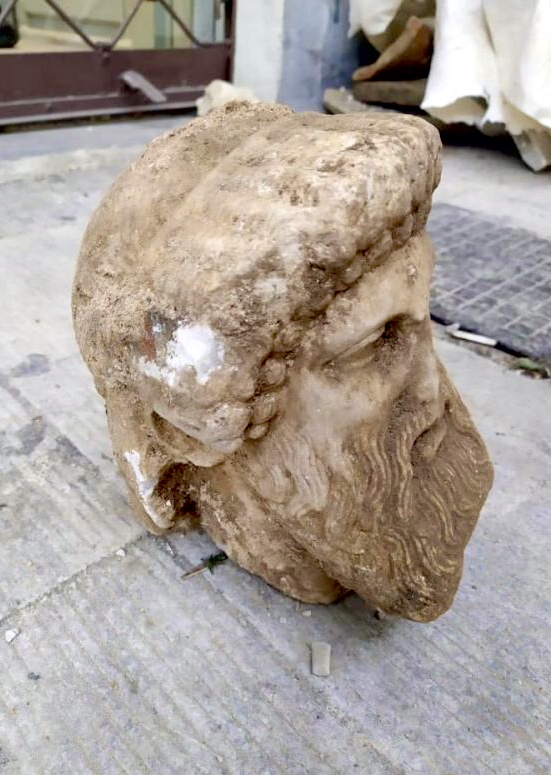
Aiolou Street is named after Aeolus, God of the Winds, and is the first street to have been paved in Athens in the 19th century. It it to this day a major shopping street in downtown Athens, and it is in its sewage system—which has been undergoing a maintenance overhaul—that workers discovered a bust of Hermes, herald of the gods.


The marble head is bearded and with his hair in strictly arranged curls. In good condition, it was found a mere 1.3 meters under the road surface.

The bust dates from around 300 BC, and is believed to have been part of a stone pillar serving as a street marker. These pillars were called Hermae, and were used as markers and also to impart good luck to travellers, and ward off harm or evil. They were placed at crossings, country borders, in front of temples or public buildings such as libraries, gymnasia, and palestrae, and also in front of houses. They were quadrangular and plain, with the head sitting on top; sometimes male genitalia were carved at the appropriate height. They were called Hermae because the head of Hermes was the most common, since he was the protector of merchants and travelers. However, the heads of other gods and heroes, and sometimes distinguished mortals, were also frequent.


Photos from Google

Music will not be stilled

Not to be cowed by the pandemic, the Greek National Opera turned to the Internet to present its Online Festival, curated by Giorgos Koumendakis, and under the aegis of the Stavros Niarchos Foundation. The Festival was a big success: each of its video performances attracted tens of thousands of viewers and many positive comments from across the globe.


Source: GNO/Andreas Simopoulos

The first part, entitled Exit: Spring,  streamed from 17th May to 30th June 2020, and offered eleven new music, opera, operetta and music theatre video-performances created during the pandemic, as well as one recorded dance performance.

Below, a video of ‘When will, when will summer come’, by the GNO children’s chorus concert, conducted by Chorus Mistress Konstantinos Pitsiakou.


The 2nd part, titled Counterpoints, was streamed online from 27 September to 31 October, and its aim was to shed light upon the relationship between Greek music and architecture. Emblematic buildings of Athens were connected to great works from the historical repository of Greek music, from the Cretan Renaissance to the present day.

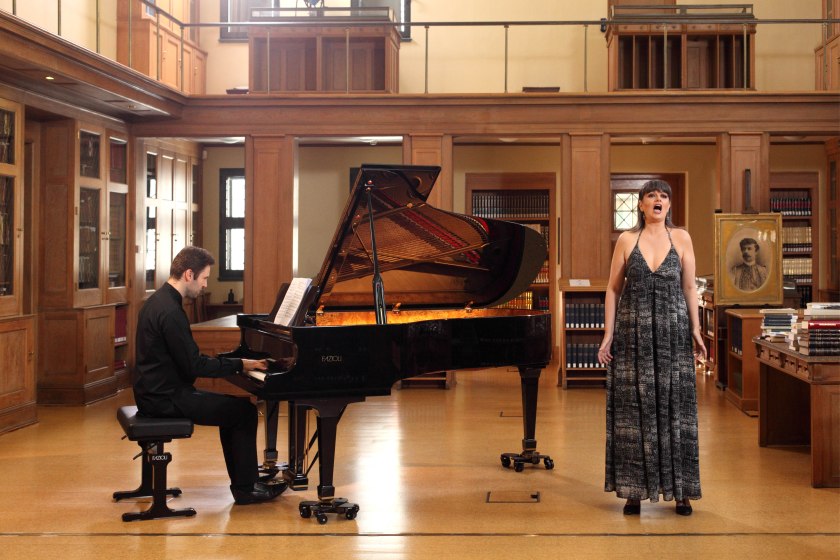
The Festival was filmed at some of the greatest buildings of Athens, such as the Church of the Holy Apostles at the Ancient Agora, the Gennadius Library, and the Athens Conservatoire, amongst others.


Photo Credit: G. Domenikos

In one example, three of the most celebrated works of Greek art music written during the interwar period were performed at the Gennadius Library by mezzo-soprano Margarita Syngeniotou, accompanied on the piano by Apostolos Palios. These were:
• Yannis Konstantinidis’ Songs of Anticipation
• Manolis Kalomiris’ Should I Speak? set to poetry by Kostis Palamas
• Dimitri Mitropoulos’ 10 Inventions set to poetry by Constantine Cavafy

The closing act, Zeitgeist, written for string quartet by distinguished Greek modern composer Christos Hatzis was performed by musicians of the Greek National Opera Orchestra, under the baton of Miltos Logiadis, at the Athens International Airport “Eleftherios Venizelos”.


Some of the  videos of the performances are available on YouTube. 

Saying it with flowers

Life seems to be getting more and more weird each day—with new lockdowns everywhere, people are forced to exist in a sort of limbo. We’re waiting—for what? To be free to return to our previous existence? But when? Meanwhile the virus in Denmark has mutated and is spreading via mink farms. They’re planning on culling 17 million animals to try and stop it. What next? Hopefully we won’t have to cull our dogs and cats. That would be too horrible to even contemplate.


In every way, we’re trying to adapt to a new reality, and make the best of things. I love going to the theatre, but sadly that’s out, so I took the opportunity to watch a play online. What a Carve Up is adapted from a satirical novel by Jonathan Coe. It is an ingenious play about the venality of the Thatcher era, a murder mystery with an extra twist. I enjoyed it: the actors were excellent, the plot was developed in original and interesting ways. Well worth it and a change from Netflix. A ticket costs £12, and you get a link to watch in the 48 hours following your chosen date. You can watch on a laptop or, better still, connect to Apple TV, in which case you can make a family evening of it, with drinks and popcorn. For anyone interested, you can get a ticket here: https://www.whatacarveup.com/

This cultural foray made me mull things over. Art depicts life in many ways—if this pandemic carries on, will people in new films be shown wearing masks, and staying away from each other? If I write a short story, do my characters need to wear masks and keep washing their hands? I continued wondering about this while watching a film set in the fifties, where the actors smoked non-stop, and nobody wore a seatbelt. Now characters in films are constantly peering at some kind of screen, and if they smoke, it’s something stronger—but more tolerated nowadays—than nicotine.


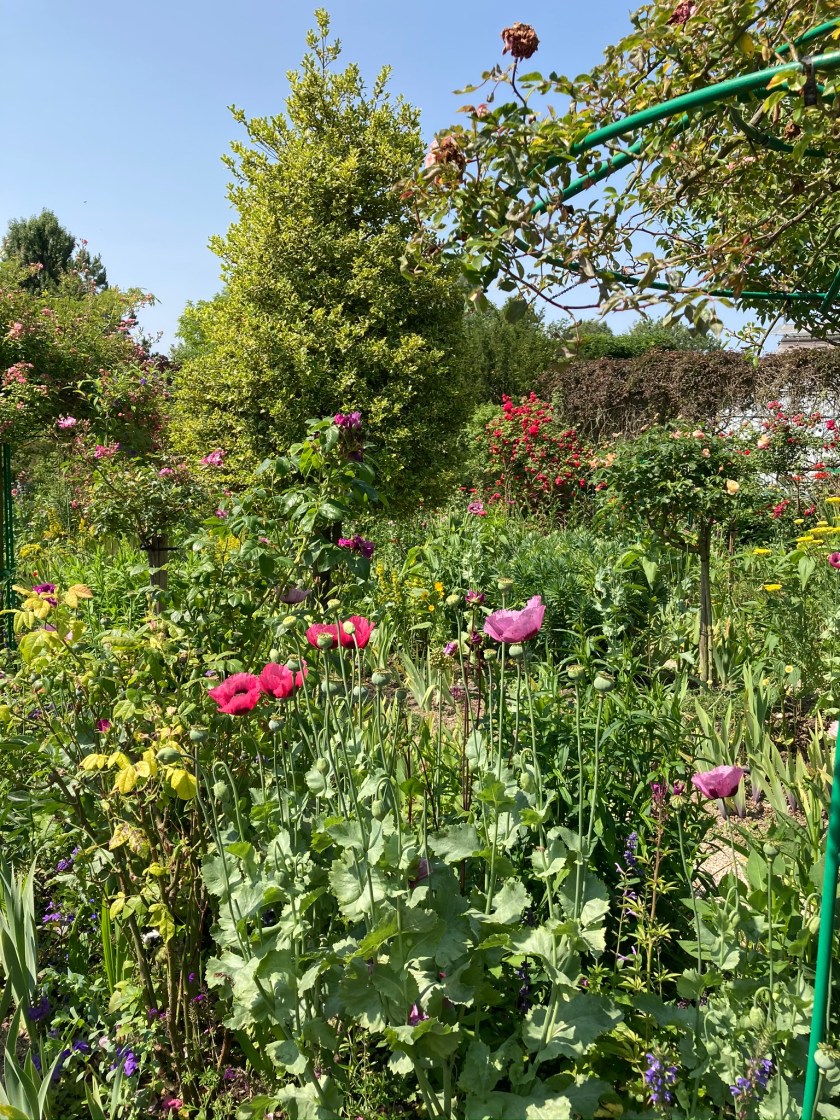
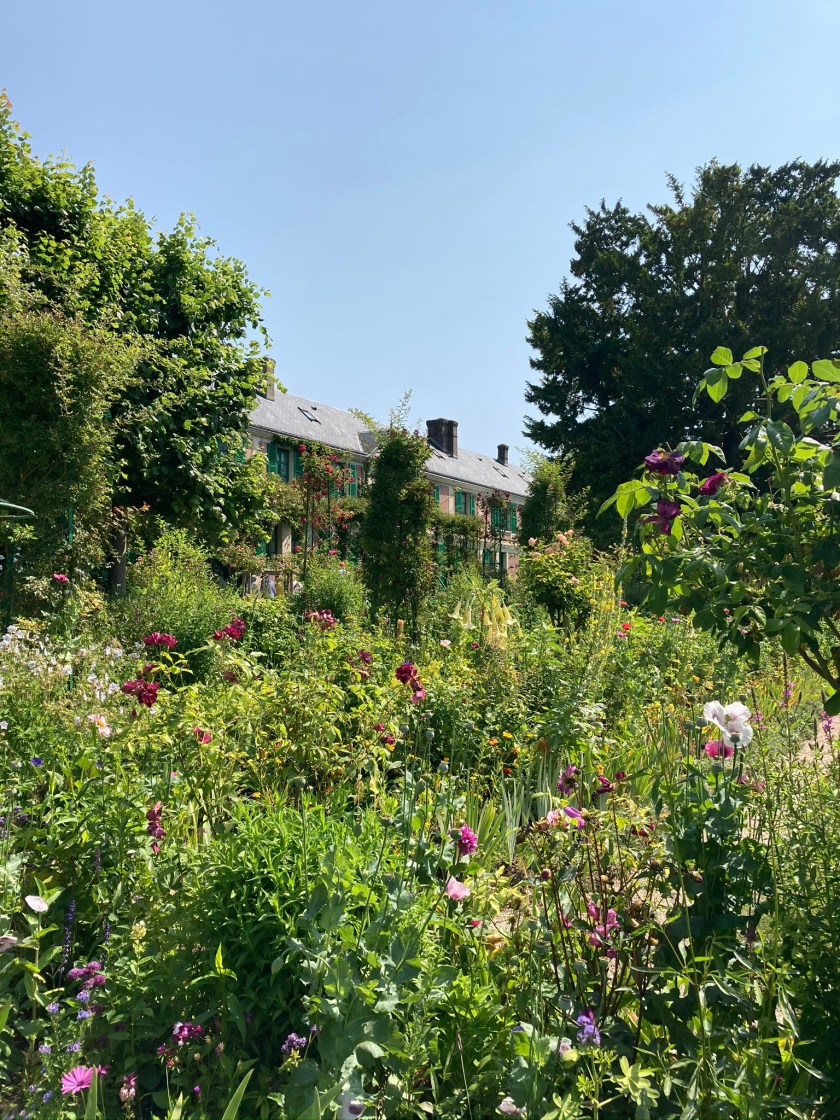
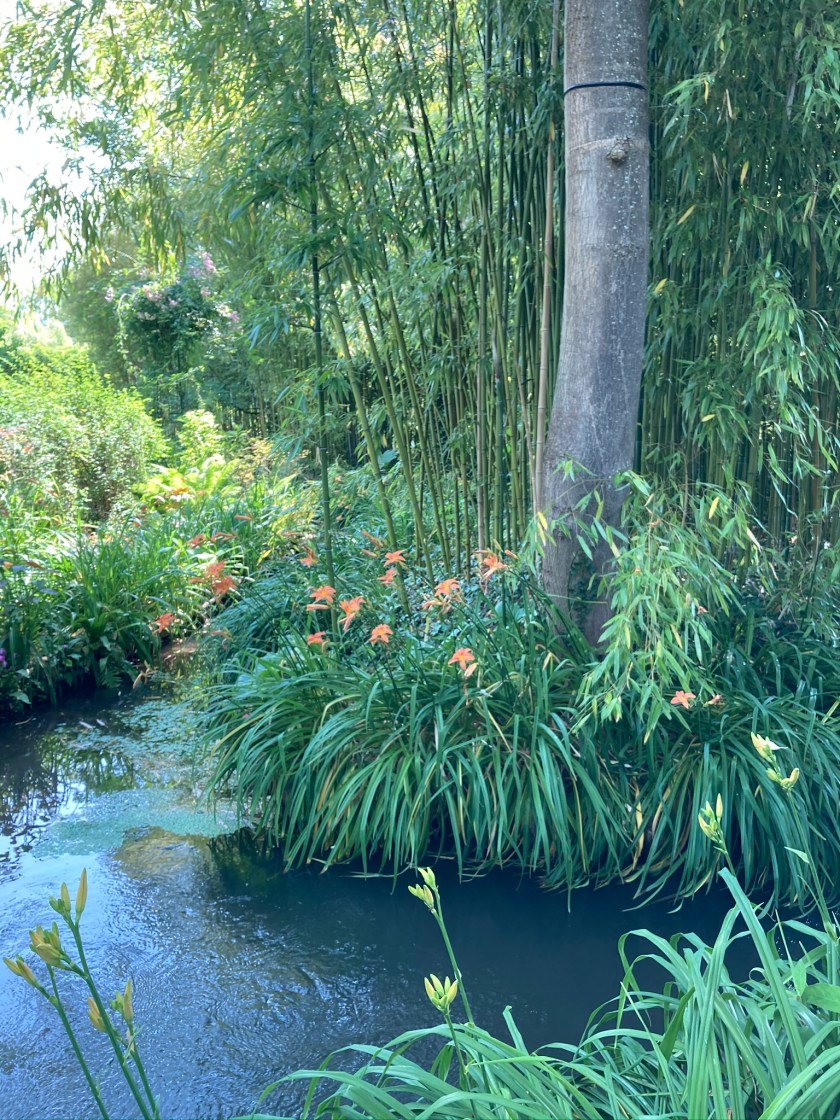
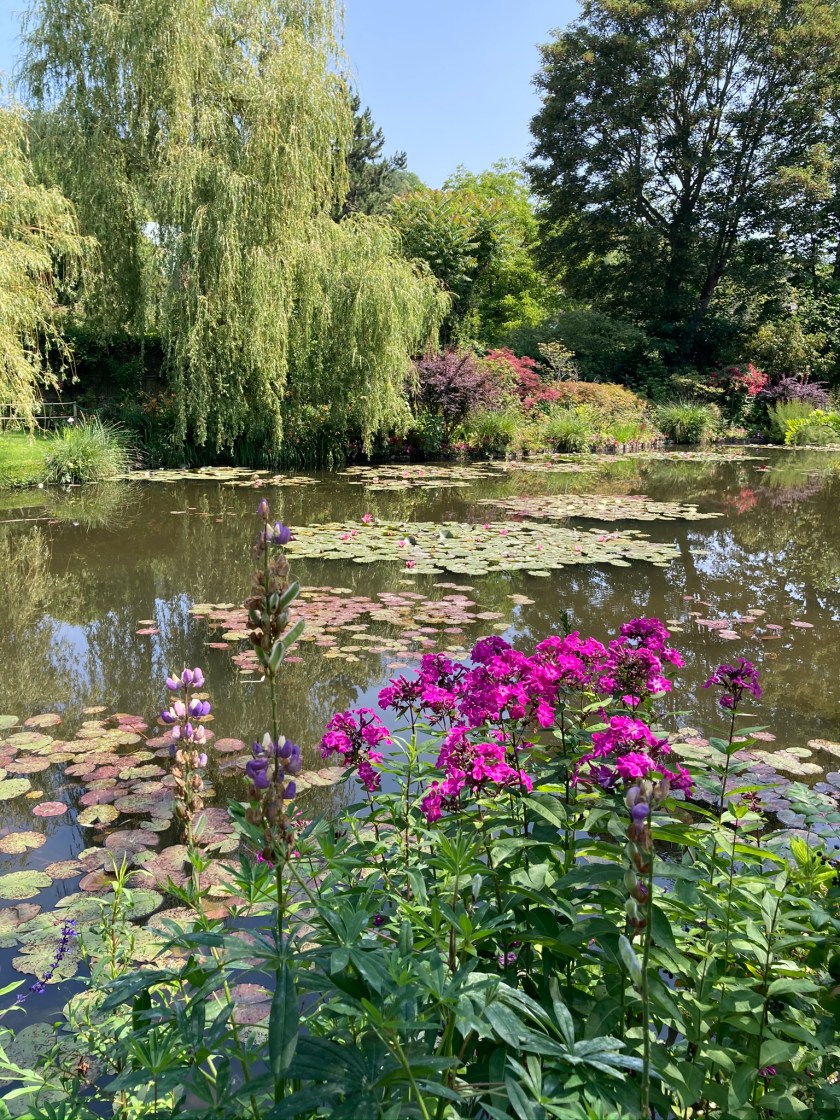
I digress, but there doesn’t seem to be much to write about these days (I refuse to dwell upon the American Elections). So I will try and lift your spirits by posting some pictures taken a few months ago, when we managed to squeeze in a visit to Monet’s garden at Giverny. There were not many people around, which was just as well, because Giverny is not a public park, but a private garden, with narrow paths between the flower beds. I dread to think what it would be like to visit when they have their usual 4000 people per day—shuffling along in a queue behind a coach group led by a guide, I suppose.


As it were, we wandered about happily. The place is beautifully kept up, and we were told it’s worth visiting at different times of the year: in May it’s covered with different types of iris, and in late August it’s full of sunflowers.


The famous lily pond lived up to expectations—it’s a magical spot. Apparently the water lilies tend to take over, so they are carefully pruned back to resemble the patches Monet painted over and over (he made a series of about 250 Nymphéas, as they’re called in France).
The inside of the house is very pleasant, with a collection of lovely Japanese etchings on the walls and a sunny yellow kitchen. Monet had a complicated personal life, reading about which gives a little extra spice to the surroundings.