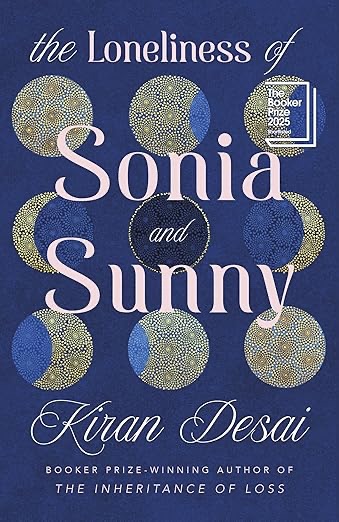
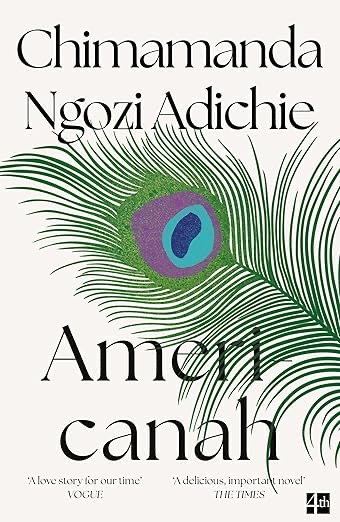
I always tend to have at least a couple of books on the go, and I choose them depending on my mood. So I must have been in the mood for a saga (in the modern sense of the word) since I plunged simultaneously into two doorstoppers: Americanah, by the Nigerian writer Chimamanda Ngozi Adichie, and The Loneliness of Sonia and Sunny, by the Indian writer Kiran Desai (both were written in English.) As I read on, I realised they shared a lot of similarities.
First of all, may I say both of these women are wonderful writers, whose clarity of prose and turn of phrase I much admire. It was very pleasurable immersing myself in their world.
Both books are meant to be, primarily, love stories. From an interview with Kiran Desai:
I wanted to write a story about love and loneliness in the modern world. I wanted to write a present-day romance with an old-fashioned beauty. In the past of my parents, and certainly my grandparents, an Indian love story would mostly be rooted in one community, one class, one religion, and often also one place. But a love story in today’s globalised world would likely wander in so many different directions.
However, the book is about so much more than that—it is about displacement, about identity, about moving to another country and then feeling you don’t belong in either your new home or your old one. It is about race and class distinctions.
Americanah deals with a lot of the same themes, although set in a primarily different background. Again based on a love story at its core, again exploring themes of displacement, race, identity and adapting to a different culture.
Both books are stories of love and expectations in today’s globalised world.
Which book did I prefer? Probably the first, for the simple reason that Ifemelu, the heroine of Americanah, is not a very likeable character. Although bright and self-assured, she often tends to shoot herself in the foot, especially as regards relationships. She can be unpleasant, disdainful and very sure her opinions are the right ones. I did enjoy the descriptions of life in Nigeria, though, a country I know little about.
This brings me to my main criticism of both books: although I understand how both writers became engrossed in the world they created (and I know that Desai worked on her book for years), I thought both books were ultimately too long and could have done with more judicious editing. I know it’s difficult to kill one’s darlings—but there was just too much detail and repetition of the minutiae of daily life, the backstory or subplots, the characters’ thoughts.
I asked myself—did I think this because our attention span has shrunk? I remember devouring long books like A Suitable Boy, by Vikram Seth. Dickens, Tolstoy, Dostoyevsky, Robertson Davies…I read Middlemarch twice. Would I have the patience now? I wonder. If I want to re-read something long nowadays, I usually get the audiobook.
What do you think? Has anyone read one or both of these books? Did you like them? Are they too long? I would be interested to know. Awaiting comments!
Vivienne very kindly hosted me on her blog, Aspholessaria , and I am happy and honoured to return the favour. She writes mostly fantasy, which has not been my cup of tea so far, but I will now give it a try! I have already heavily promoted her to members of my family who are fans. And I have put her Viking books on my TBR list.
Here’s a bit about Vivienne:
V.M. Sang was born and lived her early life in Cheshire in the north west of England. She has always loved books and reading and learned to read before she went to school.
During her teenage years she wrote some poetry, one of which was published in Tecknowledge,the magazine of the University of Manchester Institute of Science and Technology (UMIST). Unfortunately, that is the only one that is still around.
V.M. Sang became a teacher and taught English and Science at her first school.
She did little writing until starting to teach in Croydon, Greater London. Here she started a Dungeons and Dragons club in the school where she was teaching. She decided to write her own scenario. The idea of turning it into a novel formed but she did nothing about it until she took early retirement. Then she began to write The Wolves of Vimar Series.
Walking has always been one of V.M. Sang’s favourite pastimes, having gone on walking holidays in her teens. She met her husband walking with the University Hiking Club, and they still enjoy walking on the South Downs.
V.M.Sang also enjoys a variety of crafts, such as card making, tatting, crochet, knitting etc. She also draws and paints.
V.M.Sang is married with two children, a girl and a boy. Her daughter has three children and she loves to spend time with them.
She now lives in East Sussex with her husband.
⭐️
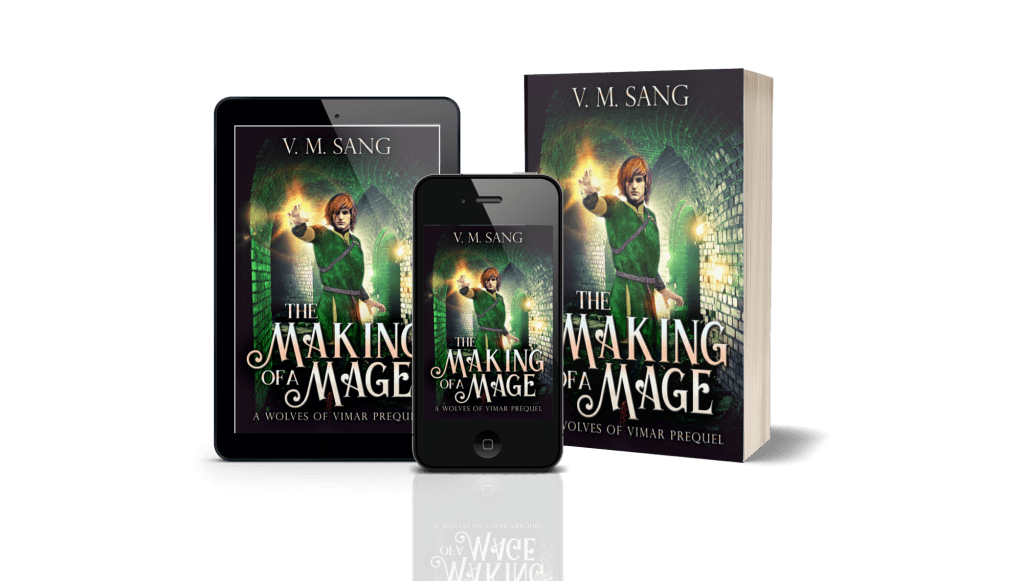
Unlike me with my one measly novella, Vivienne has been very prolific, and you will find links to her books below, and of course on her website. Here I would like to mention her novella, The Making of a Mage. It’s one of the Wolves of Vimar prequels and tells of the early life of Carthinal, one of the main characters in the series.
Blurb: Carthinal is alone in the world. His parents and grandparents have died. Without money and a place to live, he faces an uncertain future.
After joining a street gang, Carthinal begins a life of crime. Soon after, he sees a performing magician, and decides he wants to learn the art of magic.But can he break away from his past and find the path to his true destiny?
⭐️
And now onto our interview:
1. You have been very prolific. Do you spend many hours writing every day?
Not really. I’ve been rather bad recently and hardly written anything except a few poems. I think it’s because I’ve finished Book 4 of The Wolves of Vimar (Immortal’s Death) and am stuck on another couple of projects.
2. Do you finish one project before starting another, or do you have a few things on the go at once?
I usually have more than one thing on the go. I’ve started Book 3 of my Historical Novel series and I’m also writing a series of short stories inspired by fairy tales. The second story is going through a critique process at the moment and I’m partway through the third one. I’m also writing some poetry as I’ve been asked to submit some for an anthology.
3. Who is your favourite author/book?
Usually the last one I’ve read!
But seriously, I enjoy Fantasy and Science Fiction. I loved the Wheel of Time by Robert Jordan, but there are so many books and excellent writers.
One of my special favourites is Diana Wallace Peach. She writes fantasy in such a beautiful way.
4. If the above is not a classic, what is your favourite classic book?
I think Wuthering Heights by Emily Bronte. She builds such a wonderful picture of the moors. Maybe I like it because of that. I used to live not far from that country and walked many times in my teens on those bleak moorland hills. Although they aren’t always bleak! In the heather season they are quite beautiful.
5. When we were children, Enid Blyton kept us up at night (with a torch under the covers) She is much criticised now, but she got many kids to read—as did JK Rowling, who is also criticised. I believe that is so important, above other considerations. Are your books read by children? Or teens and young adults?
I wholeheartedly agree with you about Enid Blyton. I loved her books when I was growing up, and they instilled a love of books in me.
I don’t consciously write for a particular age. My Elemental Worlds has been marketed as Young Adult. Someone said they thought Vengeance of a Slave was YA, but I disagree with that.
My books aren’t read by children. They are too long for a start, and I don’t think the language is children’s language. I don’t simplify words. Most YA books are also shorter than mine.
So no. They aren’t children or YA books.
6. If you have a proper job, what is it?
I used to be a teacher until I retired. Now I enjoy life! (If you get the chance to retire early, do so!)
7. Why do you write?
There are stories in my head trying to get out. I think they’ve always been there. I made a little ‘fairy’ out of grass and told my sister tales about her, and I told myself stories at night to help get to sleep. (What does this say about my stories if they put me to sleep?)
I wrote a very bad romance when I was in my teens, and read it to my long-suffering friends. They were very kind about it.
So I think I write to get these stories out of my head.
8. Why do you write fantasy?
When I was a student, I was doing teaching practice when a nine year old boy, with the wonderful name of Fred Spittal, asked me if I’d read Lord of the Rings. I hadn’t, and he recommended it, but said I should read The Hobbit first. I found both in the College Library and from there I was hooked. I read a lot of the fantasy that was around at the time and loved the way the authors built worlds out of their imagination. It’s still one of my favourite parts of writing fantasy.
9. From your About page, I know you love dogs. Do you have any pets at this time?
I don’t have any pets at this time, no. I didn’t think it was fair to have a dog while I was working as it would have to be left alone all day. Not good for a dog, which is a pack animal and needs company. After retirement we were going away a lot, so didn’t have any pets.
Growing up I had two dogs (not at the same time) a border collie, whom I called Laddie, and a corgi called Johnnie. I also had a budgerigar called Peter who was an amazing talker.
My stepfather was a farmer on the Cheshire/North Wales border and so there were plenty of animals around. There were the farm dogs, of course, and I had a cat called Frances who would sit on my shoulder. She was lovely.
Later, well after I’d married and had children, we had goldfish and three cats, although my husband doesn’t like cats!
10. If you could meet any three people, alive or dead, who would they be and why?
I would love to meet Leonardo da Vinci. Such a clever man–an artist, an engineer, a scientist, a medical researcher and more. We visited his chateau in Amboise, France and saw his inventions brought to life using only tools and materials from his day. Quite amazing.
You say three people. Someone I had (along with Leonardo) a picture of on the wall of my lab in school was Stephen Hawking. He was incredible. Not only did he have an amazing brain, but to do all he did with such a severe disability as Motor Neurone Disease, was incredible. His determination must have been second to none.
Finally, no, not a writer, but an artist. Any of the Impressionists, I think, but having visited his famous garden, I think I’d go with Monet.
11. Do you enjoy sport? Do you prefer to watch or take part?
Yes, I do enjoy sport. I used to play tennis, badminton and the occasional squash game, and when my daughter was at school and my son was small, I used to attend a session at the local sports centre aimed at mothers. They had a creche for the kids and we did some aerobics then volleyball, badminton or basketball.
Now, I don’t partake, but enjoy watching most sports (not golf though).
12. There is a photo of a lovely flower painting on your site. Do you still paint a lot? Who is your favourite artist?
I think I’ve answered the second part of your question alreaedy. I adore the Impressionists. I don’t think I really have a favourite amongst them, though.
As to the first part, I’ve not done so much recently. I have one partly finished, but it’s in oils and I don’t like to do it indoors as it creates a smell. I’m waiting for the warmer weather so I can finish it!
13. Do you do any voluntary work? If so, what?
I don’t do any voluntary work at the moment. I did work in the small park behind our house until recently. The park had become very overgrown, the council only cutting the grass. I contacted them and they looked it up. They told me it was supposed to be a ‘community project’. It seems the original volunteers had either died, moved away or grown too old, so several of us took it over. It looked nice for a few years, then the same thing happened. People moved away, and became too old. There was only myself and my husband doing it, and we’re getting older and finding it increasingly difficult, especially the heavier jobs. We do very little now, except for the occasional cutting back of overgrown brambles that are blocking the paths.
14. What do you think is the biggest problem facing the world today?
I think there are two. One is increasing selfishness and the other is stupidity.
From the person wanting to park their car as near as possible to their destination, regardless of inconvenience to others, to governments and large organisations who trample roughshod over anyone and everyone who gets in their way. Often stopping them getting what they want, up to and including taking over other people’s countries in order to get at the minerals etc that are there.
And threatening the whole future of humanity in not accepting scientifically proven things like Climate Change. And it’s not only governments who are becoming stupid, either. Individuals seem to have lost the ability to think for themselves.
Sigh…
Thank you so much for answering all my nosy questions, Vivienne. I’m sure my readers will enjoy discovering your books—those that don’t know them already, that is. Fantasy is very much the flavour of the day!
⭐️
For those interested, I am including links to Vivienne’s books below:
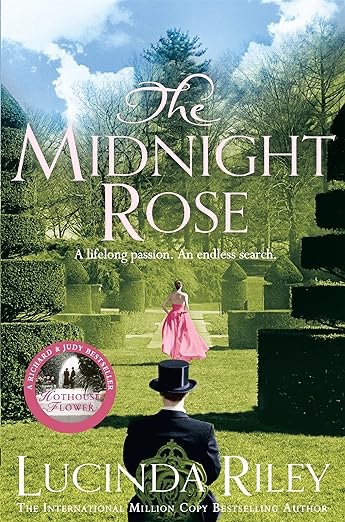
While tidying up my bookcase, I came upon some book recommendations which make for pleasant reading. A comfortable sofa, a mug of tea or chocolate, a good book and the rain falling outside…Or perhaps, depending on your location, a lounger on a beach and a large straw hat to shade your page…
For cooling off on the aforementioned beach, what better than a tale set in the frozen wastes of Antarctica?
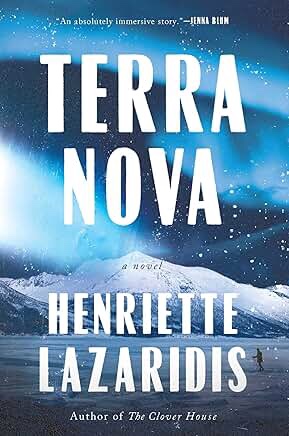
Terra Nova, by Henriette Lazarides, is the haunting story of two explorers seeking to reach the South Pole and the woman who loves them both. Set in 1910, it is a tale of love and betrayal. The two men are friends who have set themselves an impossible task of endurance and privation. Back in London, Viola, wife of one and lover of the other, is a photo journalist and suffragette. In both settings, secrets multiply and grow toxic. I have been interested by polar exploration since reading the marvelous The Worst Journey in the World, and this fictional tale hits all the right keys.
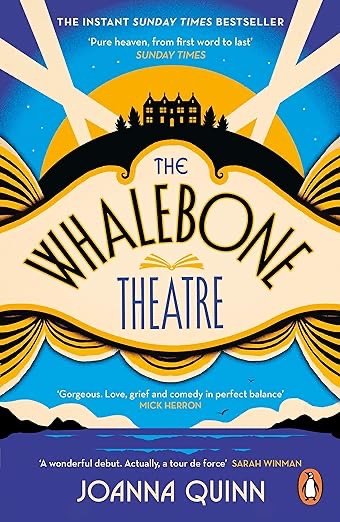
A crumbling English manor house by the sea and the three children who grow up there. A dead whale washes up on the beach. A family saga par excellence, it decribes what unfolds in the wings as the children grow, and while the war increasingly gets centre stage. Engrossing.
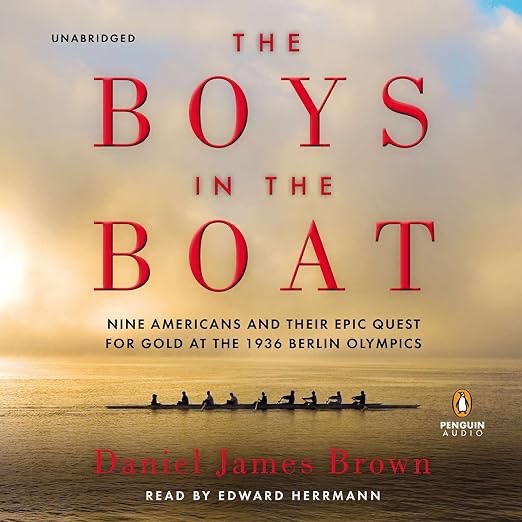
I was initially put off by the subject matter of this book, which tells the tale of nine working class boys from the American West, and their quest to win the gold medal for rowing in Hitler’s 1936 Berlin Olympics. I thought a whole book about rowing would bore me, but a friend was so insistent that I caved. All I can say is that it kept my interest to the very end—the story is so well told, the characters all have depth and empathy, the technical descriptions are, dare I say it, poetic, the races full of suspense and the whole is set within the larger stage of the Depression, the looming war, and the rising of Hitler’s power in Europe. A story of grit and courage against terrible odds—and which is soon to be a film produced by George Clooney. The trailer looked interesting and—as an added bonus when reading the book—on YouTube one can find the original, black-and-white, films of the race (mostly by the notorious Leni Riefenstahl).
Another family saga, alternating between India and England in 1911 —and the same places in the present day. It is the story of Anahita Chavan, from a noble but impoverished family, and her lifelong friendship with the headstrong Princess Indira, the privileged daughter of Indian royalty. The relationships between them and with the men they love have repercussions down the years; culminating in a love story between Anahita’s grandson and a young American film star on a film set in England.
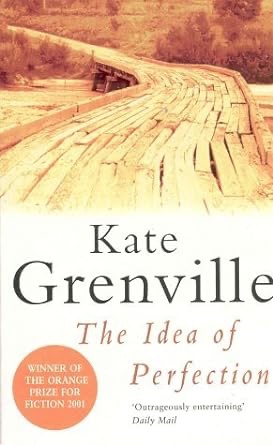
Set in the eccentric backwater of Karakarook (pop. 1,374), New South Wales, this is the story of Douglas Cheeseman, a shy and clumsy engineer with jug-ears who meets Harley Savage, a woman who is known for being rather large and abrupt. A cheerful and humorous tale.
Last but not least, non-fiction. A study of 18th century women artists, this book examines the careers and working lives of celebrated artists like Angelica Kauffman and Elisabeth Vigée Le Brun but also of those who are now forgotten. As well as assessing the work itself – from history and genre painting to portraits – it considers artists’ studios, the functioning of the print market, how art was sold, the role of patrons and the flourishing world of the lady amateur.
I found this book fascinating. The details of these women’s lives are beautifully described, and the constraints imposed upon them would seem intolerable to women artists now. The book also has beautiful reproductions of many paintings—however, it is out of print and can only be read as an e-book (of top quality, I must say), unless it can be found in a second-hand shop.
Things are moving fast all at once. After months of idleness, publication date for my debut novel, Marguerite, has been set for December 4. Very exciting!
While waiting for the publishers to reveal their complete marketing plan, I have been am busy setting up my side of things. I think I mentioned before that I joined the Author’s Guild of America, which was a shrewd move. They provide free tools to build a website (they can also build it for you if you like). They organised my domain name and an email in my pen name. They embedded the email sign-up form into the website. And the best—you communicate with a REAL PERSON (shoutout to Hector!) No bots, and no endless search for some elusive ‘Happiness Engineer’. Yay.
As for the rest, why must everything be so complicated? I was assured by Kindlepreneur (a very useful source of all kinds of information) that the best mailing service for authors is MailerLite, as well as being the easiest to set up. Well, either I’m a moron, or the other services need a degree in advanced coding. I have been struggling with the damn thing for days—despite a bot who is better than most, and even some help from a real live person. But it’s done, more or less. Finally, I’m pretty familiar with IG, via my art account, but I hate X, Facebook etc. I think I’ll pass. I’m too old to make little videos on TikTok.
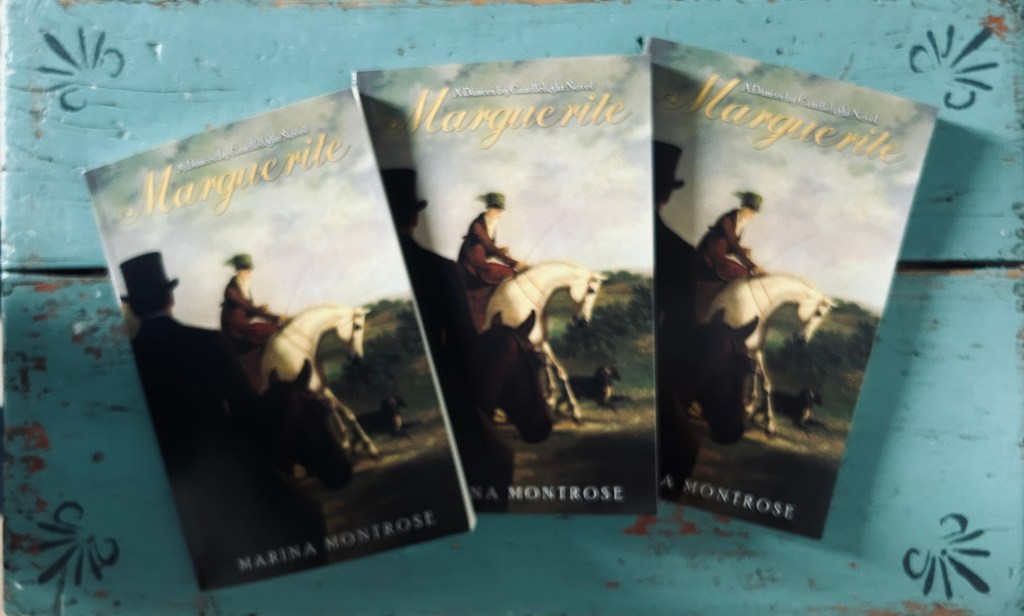
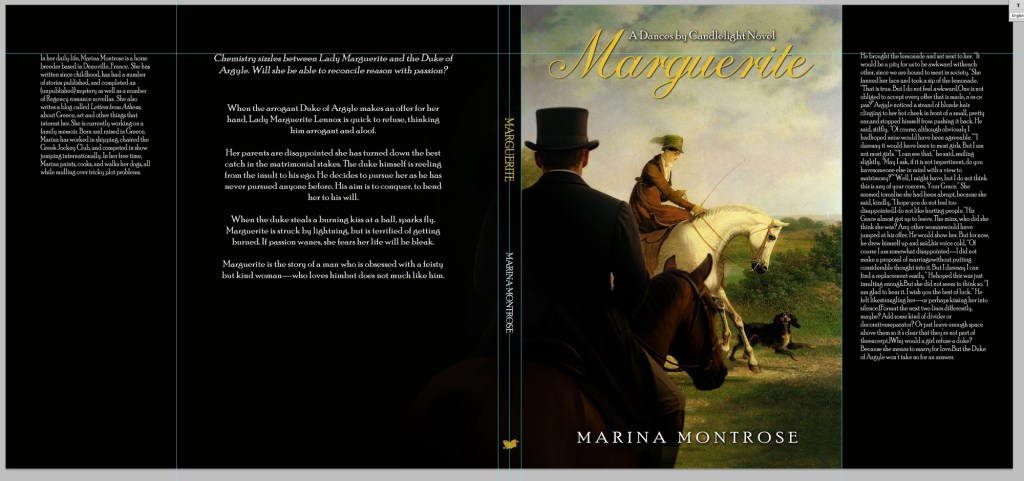
Take a look at the cover and tell me what you think. I’m quite pleased with it. I was very clear about NO bare-chested duke clutching a swooning maiden.
It was difficult for the graphic artist to find a stock photo I liked, so I came upon the idea to use an old painting (in the public domain). This is an oil portrait by Swiss artist Jacques-Laurent Agasse (1767 – 1849), possibly of Mademoiselle Cazenove. Then I wanted to superimpose a profile of the duke watching Marguerite ride in the park. The graphic artist did a good job of my ideas, I think.
Finally, a bout of shameless self-promotion:
I am delighted to present my debut novel, Marguerite. Set in the elitist and socially restricted milieu of the ton in Regency London, it is the story of an independent, opinionated girl and the man who pursues her despite her refusing his offer of marriage.
If this sounds like your cup of tea, I would be grateful if you would consider preordering the book. Preorders help new authors get discovered, and your support is invaluable.
Once you’ve read the book (if you manage to finish and if you haven’t hated it!), I would love it if you would consider leaving a review. Even a sentence helps other readers find the book, and I am interested in every piece of feedback.
I’d also like to invite you to take a look at my website, Marina Montrose Author, where subscribers to the Reader’s Club receive a free, exclusive short story as a thank you gift. You can join here:
P.S. The book is available for preorder on Amazon, but print copies only on Amazon.com still…Here is a link to all the other places where you can preorder. Or order later on.
After years of getting rejections for my writing, I finally signed with a publisher
If rejection letters were paper, I could have covered my bedroom walls with them (or made a bonfire). Thankfully, nowadays they are digital, so they remain hidden in an Excel sheet (just so that I can remember not to submit to the same agent/publisher twice!)
But let me go back a little: I have always loved writing from an early age, and in high school served as editor of the school mag, entitled Sunny Days. This activity alleviated hours of boredom in class, where I could correct texts and draw the artwork while the teacher droned on…
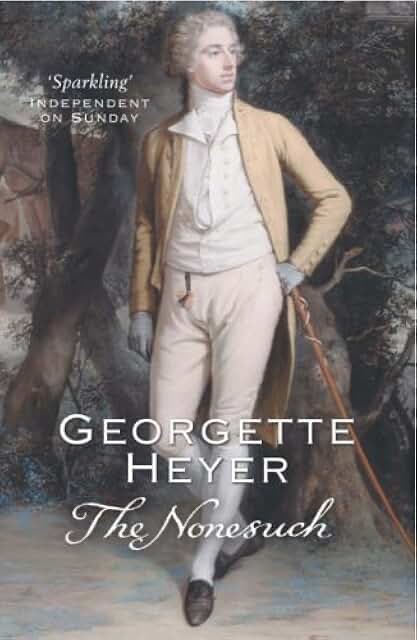
Earlier even than that, at age 10 or 11, I was let loose upon my mother’s bookshelves. She was a great fan of Agatha Christie and Georgette Heyer, both of whom I devoured (as well as a great variety of other authors, some more highbrow than others.)
This must have been the cover at the time.
Over the years, I wrote a number of short stories, some of which were placed in competitions, while others were published in Anthologies and online magazines (I got plenty of rejections there, too.)
I was (and am) a rabid bookworm, reading over a wide range of genres—literary fiction, memoir, short stories, historical novels, travel books. For entertainment I read mystery and crime. No romance.
Later I set myself the task of writing a book and of course I decided upon mystery. I took some online courses and attended the Festival of Writing at York twice (the most fun time). I completed no less than two novels, one set mainly on a yacht in the Greek islands, the next in the world of international horse racing. I really found it interesting and fun to work out the plot, the red herrings and twists and cliff hangers.
I started the process of querying agents but, although I got great feedback from some and quite a few requests for the full manuscript, the final answer was no. It was never the right timing, or quite the right thing for their list at this particular moment. Most just ghosted me, a practice I find at best impolite when they have requested the whole ms, however busy they might be. Publishers did reply, but still it was no.
I considered self-publishing but, after a lot of research, realised it would be very costly—both in money and time spent—in order to be done properly. Even if you self-edit to death, even if you find beta-readers for free, even if you design your cover yourself, it’s not enough. You need professional edits, a great cover, proper promotion. I’m not good enough to do it, don’t have the time or patience and I am too proud to press the button on a shoddy job. So I persevered and am still persevering.
This is a mock up I made for the cover of one of the mysteries, when I was considering self-publication
Meanwhile, lockdown happened and, having more time on my hands, I started re-reading Jane Austen, whom I had not touched since school. She has stood the test of time for a reason. Then I went on to read some of Georgette Heyer again, and really enjoyed the banter and great writing. One thing led to another and, having shelved the mysteries (for now) I have written a number of Regency romance novellas.
Amazingly, I sent one off to an indie publisher and got a favourable reply! I was astonished, as I had actually forgotten about it. However, my excitement was quickly dampened because, after I signed the contract, they then went radio silent for the whole summer. Apparently one of the team had a medical problem, so delays were understandable, but emails went unanswered which freaked me out a little. I reached out to one of their authors who explained this can happen with indie presses because they are short staffed, and that patience was needed. But still.
However, they returned with a vengeance and now things are moving fast. My editor Lisa was lovely and actually there was not much to change or correct. The discussion about the cover went well. Publication date is early December, all fingers crossed—and I am panicking a little because there are so many things to do. I had to set up a Facebook page (I hate Facebook), and IG and X accounts. I have joined the Author’s Guild of America (the publisher, Cupid’s Arrow Press, is American) which is great: there’s a fantastic forum where you can get feedback and advice from other writers, they have tools for building a website, which I have done, and they even offer legal advice if you need it. But there is still a lot to do, and I am new at this.
A glimpse of the cover (detail).
My book is called Marguerite, which is the name of the heroine, but more about that in another post. I am using the pseudonym Marina Montrose for the novellas.
Stay tuned for further developments. I know historical romance is not everyone’s cup of tea, but I hope some of you at least will read and enjoy it. I would be honoured.
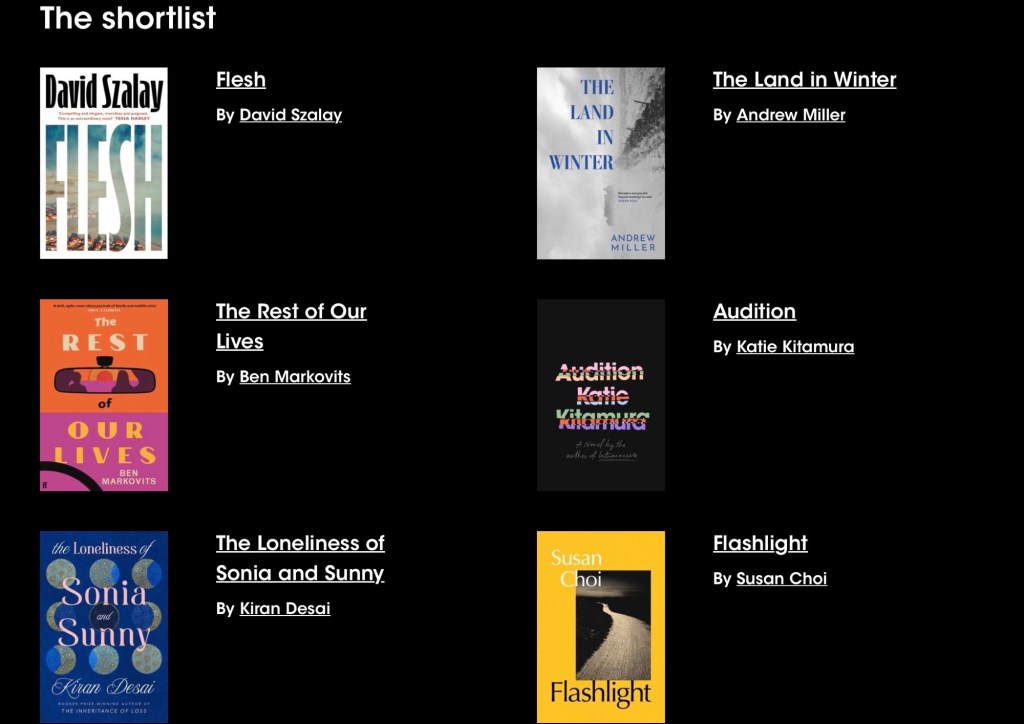
The Booker Prize season has come around again, and the shortlist has been published. Let me say at once that I have not read any of these books, but last year the list contained some pretty good stuff, so I am hopeful of a repeat, especially since Roddy Doyle is Chair of the 2025 judges and he knows a good story when he sees one.
Photos from the Booker Prize site
I don’t suppose I will read them all, and I will look at some on the long list as well, but one I am looking forward to tackling is 700-page The Loneliness of Sonya and Sunny, by Kiran Desai (who has won it before in 2006 with The Inheritance of Loss.) It reminds me of another doorstop, A suitable Boy by Vikram Seth, which I devoured at the time. Many years in the making, it is an epic tale of love and life.
Flesh, by David Slazay, is (I quote the Booker Prize site): “A propulsive, hypnotic novel about a man who is unravelled by a series of events beyond his grasp.”
The Land in Winter, by Andrew Miller, is about two couples, a doctor, a farmer and their respective wives, whose lives are upended in the middle of a harsh winter landscape.
The Rest of Our Lives, by Ben Markovits, is about a middle aged academic who goes on a road trip after his wife has an affair, trying to escape his problems.
The last three all seem to be about lives unravelling. Hmm…it depends how each writer deals with the subject.
Audition, by Katie Kitamura, is about the relationship between two very different people: an attractive actress and a man young enough to be her son. Intriguing.
Flashlight, by Susan Choi, is a saga about a father’s mysterious disappearance and the reverberations of this event on his family.
All six authors are deep into their literary careers, with a number of books to their name and, besides previous winner Kiran Desai, Andrew Miller and David Szalay have been shortlisted before.
If (or when) any of you read any of these books, I will be glad of an opinion. In any case, a pile of new books is always enticing, even if at the moment it is not on my shelf but only on my screen.
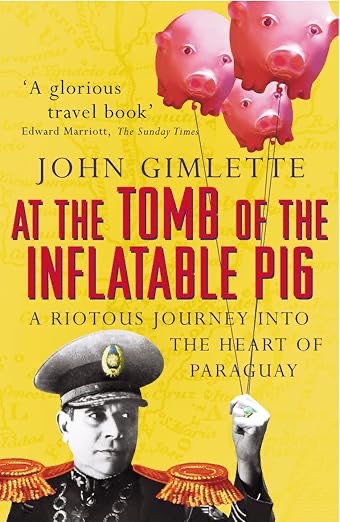
“Reading the book is like watching a Komodo dragon eat a tethered goat. Paraguay, as Gimlette portrays it, is . . . completely bizarre. . . . Conquistadores and Nazis, whores and cannibals, all of them rather awful, all of them splendidly rendered. . . . Graham Greene would have approved.” –National Geographic Adventure
I seem to be on a roll of recommending favourite books. This one is in a category of its own, a crazed travelogue on Paraguay, one of the most exotic, captivating and eccentric countries in the world, according to writer John Gimlette. Even the title of the book is insane.
I have never been to Paraguay, nor are there any Paraguayans amongst my South American friends, so I cannot pretend to have a personal opinion on the veracity of his observations. I can only say the book enchanted me, with its descriptions of hellish jungles, Germanic villages, missionaries, utopian experiments and coups. Apparently the Paraguayans venerate Princess Diana and, if they deem it necessary, will call in Scotland Yard.
Here’s an excerpt from Chapter 1:
I had a room on the second floor. It was a vast, mildewed space that might once have been used for dancing classes. It had floor-to-ceiling louvred shutters that were so seized up with drifts of green paint that they’d become petrified in the open position, admitting scalding blasts of dust and roasted corn from the street below. I shared this great green tropical ballroom with two others, for whom it was, in its own way, heavenly. The first was an Englishman called Kevin Pluck who’d come to South America to give some long and careful thought to the question of whether or not he should ever get a job. He had an opening in the car factory at Luton, but the delicious, orange-blossomed lassitude that overwhelmed Asunción ensured that he wasn’t going to hurry the decision. He’d at least made up his mind to return to Luton with a suntan and so he spent a lot of time and effort trying to go brown. For some reason his skin remained determinedly cheesy.
I have given this book to various people as a gift, but I never followed up on whether they had read it and liked it, as I don’t believe in gifts with strings attached. I do however, consider it a fine aid to armchair travel. You will become lost in a world so exotic that it will make you feel like Alice in Wonderland.
In yet another ineffectual effort to put some order into my bookshelf I came upon one of my favourite books of all time, The Worst Journey in the World, by Apsley Cherry-Garrard (1886 -1959).
This is an account of Robert Falcon Scott’s ill-fated expedition to discover the South Pole in 1911, written by the youngest member of the team, who was just 24 at the time. A memoir, in a completely immersive style, by someone who had never written a book before, nor wrote another in his entire life.
I came upon the book by chance many years ago, browsing in the wonderful Heffers bookshop in Cambridge. Just the cover of the hardback, the shape and heft and compact size of the wonderful Picador Travel Classics edition and I was sold. I bought the thing as an object, but then I started reading it and became hooked on the subject and, most unlikely for me, Polar exploration in general.
The old-fashioned, unreal feel of the whole organisation, the details and lists of supplies and packing, the endless debates of dogs versus ponies versus men hauling the sleds. Why would anyone want to put themselves through such an ordeal, but in fact, many did. They vied to get on the expedition crew. They felt it was heroic and, being British, even more heroic to combine the race to the South Pole with scientific projects such as geologising, which meant carrying about bags of rock samples, as well as going on a winter trip in the middle of the endless dark of the Antarctic winter (the Worst Journey in the title) in order to collect Emperor penguin eggs from their impossible to reach breeding grounds. Cherry was one of three men who went on that little pleasure trip, and it is a miracle how they survived, especially since their tent was blown away in a storm one night.
Apsley Cherry-Garrard with frostbitten nose
In fact it was a miracle any of them survived, because they had miscalculated the supplies and equipment needed. Scott and his team of four all died, from scurvy and cold and hunger, having faced the most bitter of disappointments. They had lost the race—finally arriving at their destination to find the Norwegian flag already planted there. Because of course, Roald Amundsen had no interest in penguins or rocks. He and his team were highly skilled on skis and used dogs to pull the sleds and got there in a ruthlessly efficient manner, five weeks before Scott. They also had a better diet of fresh meat and so did not suffer from scurvy.
Both Amundsen and, more importantly, Scott’s wife, learned of his death more than a year later, which in our era of instant communications, seems weirdly shocking.
Photo from Wikipedia
There have been many books written on polar exploration, about the exploits of Amundsen and Shackleton and others. I have read quite a few and watched films, especially the 1985 seven-part series called The last place on Earth. I find it all quite fascinating, more so since it is something I would never dream of attempting myself. I think it amazing that still, especially now that there is nothing left to ‘discover’, there are people still doing it—such as Sir Rannulph Fiennes, who, amongst other expeditions, was the first person to visit both the North Pole and the South Pole by surface means and the first to completely cross Antartica on foot.
Be that as it may, the book is engrossing and will make you travel into a different world. What is particularly interesting is the minutiae of daily life and the relationships between the men facing such difficult conditions. Highly recommended.
My days, darkened by the quasi-permanent absence of sunlight, were unexpectedly lit up by the discovery I had somehow missed reading a couple of Penelope Fitzgerald’s books, although she has long been one of my favourite writers.
Penelope Fitzgerald died in 2000 aged 83. In 2008 The Times listed her among “the 50 greatest British writers since 1945”.The Observer in 2012 placed her final novel, The Blue Flower, among “the ten best historical novels”, and A.S. Byatt called her, “Jane Austen’s nearest heir for precision and invention.”
Fitzgerald’s books are short, but within a few pages her prodigious powers of imagination create whole worlds. In The Beginning of Spring, she manages to describe the minutiae of life in pre-Revolutionary Russia as if she had been born there. But the research is worn so lightly it is imperceptible.
The Blue Flower, about the poet Novallis, has always been one of my favourite books. Based on the life of Friedrich von Hardenberg (1772–1801) it describes the time when, aged 22, before he became famous under the name Novallis, he became mystically attracted to the 12-year-old Sophie Von Kühn, an unlikely choice for an intellectual of noble birth given Sophie’s age and lack of education and culture, as well as her physical plainness and negligible material prospects. The couple became engaged a year later but never married as Sophie died of consumption a few days after her 15th birthday. The book is sad, subtle and romantic.
One of the books I had not read yet is The Golden Child, which is actually a murder mystery (she did not include it in her novels) with such a biting sense of humour that I found myself laughing out loud. The book is set in a museum, where “Even in total silence one could sense the ferocious efforts of the highly cultured staff trying to ascend the narrow ladder of promotion.” A perfect phrase if there ever was one. Or the description of the characters, even their names: “Hawthorne-Mannering, the Keeper of Funerary Art, was an exceedingly thin, well-dressed, disquieting person, pale, with movements full of graceful suffering, like the mermaid who was doomed to walk upon knives. Born related, or nearly related, to all the great families of England (who wondered why, if he was so keen on art, he didn’t take up a sensible job at Sotheby’s), and seconded to the Museum from the Courtauld, he was deeply pained by almost everything he saw about him.”
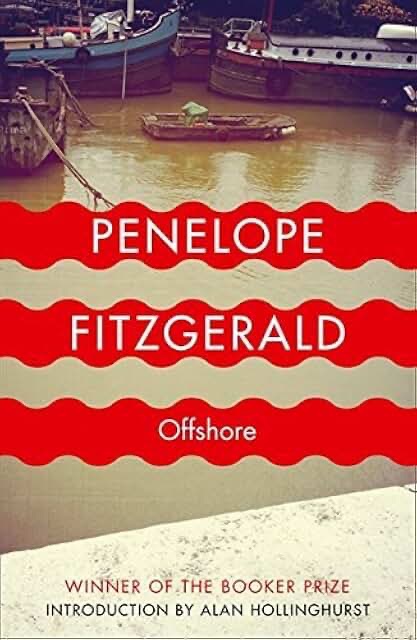
Her third novel, Offshore, won the Booker Prize in 1979. Based on her own years of living on an old sailing barge moored at Battersea Reach, it is about the mixed emotions of houseboat dwellers who live between the water and the land, fully belonging to neither.
Although she launched her literary career late, at the age of 58, Fitzgerald wrote nine novels, plus several biographies, short stories and articles. She had a hard life because due to her husband’s alcoholism she faced poverty, living for years in a houseboat which sank twice, and in public housing. She taught until the age of 70. Would she have been as good if she’d had an easy life? I think probably yes, because she was born in a scholarly family: she was the daughter of Edmund Knox, later editor of Punch, and Christina, daughter of Edward Hicks, Bishop of Lincoln and one of the first female students at Oxford. She was a niece of the theologian and crime writer Ronald Kox, the cryptographer Dillwyn Knox, the Bible scholarWilfred Knox, and the novelist and biographer Winifred Peck. She obviously also had great inherent talent.
She remains a unique, luminous voice in the literary firmament. I highly recommend her to anyone wanting to immerse themselves in her world.







 Letters from Athens