Medical tourism

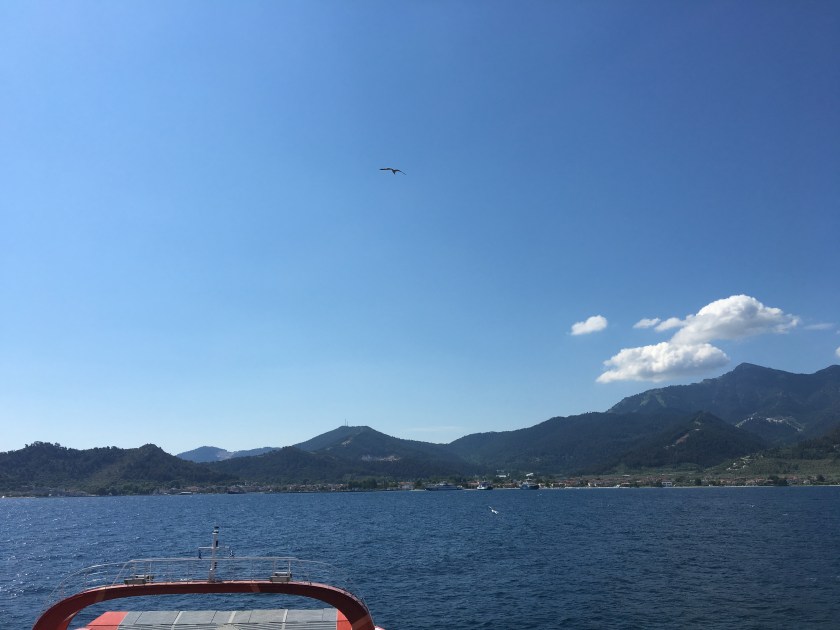
There were storks strolling on the runway as my plane taxied to the terminal in the airport of Kavala, a town in Northern Greece to which I flew in order to catch the ferry to the lovely island of Thasos.

Seagulls accompanied the boat on the 35-minute crossing, and a gaggle of kids on a school outing ran around screeching, while I had my coffee sitting in the sunshine.


Arriving in Thasos


I came here to visit my doctor, Athina Mavromati (she was one of my Q&A subjects, read about her here) who, with her husband, decided to quit the rat race and move to this lovely spot. They took their sailing boat and their dog, and have never looked back. Athina’s family come from this island, so it was an obvious choice.


This is the picturesque old port.  Under a huge, ancient plane tree, a fisherman was mending his nets.


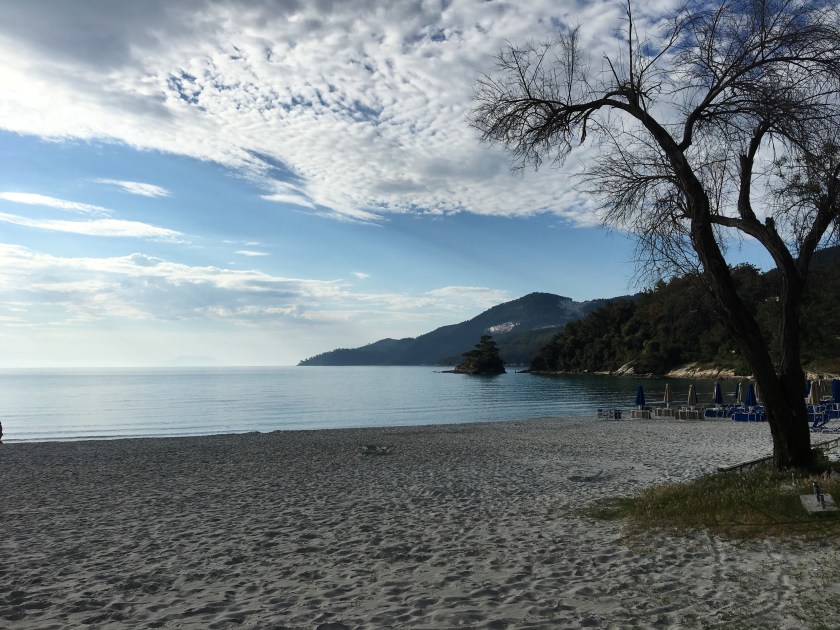
The island is large and green, with pine, olive and plane trees coming all the way down to the crystal clear sea. The beaches are of fine, white sand.


It was a good time of the year to come, since the season has only just started, so it was not too busy – and also not too hot yet, although the weather was beautiful. However, there were plenty of tourists already, most of them Russian.

This tiny island looked like something in a Japanese painting


There is one street with ‘tourist-trap’ shops selling local produce such as honey, olives and oil, sponges; as well as clothes, straw hats, and hideous articrafts made of sea-shells. The rest of the town is quiet and full of cafés and little restaurants – there’s even a shop selling frozen Greek yogurt!

Greek salad and stuffed vine leaves at a shady spot in town

There are many places to visit along the road going all around the island – lovely monasteries, and ancients ruins scattered everywhere, since Thasos was famous for its white marble and olive oil and thrived both in Ancient Greek and Roman times. There are also lovely little mountain villages and hiking trails in the forest. All this was explained to me by Athina and Yannis, who very kindly took me out to eat in a little taverna by the sea, where we had the most amazing fish, accompanied by various local delicacies. Unfortunately, I did not have much time, so I only managed to swim in the sea. But I will definitely be back!


Skiing with a view of the sea

Did you know it’s possible to ski in Greece? Yes, we are not just about idling on the islands – we have beautiful mountains, too. When I was in high school, a bunch of us used to climb onto the Mountaineers’ Club bus on a Friday afternoon in winter. After five or six hours, including a stop in Volos for bougatsa, a cream-filled pastry, we’d arrive at the parking lot on Mount Pelion. From there it was a mere 25′ walk in the dark along a snowy track, carrying backpack and skis, to the refuge. Us kids would hurry along, so we’d get there first and grab a room with no ‘oldies’ in it. Next morning, we’d ride up on the t-bar and snowplow down the slope in a row, arms linked, in order to ‘groom’ the piste, so proper skiing could commence. Evenings were spent singing along to someone’s guitar and playing board games. There was no way of ringing home – our parents saw us again on Sunday night, when they came to collect us off the bus. I wonder how many parents would be ok with this nowadays?

Now, of course, it’s all properly organized, with chairlifts and snowplows and instructors. And the beauty of it is that in the early spring, with a bit of luck, you can ski and swim on the same day. Ski in the morning on Mount Parnassus, then, when the sun turns the snow to soup, drive down the mountain and go for a swim in Galaxidi bay. The same can be done on Mount Pelion and the Aï-Yannis beach.


Photo from Google


If anyone’s interested in doing that, or even just skiing with a view of the sea, or hiking in the Greek mountains, Christian Mayer, an official at Germany’s Federal Ministry of Finance who spent more than three years based in Athens, has written a book with all the necessary information on how to go about it.

After climbing Mount Ziria one summer in order to escape the Athens heat, Mayer, a skilled skier, got acquainted with Greece’s mountaineering community, making friends with people who had the same interests and exploring the Greek mountains extensively. He kept a journal, and eventually he turned his notes into a book, Ski Touring With Sea View, with beautiful photographs and detailed descriptions of 23 routes on the Greek mountains.


As well as being a great guide for skiing, the book is useful for summer hikes.  It contains practical information about the different locations, such as maps, starting points, mountain refuges or other places to stay, altitudes, potential dangers like a risk of avalanche and necessary attire.  It also seems refuges and tavernas mentioned therein and will give you a 10 percent discount if you have the book with you!
A must for everyone who loves mountains and wants to explore Greece. Amazon link


Christian Mayer in the Greek mountains (source: Kathimerini)

Day trip to Mycenae

In the Iliad, Homer described Mycenae as ‘a city rich in gold.’ It was the legendary home of King Agamemnon, leader of the Greeks who went to Troy to fight the Trojan War. The Greeks of classical antiquity idealized the Mycenaean period as a glorious period of heroes, closeness of the gods and material wealth, as described in the Trojan Epic cycle.
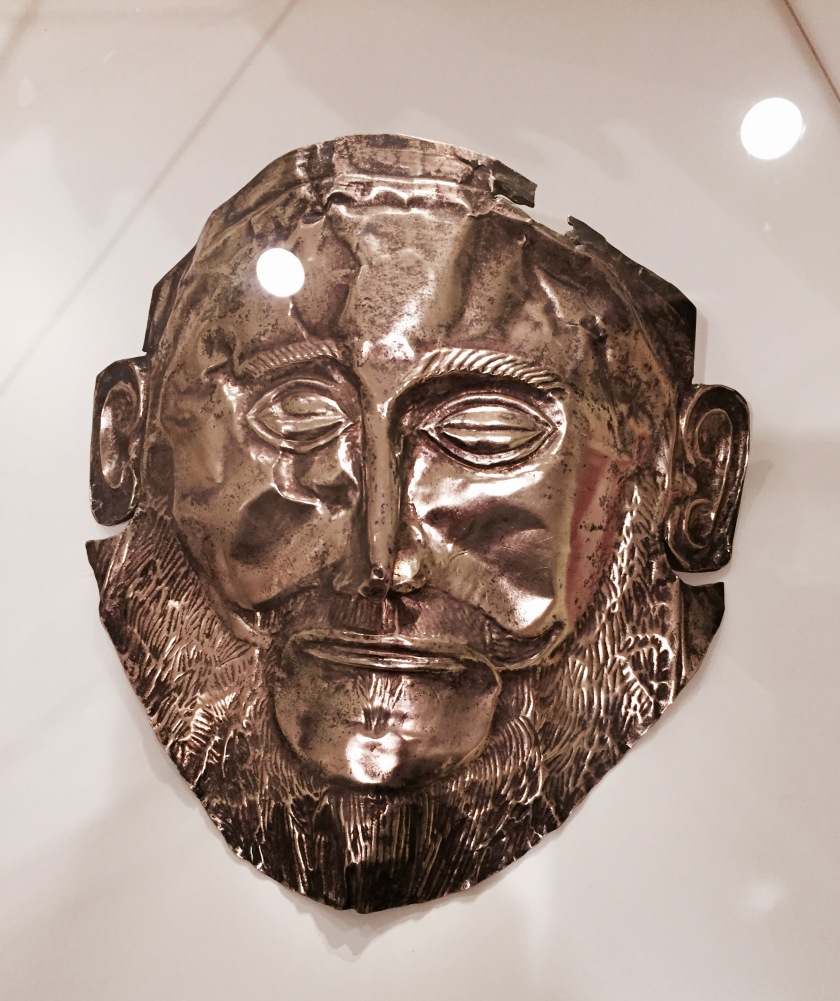
In 1876, amateur archaeologist Heinrich Schliemann set out to prove the historical accuracy of the Iliad by identifying the places described by Homer. Using the text of Pausanias, the second-century A.D. traveller, as his guide, he excavated the site at Mycenae, discovering the deep shaft graves where bodies were buried dressed in lavishly decorated shrouds adorned with gold items and diadems and with their faces covered by masks of gold or electrum (such as the Mask of Agamemnon, below).

Copy of the mask of Agamemenon


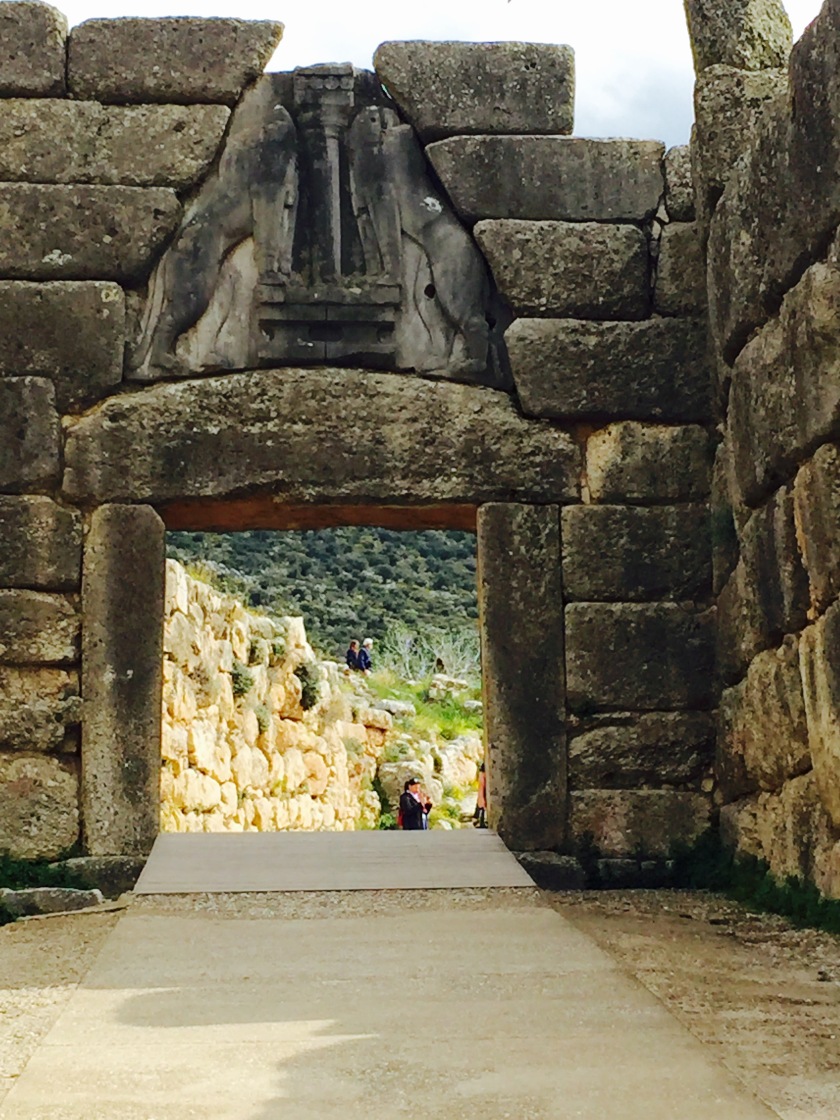
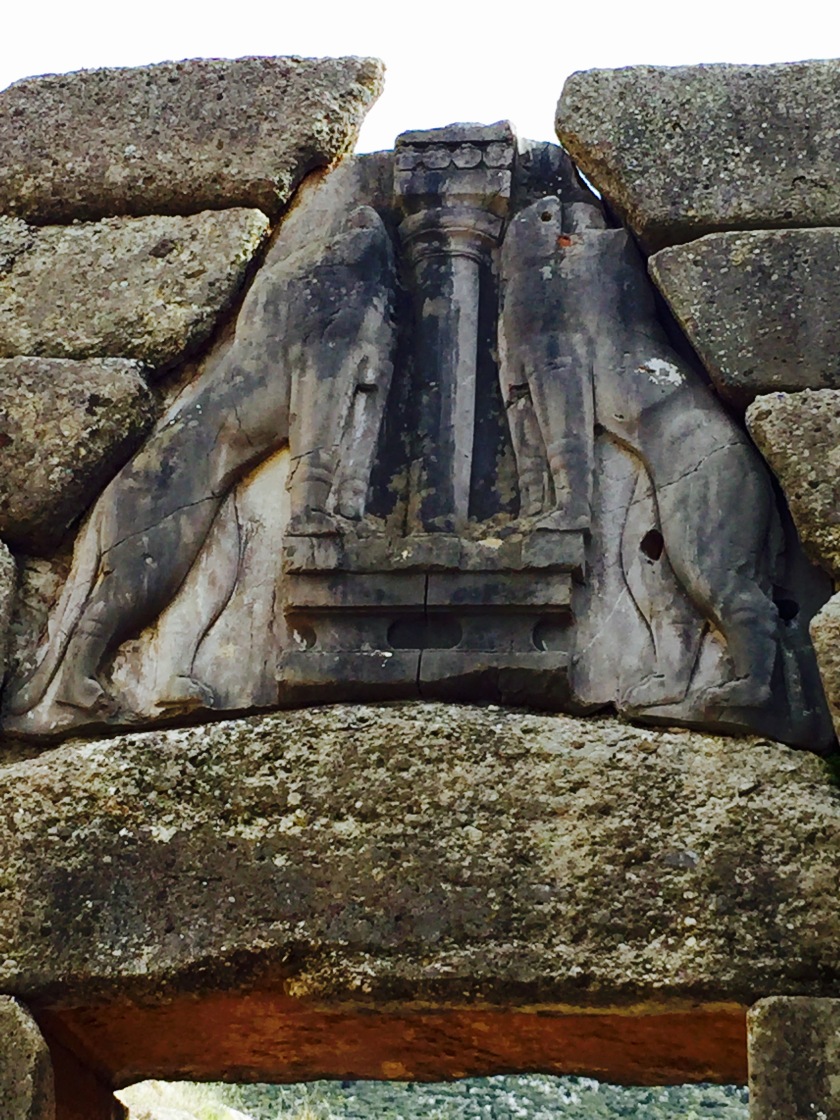
However, the very first excavations at Mycenae were carried out in 1841 by Greek archaeologist Kyriakos Pittakis, who found and restored the impressive Lion Gate, at the entrance to the acropolis.


The gate of lions
The gate of lions


image

The Minoan civilization (see post, here) was brought to an abrupt end in c. 1500 BC. Historians surmise the palaces were destroyed by fire, earthquake and a tsunami caused by the eruption of the Santorini volcano.

Meanwhile, another brilliant civilization was emerging, that of the Mycenaeans, who set up a number of centers of power in southern mainland Greece. They were a warrior elite society, as is witnessed by their palaces which, contrary to those of the Minoans, featured impressive fortifications.

The Myceneans were much influenced by Minoan Crete, and, after its decline, took control of Crete including Knossos, and colonized several other Aegean islands, reaching as far as Rhodes.

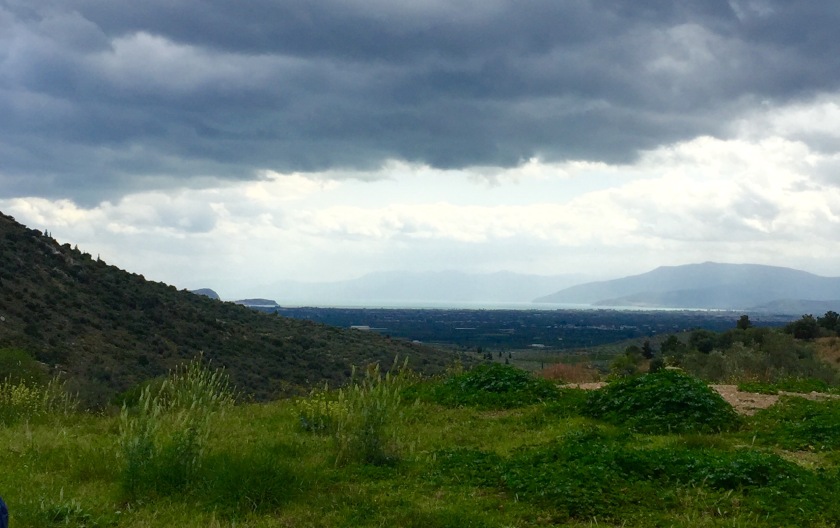
The principal Mycenaean centers were well fortified and usually situated on an elevated terrain. One of their most impressive cities, just 90km from Athens, was Mycenae, or Mykines, as we call it. Built on a tall hill overlooking a fertile plain and the gulf of Argolis and beneath towering peaks, it is the reminder of their glorious civilization.


The view from the acropolis
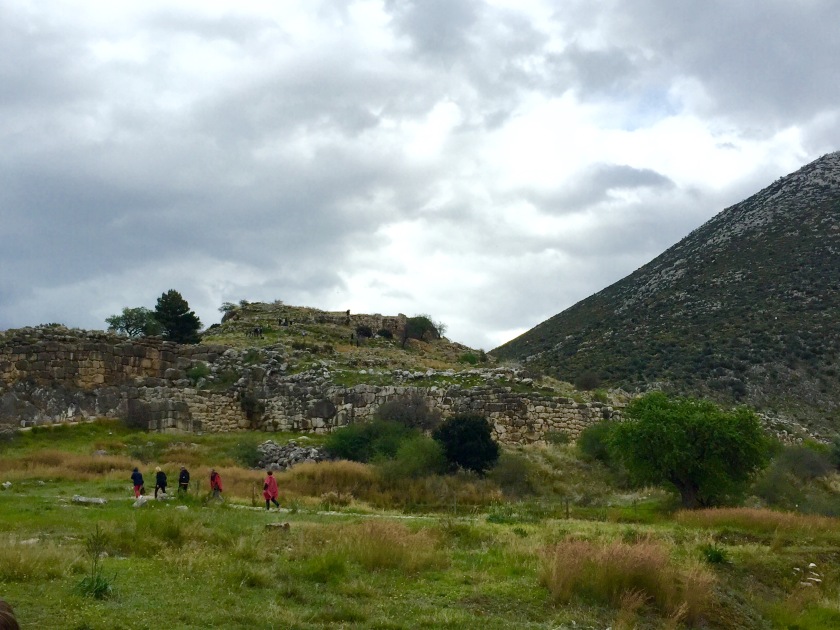
The ruined city of Mycenae

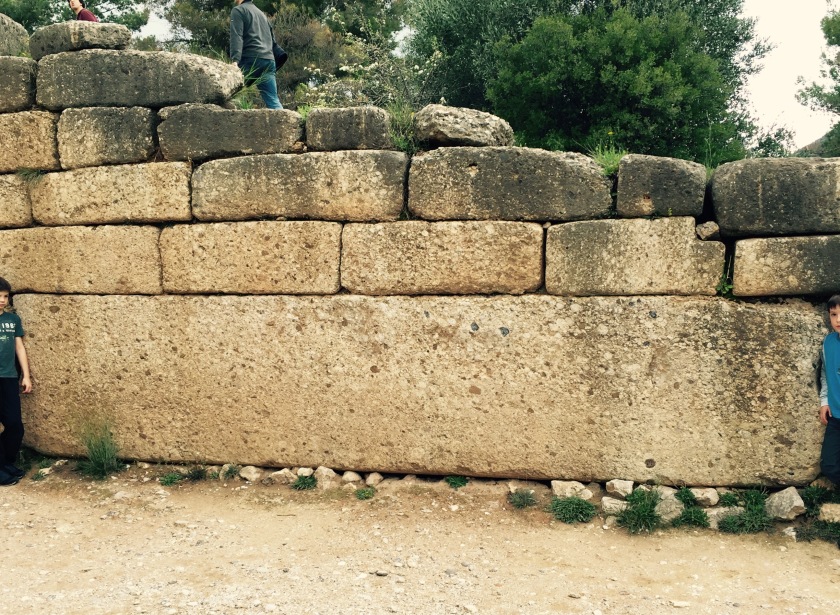
On a recent day trip, we enjoyed the amazing view of the plain stretching beneath the city ruins to the sea. The famous fortifications, know as Cyclopean walls, are built of large, unworked boulders more than 8 m (26 ft) thick and weighing several metric tonnes. They were roughly fitted together without the use of mortar or clay to bind them, though smaller hunks of limestone fill the interstices.


image


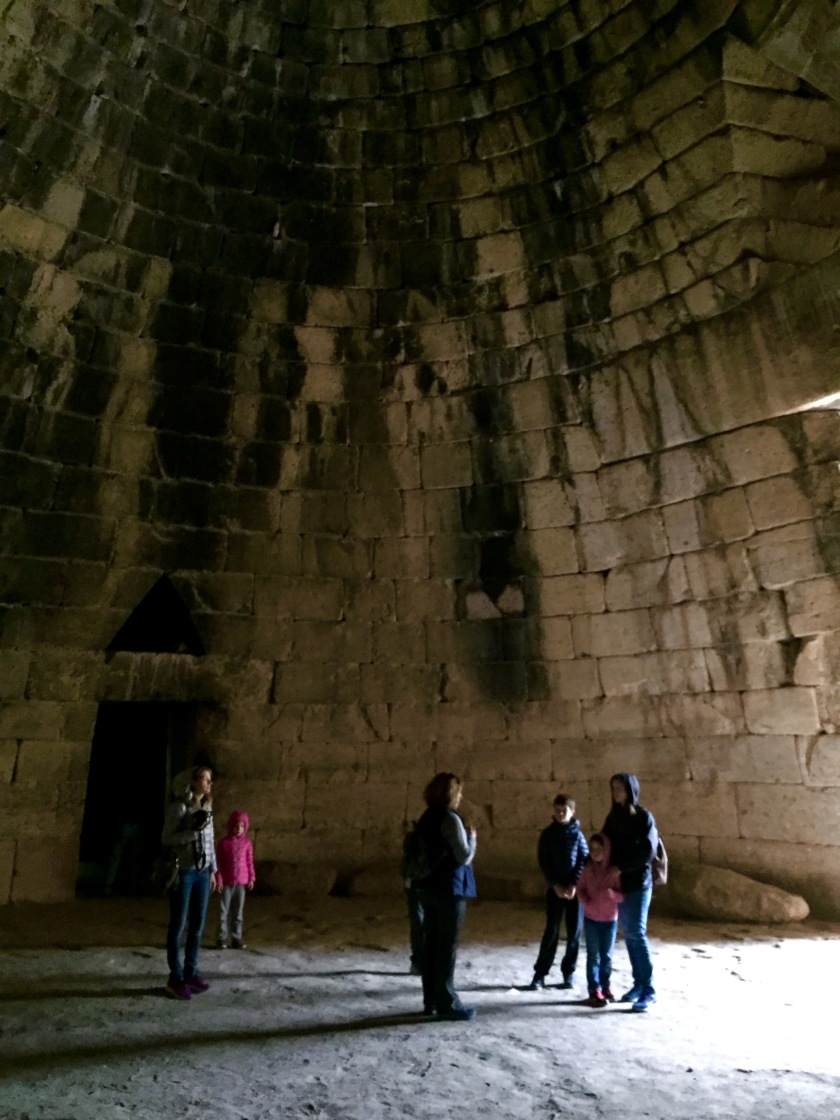
Following the Shaft Grave era, a new and more imposing type of elite burial emerged, resulting in a characteristic feature of the Mycenaean civilization, the Tholos: large circular burial chambers with high vaulted roofs and a straight entry passage lined with stone.

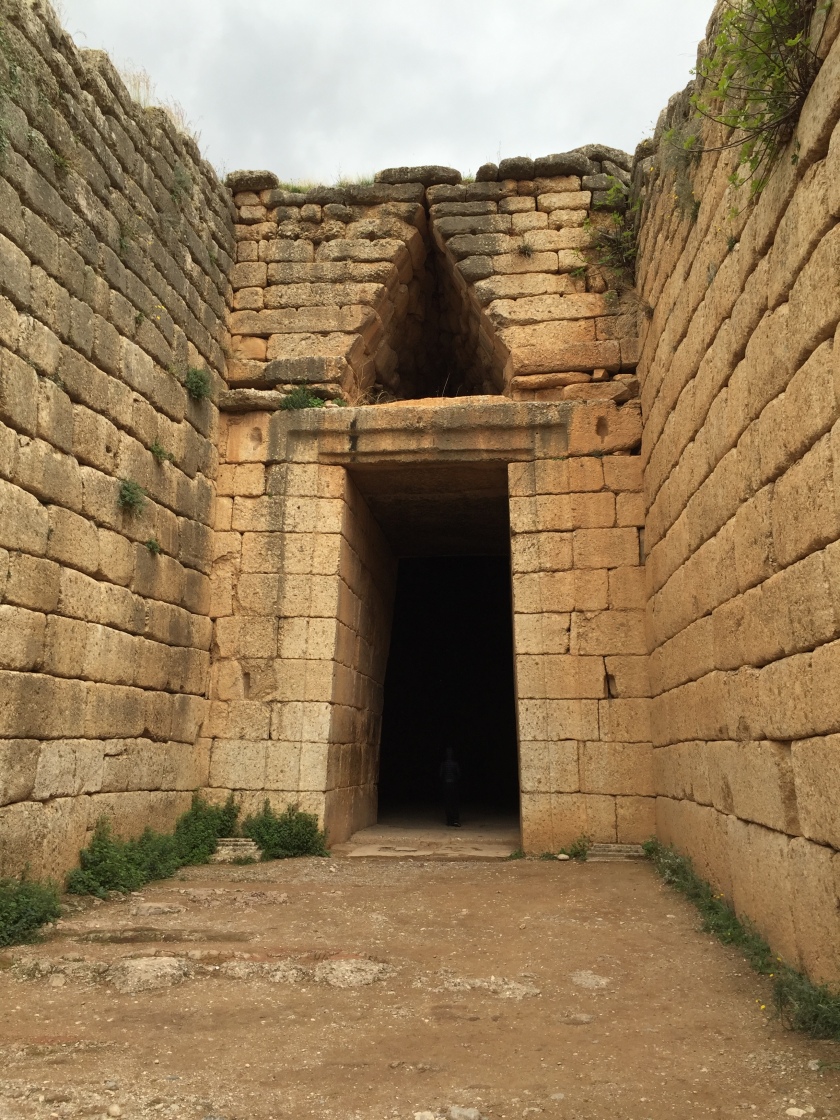
The most impressive of these is the Treasure of Atreas, which might have been the tomb of Agamemnon, or his father, Atreas.

image
Entrance to the tomb. Above is the ‘relieving triangle’. The stone beneath is the largest and most heavy found on the site.


Above the entrance we can see one of Mycenaens’ architectural innovations,the relieving triangle. The Mycenaean Greeks were pioneers in the field of engineering, launching large-scale projects unmatched in Europe until the Roman period, such as fortifications, bridges, culverts, aqueducts, dams and roads suitable for wheeled traffic.

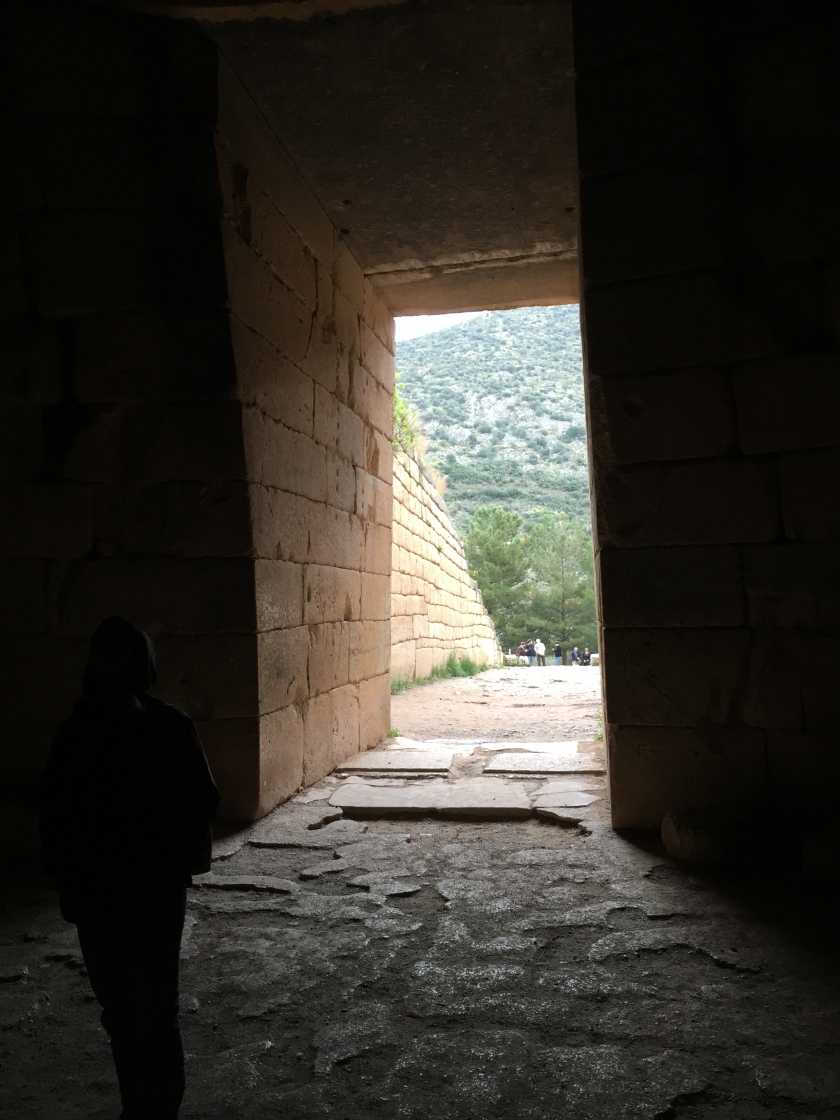
Inside the tomb
Inside the tomb

image


In an amusing footnote, today the Treassure of Atreas is being squatted by a swarm of bees, which obviously appreciate ancient culture as well as the tomb’s resemblance to a giant beehive. These bees are apparently a rare species, so the authorities are unwilling to spray them and are trying to find a way to eject them humanely. The bees are also different in that they don’t sting; when we were there, they were buzzing happily about and did not interfere with our visit in the least. However, it was still April. Apparently in the height of the season, when thousands of tourists are visiting, their numbers are such that most people are scared to enter the tomb. Also, the lure of honey attracts  numerous birds and bats, whose droppings result in a filthy floor and an unbearable smell. It will be interesting to see what solution will be found to this problem.

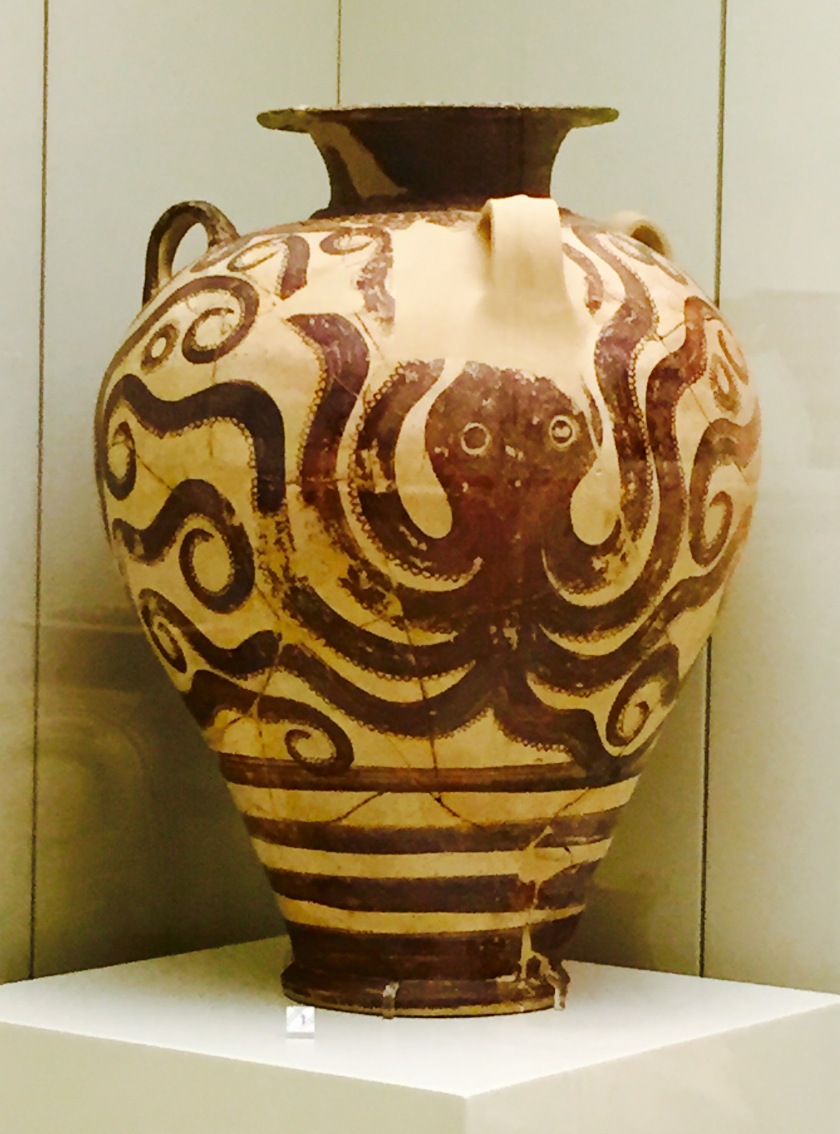
The on-site museum is small but full of treasures.

The octopus was supposed to looked after the souls of the drowned
The octopus was supposed to care for the souls of the drowned
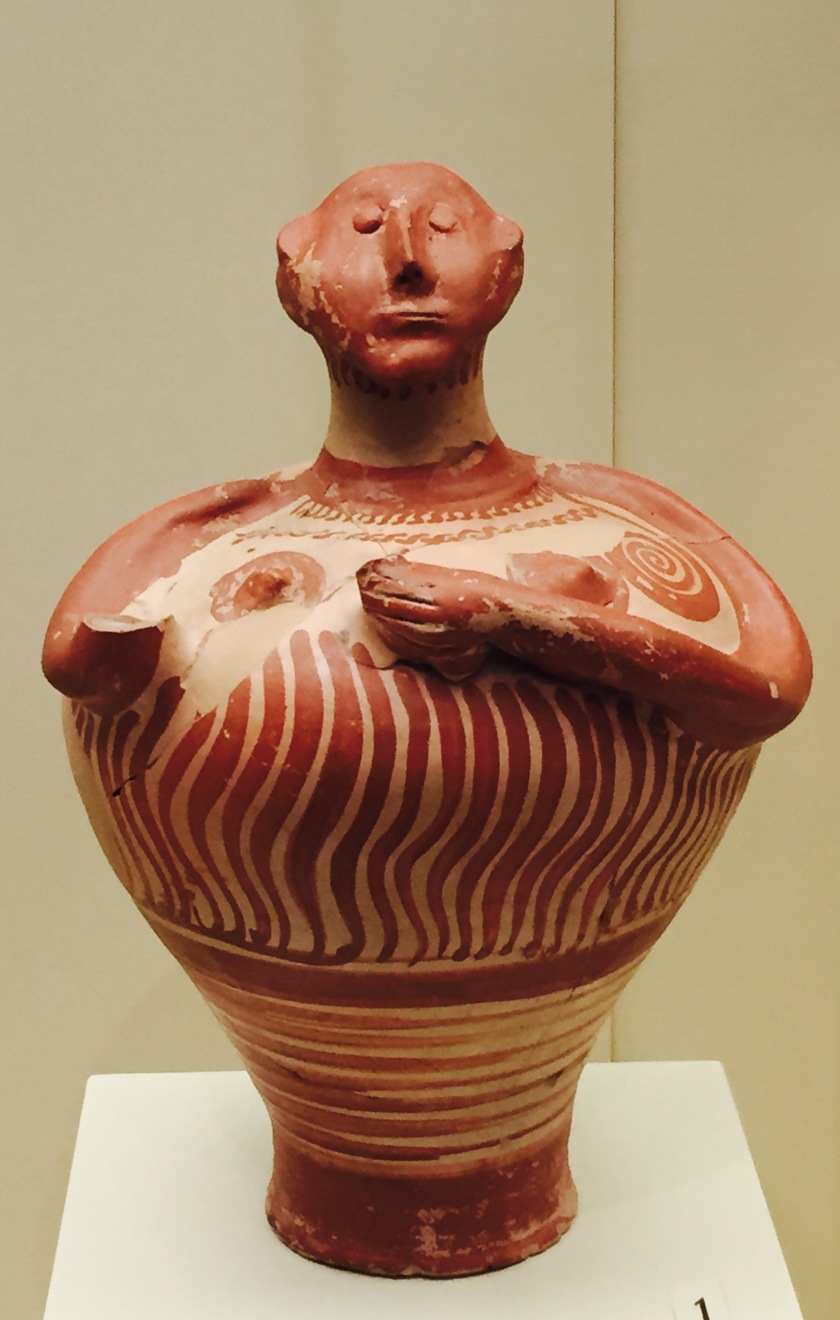
Primitive idols
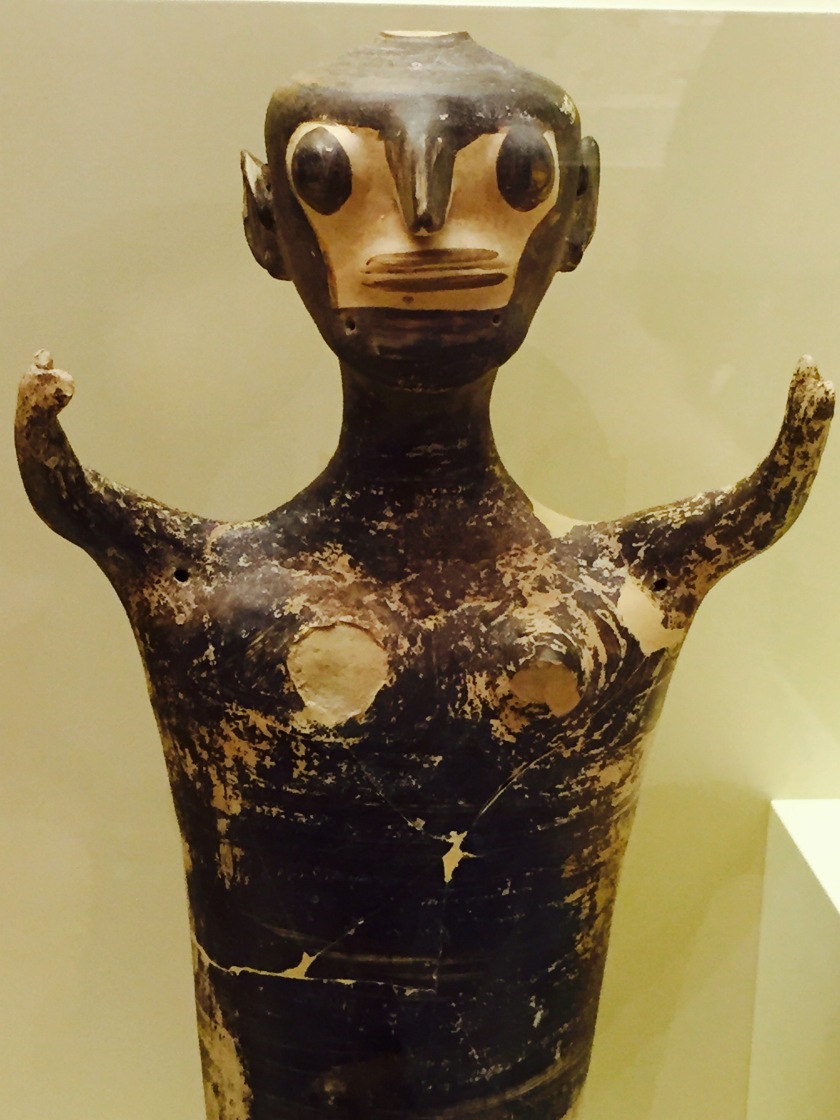
Anthropomorphic ceramic figurines
This one almost looks like an alien!


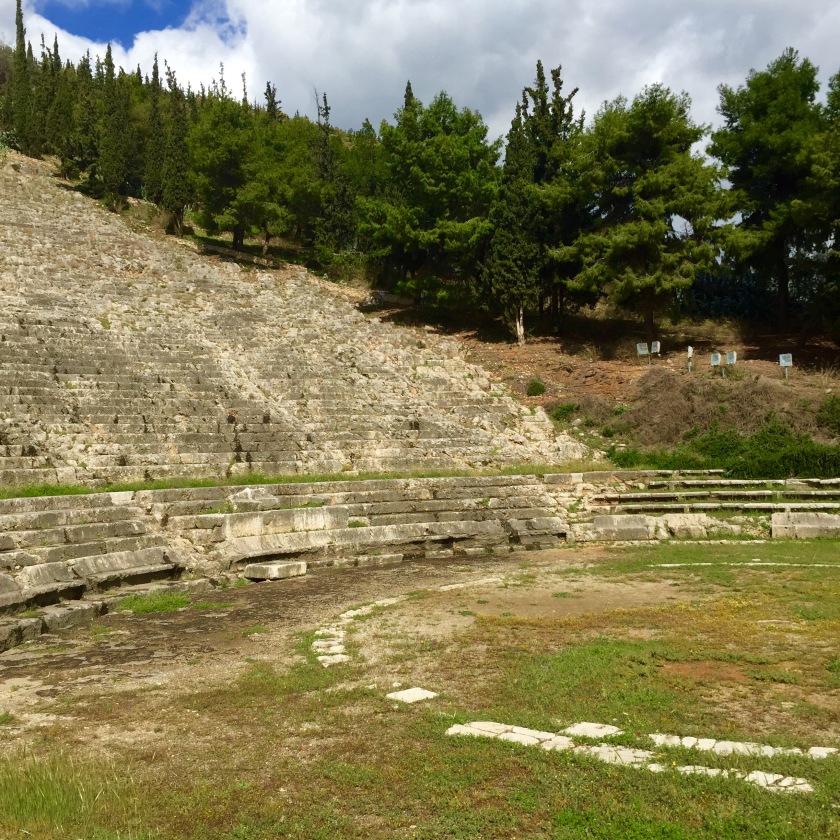
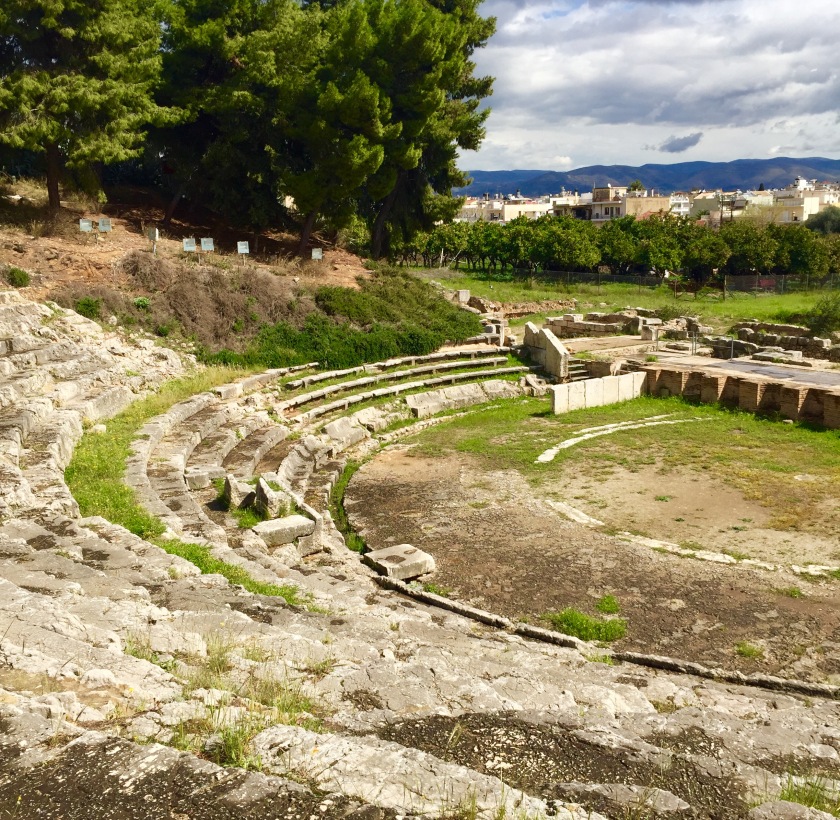
On the way back to Athens, we stopped at the Ancient Theater of Argos, nestled in the hill above the city. The theater was built in the Hellenistic period (third century BC) and had a seating capacity of 20,000. It was remodeled during the Roman period (second century AD) and even today, a number of cultural events are held there.

image


image

The Minoans

On the island of Crete, which lies nearer to the coast of Africa than to the Greek mainland, a brilliant civilization flourished from approximately 3650 to 1400 BCE. It was rediscovered at the beginning of the 20th century through the work of British archaeologist Arthur Evans and refers to the mythic King Minos. Minos was associated in Greek myth with the labyrinth and the Minotaur, which Evans placed at the largest Minoan site, Knossos.

The Minoans were the first Europeans to have a literate civilization. They were traders who built a colossal fleet and exported their products all over the Mediterranean: timber, wine, currants, olive oil, saffron and honey, herbs, exquisite pottery, jewellery, wool and cloth. They imported alabaster, precious stones, copper, ivory, gold and silver, as well as artistic ideas and techniques.
They built astonishing palaces decorated with amazing murals; the palaces, unusually, were lacking in fortifications since their choice of site provided natural protection. Also it is thought the Minoans managed to live for many centuries in contact with all the major civilizations of the time without being significantly threatened.

Urged by my grandchildren who are studying the Minoan civilization at school, we went on a two-day excursion to visit the ancient ruins at Knossos and Phaistos. Not nearly enough time to enjoy all that Crete has to offer, it was nevertheless a very interesting and enjoyable trip.
History was brought to life by our excellent guide, Maria, who illustrated the Minoans’ customs and answered every question. The kids were especially interested in the relationship of myth to history.
“Was the Minotaur ‘real’?”
“Where exactly was the labyrinth?”
On the way to Knossos from the airport they treated us to the entire story of the Minotaur, Daedalus and Icarus, etc. with a special focus on the gory bits, of which there are plenty!


image


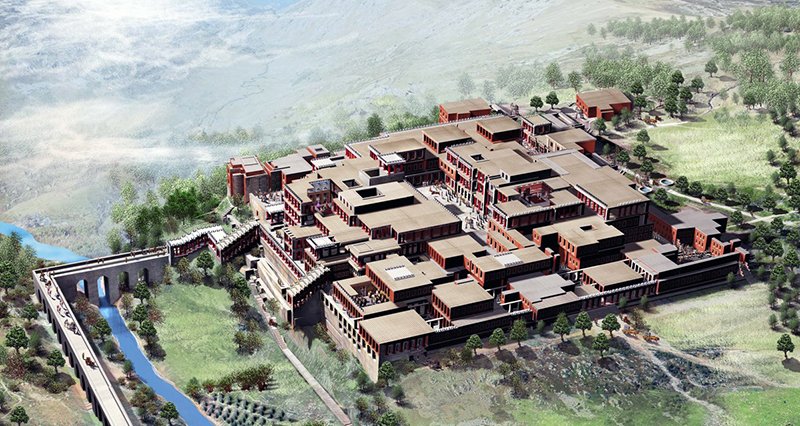
Knossos was a huge palace (700 rooms over 5 floors have been excavated out of an estimated total of 1300-1500) with very complicated architecture (hence the labyrinth?) and enjoyed superb views over the surrounding countryside and the sea. Its walls were painted in bright colors and the floors and wainscoting were made of alabaster imported from Egypt.


image


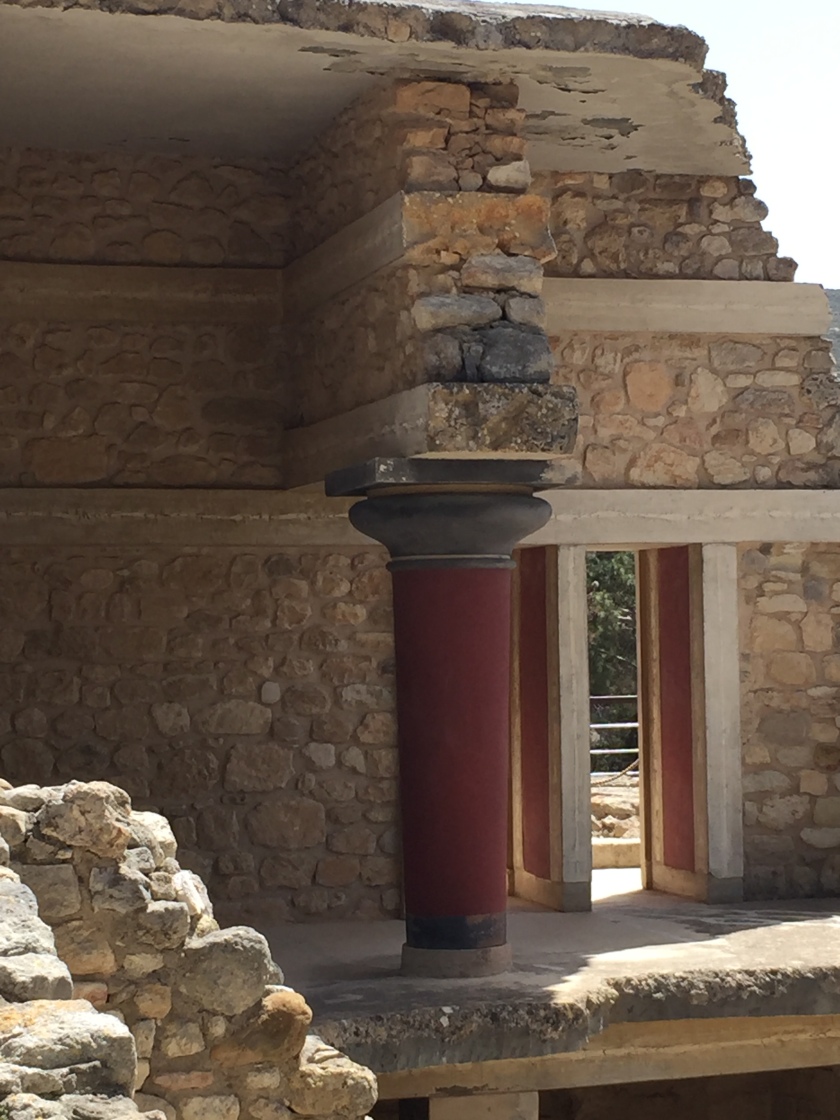
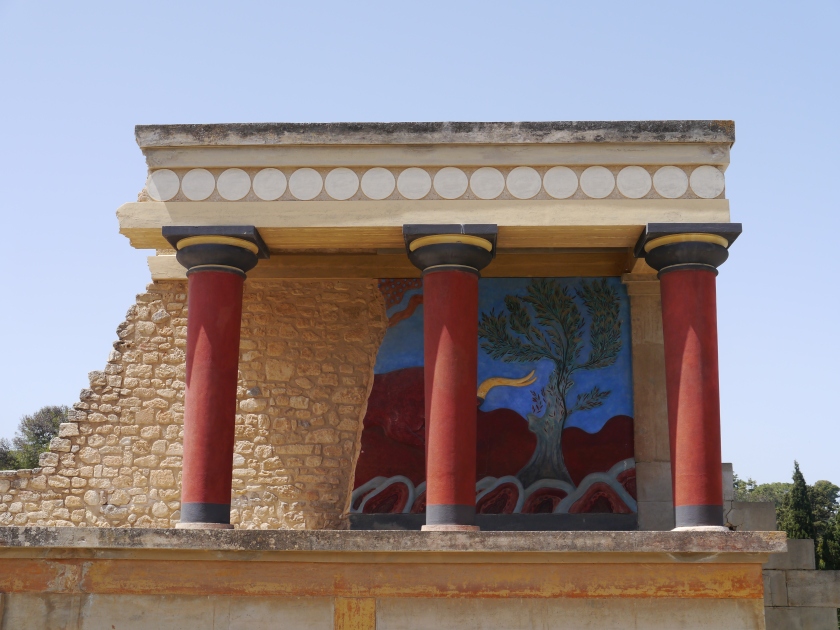
The columns, made of cypress trunks, were wider at the top than the base.


image
The palace has been reconstructed in some parts to give visitors an idea of its former splendour.


P1050110


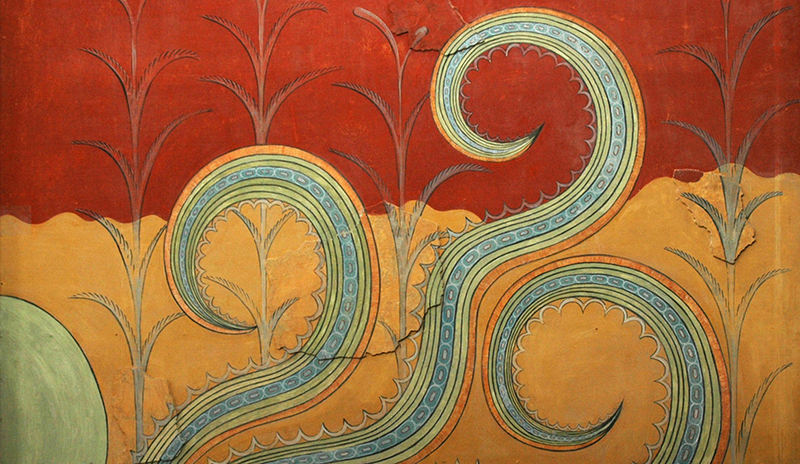
The appartment walls were decorated with wonderful murals.


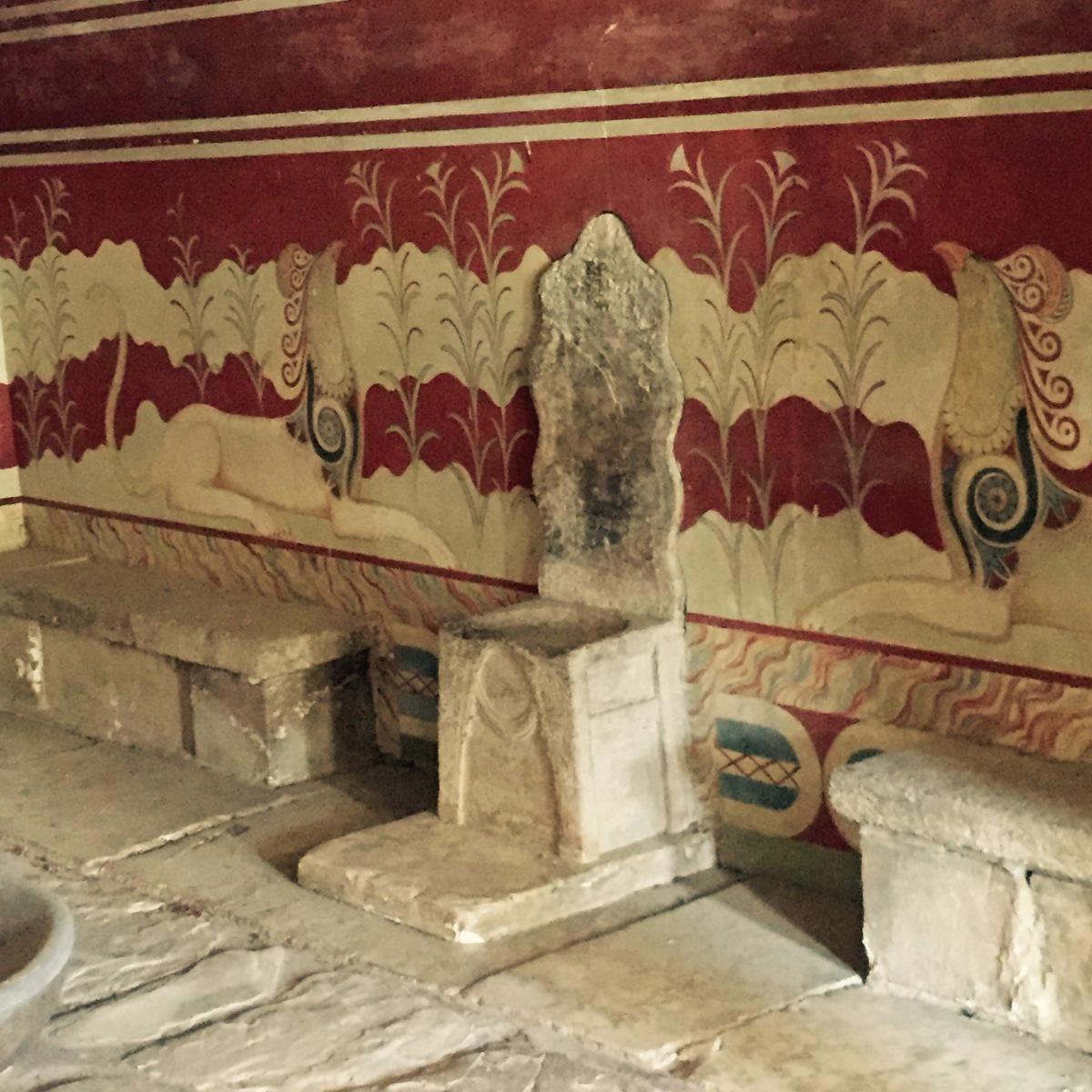
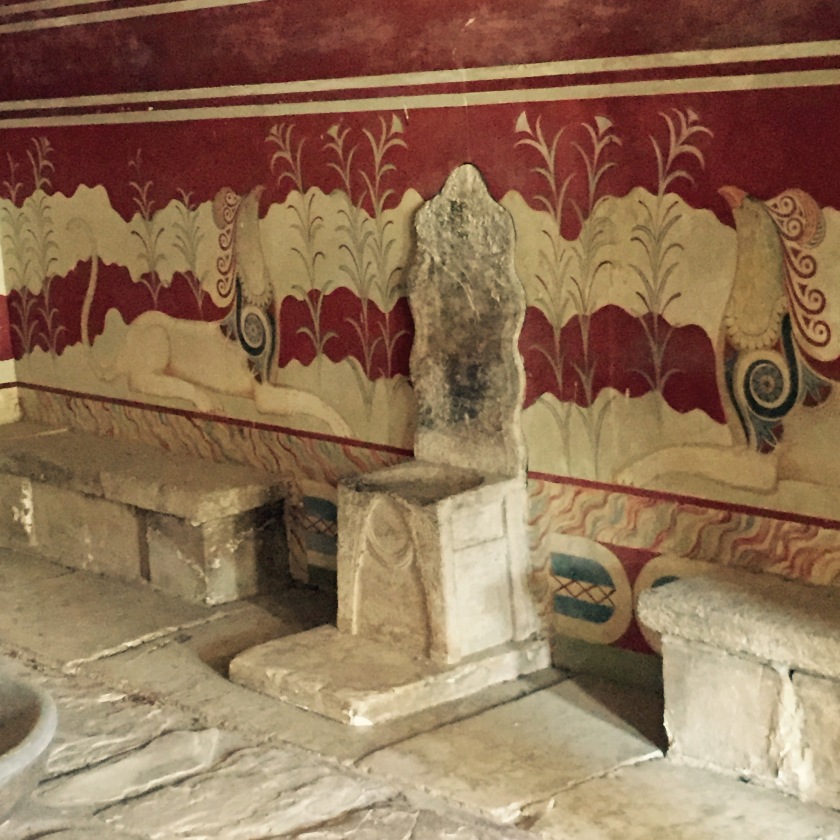
This is the throne room, with images of gryphons on the walls
This is the throne room, with images of griffins on the walls.


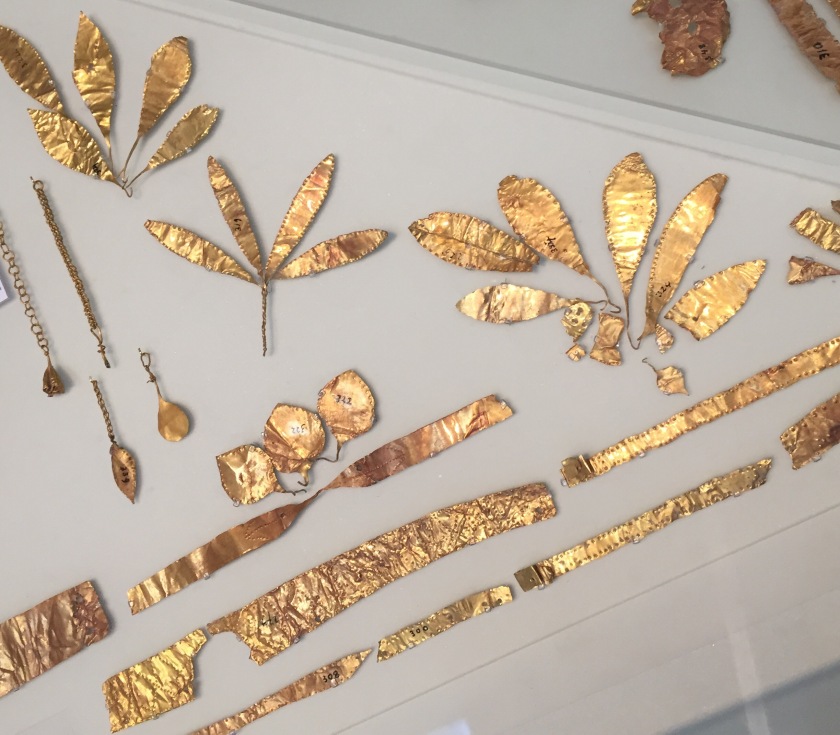
The Minoans had workshops which made delicate jewellery.


image


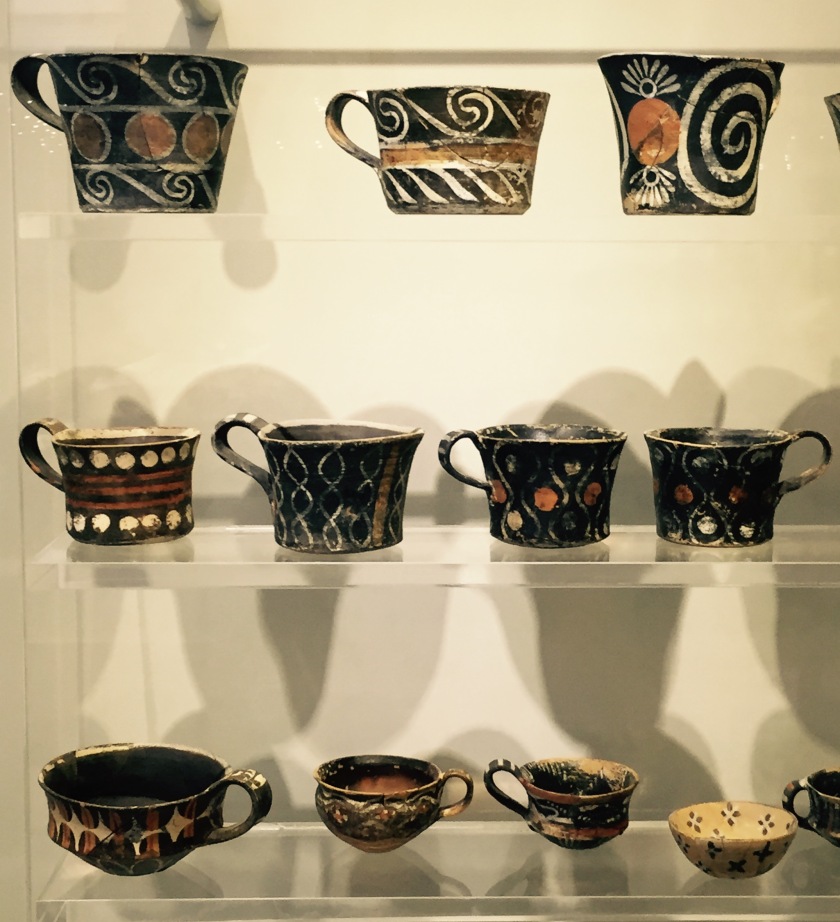
And even more delicate porcelain, known as Kamares vessels. (Καμαραϊκά αγγεία)


image


They had a theatre,


image
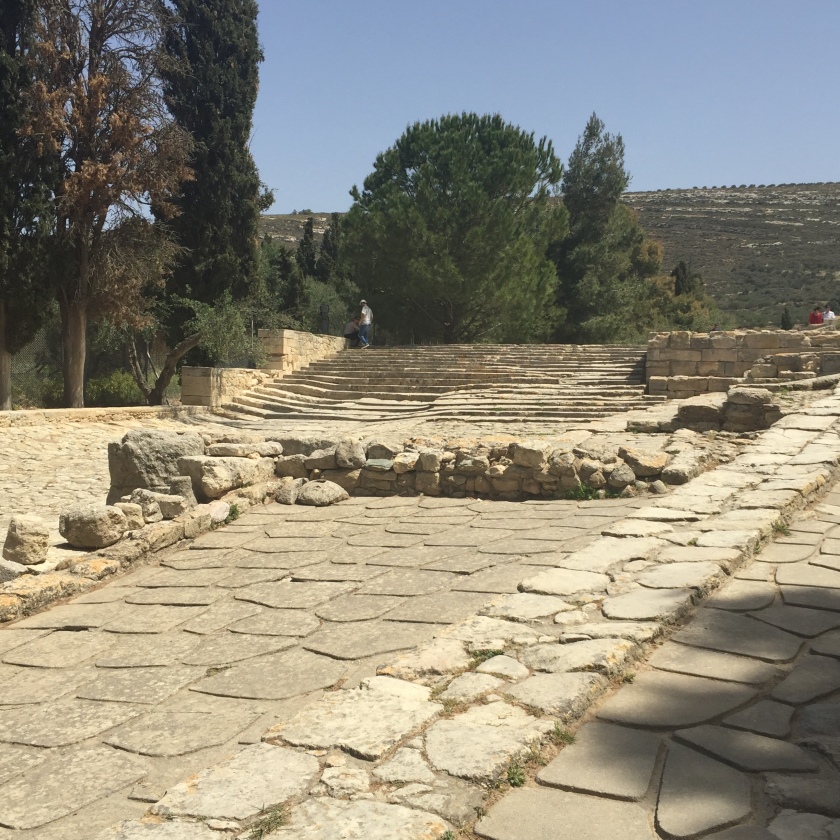
View of the theatre with a royal box (upper right hand corner) and, in the foreground, one of the oldest paved roads in Europe.


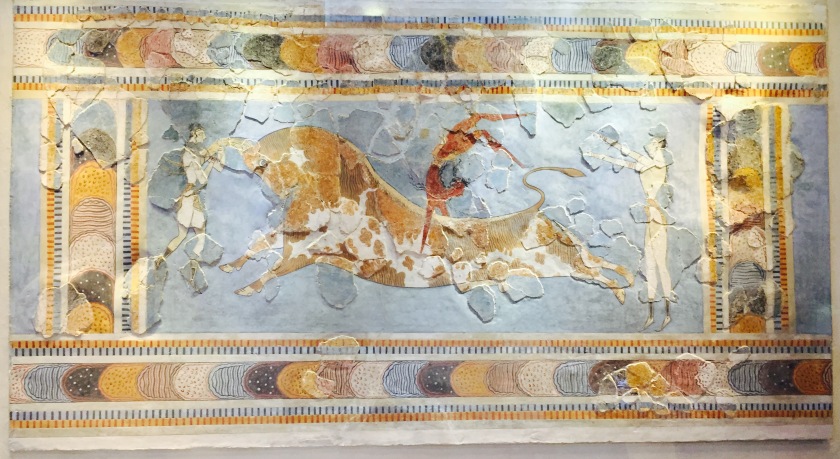
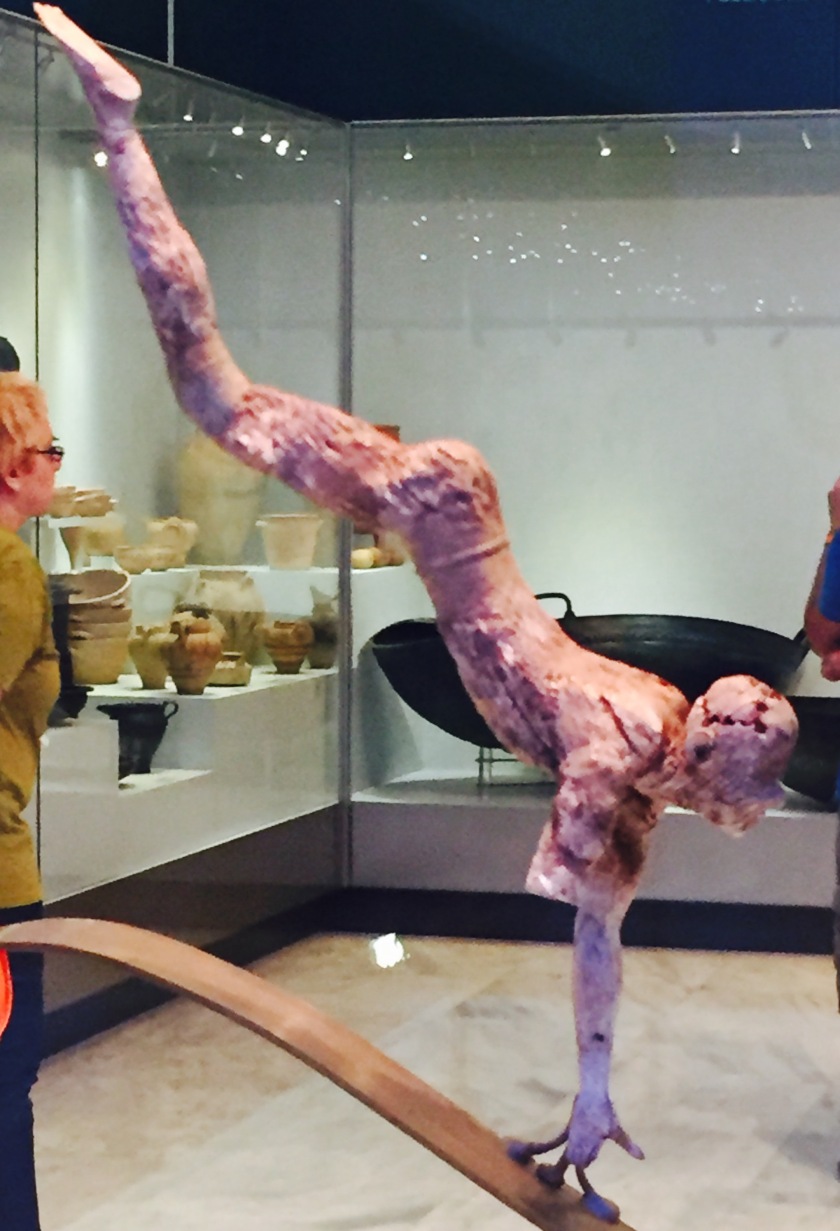
and a central courtyard where the famous bull games took place. These involved both boys and girls somersaulting over a bull, which was not killed at the end of the games (as in Spanish bullfights). It probably ended up being sacrificed to the gods, though.


Two girls and a boy showing the sequence of actions I. The bull games. This is where the expression "to take the bull by the horns" came from!
Two girls and a boy showing the sequence of actions In the bull games. This is where the expression “to take the bull by the horns” came from!


The Minoan palaces also had plumbing – running water and sewage – even on the top floors (something not seen again until the Romans, 2000 years later). Also the orientation of each room made for perfect ventilation; we visited on a hot day, and the temperature indoors was several degrees lower than outside.


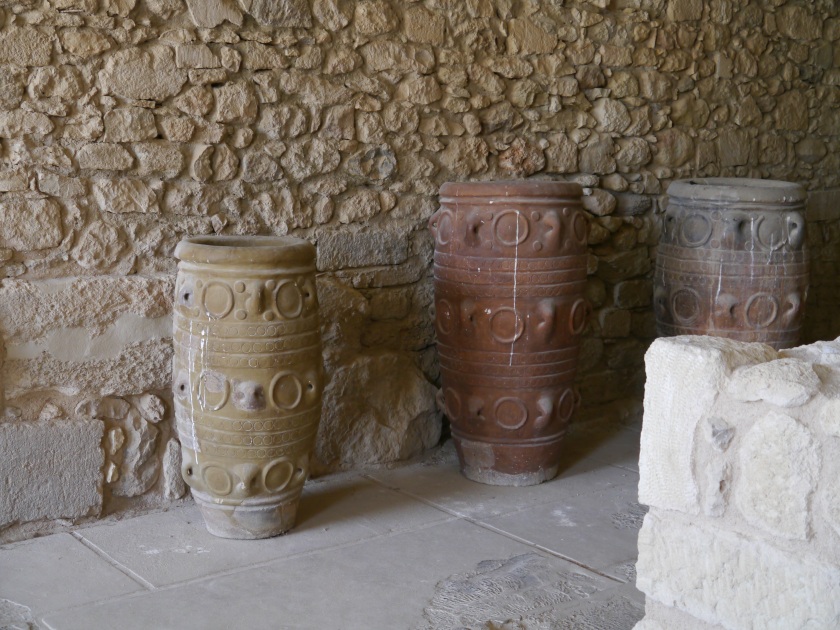
Wonderful jars in which they stored oil, honey and other produce


We continued with a visit to the Irakleion museum, which has been totally refurbished and contains all the important artifacts.

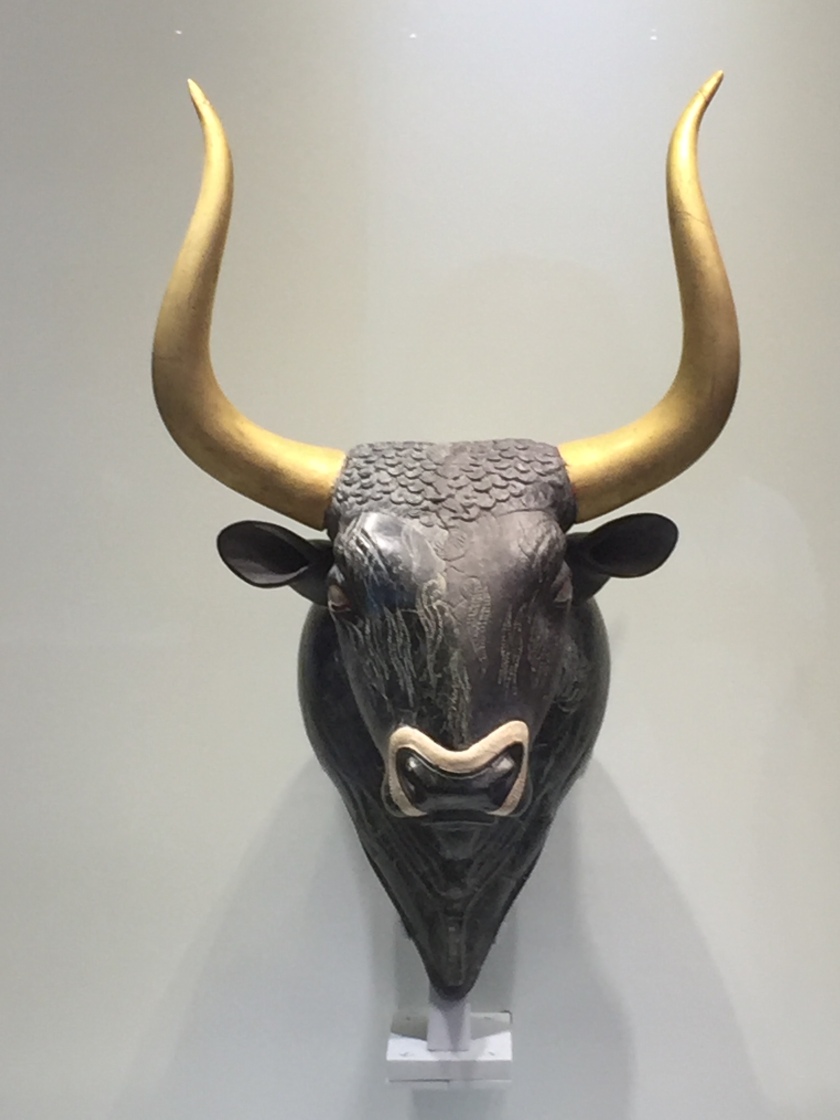
The bull was worshiped as a symbol of strength and thus portrayed in many ways.

image
Bull’s head made of steatite with mother-of-pearl nose, gilded horns and eyes of rock crystal


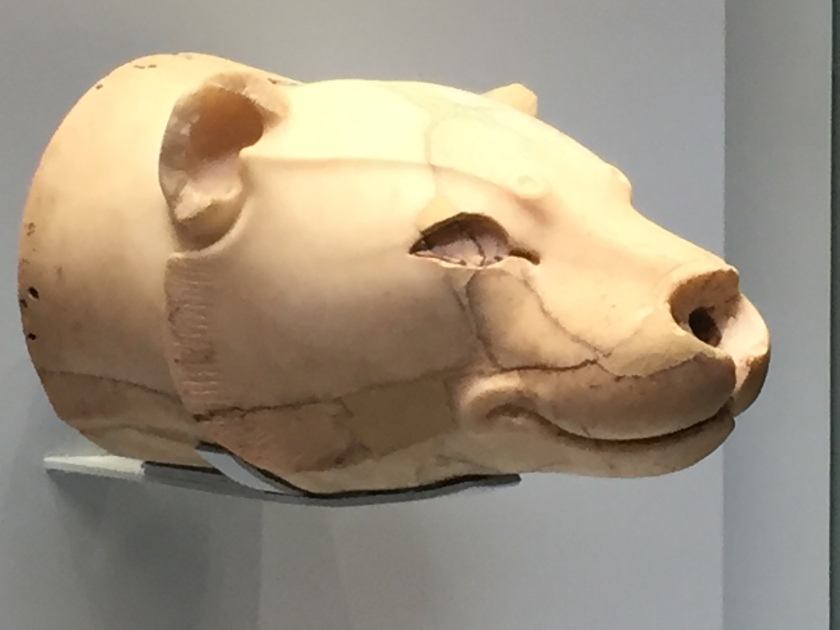
Head of a lioness made of alabaster. It used to have eyes of Amber and a Rose Quartz nose.
Head of a lioness made of alabaster. It used to have eyes of amber and a nose of rose quartz.


Statue of an acrobat in the bull games, made of ivory


We finished the day with a cooling swim in the sea, and the next morning set off for Phaistos, and hour and a half away through lovely scenery. The mountains were covered with Cretan ebony, small bushes covered in pink flowers. They looked a little like overgrown thyme, but apparently their seeds produce very vivid black dye, used in ancient times and still today.

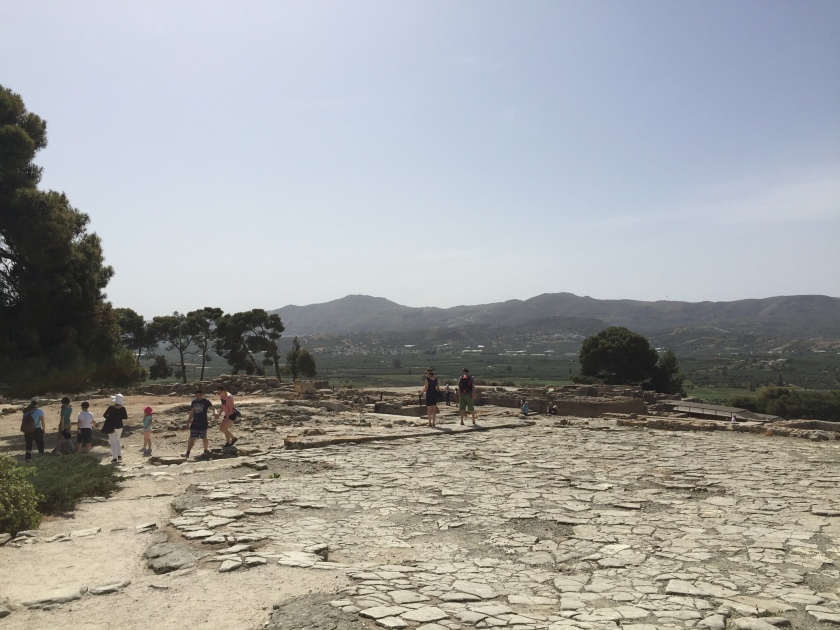
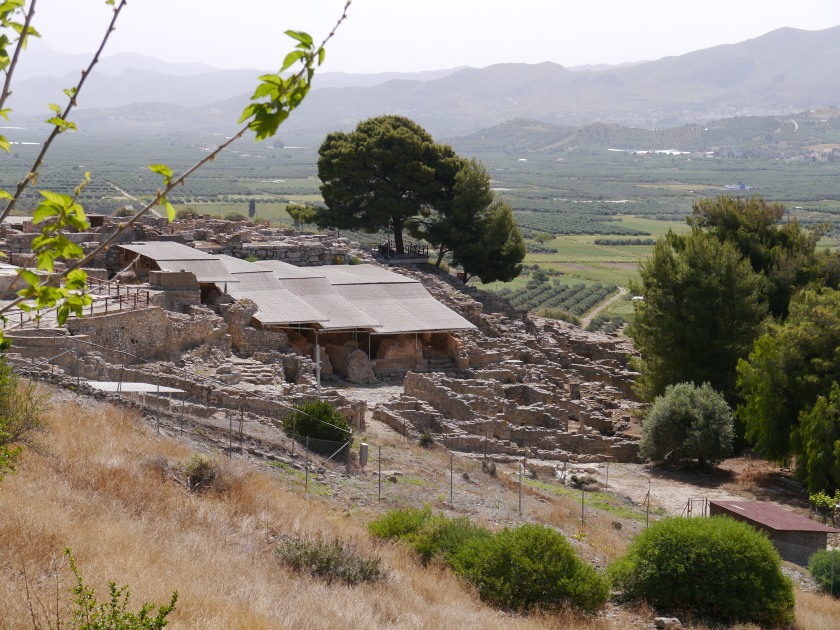
The palace of Phaistos is much smaller than Knossos (around 700 rooms), but still impressive, built on a lovely site overlooking fertile plains.

image

It faces north and thus also has superb ventilation, as well as plumbing and workshops.  One of the trades first practiced there is that of metallurgy.


P1050157

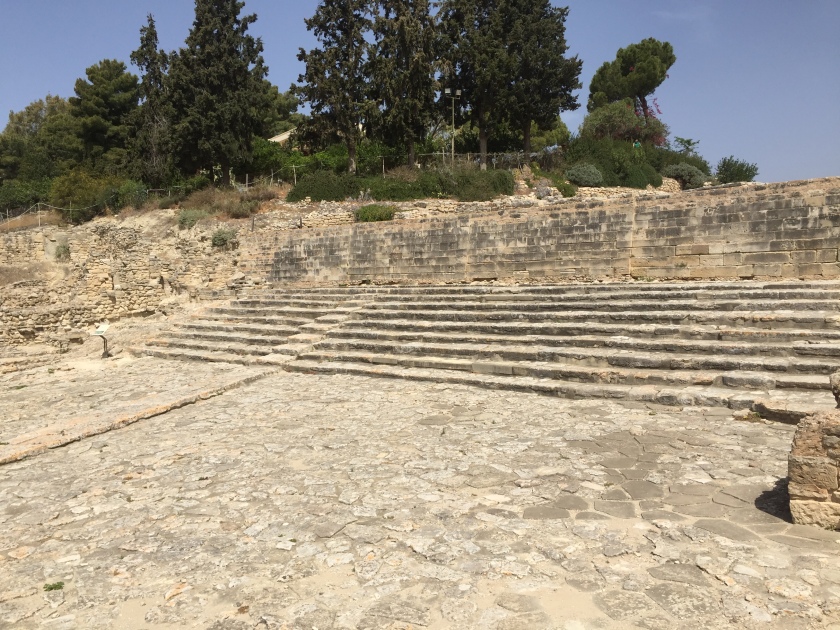
It also has a theatre,


image


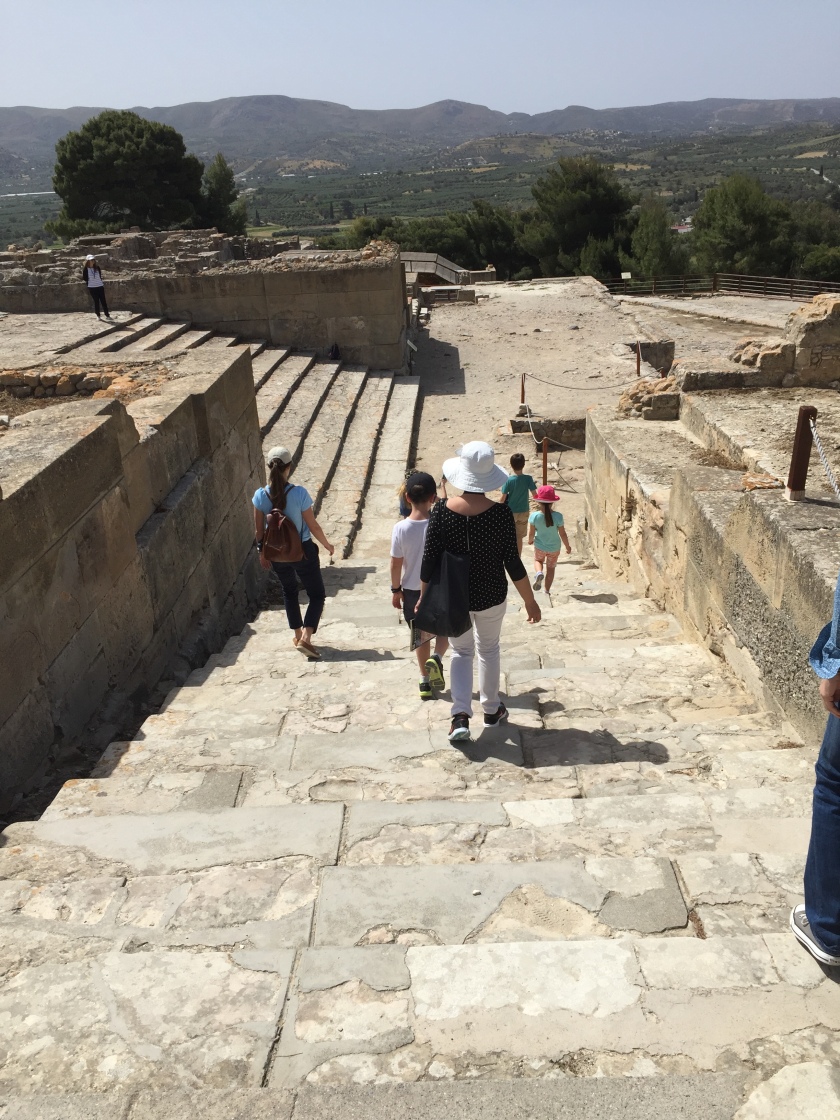
And wide stairways.


image


Feeling famished after our visit, we stopped off for lunch at a little taverna down the road. We were welcomed by a lone man who did not speak Greek well. Fearful it would take forever to get served, we made the kids all have the same thing. However, things started arriving on our table in a delicious sequence – salads of delicious tomato and cucumber, little spinach pies melting in the mouth, saganaki (grilled cheese), the most aromatic spaghetti bolognaise for the kids and, for the adults, a chicken tagine with saffron and prunes. I’d thought the man was Egyptian but he proved to be a Moroccan. Having finished serving, he sat down next to us for a chat and told us he’d been a cook on the ships, had stopped off in Crete on leave 30 years ago and stayed. But, he said, placing his hand on his heart, it was his mother who’d taught him to cook. She must have been one hell of a chef!

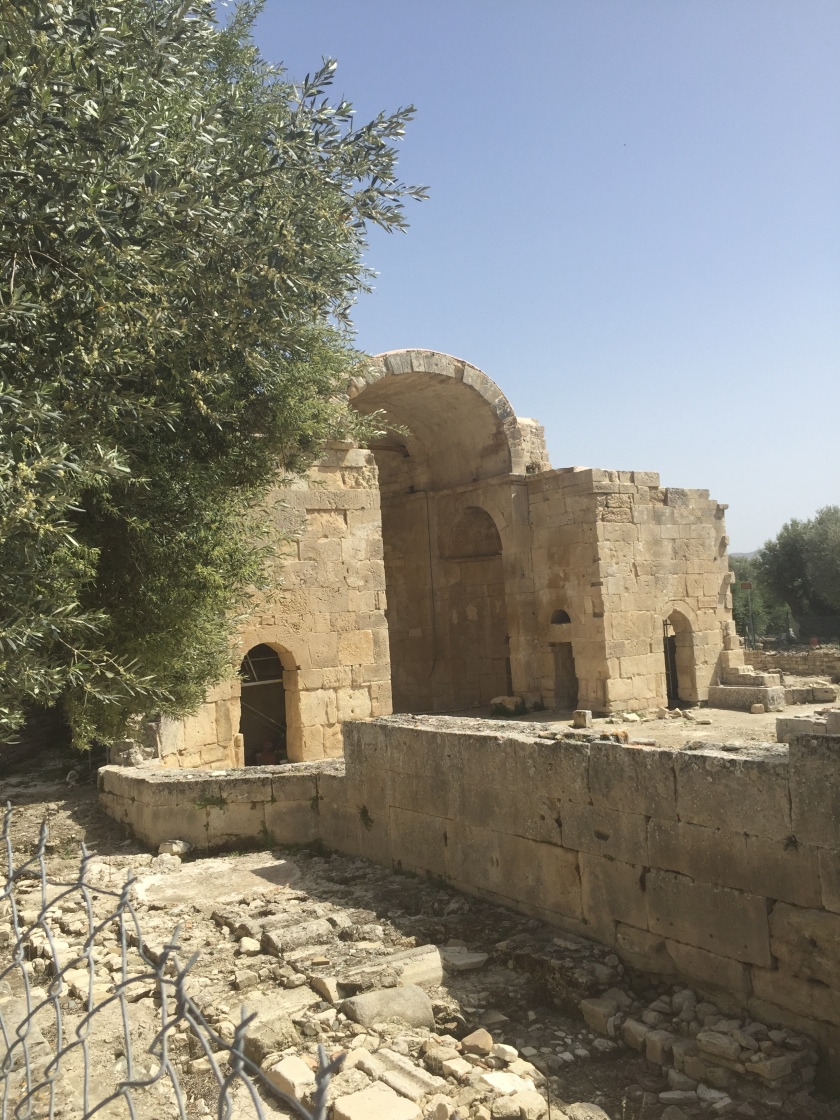
Having some time to spare before our flight, we stopped off at Gortyna, the site of a beautiful domeless Byzantine church


image


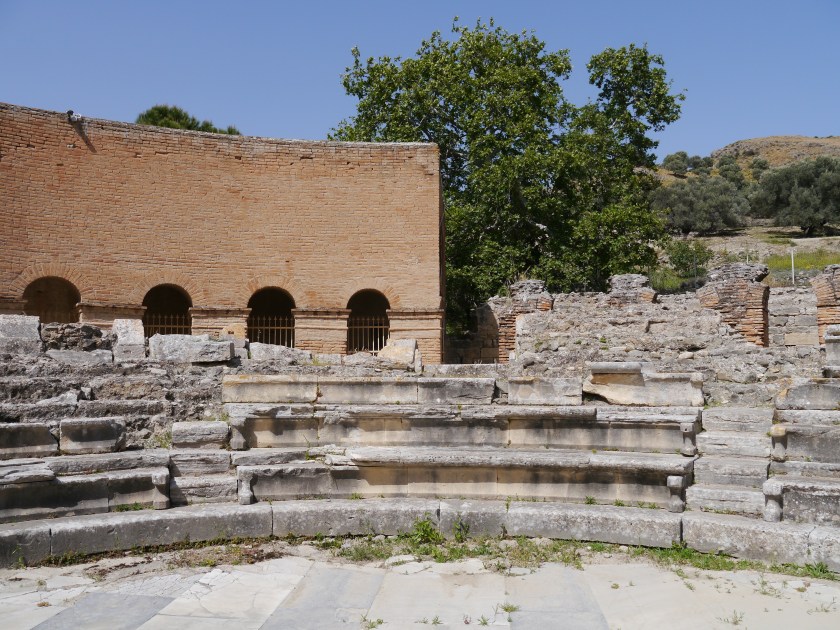
And a Roman Odeon


P1050240


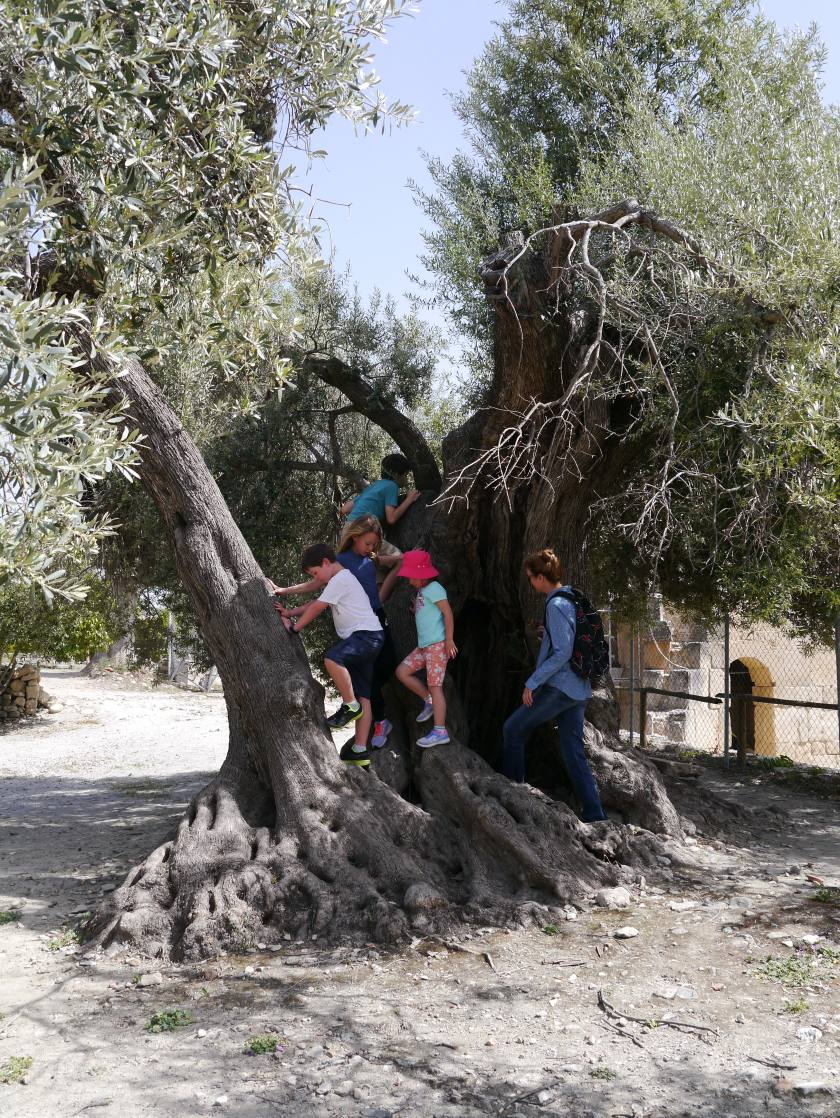
The surrounding land contained ancient olive trees, one of which was around 700 years old;

P1050228


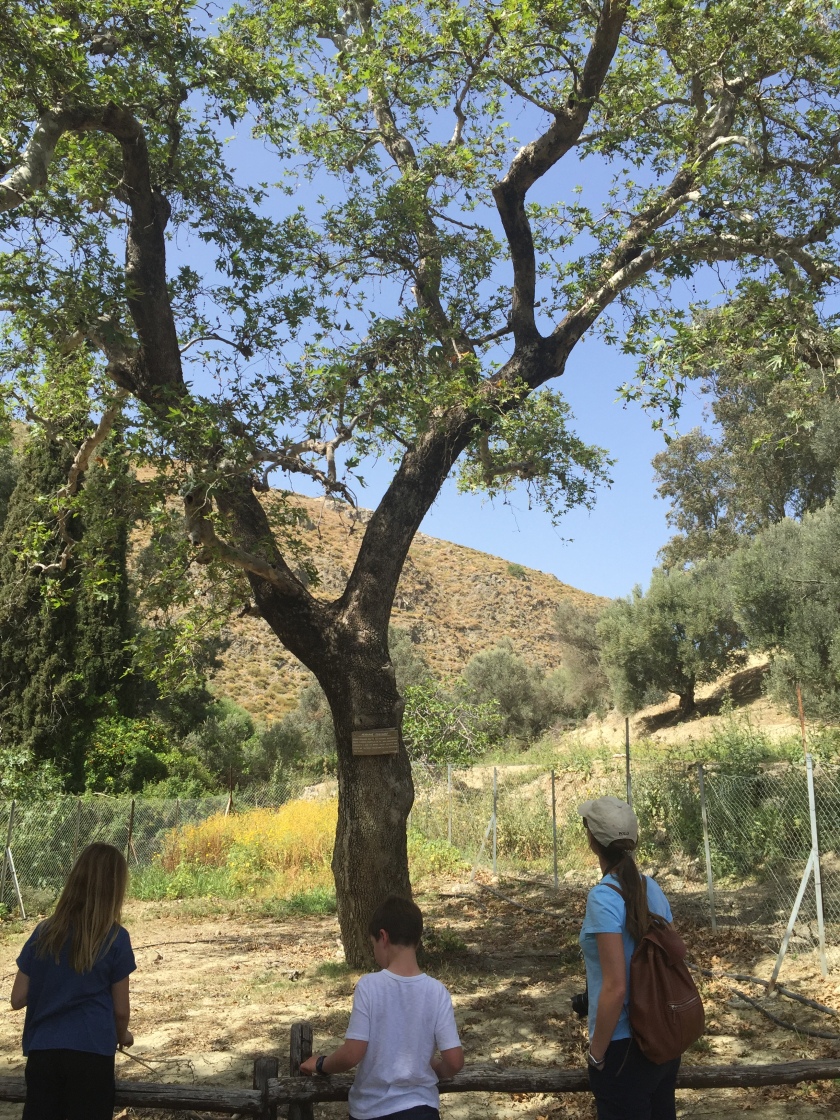
as well as the descendant of the plane tree under which the union was consummated between Zeus and Europa which would produce King Minos and his siblings, Radamanthes and Sarpedon.

The peculiarity of this tree is that it is the only plane tree that is not deciduous – it keeps its leaves in winter!

image


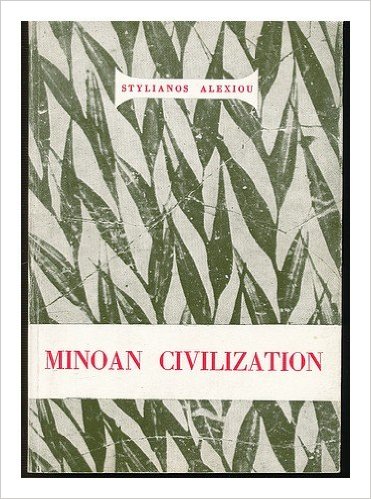
Obviously, this is just the description of a family trip. I’m no historian, so for anyone interested in finding out more about the Minoan civilization, I can recommend the excellent book written by Stylianos Alexiou.

image


Discovery: a great blog about Greece

Chrysoula Manika – Chrissy for short – writes a stunning blog,  travel passionate, about traveling in Greece. I’m reblogging one of her posts, just to give you a taste. But do go and take a look, it’s full of great places to visit, restaurants and hotels; day trips, fun things to do, where to get street food; she even gives tips on what to pack!
5 reasons to visit Greece in winter
by Chrissy on November 22, 2015 in Travel Ideas
Greece is considered one of the top summer destinations worldwide. What is not widely known, is that Greece is a great winter destination as well, with many sites worth visiting and many activities worth doing. Here are some reasons why Greece makes the perfect winter destination.

imageMeteora

Why you should visit Greece in Winter:


It’s cheaper

If you are traveling to Greece during winter you will see that everything is cheaper and especially in popular summer destinations. There are a lot of Greek islands that you can still visit in winter and although some hotels and restaurants do close, there are always some that are still open with very low rates compared to summer. Also the restaurants that stay open are the ones that the locals visit, so you are bound to eat some good food. So if you don’t have the Greek beaches in mind there are a few islands that can be easily visited in winter, for example Santorini, Crete, Syros, Corfu, Rhodes and Hydra to name a few. During winter all the air fares are cheaper as well, both domestic and international. I have recently booked a return air ticket from Athens to Santorini with only 30€.

imageold town of Corfu from harbour

Less crowded
During the busy summer season everything is crowded. The lines for the Acropolis are big. The little alleyways of the islands are filled with people. On the contrary during winter you will have a more enjoyable experience having the site just for yourselves and a few more. You shouldn’t worry about the weather either. Although it gets cold from December till February winters are usually milder compared to most countries.


imageme at lake Plastira
Nice cities to explore
Athens, the capital of Greece is a great destination all year round. You will see less tourists in winter and you will get the chance to observe the local life. Apart from Athens and its countless sites that you can visit there are other beautiful cities in Greece worth exploring, Thessaloniki in the north is a very vibrant city with many archaeological sites, a great food and shopping scene and a lively nightlife. Kavala located in the north of Greece as well, is a very picturesque seaside town built ampitheatrically with many sites worth visiting.


imageThessaloniki

Great winter destinations to discover
Apart from the big cities and the Greek islands that one can visit during the winter, Greece has many popular winter destinations as well, with great natural beauty. The beautiful villages of Zagorohoria and the town of Kastoria in Epirus, Pelion villages, Arachova and lake Plastira near Meteora in Thessalia. Kalavryta, Mani and Nafplio in Peloponnese to mention a few. All these areas and many more make the perfect winter destination with their picturesque scenery, archaeological sites, incredible nature and local cuisine.


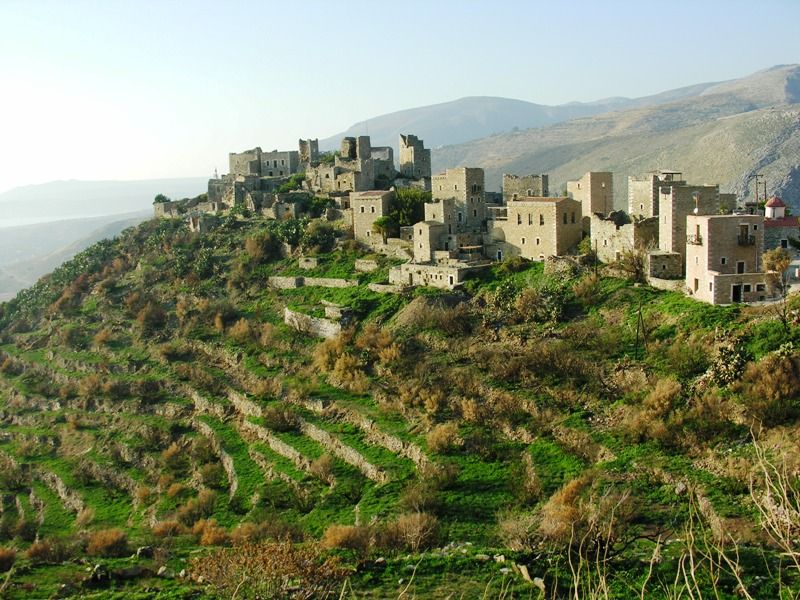
imageVathia village Mani

 
A variety of sports activities
Did you know that you can ski in Greece? There are a few big ski and snowboards centers in Greece like the one in Arachova and Kalavryta. Other sports activities include hiking trails in the mountainous regions, rafting in one of the country’s rivers and horseback riding. One of the world’s leading athletic event takes place in Athens every November, the Athens Marathon, where athletes from all over the world come to run the original classic route.


imageoutside Trikala
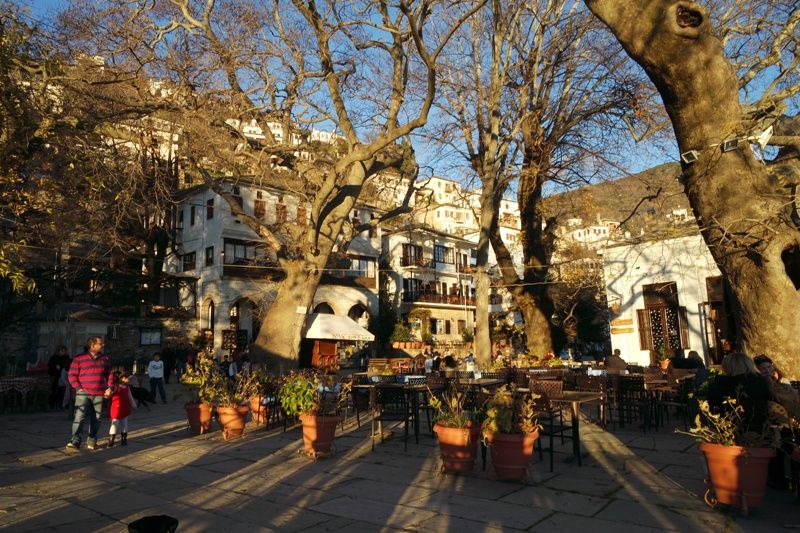
imageMakrinitsa village in Pelion

Now you know and you can too, arrange your winter visit to Greece.

Have you ever visited Greece in winter?

Did you like it?

Click on the blog name to get there – I’m sure you’ll find plenty to interest and tempt you!

City break: Athens in the winter

Most people think of Greece as a summer destination. The sea, the islands, guaranteed sunshine. But in the summer one is too hot and lazy to do much. You get into a routine of late breakfast, swim, lunch, siesta, swim, dinner. You can’t be bothered to move.

image


In the winter, you still get plenty of sunny days. Athens is a lively, bustling city, and it is easily accessible from most European countries. So, if you have a free weekend, book a flight.


There are plenty of things to do, even if the weather is bad (we do have a winter, and you might just be unlucky). Here are some ideas:


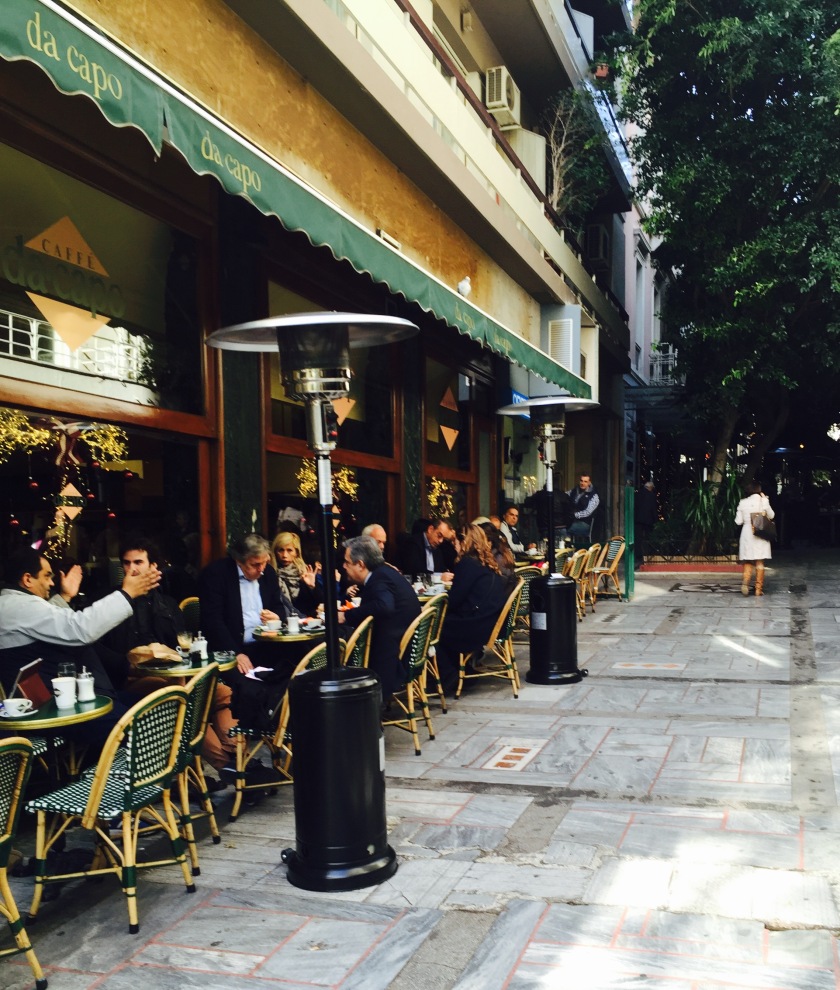
Walk in the streets. Window shop, sit in cafés and people watch, sample street food. Plaka, the old town beneath the Acropolis, is stunning. Wander around the stalls in Monastiraki market.
image

Visit. The Parthenon and the Acropolis Museum should be on everyone’s bucket list. But the city is full of antiquities, beautiful museums, Byzantine churches and art galleries.
Eat. There’s something for every taste, from luxurious gourmet restaurants to neighborhood tavernas. Great fish, in many places with a view of the sea. And ethnic: sushi, Chinese, Thai, Indian, Mexican…
image

Take in a show. Films are not dubbed in Greece, and sometimes there are plays in English. Concerts, classical music, jazz, rock… Dance, classical and modern.

Athens is famous for its nightlife. Bars, discos, Greek bouzouki music.
image


If you like sports, you can indulge: Sailing, windsurf, golf courses. A lot of people don’t know this, but you can ski on Parnassos, two hours out of Athens. The trails are not huge, and on the weekend there are queues, but if you go midweek on a sunny day, it’s brilliant. The mountain is beautiful, the ski instructors are great. You can ski until two, then go down the mountain and have a late lunch in Arachova. Or you can stay in Arachova and visit the temple of Apollo at Delphi the next day. In the spring, you can ski in the morning, then drive down the mountain and through a lovely olive grove to swim in Galaxidi.


image

If you can stay more than a few days:

Rent a car and get out of town (or join a bus tour) for a day trip or overnight stay. The are so many stunning places to visit: Delphi, the Metéora, Nafplion, Korinth, Epidaurus, Olympia.
On a sunny day you can take a day trip to one of the nearby islands. Within an hour or two, you’re in another world. The islands are different in the winter, green and covered in wild flowers. It’s calm, the locals go about their business. At lunch in one of the tavernas, you’re likely to come upon the local policeman eating with the village priest. The owner’s kids will run in after school, and sit at a nearby table to have their lunch and then do their homework. The pace of life is slow and relaxing.

So, take a look at the weather report, and book a flight!

Road trip to Metéora

Taking advantage of the brilliant weather, we headed out for an overnight excursion. Our destination: Metéora, the largest complex of Orthodox monasteries in Greece, outside of Mount Athos.
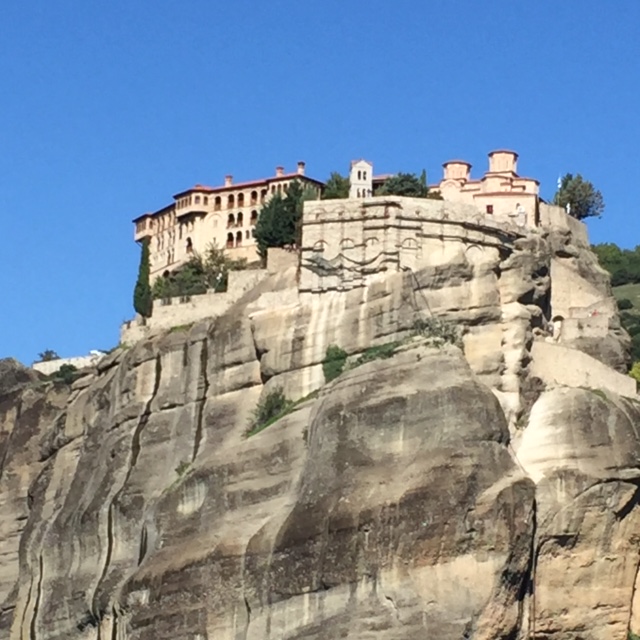
The monasteries are built atop almost inaccessible sandstone peaks, at the northwestern edge of the Plain of Thessaly near the Pineios River and Pindos Mountain, in central Greece.
image

Monks settled on these ‘columns of the sky‘ from the 11th century onwards. Twenty-four monasteries were built, despite incredible difficulties, at the time of the great revival of the eremitic ideal in the 15th century. Today there are six left.

To break up the four-hour journey, we stopped for a snack in the town of Domokos. The crisis is apparent here as well, with a lot of empty shops in the central street. An abrasive woman in a red pickup honked as we tried to park the car. The taverna that had been recommended to us was shut. We asked the woman, who was by now walking down the street, where we could get something to eat, and in two minutes she had managed to sell us a bag of beans – her own production – which she offered to bring to the kebab shop, apparently our best bet.
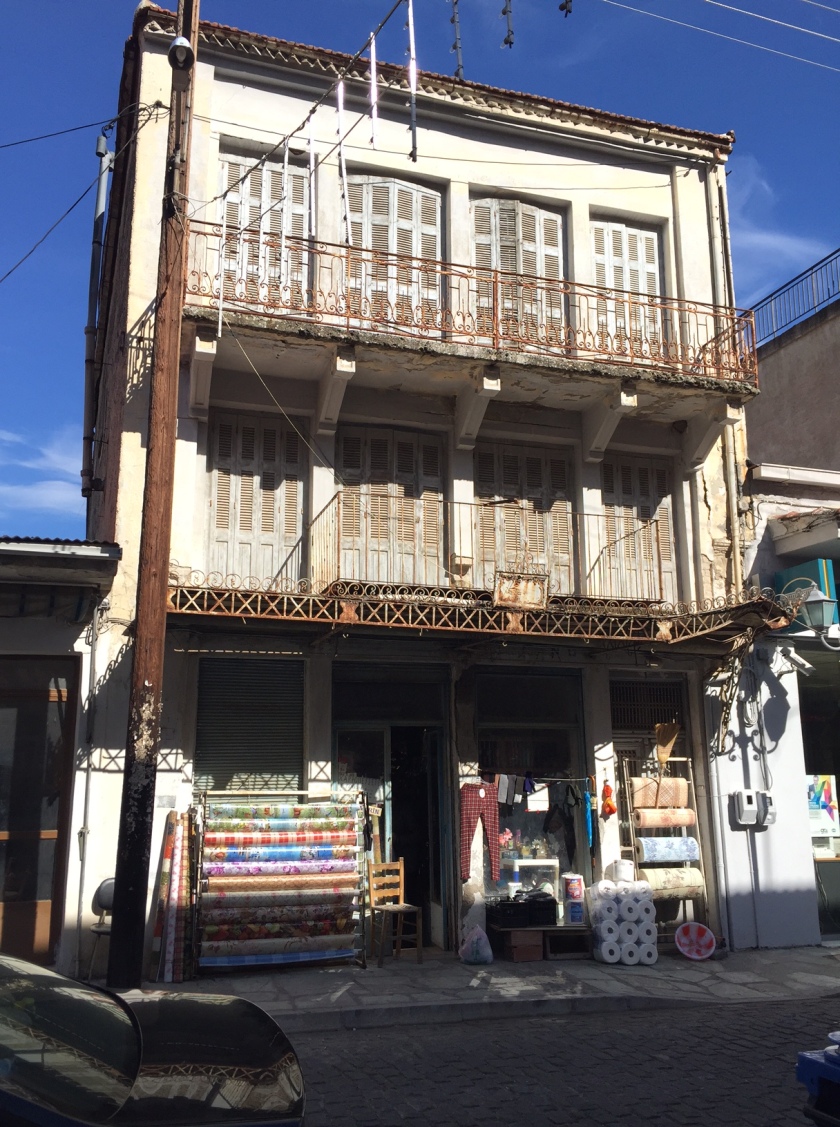
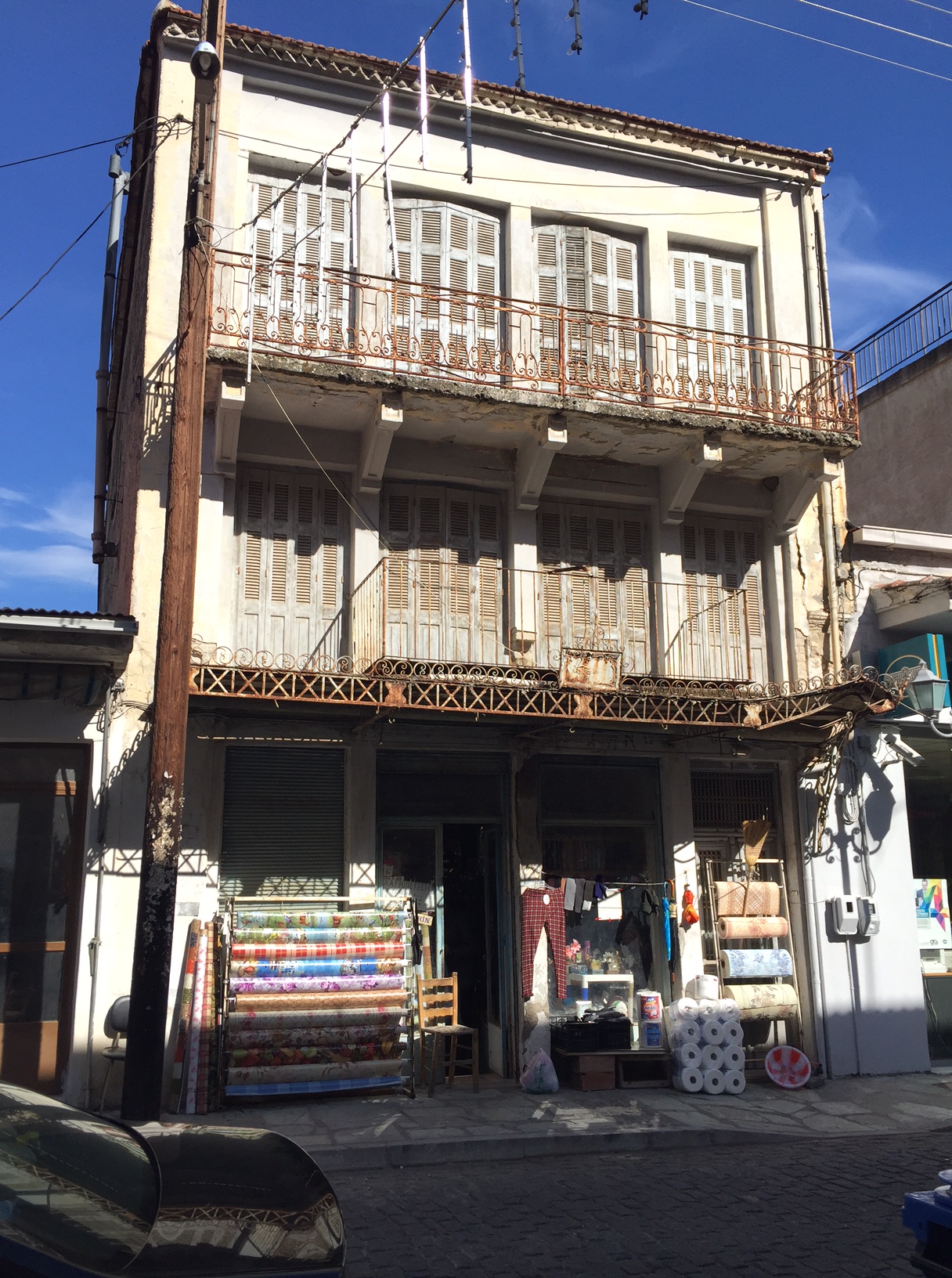
imageAs we walked down the street, ultra-modern shops alternated with more decrepit ones like the one in the picture above, which took us straight back to the 60s. Pyjama bottoms, socks, plastic baskets and kitchen paper – and those rolls of PVC tablecloth in hideous prints that most Greeks used in their kitchen! Some still do, apparently.

Walking into the kebab shop, we looked at each other in dismay. It was tiny, grotty, and the clients consisted of two crusty old men and an elderly lady, sitting at small metal tables. A half-eaten, uninspiring gyros was roasting on a spit. Amazingly, the young man behind the counter made us delicious grilled cheese and tomato sandwiches that were just perfect. In the time it took to fire up the grill, we had become firm friends with everyone. The old guys chattered away through their dentures, the lady spoke Greek with a very strong local accent but perfect English to someone on the phone, and the abrasive woman came in for a bite with us (she had the gyros), bringing the aforementioned bag of dried white beans. We answered the usual ‘Where are you from?’ questions, discussed the monasteries’ hospitality policy, and found out the best place to buy local cheese.

On to Metéora, which was simply magical. There is no other word to describe it.
Metéora in Greek means ‘suspended in the air.’ The sheer majesty of the rocks upon which the monasteries are perched like eagle nests is breathtaking. The monasteries themselves are large, complex, beautiful structures that look as if they’ve emerged from the rock.
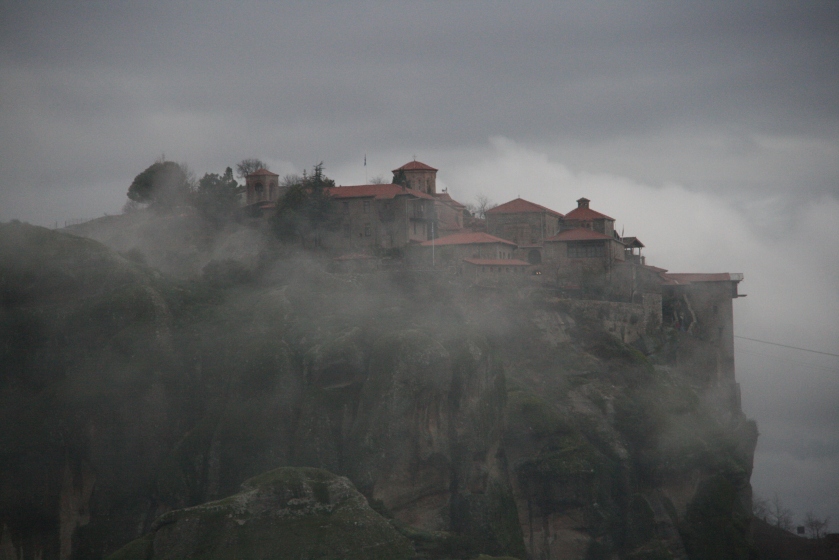
image

We started with the biggest one, Great Metéoro. Nowadays there is a road leading up to the opposite mountain slope. We scrambled down one flight of steps, crossed a bridge spanning the chasm, passed through a tunnel hewn in stone and, finally, faced a climb up another large number of steps – 330 to be precise – to emerge at last upon a stunning view.
The monastery church is a perfect specimen of Byzantine architecture; the 16th-century frescoes covering the walls mark a key stage in the development of post-Byzantine painting. The large courtyard is planted with cypress trees.

Before leaving we inspected the crude net and primitive pulley system by which monks were lowered, at great danger, to the ground, in the days before the road was built.
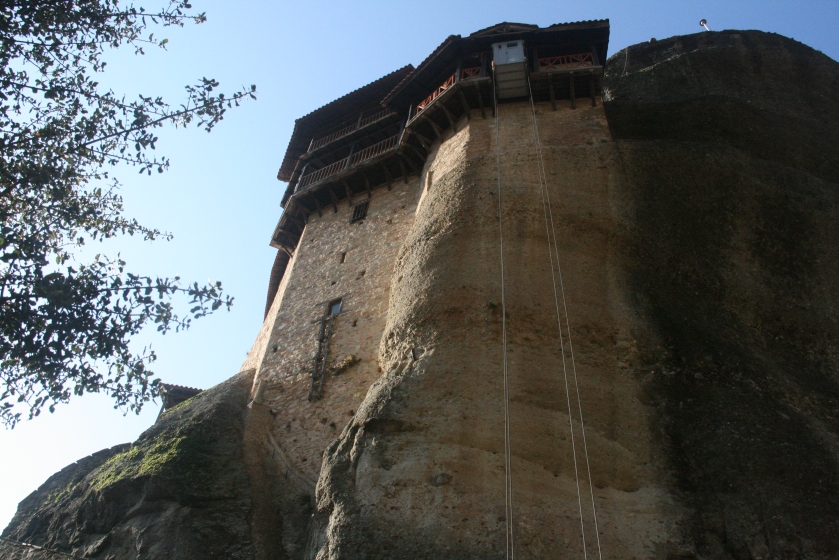
image


After climbing back down all those steps it was time to repair to our hotel, the Dellas Boutique Hotel, a stone building just outside Kalambaka, which is the nearest town. The welcome was warm, and the lounge contained a bar, comfortable chairs and even board games. The smiling girl in charge gave us maps of the area and recommended we visit an exquisite Byzantine church in the town. Then she sent us off to dinner at a taverna down the road serving local specialties.
Our rooms had a great view on the rocks, which were floodlit at night, the fissures and crannies casting mysterious shadows. At breakfast there were home-made jams and cake, local yogurt and honey scented with pine, oregano and thyme. When I asked where I could buy some to take home, I was directed to the local butcher’s! As well as a large display of appetizing meats, he sold all sorts of other products: fresh eggs, herbs, the said honey, even slabs of salted cod. I got my honey, plus some local cheeses; after which he gave me a present of his homemade country sausages, which he even vacuum-packed for me!
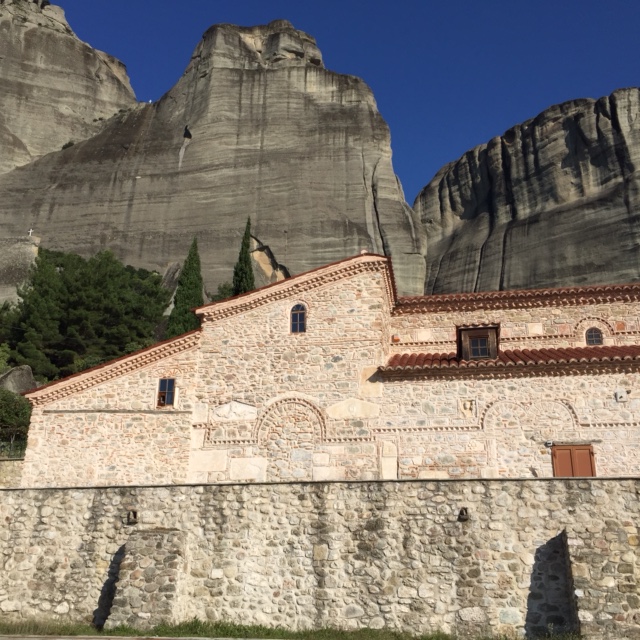
 

imageThe 11th-century Byzantine Church dedicated to the Virgin Mary – in Kalambaka itself – which was our first stop, exceeded expectations. With beautiful and intricate rose-colored brickwork on the outside, its inside walls were covered with frescoes of the Saints and the pillars were of solid marble, since the church was built on top of a temple to Apollo. Part of the floor has been dug up to expose the ancient mosaics.
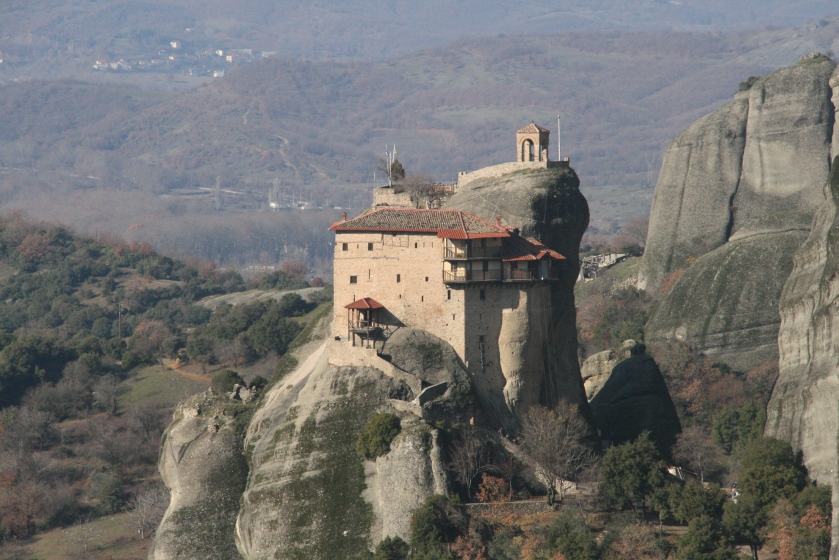
imageNext we made our way to the monastery of Saint Nicholas Anapafsas. We parked the car on the edge of a wood, and there was the monastery, about two miles up in the sky above us! It looked unreachable. As we climbed rough-hewn steps through the woods, the undergrowth was strewn with pink cyclamen and the air was crystal clear. In no time we were at the foot of the walls, and then up the 270 steps to the top. One sole monk lives in this monastery, but it was bustling with life. A lady sweeping the floor told us she worked there ‘for the views’, a bunch of workmen were putting new tiles on the roof, a Japanese tourist was availing himself of the bread and loukoumi (Turkish delights) set out for visitors. The monk said to us, ‘Up here you are in heaven.’
image

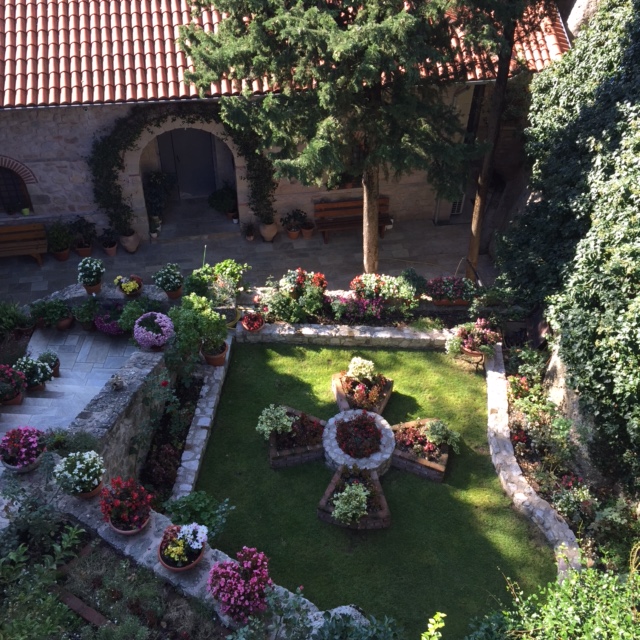
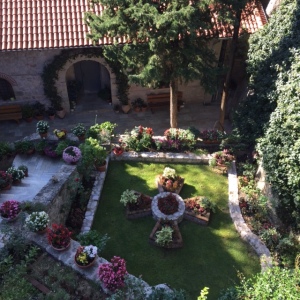
The next two monasteries we visited were nunneries, and the female touch was evident. They both had lovingly-tended gardens, full of roses and lavender. The larger of the two, Aghios Stephanos,  is inhabited by 31 nuns.

The monasteries have small museums containing frescoes, precious relics and illuminated manuscripts. Every window or terrace has a different view, of the rocks, of the other monasteries seen from below or from above, of the Thessaly plain and the glint of the river.
The people who first climbed the rocks and built upon them, trying to find protection from the raids of various conquerors, established a tradition of Orthodoxy which has continued uninterrupted for 600 years. Today the Metéora is included on the UNESCO World Heritage List.


image

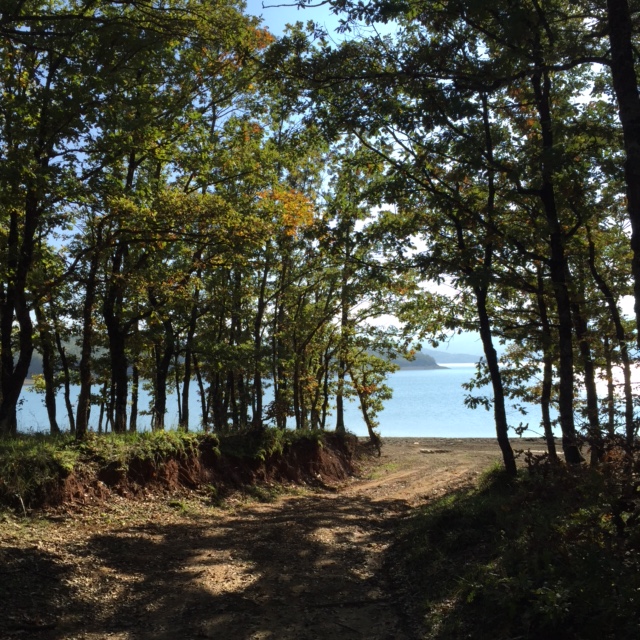
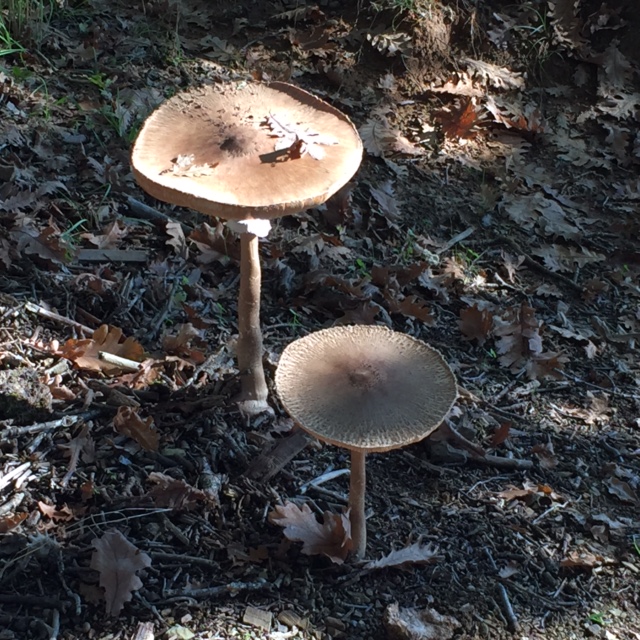
Before heading for home, we made a detour to catch a glimpse of the man-made Plastiras Lake, named after the Greek prime minister who had the vision of building a dam across the Tavropos River in order to irrigate the plain of Thessaly. It was a glimpse only, since the lake is large and surrounded by an area of exceptional natural beauty. It merits a trip in itself, in order to explore the villages surrounding it and enjoy the various activities on offer. We only had time to stop for a delicious lunch at a roadside taverna, where once again the owners were friendly and welcoming, as well as being great cooks! After lunch and a chat, we walked through oak woods dotted with mushrooms to the shores of the lake, whose waters were calm and clear as well as – we were told – teeming with fish.
image

Some photos are mine , others by Anna Koenig. I will leave you to guess which! To go on the Dellas Hotel site, click on the name. Great value for money.