How about some poetry instead of the relentless march of horrific news we are subjected to daily?
I never watch the news live anymore. I only scroll through the titles, glance diagonally in case something catches my attention and read pieces that interest me—about new books and films, art exhibitions, or people who do unexpected and funky things. My children mock me about being a fringe reader, but I do enjoy it.
Irrelevant but hopefully cheering sketch
Looking through available films on iTunes and elsewhere, I notice a huge number are horror movies. This is amazing to me—aren’t people horrified enough by what is happening in real life but they need to scare themselves further? To each his taste, I suppose.
Meanwhile, there is nothing more soothing than poetry, so I leafed through favourite books to find something to improve your day. Browsing, I realised a great number of poems deal with grief, loss, fear and other lowly feelings—of course, expressed in beautiful language. Nothing like newspaper articles, but still. Even the Romantics are very concerned with death and loss of love. However, there are poems to lift the heart, so here is one of them, about the transformative power of words, by Dylan Thomas.
Notes On The Art Of Poetry
I could never have dreamt that there were such goings-on in the world between the covers of books, such sandstorms and ice blasts of words,,, such staggering peace, such enormous laughter, such and so many blinding bright lights,, , splashing all over the pages in a million bits and pieces all of which were words, words, words, and each of which were alive forever in its own delight and glory and oddity and light.
After years of getting rejections for my writing, I finally signed with a publisher
If rejection letters were paper, I could have covered my bedroom walls with them (or made a bonfire). Thankfully, nowadays they are digital, so they remain hidden in an Excel sheet (just so that I can remember not to submit to the same agent/publisher twice!)
But let me go back a little: I have always loved writing from an early age, and in high school served as editor of the school mag, entitled Sunny Days. This activity alleviated hours of boredom in class, where I could correct texts and draw the artwork while the teacher droned on…
Earlier even than that, at age 10 or 11, I was let loose upon my mother’s bookshelves. She was a great fan of Agatha Christie and Georgette Heyer, both of whom I devoured (as well as a great variety of other authors, some more highbrow than others.)
This must have been the cover at the time.
Over the years, I wrote a number of short stories, some of which were placed in competitions, while others were published in Anthologies and online magazines (I got plenty of rejections there, too.)
I was (and am) a rabid bookworm, reading over a wide range of genres—literary fiction, memoir, short stories, historical novels, travel books. For entertainment I read mystery and crime. No romance.
Later I set myself the task of writing a book and of course I decided upon mystery. I took some online courses and attended the Festival of Writing at York twice (the most fun time). I completed no less than two novels, one set mainly on a yacht in the Greek islands, the next in the world of international horse racing. I really found it interesting and fun to work out the plot, the red herrings and twists and cliff hangers.
I started the process of querying agents but, although I got great feedback from some and quite a few requests for the full manuscript, the final answer was no. It was never the right timing, or quite the right thing for their list at this particular moment. Most just ghosted me, a practice I find at best impolite when they have requested the whole ms, however busy they might be. Publishers did reply, but still it was no.
I considered self-publishing but, after a lot of research, realised it would be very costly—both in money and time spent—in order to be done properly. Even if you self-edit to death, even if you find beta-readers for free, even if you design your cover yourself, it’s not enough. You need professional edits, a great cover, proper promotion. I’m not good enough to do it, don’t have the time or patience and I am too proud to press the button on a shoddy job. So I persevered and am still persevering.
This is a mock up I made for the cover of one of the mysteries, when I was considering self-publication
Meanwhile, lockdown happened and, having more time on my hands, I started re-reading Jane Austen, whom I had not touched since school. She has stood the test of time for a reason. Then I went on to read some of Georgette Heyer again, and really enjoyed the banter and great writing. One thing led to another and, having shelved the mysteries (for now) I have written a number of Regency romance novellas.
Amazingly, I sent one off to an indie publisher and got a favourable reply! I was astonished, as I had actually forgotten about it. However, my excitement was quickly dampened because, after I signed the contract, they then went radio silent for the whole summer. Apparently one of the team had a medical problem, so delays were understandable, but emails went unanswered which freaked me out a little. I reached out to one of their authors who explained this can happen with indie presses because they are short staffed, and that patience was needed. But still.
However, they returned with a vengeance and now things are moving fast. My editor Lisa was lovely and actually there was not much to change or correct. The discussion about the cover went well. Publication date is early December, all fingers crossed—and I am panicking a little because there are so many things to do. I had to set up a Facebook page (I hate Facebook), and IG and X accounts. I have joined the Author’s Guild of America (the publisher, Cupid’s Arrow Press, is American) which is great: there’s a fantastic forum where you can get feedback and advice from other writers, they have tools for building a website, which I have done, and they even offer legal advice if you need it. But there is still a lot to do, and I am new at this.
A glimpse of the cover (detail).
My book is called Marguerite, which is the name of the heroine, but more about that in another post. I am using the pseudonym Marina Montrose for the novellas.
Stay tuned for further developments. I know historical romance is not everyone’s cup of tea, but I hope some of you at least will read and enjoy it. I would be honoured.
Wild thing is a life of the artist Paul Gaugin. Sue Prideaux does her subject proud—she is a sympathetic and judicious biographer who writes like a novelist and has researched her subject from different angles.
The biography contains information which was new to me. Gaugin had an extremely varied and interesting life, knowing both riches and poverty.
I will not reveal too much detail because it is a book well worth reading. But did you know that Gauguin:
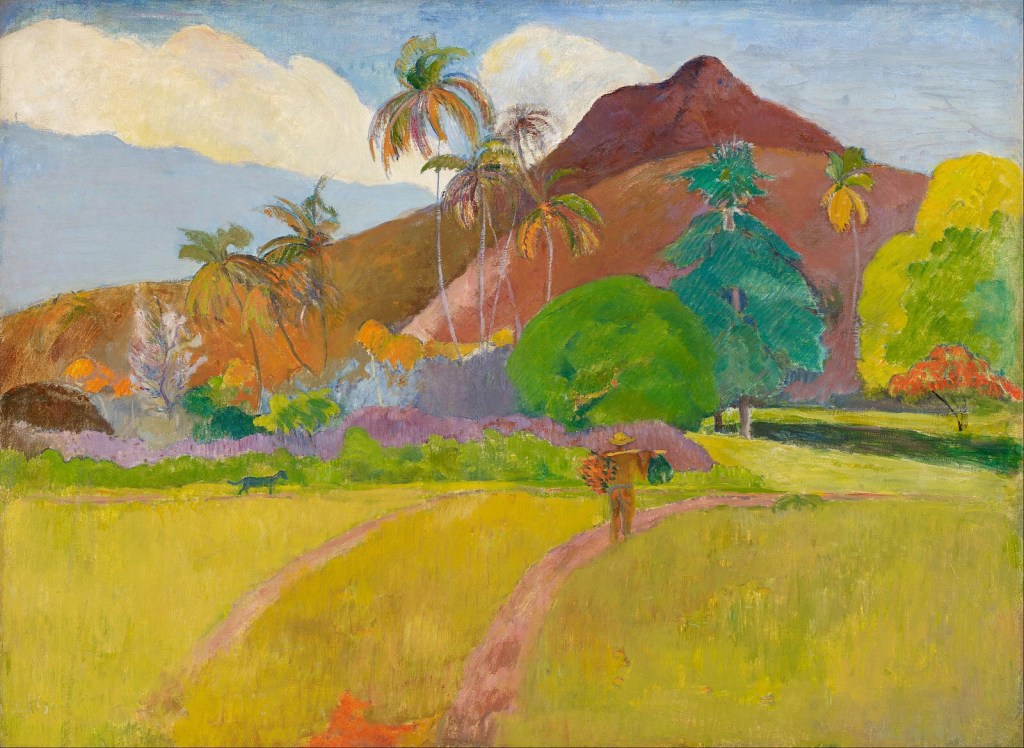
Paul Gaugin, Tahitian landscape
-Spent the first seven years of his life in Peru, which left indelible impressions of colour, heat and life in him? To my mind, this explains a lot about his palette and use of colour.
-That he then led a very bourgeois existence, working at the Bourse in Paris and becoming extremely wealthy? Even as he started painting and married, he lived luxuriously, spending without a thought for the future.
Then the Bourse failed in 1882 and for the rest of his life he was poor, living a hand to mouth existence, begging and borrowing from friends. He often did not have enough to eat.
La vision après le serment, 1888
-That he had a very complicated and close relationship with Vincent Van Gogh, which continued up to his death. Read the book to find out details of the famous ear-cutting episode.
-That Vincent’s brother, Theo Van Gogh, was Gauguin’s agent.
-That he was deeply affected by attending a public execution in Paris: the death by guillotine of a mysterious murderer.
-That he was greatly inspired by the colonial exhibits at the 1889 Exposition Universelle in Paris, where the Eiffel Tower, built for the celebration, soared heavenward, lit by electric light. Round its feet sprang recreations of the colonies and their treasures, from which he borrowed elements and incorporated them into his art. For this Camille Pissarro called him a bricoleur, a cobbler-together of second-hand ideas.
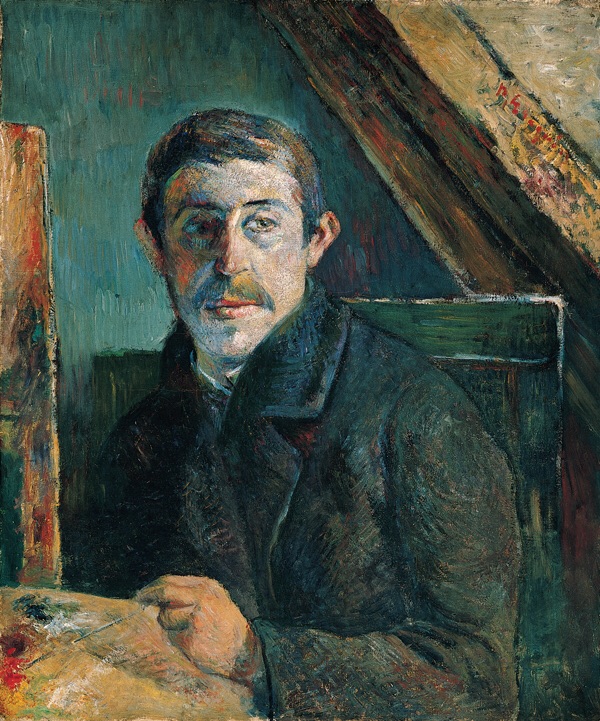
Self portrait
The book details his marriage and relationship to his children, and his friendships and dealings with prominent men of his world, such as André Gide, Pierre Loti, August Strindberg, Frederick Delius and others. One of his main supporters in hours of need was Edgar Degas. The biography is full of delicious anecdotes of this crowd of supremely talented men.
Finally we get an account of his latter years in Tahiti, where he ended up almost by chance. Gaugin’s life is one of the richest in the history of wester art, and Sue Prideaux does it full justice.
Les ancêtres de Tehamana, 1893 (portrait of Tehura).
On a flying visit to London I took the opportunity to see an outstanding exhibition of the work of American artist Kerry James Marshall.
2009. Acrylic on PVC panel. Notice the painting by numbers on the wall?
I had never before seen his paintings in person, and they are very powerful indeed.
Untitled (Studio) 2014. I love the bright pots of paint—the yellow seems to have dripped onto the dog under the table.
Marshall is an artist possessed of a vivid imagination, and his work is full of references which span art history, civil rights, comics, science fiction, his own memories and more.
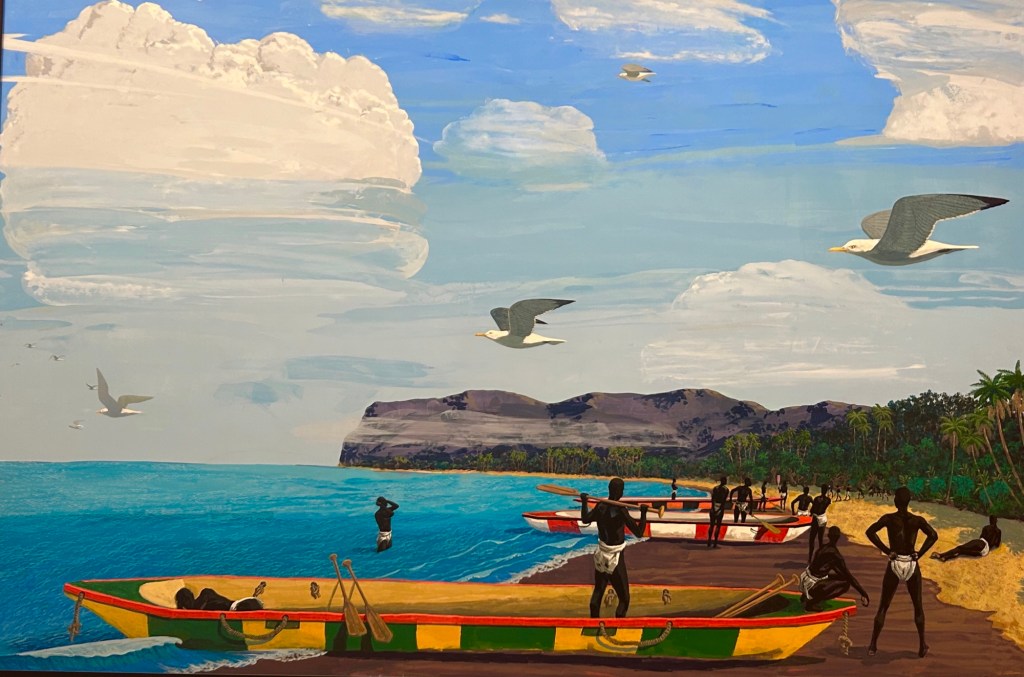
Untitled (the Cove)
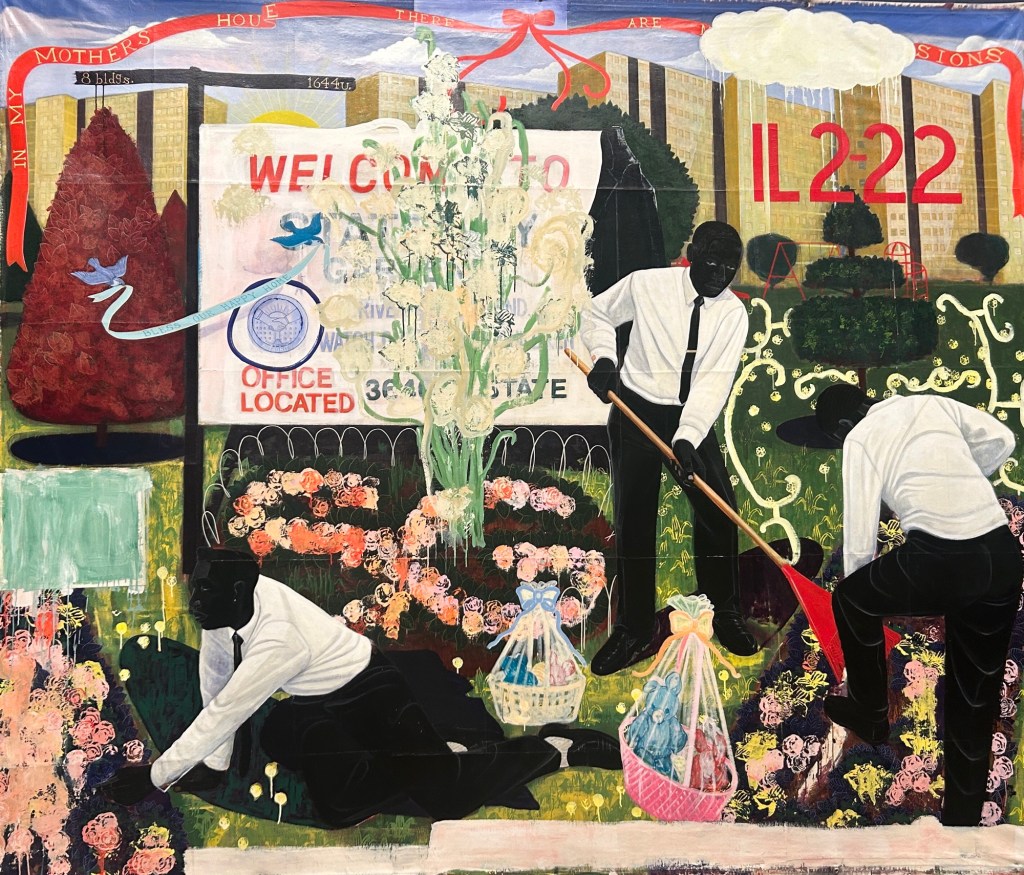
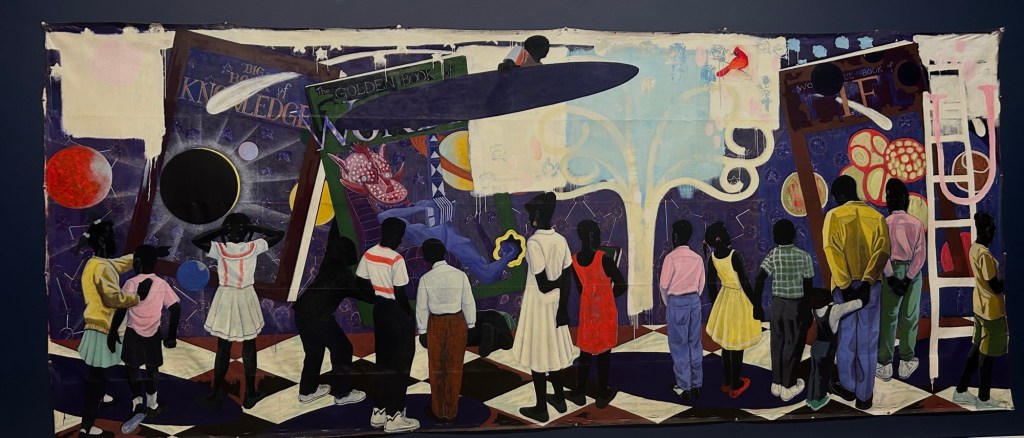
There is a very wide range of work on display, and I cannot say I liked it all, but the large paintings—some just huge sheets of canvas pinned to the wall—were fascinating. They are vivid, acrylic works full of signage, collage and hidden references; they are realistic, but also contain allegory and symbolism.
Many Mansions 1994. Acrylic on paper
Every painting tells a story—and every time you look, you notice another detail. Sheets of music, code numbers, letters and words, flowers and animals. There are references to historic events, especially concerning Black history and slavery, but he also celebrates daily life and imagines optimistic futures.
This was an enormous roll of canvas pinned to the wall. I love the people’s postures and their bright clothes
An artist and professor, Kerry James Marshall was born in Birmingham, Alabama, in 1955, and is probably one of the most influential painters working in America right now. In 2017, Marshall was included on the annual Time 100 list of the most influential people in the world.
For some reason most of the photos I took were crooked, so I had to crop them before posting.
His subject matter is African-American life and history. If you zoom in on the photos, you will notice a lot more detail.
Untitled (Underpainting) 2018. Monochrome work (literally an underpainting) of Black kids on a museum trip
Despite his often bleak subject matter, Marshall’s work is joyful and optimistic—due to his vivid palette, but also because his subjects appear to be enjoying themselves.
Keeping the Culture, (2010, Oil on board) depicts an Afrofuturistic household where the future merges with the past.
In a 1998 interview with Bomb Magazine, Marshall observed:
“Black people occupy a space, even mundane spaces, in the most fascinating ways. Style is such an integral part of what black people do that just walking is not a simple thing. You’ve got to walk with style. You’ve got to talk with a certain rhythm; you’ve got to do things with some flair. And so in the paintings I try to enact that same tendency toward the theatrical that seems to be so integral a part of the black cultural body.”
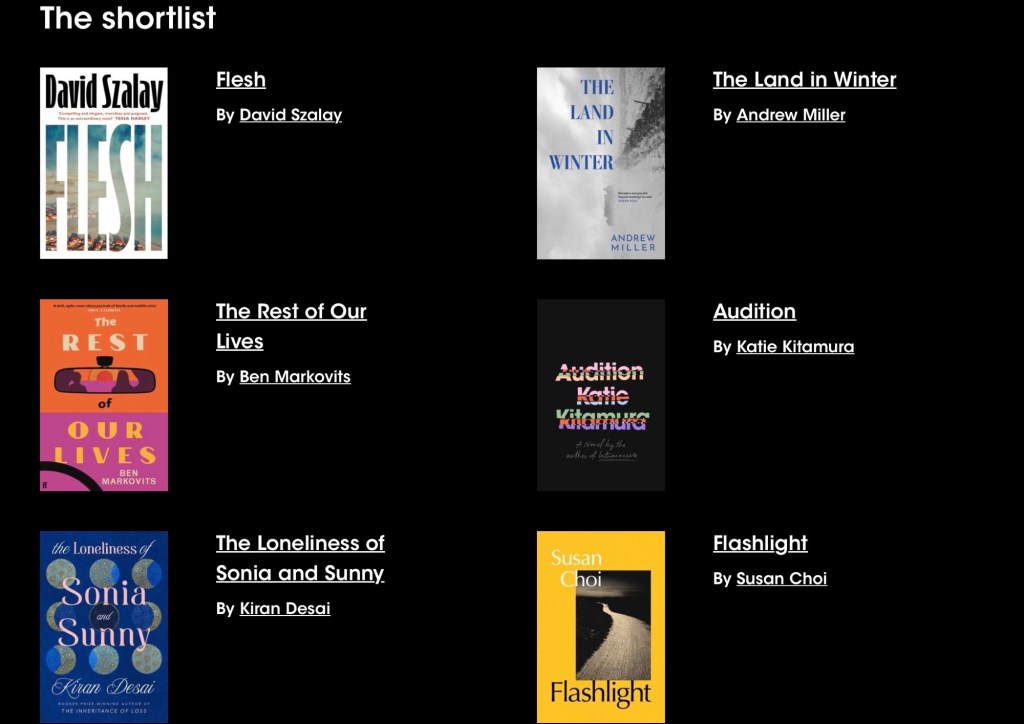
The Booker Prize season has come around again, and the shortlist has been published. Let me say at once that I have not read any of these books, but last year the list contained some pretty good stuff, so I am hopeful of a repeat, especially since Roddy Doyle is Chair of the 2025 judges and he knows a good story when he sees one.
Photos from the Booker Prize site
I don’t suppose I will read them all, and I will look at some on the long list as well, but one I am looking forward to tackling is 700-page The Loneliness of Sonya and Sunny, by Kiran Desai (who has won it before in 2006 with The Inheritance of Loss.) It reminds me of another doorstop, A suitable Boy by Vikram Seth, which I devoured at the time. Many years in the making, it is an epic tale of love and life.
Flesh, by David Slazay, is (I quote the Booker Prize site): “A propulsive, hypnotic novel about a man who is unravelled by a series of events beyond his grasp.”
The Land in Winter, by Andrew Miller, is about two couples, a doctor, a farmer and their respective wives, whose lives are upended in the middle of a harsh winter landscape.
The Rest of Our Lives, by Ben Markovits, is about a middle aged academic who goes on a road trip after his wife has an affair, trying to escape his problems.
The last three all seem to be about lives unravelling. Hmm…it depends how each writer deals with the subject.
Audition, by Katie Kitamura, is about the relationship between two very different people: an attractive actress and a man young enough to be her son. Intriguing.
Flashlight, by Susan Choi, is a saga about a father’s mysterious disappearance and the reverberations of this event on his family.
All six authors are deep into their literary careers, with a number of books to their name and, besides previous winner Kiran Desai, Andrew Miller and David Szalay have been shortlisted before.
If (or when) any of you read any of these books, I will be glad of an opinion. In any case, a pile of new books is always enticing, even if at the moment it is not on my shelf but only on my screen.
Nature is fickle—I assume it is a combination of factors such as sunshine, rain, frost, heat and cold in varying amounts that determine whether the grass grows much or little, how vegetables will grow and how much fruit trees will produce. I do not profess to be much of a gardener—what I like is to observe and gather.
This year we have had a profusion of fruit, starting with cherries. Usually the birds get the lot before they’re even ripe enough to pick, but this year we ate our fill, and made pies and jam. Then the mirabelles, small yellow plums, reappeared en masse after some years where there were few and far between. And greengages on a tree where I’d never seen any before.
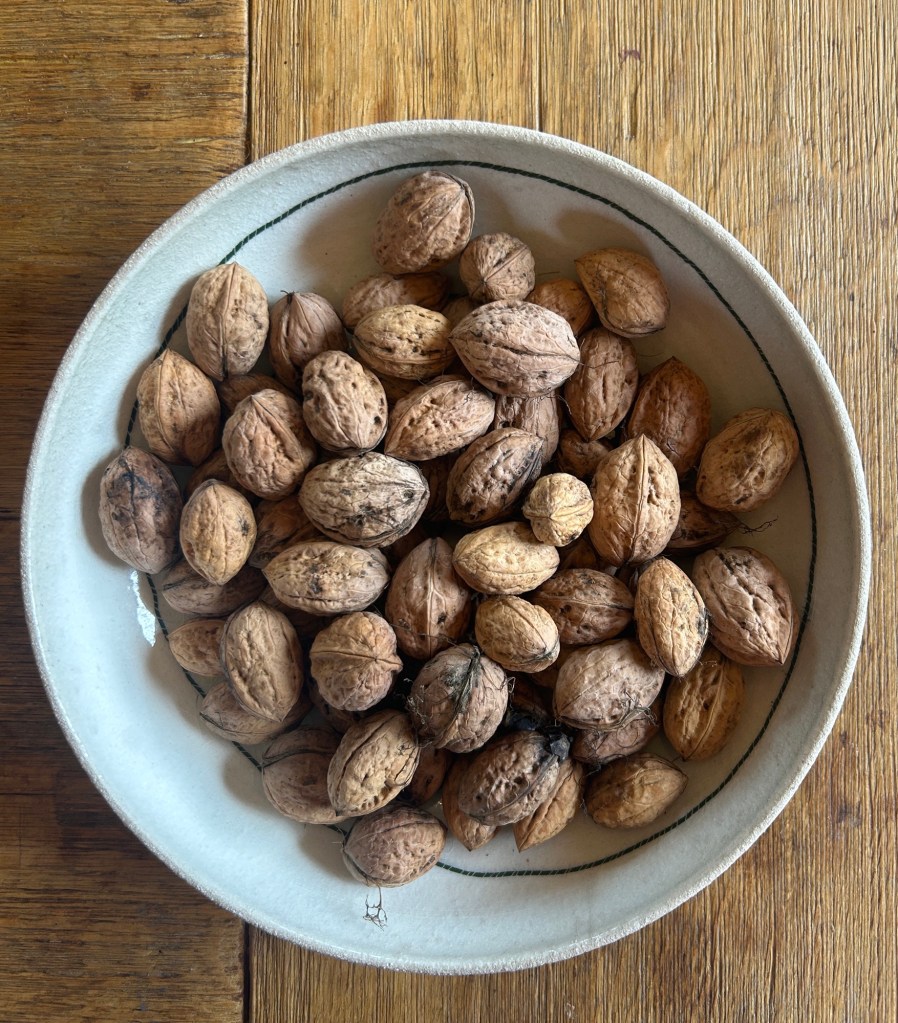
We also have walnuts, although I saw a red squirrel skitter up the tree—there are enough for everyone.
The crabapples are the dog’s delight for a mysterious reason (they are hard and sour).
The pears are ripening slowly, as are the apples.
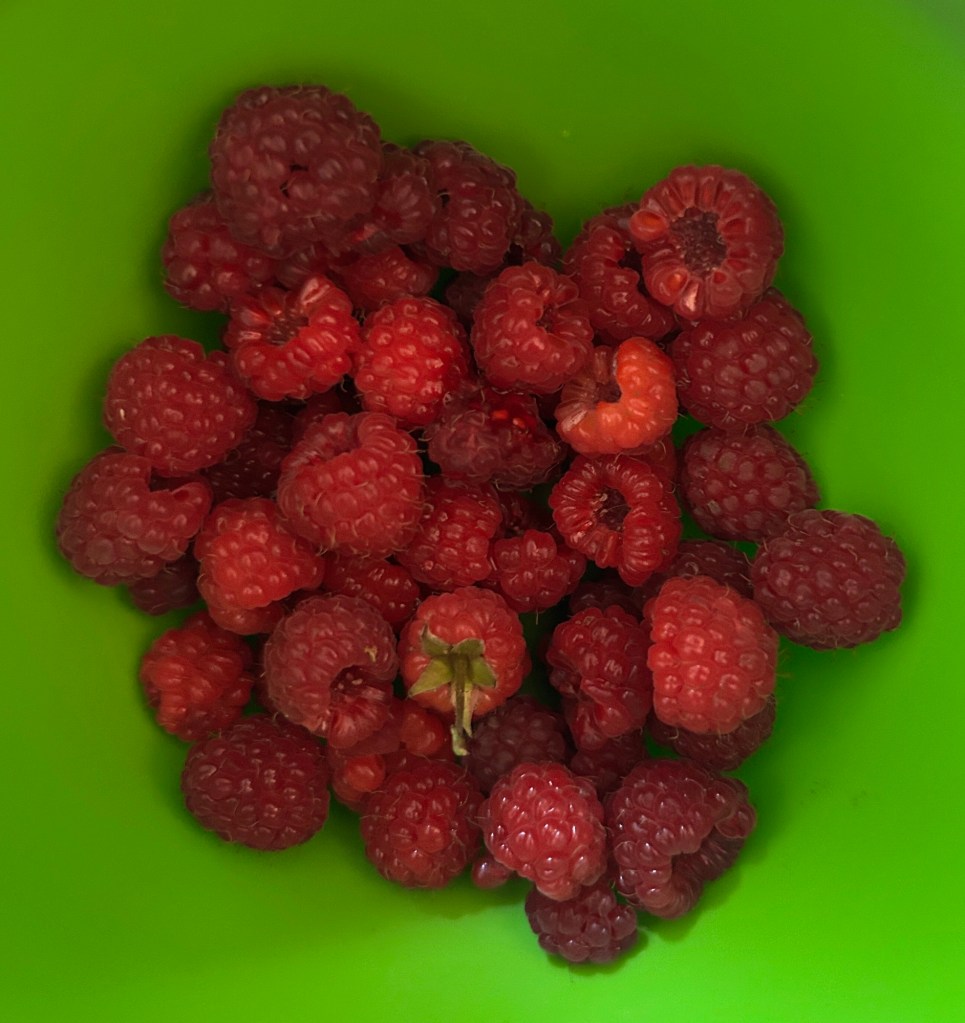
We still have raspberries which stain my morning yogurt a vivid scarlet.
And lovely courgette flowers—they are delicious split lengthwise and sautéed quickly with a drop of lemon. And the courgettes themselves, of course. Together with late tomatoes and green beans.
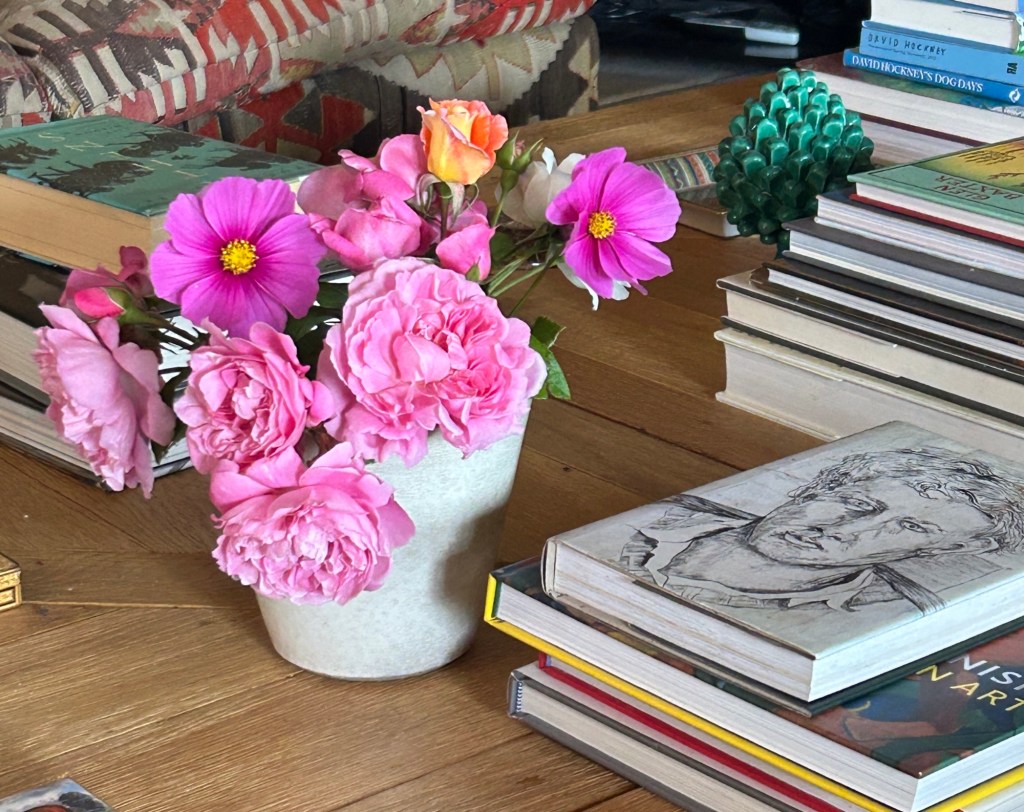
Finally, lots of flowers still. It is a delight to be outdoors, even though there’s a chill in the air.
In more news of my trip to Japan, one afternoon we went to the Mori Art Museum expecting to see contemporary art, only to find there was an exhibition on the architect Sou Fujimoto.
This proved to be fascinating, because he was inspired by the shapes in nature to create buildings which are both avant garde and pleasing to the eye.
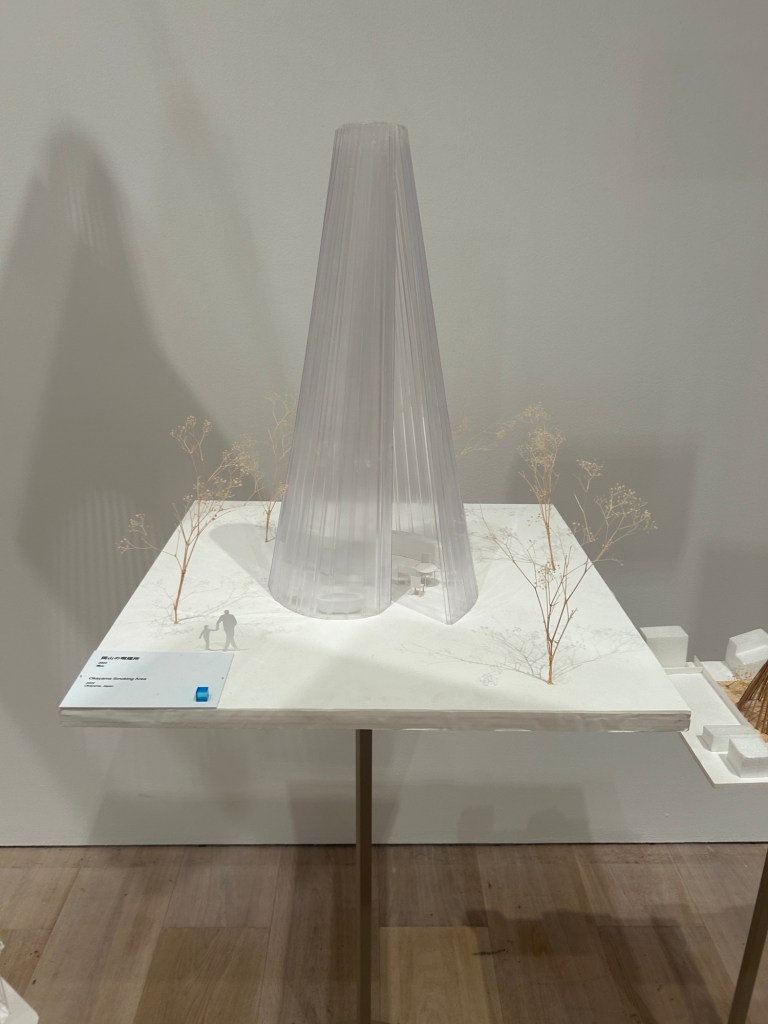
Okayama smoking area. 2022
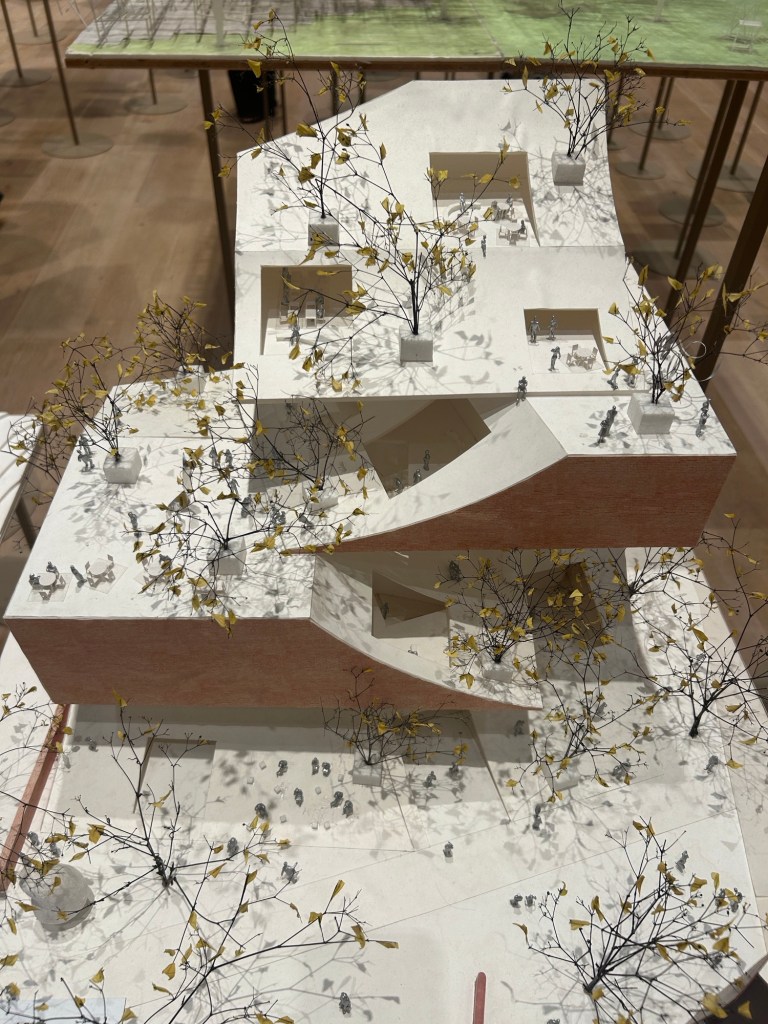
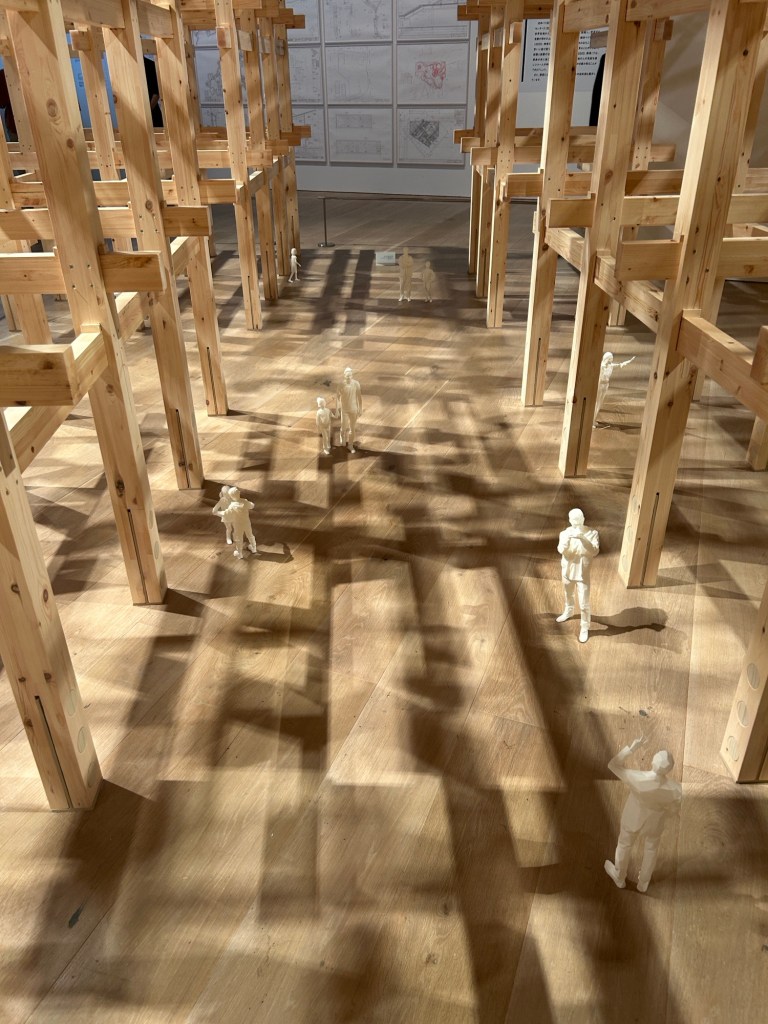
The exhibition consisted of maquettes of a variety of mostly public buildings, some of which had actually been built, while other had not, due to practical or financial considerations.
This is a plan (below) for an urban hub to be built along the Sava river in Belgrade, where ‘the building converts flows of people into architecture, creating a “cloud” of slopes that converge in a spiral.’ Pretty cool, no?
Béton Hala Waterfront Center. 2011 (conceptual) Belgrade
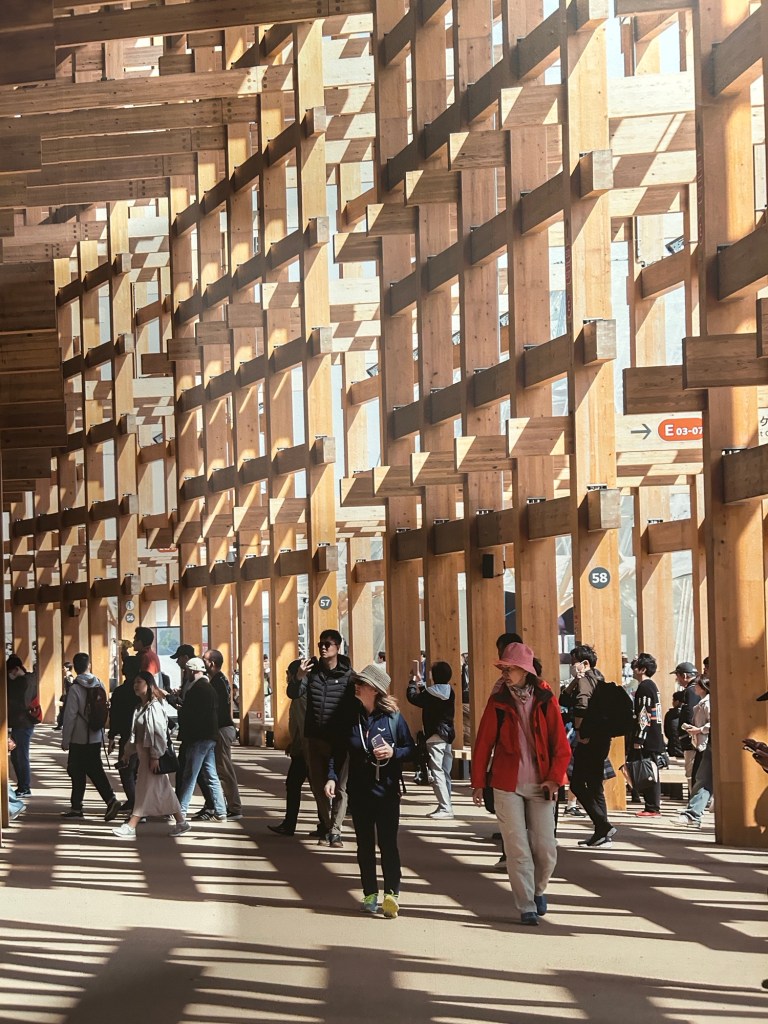
There was one mock-up, The Grand Ring for Expo 2025 Osaka, Kansas, which was impressive if one considered the scale.
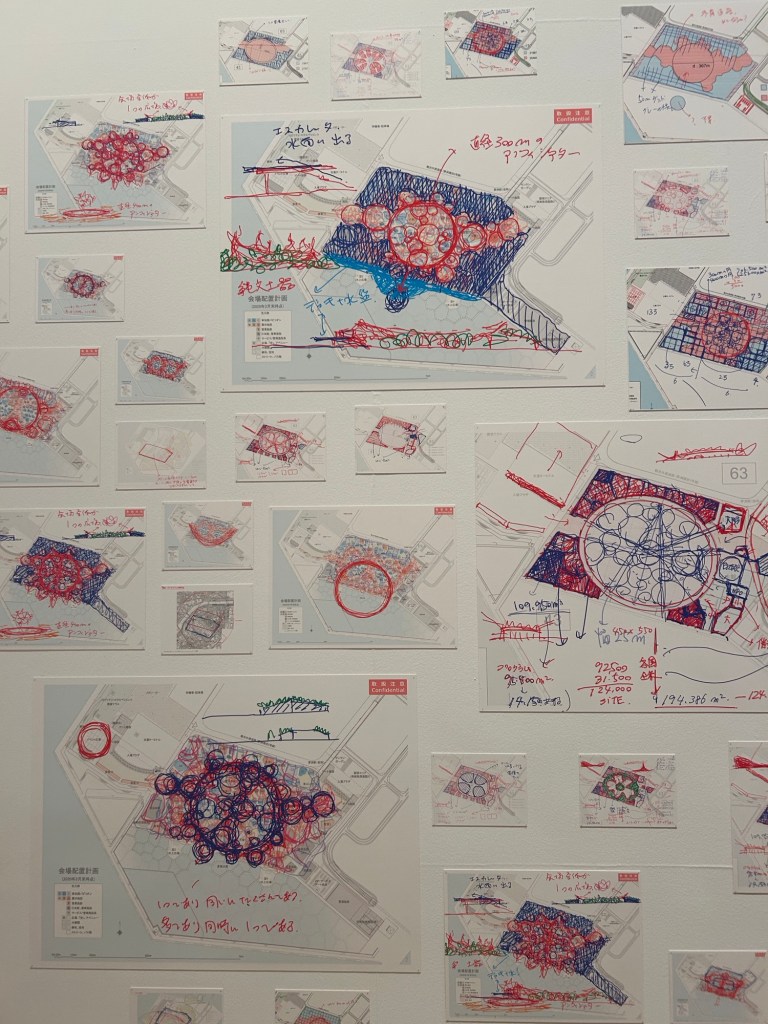
A number of Fujimoto’s sketches on display gave insights into his thought processes, as did a video where he is interviewed and talks about his inspirations.
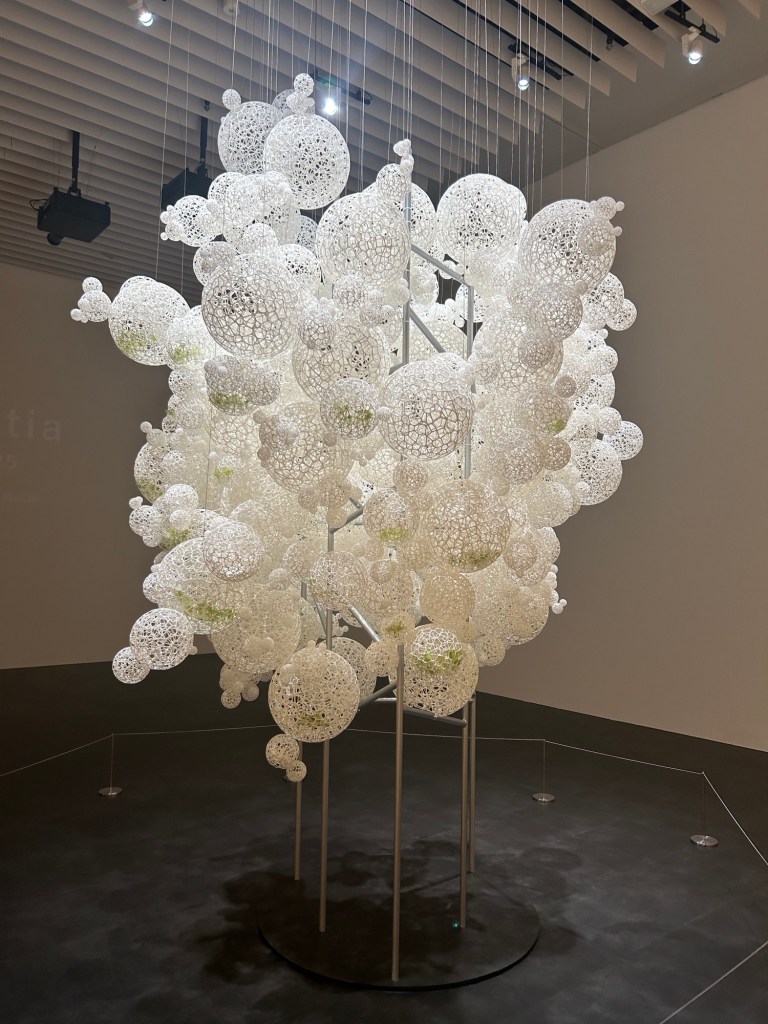
There was even a futuristic city made up of spherical units which ‘function as “breathing devices” rather than mere structures.’
‘In this future city, we define space not merely as a container, but rather a place where different values and life forms can meet and converse with each other.’ Perhaps we will have a need of cities like these when we have polluted our planet beyond redemption…
There are myriads of wonderful discoveries to be made in Japan, but the first I came into contact with on a recent trip disconcerted me. Upon arrival in Tokyo, I walked into a blindingly clean bathroom at the airport (cleaner than mine at home?) to be confronted by a toilet which was a triumph of high-tech engineering.
As I approached it, a veritable tsunami occurred within the bowl, water swirling around with such gay abandon I stepped back. What the hell had happened? I had touched nothing. I later found out the noise was to prevent your neighbour from hearing you pee. Being in an international venue, at least there was a notice explaining, in pictures, how to flush the thing—a task more complicated than you might think. There was obviously nothing so vulgar as a button to push or something to pull, or even something obvious to hover your hand over. A discreet metal plate in the wall. Then another tsunami.
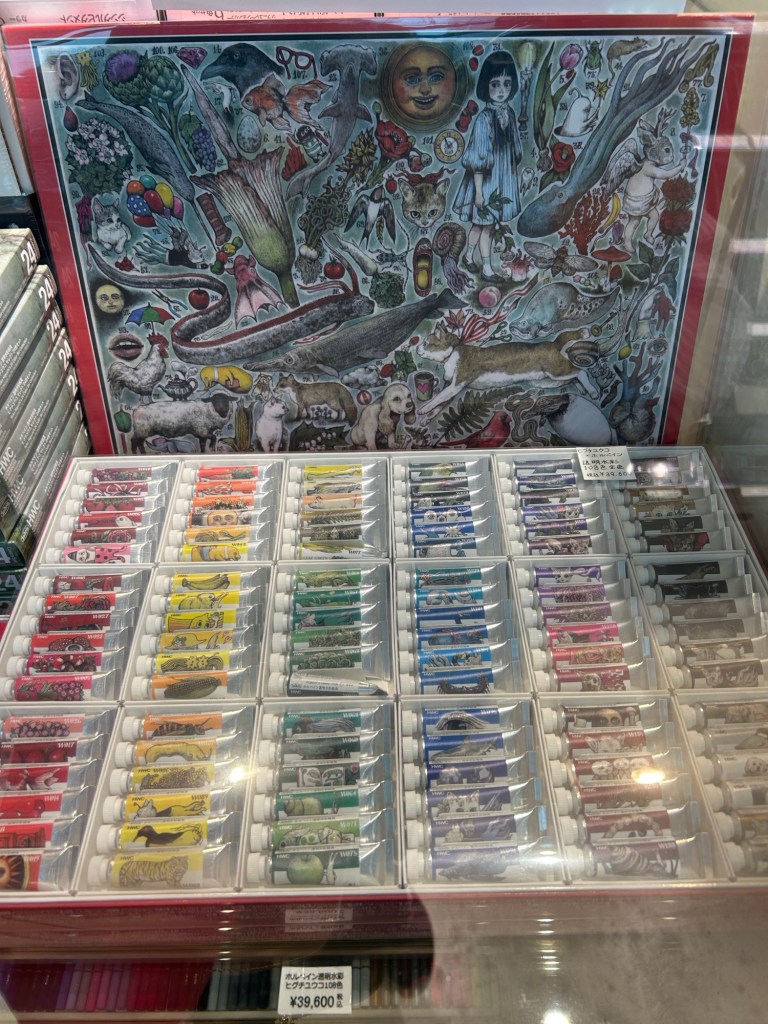
A dreamy box of watercolours. Art in itself.
I walked out thinking I had conquered this bit of local culture, at least—but no. There are many brands (TOTO being the elite) and types of toilets in Japan, adorned with a dizzying array of functions—to warm the seat, deodorise, etc etc. It’s all somewhat similar to a sophisticated car wash! In one hotel, the toilet would sense your presence and the lid would slowly rise as you approached, like some large carnivorous jungle flower. It was a little disturbing at first. Apparently some can even make you a quick cup of coffee or print out a shopping list, but I have not met them yet 🙂
The beach in Okinawa.
I loved everything about our trip—the food, the wonderful trees everywhere, the people bowing to each other. It is a very elegant custom and a lot more hygienic than the European fashion of kissing all and sundry. A lot of working people such as taxi drivers still wear white gloves.
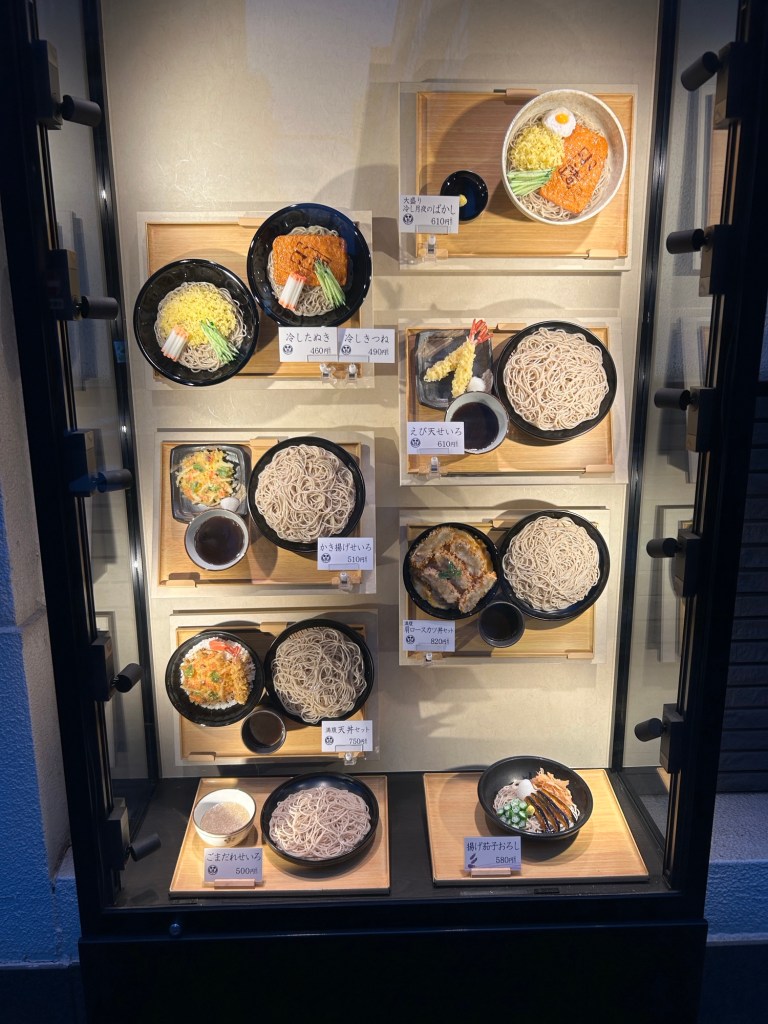
The menu in a tiny restaurant up some rickety steps in Tokyo
Not many Japanese speak English, and why should they? They are a population of 123 million on their islands and inhabit their own world. The communication problems are easily solved with little pocket translators that everyone seems to carry. We relied heavily on Google Translate—for example, when arriving at a restaurant to discover the name was only written in kanji.
This is how you choose your food
Also they use laminated photos, or even fake versions of the food (see above) so you can see what you’re ordering. I loved it that even the food they qualified as ‘western’ had a Japanese twist to it—a sliced pickled radish here, a sliver of raw fish there.
French toast—a ‘western’ breakfast with a twist
Everything was delicious—tempura and sushi made to order before our eyes, street food, even the onigiri (rice balls or triangles) from the 7-eleven.
Most delicious ice cream
There are vending machines everywhere—selling beer, soft drinks, ice cream and all sorts of other stuff. It is very amusing when everything looks so different from the stuff at home. It all costs thousands in yen (but we did refuel the car for the equivalent of €23…)
If you zoom in, these are called Honnamayokan. Who knew?
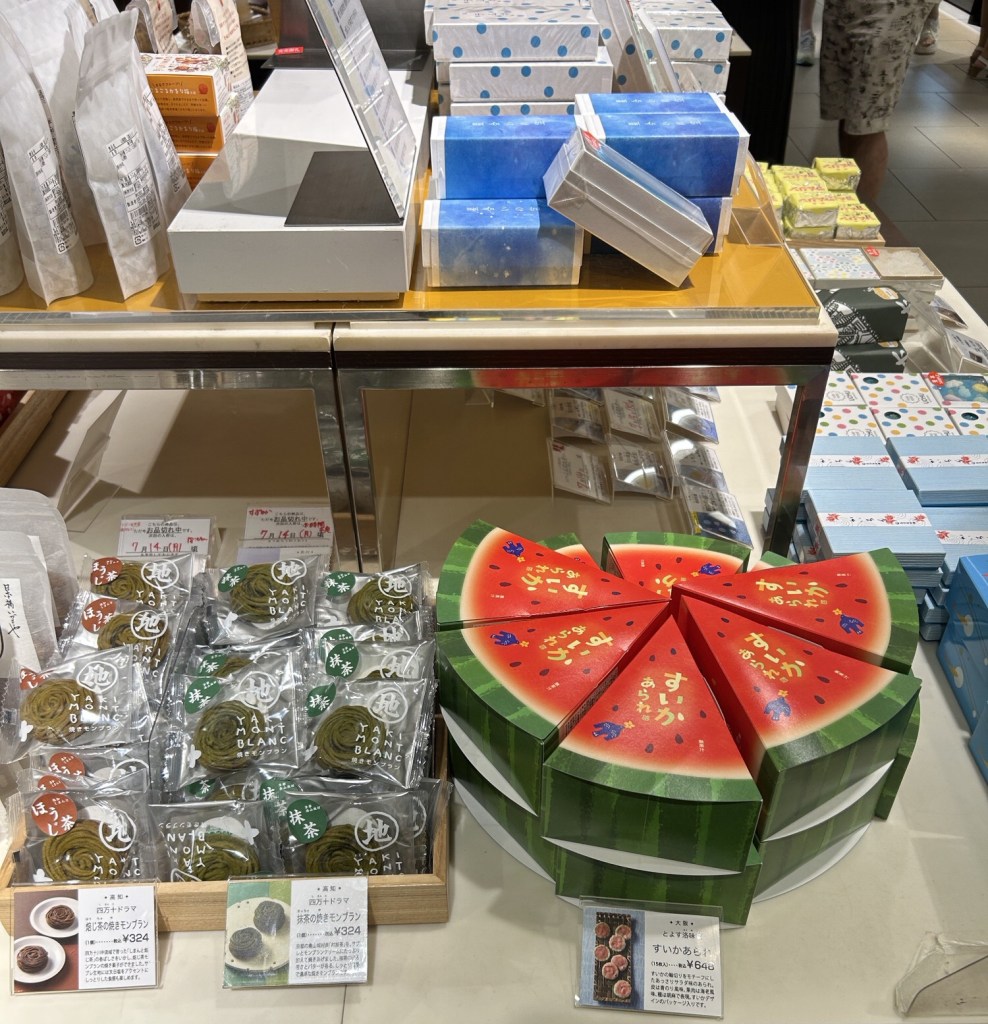
A visit to the food hall in the basement of department stores is a voyage in itself. Almost nothing is recognisable…
The most wonderful packaging
Also, the cars! Models that are not sold in Europe. I totally fell in love with the little boxy cars in Okinawa, where we spent a few days. Especially the little mint green Suzuki.
My dream car—so cute
I liked everything about our trip, so much so that, if I could possibly learn Japanese, I would seriously consider never coming back. Meanwhile, I am sorely tempted to acquire a TOTO toilet but sadly I do not think a Normandy plumber could cope with it.
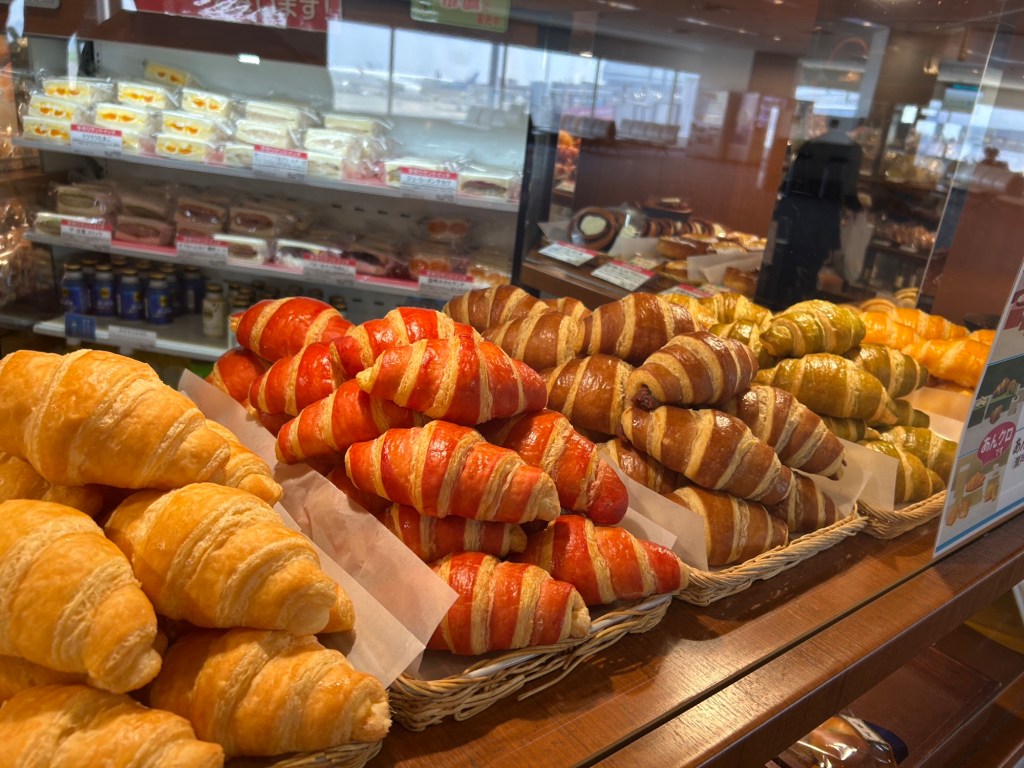
Croissants at the airport
More Japanese discoveries in later posts. Stay tuned.
La rentrée is the French expression for the end of summer, when everyone returns from their holidays and the kids go back to school. An expression guaranteed to provoke annoyance if not anxiety in childish breasts. As a child in Greece, I remember being enervated by cliché talk of ‘the first rains’ (after months of drought) and ‘every rascal goes back to his desk’. It was the last thing we wanted to hear after running around barefoot and half-naked for three months. Back to ghastly leather shoes and blue overalls with white collars.
Autumn view of Normandy fields
Be that as it may, the days are drawing in and there is a chill in the air.
I have been painting a lot, inspired by summer bouquets. Peonies, watercolour on paper
After a very busy but pleasurable summer, with all the family here and meals for up to fifteen people (necessitating endless shopping, cooking and cleaning up!)—al fresco lunches and barbecue dinners—we are back to being à deux. The garden is, somewhat belatedly, providing us with plenty of tomatoes, courgettes, green beans and lettuce, so I am planning some healthy eating after the plethora of ice creams and chocolate eclairs.
Greek Interior. Oil on hardback book cover
I am determined to avoid the horrendous news as much as possible (why are most politicians so hideous?) and cocooning with painting, writing and reading. I have neglected the blog for weeks, due to lack of time and inspiration, but will now do some catching up on summer activities. Also resuming the puppy’s training, since he has become horribly spoiled by everyone.
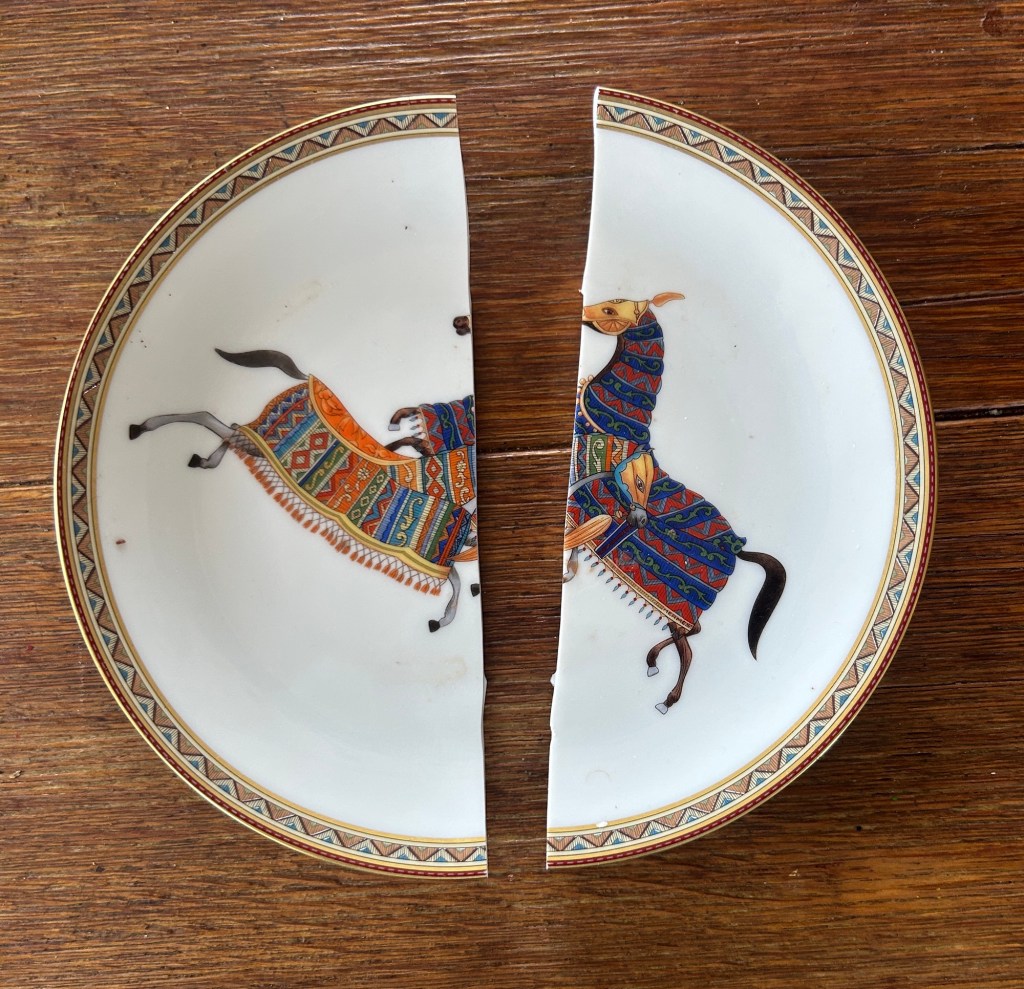
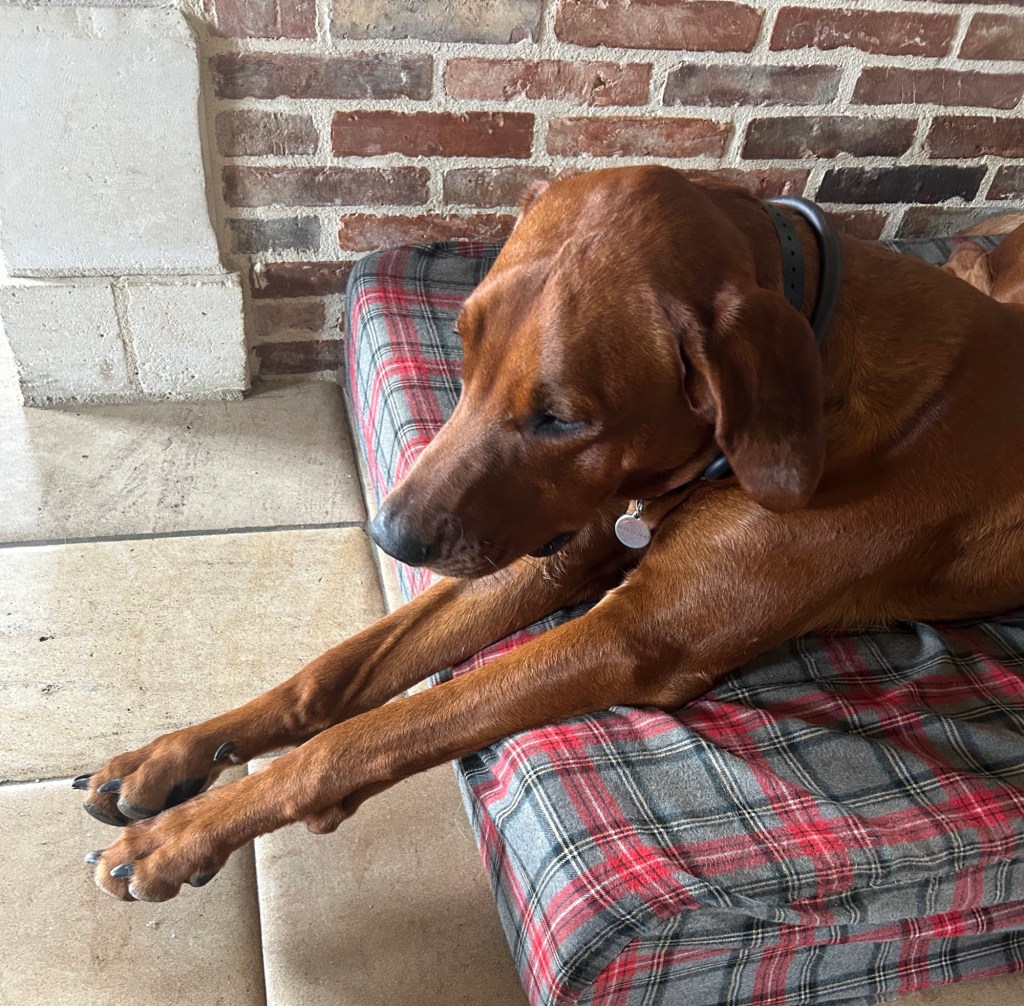
Meet Sanga, our overgrown and over enthusiastic puppy. In one day he ate my slippers, shredded my favourite pashmina and broke the lovely little plate above.
Butter wouldn’t melt…
Having got over my extreme annoyance and digested the fact that both slippers and pashmina were shot, I thought it would be an opportunity to try something which has intrigued me for a while: the ancient Japanese art of Kintsugi.
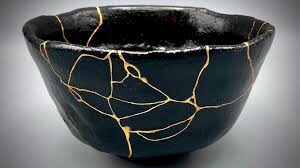
Kintsugi, which probably originated in the 15th century, is a method of repairing broken pottery by mending it with urushi lacquer dusted or mixed with powdered gold. People became so enamored of the new art that some were accused of deliberately smashing valuable pottery so it could be repaired with the gold seams of kintsugi. Sometimes a pottery piece was chosen for deformities then deliberately broken and repaired, instead of being discarded.
Kintsugi means “to join with gold” and it serves as reminder to stay optimistic when things fall apart and to celebrate the flaws and missteps of life.
Kintsugi encompasses a profound meaning and philosophy beyond mere repair, namely the idea of embracing imperfection and impermanence and transforming them into something valuable. It reflects an aesthetic perspective on the way people live, since from this perspective our life is like a vessel.
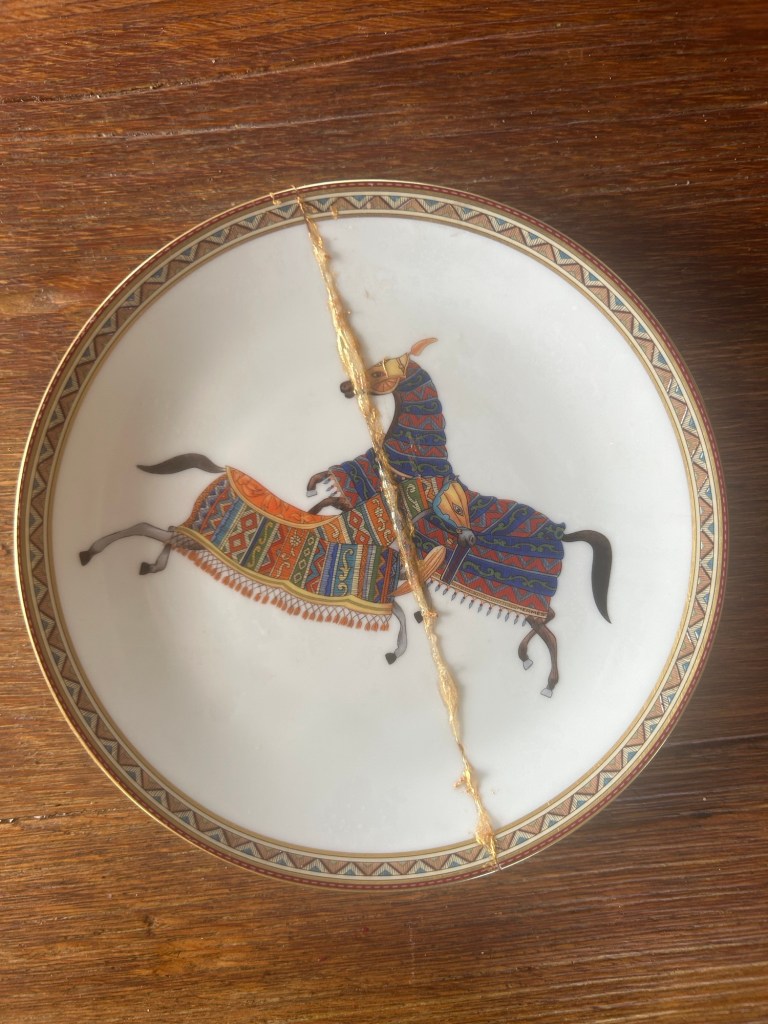
Not bad for a first try
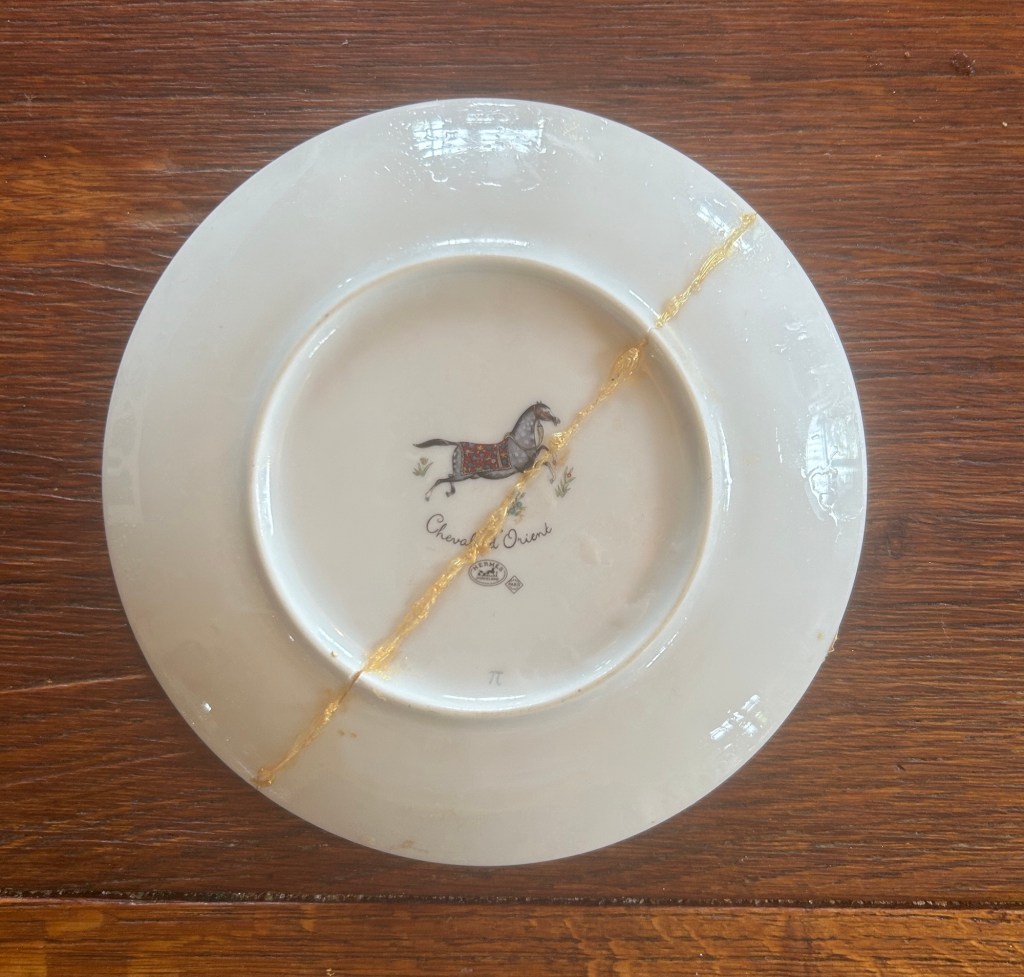
A good Kintsugi vessel can be very expensive, because it requires months of intricate work. My plate was only broken neatly in two pieces, and I used glue mixed with gold powder (courtesy of YouTube) but I can assure you it is a messy and delicate procedure which ended in my kitchen looking as if a gold storm had hit it.
I am too impatient for the real thing, I’m afraid. Look at this:




























 Letters from Athens