An afternoon at the Musée d’Orsay

A few days ago I went to Paris to visit a friend, who lives right next to the Musée d’Orsay, in a bustling neighbourhood on the Left Bank. After a delicious lunch that she had prepared for me, we wandered over to the museum, which has always been a great favourite.
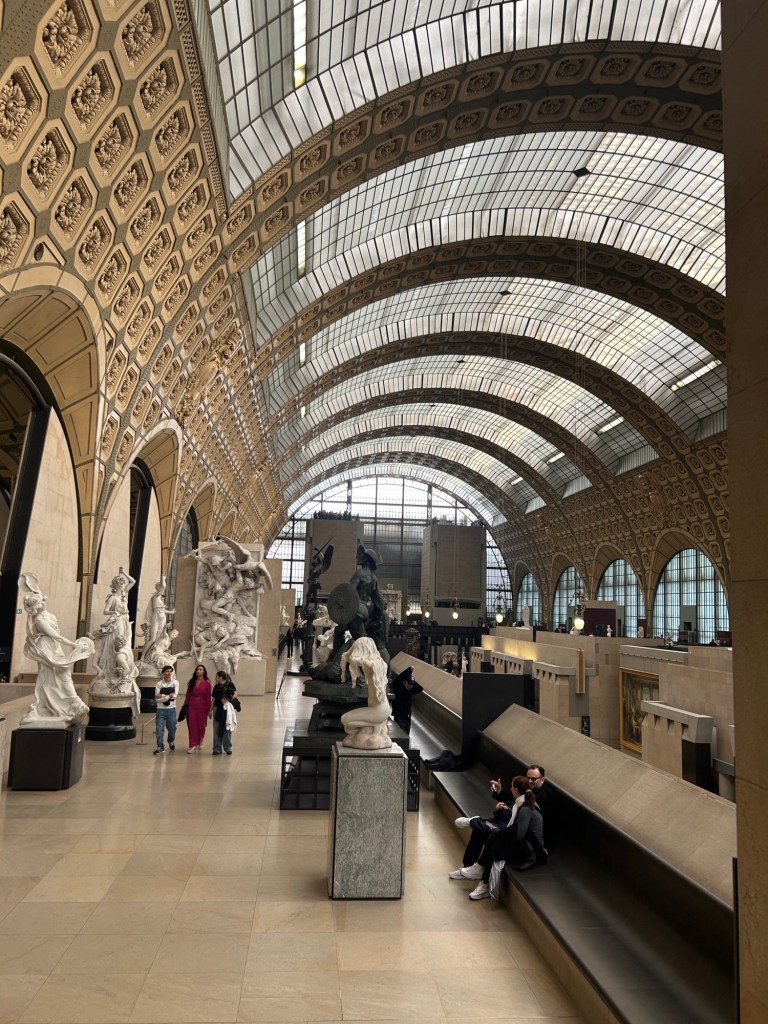
A conversion of the Gare d’Orsay, a Beaux-Arts railway station built in the late 19th century, the building itself is amazingly beautiful, with stunning views of Paris out of every window. Regular readers will know I visit as often as I can, and have written about exhibitions by Picasso, Caillebotte and others (for those interested, putting “Musée d’Orsay” in the finder will lead you to them).
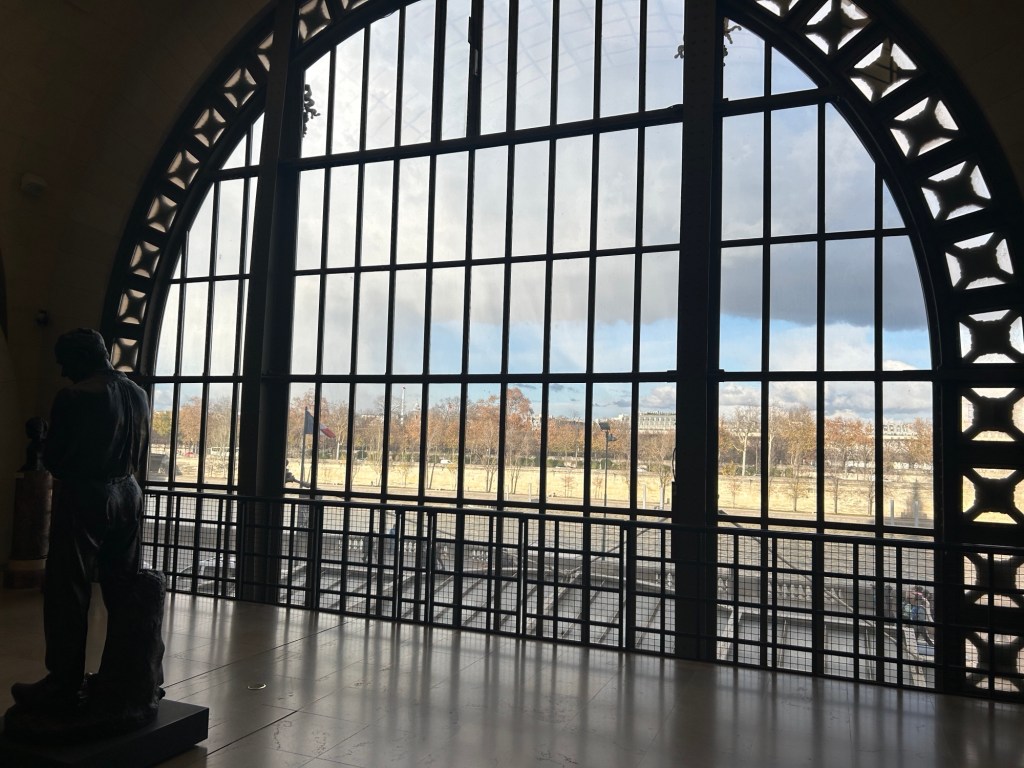
The permanent collection is full of treasures, and every time I go I discover something new amongst the old favourites. My friend and I walked around, admiring the Gaugin paintings some of which I had read about in Sue Prideaux’s biography,Wild Thing (reviewed in a recent post).

The Meal, also known as The Bananas. 1891

Another lovely painting, the portrait, by Odilon Redon, of Baronne Robert de Domecy

Odilon Redon, 1900

This time the temporary exhibition was of the previously unknown to me sculptor Paul Troubetzkoy (1866-1938).

Troubetzkoy, who was an iconic figure of his time, was the illegitimate child of a Russian diplomat and an American singer and pianist. He was acknowledged by his father at the age of five, trained in Milan and started his career in Moscow and St Petersburg, where he was well received by the local elite, despite speaking virtually no Russian. Having a wonderful facility of capturing people’s likeness in clay (which he then cast in bronze) he sculpted numerous portraits of the aristocracy, but his masterpiece of that period was the portrait of Tolstoy, a vegetarian who made a profound impression upon him (and converted him to the cause).

In 1906, when Russia was racked by the first throes of revolutionary unrest, Troubetzkoy left for Paris, where he quickly won over Parisian society. Bohemian and eccentric, he walked his domesticated wolves in the Bois de Boulogne, and hobnobbed with the city’s cosmopolitan elite, earning numerous portrait commissions. He perfected the genre of portrait statuettes that would make him famous—Anatole France, George Bernard Shaw, Auguste Rodin, Baroness de Rothschild and Roland Garros were amongst those who posed for him.

In his studio, with wolves and statuettes

He also loved to depict children and animals. His passion for the latter was the reason he became a vegetarian.
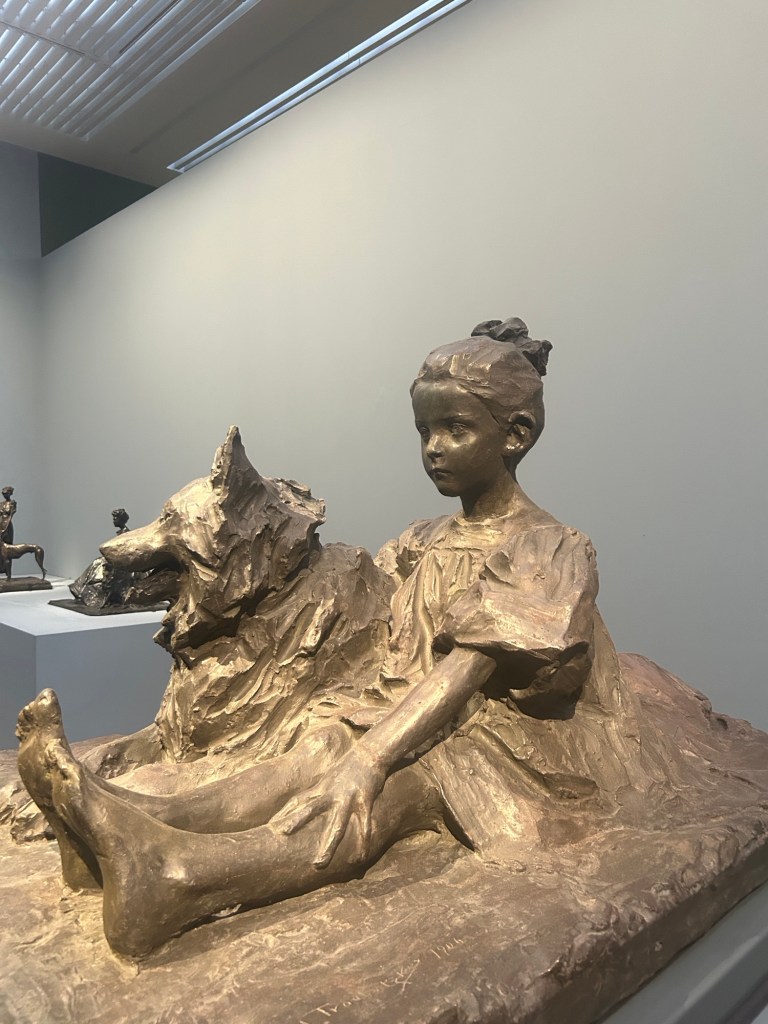
A little girl and her dog

He suffered unbearable tragedy when his only son, Pierre died at the age of two and a half—just after he had sculpted a moving portrait of him with his mother, Paul’s wife Elin.

Troubetzkoy also had much success in America, where he travelled three times between 1911 and 1912, then stayed for almost seven years (1914-1920), again attracting numerous commissions.

Franklin D. Roosevelt, 1911, commissioned by his godmother when he was elected senator of the state of New York.

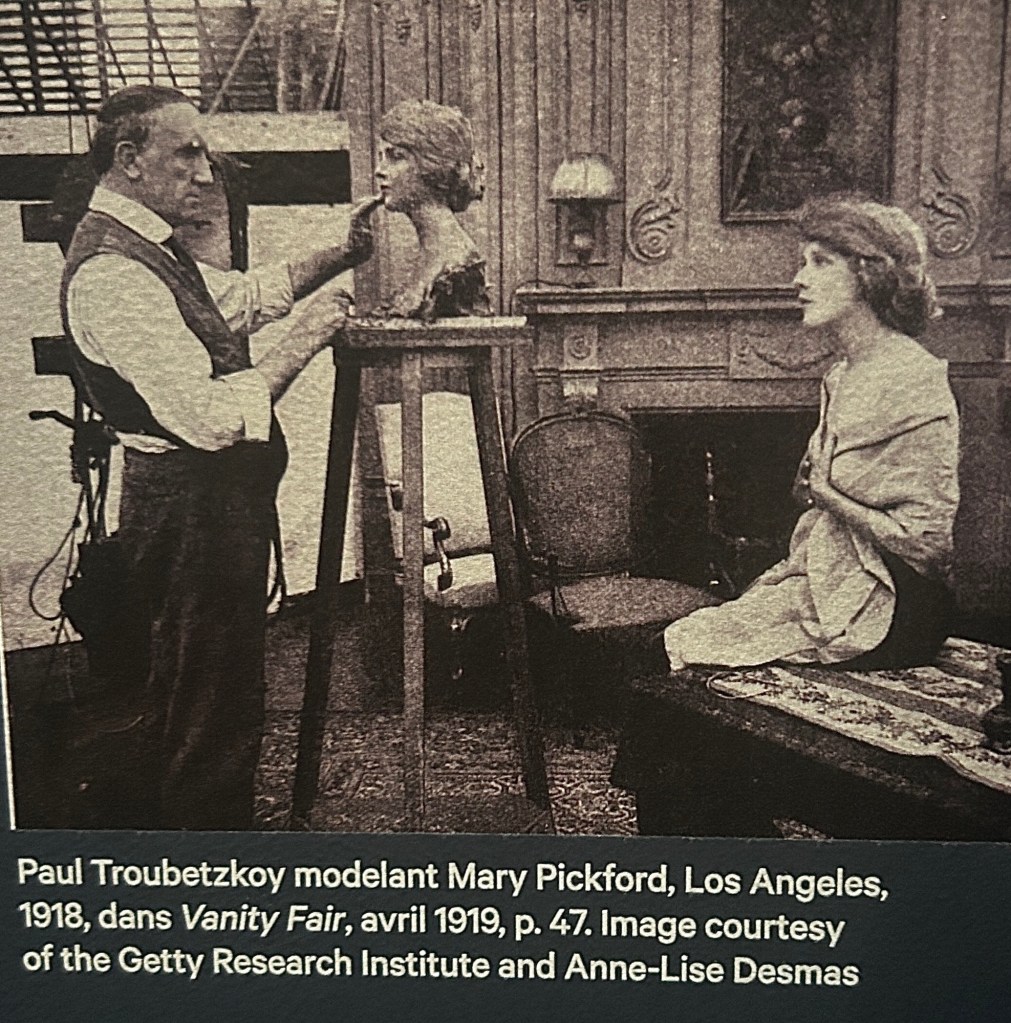
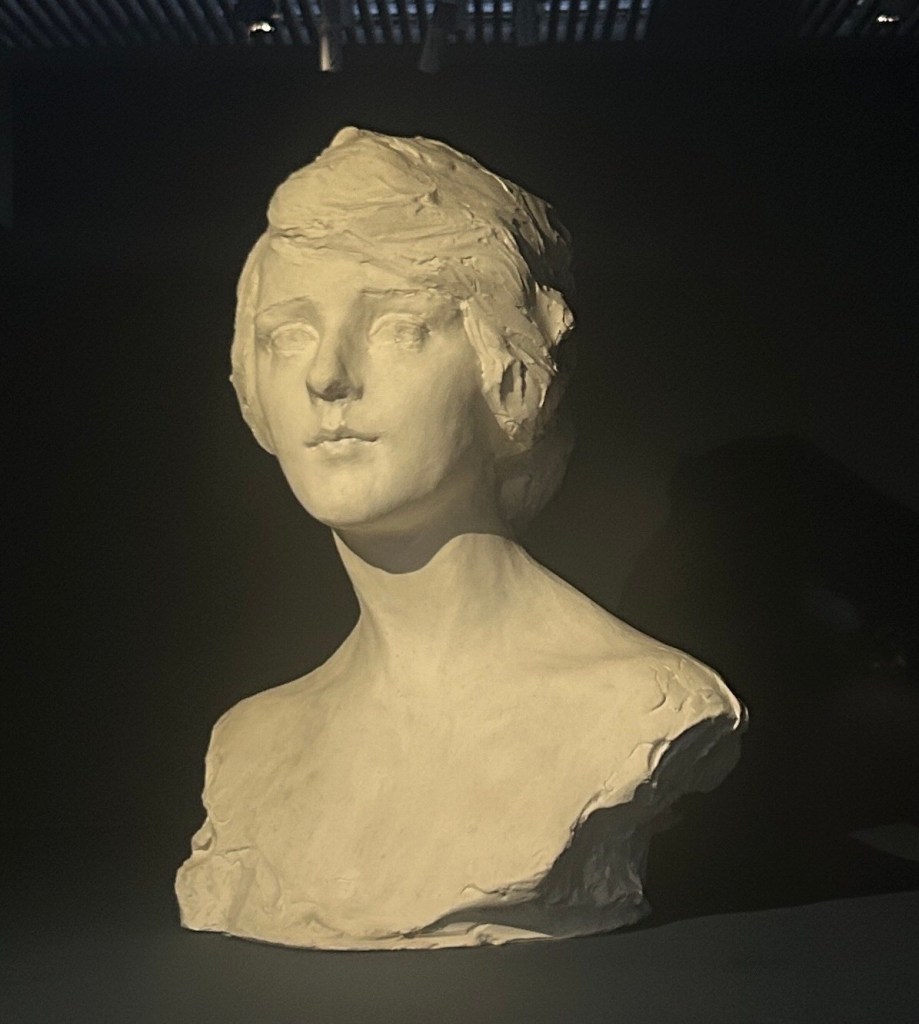
Here he is sculpting the actress Mary Pickford. Amazing how he works in a waistcoat, shirt and tie! He also had a magnificent comb-over…
And the finished portrait.
I adored this lovely statuette of an Arabian horse.
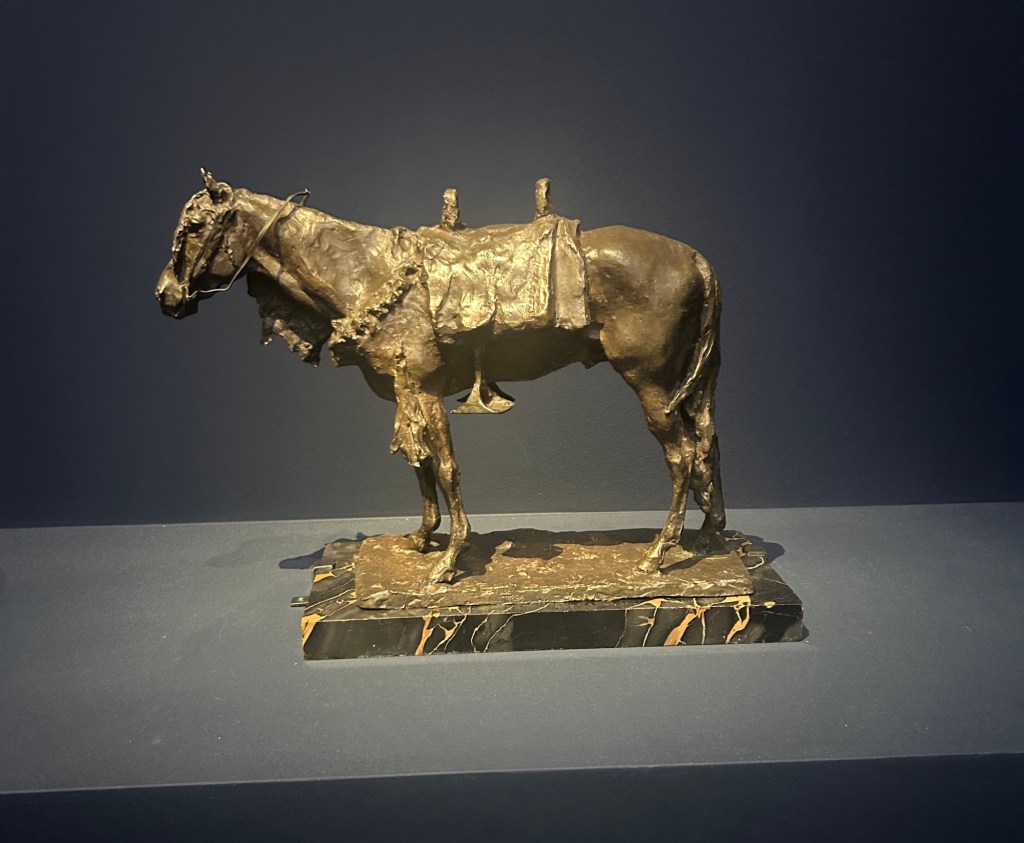
Troubetzkoy returned to Europe in 1920, where he settled in France and stayed until his death in 1938 at the age of 72, travelling often to Italy and continuing to sculpt portraits of political figures and representatives of cosmopolitan high society in both countries.

Jean Bugatti, circa 1930

An Intervention

Artist duo Elmgreen&Dragset were invited to exhibit their work in the iconic sculpture gallery of the Musée d’Orsay.

They called this installation, consisting of a number of boyish figures engaged in incongruous—in the context—pursuits, L’Addition.

Michael Elmgreen (born 1961 in Copenhagen, Denmark) and Ingar Dragset (born 1969 in Trodheim, Norway) have worked together as an artist duo since 1995, exploring the relationship between art, architecture and design.

Elmgreen&Dragset live and work in Berlin. They are known for art work that has wit and subversive humour, and also addresses social and cultural concern. Their work is too varied and prolific to be described in a short post, but anyone interested can look them up on Wikipedia—and they are, indeed, interesting.

For the first time in its history, the Musée d’Orsay invited someone to intervene in the museum’s permanent display of 19th century sculpture, which has remained the same for nearly 40 years.

As quoted in the museum’s site: In a trans-historical encounter between past and present, L’Addition highlights themes of evolving masculinities, solitude, and the magic of everyday situations. There is a certain beauty to be found in each of the fleeting moments captured in the works, whether it is in the pause before jumping from a diving board, the split second before a drone is sent off from a child’s hand, or a glimpse through the lens of a camera.

The figures are made of bronze, stainless steel and laquer. Boys waiting to dive, taking pictures from the mezzanine, setting off drones or just lounging upside down on the ceiling. It was all pretty cool, and an extra treat combined with the Caillebotte exhibition.

Gustave Caillebotte at the Musée d’Orsay

Amongst the lesser-known of the Impressionists, for the simple reason he was wealthy and did not need to sell his paintings in order to live, Gustave Caillebotte (1848-1894) is nevertheless a most interesting artist, because he had a unique take on things, using perspective and composition in original ways. He was very ‘modern’ for his time as well as more realistic in his technique than some of the others.

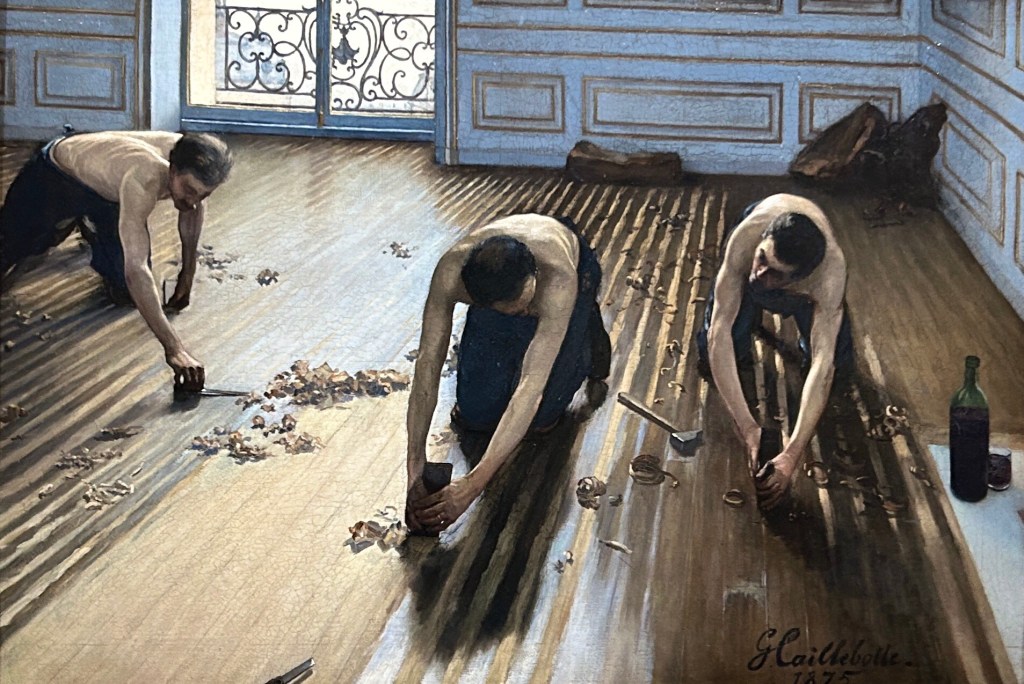
A lawyer and engineer, he fought in the Franco-Prussian war and upon his return frequented the Académie des Beaux Arts, as well as befriending several artists. The first painting he exhibited, of labourers working on a wooden floor, was criticised as “vulgar” (sweaty men doing a menial job) and rejected by the Salon of 1875. It is a masterpiece, if only for the light and perspective.

Rabatteurs de parquet, 1876 (détail)

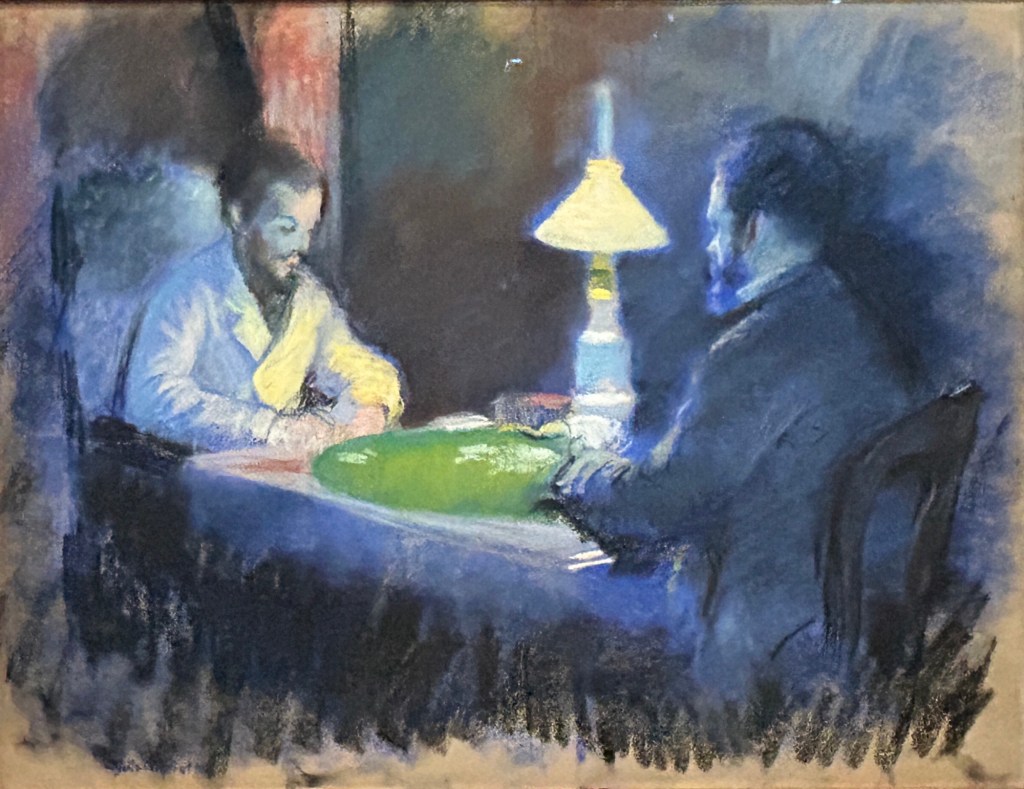
Caillebotte painted many domestic scenes, depicting his family and friends in everyday pursuits.

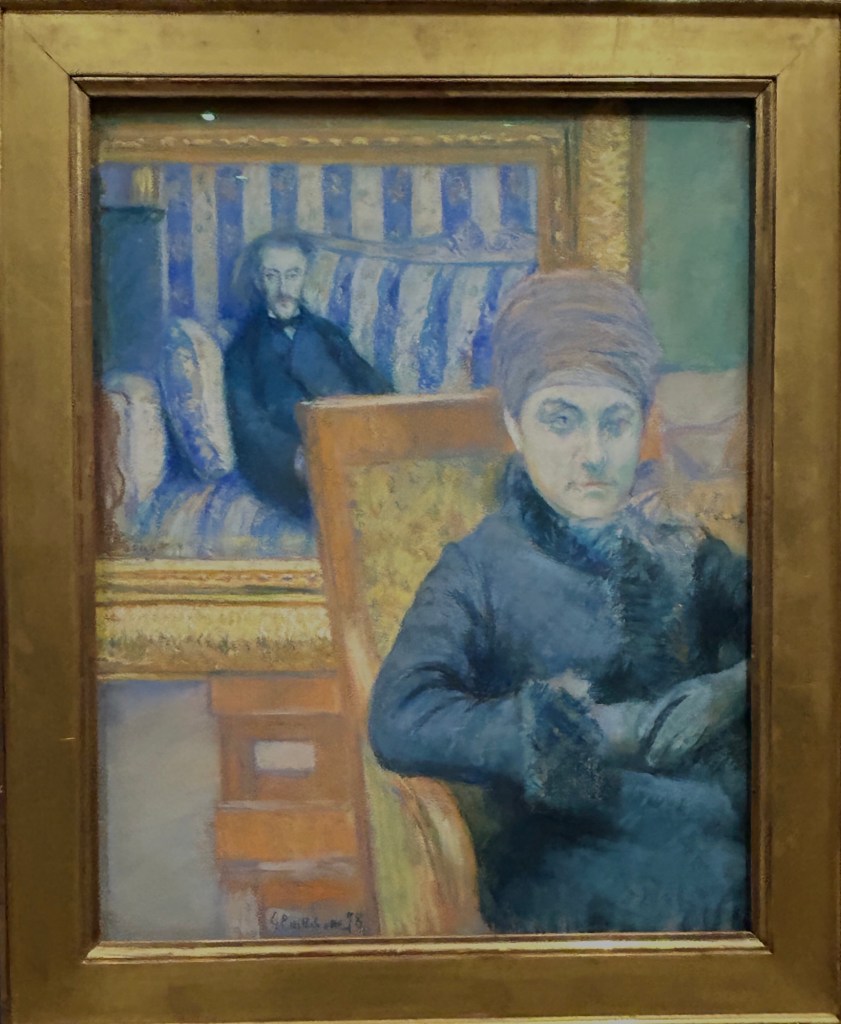
A beautiful pastel, which does not really show to advantage in a photo

I love the composition in this painting, the frame of the portrait replicated in the chair’s back, the diagonal made by the blue clothes…

He also loved sport and painted people rowing or sailing at the family’s Yerres estate. His technique of cropping or zooming in is original and gives a lot of movement to his scenes.

If I had painted this, I don’t think I would have thought to chop off the front of the first canoe, which is just sliding out of the picture.

In this view the boats are coming towards us

And here, seen from the back.

I love this gentleman, who is not rowing for sport, only taking himself on a little jaunt in his city clothes.

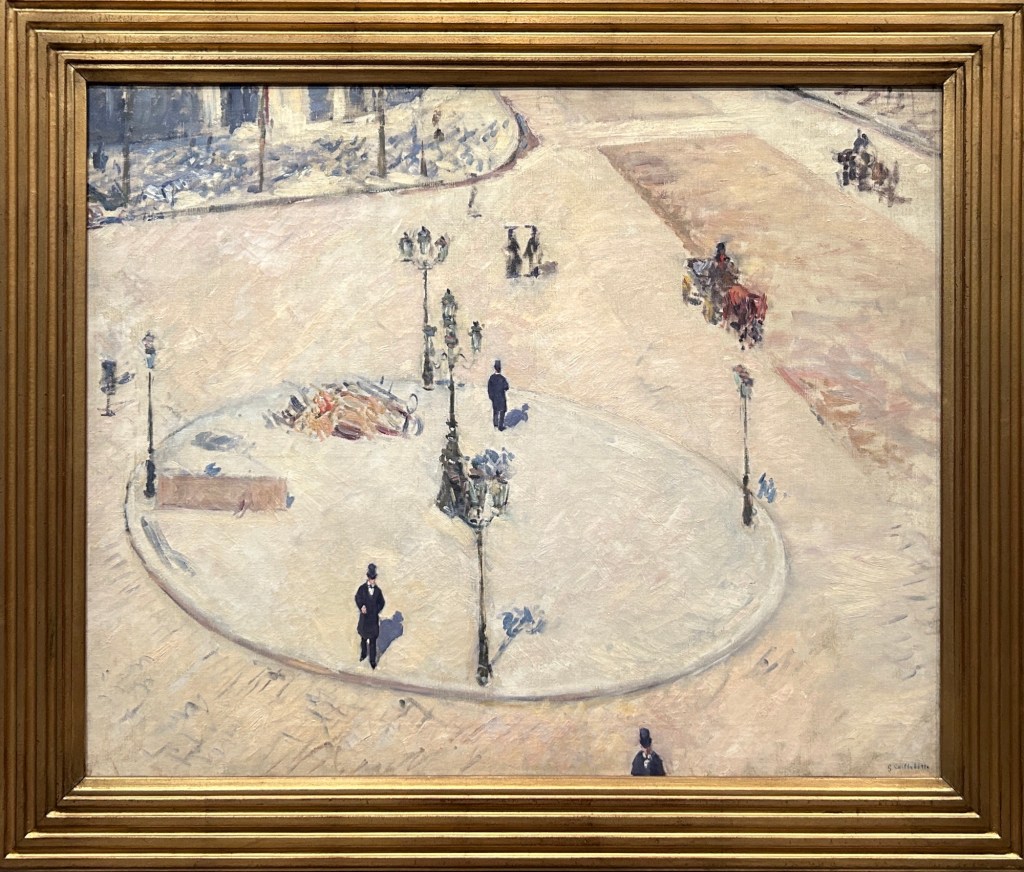
Caillebotte also did many urban paintings, some from an elevated perspective, such as the one below.

His paintings of Paris give off a very special flavour of the city.

Two of the artist’s friends looking out towards the Boulevard Haussmann in this painting entitled Balcon (circa 1880)

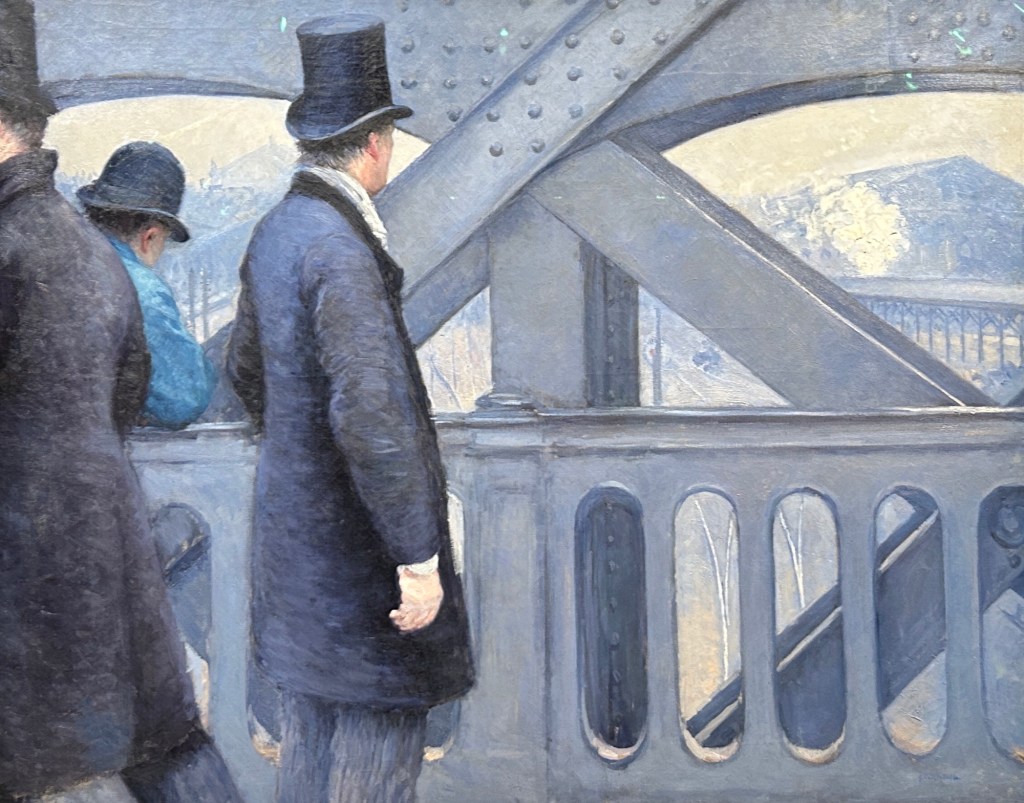
Le pont de l’Europe (1877)

He also made realistic studies of the human body and his paintings of males nudes were considered revolutionary, depicting ‘real’ men in domestic settings, instead of heroes in allegories.

Homme au bain, 1884 (note the wet footprints on the floor!)

Caillebotte used his wealth to support many of his fellow artists, notably Renoir—who was a close friend—Monet and Pissarro, amongst others. He died young, at the age of 45, of pulmonary congestion. He left behind an impressive body of work and bequeathed a large and varied collection—he had acquired many works from his fellow artists—to the French government. Here he is below, in one of those funny hats they all wore to row on the river. He looks like a jolly good sort.

Self portrait in a summer hat (circa 1873)

I was very lucky to visit the exhibition before the crows swarmed in, with a friend who is a Friend of the museum and holder of a card allowing early entry. A most impressive artist.

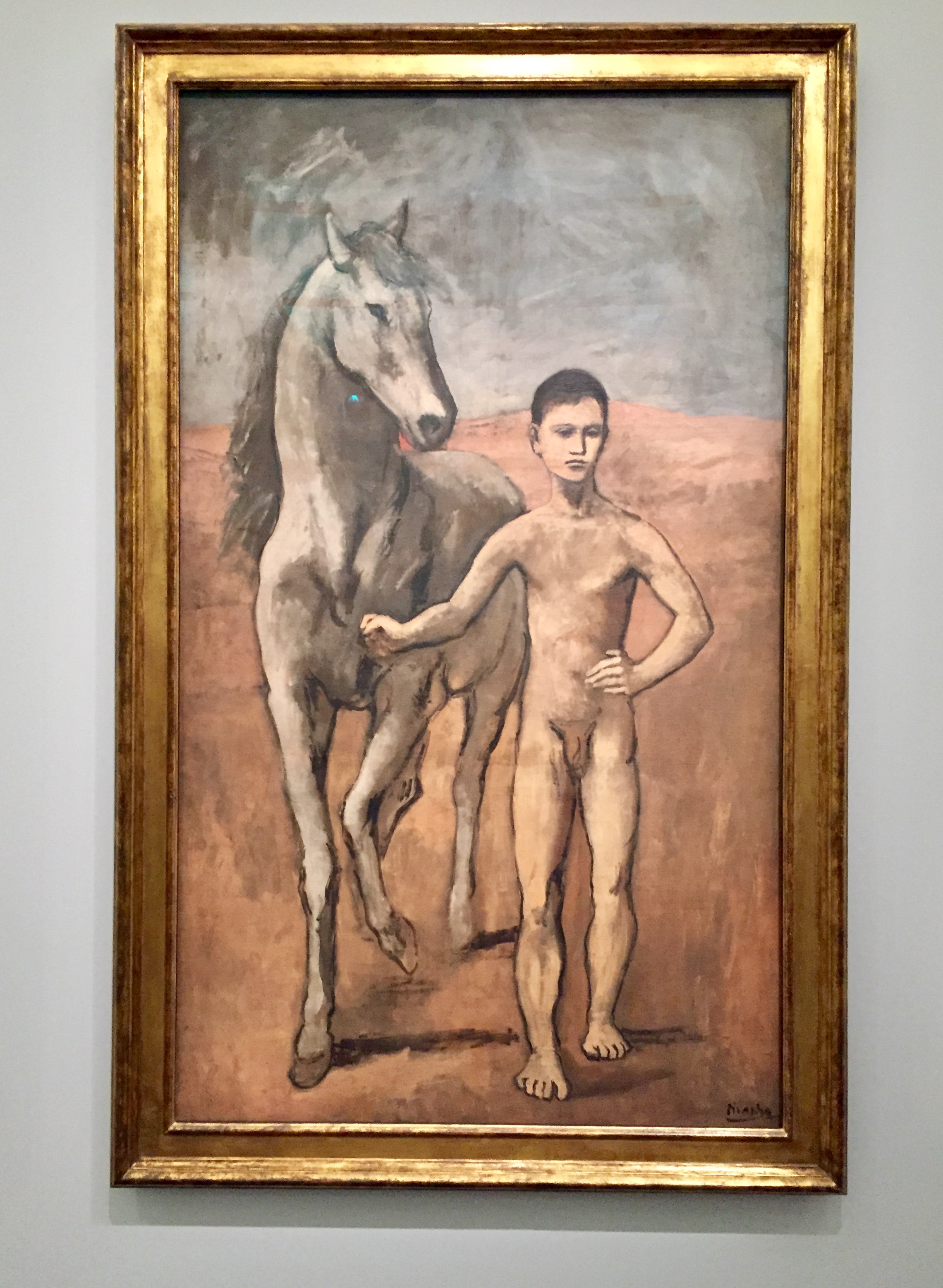
Bleu et rose. Picasso

There’s no need to describe Pablo Picasso—everyone knows about him, and most of us have come across one or more of his works in an exhibition or museum, since he was extremely prolific.
For me, most enchanting were his early works, the Blue and Rose periods, which visitors to Paris have the chance to admire at the Musée d’Orsay. The exhibition is a collaboration between the museum and the Musée National Picasso, and has gathered major works that focus on the period from 1900 to 1906.


Picasso was a fantastic draughtsman, and could produce detailed academic drawings with great ease. In his paintings, however, he expressed his highly personal viewpoint, often distorting body parts, foreshortening limbs or elongating fingers.


It is difficult to comprehend today, but at the time he was derided  for this by art critics, and floundered in the teeming artistic milieu of Paris, until he was picked up by American art patron Gertrude Stein. Although they did not speak each other’s language, they became friends, and she had a major influence on his career. He painted her portrait, which everyone agreed did not look at all like her, but which eventually became one his most famous portraits. After 1919 he was giving her paintings for free, since he had become so successful that she could no longer afford to buy them!


Picasso painted prostitutes, blind men, drunks, but also babies and children. He was moved by the notions of family and motherhood. His palette made up of blues gives off an aura of melancholy. He was also inspired by other artists of his time, such as Van Gogh and Gaugin, whose influence can be seen in some of his work.


It is amazing that these paintings were made when Picasso was only 20 or 21. The blue period lasted until 1904, when hints of pink started creeping into his palette, to evolve into the rose period,  where joyful pinks, reds and  oranges dominated, and his subjects were harlequins and circus people. This lasted for just two years, and ended with the Les Demoiselles d’Avignon, the first painting of the cubist period.


It is also astonishing how prolific Picasso was. He left behind tens of thousands of works,  even though, when he was young and broke, he reused canvasses and even burnt drawings for warmth.


Anyone within reach of Paris should go and see this exhibition—it is just wonderful. I left unsure whether to be greatly inspired or simply throw my pens and brushes in the bin and take up knitting!