The food conundrum

'What's for dinner?'
 Providing the answer to this simple question is getting increasingly complicated.  Even a quick glance at the daily news turns every meal into an experience fraught with uncertainty and guilt. Because almost everything turns out to be bad for the health, or the environment, or both.

Meat is high in fats and cholesterol and stuffed with antibiotics and hormones.
– Fish is full of metal deposits and also guilt-inducing due to overfishing. Sushi is particularly to blame for the depletion of the oceans. Another minus is that, according to a recent article, fish are eating minute particles of plastic – it seems that plastic smells good when mixed with seawater – and this ends up in their tissues.
Vegetables and fruit are riddled with pesticides, unless they are organic.
Dairy products are to be totally avoided, being indigestible and artery-clogging. Cheese, in particular, is maligned as being tantamount to poison.
– Sadly, almond milk, which is a good substitute for dairy, is terrible for the environment, since its production uses up huge amounts of water.
– Anything ‘white’ and ‘refined’, such as flour, pasta and rice, should be avoided like the plague. Only the wholemeal varieties will do, if that.


There is very little one can be sure about:
Wine, in small quantities, appears to be good for you – until you read the next study, which has now discovered it is bad (or is it good again?) The same goes for chocolate (black, of course) and coffee.
Eggs are terrible for cholesterol levels – BUT I just read an article that it is now considered advisable to eat up to ten a week.                                                                                              – Seafood is also high in cholesterol, with the added environmentally-unfriendly aura connected with fish (see depletion of oceans, above).
– We can’t even count on spirits to raise our spirits (pardon the awful pun). A lovely mojito, a vodka tonic, a drop of whisky – out of the question. Not should any morsel of dessert (brownies, ice cream, cake) pass our lips. I did, however, read an article that gin is good for the health.
– And salt? Is salt good or bad? Opinion differs here too.


There are also practical matters to be considered:
– Should you eat breakfast, or can you skip it? I recently read that it’s okay, even beneficial, to do the latter, although up to now we were taught to ‘breakfast like a king…’ etc. etc.
Juicing helps with getting your five-a-day, but breaks down the fibers in the fruit and veggies. So better not.

And moral ones:
I admit I’m a terrible hypocrite, since I enjoy a lamb chop as much as the next person, but would probably be a total vegetarian if I had to kill the said lamb myself. However, I feel like screaming when I hear vegetarians self-righteously proclaim they still eat butter and cheese, ‘because no animals get killed in the process.’ When I try to explain the basic facts of agriculture, they just don’t seem to get it. I have good friends who keep repeating the same argument every time food is discussed.

So, what the devil are we supposed to eat?

As far as I can see, that leaves seeds (chia, sesame) pulses (chickpeas…) and insects (which are full of protein and totally devoid of fat). The Swiss are about to stack supermarket shelves with food made from mealworms, which are the larval form of the mealworm beetle. We’re talking ‘burgers’, made by a startup called Essento, in which the mealworms are combined with vegetables, herbs and spices. Sound yummy? Their byword is ‘delicious insects.’

Apparently, fried crickets and grasshoppers are also tasty and crunchy, I suppose as a substitute for potato chips, which are notoriously bad for the health. According to the experts, insects have a high culinary potential, their production saves resources and their nutritional profile is high-quality. They are the perfect complement to a modern diet.


On the strength of the above, I have compiled a menu for a dinner party:

Drinks: Gin and tonic (gin is good for you, right? Unless a new survey comes out before the evening in question, saying the contrary). Crispy fried locusts and organic carrot sticks.

Starter: Organic quinoa with kale chips and sliced raw radishes. I actually had this made for me by a friend, and it was surprisingly tasty.

Main course: Mealworms ‘burgers’ with raw cauliflower ‘risotto’. The latter is a recipe favored by vegans, but I confess I’ve never had it – I love cauliflower, but eating it raw instead of rice – not so much.

Desert: I need to find a recipe that avoids eggs, sugar and flour – probably something made with oats and fruit and sweetened with stevia. As if life was not complicated enough…

One must not forget to be extra careful because of people’s allergies to nuts, gluten or even strawberries. Thus the planning of a simple dinner has been turned into a major strategic exercise – what with reading up on the latest developments and finding the ingredients (although some might be captured in the garden?)

Perhaps the answer is to eat everything, but stop reading? Because it never ends. Today, I read an article about antibiotics. It seems doctors now are not sure which to prescribe, because of resistance and allergies. Also they disagree about whether you should finish the whole course, or stop taking them as soon as you feel better.

I rest my case.

Bon appetit, everyone!


An art page and a shop

The more perspicacious amongst you might have noticed an extra page in the menu bar of my blog entitled MY ART.

AthensLettersArt. My Etsy shop logo

Since I seem to be spending more and more of my time painting, I decided to add some information about this aspect of my life. It is a change in lifestyle which makes me happy. Art is fun and great therapy! As Picasso put it, Art washes away the dust of everyday life.’

Click on MY ART to find out more. I have no idea how this will develop, we shall see.

Also, bowing to popular demand (drum rolls and applause), I have set up an Etsy shop, AthensLettersArt,  for my smaller watercolors. I invite those interested to take a look.(Click here)

And that’s all for today, folks!

The Worldwide Tribe

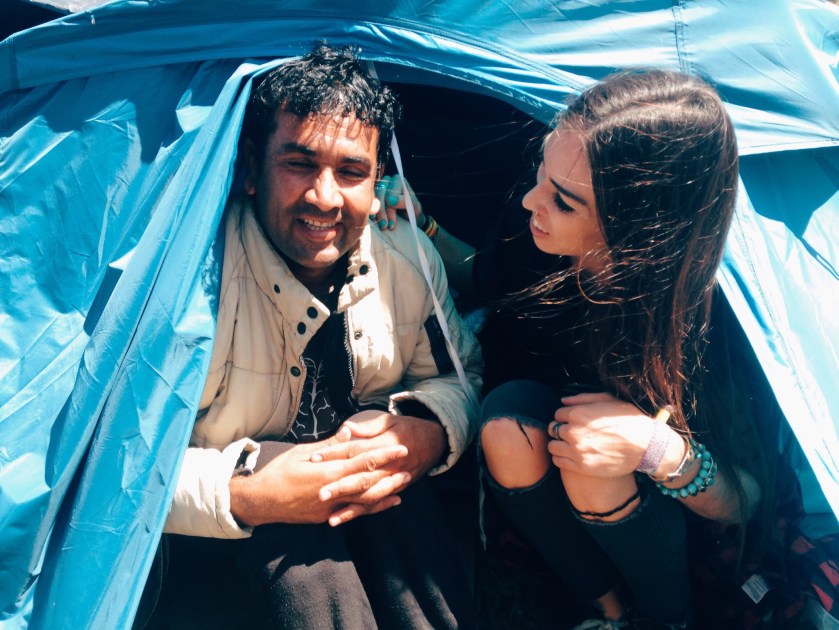
Meet Jaz.


And Nils, her brother.


The O’Hara siblings used to work, respectively, in fashion and advertising. Then they visited the Jungle, a large refugee camp near Calais. They’d been hearing little bits about it, mostly about how it was affecting holiday makers by delaying the trains going across the English Channel.
They became interested, because their parents were already involved in the long and complicated process  needed to foster a refugee. Since it wasn’t so far from their home in Kent, they decided to go over for the day and take a look.


Two years later, they have acquired two new brothers, one of whom comes from Eritrea and the other from Afghanistan. And they have founded the Worldwide Tribe.

The first time they visited Calais, there weren’t many volunteers about yet. They were, of course, shocked by the conditions there, and by the fact that there weren’t many people helping at all. However, what made the greatest impression, was, in Nils’s words, ‘How nice and welcoming the refugees were to us. Everyone wanted to share what little they had, to feed us and make us tea.’ People were polite, smiling, and full of optimism. The siblings went home, feeling very emotional about what they’d seen, and Jaz wrote about it on her Facebook page. The post went viral. Overnight, people started sending donations, both physical and monetary. In a short amount of time, they’d gathered a lot of clothes, shoes and food, as well as money.


Jaz and Nils soon realized that in the long run they weren’t best placed for managing warehouses and dealing with the distribution of donations – others were better at it. What they felt they were good at was telling people’s stories. They started diverting donations and volunteers towards other organizations, and they created the Worldwide Tribe.
They see their organization not so much as a charity, but as a platform for people to share their stories.


Jaz concentrates on content creation and writing, setting up talks in schools and universities and organizing different events. Both siblings manage the production of documentaries, of which the latest is the film DIASPORA.


Meanwhile, Nils and two friends have been setting up WiFi in camps. This is very important to refugees as it is the only way they can keep in contact with what’s left of their families, and also get information about their status, prospects, etc. This activity has resulted in the creation of a product which has generated commercial interest, which they believe has the scope to get bigger, and maybe result in the generation of funds towards their projects.


I was curious about the two boys the O’Hara parents are fostering. One, Mez, comes from Eritrea, which he fled because his only choice was to spend his life in the Army, where his brother already is. Having arrived in England aged 14 speaking not a word of English, he has now done all his GCSEs and is heading to college. He still has family in Eritrea and keeps in touch with them. In the beginning things were difficult because the cultural differences are huge but he managed to adapt quite quickly and has done ‘incredibly well’, according to Nils.

The other boy, Arash, is Afghani. He saw some of his family killed before his eyes, has lost all contact with them and doesn’t know if his mother is still alive. Speaking to Nils, I found it hard to imagine how difficult it must have been for this family to open their home – and how ultimately rewarding. I asked Nils how the two got on and he laughed and said: ‘They get on OK – but they are classic teenage boys.’


The O’Haras’ vision for the Worldwide Tribe is to inspire as many people as possible to share and contribute in any way they can, whether by volunteering, sharing a post or just talking about things. They hope this will create change from the ground up, while pointing out that their platform is not at all political.

Nils hopes the WiFi project will take off – if they manage to commercialise the product, it will earn money they can then plough back into the Worldwide Tribe, to help more people across Europe and the Middle East.

I asked Nils if it was hard to keep positive at all times. His answer was that they do see a lot of misery and it’s difficult not to take it home. What helps them is that although they spend a lot of time in the camps, in Greece, Turkey and Lebanon, they are not there all the time, so they manage to get some distance. Of course, they have seen bad things, and violence, but they have mostly been inspired by the positivity and humanity they encounter. They feel they’ve learned a lot and are awed by the human spirit, and the incredible stories they’ve heard. They are amazed by how people in such difficult circumstances keep trying and finding resources, and they reckon the experience has generally been far more positive than negative.


You should go on their site, and read some of the incredible stories there.  Such as the one about Noor, who’s in a wheelchair but is determined to become a judge, or Besh, who, with his four younger brothers, searched practically every refugee camp in Europe to find his mother, and then miraculously located her in Dunkirk. You can also follow Jaz on Instagram or Facebook.

Young people spreading good will – perhaps it will offset some of those intent on spreading havoc…