Something there is that doesn’t love a wall, That sends the frozen-ground-swell under it, And spills the upper boulders in the sun; And makes gaps even two can pass abreast.
From “Mending Wall” by Robert Frost (1875-1963)
I have always loved walls. Beautiful stone or aged brick walls enclosing secret orchards.
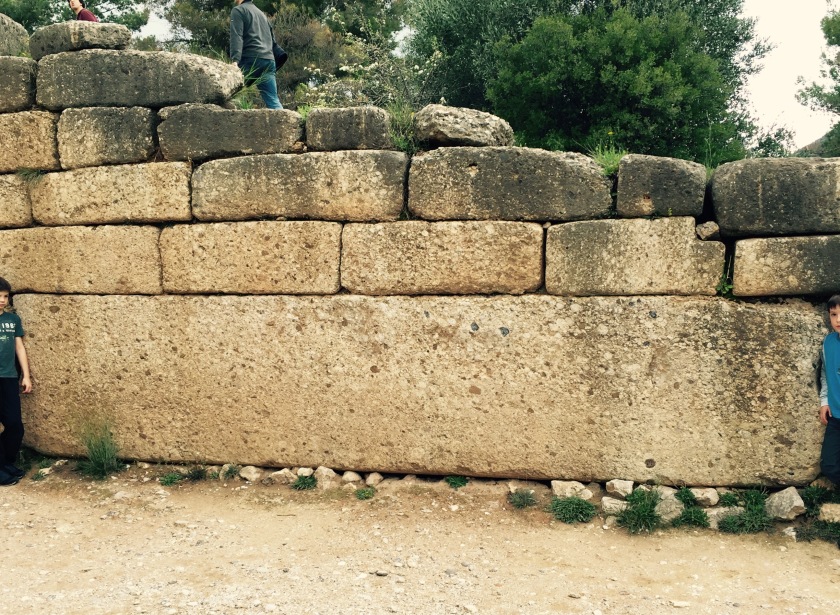
The awesome Cyclops walls at Mycenea, built of huge hand-hewn blocks.
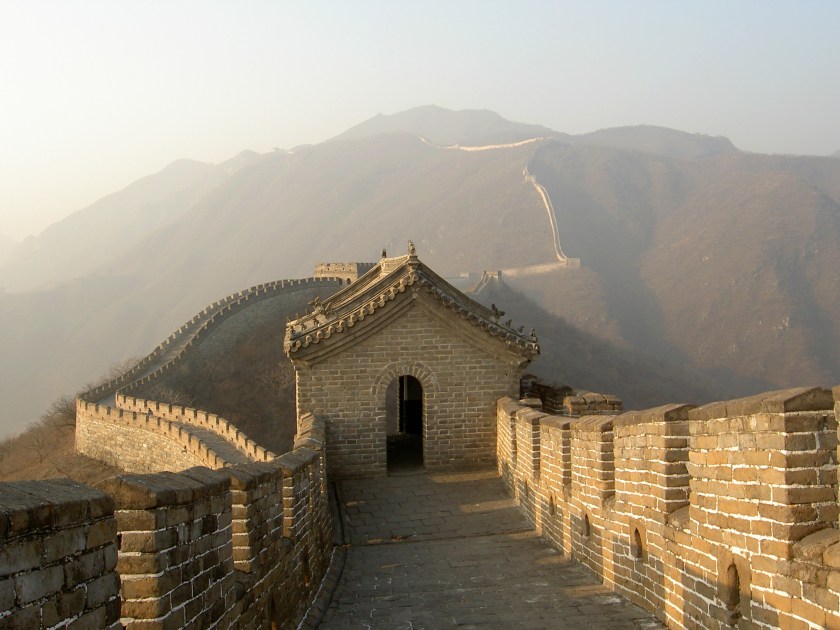
The great Chinese wall – it’s been on my bucket list for ages.
Walls protect, from the wind, from predators. They were used to defend cities. They retain mountains from sliding down, or rivers from flooding their banks, or the sea from encroaching on the land.
But walls can also be divisive.
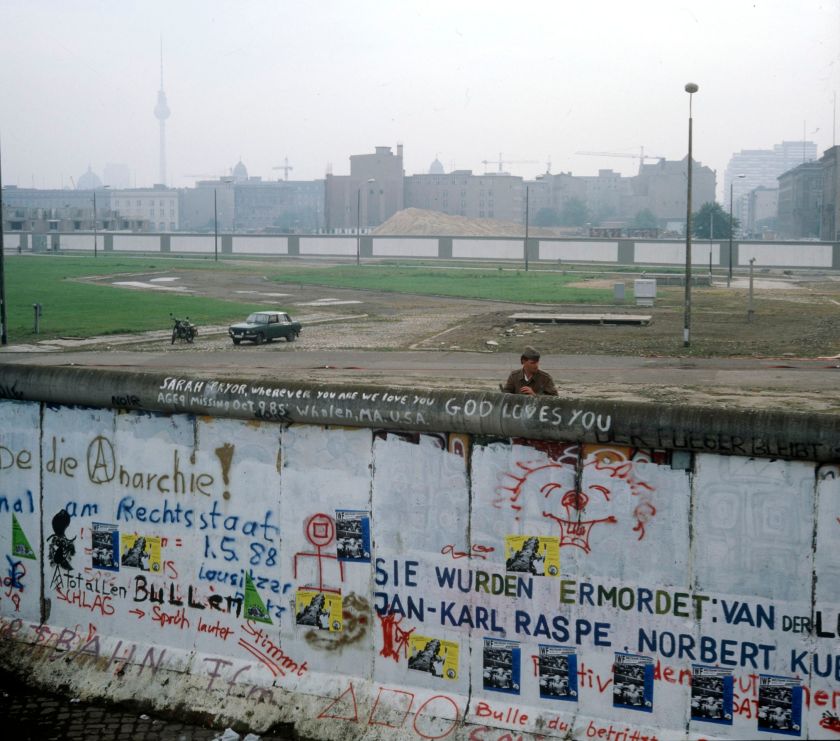
In Berlin after the war, people woke up one morning to find out they’d been cut off from their neighborhood.
Photo from 1988
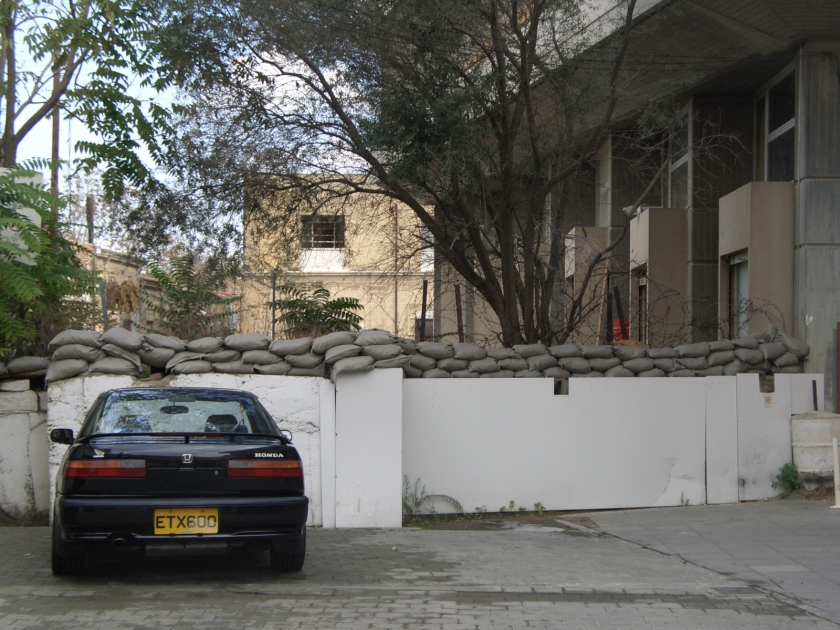
On a visit to Cyprus some years ago, a friend took me down a busy road lined with shops and cafes where people sat having a drink and a chat. Shockingly, the road was blocked by a wall cutting straight across it – a wall on which was written OCCUPIED TERRITORY. A guard stood watch on top, holding a machine gun. My friend said: ‘Our house was a hundred meters further down this road. We lost our house and half our friends, who were Turkish Cypriots.’ Interestingly, a few years later when the crosspoint was partially opened, they went to visit their old house, and the people who’d taken it over – complete strangers – gave a party for them. Which made me think that, for the amount of suffering caused to both sides by a political maneuver, there was zero benefit.
A city cut in half
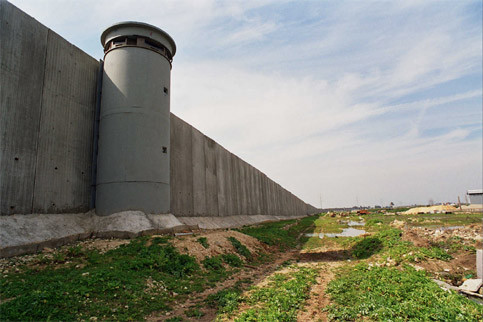
Governments continue to build this kind of wall. The kind of wall where people are always trying to get to the other side. After the fall of the infamous Berlin Wall, there were about 16 walls blocking borders around the world. Today there are some 65 walls, built or under construction, according to researcher Elisabeth Vallet of Quebec University.
Israel West Bank Barrier
History has shown us that there are always those who wish to expand their borders to include additional territory, and those who wish to close them to preclude immigration. Today more walls are being planned to keep out migrants. Donald Trump wants to build a wall to stop the Mexicans. Soon, at vast expense (around $3 million), there will be a new wall in Calais, France: it might protect the trains and the road, but will it stop migrants from getting into the UK? There is always another road, another way…
You may have already seen Channel 4’s ad for the Paralympics…..if you have, watch it again, because it is worth it. If you haven’t watch it to be uplifted, inspired and listen to a fantastic song.
Now find out more……..
As Alvin Law says, there are no disabilities, just people with incredible talents!
[Thanks to everyone who taught me how to imbed videos. It worked like a charm. I think I was overthinking the whole process!]
It was lovely being asked to write a guest post by Pete. Take a look at his blog, Beetleypete, where he writes about his walks around Norfolk with his dog Ollie, and about a lot of other stuff.
I am delighted to have received a guest post from Marina Marinopoulos. The subject is the Greek Poet, Georgios Seferis. Her own attractive and informative blog can be found via this link. https://athensletters.com/
A great poet: Giorgos SEFERIS
I’ve kept a rein on my life, kept a rein on my life, travelling
among yellow trees in driving rain
on silent slopes loaded with beech leaves,
no fire on their peaks; it’s getting dark.
I’ve kept a rein on my life; on your left hand a line
a scar at your knee, perhaps they exist
on the sand of the past summer perhaps
they remain there where the north wind blew as I hear
an alien voice around the frozen lake.
Giorgos Seferis, ‘Epiphany’ [excerpt]
Greece can boast of many great poets, such as Constatine Cavafy, Andreas Kalvos, Kostis Palamas, Angelos Sikelianos, Yannis Ritsos and others. Two of these, Giorgos Seferis…
Some time ago, my grandchildren’s art class teacher held an end-of-year session where parents could join in, and I was asked if I wanted to tag along. I accepted gladly –
1. Because I can never resist artsy things, or anything where you get your hands dirty.
2. Because I love taking part in anything the grandkids do.
3. Because their teacher, Maria, happened to go to school with my sons and I thought it would be fun to catch up.
The class is an after-school activity comprising a handful of kids, and I followed them and their mothers (no dads present) into a darkened room where we sat listening to a cd of intriguing sounds. No explanation was given as we silently tried to guess what we were hearing. Water? Yes, definitely water – not waves, maybe rain – but perhaps not rain…perhaps a stream running over pebbles. Definitely something solid there, stones…hail? Then an image popped in my mind, of a video installation by the artist Bill Viola. On a huge, vertical screen, a man lies on a slab of stone under a waterfall. Only the water is not falling on him, but flowing upwards. (You can see it here.)
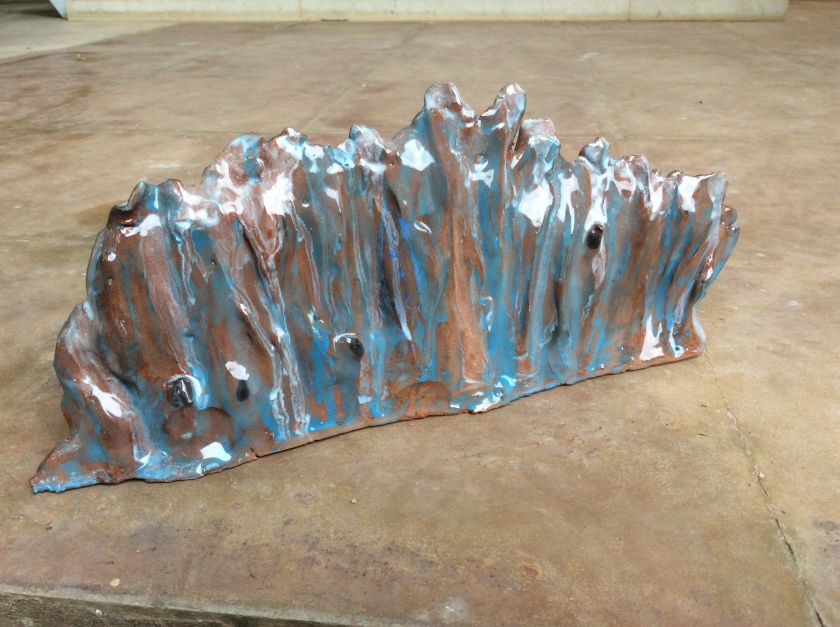
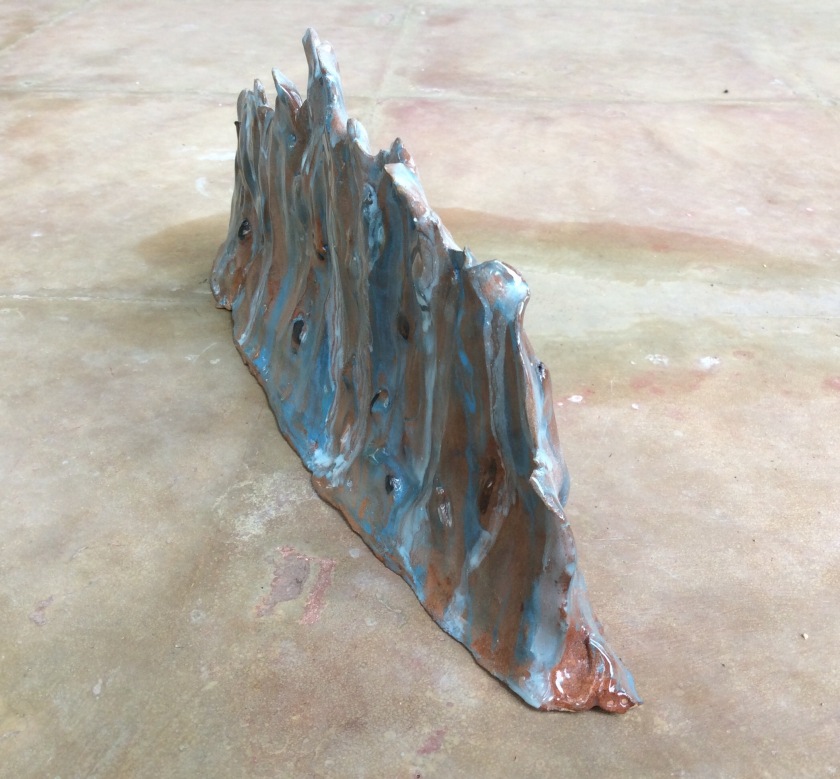
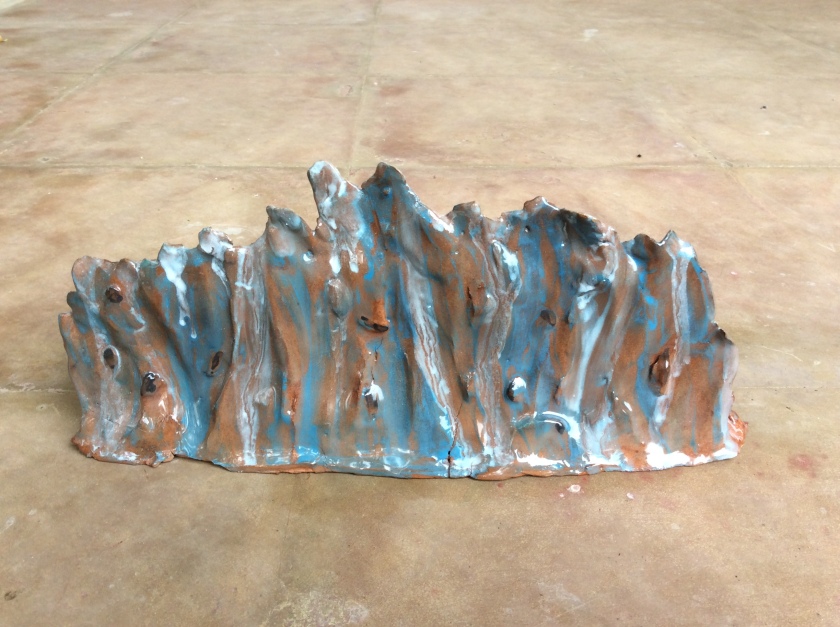
Back around the large table in the studio, we were each given a big lump of clay. Some kids joined up with their moms, others worked alone, and it was fun to see how everyone interpreted what they’d heard. All the pieces were different. But oh the joy of pounding that cool, humid piece of clay, fingers sliding over or digging in, drawing out or pushing it back. I called my obscure-looking creation Frozen Wave; I imagined it as water flowing upwards, carrying debris with it.
We glazed our pieces in different colors and left them with Maria so she could fire them in her kiln when dry. Before leaving I tried to persuade her to let me join her class on a more permanent basis, but sadly I was considered to be just outside the age limit.
Oh yes, we were told at the end that the sounds were a recording of a glazier or moraine. How cool was that?
As you will see below, Sofia Kioroglou is not just a (twice award-winning) poet. However, since I love her poetry, I thought I would focus upon that facet of her multi-talented personality. She writes in several languages and, of all my subjects, she was the only one to submit her answers, perfectly written, within hours of receiving the questions. That is why, for the first time, the monthly interview is posted on the first day of the month!
Sofia is also a prolific blogger. You can visit her site here.
Tell us a little about yourself.
I am a writer, translator, lexicographer and painter born and bred in Athens, Greece. I am an avid reader and iconographer of saints and believe in human kindness and sacrifice. I would be a cave recluse in Raitho or Sinai had I not met my husband Peter in Jerusalem at the Holy Light Ceremony in 2012. I love the Holy Land and wish I had the chance to publish work revolving around the difficulties encountered by the Greek Orthodox monks and fathers guarding the Holy Monasteries in and beyond Jerusalem whom I respect and admire. My literary work has been included in many international literary journals such as Silverbirchpress, Lunaris Review, Verse-Virtual, Winamop, Halkyon Days, Ashvamegh, Poet’s Corner, The Galway Review as well as in many anthologies like the Poetry against Terror Anthology, the Spiritual Horizons Anthology, the Poetry Against Inequality Anthology , By Land and By Seas and the Universal Values Anthology, with my flash fiction “Cubicle Coma” forthcoming for publication in Books’ Journal and Planodion.
What were the major difficulties you’ve faced in the last five years?
The loss of my father was the hardest. It just came out of left field! Paradoxically, his passing has been something of a blessing so to speak as I went into overdrive and started to pursue my passion for writing, undaunted by the grim prospects surrounding publishing.
Did anyone in particular inspire you or help you?
My dad and my supporting hubby! I owe a lot to them.
What are your hopes/plans for the future?
I have no long-term plans. I have learnt to anticipate nothing as life is so unpredictable. The only thing that bothers me is that there are people out there who can’t make ends meet, mothers who abandon their newborns in maternity clinics due to povert and people dying on the streets.
What are your hopes for Greece? What changes do you hope to see happen?
Despite the negative vibe sloshing around right now, I feel confident that we will ride out the storm. It is not wishful thinking! Greece has always survived worse rollercoasters than this current crisis.
Have you considered leaving? If so, where would you like to go, and why?
Never has the idea of leaving my country crossed my mind. I love Greece, its history and the grit that typifies our nation. I reckon Greece will rise again out of its ashes like a phoenix!
If you have already decided to leave what would make you stay?
I have not decided to leave but if I ever had to my mother’s pleas would be enough to make me stay.
Are you actively doing anything to help with the situation? Is there something you would like to do?
Having a positive vibe and hoping for the best is the most efficient weapon to neutralize the prevailing negativity and defeatism.
How do you see Greece in 5, 10 years?
I see it totally disentangled from the mess its political leaders have thrown it into. A new era for Greece will emerge with more ethos and dignity, two qualities inextricably linked with the history of our nation.
How do you cope with obstacles and frustrations in your everyday life ?
When I have a problem or have to deal with an avalanche of frustrations, I share my distress with my husband. He is always the one who takes a dispassionate view of things and puts them in perspective.
What are the positive sides of living in Greece? Have you had any good experiences lately?
The weather and the camaraderie of the people which gives this country and its people the chance to hope and dream for future generations. My recent trip to Methana was a real boon which lifted my spirits and made me forget all about the daily grind gnawing away at my innards.
As well as reading about Sofia’s positive attitude, sense of humor and amazing husband, I thought you might like to experience a sample of her work. Here is one of her favorite poems:
“Hypochondria winking at grime”
As time goes by
the twain shall eventually meet
with scraps of kneejerk iconoclasm
starting to meekly recede
Years of being together
have mellowed my tetchiness
brimful ashtrays no longer call for
scathing versified onslaught
The caterwauling about dripping faucets
not affecting him too much
my hypochondria now winking at grime
in love’s dazzling and menacing world
our hearts melting in its immensity.
Now that the fanfare is over, and the frenzy of the medals tally, and the usual grubby IOC scandals; now that the Rio Olympics have been declared, by IOC president Thomas Bach, “the people’s Games, the most happy Games ever, the beautiful Games, the passion Games” (how do they think up this rubbish? but of course London and Sydney had already been voted the “best ever Games”, so he was obviously running out of superlatives); now that the green diving pool and the sewage floating in the sea have been conveniently forgotten and the Brazilians left to deal with the aftermath and the cost; I thought it would be fun to post some random facts about the greatest sporting show on earth. Not so much facts, actually, as human stories, which is what I always find the most fascinating.
Three runners. (Wikimedia commons)
The ancient Olympic Games, primarily part of a religious festival in honor of Zeus, were a series of athletic competitions among representatives of city-states. The games were staged every four years, starting in 776 BC, in Olympia, a sanctuary site for the Greek deities in the Peloponese. They reached their zenith in the 6th and 5th centuries BC, but then gradually declined in importance as the Romans gained power and influence in Greece. It is believed they ended in the 4th century AD, when emperor Theodosius I decreed that all pagan cults and practices be eliminated.
During the celebration of the games, an Olympic Truce was enacted between warring cities so that athletes could travel to the games in safety through hostile territory.
Athletes competed naked, and victors were rewarded by a kotinus, or olive branch wreath, and a large number of amphorae full of olive oil, which they most probably sold.
Only Greeks could compete. Greek men. No women, slaves or foreigners were allowed.
Fencing before the king of Greece – 1896 Summer Olympics. By André Castaigne ( died 1929)
The Olympics were revived in 1896 by the International Olympic Committee (IOC), which had been created by Pierre de Frédy, Baron de Coubertin, and were held in Athens, Greece, from 6 to 15 April. Women were still not allowed to compete, because de Coubertin felt that their inclusion would be “impractical, uninteresting, unaesthetic and incorrect”.
However, one woman, Stamata Revithi, ran the marathon course on 11 April, the day after the men had run the official race. Although she was not allowed to enter the stadium at the end of her race, Revithi finished the marathon in about five hours and 30 minutes, and found witnesses to sign their names and verify the starting and finishing times. Revithi intended to present this documentation to the Hellenic Olympic Committee, hoping that they would recognise her achievement. It is not known what happened in the end – nor, sadly, could I find any photos of her.
Alfréd Hajós (Wikimedia commons)
The undisputed star of the swimming events at these Games was Hungarian architecture student Alfréd Hajós. Battling the elements on a cold April day – with 4m waves crashing around him – the 18-year-old Hajós served up majestic victories in both the 100m and the 1,200m freestyle events, to become the youngest champion of the inaugural Olympic Games.
While attending a dinner honouring the Olympic champions, the Crown Prince of Greece asked Hajós – who had been dubbed “the Hungarian Dolphin” by the Athenian press – where he had learned to swim so well. “In the water,” was his laconic response!
Hajós later showed himself to be an extremely versatile athlete, winning Hungary’s 100m sprint, 400m hurdles and discus titles. He also played as a centre forward in the Hungarian national football championship and was a member of the Hungarian team for its first ever international. He became a prominent architect specialising in sport facilities.
Spiridon Louis (Wikimedia Commons)
Because of its close connection with Greek history, the public desperately yearned for the marathon to be won by one of their countrymen. Spiridon Louis, a Greek water-carrier, rewarded their expectations, thereby becoming a national hero. When Louis arrived in the stadium, which erupted with joy, two Greek princes – Crown Prince Constantine and Prince George – rushed to meet him and accompanied him on his final lap for a finishing time of 2:58:50.
Louis’s victory set off wild celebrations, and the king offered him any gift he would care to ask of him; but all Louis could think of was a donkey-drawn carriage to help him in his water-carrying business!
Louis lived a quiet life thereafter, but his legacy includes an expression in Greek: “yinomai Louis” (γίνομαι Λούης – “I becοme Louis,”) which means to flee, or “disappear by running fast.”
The silver cup given to Louis at the Olympic Games was sold for 541,250 pounds ($860,000) in London on 18 April 2012, breaking the auction record for Olympic memorabilia. Breal’s Silver Cup stands just six inches tall and was offered for sale at Christie’s by the grandson of the victor, and bought by the Stavros Niarchos Foundation.
Spiridon Louis. Colored photograph by Albert Meyer (1857-1924)
Over the years, there are many of these stories to be told, showing the resilience of the human spirit, the will to overcome difficulties and deal with failure as well as success. Driven by the megalomania prevalent in the IOC, and the political and financial interests present in any such endeavor, the Olympic Games have turned into an overblown media circus, bankrupting most countries brave enough to stage them. But still, time after time, these stories surface, and we get to witness amazing feats and riveting drama.
Who knew this was ILLW, or International Lighthouse Lightship Weekend?
Well, in Greece the Navy has opened 30 Lighthouses to the public, who can visit and find out about their history and the way they work.
Lighthouses are used to mark dangerous coastlines, hazardous shoals, reefs, and safe entries to harbors. They can also assist in aerial navigation. However, the number of operational lighthouses has declined due to the expense of maintenance and use of electronic navigational systems.
Older lighthouses, especially half-ruined ones, are romantic structures, having about them the whiff of history – stories connected to lonely lives, pirates and derring do at sea.
Before the development of clearly defined ports, mariners were guided by fires built on hilltops. To improve visibility, the fires were placed on a platform, a practice that led to the development of the lighthouse.
The most famous lighthouse structure from antiquity was the Pharos of Alexandria, built by the Ptolemaic Kingdom between 280 and 247 BC. One of the Seven Wonders of the Ancient World, it was between 120 and 137 m tall, and one of the tallest man-made structures in the world for many centuries, until badly damaged by three earthquakes between AD 956 and 1323.
Drawing of the Phoros of Alexandria by archaeologist Hermann Thiersch (1909)
So if there is a lighthouse near you, perhaps today would be a good time to visit.
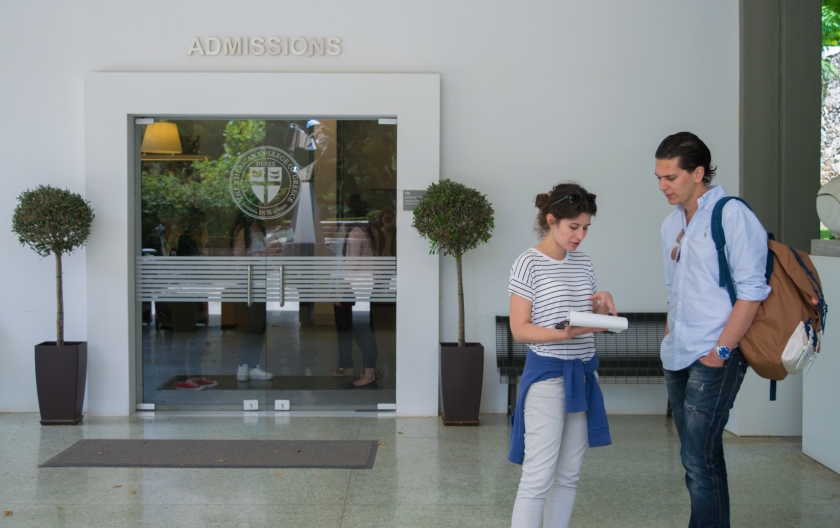
Lucy Kanatsoulis is a business consultant turned college admissions officer. No one ever grows up saying “I want to become a dean of admissions!” It’s one of those jobs that one stumbles into and only understands its complexities when one actually does it…
Tell us a little about yourself
I was raised in Athens and lived in London and New York, where I worked as a business consultant for investment banks. Fifteen years ago I decided to give in to my inner Greek and return to Athens, where I currently live and work as the Dean of Admissions at Deree – The American College of Greece. Working in such a beautiful environment where I have the potential to help students and change their lives, remains an inspiration to me despite the difficult times we are facing.
What were the major difficulties you’ve faced in the last five years?
Certainly the current economic crisis has created a sense of uncertainty for all Greeks. And unfortunately, uncertainty is a toxic foundation for growth that highlights even further the problems of Greece – resistance to change, lack of opportunities, absence of inspirational political leadership. Admissions is incredibly personal—you’re asking applicants to open up their lives to you and on many occasions I witness the anxiety and depression that young people and their families face today. The feeling of being “swallowed up” by the current situation takes over your dreams and hopes. Coping with this uncertainty and anxiety has been one of the major difficulties I have faced.
Did anyone in particular inspire you or help you?
When I returned to Greece, I was desperate to find a job that would make me happy and give me some meaning. Through a friend I met Nikos who introduced me to the world of “education”. This person has unique values and an exceptional approach to life: Inspired by education and committed to service, he motivated me to take the job because I believed in the institution, I loved doing right by students, and I hoped to use it as a platform to make a difference in young people’s lives.
What are your hopes/plans for the future?
At this point I have decided to live for the moment. The current situation of uncertainty prohibits me from making any short-term or long-term plans. Even summer vacation is a spur of the moment decision. An eternal planner, it has taken a huge effort on my part not to plan for the future and take every day as it comes.
What are your hopes for Greece? What changes do you hope to see happen?
I hope for Greece to make a comeback – I believe that the foundations of this comeback lie in the proper education of the future generation, both at home and at school. Greek families need to inspire a work ethic, honesty and ideals for change and through education we need to provide the knowledge, opportunities and team spirit to achieve this.
Have you considered leaving? If so, where would you like to go, and why?
Yes. I often find myself flirting with the idea of moving to Canada, a place I have never visited but a country that I feel represents the best of what both Europe and America has to offer with inspirational leadership that creates opportunities. However, this still remains a flirtation and my inner Greek has not given up – leaving my country, my home and my job is not something I am ready to do yet.
Are you actively doing anything to help with the situation? Is there something you would like to do?
Working in education enables you to impact young people’s lives through scholarship programs, funded study abroad opportunities, international internship programs, and academic counseling that indirectly contributes to changing Greece’s future. I also participate in volunteer community actions organized by the College to help those afflicted by the crisis. I always feel, though, that I could do more…
How do you see Greece in 5, 10 years?
Unfortunately I do not believe much will have changed in 5 or 10 years. For us to actually see a different Greece and a change in the deeply rooted Greek mentality we will have to wait for the next generation to take over and this might take longer than 5 or even 10 years. It is impossible to predict but I remain hopeful.
How do you cope with obstacles and frustrations in your everyday life?
For many people like myself coping with the daily Greek frustrations has become a challenge.
Many times, I find that it takes all my inner strength to try and put things in perspective and continue with my daily life. There are good days and gloomy days. In these times, I try to nurture the stability that I have, focus on my family, job and friends, and alleviate as much of uncertainty that I can.
What are the positive sides of living in Greece? Have you had any good experiences lately?
The Greek summer: the smell of jasmine in the evening breeze, open air cinemas, starlit skies, the sound of the sea, sand on your bare feet, fresh fish at a taverna by the sea, open windows, the taste of succulent summer fruit, hair flowing freely, scanty linen and cotton clothes, bare skin and summer wine! As my husband so eloquently puts it: In spite of Greece’s financial plight, the sun still shines so strong and bright!
While some of us are gripped by Olympic fever, and some of us are annoyed by all the fuss and the endless TV coverage, the Fundación Vida Silvestre (which represents WWF in Argentina since 1988) has been viewing the whole concept as a golden opportunity, by launching “Add the ring”: a campaign to add the missing ring, the one representing the Antarctic, to the Olympic symbol.
Antarctica is the sixth continent, and one that belongs to all of us. It is one of the world’s last wild places, and one of the most vulnerable. Every one of the changes it experiences has a major impact on the rest of the planet, and so everything must be done to preserve it.
The campaign includes appeals from current and former Olympic athletes, radio spots, print advertisments, and an interactive website where, by working together, we can add the sixth ring.
I read about this on Slippery Edge, a site that showcases the arts – painting, photography, architecture and video – by presenting a number of different contemporary professional artists, art students & creators from around the globe. As they say in their ABOUT page, they’re into the ‘exploration of beauty and creativity.’
I’ve been following them for a while – they’re featured on my BLOG PARADE page – and I’m particularly fond of their short animated films. I’ve also found great artists and photographers I’d never heard of before. I urge everyone to take a look.





 Letters from Athens