Cyclamen, tomatoes and olives

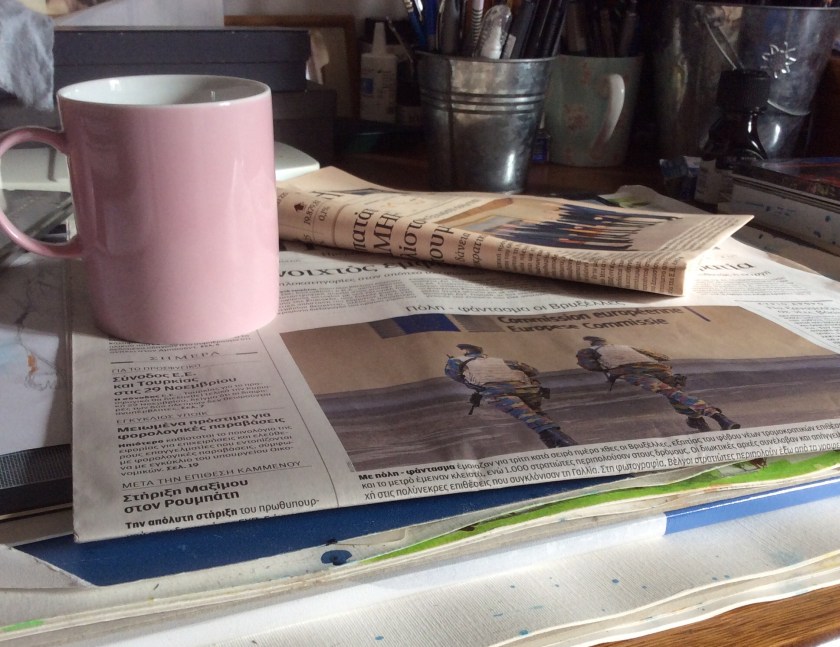
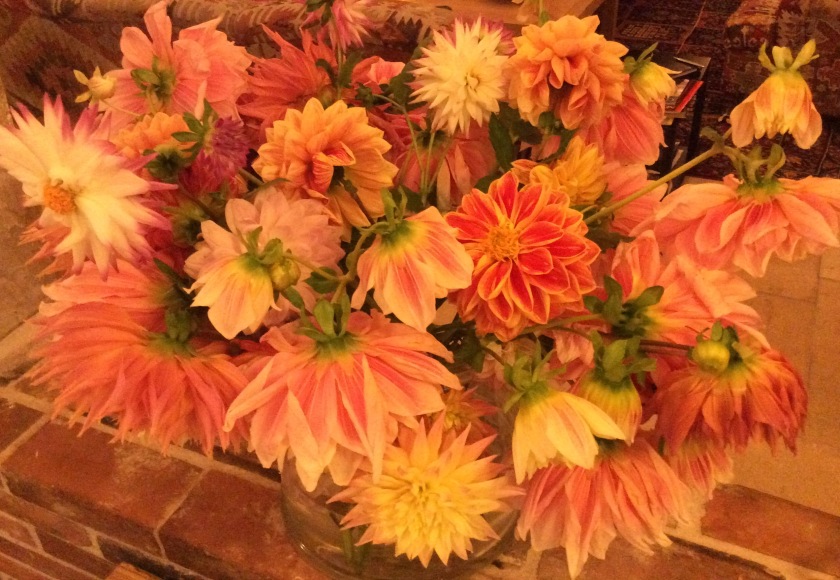
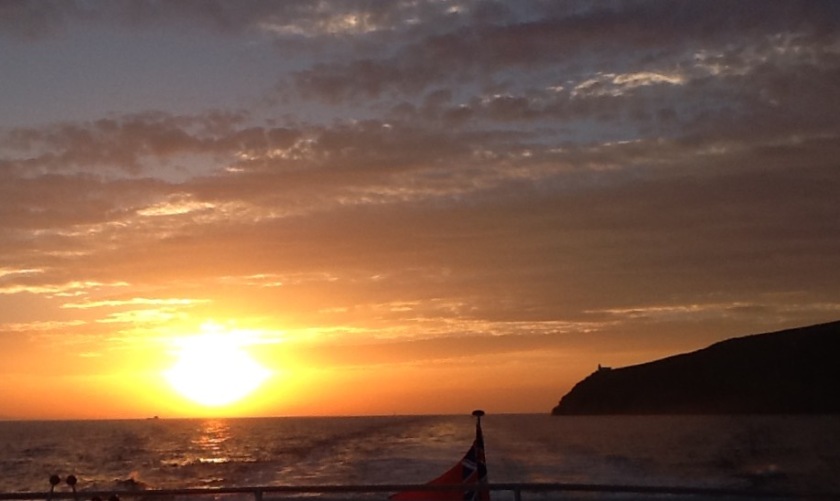
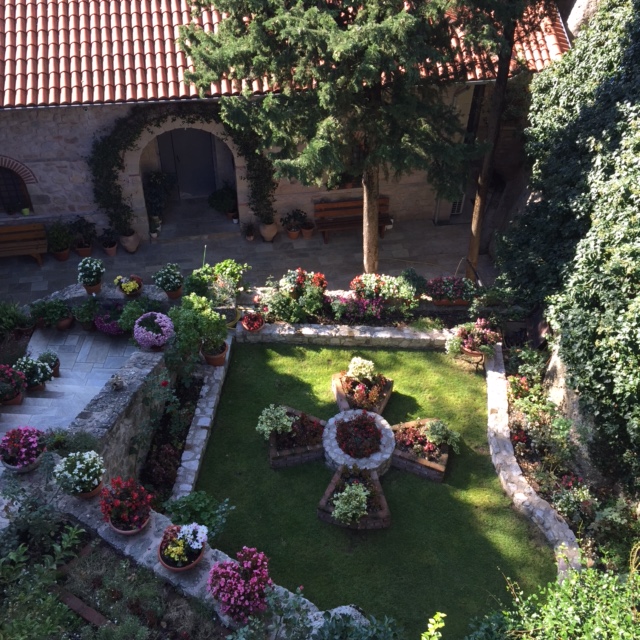
Autumn is a good time to head out for a country walk. It’s not too hot and it’s rained already, so the hillsides are dotted with wild cyclamen. I pick bunches of them and put them in small pots, which are then spread around the house. My dog has learned to be patient while I am foraging. Today she investigated various interesting items, the most fascinating of which was a very dead, flattened frog which I had to prise from her with great difficulty, my orders of ‘Drop it!’ having no effect whatsoever.

Below please admire the results of my Saturday morning outing.

image


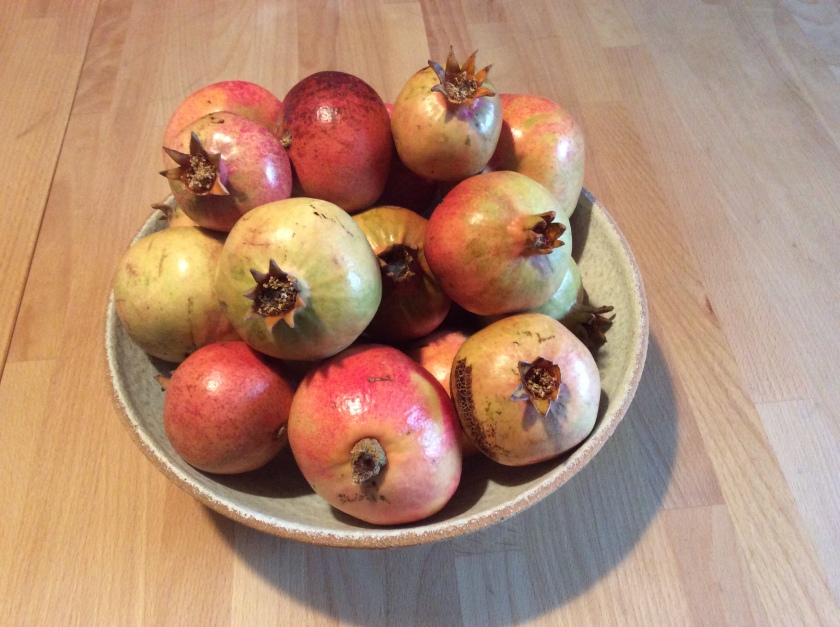
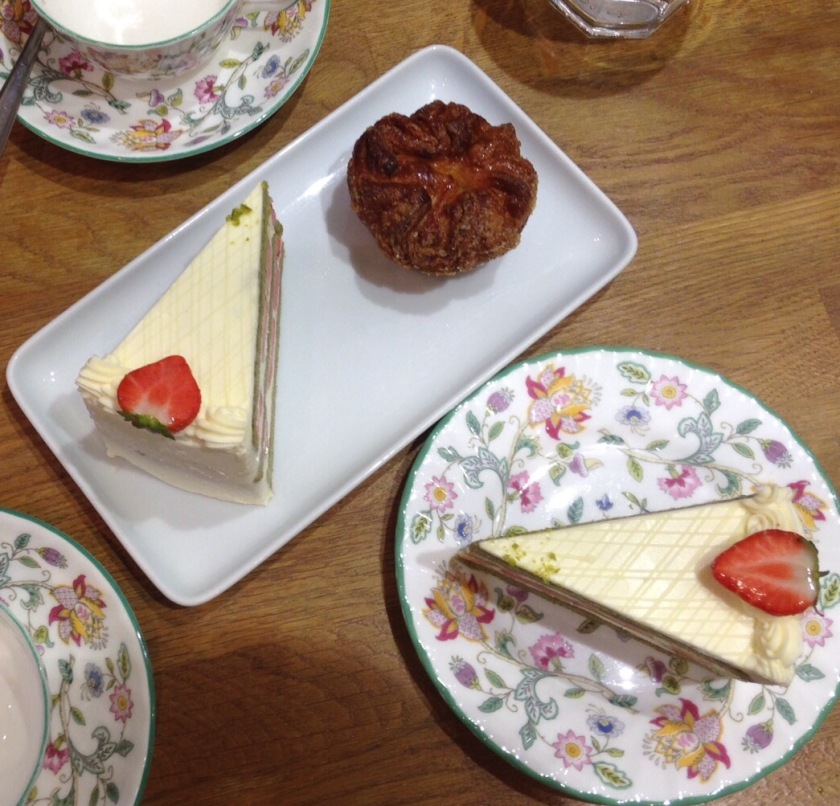
This is also the time to enjoy the last sun-ripened tomatoes. I do make a small batch of sauce for the winter, the emphasis being on small, since I can’t be bothered to sterilize jars and just put them in plastic boxes in the freezer.

image


Meanwhile, the olives are ripening on the trees. Already we have put up a few green ones in brine. We call them tsakistes (smashed) since you have to crack them with a stone. Soon it will be time to pick them. The groves will be full of people gathering and the roads will be full of tractors taking them to the press.

image


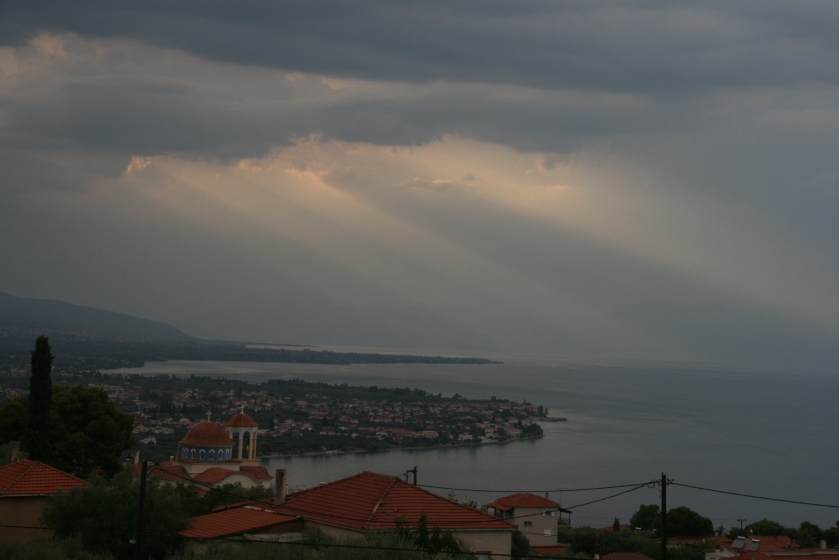
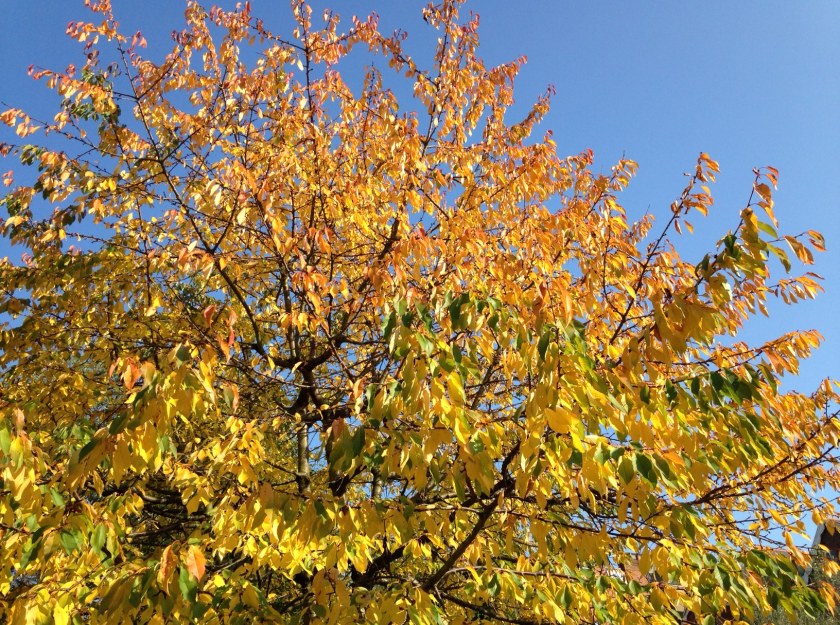
And for a more melancholic autumnal mood, I am re-posting Josephine‘s stunning photograph. She calls it ‘September’, but in Greece September is still summer to all intents and purposes.

image

Not everyone wants to cheat on their taxes

Irini* is an esthetician. She lost her job at an upmarket salon when it closed down abruptly. The owner, a shady entrepreneur with fingers in a lot of pies, had declared bankruptcy and was subsequently arrested for tax evasion. That was three years ago, and she is still owed a few months salary. Irini found another job immediately, but only part-time. She supplements her meager salary by offering facials at home. She gets paid in cash. She would dearly love to start a little business with a friend, but has yet to find a way to make it affordable.

Roula* is a masseuse, earning good money making house calls (as much as €1,000/week, on good weeks.) She has tried many times to start a proper business, because she wants to be able to declare a steady income so that she can ask for a bank loan in order to buy an apartment. This is unaffordable with the present laws, since she would need to invest a large sum to set up her own space. A sum she does not have. She is a single mother with a son to support, so she has been forced to take a part-time job where she is paid a lot less per hour, just so that she can qualify for some social security.

Myrna* opened a tiny cake shop in an affluent Athens suburb, investing a lot of her own money. Three years later, and although she has acquired a loyal clientèle and as much work as she can manage, if not more, she is still not making a profit. And yet she has to pay a lot of taxes. She might have to close down.

If people like these were given incentives in starting and running small businesses, they could each pay a few thousand in taxes yearly. One million people times one thousand in tax a year? Do the math. The state would get a cool billion, where now it gets nothing. In France, for example,  if you have a ‘micro-enterprise’ declaring up to €23,000, you pay around €5,000 in tax. Again, do the math.
There are A LOT of such people in Greece. Proper laws would help with tax evasion, and with unemployment. Instead, thousands of small companies have been forced out of business, and the black economy is thriving. The capital controls, which – despite promises – are still enforced, are not helping the situation.

And another thing, it’s not very easy to make a budget when the laws change every two minutes, and some taxes are applied retroactively.

imageIn another surreal twist, Manolis*, who is a farrier, was preparing his tax declaration form, when he was astonished to discover that the profession of farrier had been struck off the list! Unable to decide how to fill in the form, he went to the tax office where a harassed employee had no idea what he was talking about. He asked to see the person  in charge, and was directed to an office where a man lounged behind a desk, drinking coffee.
‘Well, just put the profession closest to yours,’ the man told him, totally uninterested.
‘I shoe horses! So, what shall I put? Cobbler? Ironmonger?’ Manolis was both sarcastic and indignant.
The man looked at him.
‘Did we summon you here?’ he asked.
‘No. I came because I need to know what to do with my tax form.’
‘Oh, for god’s sake, man, what’s your problem? Just put what you like, don’t waste my time.’

Anestis* is a physiotherapist. A lot of his patients are covered by social security, which means they don’t pay him directly – he subsequently gets paid by the state. However, a law came out reducing the price of each treatment retroactively  from €15 to €12 (effective since 2012.) In May, he was paid for 2014 – but, of €45,000 he was owed, he only got €15,000. He still has not received the rest, and has no idea when and if he will get any of it. He seems resigned to the fact that it will certainly not be the whole amount. Meanwhile, he’s had to pay €30,000 in taxes – the tax people having refused to offset his credit against his debt.

Now for the flip side of the coin. Something Greeks seem unable to understand is that ‘the State’ is not an abstract entity that gets its money from a higher deity. Cheating the government is cheating your family and neighbors, those who do pay. But people still admire a friend or colleague who’s found a clever way of getting around some taxes, refusing to understand that it’s their own taxes that will pay for the shortfall.

Nobody likes paying taxes. But paying taxes is more painful if you feel the government is robbing you, or if you feel you’re not getting anything in return (roads, schools, etc.). A change in mentality is desperately needed – on both sides.

image* All names have been changed

Digging to the Past

Greece is a small country that has seen many brilliant civilizations. Layer upon layer, everywhere you dig, you come upon remnants of one or more of them. Each square foot of earth can hide a treasure.

Despite the lack of funds and personnel, archaeological digs are going on all over Greece. Archaeologists, architects, restorers, and marble artisans are aided by student volunteers from all over the world. Armed with spatulas, brushes, scrapers, sieves, and even dental equipment for delicate jobs, but mostly armed with patience and perseverance, they have toiled all summer under the blazing sun to bring to light artifacts and constructions from Classical Antiquity through the Byzantine years and up to modern times.

Now, more than ever, they have to rely on personal connections as well as local artisans and businesses to be able to overcome financial obstacles and continue with their projects.


imageThe most important of these excavations is the ancient Amphipolis tomb, whose discovery in 2014 in Casta Hill, northern Greece, set the archaeological world on fire. It is still not known who is buried in the grave that dates to the era of Alexander the Great, around 300 B.C. Five human skeletons were found in the grave, statues of two headless and wingless sphinxes, caryatids and an impressive mosaic of Persephone being carried to Hades.

But there are other interesting sites around Greece:

The ruins of a Mycenean palace have been discovered on a 140-hectare site near Sparta. The impressive buildings, built around a large central courtyard and decorated with wall paintings, belong to the second complex to have been erected on the site, since the first appears to have been destroyed by fire around the 15 th or 14th century BC. A large number of clay tablets, bearing writing of the Linear B form, have been preserved –  thanks to being baked by another, more recent, fire. They constitute the palace archives and are a precious source of information about the Mycenean religion and language, as well as the social, economic and administrative structures of the area. A multitude of objects and artifacts have also been found, such as cooking utensils, bronze swords, and seals.
imageIn Crete, on Psiloritis mountain, excavations are gradually revealing the luxury and grandeur of the Minoan palace of Zominthos.

In the Cyclades, on the tiny uninhabited island of Despotiko, west of Antiparos, there existed the largest sacred sanctuary after Delos. Many fragments of marble statues and pots have recently come to light.

In Pella, an impressive marble statue was discovered of a bearded man, clad in an animal skin and boots.

On the island of Astypalaia, 5.000-year-old rock drawings have been discovered. They depict boats with oars and fish designs on their prows. They are proof that the Cycladic civilization was very widespread.

imageOn the headland of Molyvoti, an ancient walled city is being excavated, possibly Strymi, which was mentioned by Herodotus. A lot of ceramic pots, urns, jewels, amulets and coins have been found.

And there are also underwater digs. In the sea near the island of Kythira, archeologists are investigating the wreck of the Mentor, Lord Elgin’s ship, which sank after crashing into rocks while carrying 16 boxes of antiquities.

DESMOS: Matching donations to needs

What do you do with a pair of old skis, an outgrown child’s bike, or a CD player you’ve not used since you started downloading movies from the Internet? How do you get a pile of blankets to those who need them most? I give a lot of stuff to the bazaars that various organizations set up around Christmas. But there are things they have no use for, things nobody takes. Throw them out? In steps DESMOS.

Since the state is, to all intents and purposes, bankrupt – as well as being unforgivably disorganized – a lot of the social work in Greece has been taken up by charities. Of course, these are suffering as well, since individuals have much less disposable income, and companies who traditionally have acted as sponsors are facing a lot of problems as well.
However, people still find it in themselves to help, and NGOs are taking up most of the slack. There are a lot of worthy ones, doing great work with children and other vulnerable groups. One of my favorites is DESMOS, which was set up by five young women who had a brilliant idea: to match donations to needs. A kind of sophisticated recycling, as it were.

I had a talk with Alexia Katsaounis, one of the founding members and the acting president.

Alexia, can you tell me a little about how you got the initial idea for Desmos and how you set it up?

In January 2012 the Greek financial crisis was unfolding and I was part of a group of five young women who wanted to do something to help. We realized something quite simple: on the one hand, many of our fellow Greeks wished to contribute and support those more vulnerable, while, on the other hand, social welfare providers were facing decreasing resources and desperately needed all the help they could get in order to deal with continuously increasing demands for aid.
This realization became our driving concept: Desmos’ mission and basic operation was formulated to bridge this gap. That is, to best utilize surplus goods and services from companies and individuals in order to help cover documented needs of social welfare providers and non-profit organizations working to address the unfolding social and humanitarian crisis in Greece.

What does Desmos do, in practice?

Since January 2012, working out of two offices in Athens and Thessaloniki, Desmos has been able to provide for more than 300,000 short- and long-term beneficiaries, by distributing goods and services exceeding €1,850,000 in – conservatively estimated – total value to 460 social welfare organizations in Greece, through the donations of 205 companies and hundreds of individuals.

Throughout the four years of our operations, because of Desmos’ in-depth understanding of both emergency and long-term needs of NGOs, we have begun to also operate in a consulting capacity for potential donors, either as part of Corporate Social Responsibility programs, or with independent projects tailored to donors’ special interests. This has resulted in large-scale national programs.

image

Can you describe a few of these?

One is Desmos Gives Warmth, a nationwide campaign, currently in its 4th year, to provide heating fuel to non-profit organizations and schools. It has been able to distribute 171,566 liters of petrol and 9.9 tons of pellets to 123 social welfare providers, giving warmth to 7,174 people in need.
Another is Desmos for Schools – Agoni Grammi, which has provided equipment and material supplies to 35 schools in 11 remote islands of the Aegean Sea, thus benefitting approximately 1,000 students.
Yet another is our most recent collaboration with Thom Feeney on the Greek CrowdFund. This crowdfund campaign, which was launched with the goal to help address dangerously rising youth unemployment in Greece, motivated over 13,000 donors from around the world, and has resulted in the Desmos for Youth program which will support the creation of around 20 employment positions for youths aged 18-28 years, for one year, at NGOs that need valuable human resources.

Have you had a positive response from the public?

Yes, the public’s response has been extremely touching. Regarding the Desmos Gives Warmth program, the gratitude we receive from parents, teachers and students  – especially from schools in remote, northern and mountainous areas that have extremely low temperatures and high humidity during the winter – is overwhelmingly moving. We have received drawings from the students and thank you notes from the teachers that are hanging on our office walls, making us very proud :-).

Especially moving are the simple, spontaneous donations of everyday people. These provide the encouragement for us to continue our work, compensating for a lot of frustration in the face of the enormous problems that Greek society is experiencing. Most recently, Desmos collaborated with another youth employment initiative to organize a collection drive of packaged food and personal hygiene products for the city homeless. 20 young volunteers staffed Desmos stands in three major supermarkets in Athens for 5 days, encouraging customers to make donations in kind, however small, with their shopping. One visiting customer, after listening to the volunteers’ explanation of the purpose of the drive, went into the supermarket and came back some time later with a full cart. He approached the Desmos stand, took out a single deodorant and left the entire cart, full of pasta, soap and other goods, to the volunteers, saying “Keep up the good work!”

image

What are strange or unusual things people have given you?

We pride ourselves in being able to handle a wide range of donations, because there usually are corresponding needs that we couldn’t have imagined unless we asked. For example, we received a call from a donor saying that she wanted to donate a professional piano synthesizer. We were baffled, because so far we had dealt with basic goods, such as food and essentials, and it was a challenge to respond to such an item. However, once we began asking NGOs whether they could use  a synthesizer, we realized that social welfare providers that care for special needs children with autism, mental retardation and other conditions needed musical instruments because music therapy and musical stimulation were essential to the learning process of the children. It was an instant and wonderful match that led us to post such needs on Facebook and equip a number of NGOs with musical instruments that would be otherwise collecting dust in some storage!

Recently we received an email from someone who wished to donate an old Mercedes in mint condition. Once again we didn’t know where to start looking, since NGOs usually ask for vans or SUVs – however, a couple of organizations responded that they needed a transportation vehicle and were open to the car and entailing costs. The donation didn’t go through in the end, because the owner couldn’t bear to part with the car, but he assured us that once he makes the decision, we’ll be the first people he calls.

Is matching donations to needs a complicated task?

Yes, it requires a lot of work and communication between various parties, so Desmos is constantly researching ways of making the process easier and more efficient. To this end, we have created Desmos Direct, a valuable digital tool that innovates the giving process by “automatically matching” goods and services offered by individuals and companies with the needs of social welfare organizations. Donors and organizations post their donations and needs online and when a match occurs, Desmos Direct notifies both parties and directs them to complete the transaction. This way, donors can browse through organizations’ needs, but also organizations can browse through donor’s items on offer to find the odd thing they may desperately need. Any donation, however strange or unusual in principle, may very well have its corresponding need on www.desmosdirect.org!

And finally, are you doing anything in particular to help the refugees?

The current refugee situation in Greece and Europe at large troubles us greatly and we continuously receive donor interest in helping out the areas that are hit the most by incoming refugees, as well as requests for aid from NGOs specializing in refugee crisis relief that are active on the sea and mainland borders, particularly the islands of the Eastern Aegean.

So far, thanks to corporate and individual financial donations, we have made significant in-kind donations in food and basic goods supplies to the islands of Tilos and Lesbos.

We are in the process of establishing a more consistent line of assistance and supplies to the island of Samos, which is developing into a significant “crisis” island, particularly in anticipation of colder weather in the next months. We are also in constant communication with most NGOs that work for the refugee crisis,  such as the International Rescue Committee, which we are helping by supplying goods to them in Mytilene.

At the moment, we are also expecting donations from the international community, and are making efforts to get through the customs bureaucracy in order to access these goods. Specifically, we have 18,500 cans of baby formula from New Zealand that are waiting for customs clearance, and we just received a large quantity of sleeping bags, blankets, raincoats, and personal hygiene products from the Greek Community of Geneva, Switzerland.

While thanking Alexia for taking the time to explain things, I would like to add a word of praise for the work done by the staff and volunteers at DESMOS. They are always cheerful, helpful and, above all, efficient. They even told me where I could give boxes of pills (in capsules) that had been opened but were not yet expired, that I found when clearing out my medicine cabinet!

imageFor updates on refugee aid, as well as to learn more about new projects and ideas, you can follow Desmos on Facebook and Twitter and register for their monthly newsletter at www.desmos.org.

And for donations, use www.desmosdirect.org or call (30)216-9001320 Monday-Friday 10:00-18:00.

The refugee crisis revisited

My heart sank when I read in the paper that Burkina Faso is on the brink of civil war. More people wanting to come over here, was my first thought.
The refugee crisis has gone on for so long, and is so out of control, that serious political and economic dimensions have been added to the humanitarian aspect.

On the one hand, it has become big business. Here is some number crunching:
It costs a minimum of €1200 per person for the passage from Bodrum to Kos. For 50 people in each boat this equals a whopping €60.000! And that’s just for a short crossing – I have no idea what traffickers from Libya make, when they pile 700-800 people into a rust bucket and cast it off without enough fuel to reach Italy…
Once you get to Greece, apparently kickbacks are extracted everywhere: €200 to get to the head of the queue, €200 to get on the bus, and so on. A lot of these ‘facilitators’ are themselves Syrian.
It’s €4000 from Morocco across the straights of Gibraltar to Tarifa in Spain. By jet ski! Although it is very dangerous since it is beyond the safe range, the trip must be undertaken under cover of darkness and the water is freezing.
For wealthier Syrians, safer, more comfortable trips can be arranged via Dubai to Turkey, then from Izmir to Rhodes on larger boats. A few more thousand euros then have to be paid out in taxis, hotels and fake documents. I read an interview with a Syrian doctor who had turned ‘travel agent’ after failing to cross over himself – he was saying people trust him because he’s a doctor and prided himself on not having a single person die on his boats.

On the other hand, attitudes are hardening:
Donald Tusk, the EU president, has claimed that migrants are being sent to Europe as a campaign of “hybrid warfare” to force concessions to its neighbors. An influx of hundreds of thousands of refugees becomes a “weapon” and a “political bargaining chip” used by the EU’s neighbors who want to put pressure on Europe to obtain extra aid or other benefits.
Mr Tusk warned that the Schengen system of passport-free travel would collapse and Europe would become a “breeding ground of fear” unless Europe’s external borders are secure. There is mounting frustration in Brussels at President Recep Tayyip Erdoğan’s refusal to seal Turkey’s coasts and border with Greece.

At the same time, a controversial plan to relocate 160,000 people from Greece and Italy to other parts of the EU by quota was announced.
The countries that refused this project, one of which is Romania, claimed that the immigrants will alter the fabric of their society. That’s as it may be, but people from these countries have themselves emigrated in the not so distant past. Greece accepted more than 20,000 Romanian refugees after the fall of communism. Did they ask themselves if they would alter the fabric of our society?

Unfortunately, the West does bear a part of responsibility for this situation, by meddling in these people’s countries. As usual, economic interests are mostly to blame. For one, the arms industry needs wars in order to make a profit – then there is oil, and minerals, and construction… Now we have to deal with the fall-out. Theoretically, it would make a lot more sense to spend the money making their countries safe for them, than dealing with them in Europe. It is probably too late now. Boris Johnson, the Mayor of London, has suggested there should be a safe haven organized for them in the Middle East. I don’t know how feasible that would be, but I do think the Arab world should be doing more to help.
image

Meanwhile, in Athens, the situation remains dire.

On September 30th, a friend of mine went to Victoria Square, in downtown Athens, to evaluate the migrant situation first-hand. This is what she wrote:

‘Flanked by three friends, all laden with bags bulging with juice boxes, cans of long-life milk, packets of biscuits and cereal bars, markers, children’s books and clothes, I exited my car on the busiest side of the square. We were immediately accosted by tens of people, including many children.
I wasn’t psychologically prepared to be faced with such palpable desperation. The situation was worse than I’d imagined. And a thousand times more unsettling, too.
People grabbed at the bags, tore them straight out of our hands, served themselves to as many goods as they could carry. We made sure the children received priority but, soon, we were mobbed by grown men, too.
It was actually pretty terrifying. If you don’t see it first hand, it’s hard to fathom how bad it is.
Turns out the people here were not political refugees from Syria. These were all illegal immigrants from Afghanistan. I was shocked to find that they were not even all that grateful for the things we’d brought.
I certainly don’t regret going, but, having said that, I value my safety and I’m not about to go back any time soon. I would not recommend that unprepared civilians intervene, but I did approach a harried-looking volunteer from Holland who shed some light as to what you can do if you really must help in person.

1- Bring warm clothing, blankets and socks. With winter coming, this is what they will need the most.
2- Bring food, always a necessity.
3- Circulate with a zippered bag rather than paper or plastic, both of which tear easily, and hand the goods out directly to the people you choose. Keep moving. Stay too long in one place and you will be mobbed. (Easier said than done.)
4- Prioritize women and children. The men come third.
5- Make sure you are not carrying valuables. Gypsies who roam amongst the Afghans are quick to pounce on unsuspecting strangers.

The situation is really too bad to be true and pressing questions arise: where will all these people live should they choose—or be forced—to stay here? After all, they can’t camp out forever.’

image


Other friends who ventured to Victoria square told me approximately the same things, adding, however, that the baker where they went to buy food for the refugees gave them ten loaves which he also cut into pieces for them.The same thing happened to us, when we went to buy medicines for them at a pharmacy. The pharmacist added a large number of freebies to our bag. Greeks, whatever their other faults, remain human and sensitive to the pain of their fellow men.

Roger Cohen, writing in the New York Times, says:

Greece has made me think about everything statistics don’t tell you. No European country has been as battered in recent years. No European country has responded with as much consistent humanity to the refugee crisis.

For the whole article, click here.

A Greek church near Ground Zero

Inspired by visiting the churches in Patmos while sailing in the Greek islands, Spanish architect Santiago Calatrava did not hesitate to submit his design for the building of the St. Nicholas Orthodox Church at the World Trade Center.

image

He visited many churches, and notably Aghia Sophia and the Church of the Holy Saviour in Chora (both in Istanbul) and made thousands of sketches before perfecting his proposal. This was selected from over a dozen others to replace a 19th-century building that was destroyed by falling debris and building parts from World Trade Center Tower Two during the 9/11 attacks in 2001. The Greek Orthodox Archdiocese had to negotiate hard with the Port Authority to have the church rebuilt, and is funding part of the project.


The domed structure will be partly clad in a translucent skin, made of thin stone and laminated glass, which will allow it to glow softly from the inside at night. A small white flame beneath the skyscrapers.

image

The project is being  presented in an exhibition at the Benaki Museum. At the preview, looking at the maquettes and the original sketches that made up the exhibition, one could sense the church would provide an ideal counterpoint to the plaza’s twin reflecting pools.

image

Although St. Nicholas will function as a Greek Orthodox Church, it will also be open to anyone as a shrine and spiritual beacon overlooking the Ground Zero memorial Plaza. It is designed to be a place where people of every belief will be inspired to go in and light a memorial candle – even people who do not practice any religion.

The September 11 terrorist attack in the name of Islam gave rise to a discussion about the role of religion as a weapon of fanaticism. The fact that a Catholic architect designed a contemporary Byzantine church inspired by structures that were used also as Muslim mosques can only add a note of optimism and hope.

In my mind, there is also a historical connection of this idea with Constantine the Great, a Roman Emperor who later converted to Christianity and built Constantinople. In 313 A.D. he signed the Edict of Milan, concerning religious tolerance, which stopped the persecution of Christians. A small excerpt: ‘And thus by this wholesome counsel and most upright provision we thought to arrange that no one whatsoever should be denied the opportunity to give his heart to the observance of the Christian religion, of that religion which he should think best for himself, so that the Supreme Deity, to whose worship we freely yield our hearts may show in all things His usual favor and benevolence.’

Calatrava’s work is known for courting controversy. As well as supremely talented, he is perceived as vainglorious, designing meta-modern Parthenons that will secure his place in the Pantheon of architecture. His projects are often plagued by delays and spiraling costs. This particular design has been criticized by many as being ‘cold’, ‘like a pumpkin sitting in a box’, ‘more like a museum than a church’ and, worse, ‘like a mausoleum’. It is certainly not as welcoming inside as a traditional Byzantine church with its gold and red icons. In the context of the specific site, however, I personally found it awe-inspiring and very apt.

I’d be curious to know what everyone else thinks.

Below is a short video. The quality is mediocre, since I recorded it on my phone. But it shows a fascinating insight into Calatrava’s thought process as his design evolved.

Duration of the exhibition:
24/09/2015 – 25/10/2015

Venue:
Athens Benaki Museum
Main Building

Come on, everybody

A few days ago I received this comment:

“Had a stroll through your blog thing. It is very well organized and I found your stuff to be topical, on the point of controversial, and very well presented. I was very impressed, which doesn’t happen often, particularly when I have slightly different views than yours on some of the topics.”

Well, good. Pity my friend didn’t write this comment on the blog itself, as I pointed out to him (he has since been doing so). I wish more people would disagree with me, have a different opinion, or point out something they didn’t like.
Of course it’s lovely to get compliments, and it gives me a real boost when people enjoy something and say so, so thanks to all of you out there!
But one thing, which I haven’t succeeded in doing much of yet, is start a conversation. Occasionally, it would be nice if people had a good old discussion in the comments.
I can’t always be right. Sometimes I’m angry, frustrated, or just biased. You don’t have to even like the same artists I do.
So bring it on!

(Within the limits of civility, of course 🙂 )


image

And while we’re at it, is there something in particular you’d like me to write about? Things I should write about more often? Less often? Let me know.

.

Sculpture update: Tony Cragg in Athens


imageThe little girl standing next to me was counting faces.
‘There’s one,’ she pointed. ‘And another!’

imageThe sculpture before us was made of sheets of plywood glued together in layers. Three twisted pillars that reminded me of rock formations – or stalagmites (see photo on left). But as we circled it slowly, human profiles revealed themselves: some impassive, some stern, some faintly smiling. The little girl got excited, and so did I. If you look at the photo above, and the close-up below, you will see what I mean. This was one of the most deceptively simple, yet, upon inspection, incredibly complex pieces of art I’ve ever seen.
image

When asked if some of the faces somehow ‘appear’ when he’s creating the piece, Tony Cragg is firm. Everything is meticulously planned. He takes pencil to paper and sketches out every facet of a new idea before converting it to 3D. Sometimes this proves impossible – his imagination has run away with him. Some ideas never evolve beyond the drawing stage, but if the drawings themselves are lovely, the completed sculptures are breathtaking.

On September 8, a cosmopolitan and mostly young crowd gathered at the Benaki Museum for the opening of Tony Cragg’s sculpture exhibition. Cragg, 66, born in Liverpool, winner of the prestigious Turner Prize in 1988, has never shown his work in Greece before. He appeared happy to explain his thought processes as he stood in the auditorium, looking relaxed in an open-necked shirt. The audience enjoyed his engaging narrative which was accompanied by a slide show, and afterwards plied him with questions and requests to sign their catalogues.

Wandering amongst the works after the talk, my overwhelming urge was to touch them. Their curved, smooth surfaces cried out to be stroked.
imageCragg uses natural materials such as wood, polished stone and bronze as well as mirror-finish steel and even plastic.
The sculptures are very different. Some are squat and grounded.
image

Some seem to be leaning into the wind, their surface eroded into the outlines of human profiles. Others soar upwards. Yet they all emit the same energy, their shapes shifting depending on where you’re standing.

image

As I was leaving, I stopped to admire a few of the bigger bronze sculptures dotted about the museum’s wonderful courtyard.

image

The exhibition was curated by Xenia Geroulanou of the Thaddaeus Ropac Gallery,  who has represented the artist for 20 years; the Benaki Museum; and the artist himself, who loaned all the works from his own foundation.

*For anyone interested, below is the link to an article about Tony Cragg written by Vanessa Wildenstein for Athens Insider Magazine.

*For those in Athens, the exhibition runs until November 8, 2015.

Opening hours are Thursdays and Sundays from 10 a.m. to 6 p.m. and Fridays and Saturdays from 10 a.m. to 10 p.m.

Benaki Museum, 138 Pireos & Andronikou, tel 2102.345.3111, http://www.benaki.gr

Election Results

Alexis Tsipras, the ‘Laughing Boy’ as he’s known locally due to his youthful looks and smiling face, won the elections by a comfortable margin. He is to form a government with ANEL, a right-wing, anti-austerity party he’s already collaborated with in the past. Godspeed – he has a huge task ahead, and now he’s been given the mandate to proceed. No more referendums or elections, no more escape routes.

The ‘Return to the drachma’ faction was wiped out as it failed to win a single seat in Parliament. Tsipras bounced back from an in-house revolt of radicals which nearly made him lose control of his party. He now must prove himself as a leader to deal with issues such as the immigrant crisis and also implement the reforms he signed for the bail-out agreement.

The elections are finished, the Troika returns, screamed a headline in one of the dailies. The election is over, the crisis isn’t, wrote another paper.

Let’s hope that politicians will settle down now and do their jobs, instead of spending their days on TV panels, shouting at each other.
In a worrying statistic, 2 million less people turned up to vote than in 2004. That’s around 45% of the electorate, a record by Greek standards. In a population of around 10 million who can vote, that is huge. Parties will have their work cut out to win those people back.

imageEven more worrying, Golden Dawn, the extreme-right party, won two more seats in Parliament than before. That means that 400,000 people voted for a party who has acknowledged murdering people and whose leader has spent time in jail.

What will be the face of Greece in two years? In five? We are facing an uphill battle, but Greeks have proved they are resilient, so we must hope there will be light at the end of the tunnel.

photo by Eleni Koryzi