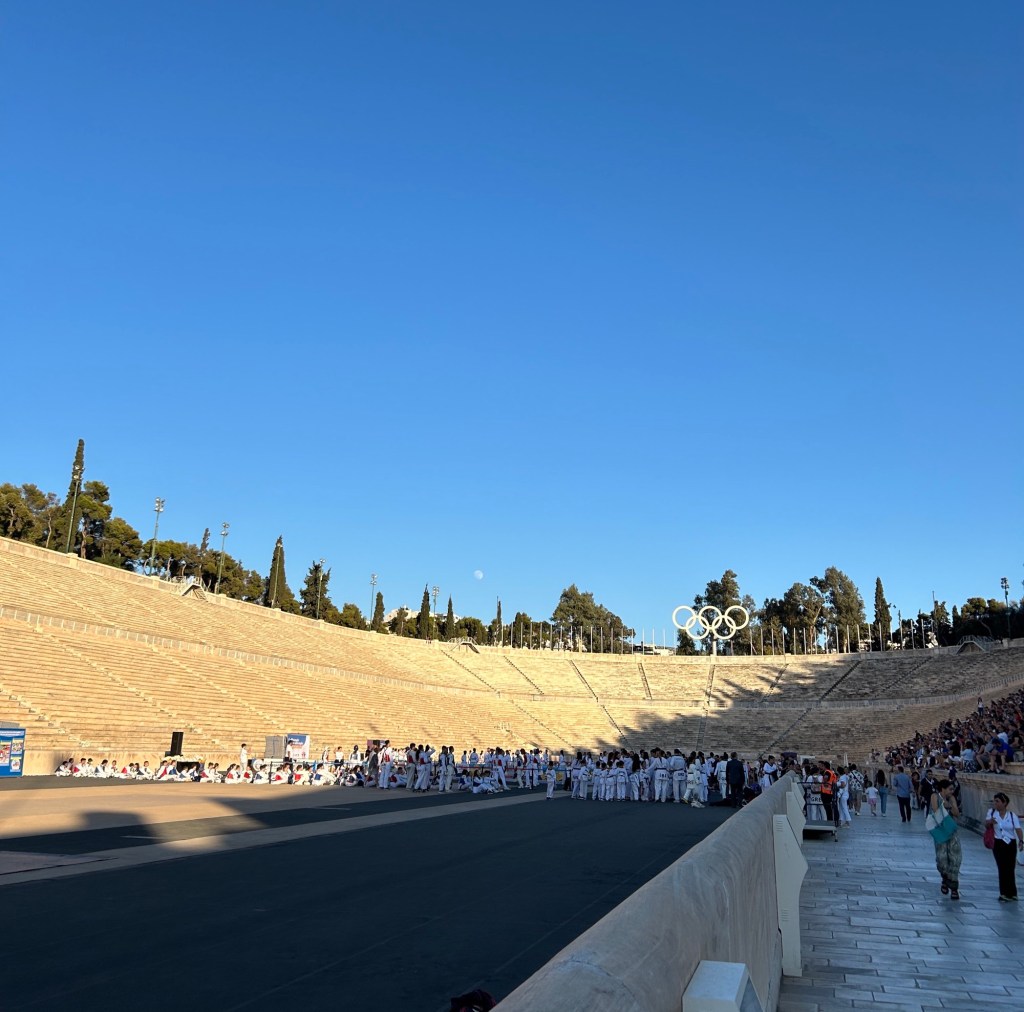
Although I have been multiple times to the Panathenaic Stadium or Kallimarmaro (beautiful marble) every new visit strikes a fresh chord.
A truly magical place under the pure blue Attica sky
Built entirely of white marble, the stadium was first constructed on the site of a simple racecourse by the Athenian statesman Lykourgos c. 400 BC, primarily for the Panathenaic Games. It was rebuilt in marble by Herodes Atticus, an Athenian Roman senator, by 144 AD it had a capacity of 50,000 seats. After the rise of Christianity in the 4th century it was largely abandoned, but was excavated in 1869 and hosted the Zappas Olympics in 1870 and 1875. After being refurbished, it hosted the opening and closing ceremonies of the first modern Olympics in 1896.
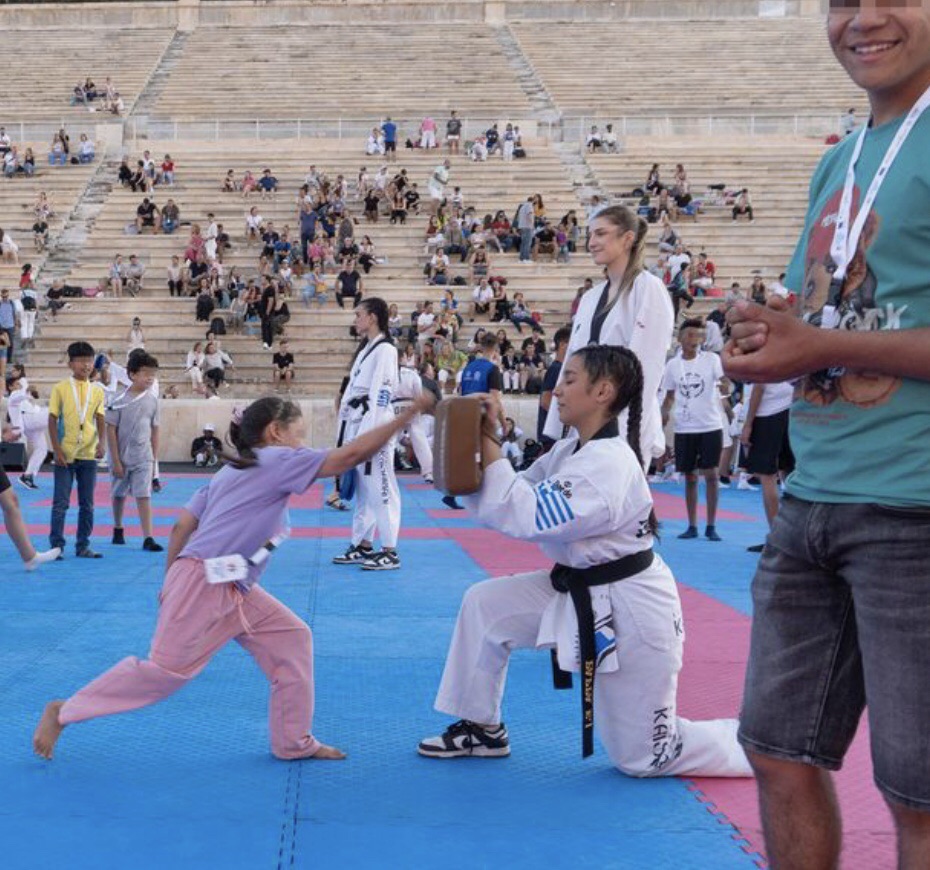
The reason for my visit, a few days ago, was a Taekwondo event within the framework of the Together in Sport program, titled Together in Taekwondo.
More than 400 young Taekwondo athletes, boys and girls, took part in a series of competitions and poomsae.
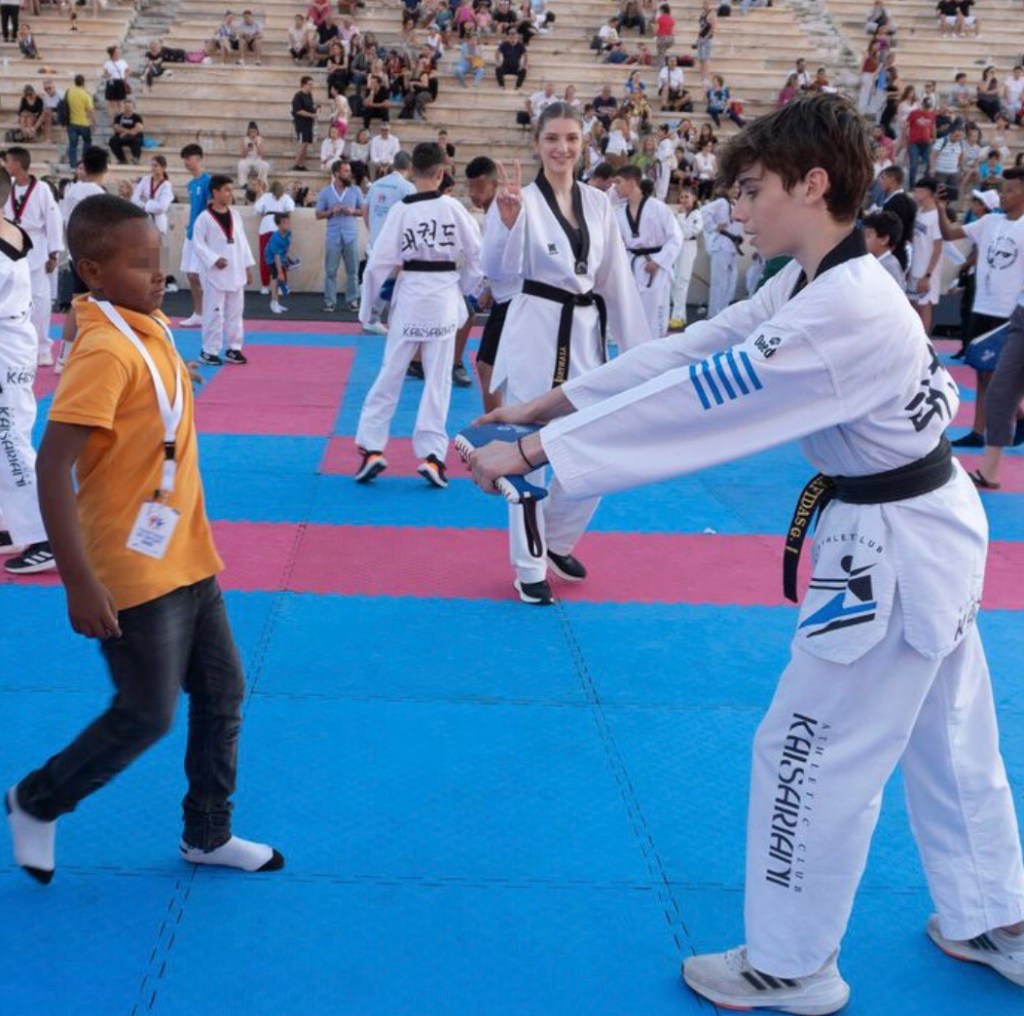
As I entered the stadium an impressive number of black-belted teenagers were literally flying about in breathtaking movements—it was like watching a Ninja movie.
On the side, smaller kids in helmets were performing more basic moves.
In the second part of the event, young refugees of all ages and from a myriad countries mingled with the Greek kids and got a chance to try the sport for themselves.
Some of the action
Emotions ran high, there was much laughter and bantering as big boys tried various kicks while tiny girls in skirts spun cartwheels around them.
The event was rounded up with speeches, awards and gifts and there was also an art exhibition titled ‘We are all on the same team’, sponsored by the High Comission for Refugees, with drawings, posters and comics by 1.800 students of all ages.
The President of the Teakwondo Federation declared that it was a dream come true for them to find themselves in the historic stadium.
Photo by Lina
Together in Sport is a European project implemented by METAdrasi, an NGO helping refugees, in cooperation with the Hellenic Olympic Committee and the German Olympic Sports Confederation (DOSB)
The main aim of the project is to use sports as a social medium to give the chance to asylum-seeking children (from 7 to 17) to learn about and take part in organized sports—but also through sports to develop relationships with their peers from the local communities. The project enjoys the support of Μunicipalities in Attica and the rest of Greece.
Amongst the aims of the project is to cultivate and promote values like mutual respect, team spirit and intercultural tolerance—as well as improve the everyday life of these kids and enhance their sense of belonging.
The programme also includes recreational and cultural activities of an educational nature (visits to museums, archaeological sites, sports facilities etc.)
Photo by Lina
The above is to give some general information, but what was wonderful about this particular event was the sense of enjoyment in all present and the appreciation of being in such a unique place as the sun fell.
The novel by Jenny Erpenbeck, Kairos, has won the International Booker Prize, which is awarded annually ‘for the finest single work of fiction from around the world which has been translated into English and published in the UK and/or Ireland.’As such she shares the prize with Michael Hoffman, her translator, who has done a brilliant job. She is the first German novelist and he the first male translator to win the award.
The novel is a romance of sorts, between a 19-year-old student and a 50-something , married, semi-famous professor and novelist. Set mostly in East Berlin in the late 1980s, the affair tracks the history of the country before and during the collapse of the Berlin Wall.
When I started reading the book, I was dazzled by the immediacy, vividness and general brilliance of the writing. I would have given the book a five star plus. The quality of the prose, set in the present tense, continues to the end, and one can taste life in East Berlin at that time in fascinating detail. This background, which is intimately interwoven with the characters’ lives, is a major part of the book’s attraction. Erpenbeck has said that the fall of the Berlin Wall and the turbulence that followed was what led her to become a writer, because she lost the system that she knew and had grown up in.
However, as I went on reading I became less enthused because I found both the main characters singularly unappealing. She, Katharina, is a prize idiot, obsessed by a man who abuses her, physically and mentally, to the point of surrendering all independence and even free thought. And he, Hans, is simply awful: full of his own importance, an unfaithful husband, terrible father, a manipulative and abusive lover. I was also annoyed that Katharina’s family, with whom she is close, never lift a finger to dissuade her from this destructive relationship.
I will not describe the book in more detail because multiple reviews can be found online, by people more qualified than me. It makes for uneasy reading at times—one critic describes it as a ‘wallow’. Others enthuse.
Nevertheless, I think Erpenbeck deserved her win, although I have not read all the other books on the shortlist. In this age when everything has to be politically correct to the point of blandness, and anyone expressing an unpopular opinion is trolled into oblivion, it is refreshing to read somebody who is not out to please—especially since the quality of her writing is outstanding. It is a novel that will provoke discussion and debate. Also, I loved watching the video of her acceptance speech.
It is an unsettling book, so I was interested in people’s reaction to it.
I’m sure by the time this is published, everyone will be groaning under a surfeit of lamb, mageiritsa, manouri, red eggs, and wine. And tsoureki.
If any new readers are interested in Greek Easter customs, I have written about them in earlier posts, which you can find here : https://athensletters.com/?s=Easter
Does anyone agree that reading the papers has become a surreal experience? I find I only scroll through the headlines, skimming diagonally through a couple of pieces, before going on to the fringe articles such as book, film and art reviews, travel and some opinion essays.
Irrelevant but hopefully cheering collage
Otherwise one has to toil through:
The minutiae of the trial of an ex (and perhaps, horrifyingly, future) president of the USA v. a porn star
The doings of an American Governor who shot her dog and her goat (I thought one called the vet in such cases, but she obviously thinks she’s in the Far West.)
A number of horrifying and endless wars, now fought in large part with drones. Fatigue has set in and no one can bear to read more awful stories of grief and atrocities.
Tales of Chinese spying and manipulation of elections in the West. Are these true or conspiracy theories?
The details of the Met Gala, which every year becomes more unreal, with fortunes being spent on mostly hideous and ungainly outfits.
The doings of Taylor Swift. OK, I’m probably too old to appreciate her, and she is certainly talented and very shrewd, but…is it literature? They’re actually, believe it or not, teaching a class about her at Harvard…
Teenage girls who are confronted with deepfake pornographic images of themselves posted on social media. The only relief here is that it’s getting so wide spread that in a while nobody will believe them or care anymore.
Regarding the above-mentioned book reviews, memoirs which can be very interesting are also getting weirder. They used to be accounts of exceptional lives full of adventures and tribulations, now many are about navel-gazing, real or imagined psychological trauma and ‘polyamorous’ relationships (see ‘Open’ by Rachel Kranz—not on my TBR list, I hasten to say.)
Inane studies about—for example—how to prolong your life by eating ten avocadoes a day or other theories. Who funds these and why should one believe them?
Prince Harry and Megan. Is there anyone who still cares?
On a lightning trip to London, I managed to squeeze in a visit to the stunning Sargent exhibition at Tate Britain.
Sybil Sasoon, the Countess of Rocksavage, 1913
John Singer Sargent (1856 – 1925) was considered the most important portrait painter of his generation. His speciality was making evocative paintings of Edwardian society, depicting beauty, wealth and luxury. He created roughly 900 oil paintings and more than 2,000 watercolors, as well as countless sketches and charcoal drawings, travelling worldwide to Europe, America and the Middle East.
He was born in Florence to American expatriate parents, and trained in Paris before later moving to London, living most of his life in Europe.
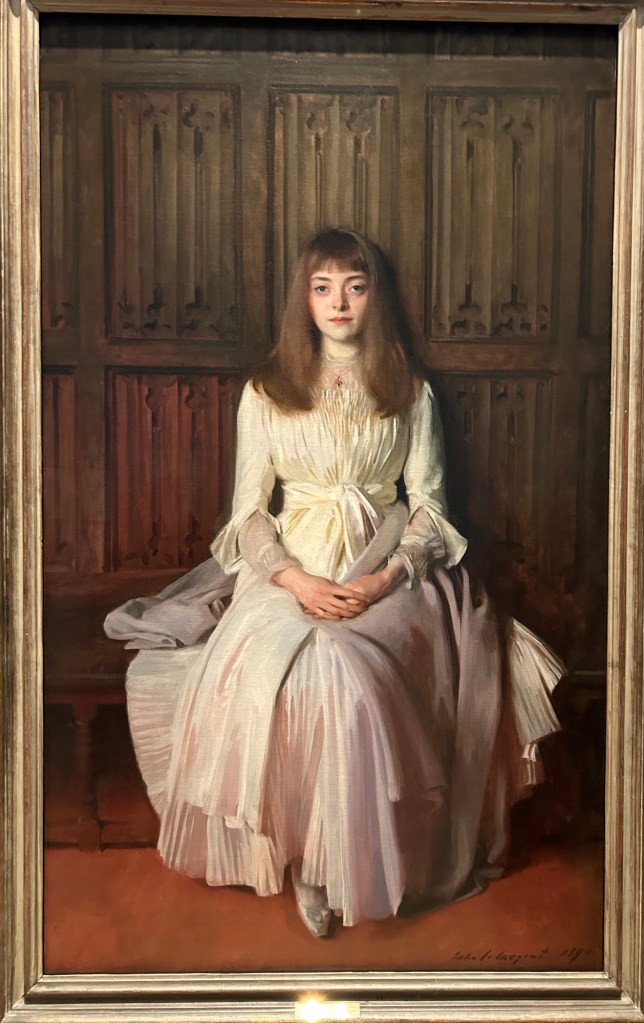
Sargent was a very demanding portraitist, almost a bully with his sitters. Believing their attire was an important part of the composition, he chose and then manipulated their clothing until he achieved the desired effect.
Lady Helen Vincent, Viscountess d’Abernon, 1904
Sitting for one’s portrait is in any case a disquieting activity—the self-consciousness at being stared at in such detail, exposing all one’s flaws, the discomfort of retaining the pose for an extended period of time, the boredom, and the possible dissatisfaction with the result. And that is without mentioning the cost: at the height of his fame Sargent charged $4000 for a full length portrait, compared to $400 for an average artist (from an invoice he sent to the Harvard Club of New York in 1896) —or a whopping 150k in today’s money. Sargent was sought after for his ability to produce a flattering likeness in most cases, but that did not make it any easier, either for the sitter or for him. He often said he hated painting portraits.
Miss Elsie Palmer, or A Lady in White, 1889-1890
Sargent seldom let his sitters choose their own dresses—and often he added chiffon scarves, shawls, wraps or simply pieces of material and pinned the dresses up or wrapped them around the body to achieve the desired effect. One of his subjects remembers being pricked by the pins he stuck in the fabric to make it stay in place.
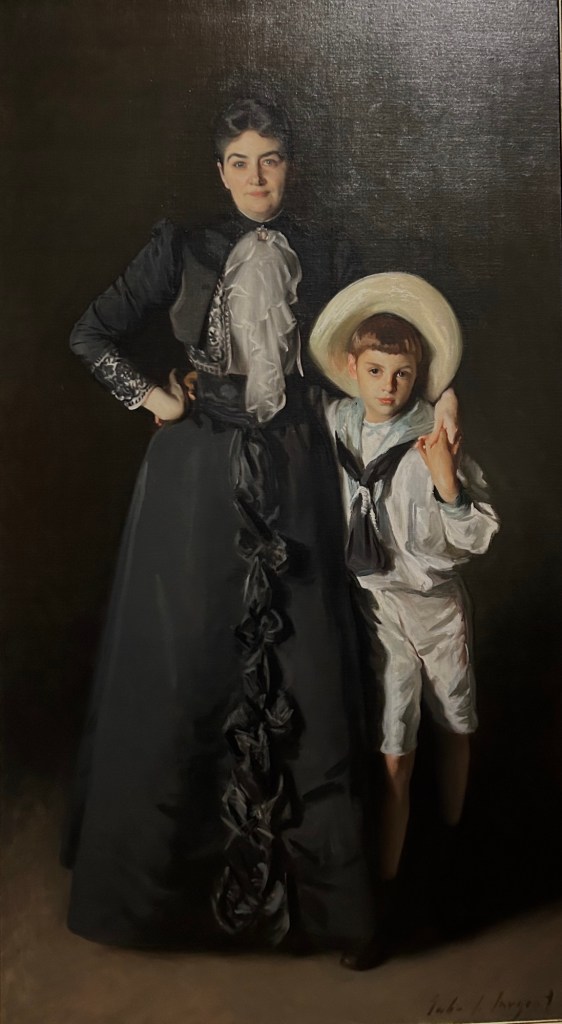
Mrs Edward L. Davis and her son, Livingston, 1890
Looking at the paintings, I was struck by how uncomfortable some of the poses looked, whereas others were a lot more relaxed and natural.
In some cases there was a photograph of the subject next to the painting, which showed that Sargent was wonderful at capturing a likeness, although often flattering and prettifying, whether the face, making look younger and smoother, or the body, which he often elongated to render it more elegant.
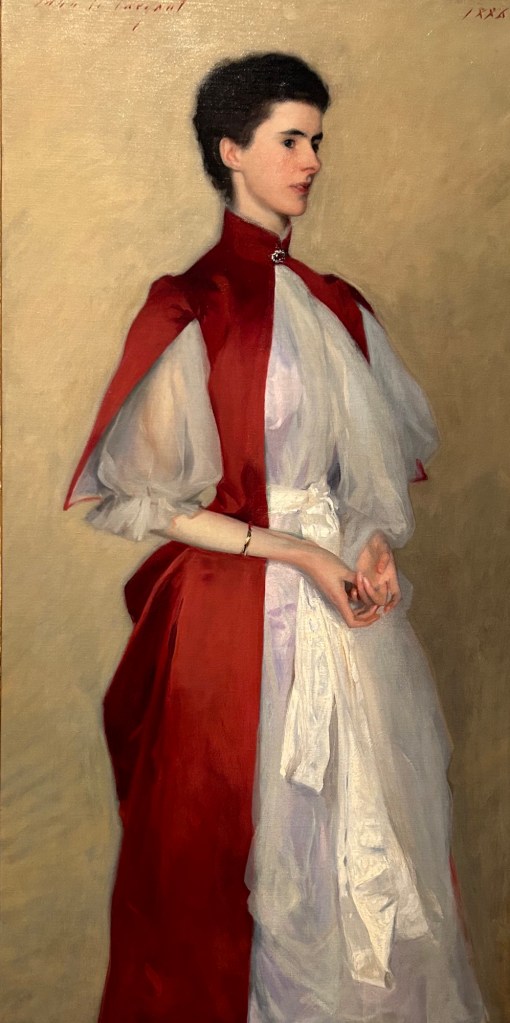
He was a master at painting fabrics. Notice the difference between satin, in the portrait of Mrs Harrison, below, and her strange cape…
Mrs Robert Harrison, 1886
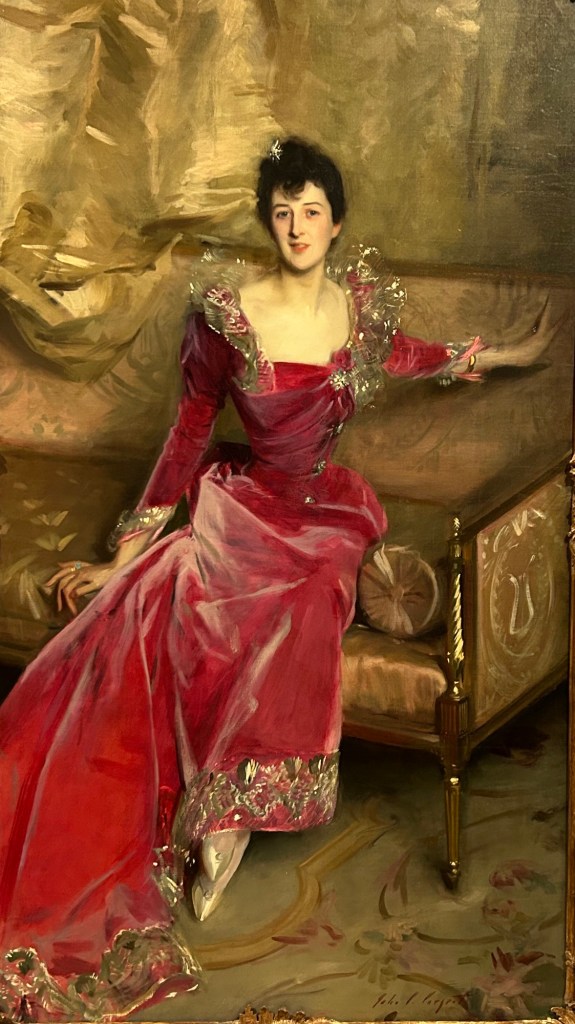
…and the silk velvet of the cherry red gown trimmed with gold lace, worn by his friend Mary Hammersley.
Mrs Hugh Hammersley, 1892
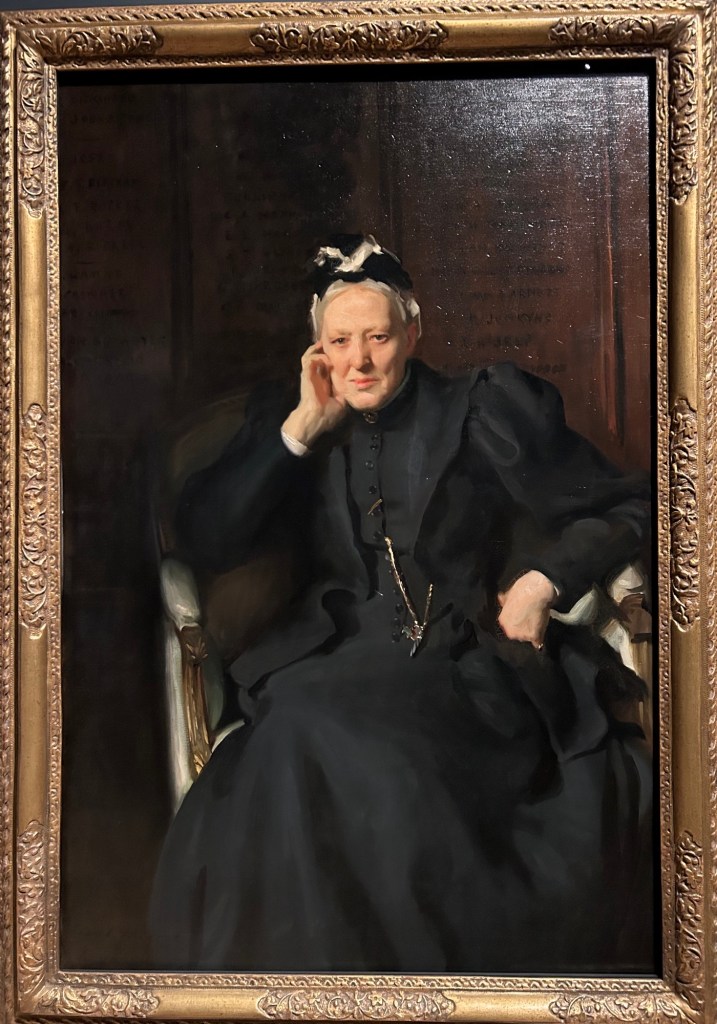
Sargent was a master at painting black fabric, which is not only apparent in the frock coats of his male models, but he often induced females to wear it, too.
Jane Evans, 1898
Jane Evans, who ran a boarding house at Eton College, was said to be ‘able to see through a boy as if he were a pane of glass’, and one can picture them quaking before her—the portrait fully conveys her authority and the power of her personality.
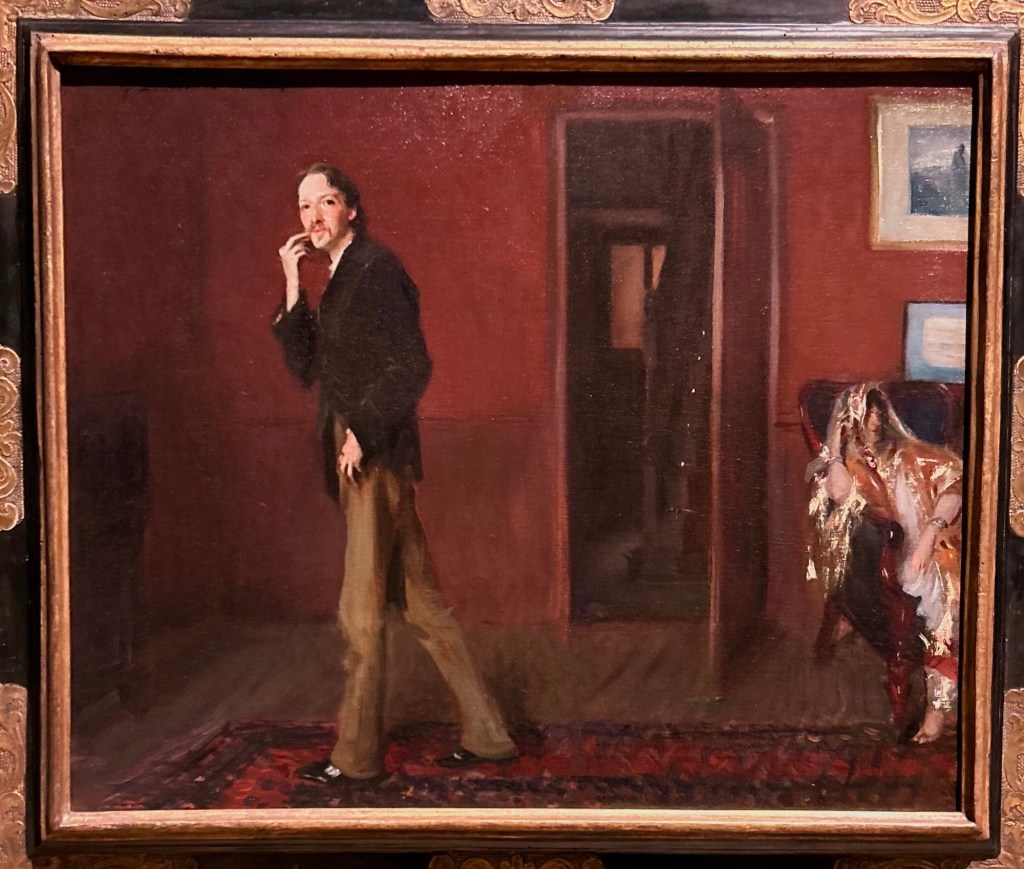
Interesting little picture of a staged scene between two writers: Robert Louis Stevenson and his wife Frances Osbourne. She had worn a South Asian dress to show Sargent, in he insisted on painting her slumped in it in a corner of the sofa.
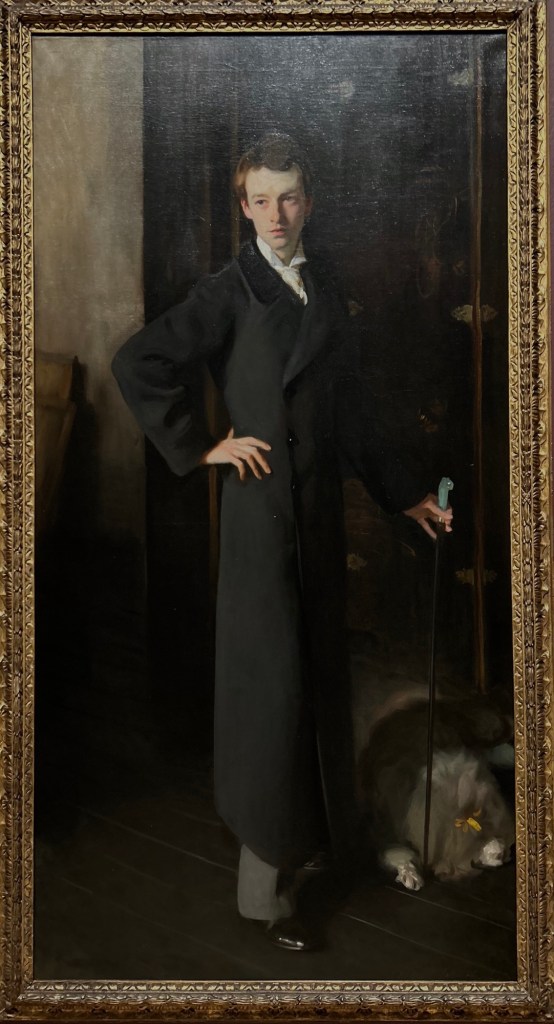
Sargent made Graham Robertson, below, wear a long Chesterfield coat in the heat of summer, despite his objections, because ‘the coat is the picture…’ Robertson was an artist, writer, collector and friend of Oscar Wilde. Please note the cane and be-ribboned poodle at his feet.
W. Graham Robertson, 1894
Sargent depicted a world of wealth and leisure enjoyed not only by the aristocracy but, increasingly, by a new cosmopolitan elite. His compositions included fashion as well as furnishings and props.
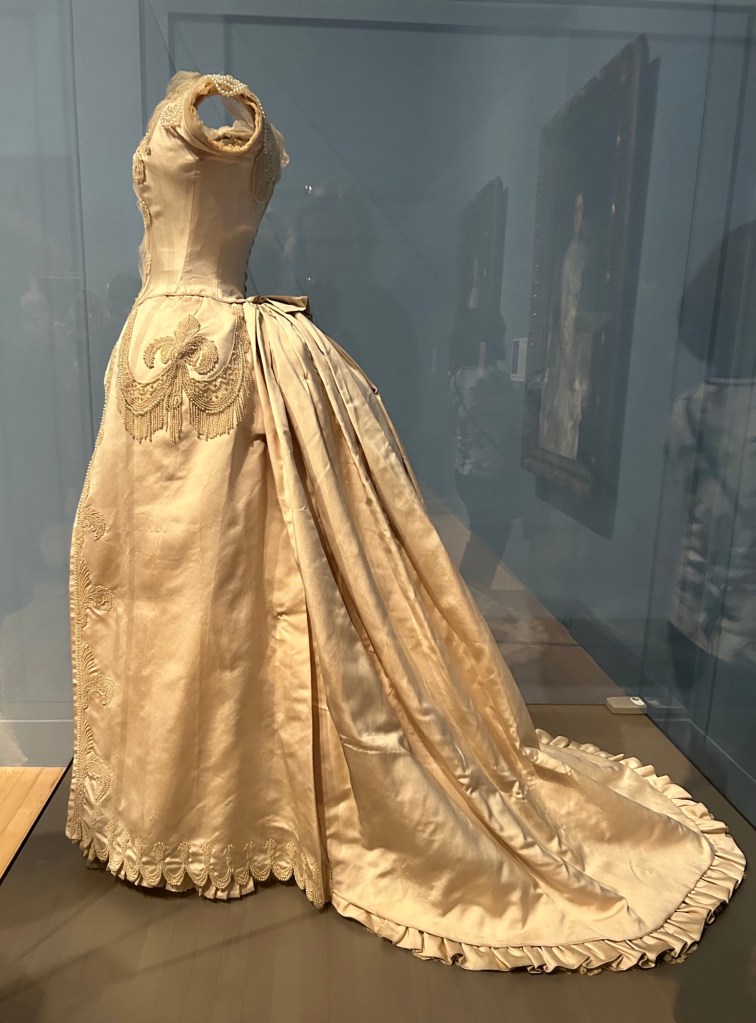
The Gilded Age and the Belle Epoque (1870-1914) saw the birth of Haute Couture. The exhibition featured dresses from that era, such as the one below made by the House of Worth, one of the leading couturiers of the era.
Pearl-embroidered bengaline
Absolutely beautiful and very expensive—dresses like this could cost up to £25.000 in today’s money—but personally I would not like to wear something like that. How could one possibly sit in this, or even breathe? Look at the tiny waist, strangled by stays, and the huge bustle at the back.
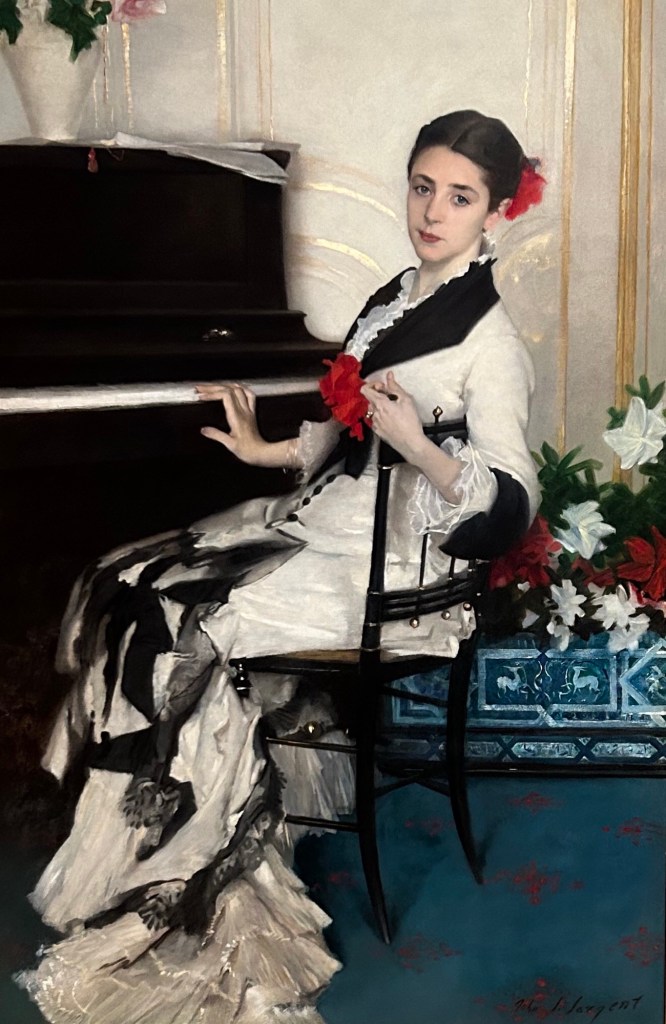
But I digress. The wonderful portrait below, of the Chilean beauty Madame Ramòn Subercaseaux was widely admired and brought more custom to the young artist.
Mme Ramòn Subercaeaux, 1880-1881
There might not have been social media at the time, but there was a closed society ready to critique everything people wore.
In an age when there were no photographs to look at, people even consulted portraits at exhibitions on matters of taste in dress.
To be painted in a couture dress, in a portrait singled out at a prestigious exhibition venue such as the Royal Academy or the Paris Salon, could help gain or assert a woman’s social status.
Of course this facility at painting beautiful dresses enabled his critics to assert Sargent was not a serious artist but just a clever painter of fashion, what art critic Walter Sickert called ‘ the chiffon and wriggle school of portraiture.’
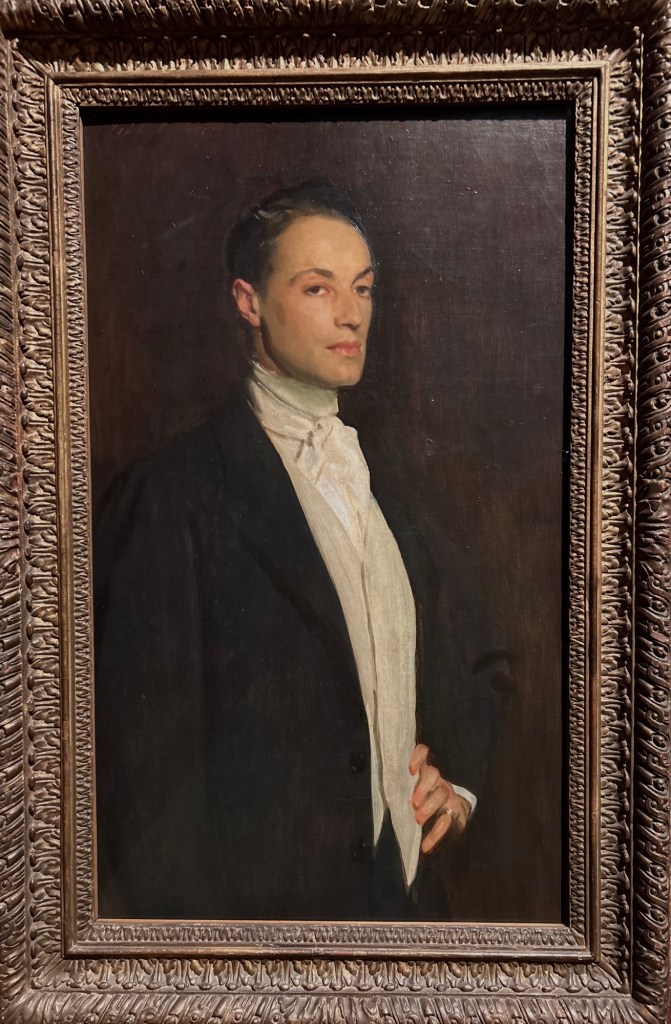
Sir Philip Sasoon, 1923. Although Sasson was known for his flamboyant taste, Sargent painted him in very formal attire.
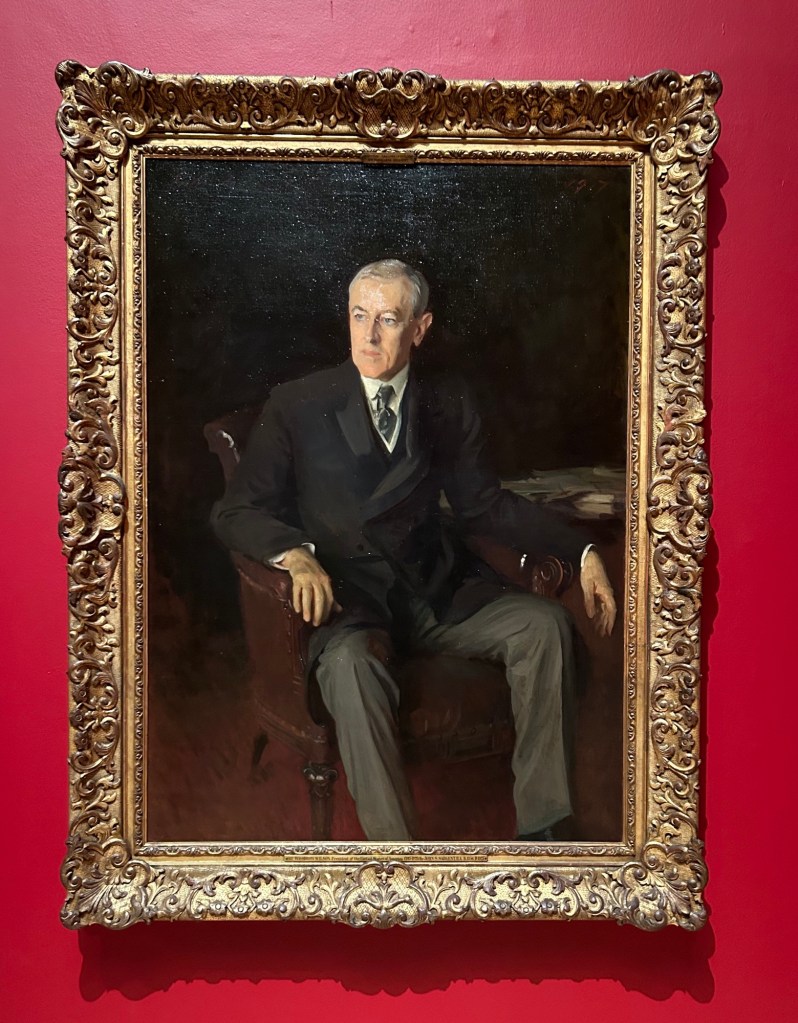
However, when painting men he usually confined himself to a darker and more conventional palette, depending on his sitter’s character and position in life.
President Woodrow Wilson, 1917
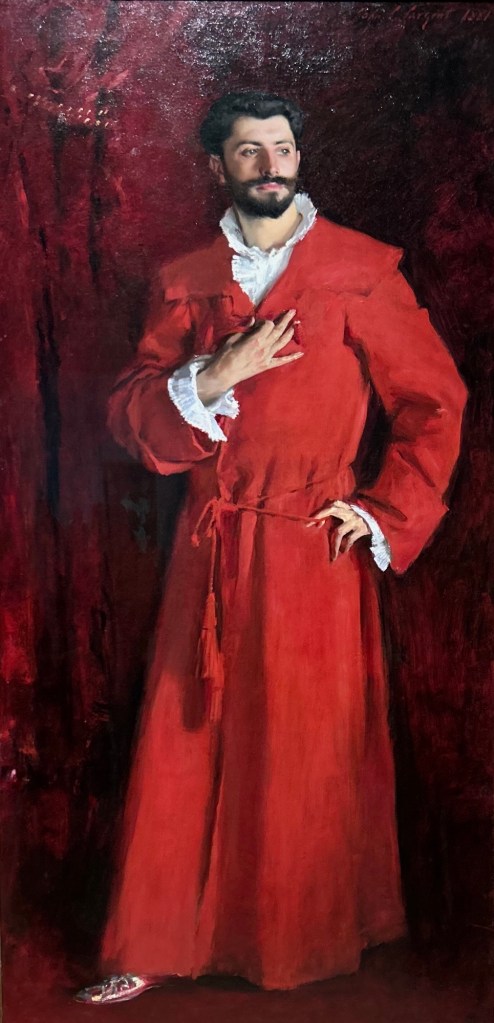
But not always. He painted the notorious womaniser, surgeon Dr Pozzi en desabillé, in a sumptuous red dressing gown and Turkish slippers, as if standing in front of a stage curtain.
Dr. Pozzi at home, 1881
Dr.Pozzi was said to be ‘disgustingly handsome’ and had many scandalous affairs including, famously, with Sarah Bernhartd. Despite this, he was a brilliant avant-garde gynecologist, who made women’s lives better. Sadly, he was murdered in his own consulting room by a disgruntled (male) patient.
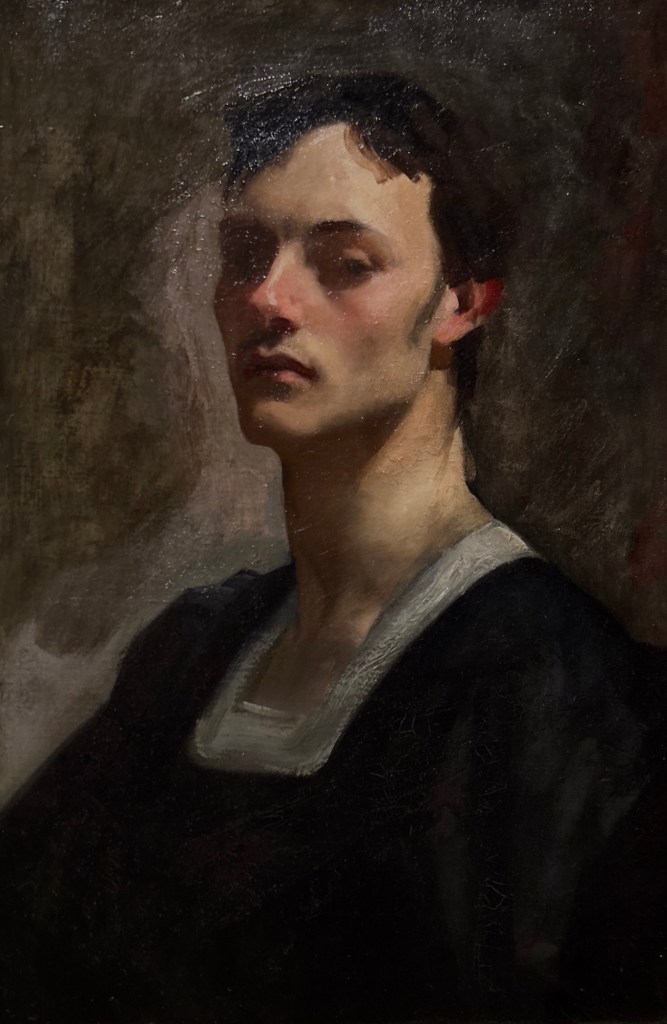
Albert de Belleroche, a very close friend of Sargent
It is interesting, and proof that Sargent made his sitters expressive, that as I wandered through the exhibition with a friend we commented on whether we ‘liked’ or ‘disliked’ the sitters, making totally subjective comments on their character, such as ‘she looks nice’, ‘he looks very full of himself,’ etc. Most amusing and, judging by overheard comments, most visitors were doing the same. By observing the portraits closely one can perceive many hints as to the sitter’s character, mood, or even sexuality.
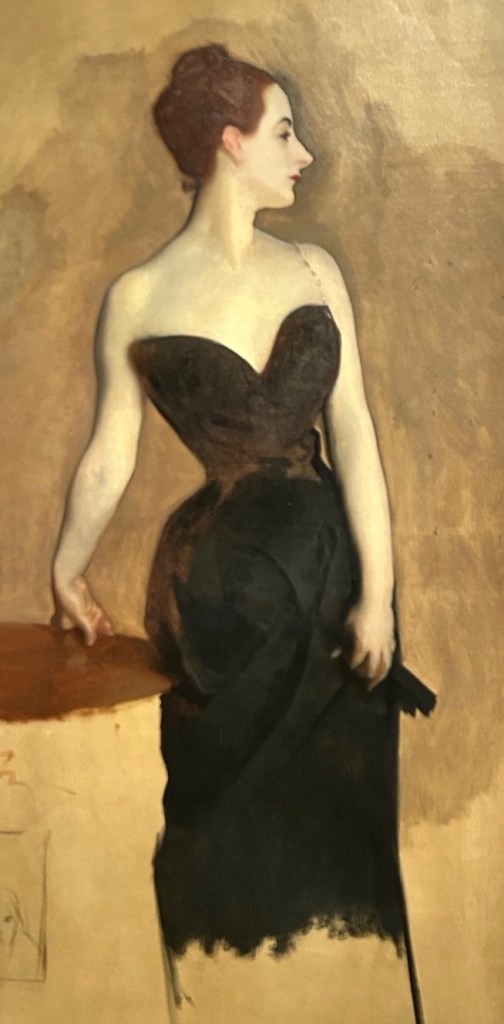
However, what today is almost universally admired, at the time drew more than its fair share of criticism. Sometimes the finished portrait was met by a disapproving silence by the sitter and his of her family. Sometimes portraits even caused a scandal, such as the famous one of Mrs Gatreau, a study of which see below.
Madame X (her missing strap was painted in on the finished portrait)
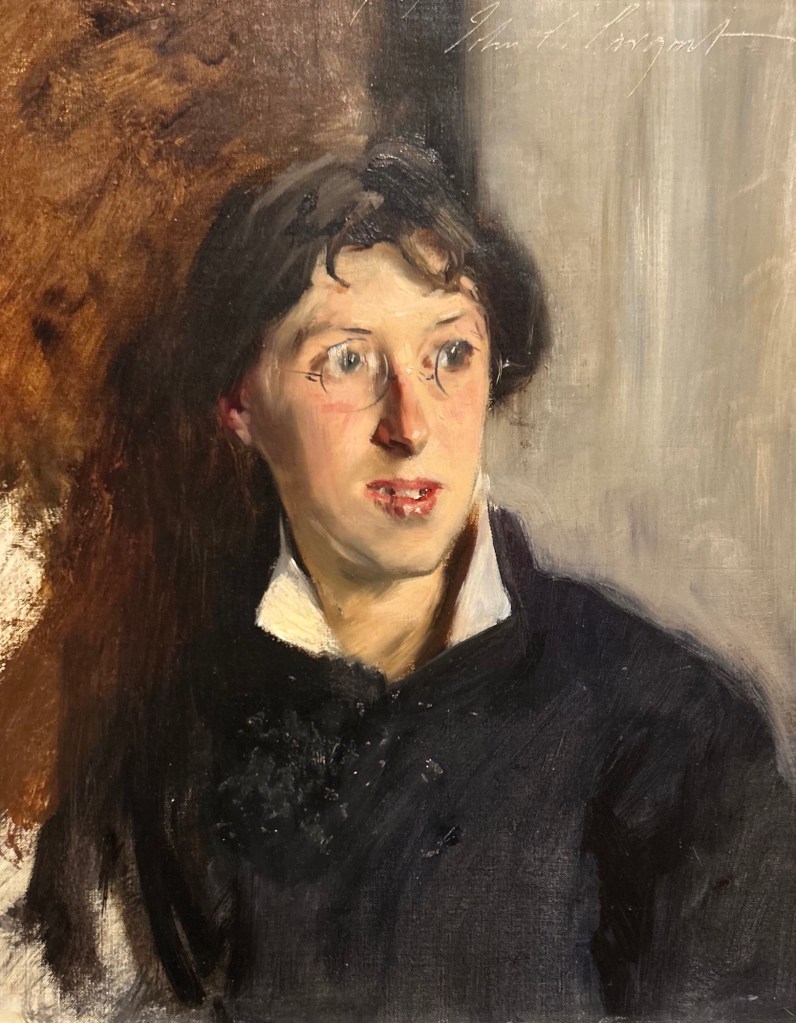
Besides the paintings of nobility, ‘Dollar Princesses’—as wealthy American heiresses coming to England to bag a title were called—and politicians, Sargent made lovely sketches of his friends, like the quick study below, which was finished in one hour.
Vernon Lee, 1881.
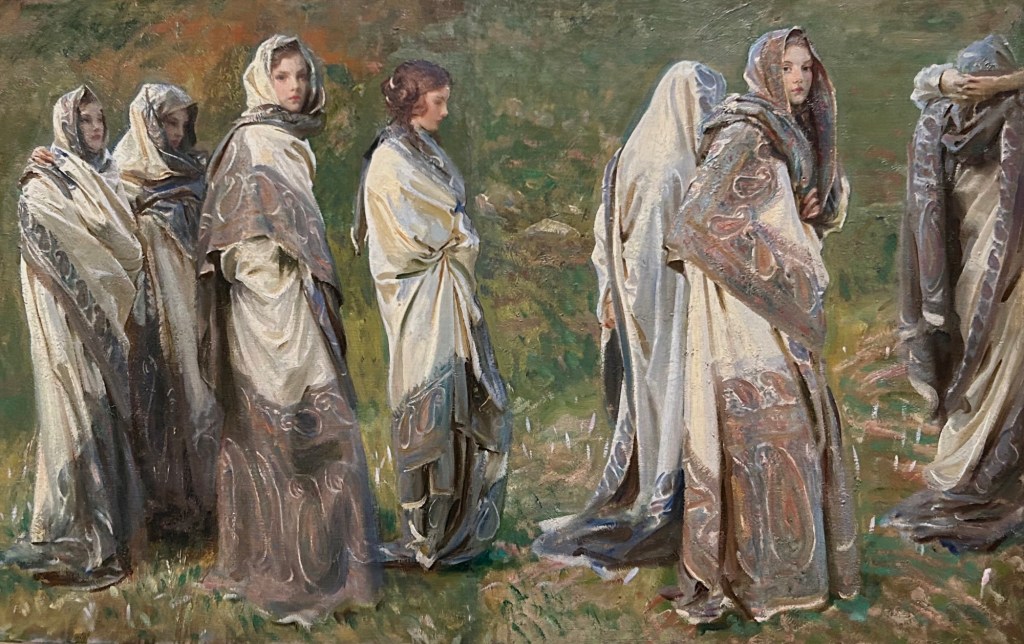
And this wonderful painting of girls wearing Indian shawls (his beloved niece posed for most of the figures).
This post gives but a glimpse into Sargent’s long and diverse career. A fascinating man and fascinating work.
As all creatives find out, sooner rather than later, rejection is part of the fabric of life. Of course, that is true for everyone sometimes: rejection of an invitation to dinner, a proposal of marriage, a coveted job. But in the arts, rejections drop upon one, not as a gentle rain, but more like a fist to the gut.
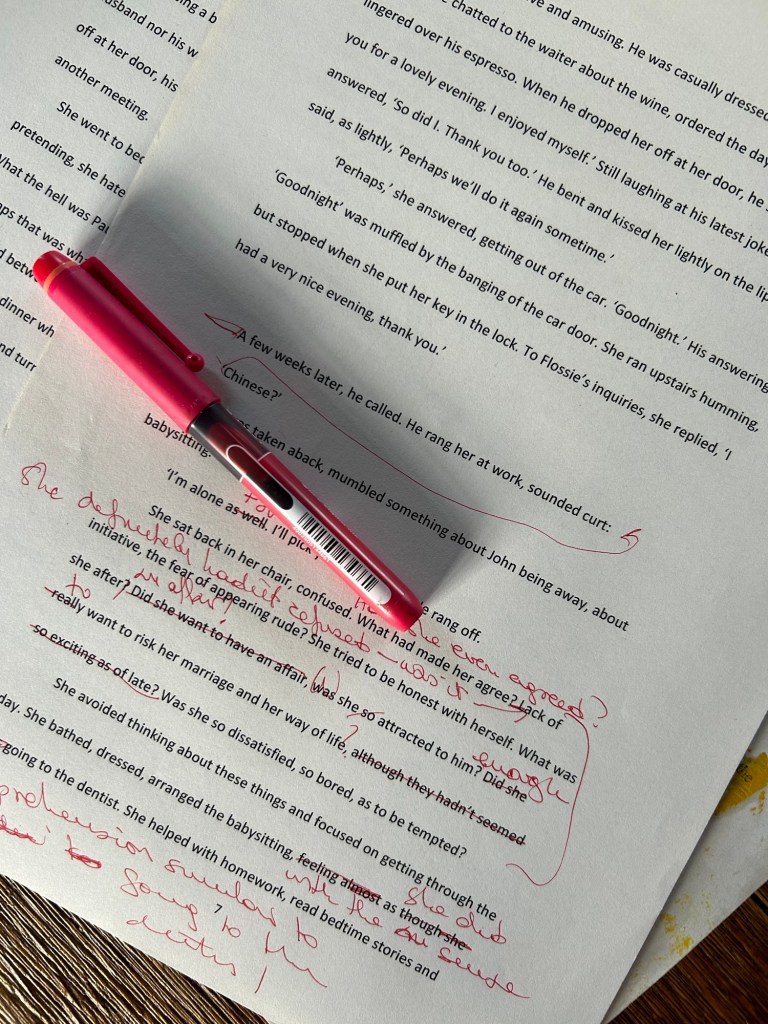
Having completed a mystery novel for which I am ‘seeking representation’, i.e. for a literary agent to take me on, in former times I could have papered a room with rejection slips. These days, they would have clogged up my iCloud storage if I hadn’t erased them, while keeping note on an Excel sheet so that I do not apply to the same agency or publisher twice.
Of course, one has to feel for the agents. They only get paid if they can sell your book, so even if they love it, they cannot take you on unless they can. And that depends on a lot of factors: their contacts in the publishing world, the market at that particular moment, the zeitgeist, etc, etc. Also, the slush pile has become unmanageable since the advent of ‘copy-paste.’ People used to write in longhand, then on a typewriter, keeping copies using carbon paper, making corrections with Typex and having to rewrite whole passages. Now corrections and alterations to the text take seconds. A lot more people are finishing their novels as a result.
Many more are self-publishing. Too many. It is easy to take the plunge before your work is ‘as good as it could be’. The thought did cross my mind, of course—but I am happy I did not go down that route at once, because I have received valuable feedback from a couple of lovely agents, which has improved the book no end. I would have ‘pushed the button’ too soon—before the book was polished enough.
Also what is stopping me is that if you self-publish, you’ve got to sell the book yourself—and there is nothing that appeals to me less. I’d rather be writing, painting, cooking or even mucking out stables than doing blog tours or begging people to buy my masterpiece. Or, horrors, making videos on Tik Tok (which is how many books find readers nowadays). However, I might not have the choice in the end, if I want to see said masterpiece in print, so perhaps I shall bite the bullet one of these days, and see what happens…
Also, indie authors get the most of the (potential) profits themselves, instead of giving half to the agency. However, they first need to shell out for edits, a professional cover design, formatting etc.
Meanwhile, what annoys me more than a rejection is being ghosted. Some agents promise to reply but never do so, others warn you that no answer after a specified amount of time means it’s a pass. Fine—athough how hard would it be to have a polite rejection form ready and just add the name? An agent complained recently on X that some people reply rudely if they get a rejection, so now she does not bother to answer—but surely that is but a part of the job? A rejection, though painful, is some kind of closure; it allows you to move on from that particular slot.
But what gets my goat most is when your writing is praised and you get asked for the whole manuscript, which you send off with all fingers and toes crossed, and a glimmer of hope (or anticipation). Then, nothing. That is just plain bad manners. That is why I am so grateful to the lovely agents who spent time offering detailed advice.
As with everything else, writing takes grit. Rewrite, revise, edit, kill your darlings, read widely, try new things. I have had some short stories published, and that gives me courage that my writing is not hopeless. Onwards.
And I take heart from reading famous rejections, of writers I could never try to emulate. I bet those agents or publishers had a few regrets (such as the one who rejected the Harry Potter books…) Here are some good ones:
“You’d have a decent book if you’d get rid of that Gatsby Character.” – to F. Scott Fitzgerald, The Great Gatsby
“Stick to teaching.” – to Louisa May Alcott, Little Women
“We are not interested in science fiction which deals with negative utopias. They do not sell.” -to Stephen King, Carrie
“I rack my brains why a chap should need thirty pages to describe how he turns over in bed before going to sleep.” – to Marcel Proust, Remembrance of Things Past
“I haven’t the foggiest idea about what the man is trying to say. Apparently the author intends it to be funny.” – about Joseph Heller, Catch-22
And the best of them all:
“Our united opinion is entirely against the book. It is very long, and rather old-fashioned… First, we must ask, does it have to be a whale? While this is a rather delightful, if somewhat esoteric, plot device, we recommend an antagonist with a more popular visage among the younger readers. For instance, could not the Captain be struggling with a depravity towards young, perhaps voluptuous, maidens?” – to Hermann Melville, Moby Dick
Some time ago I subscribed to a site called Artwork Archive, one of a several available tools for managing artwork.
At first I just entered my drawings and paintings indiscriminately, using hastily made photographs, in order to keep track of the work I had, what had been given to people as gifts, and what had been sold. I never took the time or the trouble to use the multiple features offered, such as adding up expenses, generating invoices, or setting up a public profile.
The work can be organised as a portfolio, in the order of one’s choice, or sorted into collections
Then when I started entering art for online exhibitions or competitions, I kept getting asked for my website address, so I decided I now needed my own art website. After wasting numerous hours trying to choose between Word, Winx and Squarespace, and more hours attempting to navigate their sites, I belatedly realised the Artwork Archive Public Profile would do the job more than adequately.
It would save me from paying for another site, plus their client support is excellent.
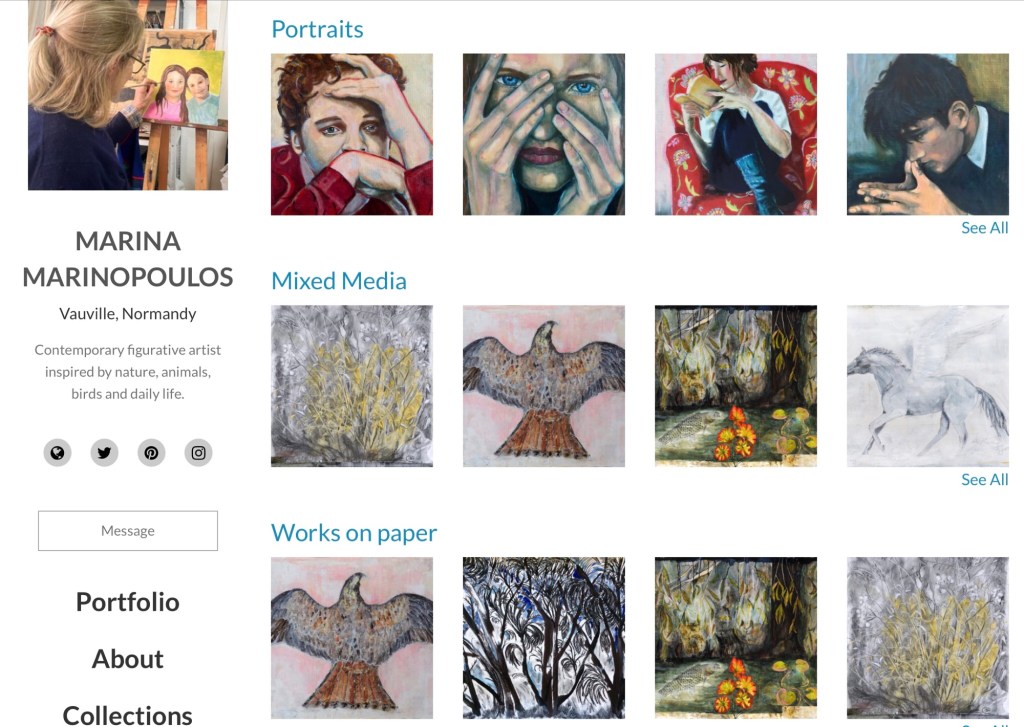
Here is a random page showing the tools offered, and how the work looks in the portfolio mode
So if I have not posted anything here for a while, it is because I’ve been working on taking better photos, deciding which pieces to put on the public platform, and entering any relevant information. All this takes an inordinate amount of time…
Viewed as a portfolio
But here it is! Although it is still a work in progress, and will continue to be one as I make new work and improve my presentation and other parameters, I am now proud to reveal it to you.
Viewed as Collections
If you are interested in actually going on-site, here is a link.
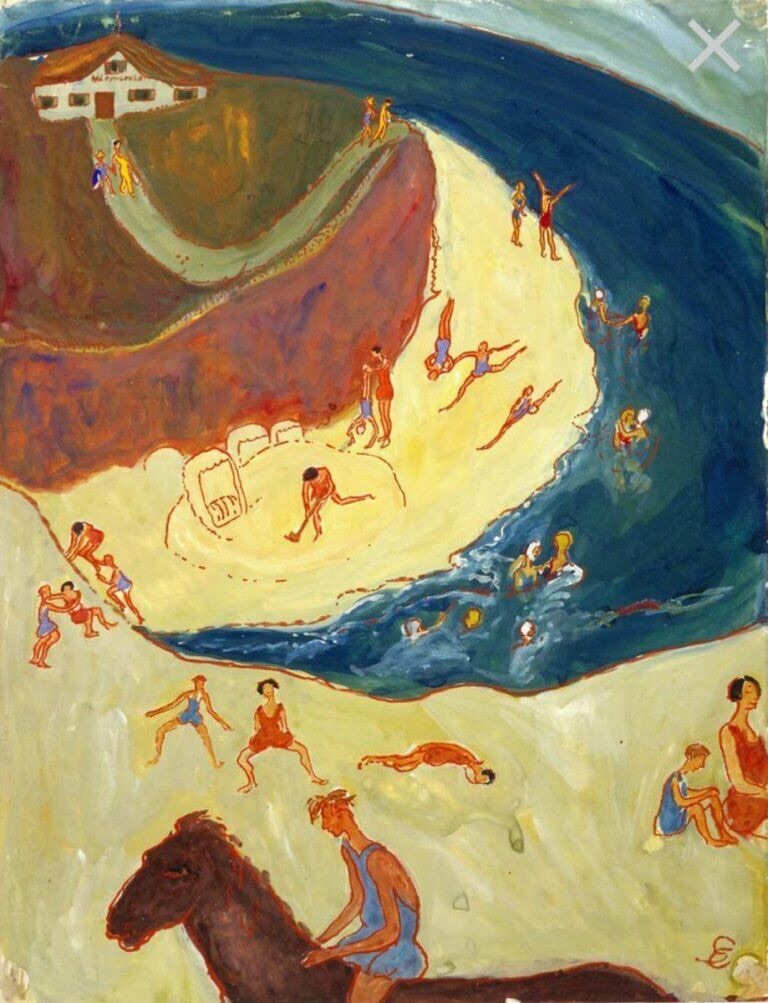
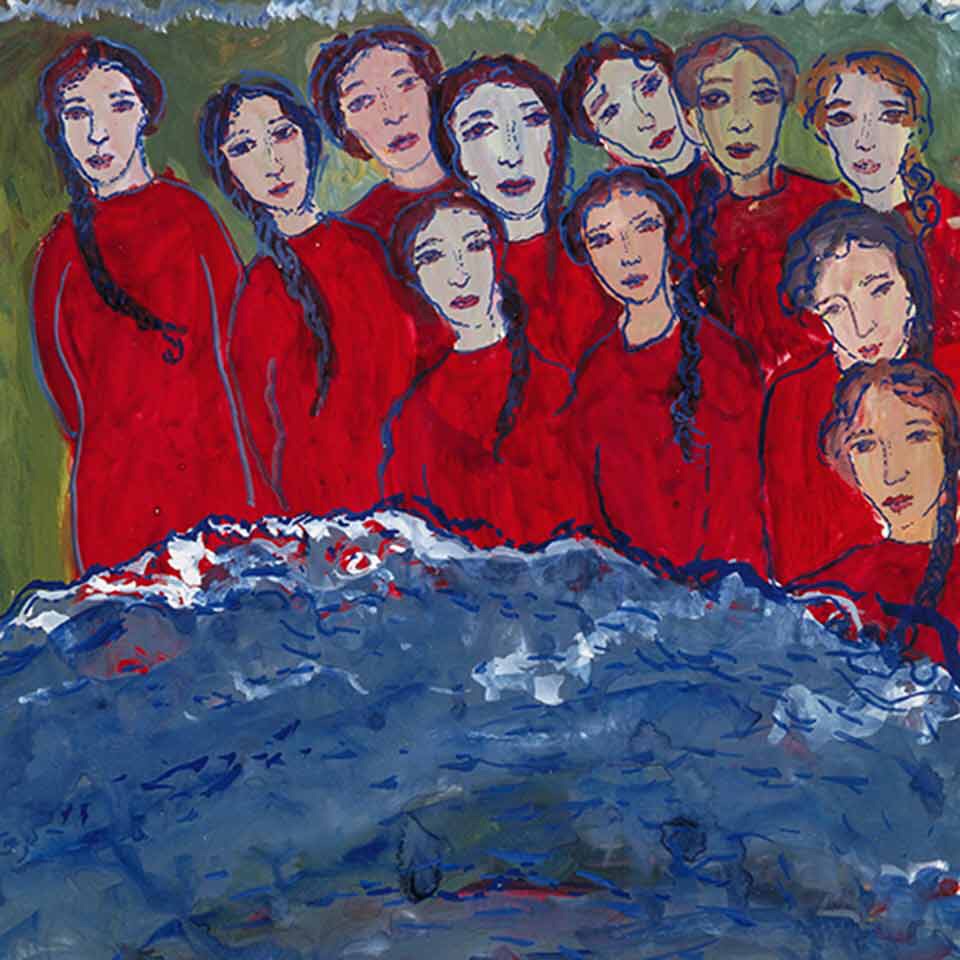
Can one have a horrible life, punctuated by difficulties and tragedies and ending in extermination at Auschwitz, yet leave behind work that, despite its disturbing themes, is poignant, breathtaking and uplifting in its luminosity and colour?
This is the case of Charlotte Salomon, the only Jewish artist who died in the Holocaust to leave behind such a large body of work. It consists of 769 works painted between 1941 and 1943—a mere two years—while she was hiding from the Nazis in the South of France. In October of that year, 5-months-pregnant Salomon was captured and deported to Auschwitz where she was immediately killed.
Born to a prosperous and well-assimilated Jewish family in Berlin, Charlotte was 16 when the Nazis came to power. By 1938 it became too dangerous for her to continue her studies, so she left the art school she was attending, and after Kristallnacht she was sent to live with her grandparents in Nice; her father had been interned and, when her stepmother succeeded in freeing him, they left for Amsterdam. Her mother, suffering from depression, had committed suicide when she was eight.
After several attempts, her grandmother also succeeded in killing herself and Charlotte remained with her grandfather, who it appears was abusive. To escape him, she went to Saint-Jean-Cap-Ferrat where—in order to recover her mental sanity—she started painting; stating that she was driven by the question, “whether to take her own life or undertake something wildly unusual”.
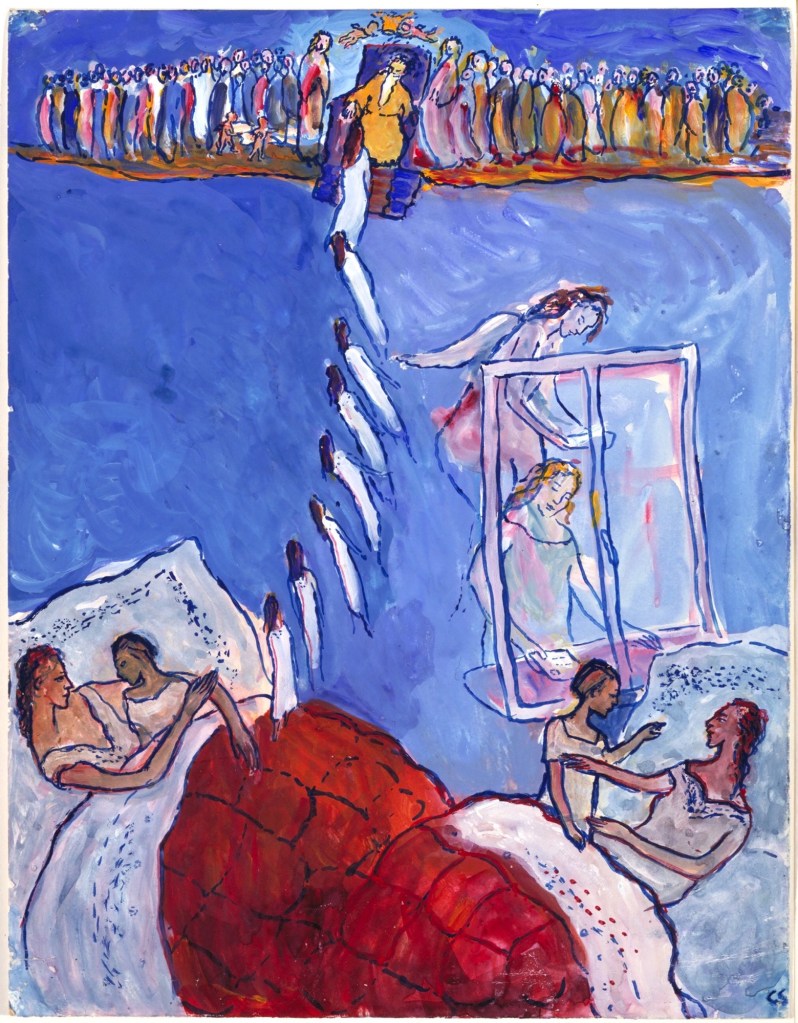
Painting obsessively, in less than two years she produced more than 1.300 gouaches, amongst which she chose the 769 which she numbered and edited, adding text, captions and transparent overlays, to make a kind of autobiography outlining the main events of her life—speaking of herself in the third person, altering all the names and adding elements of imagination.
In 1942 she was obliged, due to her residence permit, to join her grandfather in Nice. Shockingly, shortly after, she poisoned him with a Veronal omelette, then drew him as he lay dead (the drawing exists). She made a 35-page confession which she sent to a former lover who, however, never received it; it remained a secret until much later.
In 1943, as the Nazis closed in, she packed up her paintings and gave them to a local doctor with instructions to forward them to Otillie Moore, a wealthy American who was her protector and sponsor. At war’s end, the package found its way to her remaining family.
In 1943, Charlotte had married Alaxander Nagler, another German Jew refugee, with whom she had been confined in Otillie Moore’s house for a while. Soon after their marriage, they were both deported and murdered.
I find it beyond me to talk about her work, which is based on film-making techniques and is extremely layered and complex; and one must also follow the narrative, in its dream-like dimension. It is, in some ways, a precursor to the graphic novel as we know it today. Although Salomon has always been classed as a Holocaust artist, her work—save for very few drawings—is not about the Holocaust: it is about her childhood, her very disfunctional family, her life and her loves. In the final pages of her book, two sentences stand out. She writes, ‘And with dream-awakened eyes she saw all the beauty around her, saw the sea, felt the sun, and knew; she had to vanish for a while from the human plane and make every sacrifice in order to create her world anew out of the depths.’
I have seen her paintings live in a couple of exhibitions, and they are simply wonderful. I have a book published by the Royal Academy of Arts, with colour reproductions, which I highly recommend.
More information:
Charlotte is a biography by David Foekinos, which I have not read yet, but which has excellent reviews. This is the Amazon link to the English version (the original is French).
Also there is a very interesting article in the New Yorker with more information than I have given on both her life and her work, and great images. Link below:
The dawn of a new year: who knows what it will bring. Is there a glimmer of light on the horizon? Let us be optimistic, although things are pretty grim at the moment. I skim over the headlines each day, trying to avoid the worst of the news.
We all wish for world peace, at least those of us who are not dictators or involved in the arms industry. Meanwhile, let us take comfort in the good things in life, if we can manage it: art and books and nature, family and friends. And let us hope for good health.
Let us think of those who have none of the above, and lend a helping hand when we can. Let us hope for that glimmer of light on the horizon.
And for those who like to celebrate, here is a painting by Toulouse Lautrec, who was a master at depicting people enjoying themselves!