The weather refuses to improve yet, and we are treated to endless rain and waterlogged grass. So I took refuge in poetry, and I would like to share this poem by Louis MacNeice, which evokes the ephemeral pleasures of life. It is lyrical and sad, exploring themes of time, memory and loss.
I particularly like MacNeice’s mastery of the poetic form in the poem’s distinctive rhyme scheme and rhythm. The poet was anxious about the darkening political situation evolving in Europe at the outbreak of the Spanish Civil War and he evokes a sense of impending destruction. The allusions are vague and a modern reader can surely adapt them to his or her own experience.
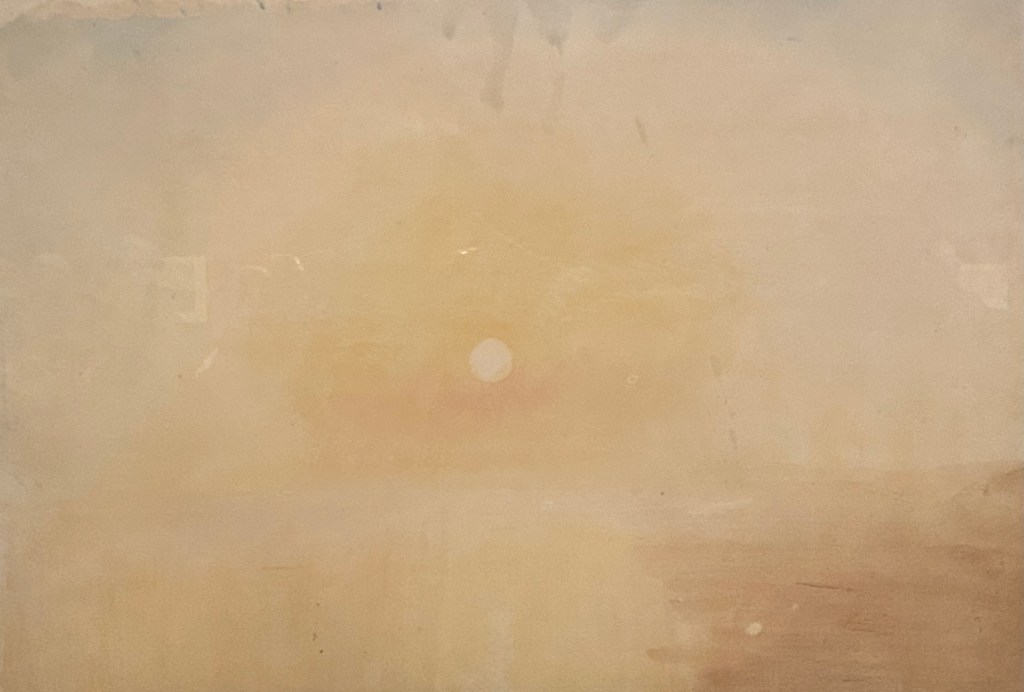
Detail of JMW Turner’s painting, The Sun Rising over water (1825-30)
While sorting out my camera roll I came upon various photos that I had saved out of interest. I thought I might share some of them.
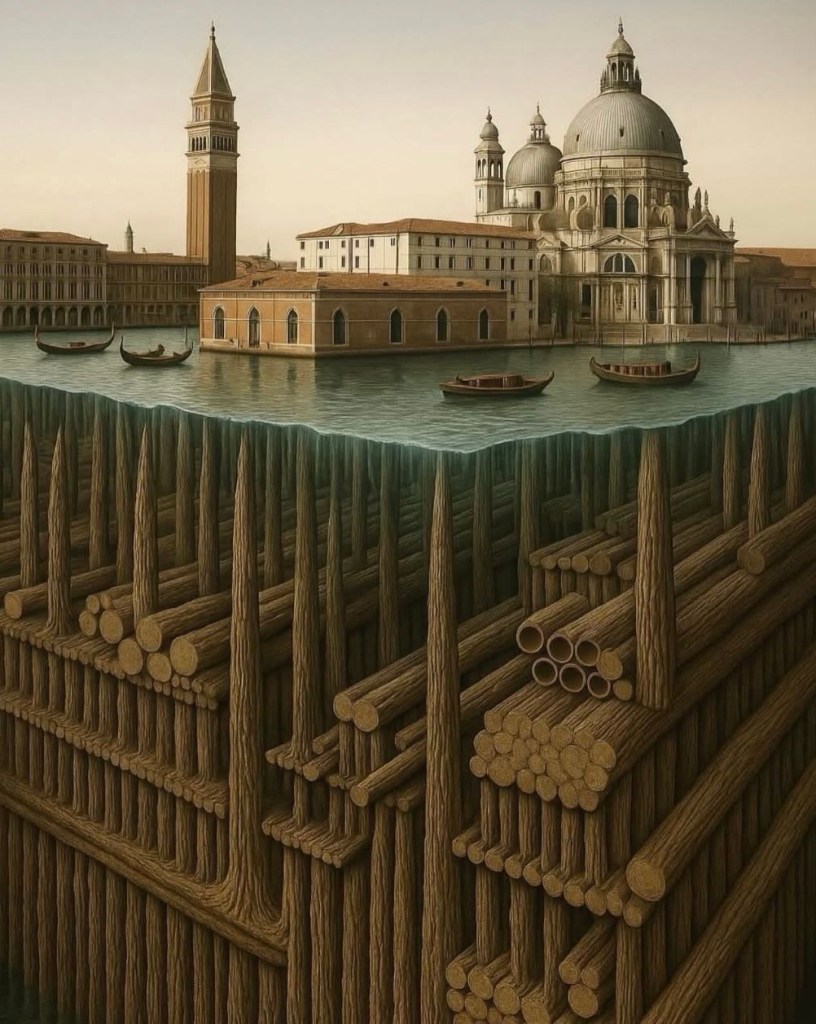
Although this print is reproduced on many sites about Venice, I could not find out where to credit it…
This one in particular fascinated me, especially after our recent trip to Venice.
It shows how the millions of wooden poles upon which the city was built were placed. The wood was transported from surrounding forests via the rivers. It does not rot but, when it comes into contact with the clay mud at the bottom of the lagoon, becomes petrified. The construction process itself is awesome.
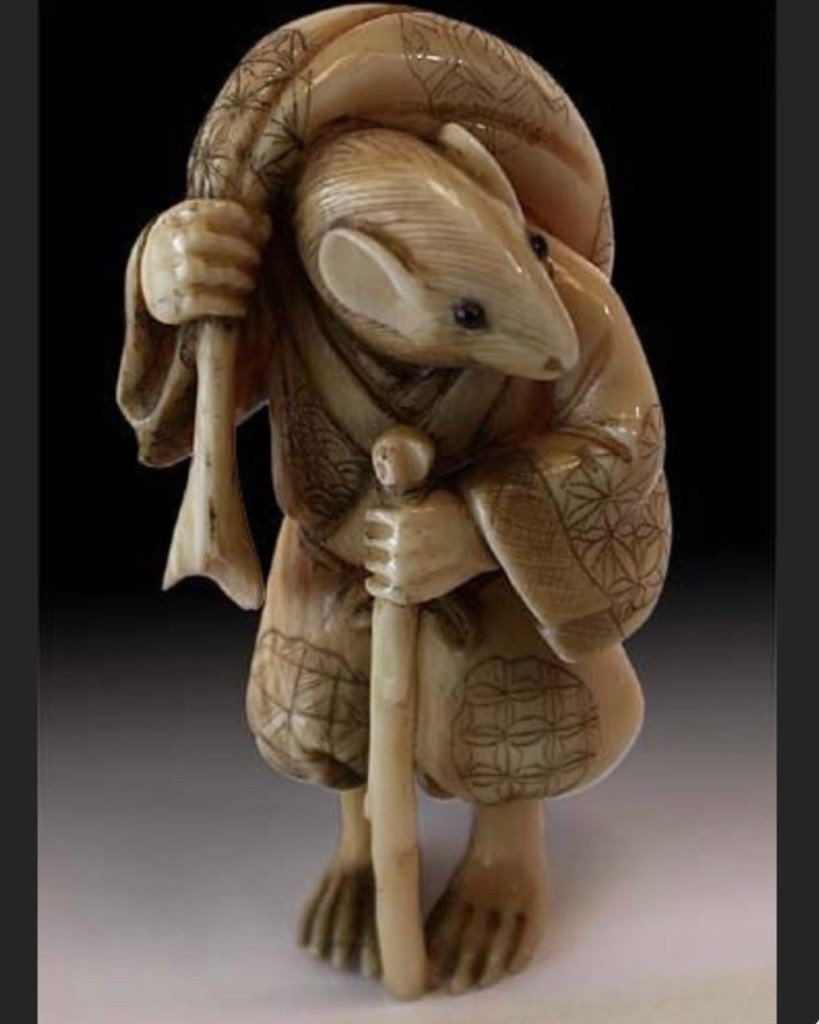
19th century carved ivory netsuke depicting a mouse traveller. Netsuke originated in the 17th century, starting as useful accessories for fastening a pouch to a kimono, for example, but evolving into an art form. This one is attributed to Giyokuseki.
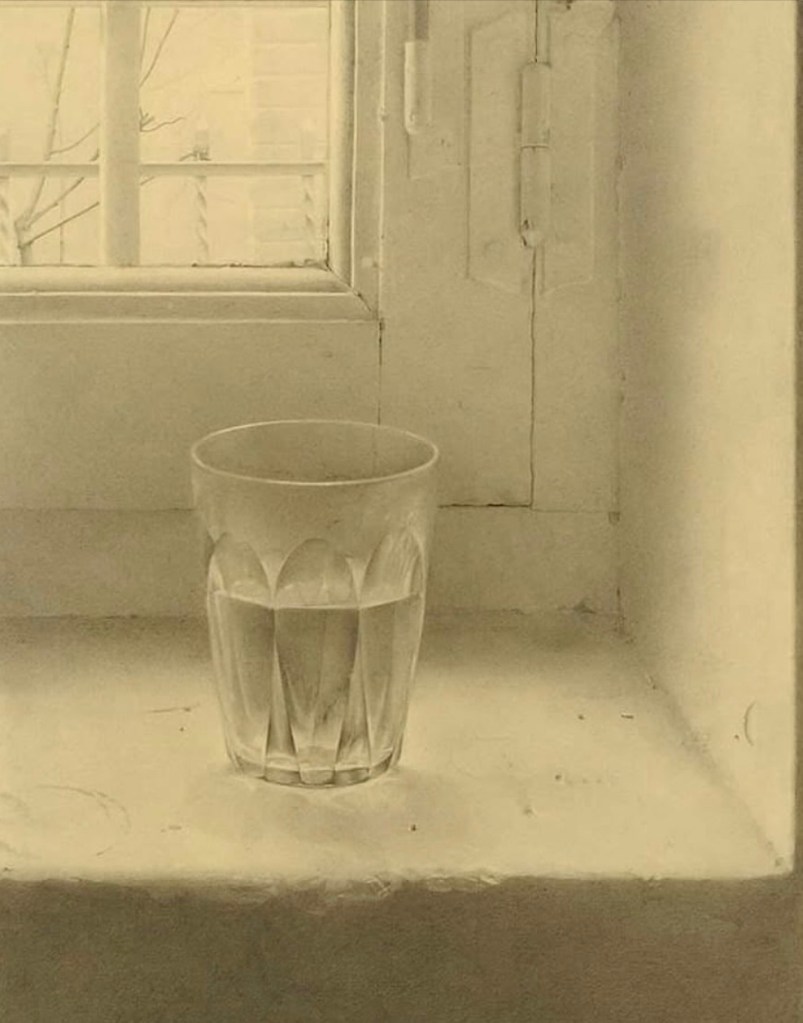
I am in awe of this simple drawing of a glass (pencil on paper). By the Spanish artist Isabel Quintanilla (1938-2017)
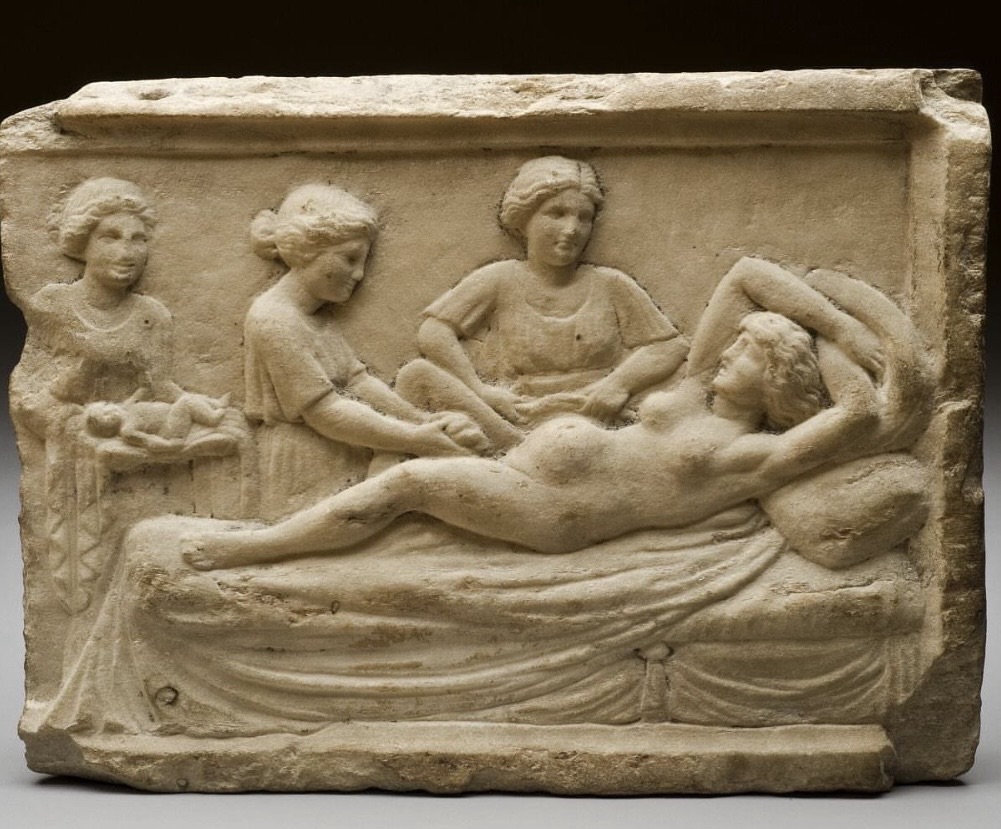
An astonishing Roman marble bas-relief, depicting a midwife assisting a woman having a baby. I have never seen anything like it before, and I think it is lovely. What a feat, to convey such an atmosphere of serenity in stone.
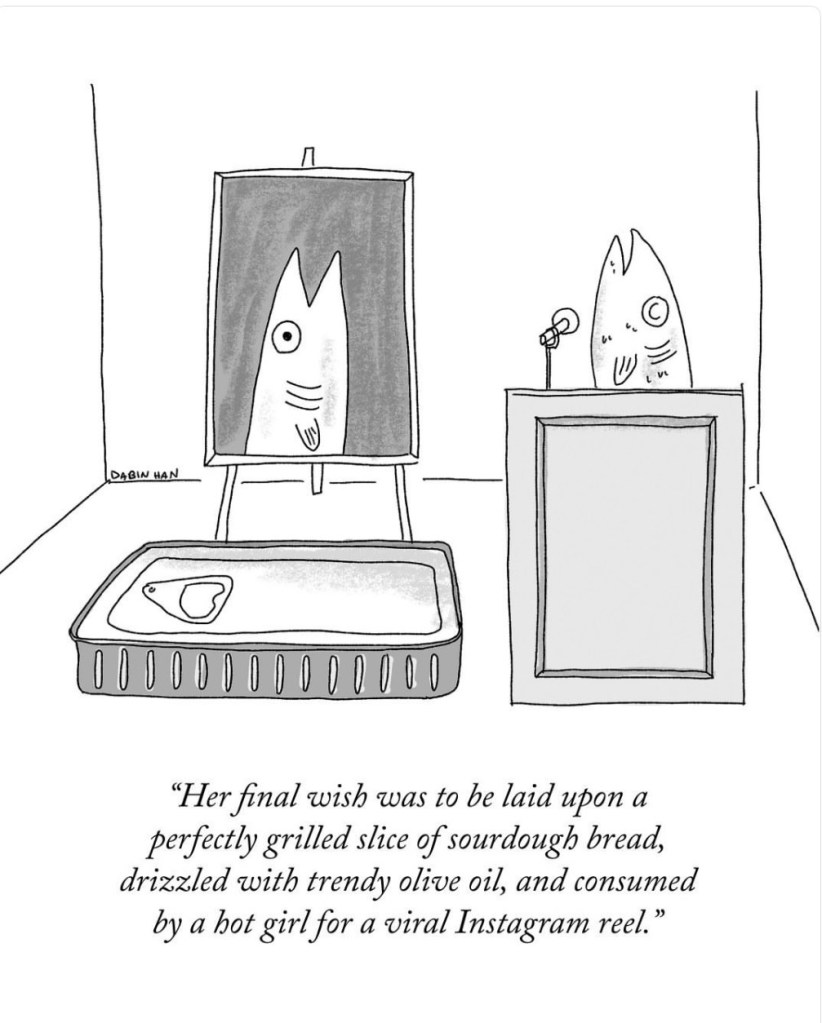
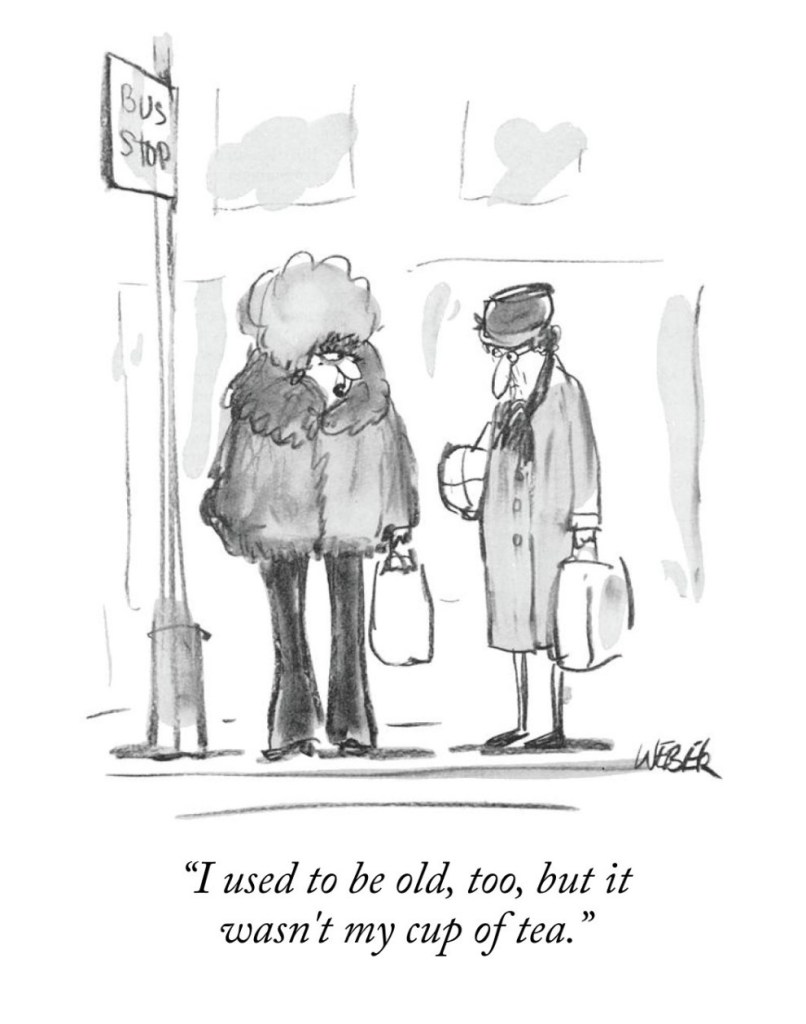
I could not resist adding a couple of cartoons I had also saved, because what’s life worth without a good laugh? The one below is from the New Yorker.
Vivienne very kindly hosted me on her blog, Aspholessaria , and I am happy and honoured to return the favour. She writes mostly fantasy, which has not been my cup of tea so far, but I will now give it a try! I have already heavily promoted her to members of my family who are fans. And I have put her Viking books on my TBR list.
Here’s a bit about Vivienne:
V.M. Sang was born and lived her early life in Cheshire in the north west of England. She has always loved books and reading and learned to read before she went to school.
During her teenage years she wrote some poetry, one of which was published in Tecknowledge,the magazine of the University of Manchester Institute of Science and Technology (UMIST). Unfortunately, that is the only one that is still around.
V.M. Sang became a teacher and taught English and Science at her first school.
She did little writing until starting to teach in Croydon, Greater London. Here she started a Dungeons and Dragons club in the school where she was teaching. She decided to write her own scenario. The idea of turning it into a novel formed but she did nothing about it until she took early retirement. Then she began to write The Wolves of Vimar Series.
Walking has always been one of V.M. Sang’s favourite pastimes, having gone on walking holidays in her teens. She met her husband walking with the University Hiking Club, and they still enjoy walking on the South Downs.
V.M.Sang also enjoys a variety of crafts, such as card making, tatting, crochet, knitting etc. She also draws and paints.
V.M.Sang is married with two children, a girl and a boy. Her daughter has three children and she loves to spend time with them.
She now lives in East Sussex with her husband.
⭐️
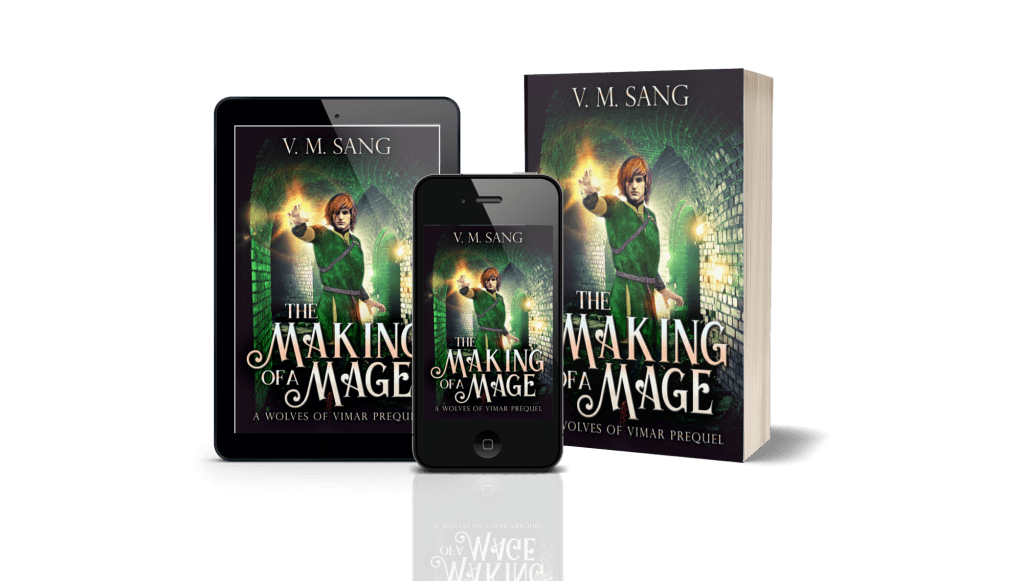
Unlike me with my one measly novella, Vivienne has been very prolific, and you will find links to her books below, and of course on her website. Here I would like to mention her novella, The Making of a Mage. It’s one of the Wolves of Vimar prequels and tells of the early life of Carthinal, one of the main characters in the series.
Blurb: Carthinal is alone in the world. His parents and grandparents have died. Without money and a place to live, he faces an uncertain future.
After joining a street gang, Carthinal begins a life of crime. Soon after, he sees a performing magician, and decides he wants to learn the art of magic.But can he break away from his past and find the path to his true destiny?
⭐️
And now onto our interview:
1. You have been very prolific. Do you spend many hours writing every day?
Not really. I’ve been rather bad recently and hardly written anything except a few poems. I think it’s because I’ve finished Book 4 of The Wolves of Vimar (Immortal’s Death) and am stuck on another couple of projects.
2. Do you finish one project before starting another, or do you have a few things on the go at once?
I usually have more than one thing on the go. I’ve started Book 3 of my Historical Novel series and I’m also writing a series of short stories inspired by fairy tales. The second story is going through a critique process at the moment and I’m partway through the third one. I’m also writing some poetry as I’ve been asked to submit some for an anthology.
3. Who is your favourite author/book?
Usually the last one I’ve read!
But seriously, I enjoy Fantasy and Science Fiction. I loved the Wheel of Time by Robert Jordan, but there are so many books and excellent writers.
One of my special favourites is Diana Wallace Peach. She writes fantasy in such a beautiful way.
4. If the above is not a classic, what is your favourite classic book?
I think Wuthering Heights by Emily Bronte. She builds such a wonderful picture of the moors. Maybe I like it because of that. I used to live not far from that country and walked many times in my teens on those bleak moorland hills. Although they aren’t always bleak! In the heather season they are quite beautiful.
5. When we were children, Enid Blyton kept us up at night (with a torch under the covers) She is much criticised now, but she got many kids to read—as did JK Rowling, who is also criticised. I believe that is so important, above other considerations. Are your books read by children? Or teens and young adults?
I wholeheartedly agree with you about Enid Blyton. I loved her books when I was growing up, and they instilled a love of books in me.
I don’t consciously write for a particular age. My Elemental Worlds has been marketed as Young Adult. Someone said they thought Vengeance of a Slave was YA, but I disagree with that.
My books aren’t read by children. They are too long for a start, and I don’t think the language is children’s language. I don’t simplify words. Most YA books are also shorter than mine.
So no. They aren’t children or YA books.
6. If you have a proper job, what is it?
I used to be a teacher until I retired. Now I enjoy life! (If you get the chance to retire early, do so!)
7. Why do you write?
There are stories in my head trying to get out. I think they’ve always been there. I made a little ‘fairy’ out of grass and told my sister tales about her, and I told myself stories at night to help get to sleep. (What does this say about my stories if they put me to sleep?)
I wrote a very bad romance when I was in my teens, and read it to my long-suffering friends. They were very kind about it.
So I think I write to get these stories out of my head.
8. Why do you write fantasy?
When I was a student, I was doing teaching practice when a nine year old boy, with the wonderful name of Fred Spittal, asked me if I’d read Lord of the Rings. I hadn’t, and he recommended it, but said I should read The Hobbit first. I found both in the College Library and from there I was hooked. I read a lot of the fantasy that was around at the time and loved the way the authors built worlds out of their imagination. It’s still one of my favourite parts of writing fantasy.
9. From your About page, I know you love dogs. Do you have any pets at this time?
I don’t have any pets at this time, no. I didn’t think it was fair to have a dog while I was working as it would have to be left alone all day. Not good for a dog, which is a pack animal and needs company. After retirement we were going away a lot, so didn’t have any pets.
Growing up I had two dogs (not at the same time) a border collie, whom I called Laddie, and a corgi called Johnnie. I also had a budgerigar called Peter who was an amazing talker.
My stepfather was a farmer on the Cheshire/North Wales border and so there were plenty of animals around. There were the farm dogs, of course, and I had a cat called Frances who would sit on my shoulder. She was lovely.
Later, well after I’d married and had children, we had goldfish and three cats, although my husband doesn’t like cats!
10. If you could meet any three people, alive or dead, who would they be and why?
I would love to meet Leonardo da Vinci. Such a clever man–an artist, an engineer, a scientist, a medical researcher and more. We visited his chateau in Amboise, France and saw his inventions brought to life using only tools and materials from his day. Quite amazing.
You say three people. Someone I had (along with Leonardo) a picture of on the wall of my lab in school was Stephen Hawking. He was incredible. Not only did he have an amazing brain, but to do all he did with such a severe disability as Motor Neurone Disease, was incredible. His determination must have been second to none.
Finally, no, not a writer, but an artist. Any of the Impressionists, I think, but having visited his famous garden, I think I’d go with Monet.
11. Do you enjoy sport? Do you prefer to watch or take part?
Yes, I do enjoy sport. I used to play tennis, badminton and the occasional squash game, and when my daughter was at school and my son was small, I used to attend a session at the local sports centre aimed at mothers. They had a creche for the kids and we did some aerobics then volleyball, badminton or basketball.
Now, I don’t partake, but enjoy watching most sports (not golf though).
12. There is a photo of a lovely flower painting on your site. Do you still paint a lot? Who is your favourite artist?
I think I’ve answered the second part of your question alreaedy. I adore the Impressionists. I don’t think I really have a favourite amongst them, though.
As to the first part, I’ve not done so much recently. I have one partly finished, but it’s in oils and I don’t like to do it indoors as it creates a smell. I’m waiting for the warmer weather so I can finish it!
13. Do you do any voluntary work? If so, what?
I don’t do any voluntary work at the moment. I did work in the small park behind our house until recently. The park had become very overgrown, the council only cutting the grass. I contacted them and they looked it up. They told me it was supposed to be a ‘community project’. It seems the original volunteers had either died, moved away or grown too old, so several of us took it over. It looked nice for a few years, then the same thing happened. People moved away, and became too old. There was only myself and my husband doing it, and we’re getting older and finding it increasingly difficult, especially the heavier jobs. We do very little now, except for the occasional cutting back of overgrown brambles that are blocking the paths.
14. What do you think is the biggest problem facing the world today?
I think there are two. One is increasing selfishness and the other is stupidity.
From the person wanting to park their car as near as possible to their destination, regardless of inconvenience to others, to governments and large organisations who trample roughshod over anyone and everyone who gets in their way. Often stopping them getting what they want, up to and including taking over other people’s countries in order to get at the minerals etc that are there.
And threatening the whole future of humanity in not accepting scientifically proven things like Climate Change. And it’s not only governments who are becoming stupid, either. Individuals seem to have lost the ability to think for themselves.
Sigh…
Thank you so much for answering all my nosy questions, Vivienne. I’m sure my readers will enjoy discovering your books—those that don’t know them already, that is. Fantasy is very much the flavour of the day!
⭐️
For those interested, I am including links to Vivienne’s books below:
Here’s wishing you all a happy, healthy and prosperous new year. And hoping for Peace on Earth, although it doesn’t seem very likely at the moment…But one must remain positive.
I seem to be in a poetic mood lately, so here’s a seasonal one by Robert Frost.
A Christmas circular letter by Robert Frost.
The city had withdrawn into itself
And left at last the country to the country;
When between whirls of snow not come to lie
And whirls of foliage not yet laid, there drove
A stranger to our yard, who looked the city,
Yet did in country fashion in that there
He sat and waited till he drew us out,
A-buttoning coats, to ask him who he was.
He proved to be the city come again
To look for something it had left behind
And could not do without and keep its Christmas.
He asked if I would sell my Christmas trees;
My woods—the young fir balsams like a place
Where houses all are churches and have spires.
I hadn't thought of them as Christmas trees.
I doubt if I was tempted for a moment
To sell them off their feet to go in cars
And leave the slope behind the house all bare,
Where the sun shines now no warmer than the moon.
I'd hate to have them know it if I was.
Yet more I'd hate to hold my trees, except
As others hold theirs or refuse for them,
Beyond the time of profitable growth—
The trial by market everything must come to.
I dallied so much with the thought of selling.
Then whether from mistaken courtesy
And fear of seeming short of speech, or whether
From hope of hearing good of what was mine,
I said, "There aren't enough to be worth while."

"I could soon tell how many they would cut,
You let me look them over."

                                    "You could look.
But don't expect I'm going to let you have them."
Pasture they spring in, some in clumps too close
That lop each other of boughs, but not a few
Quite solitary and having equal boughs
All round and round. The latter he nodded "Yes" to,
Or paused to say beneath some lovelier one,
With a buyer's moderation, "That would do."
I thought so too, but wasn't there to say so.
We climbed the pasture on the south, crossed over,
And came down on the north.

                                    He said, "A thousand."

"A thousand Christmas trees!—at what apiece?"

He felt some need of softening that to me:
"A thousand trees would come to thirty dollars."

Then I was certain I had never meant
To let him have them. Never show surprise!
But thirty dollars seemed so small beside
The extent of pasture I should strip, three cents
(For that was all they figured out apiece)—
Three cents so small beside the dollar friends
I should be writing to within the hour
Would pay in cities for good trees like those,
Regular vestry-trees whole Sunday Schools
Could hang enough on to pick off enough.

A thousand Christmas trees I didn't know I had!
Worth three cents more to give away than sell,
As may be shown by a simple calculation.
Too bad I couldn't lay one in a letter.
I can't help wishing I could send you one,
In wishing you herewith a Merry Christmas.


🎄And a very Merry Christmas from me too, to you all.
Talk about leaving something behind! Tom Stoppard, who has just died, aged 88, wrote—over the course of five decades—35 stage plays (including seven translations or adaptations of foreign work), 11 radio plays, 6 television plays, and 14 film and television adaptations of books and plays. An opus which will keep his memory fresh for years to come.
I am not about to write an obituary complete with all his life details. Every newspaper has done that, and writer, journalist and magazine editor Tina Brown, who knew him personally since she was a teenager (he lived close to them and was friends with her father) has posted a lovely eulogy on Substack.
Stoppard wrote great theatre because he wrote great dialogue, witty and argumentative. In his own words, ‘Writing plays is the only respectable way of contradicting oneself.’
Here is a description of him, from an obituary in the Guardian:
A tall and strikingly handsome man, with a long, bloodhound face, a thick tangle of hair and a casually assembled wardrobe of expensive suits, coats and very long scarves, Stoppard cut an exotic, dandyish figure, a valiant and incorrigible smoker who moved easily in the highest social and academic circles, a golden boy eliding into middle-aged distinction and never losing the thick, deliberate accent of his origins, even though he never spoke Czech. He carved out his career in his own always carefully chosen words. He was often thought to be “too clever by half,” but never patronised audiences by talking down to them, even if they had to work hard to keep up.
Stoppard lived a charmed life in England, something he was always grateful for, considering a large part of his family died in the camps. This part of his personal history he only got to research in later years.
In my case, I credit Stoppard for instilling in me an eternal love of the theatre. Not living in England, I sadly did not manage to see all his plays, but I made it a point to see as many as I could, and they remain vivid in my memory. The wit, the irony, the sarcasm, the erudition and, above all, the sheer enjoyment.
Rozencrantz And Guidenstern Are Dead, The Real Inspector Hound, Arcadia, India Ink…The list goes on. Wonderful actors, such as Bill Nighy and the incomparable Felicity Kendall, fantastic sets. A great director, for a lot of them, in the shape of Peter Wood.
He’s always been number one in my list of people to invite to an imaginary dinner party. May you rest in peace, Mr Stoppard, and thank you.
Things are moving fast all at once. After months of idleness, publication date for my debut novel, Marguerite, has been set for December 4. Very exciting!
While waiting for the publishers to reveal their complete marketing plan, I have been am busy setting up my side of things. I think I mentioned before that I joined the Author’s Guild of America, which was a shrewd move. They provide free tools to build a website (they can also build it for you if you like). They organised my domain name and an email in my pen name. They embedded the email sign-up form into the website. And the best—you communicate with a REAL PERSON (shoutout to Hector!) No bots, and no endless search for some elusive ‘Happiness Engineer’. Yay.
As for the rest, why must everything be so complicated? I was assured by Kindlepreneur (a very useful source of all kinds of information) that the best mailing service for authors is MailerLite, as well as being the easiest to set up. Well, either I’m a moron, or the other services need a degree in advanced coding. I have been struggling with the damn thing for days—despite a bot who is better than most, and even some help from a real live person. But it’s done, more or less. Finally, I’m pretty familiar with IG, via my art account, but I hate X, Facebook etc. I think I’ll pass. I’m too old to make little videos on TikTok.
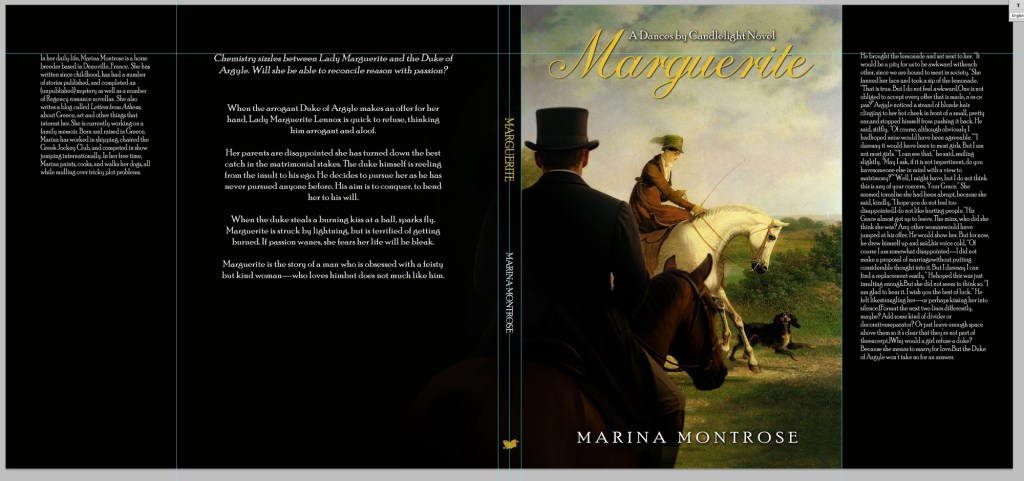
Take a look at the cover and tell me what you think. I’m quite pleased with it. I was very clear about NO bare-chested duke clutching a swooning maiden.
It was difficult for the graphic artist to find a stock photo I liked, so I came upon the idea to use an old painting (in the public domain). This is an oil portrait by Swiss artist Jacques-Laurent Agasse (1767 – 1849), possibly of Mademoiselle Cazenove. Then I wanted to superimpose a profile of the duke watching Marguerite ride in the park. The graphic artist did a good job of my ideas, I think.
Finally, a bout of shameless self-promotion:
I am delighted to present my debut novel, Marguerite. Set in the elitist and socially restricted milieu of the ton in Regency London, it is the story of an independent, opinionated girl and the man who pursues her despite her refusing his offer of marriage.
If this sounds like your cup of tea, I would be grateful if you would consider preordering the book. Preorders help new authors get discovered, and your support is invaluable.
Once you’ve read the book (if you manage to finish and if you haven’t hated it!), I would love it if you would consider leaving a review. Even a sentence helps other readers find the book, and I am interested in every piece of feedback.
I’d also like to invite you to take a look at my website, Marina Montrose Author, where subscribers to the Reader’s Club receive a free, exclusive short story as a thank you gift. You can join here:
P.S. The book is available for preorder on Amazon, but print copies only on Amazon.com still…Here is a link to all the other places where you can preorder. Or order later on.
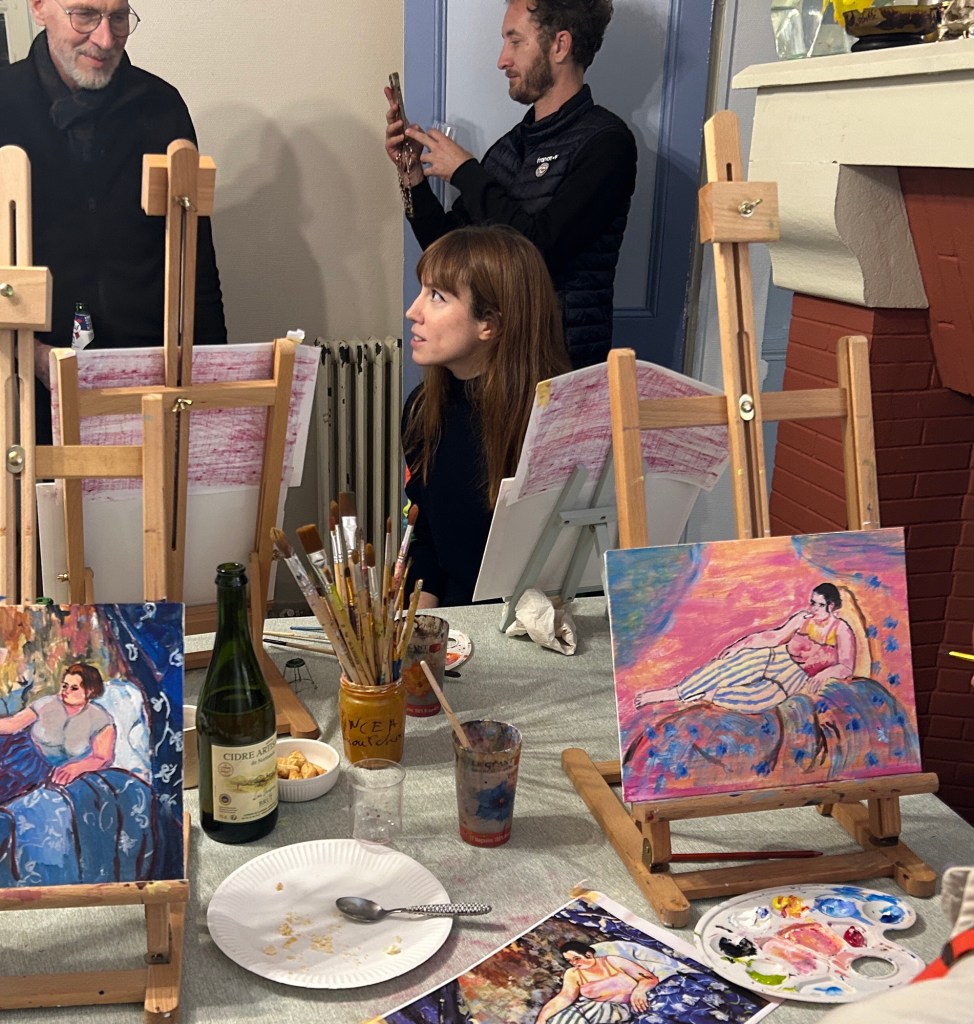
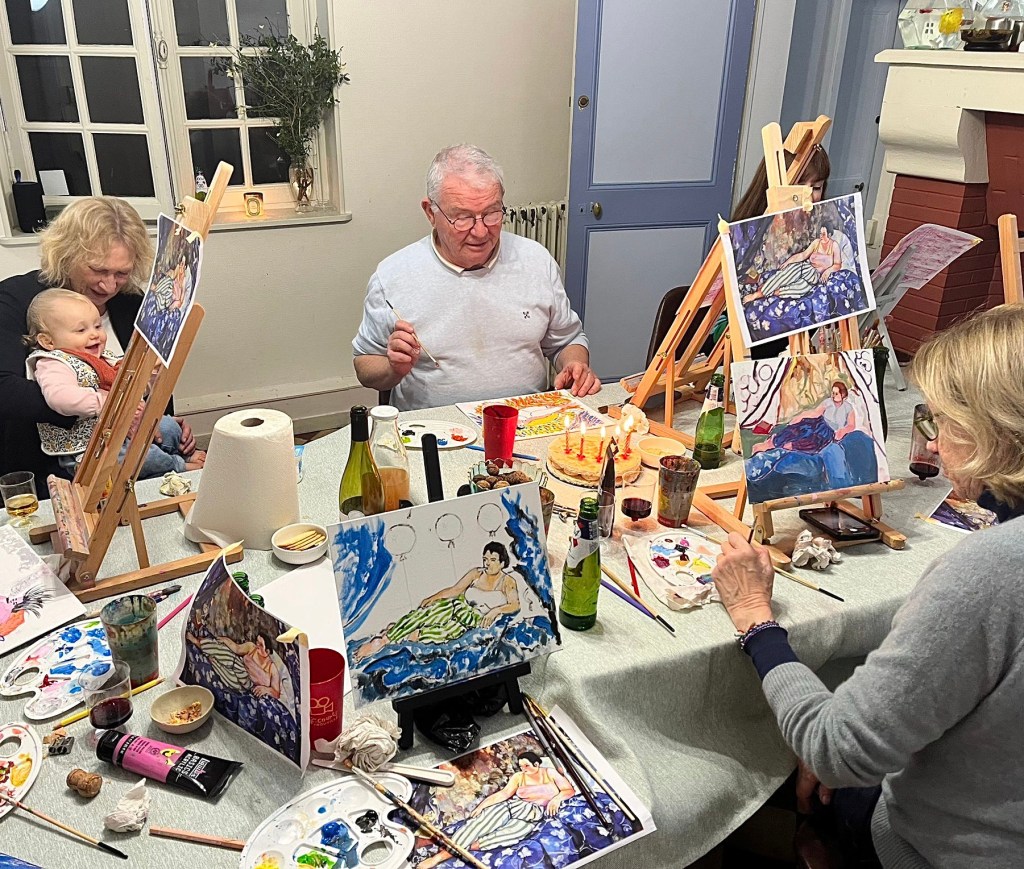
Josepha, the young woman who runs the art studio I attend on Mondays and (when possible) Tuesdays, has set up a Saturday afternoon painting session she calls apéro peinture. The idea is to attract outsiders who are beginners and just want to try painting, but this has had mixed results. Attendance varies. So, a group of the usual suspects decided to take over yesterday, to while away a rainy afternoon.
The idea is not to take ourselves seriously, but interpret the subject as the fancy takes us. We all sit around a table set with small easels, boards and acrylic paints and we all paint from the same model, provided by Josepha. We are fuelled by apple cider, wine and tidbits.
Yesterday the inspiration was a work by Suzanne Valadon (1865-1938), a French painter who in 1894 became the first woman painter admitted to the Société Nationale des Beaux-Arts. She was also the mother of painter Maurice Utrillo. The painting is of a, shall we say, corpulent woman lying on a couch, smoking.
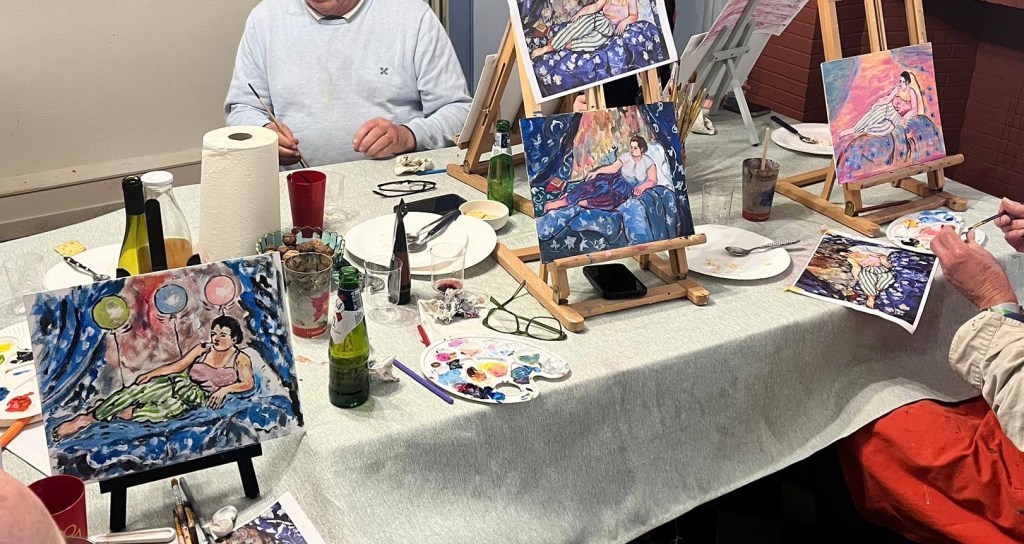
What is always interesting in such situations, is how differently people interpret the same subject. In barely two hours we were supposed to finish a small painting (acrylics dry fast), and this was accomplished amid a lot of banter. We always mock each other mercilessly and have to defend our choices.
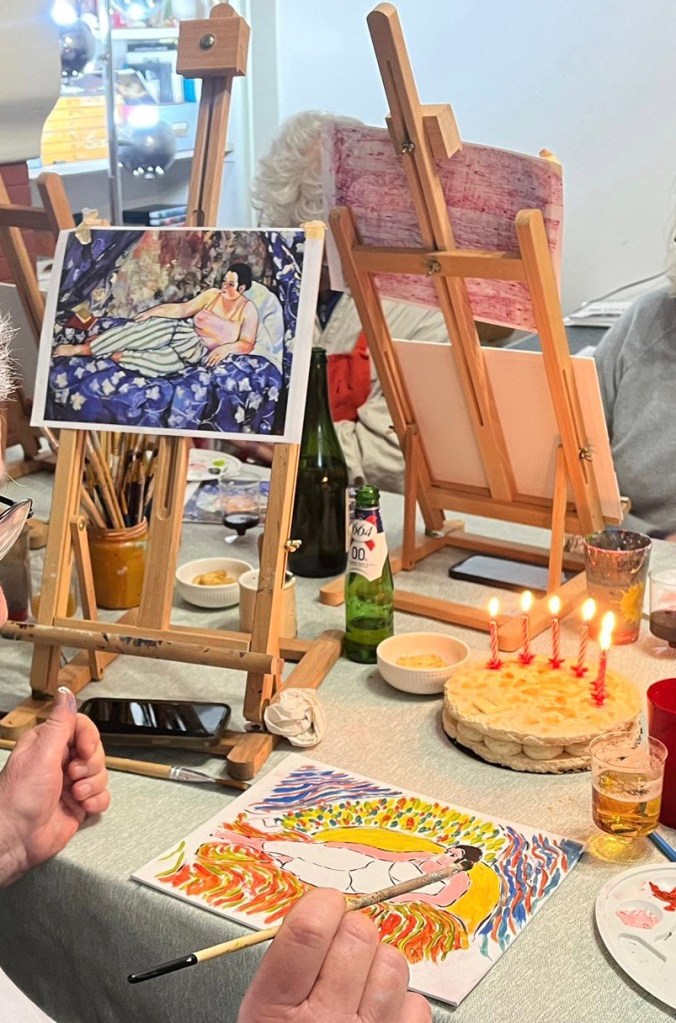
Note the birthday cake. With candles 🎂
Christophe and I decided to omit the cigarette, on the pretext that smoking is unhealthy and Non-PC; Philippe on the contrary gave the woman a spliff and drew her levitating above the couch, with three balloons hovering above; and Nathalie actually put her in a bathtub!
Josepha was accompanied by her baby, Garance, her mother (to look after Garance who has just learned to walk), her dog Odin (who is a frequent visitor to the studio) and her partner Tommy who is a journalist and does not draw of paint. His first effort was quite creditable.
Needless to say, a merry afternoon was had by all. However, the artistic benefits are not to be understated, as this type of exercise allows one to let go of rules like perspective and colour values and give free rein to one’s imagination.
My finished version. Cigarette apart, I did not stray too far from the original.
How about some poetry instead of the relentless march of horrific news we are subjected to daily?
I never watch the news live anymore. I only scroll through the titles, glance diagonally in case something catches my attention and read pieces that interest me—about new books and films, art exhibitions, or people who do unexpected and funky things. My children mock me about being a fringe reader, but I do enjoy it.
Irrelevant but hopefully cheering sketch
Looking through available films on iTunes and elsewhere, I notice a huge number are horror movies. This is amazing to me—aren’t people horrified enough by what is happening in real life but they need to scare themselves further? To each his taste, I suppose.
Meanwhile, there is nothing more soothing than poetry, so I leafed through favourite books to find something to improve your day. Browsing, I realised a great number of poems deal with grief, loss, fear and other lowly feelings—of course, expressed in beautiful language. Nothing like newspaper articles, but still. Even the Romantics are very concerned with death and loss of love. However, there are poems to lift the heart, so here is one of them, about the transformative power of words, by Dylan Thomas.
Notes On The Art Of Poetry
I could never have dreamt that there were such goings-on in the world between the covers of books, such sandstorms and ice blasts of words,,, such staggering peace, such enormous laughter, such and so many blinding bright lights,, , splashing all over the pages in a million bits and pieces all of which were words, words, words, and each of which were alive forever in its own delight and glory and oddity and light.
After years of getting rejections for my writing, I finally signed with a publisher
If rejection letters were paper, I could have covered my bedroom walls with them (or made a bonfire). Thankfully, nowadays they are digital, so they remain hidden in an Excel sheet (just so that I can remember not to submit to the same agent/publisher twice!)
But let me go back a little: I have always loved writing from an early age, and in high school served as editor of the school mag, entitled Sunny Days. This activity alleviated hours of boredom in class, where I could correct texts and draw the artwork while the teacher droned on…
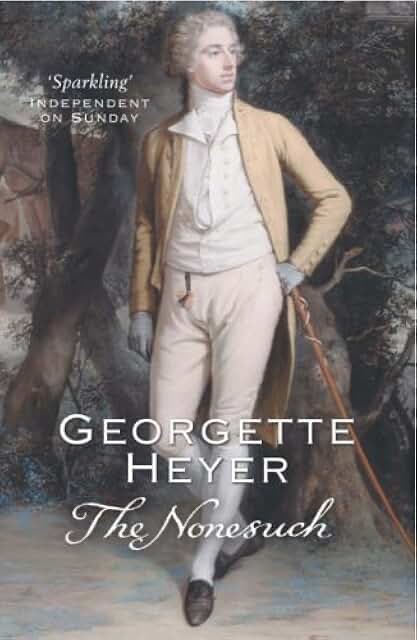
Earlier even than that, at age 10 or 11, I was let loose upon my mother’s bookshelves. She was a great fan of Agatha Christie and Georgette Heyer, both of whom I devoured (as well as a great variety of other authors, some more highbrow than others.)
This must have been the cover at the time.
Over the years, I wrote a number of short stories, some of which were placed in competitions, while others were published in Anthologies and online magazines (I got plenty of rejections there, too.)
I was (and am) a rabid bookworm, reading over a wide range of genres—literary fiction, memoir, short stories, historical novels, travel books. For entertainment I read mystery and crime. No romance.
Later I set myself the task of writing a book and of course I decided upon mystery. I took some online courses and attended the Festival of Writing at York twice (the most fun time). I completed no less than two novels, one set mainly on a yacht in the Greek islands, the next in the world of international horse racing. I really found it interesting and fun to work out the plot, the red herrings and twists and cliff hangers.
I started the process of querying agents but, although I got great feedback from some and quite a few requests for the full manuscript, the final answer was no. It was never the right timing, or quite the right thing for their list at this particular moment. Most just ghosted me, a practice I find at best impolite when they have requested the whole ms, however busy they might be. Publishers did reply, but still it was no.
I considered self-publishing but, after a lot of research, realised it would be very costly—both in money and time spent—in order to be done properly. Even if you self-edit to death, even if you find beta-readers for free, even if you design your cover yourself, it’s not enough. You need professional edits, a great cover, proper promotion. I’m not good enough to do it, don’t have the time or patience and I am too proud to press the button on a shoddy job. So I persevered and am still persevering.
This is a mock up I made for the cover of one of the mysteries, when I was considering self-publication
Meanwhile, lockdown happened and, having more time on my hands, I started re-reading Jane Austen, whom I had not touched since school. She has stood the test of time for a reason. Then I went on to read some of Georgette Heyer again, and really enjoyed the banter and great writing. One thing led to another and, having shelved the mysteries (for now) I have written a number of Regency romance novellas.
Amazingly, I sent one off to an indie publisher and got a favourable reply! I was astonished, as I had actually forgotten about it. However, my excitement was quickly dampened because, after I signed the contract, they then went radio silent for the whole summer. Apparently one of the team had a medical problem, so delays were understandable, but emails went unanswered which freaked me out a little. I reached out to one of their authors who explained this can happen with indie presses because they are short staffed, and that patience was needed. But still.
However, they returned with a vengeance and now things are moving fast. My editor Lisa was lovely and actually there was not much to change or correct. The discussion about the cover went well. Publication date is early December, all fingers crossed—and I am panicking a little because there are so many things to do. I had to set up a Facebook page (I hate Facebook), and IG and X accounts. I have joined the Author’s Guild of America (the publisher, Cupid’s Arrow Press, is American) which is great: there’s a fantastic forum where you can get feedback and advice from other writers, they have tools for building a website, which I have done, and they even offer legal advice if you need it. But there is still a lot to do, and I am new at this.
A glimpse of the cover (detail).
My book is called Marguerite, which is the name of the heroine, but more about that in another post. I am using the pseudonym Marina Montrose for the novellas.
Stay tuned for further developments. I know historical romance is not everyone’s cup of tea, but I hope some of you at least will read and enjoy it. I would be honoured.






 Letters from Athens