Regular readers will remember I have written about the artist Yayoi Kusama, who has died aged 97 in Tokyo, a few times: Here, Here, Here, and Here. I had actually forgotten how many times before looking them up.
I thought she was intriguing both as an artist and as a personality, although I suspect that she was exploited by the art world in her old age… Still, I wanted to honour her passing.
Today I came upon this article in the New York Times which I think is interesting, giving a concise view of her work.
I did not want to write an obituary of Dolly Parton, a much-loved superstar and top-selling singer, songwriter and entrepreneur, who has died aged 80. The news are full of all the memories and minutiae of her life.
I just wanted to mention a detail that perhaps has escaped people’s notice.
Dolly Parton rose from poverty to fame and never forgot her roots. Her father could not read or write, so—a year before Oprah started her book club—she set up her Imagination Library, a global program that mails free, age-appropriate books to children from birth to age 5. They can receive 60 books by the time they start kindergarten, regardless of their family’s income level.
This program began in her East Tennessee home county with The LittleEngine that Could and over time went global, sending nearly 300 million books to young readers in the U.S., Canada, the U.K., Ireland, and Australia. It earned Parton an honorary lifetime membership in the American Library Association a few years ago.
“I will always love you” was one or her well-known ballads—and for what you did for books, and for children’s libraries, we will always love you, Dolly Parton.
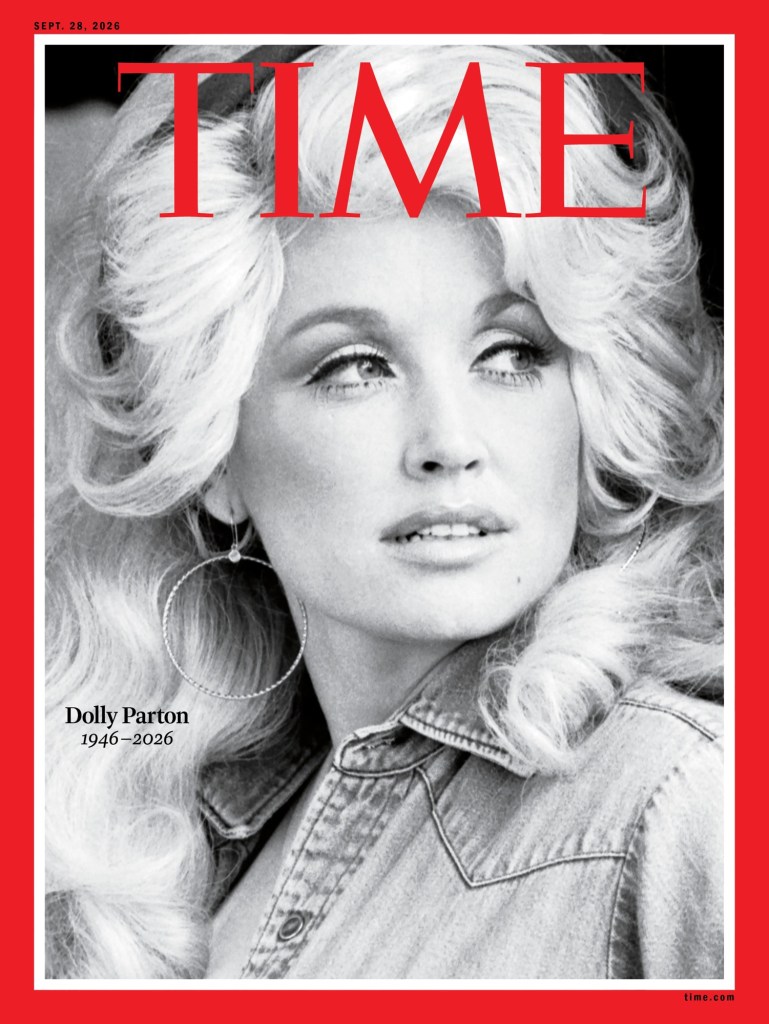
She made the covers yet again ❤️
And for a little amusing epilogue:
Dolly Parton famously said her motto was: “Leave no rhinestone unturned.” Which reminded me of her 1984 romantic comedy Rhinestone, in which she starred with Sylvester Stallone. This was an absolutely hilarious movie where her character bets that she can turn the next person she sees into a Nashville-style crooner. Unfortunately, the next person she sees is cocky New York City cabbie Nick (Sylvester Stallone), who can’t sing a note. Here’s a trailer:
Talk about leaving something behind! Tom Stoppard, who has just died, aged 88, wrote—over the course of five decades—35 stage plays (including seven translations or adaptations of foreign work), 11 radio plays, 6 television plays, and 14 film and television adaptations of books and plays. An opus which will keep his memory fresh for years to come.
I am not about to write an obituary complete with all his life details. Every newspaper has done that, and writer, journalist and magazine editor Tina Brown, who knew him personally since she was a teenager (he lived close to them and was friends with her father) has posted a lovely eulogy on Substack.
Stoppard wrote great theatre because he wrote great dialogue, witty and argumentative. In his own words, ‘Writing plays is the only respectable way of contradicting oneself.’
Here is a description of him, from an obituary in the Guardian:
A tall and strikingly handsome man, with a long, bloodhound face, a thick tangle of hair and a casually assembled wardrobe of expensive suits, coats and very long scarves, Stoppard cut an exotic, dandyish figure, a valiant and incorrigible smoker who moved easily in the highest social and academic circles, a golden boy eliding into middle-aged distinction and never losing the thick, deliberate accent of his origins, even though he never spoke Czech. He carved out his career in his own always carefully chosen words. He was often thought to be “too clever by half,” but never patronised audiences by talking down to them, even if they had to work hard to keep up.
Stoppard lived a charmed life in England, something he was always grateful for, considering a large part of his family died in the camps. This part of his personal history he only got to research in later years.
In my case, I credit Stoppard for instilling in me an eternal love of the theatre. Not living in England, I sadly did not manage to see all his plays, but I made it a point to see as many as I could, and they remain vivid in my memory. The wit, the irony, the sarcasm, the erudition and, above all, the sheer enjoyment.
Rozencrantz And Guidenstern Are Dead, The Real Inspector Hound, Arcadia, India Ink…The list goes on. Wonderful actors, such as Bill Nighy and the incomparable Felicity Kendall, fantastic sets. A great director, for a lot of them, in the shape of Peter Wood.
He’s always been number one in my list of people to invite to an imaginary dinner party. May you rest in peace, Mr Stoppard, and thank you.
I will not attempt to describe Dame Maggie Smith’s life or acheivements—following her death at 89, the papers and online sites are full of detailed biographies and tributes and I am sure everyone who is interested has read them.
This is just a short personal tribute to a great actress—someone who has provided me with unforgettable moments of delight throughout my life.
A lovely 70’s portrait (Wikipedia)
Growing up and living for a large part of my life in Greece, I was very fortunate to have been able to witness some of her best performances in the theatre, live. Thanks to my parents’ love of the theatre and a few well-timed trips to London, I saw her in various plays, and most memorably in Lettuce and Lovage. I remember tears of laughter running down my face as, playing a stately-home tour guide who embellishes her descriptions with fictions to keep the visitors’ attention, she became increasingly more demented. Also memorable was The Importance of being Ernest, where her Lady Bracknell was so haughty that her nose was parallel to the ceiling as she delivered another scathing put-down to some hapless person.
Of course I have watched her in most of her films, too. Her wit, her cool delivery, her tart and sophisticated personality were unique. It is a great privilege to have given so much pleasure to so many people during your lifetime, and she was proof that it is possible not to become invisible and diminished as one ages. On the contrary, her fame increased at the end (despite all her success, up to a certain point she managed to go about town unrecognised). Of course, not everyone has her talent.
Let me conclude with the deliciously quirky line which just sprung to my mind, asked with opened eyes a a note of genuine astonishment, ‘What is a weekend?’