Guest Post: Georgios Seferis

It was lovely being asked to write a guest post by Pete. Take a look at his blog, Beetleypete, where he writes about his walks around Norfolk with his dog Ollie, and about a lot of other stuff.

beetleypete's avatarbeetleypete

I am delighted to have received a guest post from Marina Marinopoulos. The subject is the Greek Poet, Georgios Seferis. Her own attractive and informative blog can be found via this link.
https://athensletters.com/

marina-photo-2

A great poet: Giorgos SEFERIS

I’ve kept a rein on my life, kept a rein on my life, travelling
among yellow trees in driving rain
on silent slopes loaded with beech leaves,
no fire on their peaks; it’s getting dark.
I’ve kept a rein on my life; on your left hand a line
a scar at your knee, perhaps they exist
on the sand of the past summer perhaps
they remain there where the north wind blew as I hear
an alien voice around the frozen lake.

Giorgos Seferis, ‘Epiphany’ [excerpt]

Greece can boast of many great poets, such as Constatine Cavafy, Andreas Kalvos, Kostis Palamas, Angelos Sikelianos, Yannis Ritsos and others. Two of these, Giorgos Seferis…

View original post 710 more words

Messing about with clay

Some time ago, my grandchildren’s art class teacher held an end-of-year session where parents could join in, and I was asked if I wanted to tag along. I accepted gladly –
1. Because I can never resist artsy things, or anything where you get your hands dirty.
2. Because I love taking part in anything the grandkids do.
3. Because their teacher, Maria, happened to go to school with my sons and I thought it would be fun to catch up.


image


The class is an after-school activity comprising a handful of kids, and I followed them and their mothers (no dads present) into a darkened room where we sat listening to a cd of intriguing sounds. No explanation was given as we silently tried to guess what we were hearing. Water? Yes, definitely water – not waves, maybe rain – but perhaps not rain…perhaps a stream running over pebbles. Definitely something solid there, stones…hail? Then an image popped in my mind, of a video installation by the artist Bill Viola.  On a huge, vertical screen, a man lies on a slab of stone under a waterfall. Only the water is not falling on him, but flowing upwards. (You can see it here.)


image


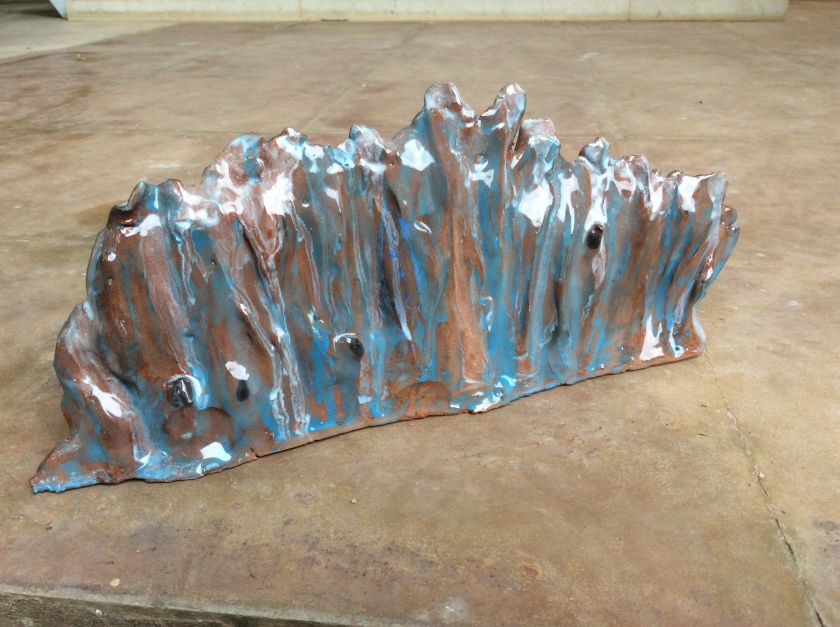
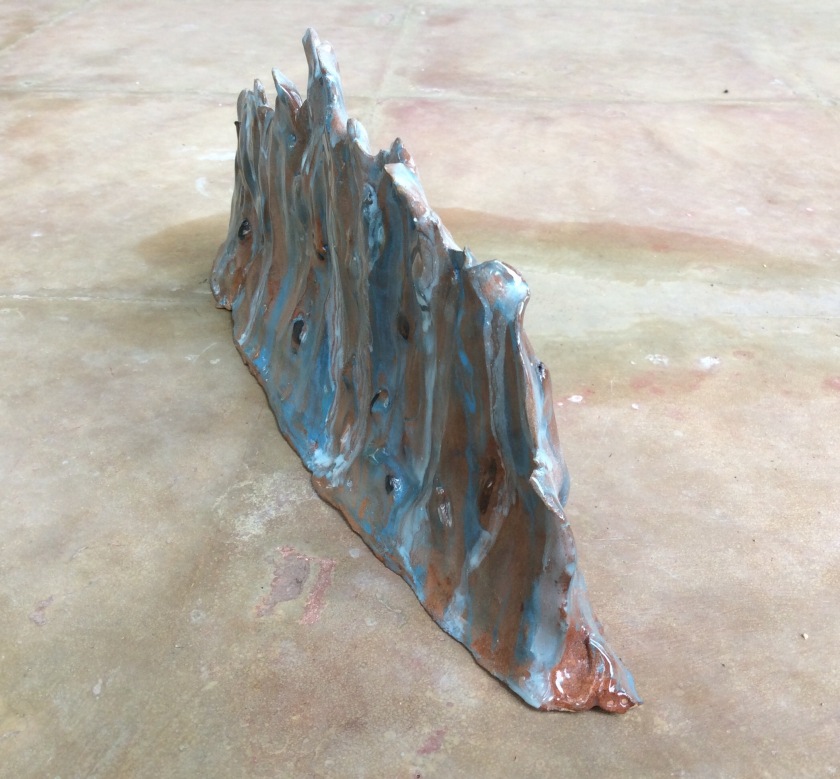
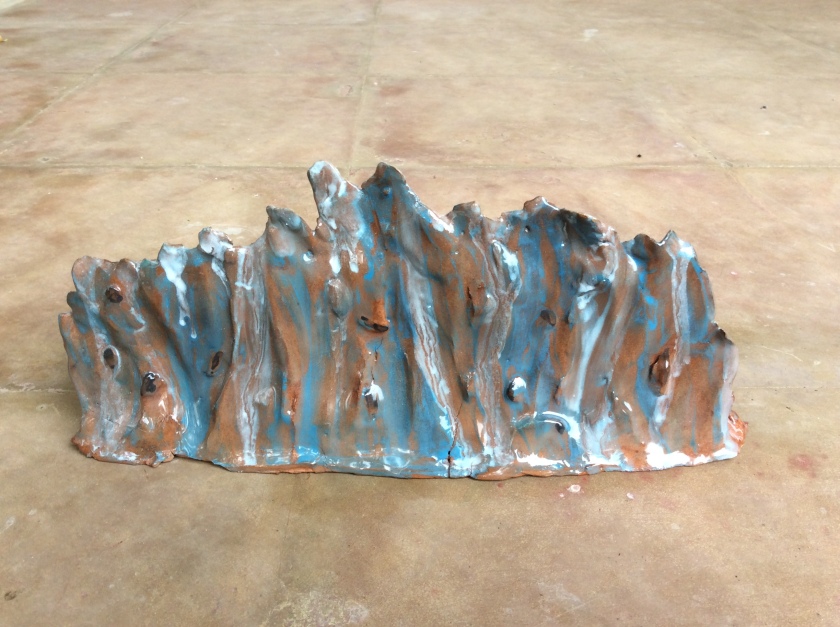
Back around the large table in the studio, we were each given a big lump of clay. Some kids joined up with their moms, others worked alone, and it was fun to see how everyone interpreted what they’d heard. All the pieces were different. But oh the joy of pounding that cool, humid piece of clay, fingers sliding over or digging in, drawing out or pushing it back. I called my obscure-looking creation Frozen Wave; I imagined it as water flowing upwards, carrying debris with it.

We glazed our pieces in different colors and left them with Maria so she could fire them in her kiln when dry. Before leaving I tried to persuade her to let me join her class on a more permanent basis, but sadly I was considered to be just outside the age limit.

Oh yes, we were told at the end that the sounds were a recording of a glazier or moraine. How cool was that?


image

Olympic Games trivia

Now that the fanfare is over, and the frenzy of the medals tally, and the usual grubby IOC scandals; now that the Rio Olympics have been declared, by IOC president Thomas Bach, “the people’s Games, the most happy Games ever, the beautiful Games, the passion Games” (how do they think up this rubbish? but of course London and Sydney had already been voted the “best ever Games”, so he was obviously running out of superlatives); now that the green diving pool and the sewage floating in the sea have been conveniently forgotten and the Brazilians left to deal with the aftermath and the cost; I thought it would be fun to post some random facts about the greatest sporting show on earth. Not so much facts, actually, as human stories, which is what I always find the most fascinating.


Three runners. Wikimedia commons.
Three runners. (Wikimedia commons)


The ancient Olympic Games, primarily part of a religious festival in honor of Zeus, were a series of athletic competitions among representatives of city-states. The games were staged every four years, starting in 776 BC, in Olympia, a sanctuary site for the Greek deities in the Peloponese. They reached their zenith in the 6th and 5th centuries BC, but then gradually declined in importance as the Romans gained power and influence in Greece. It is believed they ended in the 4th century AD, when emperor Theodosius I decreed that all pagan cults and practices be eliminated.

During the celebration of the games, an Olympic Truce was enacted between warring cities so that athletes could travel to the games in safety through hostile territory.

Athletes competed naked, and victors were rewarded by a kotinus, or olive branch wreath, and a large number of amphorae full of olive oil, which they most probably sold.

Only Greeks could compete. Greek men. No women, slaves or foreigners were allowed.


Fencing before the king of Greece - 1896 Summer Olympics. By André Castaigne ( died 1929)
Fencing before the king of Greece – 1896 Summer Olympics. By André Castaigne ( died 1929)


The Olympics were revived in 1896 by the International Olympic Committee (IOC), which had been created by Pierre de Frédy, Baron de Coubertin, and were held in Athens, Greece, from 6 to 15 April. Women were still not allowed to compete, because de Coubertin felt that their inclusion would be “impractical, uninteresting, unaesthetic and incorrect”.

However, one woman, Stamata Revithi, ran the marathon course on 11 April, the day after the men had run the official race. Although she was not allowed to enter the stadium at the end of her race, Revithi finished the marathon in about five hours and 30 minutes, and found witnesses to sign their names and verify the starting and finishing times. Revithi intended to present this documentation to the Hellenic Olympic Committee, hoping that they would recognise her achievement. It is not known what happened in the end – nor, sadly, could I find any photos of her.

Alfréd Hajós (Wikimedia commons)

The undisputed star of the swimming events at these Games was Hungarian architecture student Alfréd Hajós. Battling the elements on a cold April day – with 4m waves crashing around him – the 18-year-old Hajós served up majestic victories in both the 100m and the 1,200m freestyle events, to become the youngest champion of the inaugural Olympic Games.

While attending a dinner honouring the Olympic champions, the Crown Prince of Greece asked Hajós – who had been dubbed “the Hungarian Dolphin” by the Athenian press – where he had learned to swim so well. “In the water,” was his laconic response!

Hajós later showed himself to be an extremely versatile athlete, winning Hungary’s 100m sprint, 400m hurdles and discus titles. He also played as a centre forward in the Hungarian national football championship and was a member of the Hungarian team for its first ever international. He became a prominent architect specialising in sport facilities.


Spiridon Louis (Wikimedia Commons)

Because of its close connection with Greek history, the public desperately yearned for the marathon to be won by one of their countrymen. Spiridon Louis, a Greek water-carrier, rewarded their expectations, thereby becoming a national hero. When Louis arrived in the stadium, which erupted with joy, two Greek princes – Crown Prince Constantine and Prince George – rushed to meet him and accompanied him on his final lap for a finishing time of 2:58:50.

Louis’s victory set off wild celebrations, and the king offered him any gift he would care to ask of him; but all Louis could think of was a donkey-drawn carriage to help him in his water-carrying business!

Louis lived a quiet life thereafter, but his legacy includes an expression in Greek: “yinomai Louis” (γίνομαι Λούης – “I becοme Louis,”) which means to flee, or “disappear by running fast.”

The silver cup given to Louis at the Olympic Games was sold for 541,250 pounds ($860,000) in London on 18 April 2012, breaking the auction record for Olympic memorabilia. Breal’s Silver Cup stands just six inches tall and was offered for sale at Christie’s by the grandson of the victor, and bought by the Stavros Niarchos Foundation.


Spiridon Louis. Colored photograph by Albert Meyer
Spiridon Louis. Colored photograph by Albert Meyer (1857-1924)


Over the years, there are many of these stories to be told, showing the resilience of the human spirit, the will to overcome difficulties and deal with failure as well as success. Driven by the megalomania prevalent in the IOC, and the political and financial interests present in any such endeavor, the Olympic Games have turned into an overblown media circus, bankrupting most countries brave enough to stage them. But still, time after time, these stories surface, and we get to witness amazing feats and riveting drama.

Mid-summer blues

It’s been a gloomy summer.


A bunch of lavender. When dry, it will be put into sachets in the linen cupboard.


In Greece, forest fires have ravaged the stunningly beautiful island of Euboea.

The refugee hot-spots are overflowing again.

People are in despair because more taxes have been announced for September. Many have not been on holiday, because they cannot afford it.


A hot cat cooling of on the kitchen tiles.
A hot cat cooling off on the kitchen tiles.


Elsewhere – another day, another atrocity. I dread seeing the news each morning.

To say nothing of the depressing spectacle of the US presidential campaign.


A basket of freshly-picked, sun-warmed figs


So it’s good to have the comfort of small, daily pleasures. Most of which are connected with nature.


A swim in turquoise waters.

Homage to the olive tree

‘I will give you water,’ said Poseidon, striking the Acropolis rock with his trident. A salty fountain sprang up.
‘And I will give you a tree,’ said the goddess Athena, striking the rock with her spear. An olive tree sprang up. ‘Its fruit will feed you, its leaves will give you shade, and and its wood provide fuel.’
There was a vote, and Athena won, thus giving her name to the city of Athens.

At the first Olympic Games, held in 776 BC in honor of Zeus,
athletes were massaged with olive oil in the belief that the wisdom, power and strength of Athena would be bestowed upon them. The winners, of this and all subsequent games, were also awarded olive leaf crowns and olive oil.


'I am the Sun's daughter the most beloved of all' Poem by Kostis Palamas
‘I am the Sun’s daughter
the most beloved of all’

Poem by Kostis Palamas(1859-1943)


The olive tree was considered sacred. It was believed that if you polished a statue of Zeus with olive oil, Zeus would be so honored that he would grant you a long and happy life. The 13m-high ivory and gold statue of Zeus at Olympia made by the famous sculptor Phidias (one of the seven wonders of the ancient world) was always kept polished with olive oil.

Olive trees are ancient. Fossilized leaves, believed to be as much as 60.000 years old,  have been found on the volcanic island of Santorini. However, it appears that olive trees as we know them today originated approximately 6,000 to 7,000 years ago in the region corresponding to ancient Persia and Mesopotamia. But they were first cultivated commercially in Crete in the Minoan era, as can be seen on the murals in Knossos – they may have been the source of the wealth of the Minoan civilization. Later, Ancient Greek philosopher Aristotle further developed the cultivation of the olive into a science. Olive oil was a valuable trade commodity, and a main source of prosperity in Classical Athens. It was also used to anoint kings, athletes and warriors.

Olive trees have a special significance in all aspects of life – an almost magical dimension. The olive branch was – and still is – seen as a symbol of abundance, wisdom, glory and peace. The leafy branches of the olive tree were ritually offered to deities and powerful figures as emblems of benediction and purification, and they were used to crown the victors of bloody wars, as well as athletic games.

From the beginning of the 6th century BC olive trees were protected by special laws, first instituted by the legislator and statesman, Solon. The laws decreed how the trees were planted and how many could be cut, and differentiated between common trees and sacred ones, which were believed to be descended directly from the first olive tree given to the city by the goddess Athena. Crimes against these sacred trees were tried at the highest level and punished harshly (by exile, confiscation of property, or even the death penalty).

The olive trees was also revered in other civilizations, such as the Egyptian civilization, and went on to become the sacred tree in most religions, including Judaism and Islam. In the Christian religion, a pair of olive trees symbolize both the Old and New Testaments. A dove brought an olive branch to Noah, to signify the end of the Flood. Today, olive oil is still used in many religions for various rituals.

In everyday life, olives and olive oil are a major part of the famous Mediterranean diet. Olive oil is used in soap, cosmetics, and even to exorcise the evil eye! Greeks often give it as a present, to each other and to foreigners.
Olive wood burns slowly, so it lasts long. It is a hard wood, and can be used to make many objects and utensils.

Olive trees are resilient: they don’t need much water, they resist drought and high winds and they even regenerate after fire.  They have an enormous life-span: there are olive trees in the groves around the Mediterranean that are said to be centuries old, and ages as great as 2000 years or more have been demonstrated for some individual trees. The Olive tree of Vouves in Crete (one of many examples), has an age estimated between 2000 and 4000 years!
The older the trees get, the more dignified and wise they become. Their twisted, gnarled and scarred trunks, their dark, hollowed-out centers, their silvery leaves glinting in the sun, give each a distinct personality.

The olive tree has been celebrated in art, prose and poetry. In the Odyssey, Homer referred to olive oil as ‘liquid gold’.
As poet Odysseas Elytis, (Nobel Prize for Literature, 1979) put it:

If you take Greece apart,
In the end you will be left with
an olive tree, a vineyard and a boat…
which means that with these items
you can rebuild Greece…

A thought for Turkey

The flight of eight soldiers from the failed Turkish coup to Greece in search of asylum has become the object of protracted debate in the Greek Parliament. Turkey has asked for their extradition, but some Members of Parliament are against it , because of their probable fate… On the other hand, there is no doubt these people fired from the air on unarmed civilians and have been branded traitors in their country.

Obviously whatever happens in Turkey concerns us closely. We are neighbours, we share a border and a sea; historically we have been mostly enemies, but we have a strong connection as well. After four centuries of Turkish occupation, we share many tastes, plenty of words and cooking recipes too! We get on well in person: at universities everywhere in the world, at sports meetings, we are always forging bonds. We have business connections. We help each other in the event of natural catastrophes like fires and earthquakes. We could be doing a lot more together, to the benefit of both. But – there is always a but – there are always politics. Threats, planes invading airspace, the unsolvable crisis in Cyprus… Things that cause a lot of agony, and help nobody in the long run.


image

I swear, history just makes me tired sometimes.

At the moment, I’m thinking about my friends in Istanbul, and the uncertainty they’re facing. Battles on Bosphorus Bridge, purges, a state of emergency.  In Greece we’ve lived through a coup like this, and it ended in a military dictatorship that lasted 7 years. This one hasn’t, but combined with the latest terrorist attacks in public places, it all makes for a lot of distress.

One effect will be a huge blow to tourism. And we cannot forget that the people who were killed, as well as the thousands of soldiers now in jail, all have families – a lot of lives have been destroyed.

In her mostly photographic blog, photographyofnia, Nia has posted her thoughts and feelings about the coup. It makes for disturbing reading.
And for anyone who wants an interesting commentary on the same subject, read the relevant article (here) on Levantine Musings, a blog written by David Edgerly, who lived in Turkey and the Middle East  for 25 years.

Extreme Images of A Storm

We never get this kind of storm in Greece. Awesome images!

Cecilia Mary Gunther's avatarThe Kitchen's Garden

Late yesterday morning I saw this great broody cloud coming over the horizon like a huge intergalactic mother ship, I dropped what I was doing and sprinting past the long list of work I should have been doing, I collected my camera, jumped in the truck and went storm chasing. I love these images. The skies here fill me with awe.

Here are the best of the images in the order that I shot them. storm coming

extreme storms

storm clouds

storm clouds

And then I looked back to the house.

astorm

And said Oh my God. There is no way you can look at that image and not think that all hell will soon be rained down upon my little farm.  But this storm did not bring much rain or wind -just an ordinary storm with dramatic clothing.  Those of you on Instagram with me  (cecilia_bwg) will have seen this shot in real time. Thank fully this time I had…

View original post 482 more words

There are no words…


Another day waking up to horrendous news…

image


What is it about our times? How many individuals are prepared to commit suicide, if they can take others – many others – with them? What is this urge to go out and murder people who have done you no harm? How much anger can their heart contain?

Fanatics, I hear you say. Of course, fanatics were always dangerous – loose cannons who feel they have nothing to lose. Once they have decided on martyrdom, nothing can stop them.

But it is not only fanatics. There have always been people who are suicidal, but they went off into the woods and shot themselves, or stuck their heads in the oven. Now some feel they have to shoot down a whole classroom, or smash a plane against a mountain.


image


Is it the fault of chemicals in the air? The influence of violent video games? The availability of guns? The unfairness of capitalism? How can this be explained in terms of human psychology? I wish someone would tell me.

Meanwhile I am thinking about so many lives shattered, and taking solace in nature.

On leaving home

I keep writing about the refugees and immigrants arriving in droves upon Greek shores, but there is also outgoing traffic. Many Greeks are leaving the country in the third major wave of emigration to be observed in the last 100 years.
In the 20th and 21st centuries alone, nearly two million (1.764.000) Greeks have moved away. Why? What makes someone leave behind everything they hold dear?

The two major causes are war and poverty. At the moment we are lucky not to be at war; but we are experiencing an unprecedented economic crisis, and more than 420.000 Greeks within the 15-64 age range have left since 2008. Here I would like to point out that we are talking about a population of only around 11 million, of whom one million are immigrants themselves.

In the last 100 years, there have been three instances of mass exodus, all connected with financial crisis expect for the late sixties, where the reasons were predominantly political (to do with the dictatorship of 1967-1974). In the first phase, circa 1903-1917, those who emigrated were largely uneducated men, peasants and workers, who found employment as servants and laborers, mostly in ‘transatlantic’ countries such as the USA, Australia, Canada, and Brazil. The second wave was chiefly made up of young people, unemployed or manual laborers, who found work as factory hands primarily in Germany and Belgium.


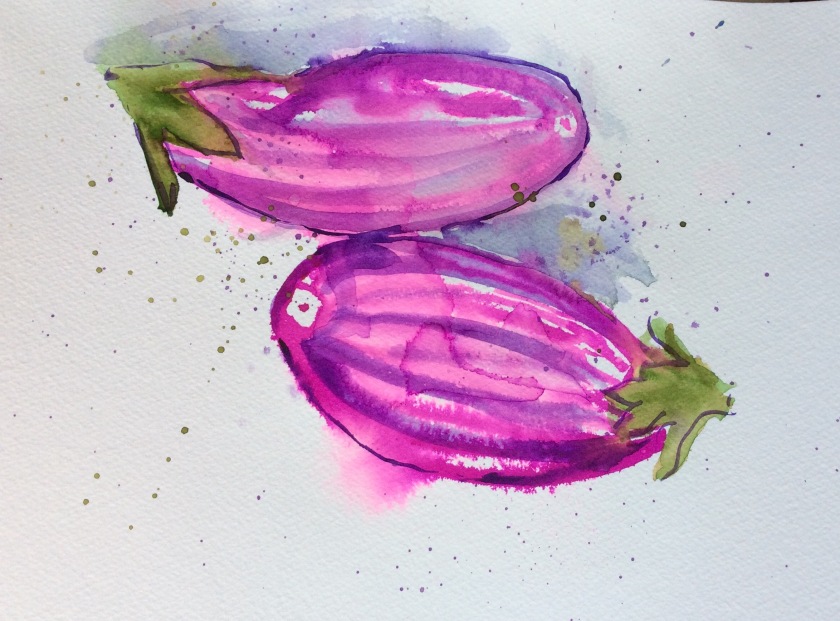
Cheerful sketch of the day by Leo
Cheerful drawing of the day, by Leo


The big difference is that today the people who are moving out are young, educated and experienced professionals. Specific countries appear to be absorbing specific types of professionals; for example, finance graduates have gone primarily to the U.K., medical graduates to Germany, computer science graduates to the United States, and engineers to the Middle East. So we are talking about a real brain drain, which is the last thing Greece needs at the moment.
This exodus is not surprising, considering nearly 1 million jobs have been lost in Greece over the last six years, according to an analysis by the Hellenic Statistical Authority.

A study made by Endeavor Greece, an international group that supports entrepreneurship, showed that a stunning 46% of Greeks living in the country are considering relocating.
This is a very disturbing statistic: at a time when the European Union wants Greece to try to pick itself up by its bootstraps and restructure its economy, the brainpower needed for this transformation is leaving.

What would make these people stay? A promise of a future, for one. Decent jobs, an environment where entrepreneurship is valued and promoted, a stable and reasonable tax system. As can be seen in my monthly Q&A, there are young people fighting to stay and make the best of things, but for how long?
What does the future hold? If nothing is done to reverse this trend, Greece could end up as a country where the indigenous population is a minority.


A hailstorm of taxes

We had a deluge yesterday – unusual for this time of year, but extremely providential, as it helped control a huge forest fire. These are the bane of Greek summers, so the water, in spite of causing some damage, was appreciated.  At the same time – much less appreciated – we have a deluge of taxes pouring down on us: new taxes, as well as increases in old ones. More are expected (threatened?) in September.

There is a saying ‘Ουκ αν λάβοις παρά του μη έχοντος’ (you can’t take from him who does not have) – a little like ‘You cannot get blood from a stone’. It’s a mythological reference to Charon, who was the ferryman in Hades, carrying the souls of the deceased from one bank of the river Styx to the other. His fee was one obolus, and a coin was placed under the tongues of the dead, so that they would be able to pay him. But I digress. My point is that people are at the end of their tether – they have no more money.


image
Fact
: 20,000 businesses will close in the next six months – we are quite a small economy, and that is on top of the many thousands that have already closed since the crisis started. How come the eggheads in Brussels don’t understand that if they don’t restart the economy they’ll never get their money back? Our government doesn’t seem to get it, either.

Fact: A lot of taxpayers are getting advice from their accountants to close their books or else they’ll be forced to close up shop. This is especially true in the case of professionals and freelancers like physiotherapists, masseurs, dog trainers, hairdressers, small shop owners and the like. Many are being forced into the ‘black economy’.

Fact: the new laws that are meant to alleviate matters for the less well-off result in the following logistics:
Someone whose income is €30.000 but declares €10.000, receives child support and the right to send one child to daycare for free. His disposable income after tax is €26.657,9.
Someone whose income is €30.000 and declares €30.000, receives no child support and has to pay for daycare. His disposable income after tax is €13.543,4 i.e. half of the evader’s.

Fact: in spite of the increase in taxation, the total of taxes collected keeps decreasing. Does this have anything at all to do with the above?(duh…)

Those who, for reasons of honesty or because they can’t do otherwise, pay their taxes, end up also paying for the rest. At the same time, the state is happily robbing a good part of the population, by not paying what it owes them while refusing to offset what they owe with what they are owed.

Fact: A lot of Greeks cannot afford to go on holiday once again this year, as seen by hotel bookings. So it is left to foreign tourists to enjoy the island life…

PS. I made a cheerful drawing, since my subject matter is so depressing…