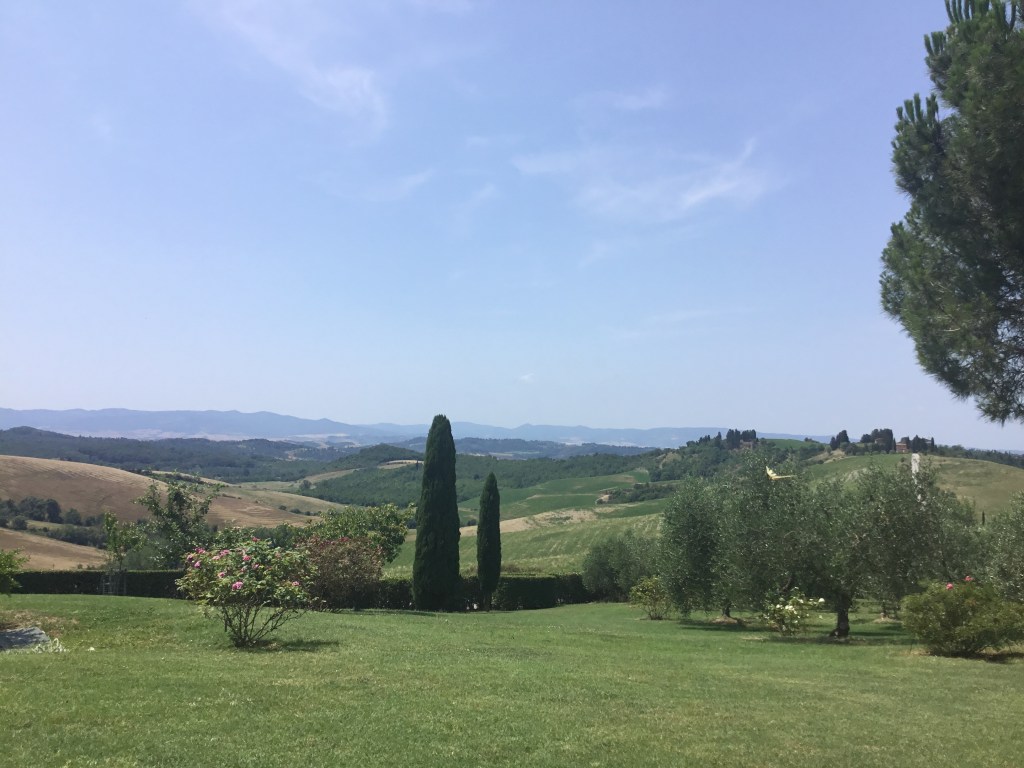
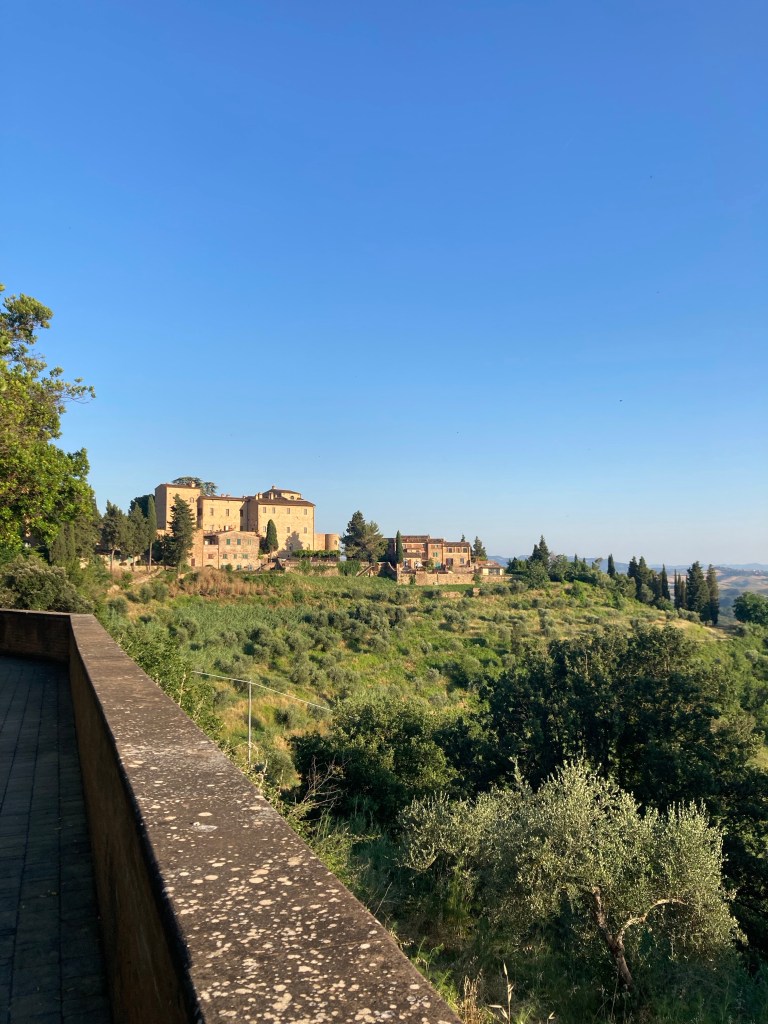
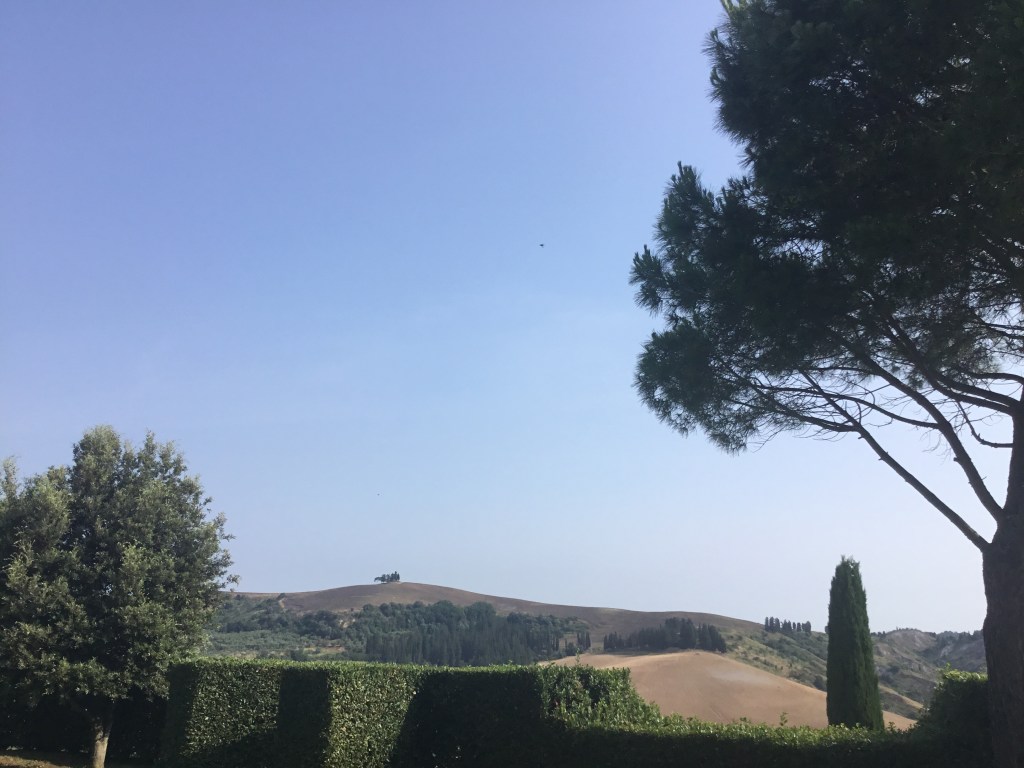
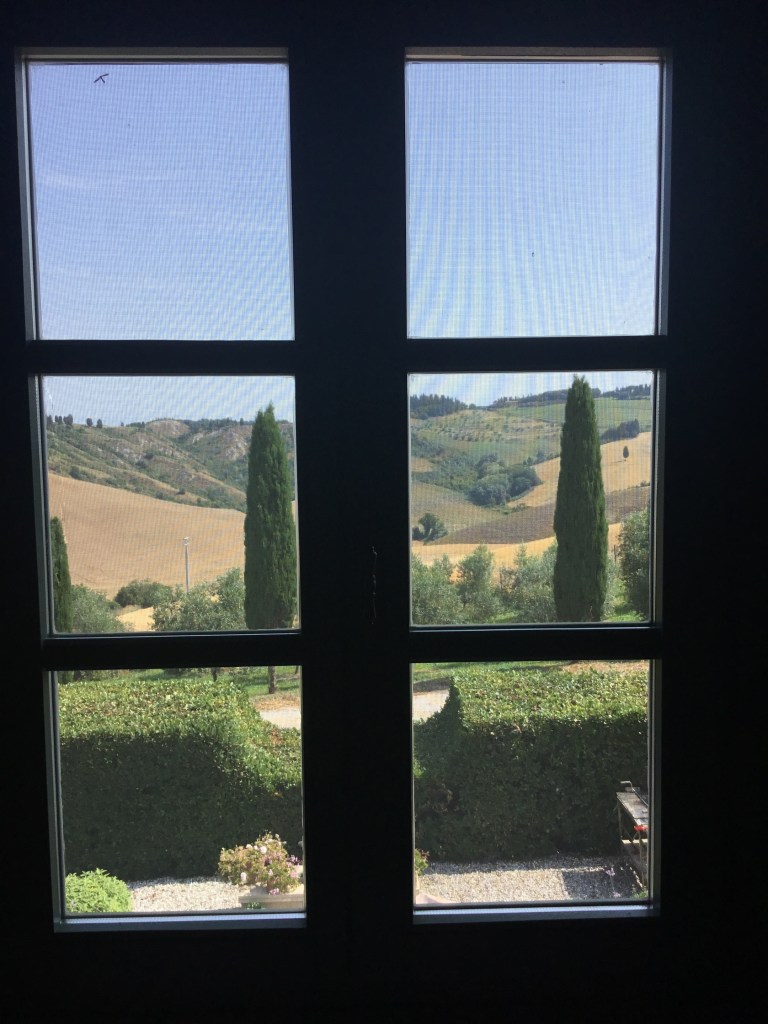
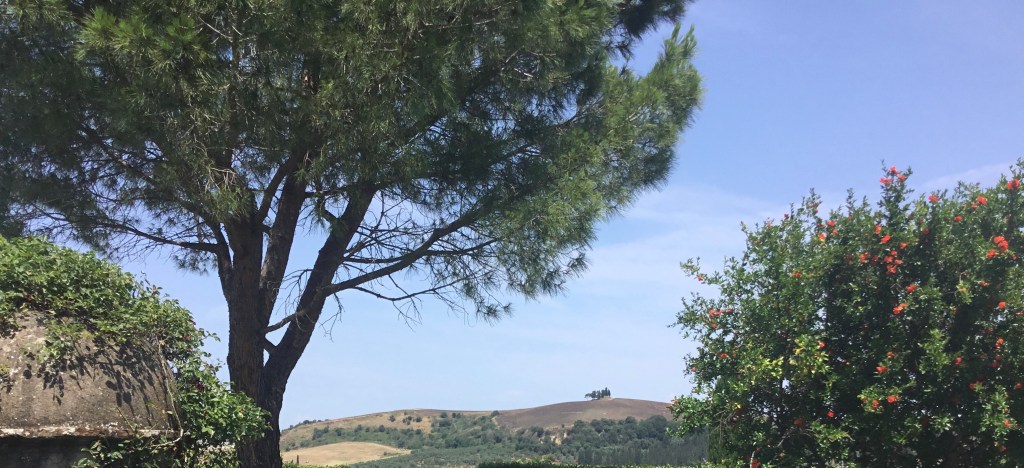
It is a blessing to have Italian friends, especially if they happen to have a house in Tuscany! The Tuscan landscape must be amongst the most pleasing in the world. And still quite unspoilt.
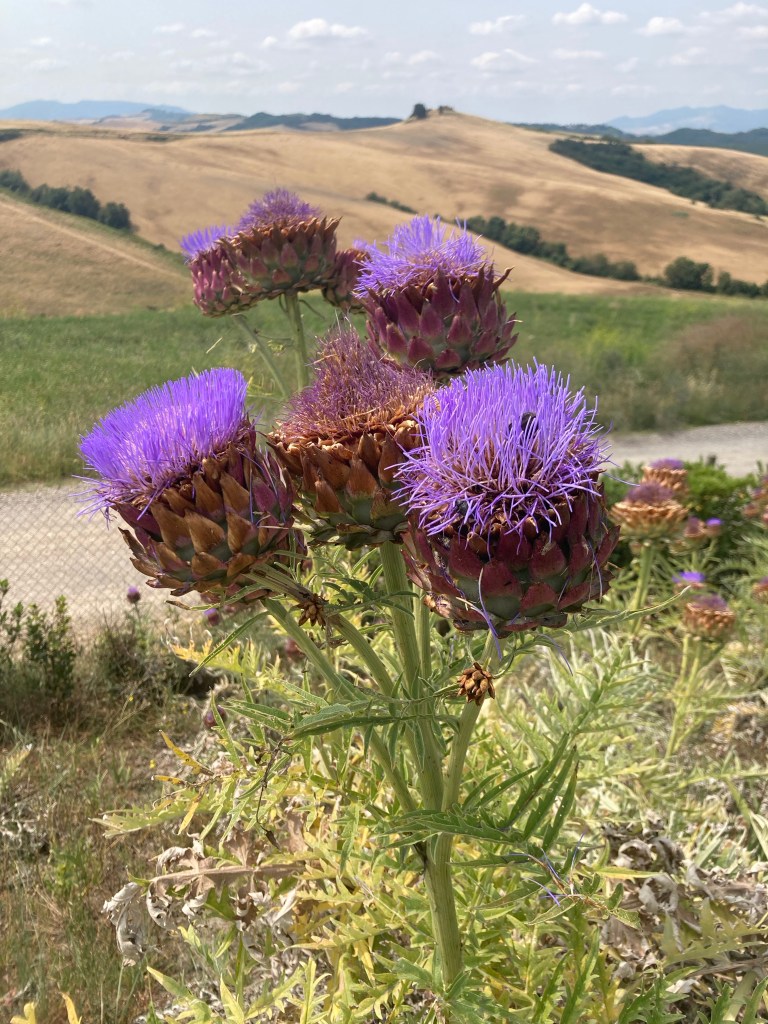
Hills upon hills, in shades of yellow, ochre and green, spiked with the dark spears of cypress, and dotted with flowering oleander.
Sometimes crowned with medieval villages, or crumbling farmhouses.
A wide, clear horizon. Blue skies.
Views from every window.
Here we are close to Pisa, Florence and Sienna, so if one is has the energy, there is a lot of art and architecture to be enjoyed within an hour’s drive. Also Forte dei Marmi, to swim and eat seafood.
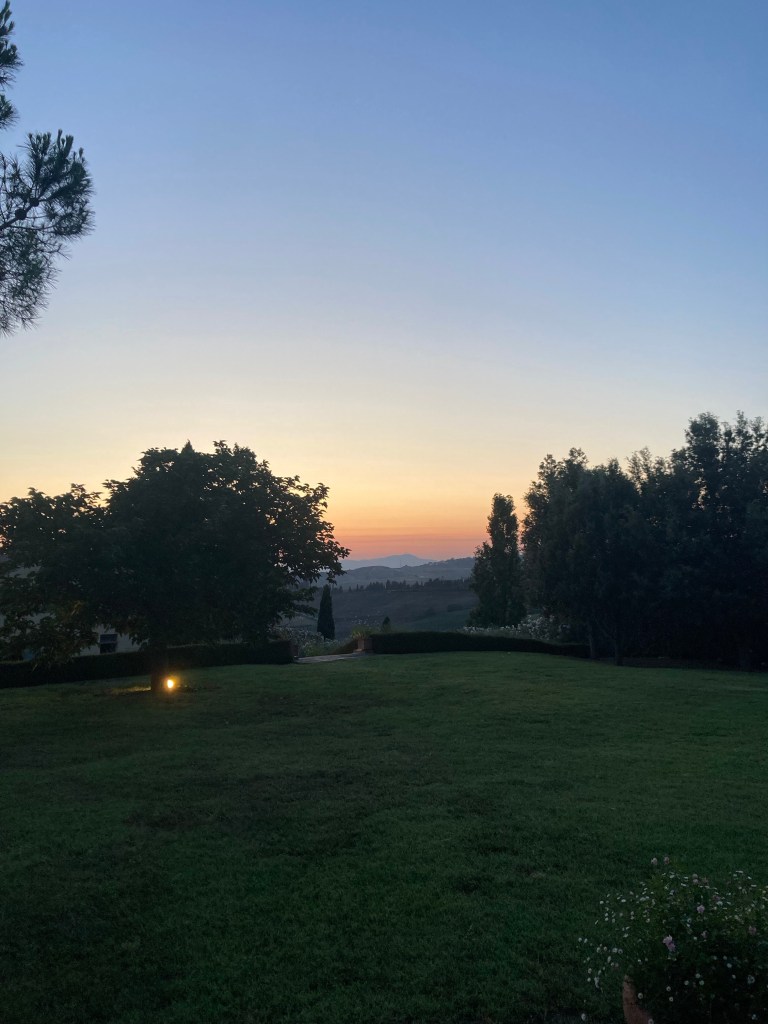
There are wonderful sunsets to enjoy, while sipping a drink—and I will not even try to describe the heavenly food.
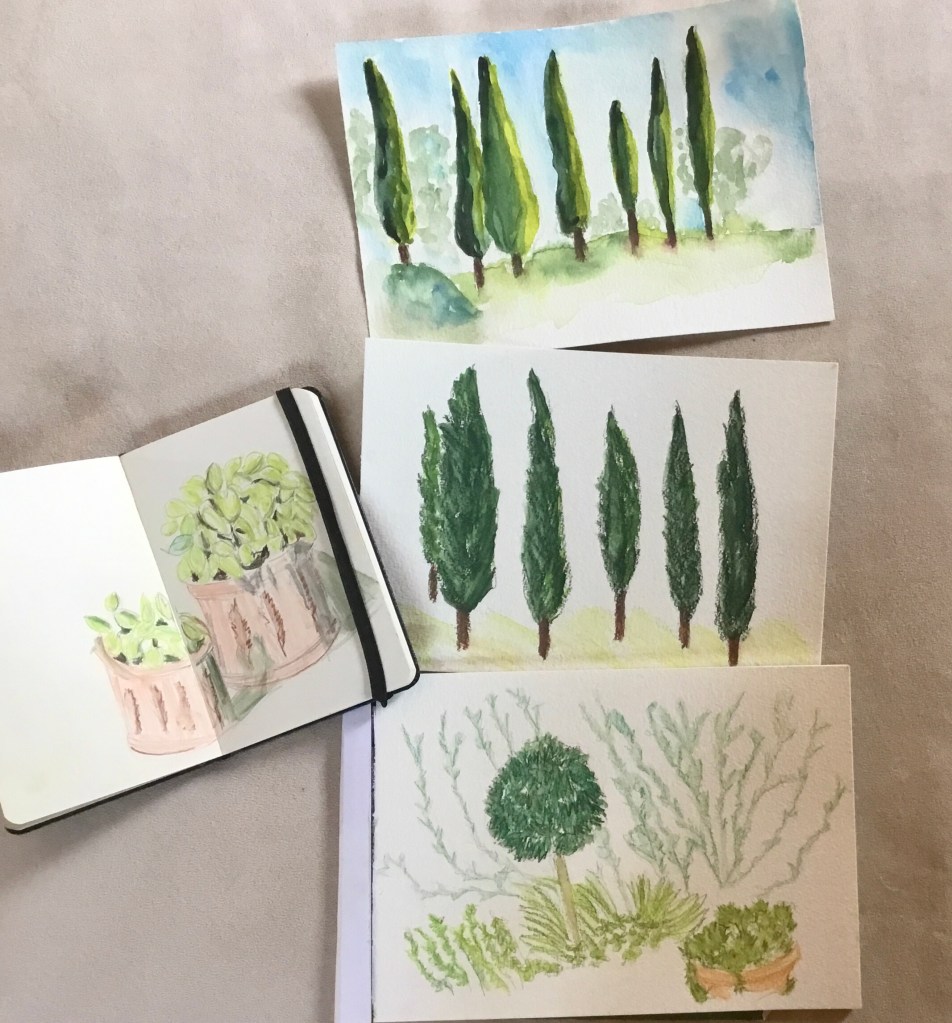
It is very tempting, however, to just stay put, eat, read, laze around, play board games and do a bit of light sketching.
Going to the dentist is not my favourite outing, as one can imagine. Coming out of this morning’s visit, my mouth numb on one side, I nevertheless felt grateful to have been born in the twentieth century—in ealier ages, surely by now I would have had but a few teeth left, if any at all. The torture of toothaches and dentures must have been unbearable in those days.
In old portraits, people almost never smile. Smiling might have been considered uncouth and awkward, a serious face more dignified and also easier to get a likeness from, but another reason was that many people had bad or even missing teeth. Not very flattering, even if the subject was clad in velvet and lace.
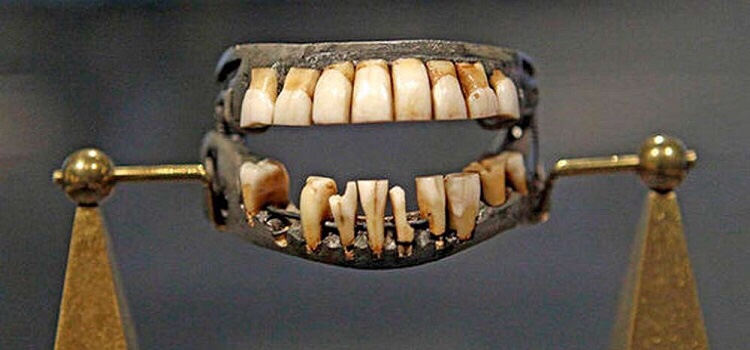
However, vanity (and practicality) made people look for solutions, starting in ancient times. The earliest known dentures—made by the Etruscans circa 700 BC, also found in Egypt and Mexico—consisted of human or animal teeth tied together with wires. Other ancient people use carved stones and shells to replace lost teeth.
In the 1700s materials improved with the introduction of walrus, elephant and hippopotamus ivory. But of course the best replacement was a real human tooth—acquired from people willing to sell them (these were difficult to find, because someone had to be desperately poor to give up his teeth) or, more easily, from corpses. Surgeons and professional grave robbers had access to these, but of course the most plentiful source was war. To get an idea of how many teeth were taken from battlefields, consider that they were sold by the barrel!
After the Battle of Waterloo there was a glut of teeth on the market. The French emperor, Napoleon, had lost 25,000 men, the Duke of Wellington’s mixed force had suffered 15,000 casualties and Blucher’s Prussians some 8,000. Viewed in the grey light of dawn the battlefield must have been a dreadful sight. But almost worse than the carnage must have been the arrival of an army of scavengers stripping dead soldiers (and some not so dead) of their valuables; coins, clothes, weapons and their teeth. Before long cartloads of teeth were heading for the Channel ports (I find this image hard to picture.)
There was already a well-established European export market for teeth, which had been started by one of George Washington’s dentists, John Greenwood, who in 1805 returned from Europe with a barrel load of human teeth from one of Napoleon’s earlier battles. George Washington suffered from tooth problems all his life, having lost his first tooth at 22; and he only had one of his own teeth left by the time he became president. He had several sets of dentures made, from various materials—but none, as popular belief has it, from wood (that is an urban legend). Some might even have been taken from slaves, another possible method for acquiring human teeth in those days.
The vast numbers of teeth flooding the London market became known as “Waterloo Teeth”. The belief that the teeth going into one’s dentures had once belonged to a brave young soldier had great commercial appeal.
However, there were already some alternatives to human teeth: The first porcelain teeth had been made in Paris by an Italian dentist in 1808. Despite that, and given that these alternatives had various flaws to start with, the demand for ‘Waterloo Teeth’ continued well into the second half of the 19th Century. At some point, due to the unbelievable slaughter of the American civil war, with over half a million deaths, the tooth trade was reversed, with millions of American teeth coming to Europe.
As for the dental health of the celebrities concerned, the Emperor Napoleon died in exile on St Helena in 1821 at the age of 52 still with all but four of his own teeth; and the Duke of Wellington lived until 1852, never having expressed a wish to acquire a set of Waterloo teeth for himself, despite having lost a few of his own.
Even as late as the 20th century, good dentistry was not available everywhere. Doris Lessing, whose parents moved to Zimbabwe (then Rhodesia) when she was five, remembers seeing her mother secretly sobbing with pain: both her parents had all their teeth removed and replaced with dentures before going to Africa.
So hurrah for modern dentistry. And apologies for the gruesome tales and photos, but I found it interesting how difficult it has been to develop something we now take for granted. I’m sure the same goes for eyeglasses—Samuel Pepys suffered much from failing eyesight, and had to read holding tubes of paper or cardboard to his eyes. But that is another story.
We have all heard of the benefits of a Mediterranean diet—but it amused me to find out how far back this goes. What did people in antiquity eat?
The Ancient Greeks were not big eaters like the Romans. In fact they mocked the Persians, who were very much into gastronomy, and considered them gluttons. They believed eating was for the delectation of the palate, not for overfilling the stomach.
They ate a great variety of foods, but in small quantities. Most frugal were the Spartans, who on a daily basis subsided on a cup of MelasZomos (black broth, made with pork, salt, vinegar and blood) and a piece of bread, and for special occasions ate boiled pork, accompanied by pies and wine.
For the rest breakfast, Akratisma, was very light, consisting of barley bread dipped in wine, with a few olives and figs—often accompanied by a drink called kykeon, made with boiled barley flavoured with mint or thyme.
Around midday they partook of the Ariston, another light meal usually of fish such as sardines, anchovies, mullet or eels; pulses such as lentils, peas, and broad beans; bread, eggs, fruits and nuts.
An occasional afternoon snack, the Hesperisma, consisted of bread, olives and dried fruit.
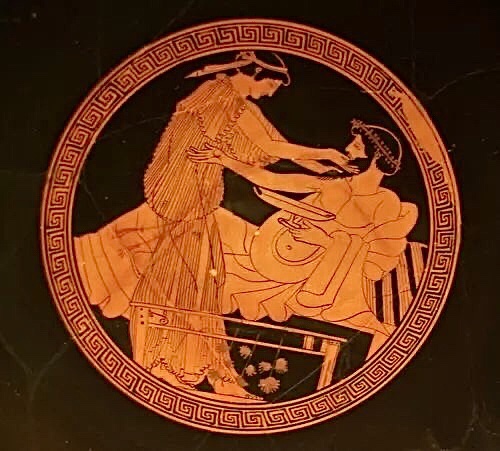
Deipnon, taken in the evening, was the most important meal of the day. That is when meat was eaten, especially by wealthy families; mostly pork and beef, as well as venison, and wild birds such as quail and thrush. This was the time, after dark, when wealthy families also held banquets, Symposia, served by their slaves. The women usually ate apart. The meal would be followed by deserts flavoured with honey, somewhat like a modern baklava.
Olive picking
Ancient Greeks loved all kinds of breads, and also ate snails, which were cooked in Crete since the reign of Minos. They grew vegetables in their gardens, and foraged for foods such as mushrooms, asparagus and nettles. Fruit played a large part in their diet, but they were limited to pomegranates, cherries, pears, apples, figs, plums, and mullberries—there were no bananas, peaches, citrus fruits or potatoes, which were imported later.
Kitchen shelves would be well stocked with spices and herbs: oregano, basil, mint, thyme, coriander, capers and sesame were all used to flavour dishes, together with sea salt and olive oil. Another flavouring was gáros, a sauce or condiment made out of fermented fish, a little like Worcestershire sauce. Food was quite light, since it was mostly baked, meat was roasted on spits, and deserts sweetened with honey—there was no sugar or cocoa. Milk and cheese were also consumed, as well as oxygala, a form of yogurt.
Wine was drunk mostly mixed with water, and was widely traded, like olive oil.
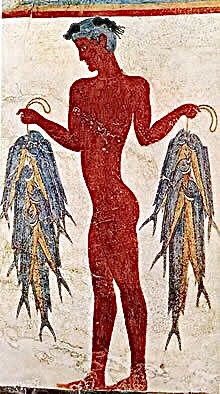
Fisherman with his catch. From a Minoan fresco.
While wealthy Greeks were able to afford elaborate banquets—the aforementioned Symposia—which boasted a wide variety of fine meats, the average person lived very frugally. However, their diet was still quite varied and based on fresh produce, and therefore healthy. As for the Symposia, some were the scenes of learned philosophical and literary discussions, while others were more like rowdy parties with hired performers and other forms of entertainment.
Cement Dinosaurs
I have been occasionally coming to London since childhood but I have only just discovered, thanks to my niece who moved to the area, a weird and wonderful exhibit I had never even heard of before: the Crystal Palace Dinosaurs.
These are Victorian cement statues representing extinct animals, which reside in the Crystal Palace Park. The sculptures are, due to the incomplete information available at the time, wildly inaccurate, which lends them an aura of fantasy and a sort of steampunk aesthetic, reinforced by natural erosion which has given them a crumbling patina.
The sculptures represent the first ever attempt anywhere in the world to model, from fossil remains, extinct animals as full-scale, three-dimensional, active creatures. Of the 30+ statues, only four represent dinosaurs in the strict, zoological sense of the word ( two Iguanodon, a Hylaeosaurus and a Megalosaurus). The statues also include plesiosaurs and icthyosaurs discovered by Mary Anning in Lyme Regis, as well as pterodactyls, crocodilians, amphibians and mammals, such as a South American Megatherium (giant ground sloth) brought back to Britain by Charles Darwin on his voyage on HMS Beagle. And Irish Elk, which at the start bore actual fossil antlers.
This section of the park was landscaped by Joseph Paxton in 1853-1855 and the sculptures remained largely in the places we find them today. They were designed by Benjamin Waterhouse Hawkins, a natural history illustrator and sculptor of international reputation, whose work combined the pursuit of technical accuracy and animate expression.
Experts in the 1850s had different interpretations of what the animals really looked like. The story of these evolving interpretations demonstrates how scientific ideas evolve when new evidence comes to light. For example, some of the sculptures have four legs, whereas later fossil discoveries suggest these animals were bipeds.
The statues were commissioned in 1852 to adorn the Crystal Palace spectacular glasshouse after it was moved from Hyde Park at the end of the Great Exhibition. They were unveiled in 1854 when the park opened as a commercial amusement.
Queen Victoria and Prince Albert were fascinated by the dinosaur display in Crystal Palace, and they visited the site several times.
Hawkins set up a workshop on site at the park and built the models there. The dinosaurs were built full-size in clay, from which a mould was taken allowing cement sections to be cast. The larger sculptures are hollow with a brickwork interior.
The models were displayed on and around three islands, and given more realism by making the water level in the lake rise and fall, revealing different amounts of the animals. To mark the launch of the statues, Hawkins held a dinner on New Year’s Eve 1853 inside the mould of one of the Iguanodon models.
Engraving of the dinner. Must have been fascinating!
The statues are now Grade I listed and funding is being obtained to restore them before they crumble away completely. I only hope this is done sensibly, because their decrepitude adds to their charm. Some of the restoration done so far on a few makes them look a little fake.
I urge anyone within reach to visit—very original and definitely worth it.
What could be the connection between Pablo Picasso and Faith Ringgold, a major figure in American feminist art?
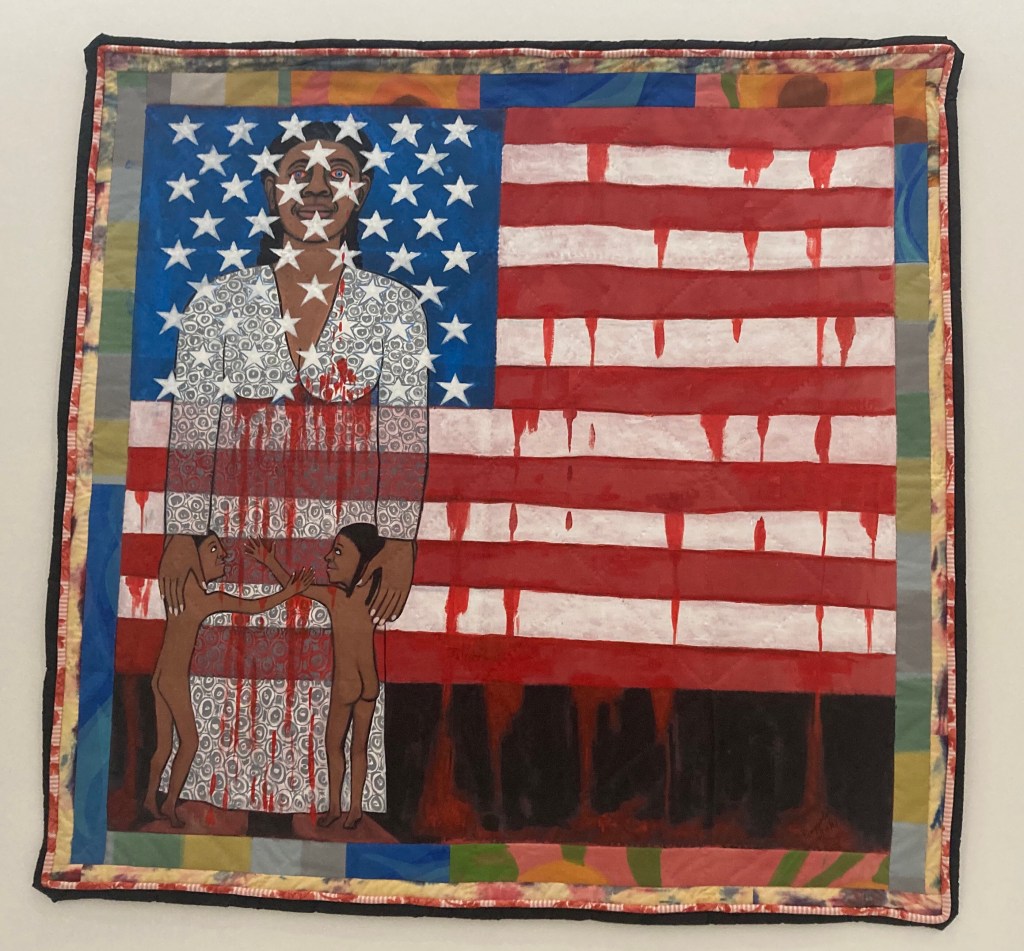
The flag is bleeding
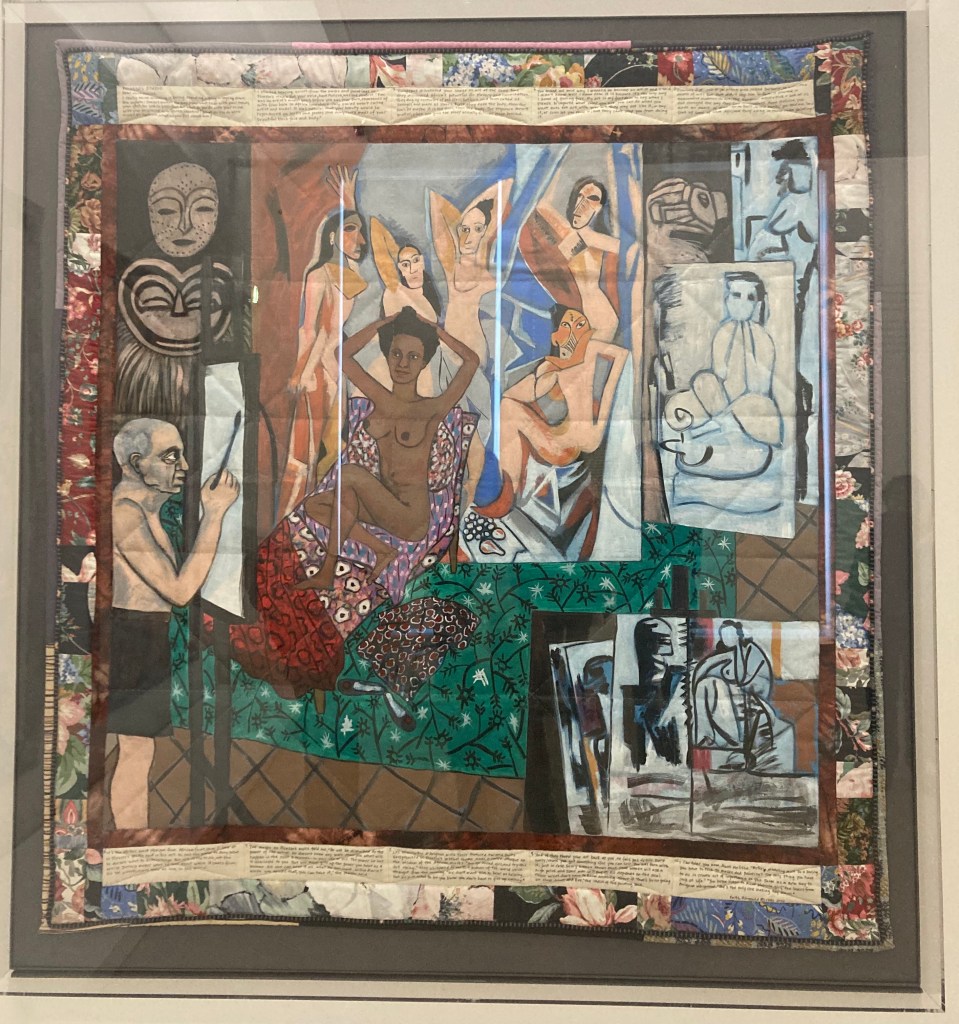
Faith Ringold was born in 1930 and raised in a middle-class home in Harlem. Her mother, the fashion designer Madame Willi Posey, taught her needlework and took her on the first of her museum-haunting trips to Europe. Picasso was her first and main inspiration. Through her rereadings of modern art history, she engaged in a genuine, critical and humorous dialogue with the Parisian art scene of the early 20th century, particularly with Picasso and his “Demoiselles d’Avignon“.
Picasso’s Studio
Ringgold is especially known for her paintings and mosaics, her sculptures and quilted pieces. She is also the author of some lovely works in children’s literature. In her work, the artist shows the difficulties and unfairness impacting the most underprivileged classes and the Black communities in the United States, and showcases her support for the civil rights movement.
Photo: Google
Ringgold studied at the City College of New York from 1948 to 1955. As the fine arts program was closed to women, she enrolled in art education. But this did not prevent her from learning the principles of her art from the painter Robert Gwathmey, known for his refusal to tolerate racist prejudices. Educated and passionate, she was interested in European artists and especially the Parisian art scene from the early 20th century, the golden age for artists from all around the world who gathered in the City of Lights
The Café des Artistes. We can discern artists like Van Gogh, Utrillo, Toulouse-Lautrec, Romare Bearden and others. The girl is Faith herself.
This was a fascinating restrospective extending the one devoted to her by the New Museum in early 2022 and organized in collaboration with this New York institution.
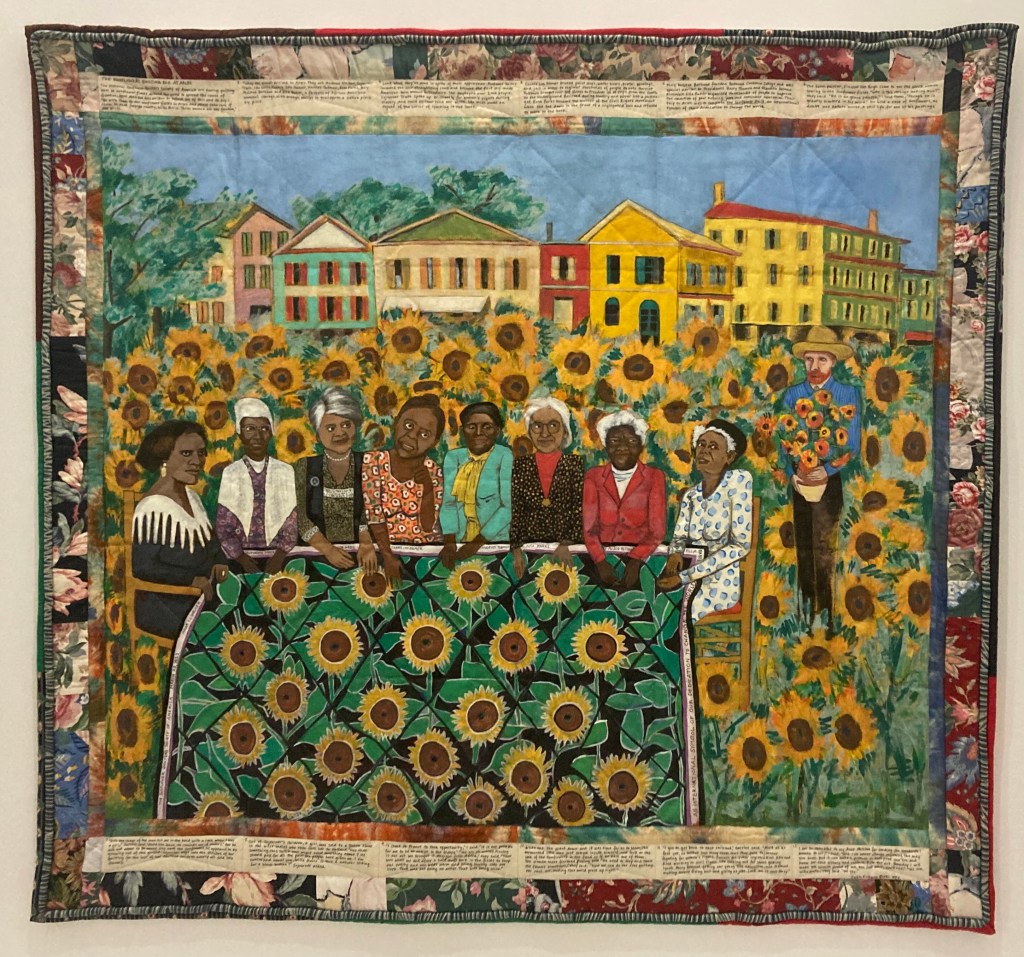
The Quilting Bee: notice a disapproving Van Gogh lurking with a bunch of sunflowers
Her painted quilts are marvelous creations, depicting known figures of her time in familiar settings. They are full of references and allusions. Sometimes she collaborated on them with her mother, who made the embroidered edges.
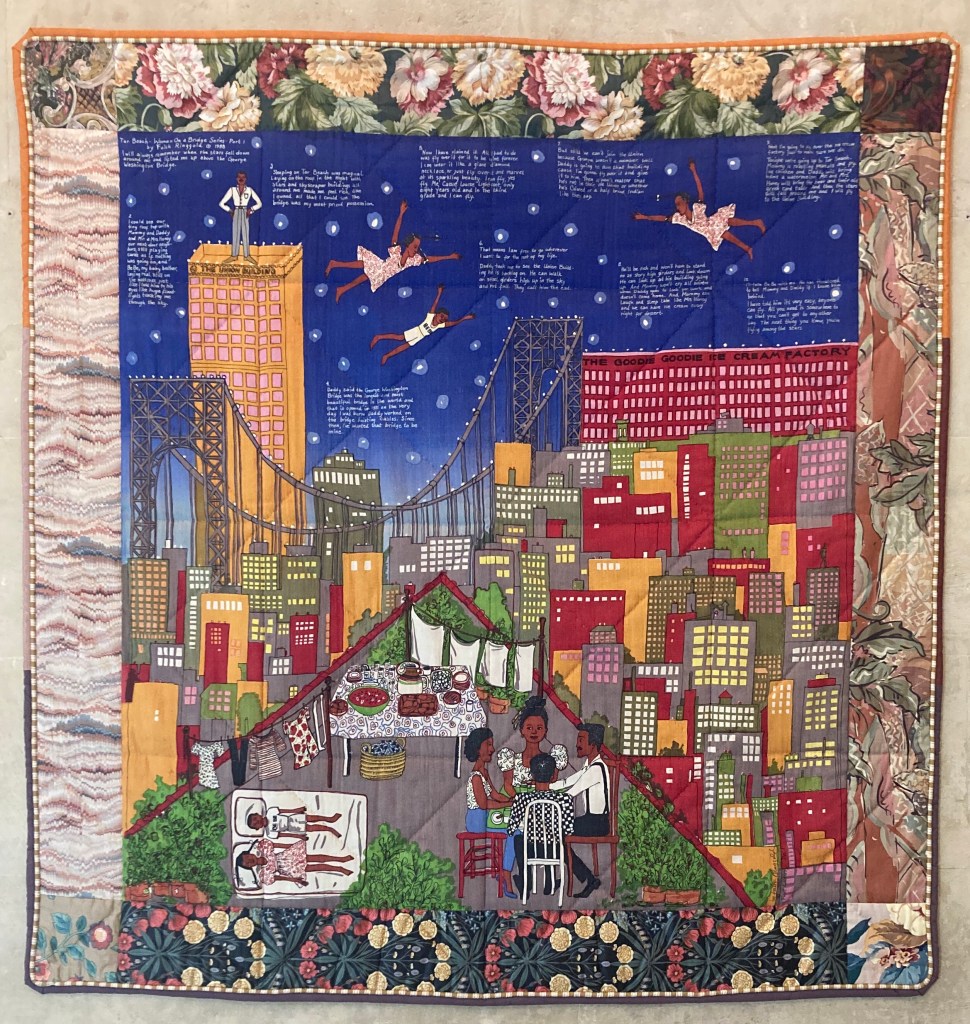
Tar Beach tells the story of a little girl who is taken to the roof of her building to espcape the heat, and dreams of flying over the city
This was a lovely, unusual exhibition. If you are anywhere near Paris, do not miss!
What do you do when you are parents, and your daughters want to embark on a perilous journey in order to have a future?
This is a film recommendation: The Swimmers tells a true story, of sisters Sara and Yusra Mardini, who were normal teenagers in Damascus, training to be professional swimmers. They left Syria because bombs started falling, and practically ‘swam’ to Greece.
This is the story of their journey; eventually Yusra fulfilled her ambition to swim at both the Rio and Tokyo Olympics. As for Sara, her story is ongoing—but I will leave you to discover it for yourselves.
I had followed the sisters’ saga via The Worldwide Tribe Instagram feed and Podcasts. You can listen to an interview with Sara, here.(highly recommended)
Often biopics can ring false, striving for a heroic bias, but I found this well done, and the actors are excellent. The two are played by real life sisters Nathalie and Manal Issa, which gets the sibling chemistry across really well. The film has its flaws, depending on different points of view—for example, it annoyed some people that the actors spoke mostly in English instead of Arabic—but I thought it gave a good insight into the wider humanitarian crisis facing migrants, and what it means to be labelled a refugee.
It is also a story of family, determination, guts, human frailty—and never giving up on your dreams.
Here is a trailer.
Footnote: See what you think about the traffickers—they are the villains in this story.
Theoretically, that is—or, at least, they do not age. Obviously, they can die from other causes: accidents, predators etc. I found this bit of arcana fascinating and thought I’d share.
One species that has been called ‘biologically immortal’ is the jellyfish Turritopsis dohrnii. These small, transparent animals hang out in oceans around the world and can turn back time by reverting to an earlier stage of their life cycle.
Then there is the Hydra: a tubular body with a tentacle-ringed mouth at one end and an adhesive foot at the other. They’re very simple animals that spend their days mostly staying in one place in freshwater ponds or rivers and using their stinging tentacles to grab any prey that happens to swim past. Their claim to immortality? They don’t go through senescence (biological aging) at all. Instead of gradually deteriorating over time, a Hydra’s stem cells have the capacity for infinite self-renewal. Cool, right? However, who’d want to be a Hydra…
Hydra. Photo:Google
Lobsters also do not experience senescence. Unlike Hydra’s reliance on particular genes, however, their longevity is thanks to them being able to endlessly repair their DNA. Unfortunately there’s a catch: they literally grow too big for their own shells. Lobsters continually grow larger and larger, but their shells can’t change size, meaning a lifetime of ditching too-small shells and growing a brand-new exoskeleton each time. That takes a fair amount of energy. Eventually, this becomes too much, and they die of exhaustion—unless they have managed to end up in a lobster roll before that happens.
Many other species offer tantalising glimpses into an ageless existence: such as naked mole rats, whose risk of dying does not increase as they get older; the Ming quahod clam; some bristlecone pines—there is a colony of quaking aspens considered to be about 80,000 years old. Also the enormous bowhead whale, which can live up to 200 years, since they can repair damaged DNA, hence are prevented from developing cancer. Scientists also suggested that these whales can survive the absence of oxygen even for a long time.
These animal can perhaps provide information which will benefit human longevity. But to the question, asked by a young relative, ‘Would you like to live forever?’ my answer is, ‘No, thank you.’ Especially if I had to live attached to a rock, like a Hydra.
Why do most of us feel a sense of renewal at the beginning of each new year?
The date itself is a completely arbitrary point in the flow of current events. Because the year is about to change, wars are not likely to stop, or natural disasters, or family feuds. And yet we do feel some change will happen—especially if the current year has been difficult. We cannot wait for it to be over, to be rid of it. A new start.
That is a good thing—the stirrings of hope. Without it, life would be too depressing. And good things do happen.
So let us be thankful of what we have, and count our blessings, and spare a thought for those who are worse off than us, for there are many. (And perhaps stop watching the news, for a day or two!)
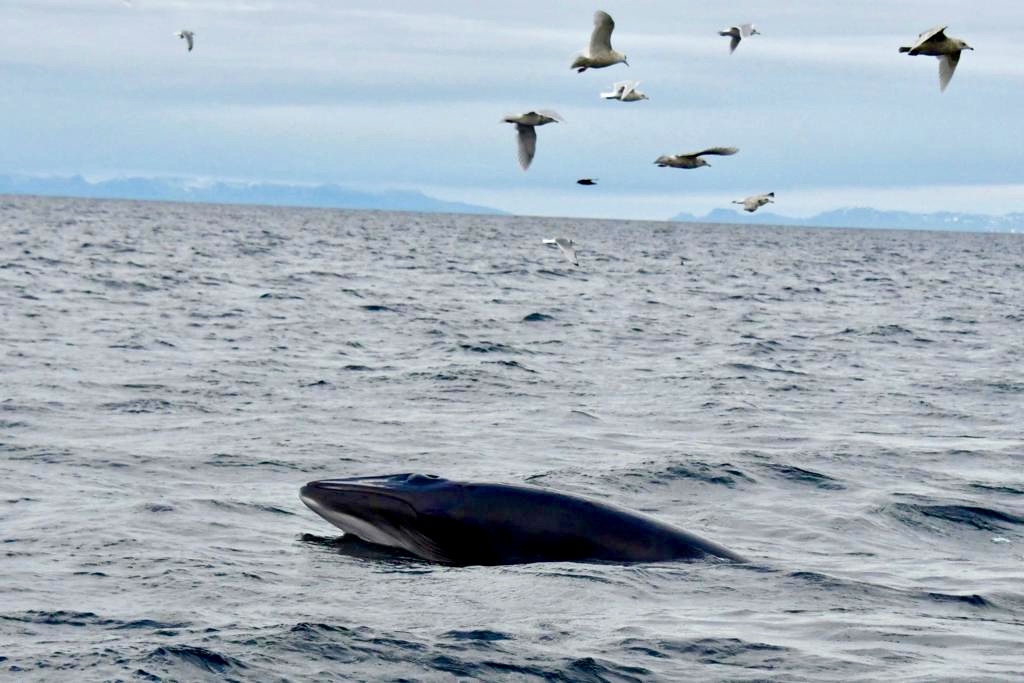
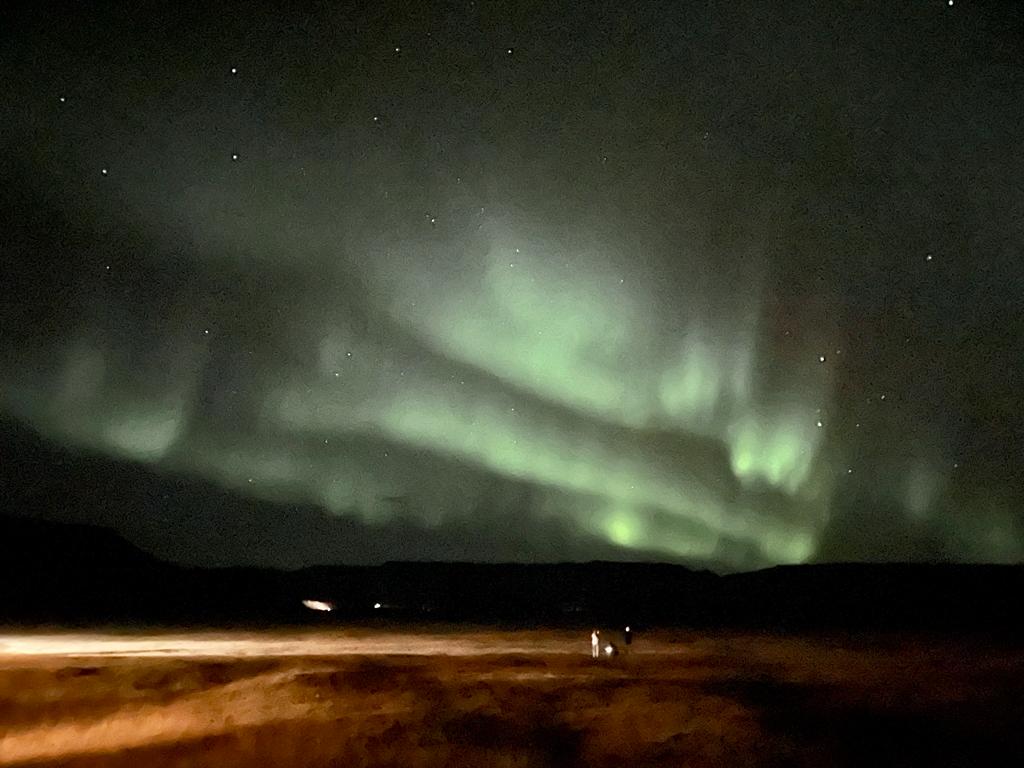
Well, here I am again! I have been extremely busy with various matters and also a family trip to Iceland, where, to my delight, I was able to cross two things off my bucket list: the Northern Lights, and whales! Both well worth the wait, and the anticipation.
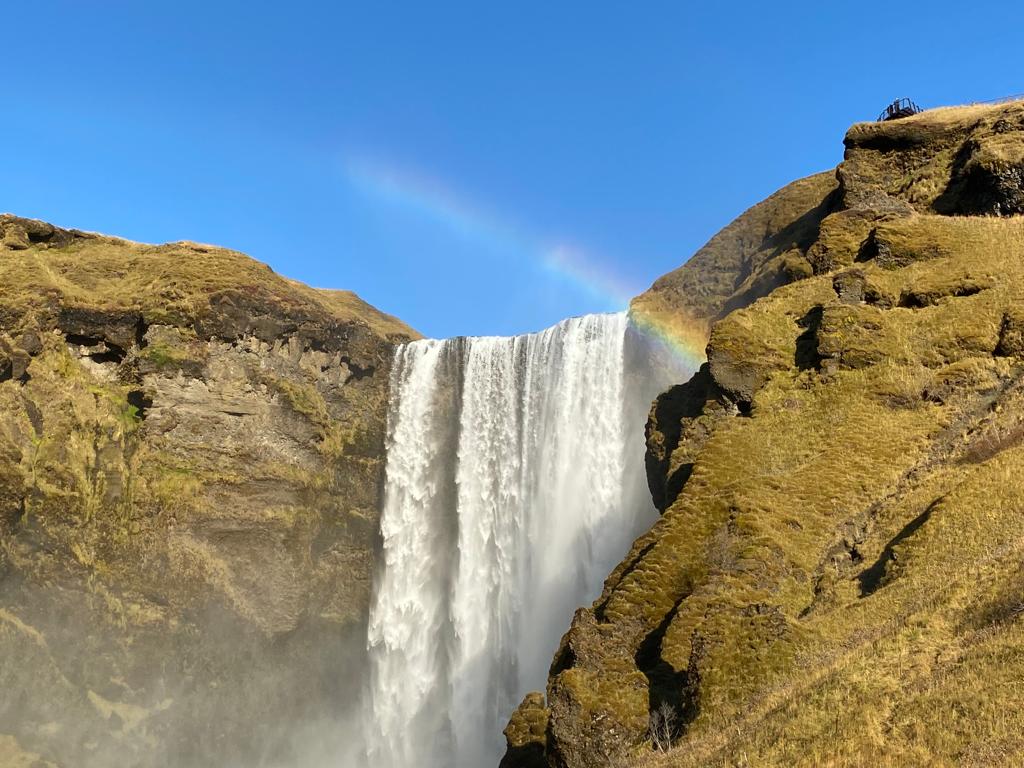
It was good fun being with all the family, getting suited up for all the activities on offer: the whale watching, snowmobile riding on a huge glacier, walking on the beaches and close to the amazing waterfalls, festooned with rainbows.
Iceland is a worthwhile destination, a stark, dramatic landscape totally different to what I, at least, am used to.
On the glacier
It was amazing sitting by a motel window, in the middle of nowhere, at 11.30 pm, watching a show I will never forget: illuminated curtains rising and falling, the colours fading and brightening in turn. Simply awesome.
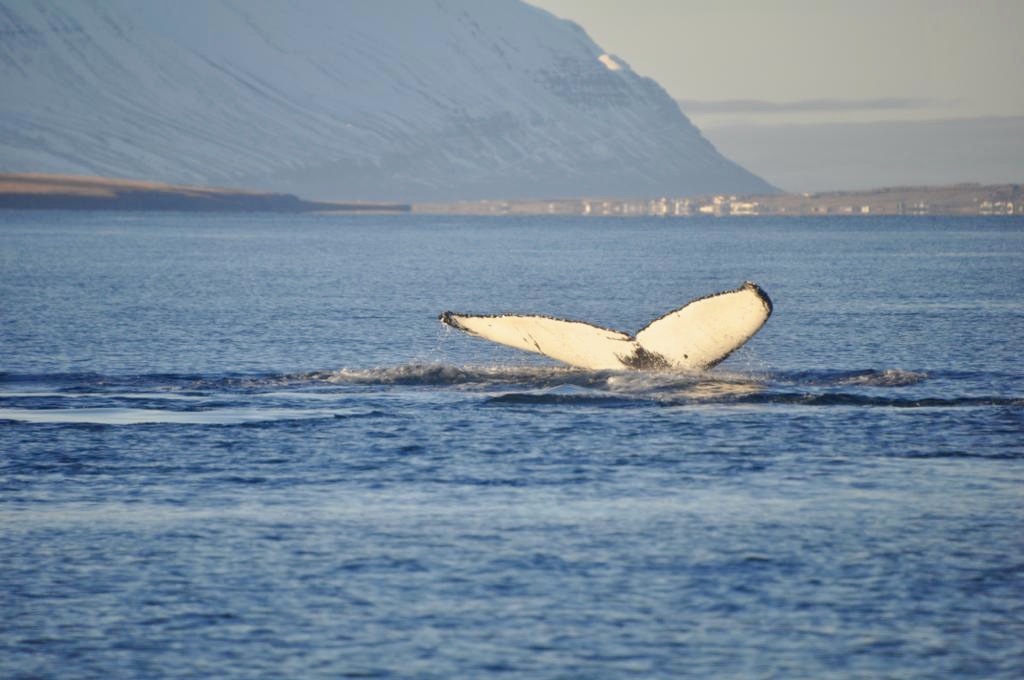
Meet Nila (below), a 15m humpback whale recognised because the flukes of her tail are very white. She gave a display of tail slapping, and even breached for us in a breathtaking performance—imagine a double decker bus rising vertically out of the water. No photo, because I prefer to watch events live than be stuck behind my phone. Also I am a useless photographer. Photo below (as well as the minke whale above), courtesy of our captain, who had a proper camera.
Another year over, and the news continues to be horrendous. As usual, art provides relief, and I have had the privilege to see a lot of it, and immerse myself in the idea that humanity cannot be that bad if capable of producing such beauty.
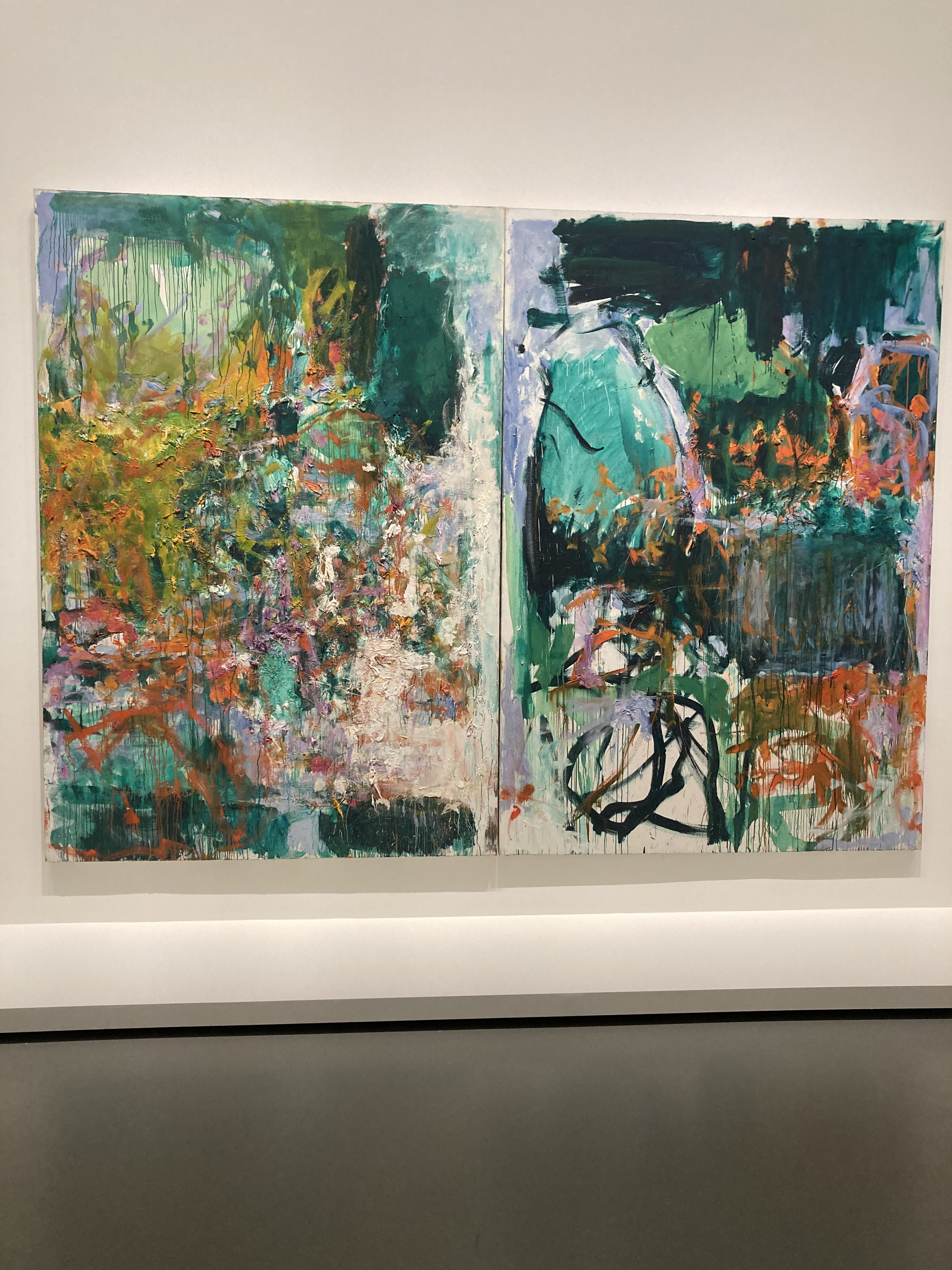
Joan Mitchell
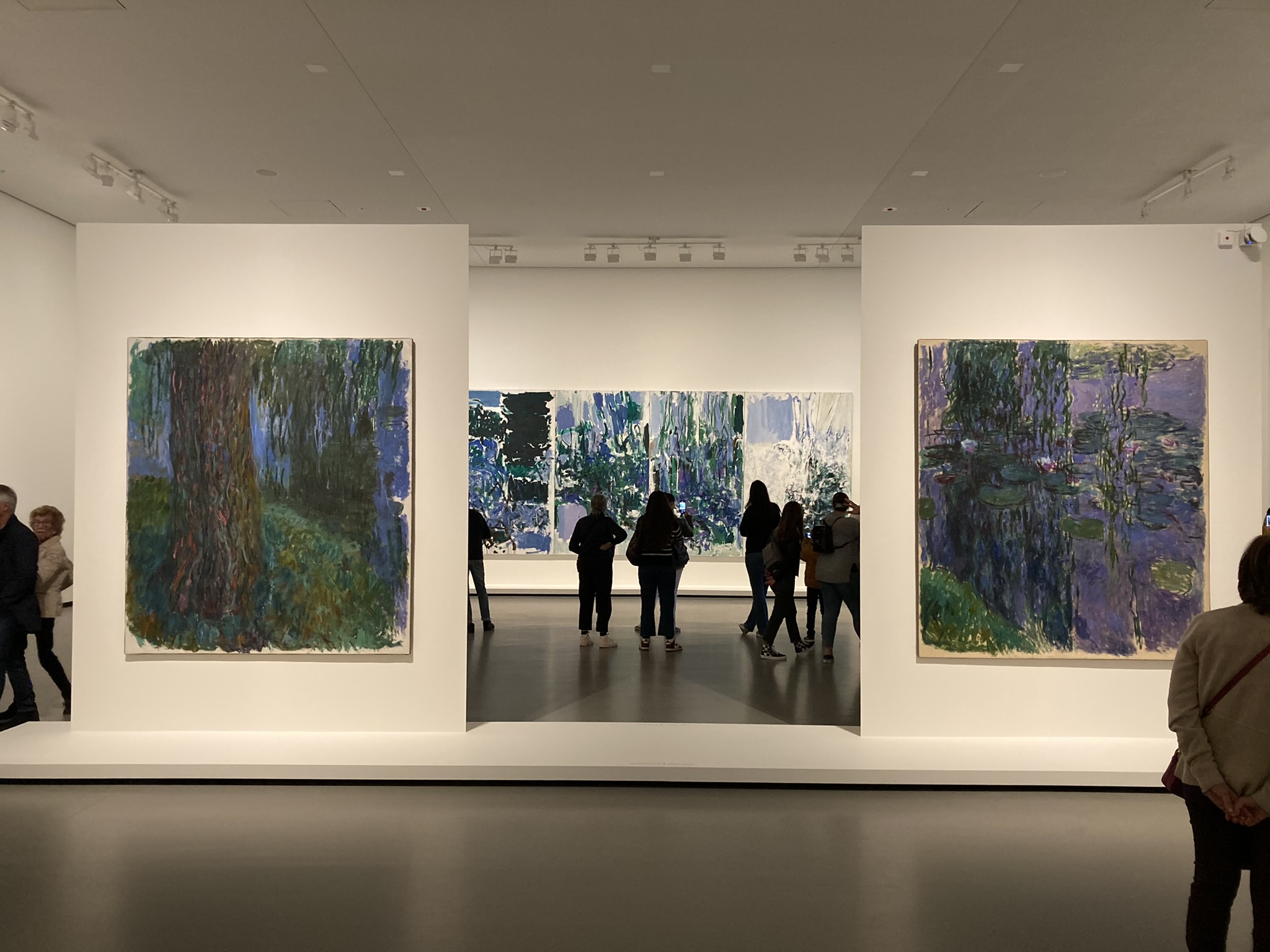
Amongst many others, a standout show was the one juxtaposing Claude Monet and Joan Mitchel at the Louis Vuitton Foundation in Paris.
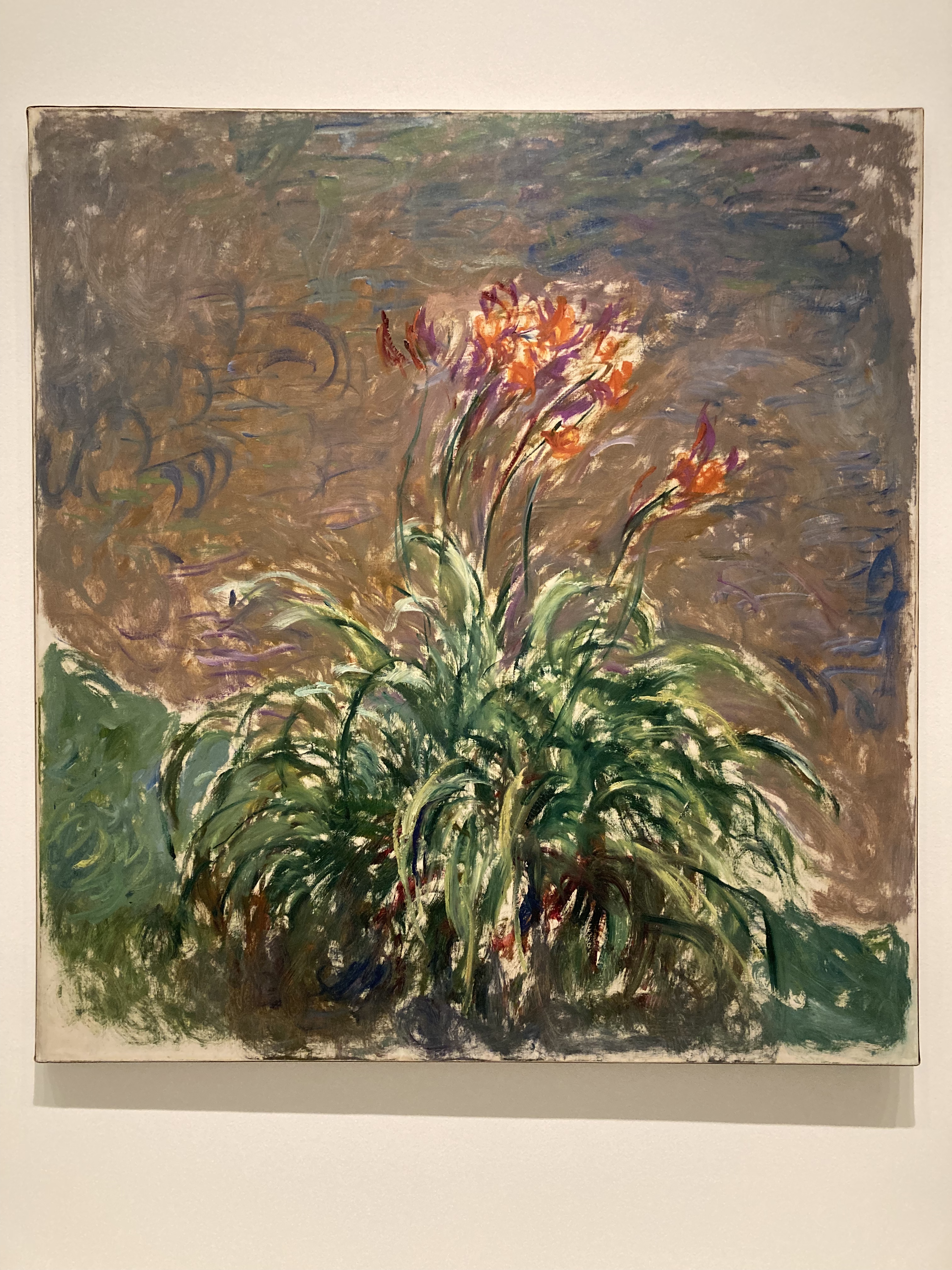
Monet flowers
The frames had been taken off the Monet paintings, giving them a surprisingly contemporary look, and they had been placed in such a way as to both contrast with and complement the abstraction of Joan Mitchell’s wonderful works.
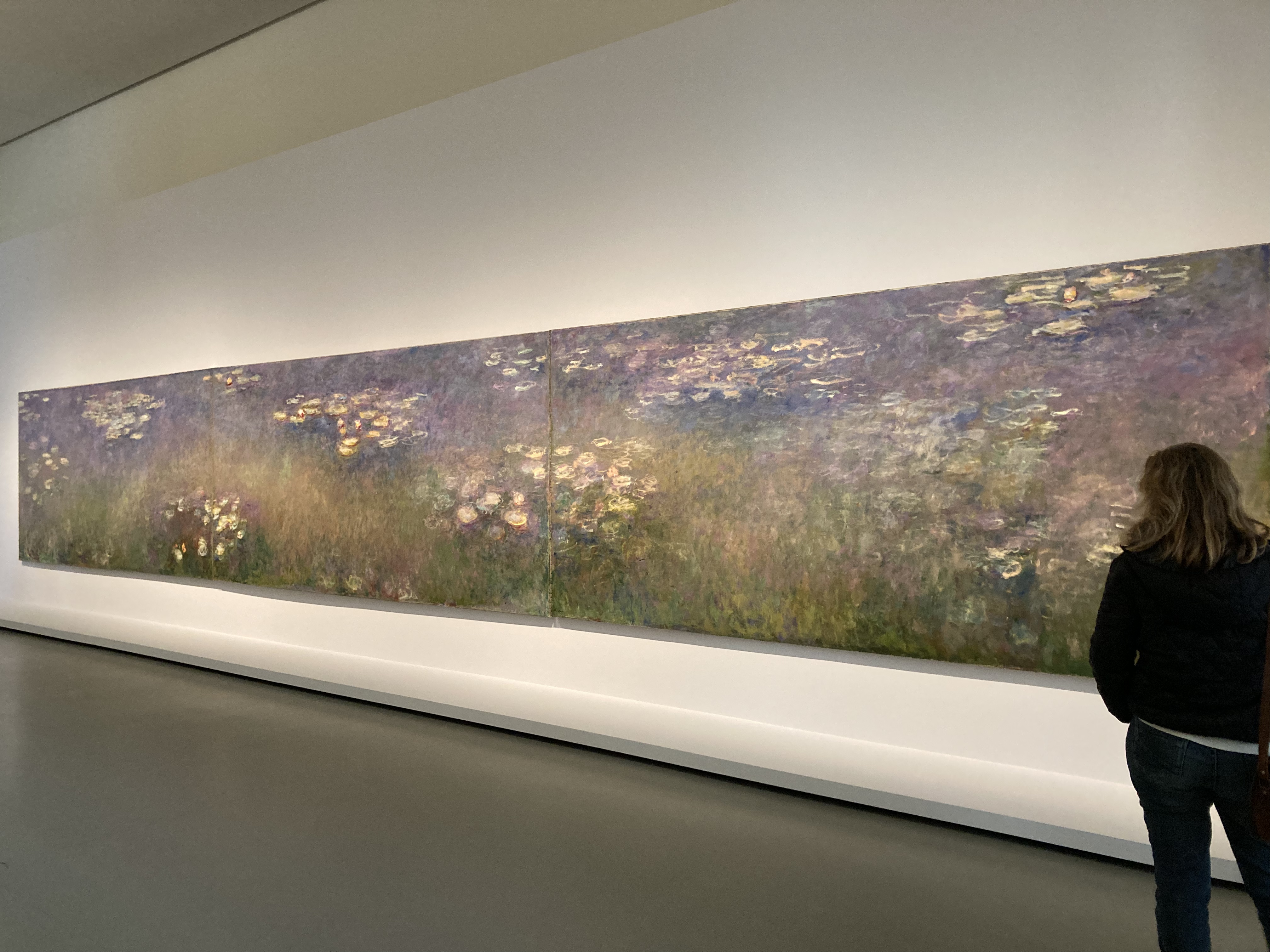
The three Monet paintings below were originally sold to three different American museums, and have never been exhibited together before. I will leave you with this peaceful image with all my best wishes for the festivities ahead.
Halloween is not really a thing in Greece but, as it amuses children—and some adults presumably— Halloween parties do take place, but no trick or treating as such. However, as put off as I am by the usual overdose of merch etc, I admit I do love some of the jokes and cartoons.
I’m a big fan of Dan Piraro and his Bizarro comics








 That is a good thing—the stirrings of hope. Without it, life would be too depressing. And good things do happen.
  “Hope is the thing with feathers;
 Iceland is a worthwhile destination, a stark, dramatic landscape totally different to what I, at least, am used to.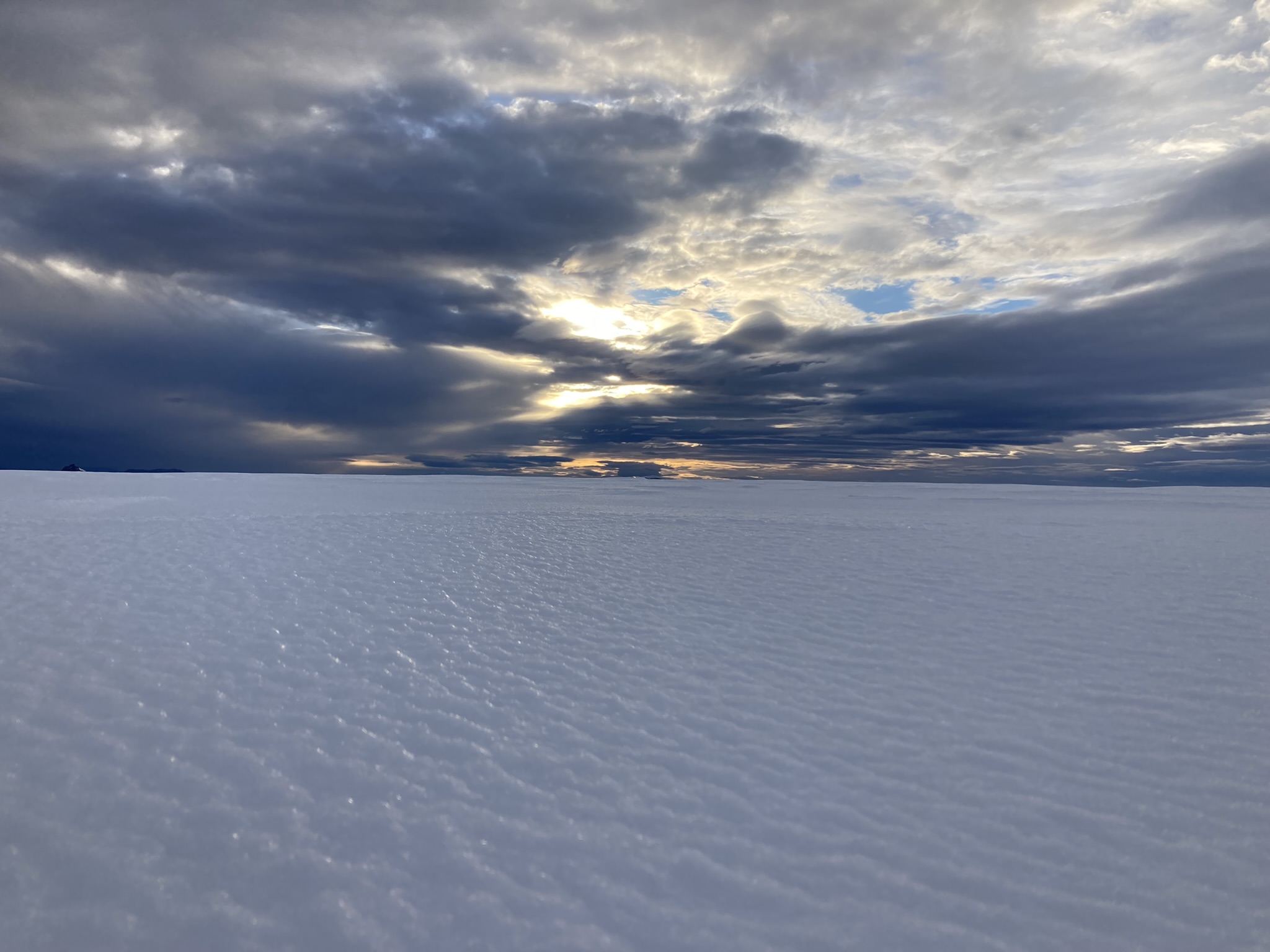


 ❤️❤️❤️ the raven
 Letters from Athens