In Greece we do not celebrate Thanksgiving, but we’re still aware of it through foreign relations and friends. Many have been asking me if things are getting better, since Greece seems to be a lot less in the international news lately. Unfortunately, I have to report that the answer is no.
We cannot be thankful that we are saddled with an inexperienced and inefficient government. And we cannot be thankful for our ‘lenders’, whose handling of things has been a disaster. Negotiations have been going on over the summer regarding The Debt. Result: more and more taxes are to be imposed. To my mind, this only makes sense if the aim of the exercise is to make sure Greece sinks. I’m sure a lot of people would be interested in buying national and private assets dirt cheap, something which has already been going on. Airports and ports, anyone? A house on a lovely island? The list goes on.
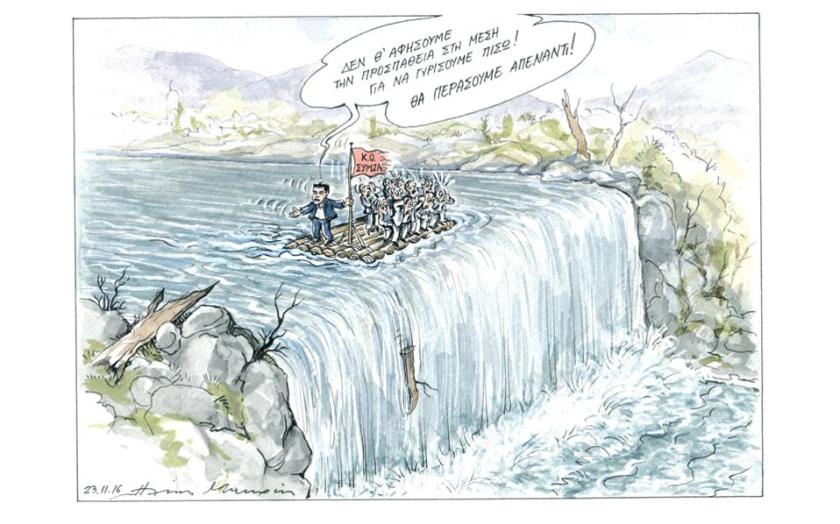
We can’t turn back now! (after all this effort…)
Various eminent economists from different countries have been at pains to explain what needs to be done for Greece to regenerate its economy, but their words are falling on deaf ears. It would seem self-evident: if you want to help the country out of this crisis, give incentives to investment, help small businesses, start new projects. Curb corruption and cut the public sector. Maybe this sounds simplistic as a theory, but what is happening now is a dead end. The government, coerced by the lenders to produce more money is basically robbing people who have no more to give. I say robbing, because those who are owed money by the government are lucky if they see half of it, after great delay. And yet they are fined if they don’t pay the whole of their taxes on time. More and more are being forced into the black economy (on the advice of their accountants, no less), paying with cash or even using barter (You fix my plumbing and I’ll fix your back…)
At the same time, the country has been obliged to face a terrible humanitarian crisis, which is being mismanaged to an appalling extent. People are herded like cattle into inadequate facilities, where, due to despair, loss of hope and lack of employment they are turning against each other. Fires are set, people are injured. These violent incidents will only result in turning opinion against them. I’m not saying that all refugees, or migrants, call them what you will, are the same. But I have taken the trouble to read some stories of these people’s journeys and misfortunes, of the situations they have been forced to flee, and I am horrified by what is happening.
As a nation, we still have a lot to be thankful for. Our climate, our beautiful countryside, our heritage, and most of all, our people who, as a whole, are managing to deal with their misfortunes and remain optimistic. But it will take more than optimism to get the country out of the mess it’s in.
*Click on each name to see the original interview.
Going forward, dear readers, I want your opinion. Do I stop here? Do I carry on? Perhaps it would be nice to change the questions a little, if there are different things people are interested in. Or perhaps it would be nice to also get the point of view of Greeks living and working abroad…Call to action: I’m really keen to know what everyone thinks. Even if it’s ‘Enough! Move on to something else.’
Diver Vassilis Mendoyannis was part of an archaeological team making an underwater inspection of the mining port in Stratoni, on the Halkidiki peninsula. Taking a detour to come out of the sea, he suddenly came upon a seahorse.
‘I was ecstatic,’ he says, ‘since, despite many years as a diver, I’d never come upon one of these creatures in the sea. Then we saw a second, and a third… The place was full of them! It was amazing.’
Seahorses are fish. They live in water, breath through gills and have a swim bladder. However, unlike other fish, they have an exo-skeleton. They eat small crustacea, sucking up the food through their snout which is like a mini vacuum cleaner. An adult eats 30-50 itmes a day. Baby seahorses, which are amusingly called seahorse fry, eat a staggering 3000 pieces of food per day!
Mendoyannis returned to the spot a few months later, and again met with a plethora of seahorses. When he asked local fishermen about it they confirmed their presence in the area, showing him many that had got caught in their nets.
This was an important discovery, since seahorses are a vulnerable species, despite being masters of camouflage: they’re able to change color almost instantly and can grow appendages which make them resemble seaweed. However, they are slow swimmers and are easily entangled in nets, and their numbers in Greek waters have been steadily dwindling. So, researchers at the Hellenic Centre for Marine Research were interested in finding out how that particular spot supported such an important population.
Then, in 2010, a bad storm resulted in tons of silt being deposited on the area due to the flooding of a dry stream, burying the eco-system of the sea bottom. After that, the seahorse population was reduced significantly. Being poor swimmers, seahorses use their prehensile tail to grip onto eel grass and other weeds in order to prevent themselves from being washed away by strong currents and waves. All this seaweed had now disappeared.
Mendoyannis came to the rescue. His team created an artificial environment, putting a metal grid on the sea floor to which were attached ropes and fake aquarium plants, giving the seahorses the means to anchor themselves. Results were impressive: the seahorses quickly adopted this artificial sea garden and their numbers started increasing again.
Today the area is still monitored by the Hellenic Centre for Marine Research and the seahorses are being photographed using a special, digital method which allows individuals to be recognized, despite their minuscule size. This will allow for various studies to be conducted, and a special documentary Is planned about the presence of the species in Greek seas.
‘Seahorses are are attractive and romantic creatures,’ says Mendoyannis, whose friends tease him about having fallen in love with the species. He believes that is why is why the local fishermen reacted positively to the idea of protecting the area.
The Greek name for a seahorse is hippocampus (ιππόκαμπος) which is a combination of the word ‘hippos’ (horse) and ‘campos’ (Campi in Greek mythology was a sea-monster, whose body was half human, half snake.) Ancient writers like Pliny thought the hippocampus had therapeutic properties, and, to this day, the traditional medicine trade (TCM) industry takes approximately 150 million seahorses per year from the wild for use mainly as natural aphrodisiacs. There appears to be a new trend for dosing Chinese children with seahorse pills in the belief it will spur growth. Seahorses have also been proven to have high levels of collagen, which is encouraging Chinese women to use them as a substitute for Botox. All this, as well as the capture of seahorses to make tourist souvenirs and to display in aquariums, has been endangering the survival of the species.
When I was a child, I had a dried seahorse given to me by some fisherman. It was one of my most treasured possessions. Seahorses are unique in that the female transfers her eggs to the male, who thus becomes ‘pregnant’ and gives birth to loads of tiny offspring. Below I’ve included an amusing and rather astonishing video.
Petros Koryzis came to cooking in a rather roundabout way. At the moment he is working in the family pastry shop, Cake & Cookie Co., who are famous for their 100% homemade goodies. They sell out of their tiny shop, but work mainly on orders, and cater events such as kid’s parties or christenings. Petros also does catering on his own or with friends, for parties and events of all kinds.
Tell us a little about yourself
After school I went to college in the United States, where I studied Italian and Economics. Then I went to London and worked for Starbucks for almost two years, completing their management course. I decided that the service sector was something I liked, but not that specific job. Brainstorming with friends, I realized the restaurant industry was what I was most interested in, so I went to the Cordon Bleu London school where I acquired the Grand Diplôme which included cooking and patisserie.
I’ve always enjoyed cooking. The hardest part to control in a restaurant is the kitchen, so I decided to start there. I spent about 7 years working in various kitchens in London, starting with an internship at Hybiscus Michelin star restaurant. I then moved around, getting experience in bistrot-style, Italian, and Mediterranean food and ending up at Buddha-Bar, which specializes in Pacific Rim cooking.
At some point I decided to come back to Greece to help my mother who had opened a pastry shop, which has now become a mother-and-son affair! Once here I also developed a catering side-line with other friends.
What were the major difficulties you’ve faced in the last five years?
Returning to Greece was something I’d always wanted, although London afforded more immediate possibilities. Despite Greece’s problems I always felt there was the potential to do something in the food industry. After all, it is my home, and my life here gave me an edge. In London the competition is vast and it’s a hub, where you get the best of the best. Here I have personal contacts and even today many of my clients are people I went to school with and their friends and families, and I’ve met many more through them.
Did anyone help or inspire you?
At Cordon Bleu they kept telling us that our choice of career was hard and offered little financial benefit. They taught us a lot about discipline and organization, which was useful as I’m not usually one to take the difficult route! Also one of the hardest kitchens I worked in taught me that this job can be a test of humility. Like in any job 90% is difficult and boring and it’s the 10% which makes it worth it. In my case the 10% makes it really worth it
A major inspiration were Peter and Hiili, the couple who were executive head chef and head chef at Buddha-Bar when I worked there. They’d met at Nobu, stuck together and risen together. They loved their job and managed to make it work. They were the chefs that opened Buddha-Bar London, and are now married with a lovely little girl. Having a woman head chef was a best case scenario for me because the kitchen ran very smoothly.
What are your hopes/plans for the future?
Ideal scenario would be to put together a group of chefs and build a team which would enable me to partly move out of the kitchen and have a choice in the catering jobs I do personally. I’d like to groom and grow others to do it properly. I think that Greece has excellent chefs who are highly skilled but perhaps do not have the disciple to offer what abroad would be seen as upscale catering. An example being the state in which some leave the kitchen at the end of the night. I’m not interested so much in the grand scale of things, but in private ‘cheffing’ at a normal price. To provide a level of quality which would be consistent and ensure repeat customers.
One of the difficulties to be faced, for example, are the waiters. There are plenty of waiters in Greece but it isn’t considered on the whole a respected profession. They are mostly people who do this as a stopgap, or a stepping stone. Having met a few who are truly professional, I’d like to form waiters who know exactly what the clients want and how to provide it.
One of the most interesting things in catering is that I get to go into houses and take over! I get to see people in their family environment, with the kids the dog, and I love being part of this, as well as delivering the food.
What are your hopes for Greece? What changes do you hope /would you like to see?
I hope that Greece will manage to get through this period of turmoil and unrest, although I fear the unrest has not reached its climax yet. My main hope would be that we all together start thinking as a group, instead of as individuals.
In Greece we have the classic example of ‘envying the neighbor’s goat’. I don’t think this is wrong per se: people should want to acquire a goat like the neighbor’s, or a whole herd of goats, in the sense of bettering themselves. To make and have more, we have to understand that we all need to benefit, and we need to work together, in order to better the current psychology, and so that the markets and infrastructure pick up..
Petros with his mother in their shop, Cake&Cookie Co.
Have you considered leaving? If so, where would you like to go, and why? If you have decided to leave what would make you stay?
I think of leaving every day! But I don’t think it would make a difference to my situation at this point, unless I get a very well-paid job. Leaving the country wouldn’t solve anything. Staying here and fighting for what I believe in and working with others I hope I may even, in a small way, be able to help.
If I left the obvious place would be London, because I know it well and I could get a job tomorrow. However I would love to work in France for a while.
Are you actively doing anything to help with the situation? Is there something you would like to do?
I’d love to think that just by going to work every day and doing my best I’m helping! I do believe that by staying and working with others I give something to the whole.
Would I like to do something more? Yes – my problem being I have no idea what that would be. I’m not one for taking to arms or politics.
How do you see Greece in 5, 10 years?
I don’t see much happening in five, to be honest. In ten, I’m hopeful we’ll be able to see some positive change.
How do you cope with obstacles and frustrations in your everyday life?
By venting! I have discovered in the last 5-6 years that I have a short temper, which, growing up, I never did. So I vent, not always on the right person. And by dancing! Sometimes out with friends, sometimes alone in my room.
What are the positive sides of living in Greece? Have you had any good experiences lately?
Not to sound corny, but I still believe Greece is one of the greatest countries in the world. Geographically and geologically we have everything, mountains and sea and climate. However, I also believe that we have good people in Greece.
Something my job affords me is to see people as they are at home; they are fathers, and mothers, and hard workers.
Thanks to the store and the human contact we have with the customers, I experience the everyday reactions to the ongoing problems and I see that everyone has to wake up in the morning and smile. There’s still good in Greece – people who want change, people who enjoy the good things going on in their life, like births, marriages… I love to travel by car, and all you need to do is go into a small village anywhere in Greece and you’ll see what Greek hospitality is all about.
For those of you living in Greece, Petros can be contacted on: info@cakeandcookieco.gr or the numbers +30 210 8078169 and +30 6946468882
Although I’m sure he’d love to be asked to go and cook in Australia or elsewhere, as long as he gets a plane ticket (first class, of course!)
As you will see below, Sofia Kioroglou is not just a (twice award-winning) poet. However, since I love her poetry, I thought I would focus upon that facet of her multi-talented personality. She writes in several languages and, of all my subjects, she was the only one to submit her answers, perfectly written, within hours of receiving the questions. That is why, for the first time, the monthly interview is posted on the first day of the month!
Sofia is also a prolific blogger. You can visit her site here.
Tell us a little about yourself.
I am a writer, translator, lexicographer and painter born and bred in Athens, Greece. I am an avid reader and iconographer of saints and believe in human kindness and sacrifice. I would be a cave recluse in Raitho or Sinai had I not met my husband Peter in Jerusalem at the Holy Light Ceremony in 2012. I love the Holy Land and wish I had the chance to publish work revolving around the difficulties encountered by the Greek Orthodox monks and fathers guarding the Holy Monasteries in and beyond Jerusalem whom I respect and admire. My literary work has been included in many international literary journals such as Silverbirchpress, Lunaris Review, Verse-Virtual, Winamop, Halkyon Days, Ashvamegh, Poet’s Corner, The Galway Review as well as in many anthologies like the Poetry against Terror Anthology, the Spiritual Horizons Anthology, the Poetry Against Inequality Anthology , By Land and By Seas and the Universal Values Anthology, with my flash fiction “Cubicle Coma” forthcoming for publication in Books’ Journal and Planodion.
What were the major difficulties you’ve faced in the last five years?
The loss of my father was the hardest. It just came out of left field! Paradoxically, his passing has been something of a blessing so to speak as I went into overdrive and started to pursue my passion for writing, undaunted by the grim prospects surrounding publishing.
Did anyone in particular inspire you or help you?
My dad and my supporting hubby! I owe a lot to them.
What are your hopes/plans for the future?
I have no long-term plans. I have learnt to anticipate nothing as life is so unpredictable. The only thing that bothers me is that there are people out there who can’t make ends meet, mothers who abandon their newborns in maternity clinics due to povert and people dying on the streets.
What are your hopes for Greece? What changes do you hope to see happen?
Despite the negative vibe sloshing around right now, I feel confident that we will ride out the storm. It is not wishful thinking! Greece has always survived worse rollercoasters than this current crisis.
Have you considered leaving? If so, where would you like to go, and why?
Never has the idea of leaving my country crossed my mind. I love Greece, its history and the grit that typifies our nation. I reckon Greece will rise again out of its ashes like a phoenix!
If you have already decided to leave what would make you stay?
I have not decided to leave but if I ever had to my mother’s pleas would be enough to make me stay.
Are you actively doing anything to help with the situation? Is there something you would like to do?
Having a positive vibe and hoping for the best is the most efficient weapon to neutralize the prevailing negativity and defeatism.
How do you see Greece in 5, 10 years?
I see it totally disentangled from the mess its political leaders have thrown it into. A new era for Greece will emerge with more ethos and dignity, two qualities inextricably linked with the history of our nation.
How do you cope with obstacles and frustrations in your everyday life ?
When I have a problem or have to deal with an avalanche of frustrations, I share my distress with my husband. He is always the one who takes a dispassionate view of things and puts them in perspective.
What are the positive sides of living in Greece? Have you had any good experiences lately?
The weather and the camaraderie of the people which gives this country and its people the chance to hope and dream for future generations. My recent trip to Methana was a real boon which lifted my spirits and made me forget all about the daily grind gnawing away at my innards.
As well as reading about Sofia’s positive attitude, sense of humor and amazing husband, I thought you might like to experience a sample of her work. Here is one of her favorite poems:
“Hypochondria winking at grime”
As time goes by
the twain shall eventually meet
with scraps of kneejerk iconoclasm
starting to meekly recede
Years of being together
have mellowed my tetchiness
brimful ashtrays no longer call for
scathing versified onslaught
The caterwauling about dripping faucets
not affecting him too much
my hypochondria now winking at grime
in love’s dazzling and menacing world
our hearts melting in its immensity.
Now that the fanfare is over, and the frenzy of the medals tally, and the usual grubby IOC scandals; now that the Rio Olympics have been declared, by IOC president Thomas Bach, “the people’s Games, the most happy Games ever, the beautiful Games, the passion Games” (how do they think up this rubbish? but of course London and Sydney had already been voted the “best ever Games”, so he was obviously running out of superlatives); now that the green diving pool and the sewage floating in the sea have been conveniently forgotten and the Brazilians left to deal with the aftermath and the cost; I thought it would be fun to post some random facts about the greatest sporting show on earth. Not so much facts, actually, as human stories, which is what I always find the most fascinating.
Three runners. (Wikimedia commons)
The ancient Olympic Games, primarily part of a religious festival in honor of Zeus, were a series of athletic competitions among representatives of city-states. The games were staged every four years, starting in 776 BC, in Olympia, a sanctuary site for the Greek deities in the Peloponese. They reached their zenith in the 6th and 5th centuries BC, but then gradually declined in importance as the Romans gained power and influence in Greece. It is believed they ended in the 4th century AD, when emperor Theodosius I decreed that all pagan cults and practices be eliminated.
During the celebration of the games, an Olympic Truce was enacted between warring cities so that athletes could travel to the games in safety through hostile territory.
Athletes competed naked, and victors were rewarded by a kotinus, or olive branch wreath, and a large number of amphorae full of olive oil, which they most probably sold.
Only Greeks could compete. Greek men. No women, slaves or foreigners were allowed.
Fencing before the king of Greece – 1896 Summer Olympics. By André Castaigne ( died 1929)
The Olympics were revived in 1896 by the International Olympic Committee (IOC), which had been created by Pierre de Frédy, Baron de Coubertin, and were held in Athens, Greece, from 6 to 15 April. Women were still not allowed to compete, because de Coubertin felt that their inclusion would be “impractical, uninteresting, unaesthetic and incorrect”.
However, one woman, Stamata Revithi, ran the marathon course on 11 April, the day after the men had run the official race. Although she was not allowed to enter the stadium at the end of her race, Revithi finished the marathon in about five hours and 30 minutes, and found witnesses to sign their names and verify the starting and finishing times. Revithi intended to present this documentation to the Hellenic Olympic Committee, hoping that they would recognise her achievement. It is not known what happened in the end – nor, sadly, could I find any photos of her.
Alfréd Hajós (Wikimedia commons)
The undisputed star of the swimming events at these Games was Hungarian architecture student Alfréd Hajós. Battling the elements on a cold April day – with 4m waves crashing around him – the 18-year-old Hajós served up majestic victories in both the 100m and the 1,200m freestyle events, to become the youngest champion of the inaugural Olympic Games.
While attending a dinner honouring the Olympic champions, the Crown Prince of Greece asked Hajós – who had been dubbed “the Hungarian Dolphin” by the Athenian press – where he had learned to swim so well. “In the water,” was his laconic response!
Hajós later showed himself to be an extremely versatile athlete, winning Hungary’s 100m sprint, 400m hurdles and discus titles. He also played as a centre forward in the Hungarian national football championship and was a member of the Hungarian team for its first ever international. He became a prominent architect specialising in sport facilities.
Spiridon Louis (Wikimedia Commons)
Because of its close connection with Greek history, the public desperately yearned for the marathon to be won by one of their countrymen. Spiridon Louis, a Greek water-carrier, rewarded their expectations, thereby becoming a national hero. When Louis arrived in the stadium, which erupted with joy, two Greek princes – Crown Prince Constantine and Prince George – rushed to meet him and accompanied him on his final lap for a finishing time of 2:58:50.
Louis’s victory set off wild celebrations, and the king offered him any gift he would care to ask of him; but all Louis could think of was a donkey-drawn carriage to help him in his water-carrying business!
Louis lived a quiet life thereafter, but his legacy includes an expression in Greek: “yinomai Louis” (γίνομαι Λούης – “I becοme Louis,”) which means to flee, or “disappear by running fast.”
The silver cup given to Louis at the Olympic Games was sold for 541,250 pounds ($860,000) in London on 18 April 2012, breaking the auction record for Olympic memorabilia. Breal’s Silver Cup stands just six inches tall and was offered for sale at Christie’s by the grandson of the victor, and bought by the Stavros Niarchos Foundation.
Spiridon Louis. Colored photograph by Albert Meyer (1857-1924)
Over the years, there are many of these stories to be told, showing the resilience of the human spirit, the will to overcome difficulties and deal with failure as well as success. Driven by the megalomania prevalent in the IOC, and the political and financial interests present in any such endeavor, the Olympic Games have turned into an overblown media circus, bankrupting most countries brave enough to stage them. But still, time after time, these stories surface, and we get to witness amazing feats and riveting drama.
Who knew this was ILLW, or International Lighthouse Lightship Weekend?
Well, in Greece the Navy has opened 30 Lighthouses to the public, who can visit and find out about their history and the way they work.
Lighthouses are used to mark dangerous coastlines, hazardous shoals, reefs, and safe entries to harbors. They can also assist in aerial navigation. However, the number of operational lighthouses has declined due to the expense of maintenance and use of electronic navigational systems.
Older lighthouses, especially half-ruined ones, are romantic structures, having about them the whiff of history – stories connected to lonely lives, pirates and derring do at sea.
Before the development of clearly defined ports, mariners were guided by fires built on hilltops. To improve visibility, the fires were placed on a platform, a practice that led to the development of the lighthouse.
The most famous lighthouse structure from antiquity was the Pharos of Alexandria, built by the Ptolemaic Kingdom between 280 and 247 BC. One of the Seven Wonders of the Ancient World, it was between 120 and 137 m tall, and one of the tallest man-made structures in the world for many centuries, until badly damaged by three earthquakes between AD 956 and 1323.
Drawing of the Phoros of Alexandria by archaeologist Hermann Thiersch (1909)
So if there is a lighthouse near you, perhaps today would be a good time to visit.
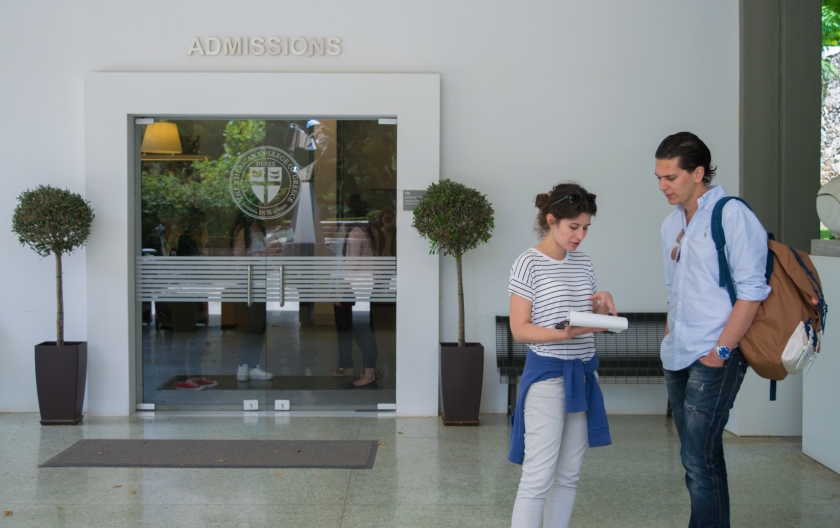
Lucy Kanatsoulis is a business consultant turned college admissions officer. No one ever grows up saying “I want to become a dean of admissions!” It’s one of those jobs that one stumbles into and only understands its complexities when one actually does it…
Tell us a little about yourself
I was raised in Athens and lived in London and New York, where I worked as a business consultant for investment banks. Fifteen years ago I decided to give in to my inner Greek and return to Athens, where I currently live and work as the Dean of Admissions at Deree – The American College of Greece. Working in such a beautiful environment where I have the potential to help students and change their lives, remains an inspiration to me despite the difficult times we are facing.
What were the major difficulties you’ve faced in the last five years?
Certainly the current economic crisis has created a sense of uncertainty for all Greeks. And unfortunately, uncertainty is a toxic foundation for growth that highlights even further the problems of Greece – resistance to change, lack of opportunities, absence of inspirational political leadership. Admissions is incredibly personal—you’re asking applicants to open up their lives to you and on many occasions I witness the anxiety and depression that young people and their families face today. The feeling of being “swallowed up” by the current situation takes over your dreams and hopes. Coping with this uncertainty and anxiety has been one of the major difficulties I have faced.
Did anyone in particular inspire you or help you?
When I returned to Greece, I was desperate to find a job that would make me happy and give me some meaning. Through a friend I met Nikos who introduced me to the world of “education”. This person has unique values and an exceptional approach to life: Inspired by education and committed to service, he motivated me to take the job because I believed in the institution, I loved doing right by students, and I hoped to use it as a platform to make a difference in young people’s lives.
What are your hopes/plans for the future?
At this point I have decided to live for the moment. The current situation of uncertainty prohibits me from making any short-term or long-term plans. Even summer vacation is a spur of the moment decision. An eternal planner, it has taken a huge effort on my part not to plan for the future and take every day as it comes.
What are your hopes for Greece? What changes do you hope to see happen?
I hope for Greece to make a comeback – I believe that the foundations of this comeback lie in the proper education of the future generation, both at home and at school. Greek families need to inspire a work ethic, honesty and ideals for change and through education we need to provide the knowledge, opportunities and team spirit to achieve this.
Have you considered leaving? If so, where would you like to go, and why?
Yes. I often find myself flirting with the idea of moving to Canada, a place I have never visited but a country that I feel represents the best of what both Europe and America has to offer with inspirational leadership that creates opportunities. However, this still remains a flirtation and my inner Greek has not given up – leaving my country, my home and my job is not something I am ready to do yet.
Are you actively doing anything to help with the situation? Is there something you would like to do?
Working in education enables you to impact young people’s lives through scholarship programs, funded study abroad opportunities, international internship programs, and academic counseling that indirectly contributes to changing Greece’s future. I also participate in volunteer community actions organized by the College to help those afflicted by the crisis. I always feel, though, that I could do more…
How do you see Greece in 5, 10 years?
Unfortunately I do not believe much will have changed in 5 or 10 years. For us to actually see a different Greece and a change in the deeply rooted Greek mentality we will have to wait for the next generation to take over and this might take longer than 5 or even 10 years. It is impossible to predict but I remain hopeful.
How do you cope with obstacles and frustrations in your everyday life?
For many people like myself coping with the daily Greek frustrations has become a challenge.
Many times, I find that it takes all my inner strength to try and put things in perspective and continue with my daily life. There are good days and gloomy days. In these times, I try to nurture the stability that I have, focus on my family, job and friends, and alleviate as much of uncertainty that I can.
What are the positive sides of living in Greece? Have you had any good experiences lately?
The Greek summer: the smell of jasmine in the evening breeze, open air cinemas, starlit skies, the sound of the sea, sand on your bare feet, fresh fish at a taverna by the sea, open windows, the taste of succulent summer fruit, hair flowing freely, scanty linen and cotton clothes, bare skin and summer wine! As my husband so eloquently puts it: In spite of Greece’s financial plight, the sun still shines so strong and bright!
‘I will give you water,’ said Poseidon, striking the Acropolis rock with his trident. A salty fountain sprang up.
‘And I will give you a tree,’ said the goddess Athena, striking the rock with her spear. An olive tree sprang up. ‘Its fruit will feed you, its leaves will give you shade, and and its wood provide fuel.’
There was a vote, and Athena won, thus giving her name to the city of Athens.
At the first Olympic Games, held in 776 BC in honor of Zeus,
athletes were massaged with olive oil in the belief that the wisdom, power and strength of Athena would be bestowed upon them. The winners, of this and all subsequent games, were also awarded olive leaf crowns and olive oil.
‘I am the Sun’s daughter the most beloved of all’ Poem by Kostis Palamas(1859-1943)
The olive tree was considered sacred. It was believed that if you polished a statue of Zeus with olive oil, Zeus would be so honored that he would grant you a long and happy life. The 13m-high ivory and gold statue of Zeus at Olympia made by the famous sculptor Phidias (one of the seven wonders of the ancient world) was always kept polished with olive oil.
Olive trees are ancient. Fossilized leaves, believed to be as much as 60.000 years old, have been found on the volcanic island of Santorini. However, it appears that olive trees as we know them today originated approximately 6,000 to 7,000 years ago in the region corresponding to ancient Persia and Mesopotamia. But they were first cultivated commercially in Crete in the Minoan era, as can be seen on the murals in Knossos – they may have been the source of the wealth of the Minoan civilization. Later, Ancient Greek philosopher Aristotle further developed the cultivation of the olive into a science. Olive oil was a valuable trade commodity, and a main source of prosperity in Classical Athens. It was also used to anoint kings, athletes and warriors.
Olive trees have a special significance in all aspects of life – an almost magical dimension. The olive branch was – and still is – seen as a symbol of abundance, wisdom, glory and peace. The leafy branches of the olive tree were ritually offered to deities and powerful figures as emblems of benediction and purification, and they were used to crown the victors of bloody wars, as well as athletic games.
From the beginning of the 6th century BC olive trees were protected by special laws, first instituted by the legislator and statesman, Solon. The laws decreed how the trees were planted and how many could be cut, and differentiated between common trees and sacred ones, which were believed to be descended directly from the first olive tree given to the city by the goddess Athena. Crimes against these sacred trees were tried at the highest level and punished harshly (by exile, confiscation of property, or even the death penalty).
The olive trees was also revered in other civilizations, such as the Egyptian civilization, and went on to become the sacred tree in most religions, including Judaism and Islam. In the Christian religion, a pair of olive trees symbolize both the Old and New Testaments. A dove brought an olive branch to Noah, to signify the end of the Flood. Today, olive oil is still used in many religions for various rituals.
In everyday life, olives and olive oil are a major part of the famous Mediterranean diet. Olive oil is used in soap, cosmetics, and even to exorcise the evil eye! Greeks often give it as a present, to each other and to foreigners.
Olive wood burns slowly, so it lasts long. It is a hard wood, and can be used to make many objects and utensils.
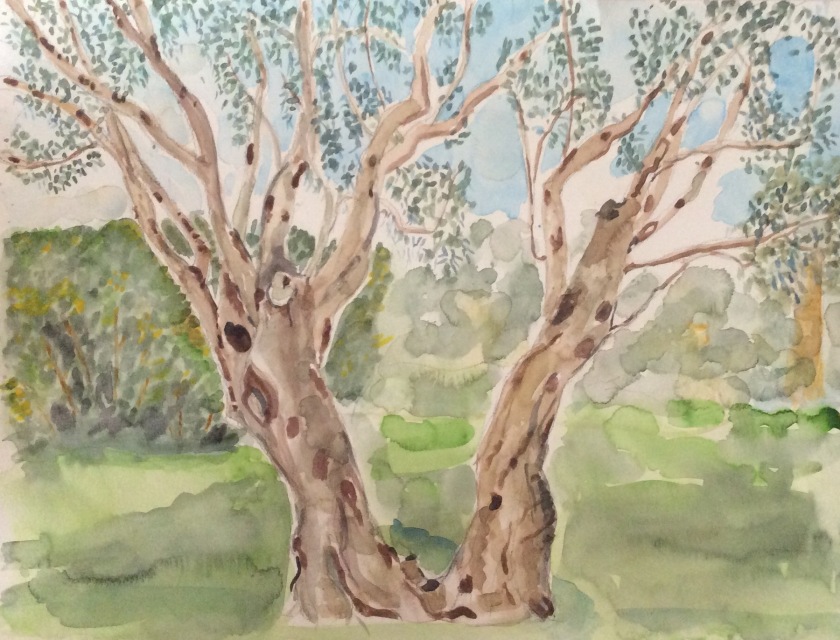
Olive trees are resilient: they don’t need much water, they resist drought and high winds and they even regenerate after fire. They have an enormous life-span: there are olive trees in the groves around the Mediterranean that are said to be centuries old, and ages as great as 2000 years or more have been demonstrated for some individual trees. The Olive tree of Vouves in Crete (one of many examples), has an age estimated between 2000 and 4000 years!
The older the trees get, the more dignified and wise they become. Their twisted, gnarled and scarred trunks, their dark, hollowed-out centers, their silvery leaves glinting in the sun, give each a distinct personality.
The olive tree has been celebrated in art, prose and poetry. In the Odyssey, Homer referred to olive oil as ‘liquid gold’.
As poet Odysseas Elytis, (Nobel Prize for Literature, 1979) put it:
If you take Greece apart,
In the end you will be left with
an olive tree, a vineyard and a boat…
which means that with these items
you can rebuild Greece…
The flight of eight soldiers from the failed Turkish coup to Greece in search of asylum has become the object of protracted debate in the Greek Parliament. Turkey has asked for their extradition, but some Members of Parliament are against it , because of their probable fate… On the other hand, there is no doubt these people fired from the air on unarmed civilians and have been branded traitors in their country.
Obviously whatever happens in Turkey concerns us closely. We are neighbours, we share a border and a sea; historically we have been mostly enemies, but we have a strong connection as well. After four centuries of Turkish occupation, we share many tastes, plenty of words and cooking recipes too! We get on well in person: at universities everywhere in the world, at sports meetings, we are always forging bonds. We have business connections. We help each other in the event of natural catastrophes like fires and earthquakes. We could be doing a lot more together, to the benefit of both. But – there is always a but – there are always politics. Threats, planes invading airspace, the unsolvable crisis in Cyprus… Things that cause a lot of agony, and help nobody in the long run.
I swear, history just makes me tired sometimes.
At the moment, I’m thinking about my friends in Istanbul, and the uncertainty they’re facing. Battles on Bosphorus Bridge, purges, a state of emergency. In Greece we’ve lived through a coup like this, and it ended in a military dictatorship that lasted 7 years. This one hasn’t, but combined with the latest terrorist attacks in public places, it all makes for a lot of distress.
One effect will be a huge blow to tourism. And we cannot forget that the people who were killed, as well as the thousands of soldiers now in jail, all have families – a lot of lives have been destroyed.
In her mostly photographic blog, photographyofnia, Nia has posted her thoughts and feelings about the coup. It makes for disturbing reading.
And for anyone who wants an interesting commentary on the same subject, read the relevant article (here) on Levantine Musings, a blog written by David Edgerly, who lived in Turkey and the Middle East for 25 years.

 December 2015:












 Letters from Athens