Kerry James Marshall at the Royal Academy

On a flying visit to London I took the opportunity to see an outstanding exhibition of the work of American artist Kerry James Marshall.

2009. Acrylic on PVC panel. Notice the painting by numbers on the wall?

I had never before seen his paintings in person, and they are very powerful indeed.

Untitled (Studio) 2014. I love the bright pots of paint—the yellow seems to have dripped onto the dog under the table.

Marshall is an artist possessed of a vivid imagination, and his work is full of references which span art history, civil rights, comics, science fiction, his own memories and more.
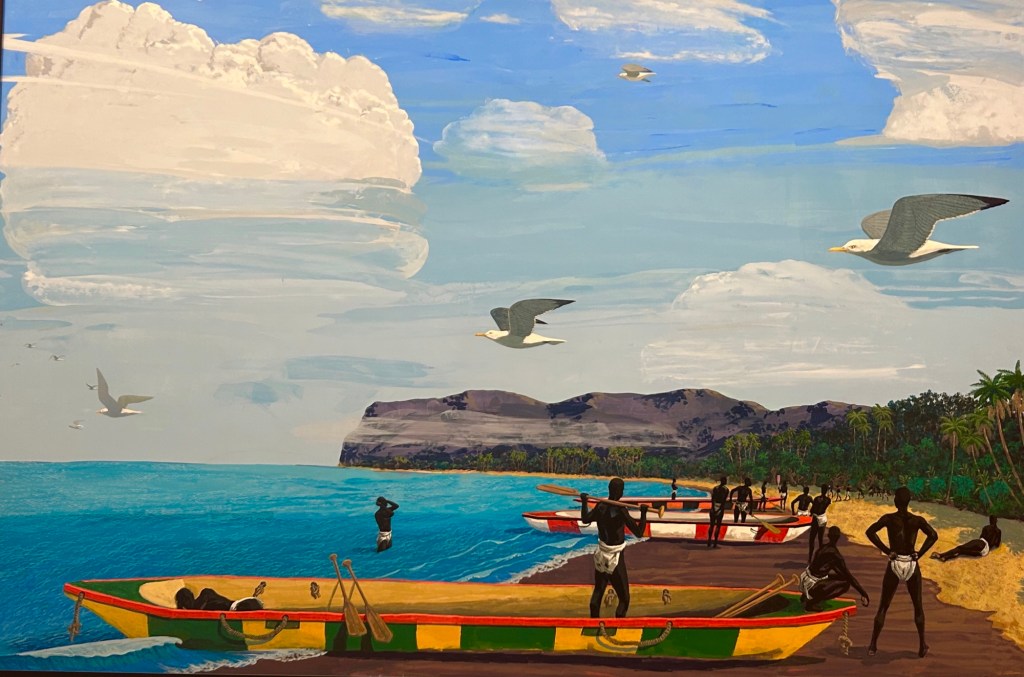
Untitled (the Cove)

There is a very wide range of work on display, and I cannot say I liked it all, but the large paintings—some just huge sheets of canvas pinned to the wall—were fascinating. They are vivid, acrylic works full of signage, collage and hidden references; they are realistic, but also contain allegory and symbolism.
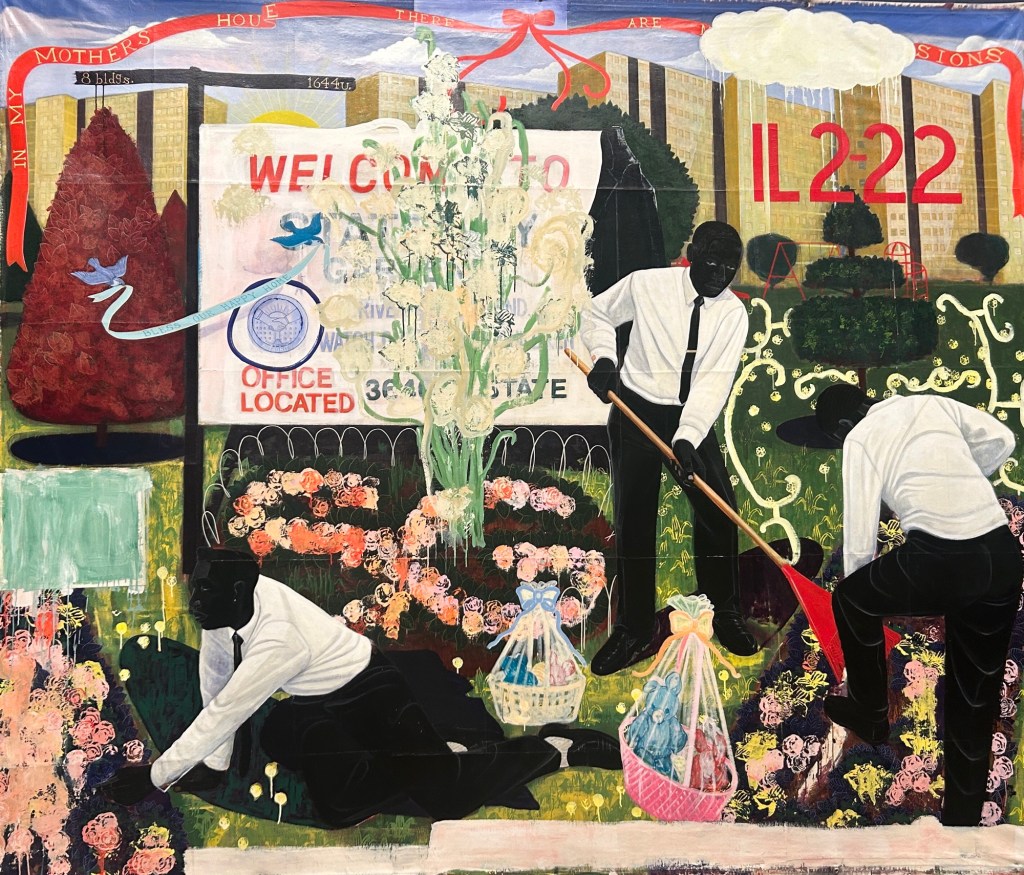
Many Mansions 1994. Acrylic on paper

Every painting tells a story—and every time you look, you notice another detail. Sheets of music, code numbers, letters and words, flowers and animals. There are references to historic events, especially concerning Black history and slavery, but he also celebrates daily life and imagines optimistic futures.
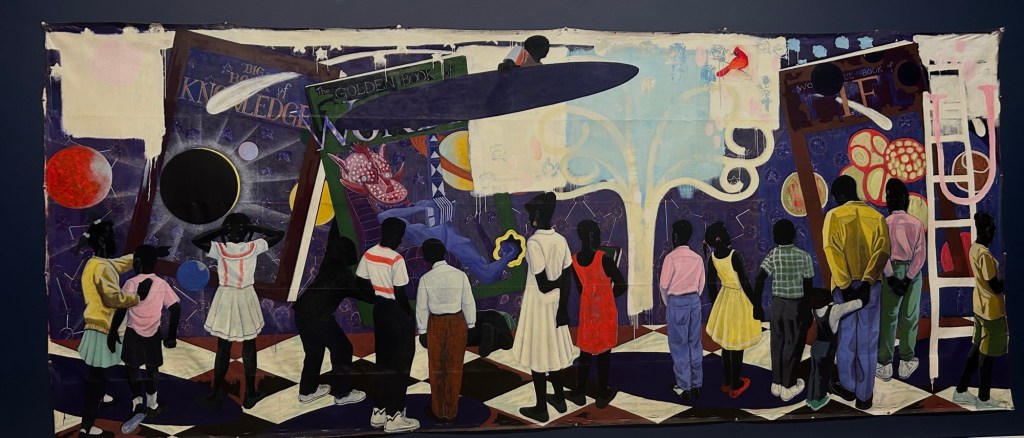
This was an enormous roll of canvas pinned to the wall. I love the people’s postures and their bright clothes

An artist and professor, Kerry James Marshall was born in Birmingham, Alabama, in 1955, and is probably one of the most influential painters working in America right now. In 2017, Marshall was included on the annual Time 100 list of the most influential people in the world.

For some reason most of the photos I took were crooked, so I had to crop them before posting.

His subject matter is African-American life and history. If you zoom in on the photos, you will notice a lot more detail.

Untitled (Underpainting) 2018. Monochrome work (literally an underpainting) of Black kids on a museum trip

Despite his often bleak subject matter, Marshall’s work is joyful and optimistic—due to his vivid palette, but also because his subjects appear to be enjoying themselves.

Keeping the Culture, (2010, Oil on board) depicts an Afrofuturistic household where the future merges with the past.

In a 1998 interview with Bomb Magazine, Marshall observed:

Black people occupy a space, even mundane spaces, in the most fascinating ways. Style is such an integral part of what black people do that just walking is not a simple thing. You’ve got to walk with style. You’ve got to talk with a certain rhythm; you’ve got to do things with some flair. And so in the paintings I try to enact that same tendency toward the theatrical that seems to be so integral a part of the black cultural body.”

More Gormley

The British sculptor Anthony Gormley seems to be everywhere these days. Sadly, I never managed to get to Delos to see his fantastic installation (for those who missed my post on this, you can find it here), because Delos is not easy to access. However, I took the opportunity to see his lovely exhibition at the Royal Academy  in London.


There were many of his ubiquitous depictions of the human body in various forms:


Some upside down


Walking on the ceiling.


But also some large and impressive installations:


Visitors were invited to walk through this one.

The one below looked like an alien vessel – an impressive 6 tons of steel rods suspended from the ceiling, dwarfing the people  beneath.


You could also walk through this next one, via the rectangular opening leading into a narrow steel tunnel, in almost total darkness – if you weren’t claustrophobic, that is.


But I mostly loved its architectural shapes, framed by the arched doorway.


Another installation featured a room flooded with Atlantic seawater on a bed of clay from Buckinghamshire. In general, the installations were  site-specific, fitting beautifully into the shape of each room.


Wall art included the work below, made with clay on a blanket, which had a fleeting, haunting aura.


The one below was not one of my favorites, but intriguing nonetheless, since it was made out of slices of bread dipped in wax:


Finally, for someone like me who loves works on paper, there was an abundance of treasures on offer, including a multitude of small spiral notebooks where Gormley recorded his ideas (these proved impossible to photograph, since they were presented in glass cases).


These drawings were made with charcoal and casein.


Deceptively simple,


But very evocative.


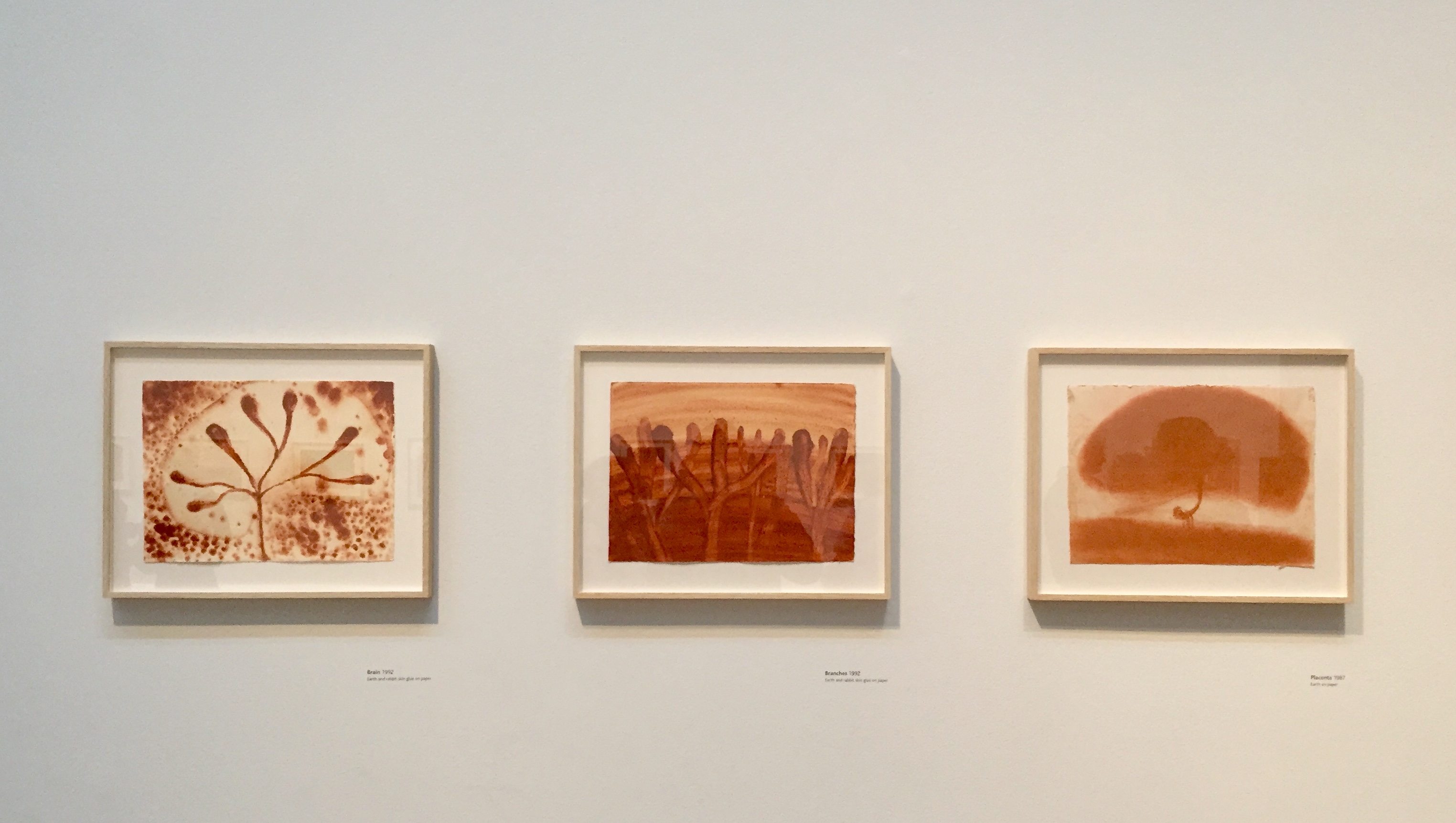
And there was a whole, luminous series made with earth mixed with linseed oil.


I came away most inspired.


Highly recommended, if you’re anywhere nearby.