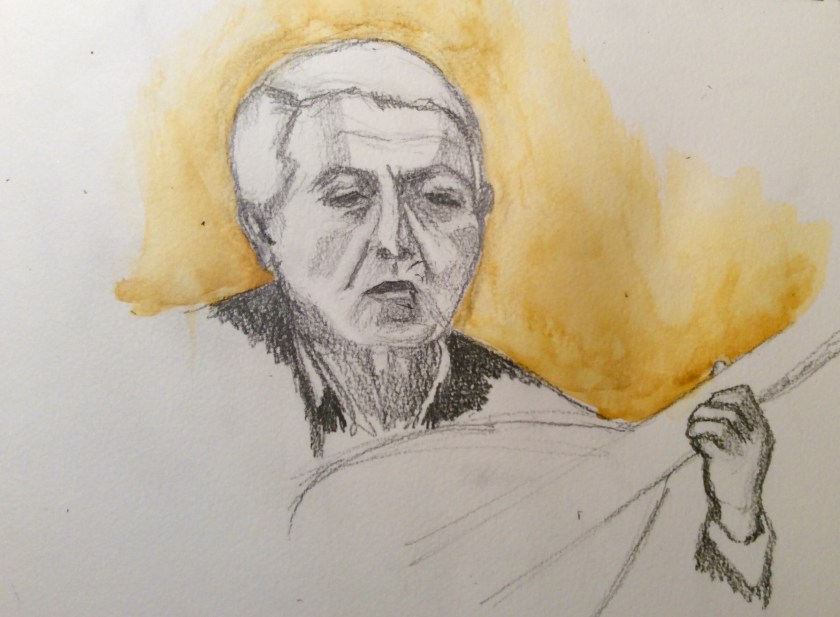
Day 16: Drawing people is not my strong point, and World Watercolor Month is all about trying new things, so I thought I’d challenge myself. I love Francesco Clemente’s watercolor portraits, and I used those as my inspiration. Still a long way to go…(sigh…). But they were fun to do, and I’ll definitely repeat the exercise.
Day 17: Everything possible went wrong with this drawing of a starfish – the masking fluid wouldn’t dry, the masking tape ripped the top layer of the paper off… I think it was all due to the heat. However, I still enjoyed playing with the stencils.
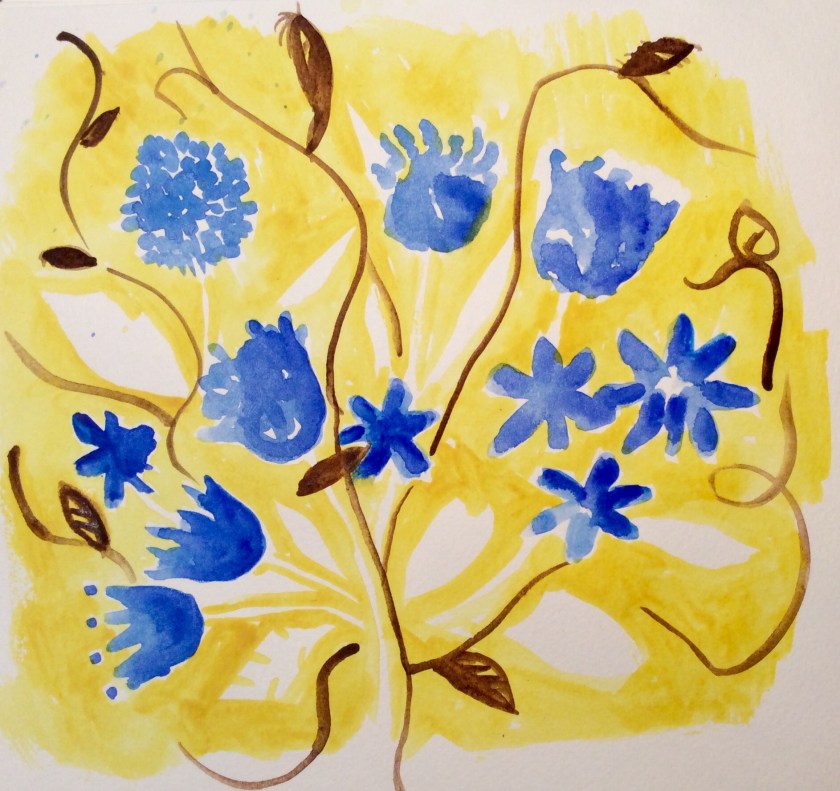
Day18: Very busy day, and I got back late, so I only had time to doodle these little blue flowers.
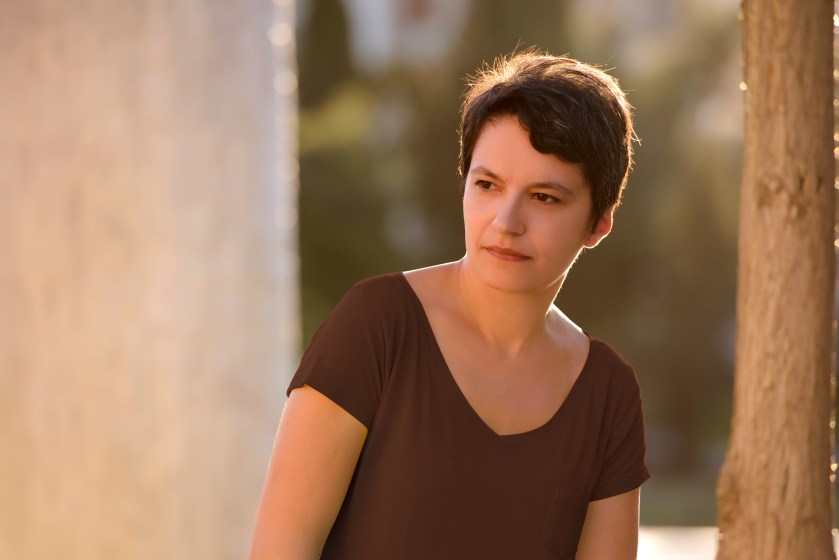
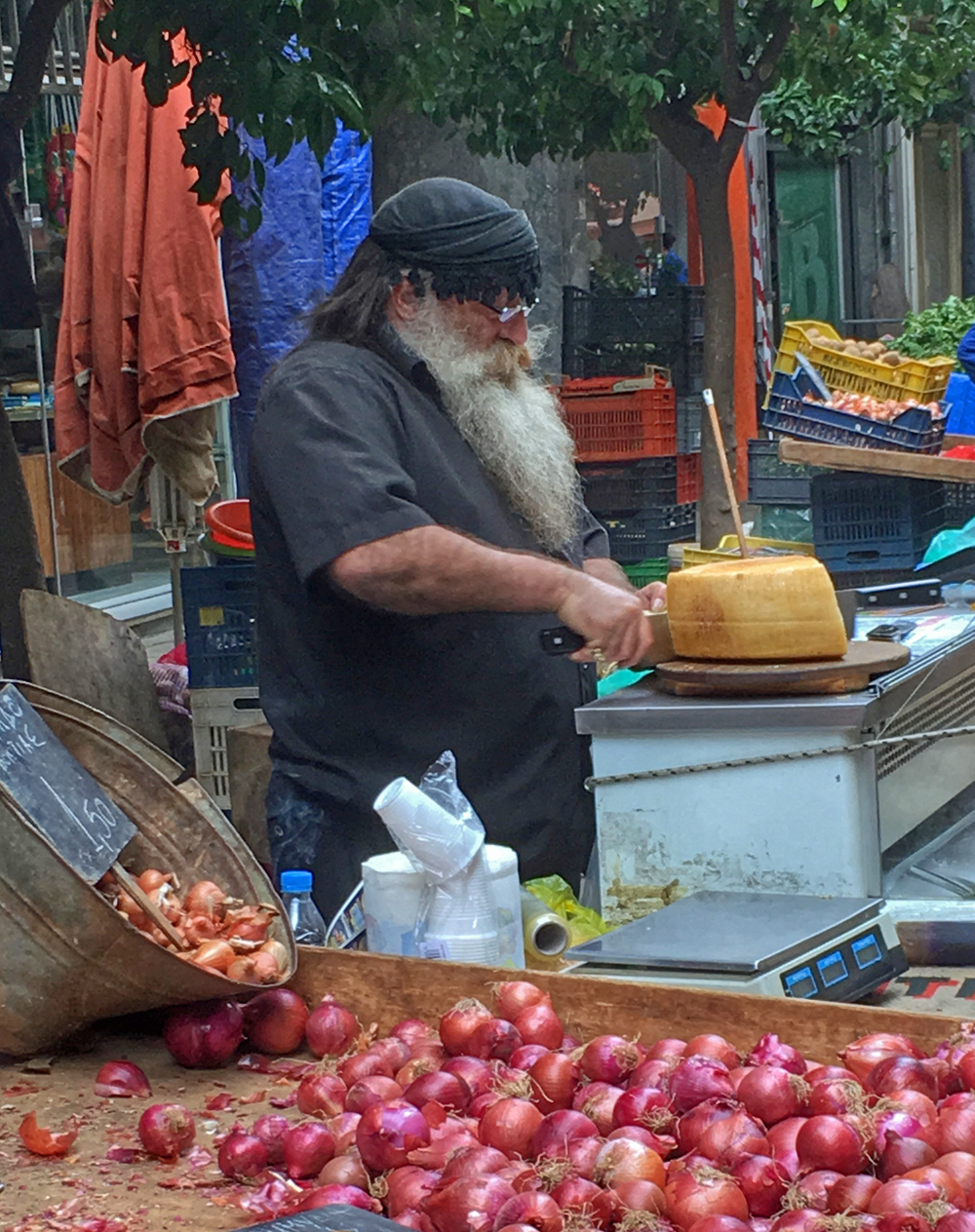
Day 19: More people drawing practice – this time inspired by a photo I took on my visit to Metsovo.
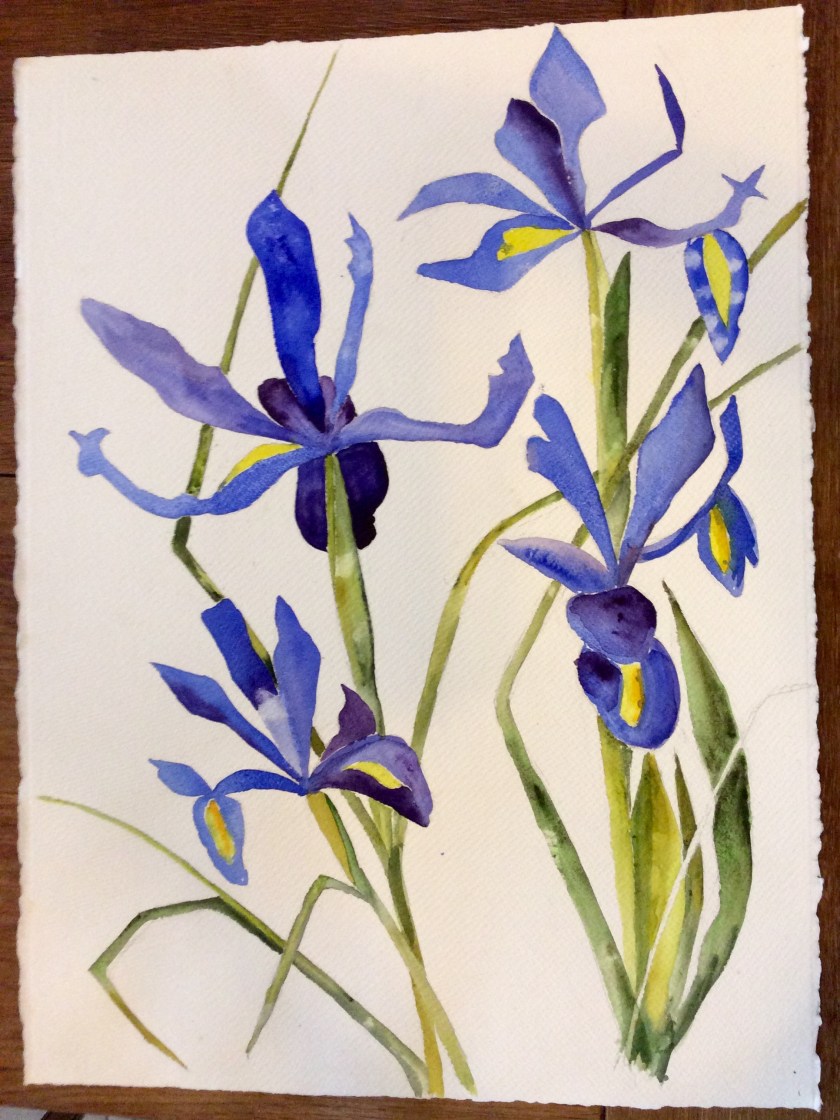
Day 20: Found time to start my new project, a floral triptych. I’ve been doing studies for this since the spring, when the irises were blooming in the garden. I find it really makes a difference to draw things from life, rather than from a photograph. It’s easier to distill the essence of your subject, rather than just its image.
Day 21: I’m now obsessed with this project , so just carrying on. I’m using Canson Watercolor paper, very thick (640msg). I’ve never used this before, and I find it very interesting. It absorbs the color, and leaves it very vivid. Good for wet-in-wet, but also for a hard edge, although the surface is very rough. The back of the paper is smooth, so maybe I’ll try that next time.
Day 22: Started on the leaves. I got interesting effects from lifting the paint with a paper towel, although it won’t lift with a rag. Still playing about, not sure what I’ll leave in and what I’ll paint over.
Day 23: This ‘week’ has eight days, since there are another eight to the end of the month. Here’s the next step to my painting.
I wonder if it’s cheating to post consecutive images of the same drawing? Who knows, and, more importantly, who cares?
Well, it’s been a busy week, but I was determined not to fall behind on the WorldWatercolor Monthchallenge, so I mostly resorted to quick sketches at bedtime.
Day 8: Seagulls. I seem to be inspired by birds lately, and it is the summer and beach weather. After making a quick and splashy background, I drew the seagulls in ink and added oil pastel for highlights.
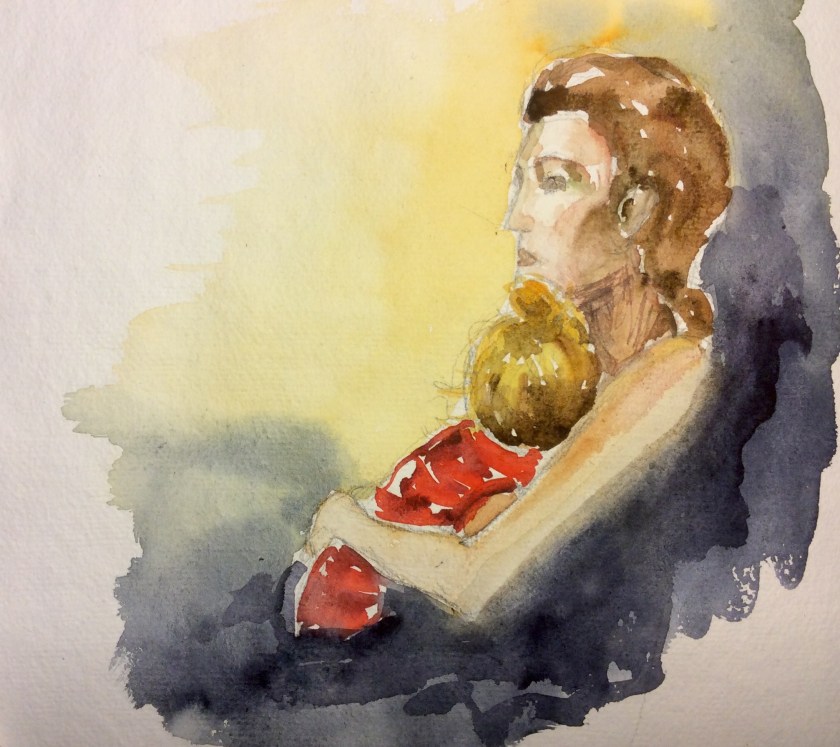
Day9: Mother and child. I have to force myself to draw people (not my strongest point, so I need the practice). I had a little more time tonigh, and I found an appealing photo as a reference – it would have been better drawn from life, but no models available (sigh…)
Day 10: Garden produce. I’d gone out to pick some lettuce, onions and cauliflower, so I just dumped them on the kitchen table (I used a tea towel not to get dirt onto the table, and that proved quite a useful addition to the sketch!)
.
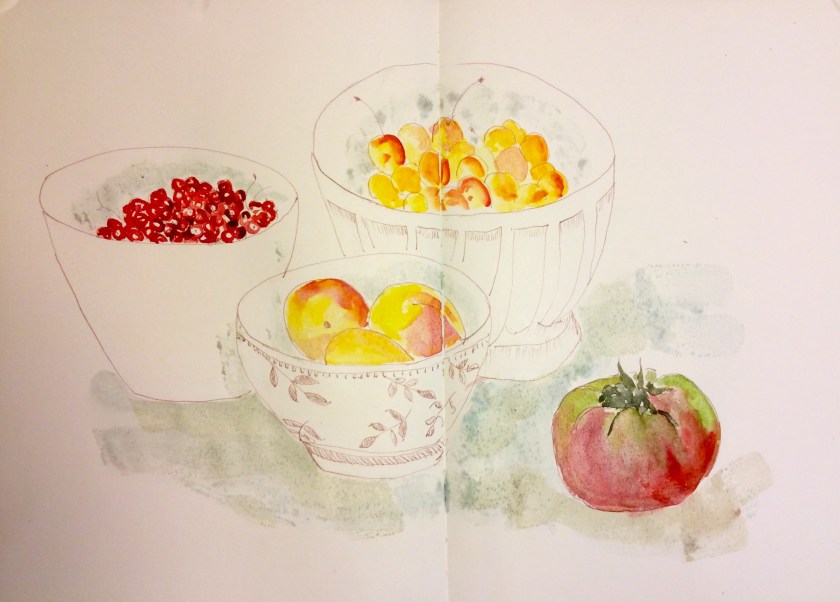
Day 11: Three bowls of fruit and a tomato. I do love summer fruit. These are peaches, yellow cherries and red currants. What could have been more inspiring than to make a sketch of them in a large Moleskine journal.
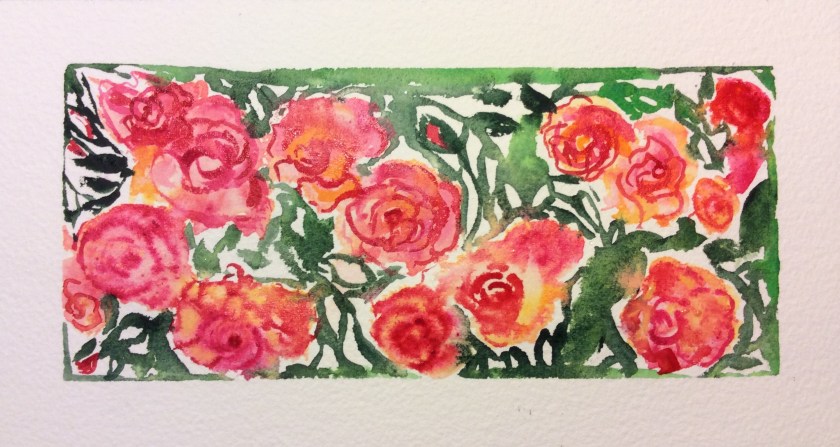
Day12: Roses. Really no time tonight, so I just sloshed some paint around and doodled on top. It was a good way to test some new Daniel Smith watercolors, too (Quinacridone Rose, New Gamboge and Deep Sap Green).
Meanwhile, I’ve been putting the finishing touches on my bird project, ‘Sandhill Cranes In Flight’. This is watercolor, oil crayon and gold leaf on two large sheets of Arches paper (100x60cm). It has now been packed off to the recipient, who I hope will be happy with it. I’m a rotten photographer, only use my iPhone and couldn’t get the light right, but you get the idea (I blue-tacked it to the wall to take the picture, but the left side was in shadow).
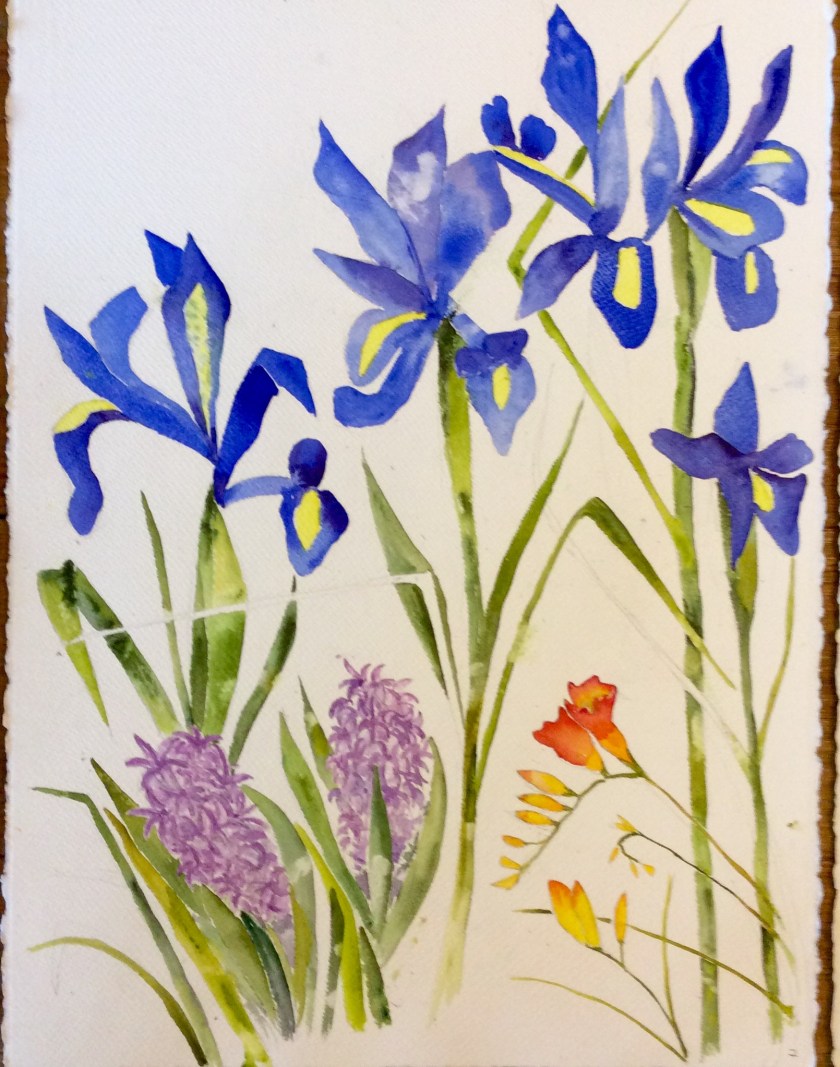
Day13: Three-panel study of floral painting. This is my new project, so I started making some studies to help me decide how to proceed. It will be based on plein air sketches of irises, tulips and hyacinths I made when they were in flower in the garden. Always gives a better result than painting from photos.
Day14: Six-panel study. Another version, using six pieces of paper instead of three. I probable prefer the first one.
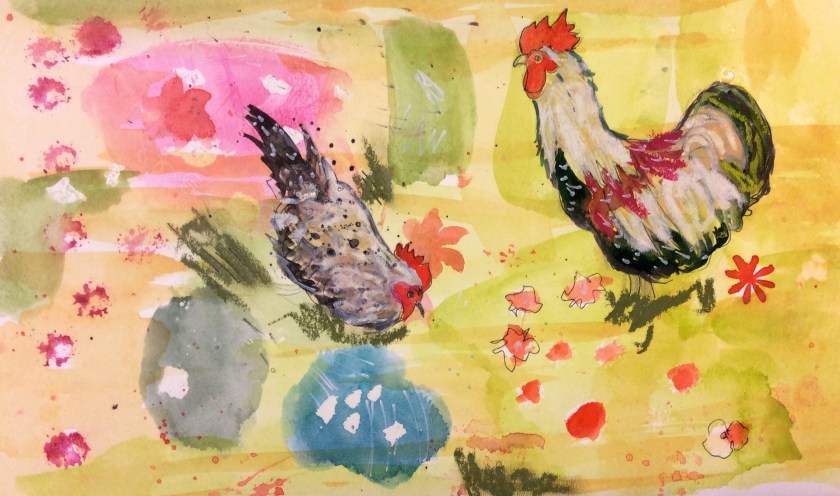
Day15: Chickens. Really got back late today, so when I came upon a piece of paper on which I’d been testing color mixes and some flower stencils, I just added a rooster and a hen on top.
I love crime fiction – so when I came upon Eftichia Giannaki‘s books, I felt I’d stumbled onto a treasure trove. They’re very atmospheric, with three-dimensional characters, and a hero who is just troubled enough while being likeable.
Eftichia is a rising star on the Athens literary scene. Her first book, On the Back Seat, a crime novel featuring an interesting cast of characters, is a page-turner set in the Athens of today, a city beset by the crisis. It won the PUBLIC prize for Best Greek Novel of 2017, and the second book in the proposed trilogy, Halcyon Days, has just been published. She has also written a previous book, Hardcore, under a pseudonym, which has been made into a film. Two of her plays have been staged in the Greek theatre.
Tell us a little about yourself
I was born and live in Athens, where I write crime novels and theatre scripts. My first two books, On the Back Seat and Halcyon Days, are both published by IKAROS publishers and are part of the Athens Trilogy featuring Superintendent Haris Kokkinos. One can understand a lot about me and my relationship to the city and its inhabitants by reading my books, which are all set in Athens.
What were the major difficulties you’ve faced in the last five years?
The most serious difficulties are connected to matters of plot, seeing as I pose my readers the problems and questions that concern me in the first place. The social commentary I attempt and the deeper psychological analysis of my heroes unveil the difficulties and problems I have faced over the last few years.
Did anyone in particular inspire you or help you?
I’m inspired and helped by the people who live around me.
What are your hopes/plans for the future?
My hope is to have good health so that I can continue to make plans.
What are your hopes for Greece? What changes do you hope to see happen?
My wish is for the country to acquire a plan so that it can aspire to better days.
Have you considered leaving? If so, where would you like to go, and why?
I considered it seriously three years ago, because many people close to me are now living abroad. But when I decided to dedicate myself to my great passion, which is writing, I stopped thinking about it.
If you have already decided to leave what would make you stay?
If I decided to leave, I don’t think I’d change my mind. Usually I think things through before deciding.
Are you actively doing anything to help with the situation? Is there something you would like to do?
I think of writing as my positive contribution to the situation. There’s always more to be done, but it has to be achieved first, before being discussed.
How do you see Greece in 5, 10 years?
I can’t see that far.
How do you cope with obstacles and frustrations in your everyday life ?
With optimism. I see obstacles as a challenge, otherwise probably I would not be writing crime fiction
What are the positive sides of living in Greece? Have you had any good experiences lately?
The people, the people, and, again, the people. As are people in every country. In every difficulty it’s always solidarity which touches me and thankfully there is a lot of that surrounding us.
Read more about Eftichia on her site, here (in Greek).
No poetry could do my local market – laiki – justice, or at least the kind of poetry that I might come up with. That said, I am sure that many others who are gifted wordsmiths could create a beautiful ode. In fact, Michael Llwellyn-Smith, in his 2004 travel book Athens, in Signal Book’s ‘Imagined Cities’ series, has eloquently described (albeit in prose) our Friday laiki:
It is one of the most vivid displays of everyday life in the city, with its regularity, the personal encounters with neighbours, the cheerful noise of the vendors crying their wares, the quiet purpose of the shoppers stocking their trolleys and baskets.
What I can offer is a photo essay from images I’ve taken in the market over the past year. The great majority of the photographs I have taken record the seasonal produce, but every once in a while, people catch…
For those who did not read my post last year, World Watercolor Month is the brainchild of Charlie O’Shields of Doodlewash fame. It’s a challenge designed to encourage anyone who joins in to post a watercolor painting each day of the month of July. It’s a fun thing, with very relaxed rules – there are no prizes, or obligation to post each day.
Day 1: Bunnies – Present for a child’s christening (part 1)
We do have a list of prompts, but nobody’s obliged to follow it, they’re only meant to help people with inspiration. The idea is to bring together artists of all levels, from all parts of the world.
Day 2: Ducks – present for a child’s christening (part 2)
WWM started in 2016 and proved a great success, prompting Charlie to greater efforts this year. The project, which has attracted sponsorship from various well-known art supply brands, has also teamed up with The Dreaming Zebra, a non-profit foundation that provides underprivileged schoolchildren throughout the world with art and music supplies.
Day 3: Mountain village – the view from the window. Quick evening plein air sketch.
I joined in last year, and the results were beyond my expectations. It got me into the habit of drawing or painting every day, which I’ve kept up since. It made me open an Instagram account, and inspired me to follow many artists from whom I’ve learnt so much. I’m self-taught, so the encouragement, tips, comments, ideas and support I’ve been getting have proven invaluable. I’ve met new people, improved my technique and, most of all, had so much fun. I’ve now started getting commissions, and am even thinking of opening an Etsy shop.
Day 4: result of a walk in the fields
I’m so grateful to Charlie, who has shown that you don’t need more than enthusiasm, new ideas and a lot of TLC to make a real difference. His site, Doodlewash, hosts watercolor artists from all over the world (I was extremely proud to be included, here) and every Saturday there is a post where artist Jessica Seacrest reviews art supplies that she has tested. We’re talking types of paper, brushes, paints – very addictive, although bad for the wallet! And, of course, Charlie never fails to post his own daily doodlewash, with an amusing story to accompany it.
Day 5: Starfish. Watercolor and oil crayon over comic strip glued in tiny sketchbook.
I’m getting stuck in again this year, even if some days it will mean just splashing some paint around for a few minutes. I will post my output at the end of each week, and you can tell me what you think. What you see today is this week’s output.
Day 6: Summer fields. Mini landscape in tiny sketchbook.
I urge any of you with a creative streak to join in. You can jump in at any time, post as little or as much as you like. Just tag your work #WorldWatercolorMonth
Metsovo is a beautiful town in northern Greece, perched in the Pindos Mountains, 1000m above sea level. Its traditional houses, stone-built and adorned with tile roofs and wooden porches, are built in a natural amphitheater and nestle between tall trees. It was a good destination for escaping the heatwave and piles of rubbish in Athens.
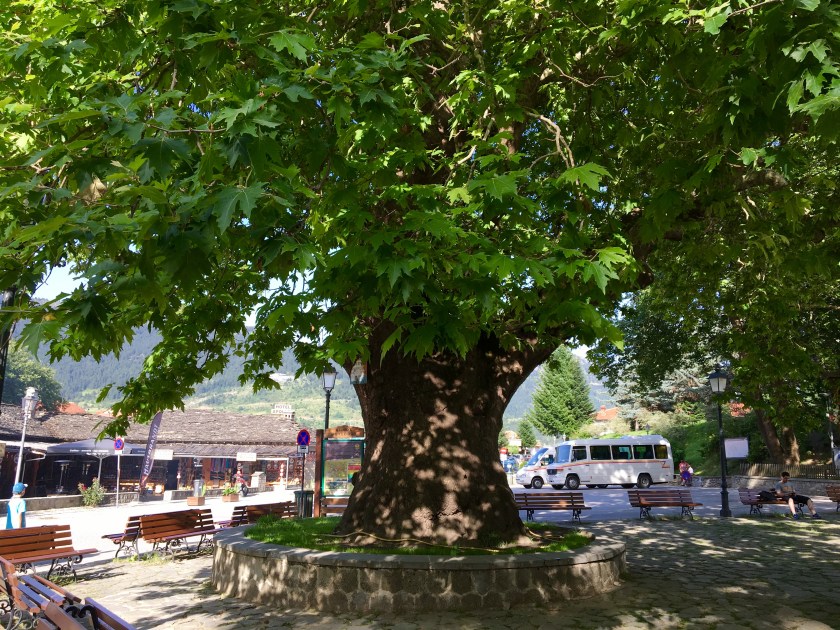
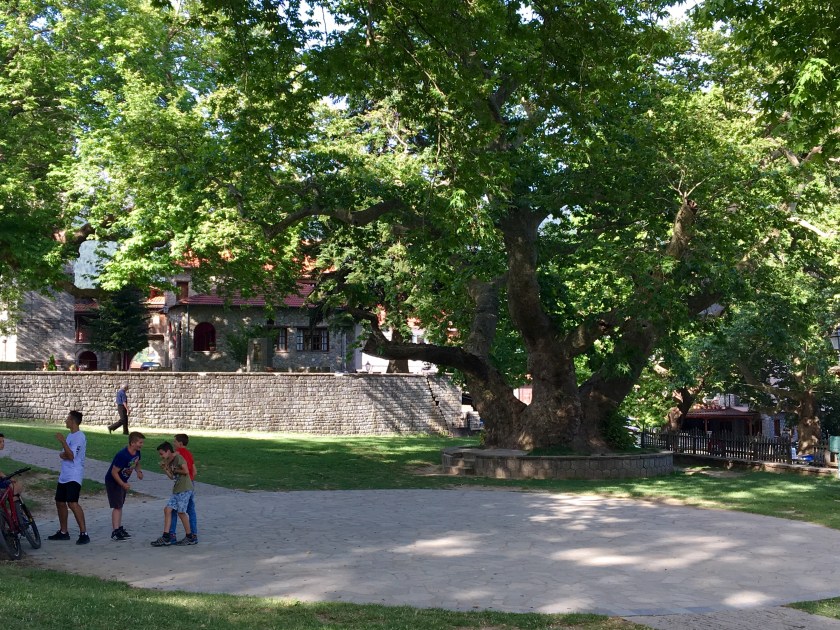
The central square is kept cool by the refreshing shade of ancient plane trees.
More than 1000 years old
Metsovo owes a lot to two benefactors: Michael Tossizza, a wealthy and eccentric man who left his fortune to the town, and Evangelos Averoff, a prominent politician and Prime Minister of modern Greece, whose friendship with the former and passion for the town, resulted in the establishment of the Tossizza foundation.
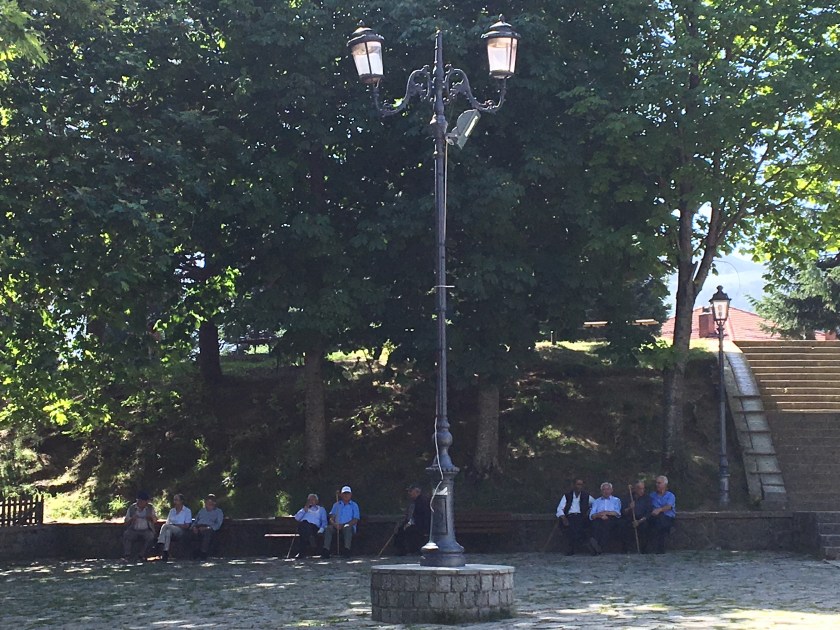
Village elders take the air on the square
The BARON MICHAEL TOSSIZZA FOUNDATION was founded in 1947 with the aim of maintaining Metsovo’s cultural heritage and sustaining its economic growth.
The foundation implemented many projects, building schools and roads, a hospital and a ski resort; renovating and maintaining traditional buildings, churches and monasteries, planting trees, and creating student housing in Athens for students from Northern Greece. It established a timber factory, and a cheese factory (today Metsovo cheeses such as Metsovone, a type of provolone, are famous in Greece and one of the must-buy products for visitors). There is a Folk Art Museum and the Katogi Averoff Wine Factory, which also houses a hotel.
Barrels of wine in the Katogi factory
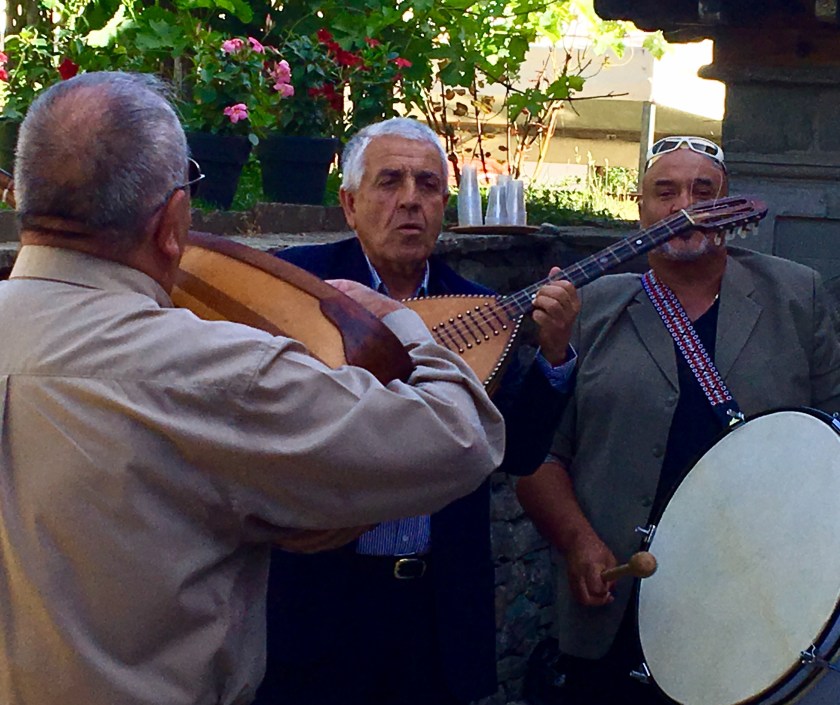
There was a wedding going on, and it was fun to watch the traditional procession through town. There was much playing of music, and stopping for impromptu dancing.
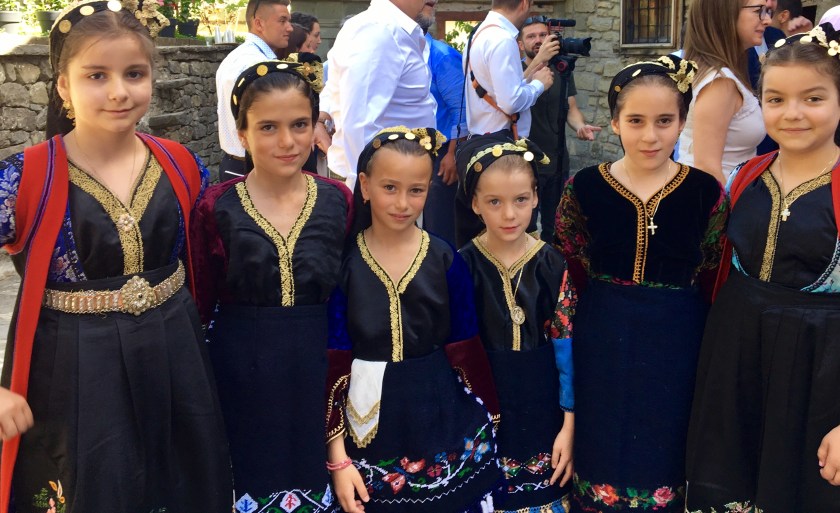
Young and old alike dressed in traditional finery.
Little girls wearing the beautiful national costume
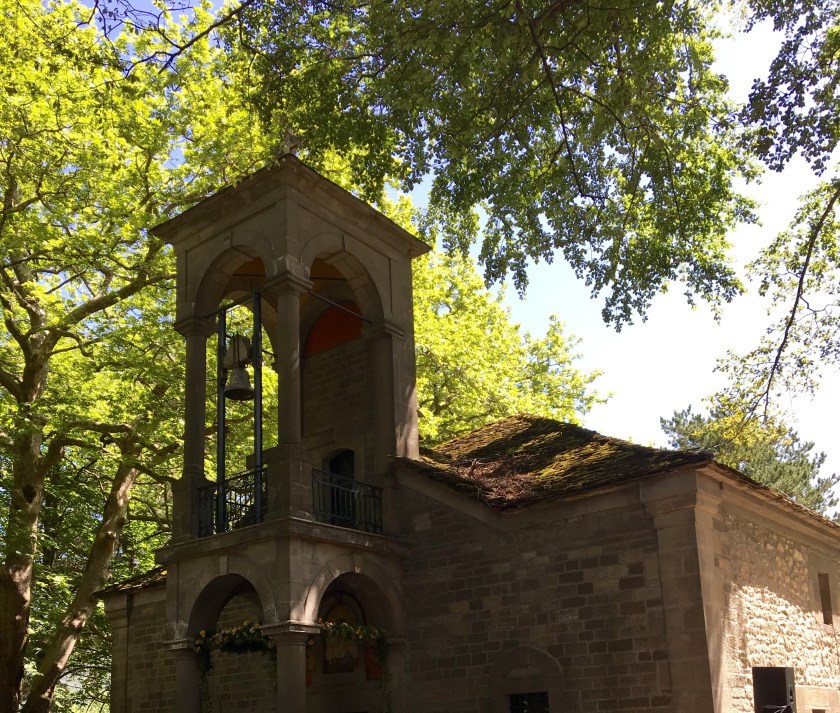
The Church of Saint George is a beautiful stone building, surrounded by a variety of shady trees.
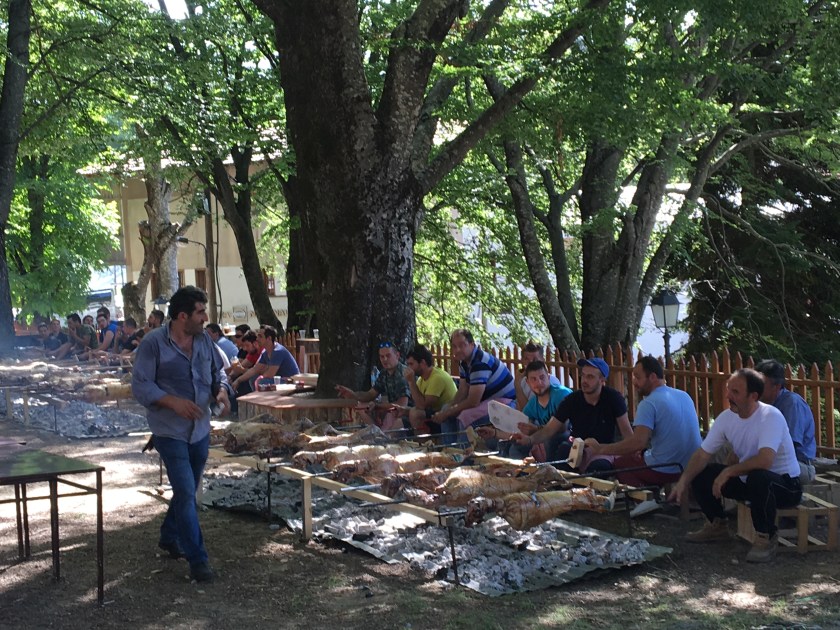
After the ceremony, a feast was held under the trees in the park, involving the roasting of umpteen lambs on the spit.
Sticking to tradition means spurning the use of electricity to turn the spits!
The meat was supplemented by home-made pies and local cheeses. Wine and beer flowed freely.
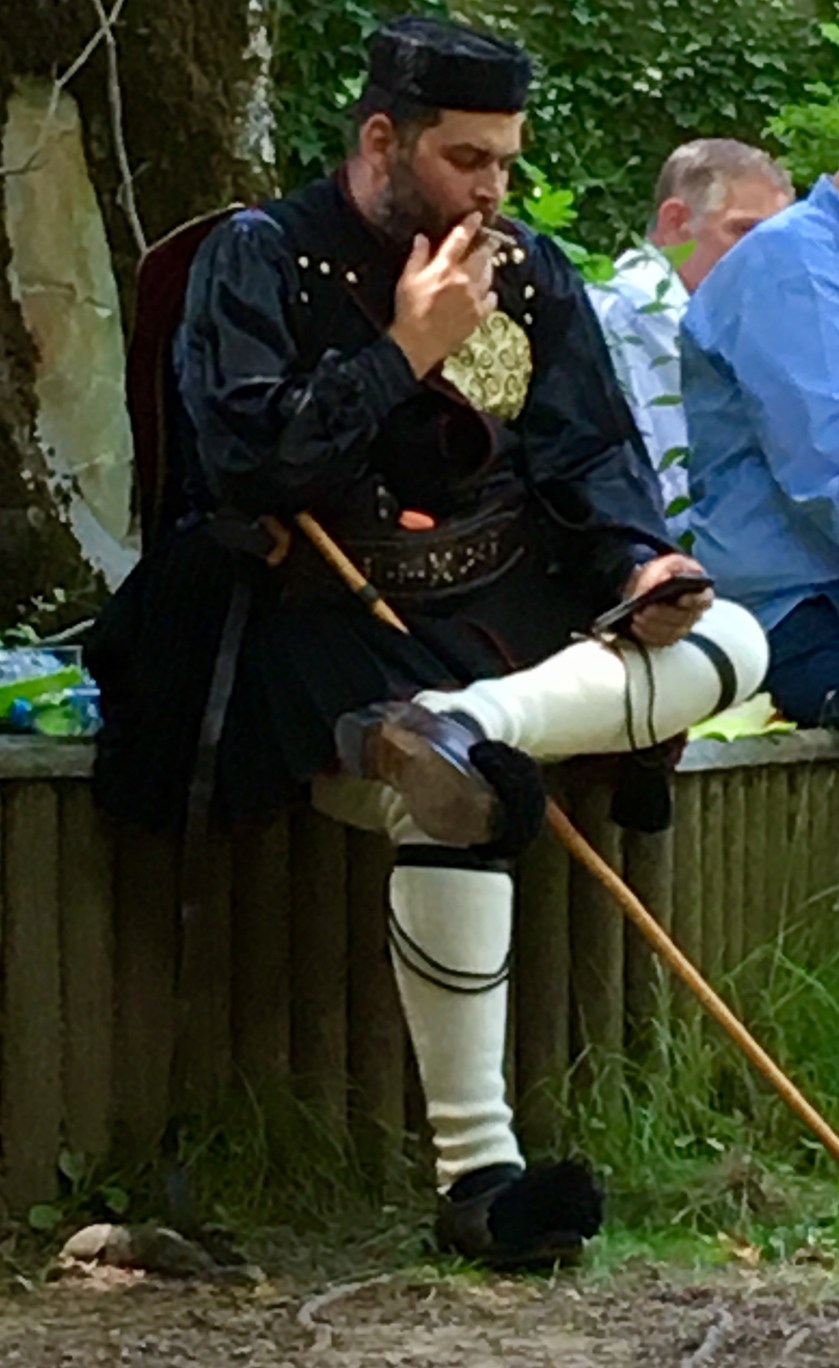
The wearing of traditional dress does not preclude the use of modern appliances
A lovely place to visit, and so different from the Greek islands.
Children run free around town. The plane tree in the background is a lot older than the one in the first photo
Lina Giannarou writes great articles on all kinds of interesting subjects. I’ve always been a fan, so I was delighted when I contacted her through Instagram and she immediately, and very kindly, agreed to do the Q&A.
Tell us a little about yourself
I was born in Athens, I grew up in Athens and I’ve never moved from here, except to go on holiday. For a while I toyed with the idea to go to England for post-graduate studies, but I managed to find a job just in time and thus an excuse not to leave my comfort zone. That was in 1977, and the job was at the METRO magazine. Having studied sociology I’d never considered a career in journalism, but journalism considered me, in the shape of some good people who – apart from the prospect of having to live in some Northern European campus with TOTAL STRANGERS – saved me from the necessity of having to decide what to do with my life! Because finally that was it. Since 2000 I’ve been working for the daily KATHIMERINI, doing free-lance reportage, mostly human interest stories. Besides that, I try to fit my personal life into the gaps, like everyone else.
What were the major difficulties you’ve faced in the last five years?
Seeing some of my friends emigrate, others lose their jobs or being obliged to tolerate unacceptable working conditions because “there’s a queue of candidates out there.” I also found exhausting, as well as terrifying, the social clash which had obviously been brewing but which exploded with the 2015 summer referendum, and which rages to this day. We’re all pretending things are as before, which they glaringly aren’t, and this cannot be very beneficial to good health.
Did anyone in particular inspire you or help you?
My family has proved resistant to difficulties (we do less well when things are good) and I’m generally very lucky with the people who surround me. I will say, however, that the cinema has often been a great savior.
What are your hopes/plans for the future?
I’d like life’s surprises to be good ones; perhaps to work a little less, to succeed in writing the stories that lurk in my head, and not to see my country destroyed.
What are your hopes for Greece? What changes do you hope to see happen?
I’d like to see the prevailing mood of suspicion about everything abate. Greater transparency in the public sector, exploitation of resources with more wisdom and inspiration. Cooperation between services for better service to the public. Better schools, less exhausted doctors. Not to have to use the emergency lane.
Have you considered leaving? If so, where would you like to go, and why?
For many years the prospect of emigration was my ultimate nightmare. Lately the thought raises my pulse rate a little less. This is thanks to our government, the feedback from friends who are living in normal countries and the people with whom this step, if it should be taken, would be taken. As to where, I’ve no idea – now you’ve got me stressed again!
If you had already decided to leave, what would make you stay?
A simple “Don’t go.”
Are you actively doing anything to help with the situation? Is there something you would like to do?
I do the minimum to help, but the minimum would be enough if everyone did it. Through my work, I try to promote good practices, to showcase positive examples, to expose the things that are wrong in our society – all of which is obviously not a huge achievement. I try not to complain too much in public, and thus to avoid adding to the general atmosphere of despondency. To be polite, conscientious and to recycle. I would also like to be more involved with the refugee crisis, besides through reportage.
Portrait by Nikos Kourtis
How do you see Greece in 5, 10 years?
I don’t believe a lot will have changed by then. If bankruptcy has been avoided, some basic reforms will have been made which will perhaps improve the workings of the state and help entrepreneurship.
How do you cope with obstacles and frustrations in your everyday life ?
By wailing “WHY ME??” Yes, I’m a big drama queen, I lack sang-froid, I easily let my nerves get the better of me, as my desk mates will attest.
What are the positive sides of living in Greece? Have you had any good experiences lately?
Yes, I bought some great vine leaves the other day, they were organic and totally fantastic. Soon I will make my first visit to an outdoor cinema this season and in about a month I will get on a boat and go to an island. Little, everyday, emotional things.
The result of Lina’s shopping spree: yummy stuffed vine leaves
You can read some of Lina’s articles in English here and here.
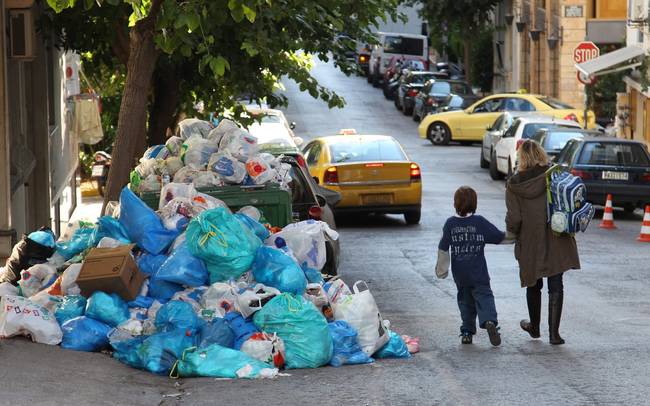
While we are awaiting a major heatwave in Greece, we are surrounded by piles of rubbish, since garbage collectors have decided to go on strike. In fact, they have been on strike for some time and, following days of protests, rallies, occupation of public car parks and camping outside city halls, yesterday they voted to carry on, unhappy with the terms of their employment. The government, as usual, is dithering, wavering between the country’s needs and the demands from the Troika, while every decision taken is delayed by the usual bureaucratic tape.
As neighborhoods are being asphyxiated by piles of bin bags, some cities – such as Thessaloniki, which boasts a very active mayor – are looking to hire private firms to do the job, something which is not looked upon kindly by the syndicates. The impact on tourism is incalculable.
A street in the town of Tripoli (source: Google)
Meanwhile, citizens already suffering from heatstroke and inhalation of toxic fumes are to be dealt another major blow: taxes for employees, farmers, pensioners and the self-employed are due another whopping rise, since they will now be calculated in a different, ‘new’ way. Speaking of which, the government has taken to inventing creatively named ways of fleecing the population – such as the ‘claw-back’ and the ‘solidarity tax’. I leave it to your imagination to make out their meaning.
This is the result of demands for more and more money from our lenders, which will go to paying back what we owe. But the well is running dry, and the economy, instead of being revived, is being driven underground. I know a lot of people who already use barter – the dentist putting fillings in the plumber’s teeth in return for having the shower fixed, and so on. Back to basics, I suppose…
I know I’ve written about the Meteora before (https://athensletters.com/2015/10/31/road-trip-to-meteora/) but I find this place magical, and enjoyed reading a post on the blog Kritsa, at the heart of it all, written by Yvonne, who shares her time between the U.K. and Crete. Take a look, it might inspire you to visit!
In early May we set off on a road trip around central Greece…what an adventure.
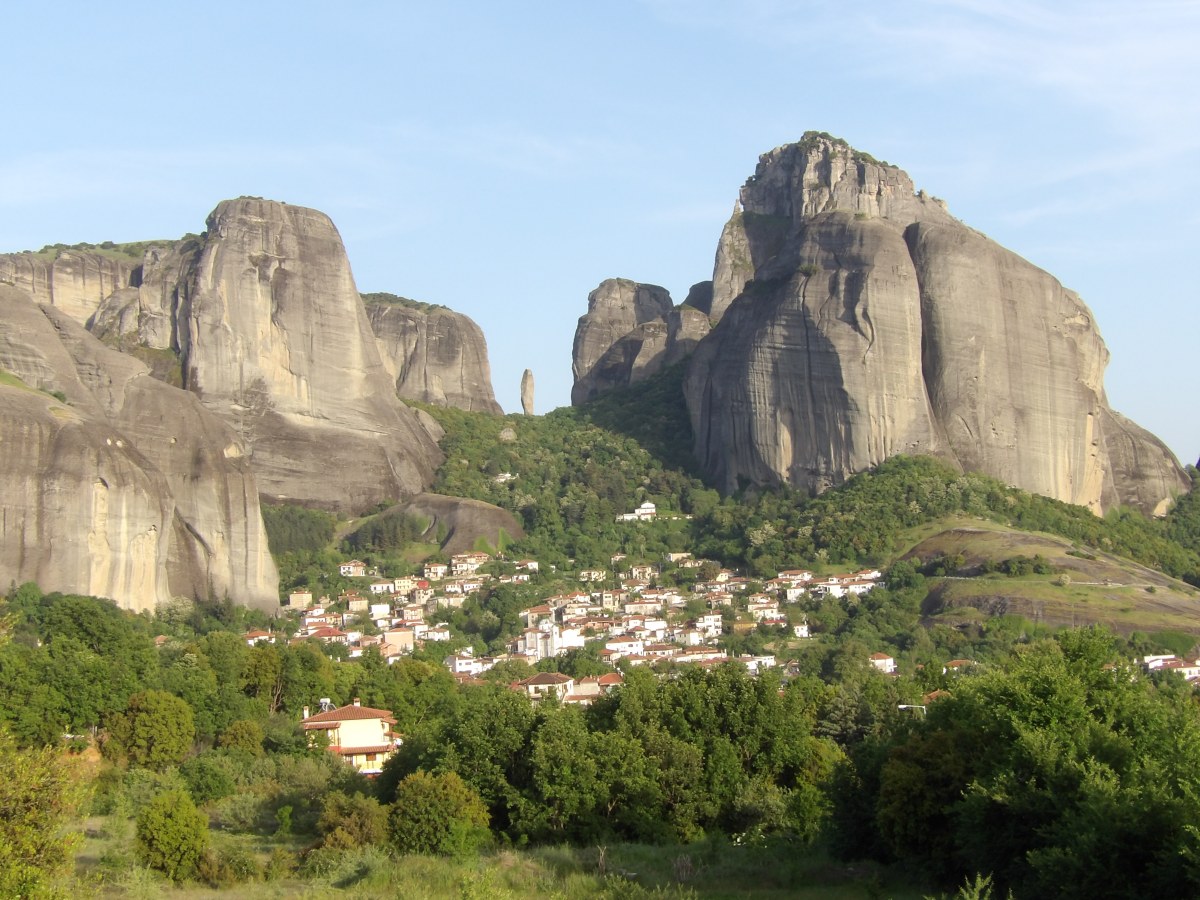
We drove aboard the overnight Minoan car ferry from Heraklion, Crete to Pireaus, the main port near Athens. Bright and early next morning found us zooming up the excellent motorway on a four hour trip to odd peaks named Meteora. Our aim was to see the monasteries that ‘balance’ between heaven and earth. For the Greek Orthodox faith, this Holy area is second only to Mount Athos.
After checking in to the Kastraki Hotel for two nights ‘Wow’ was a common term.
I’d pre booked asunset tour and it proved to be an excellent way to see many of the monasteries perched atop the peaks. Hard to believe the top of the rocky towers were once the bottom of a lake. Close up you can see they’re an aggregate of mud and rocks.
There is plenty of art on show in Athens these days. As well as the Documenta project, which is spread all over town, from May 26 to 28 there was also Art Athina, a three-day fair open to the public.
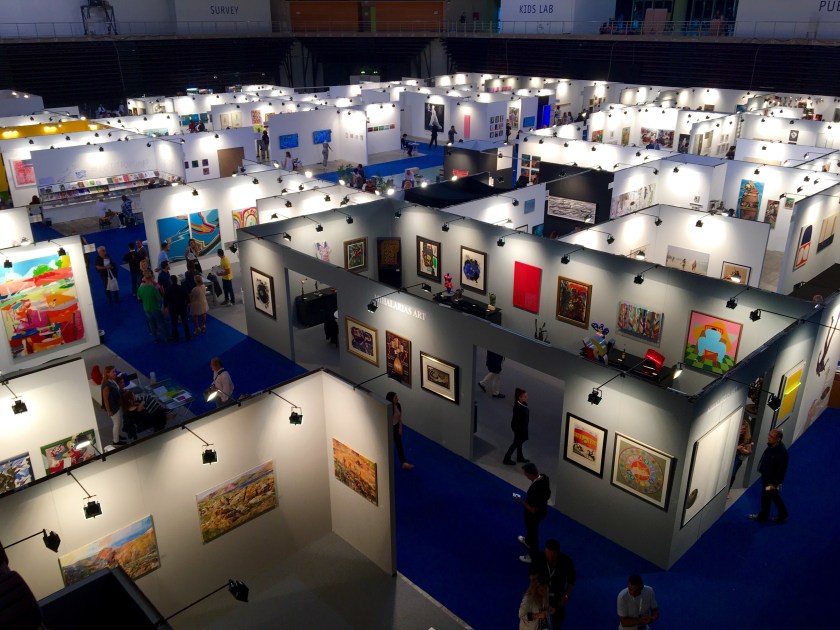
Fifty eight galleries, mostly from Greece but quite a few from abroad (Paris, Istambul, Vienna, Zurich, and even as far away as Dubai, Australia and Mexico) offered modern art for sale in a wide range of prices.
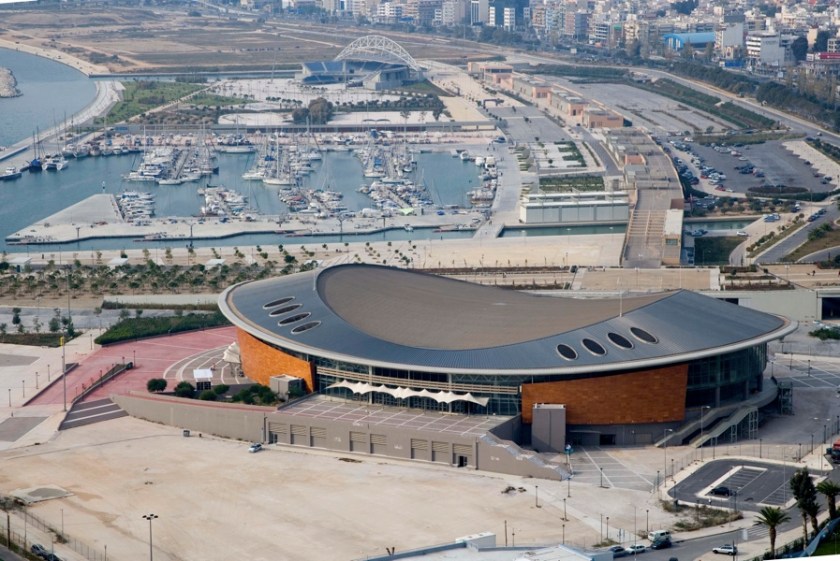
Art Athina venue: the Olympic Tae Kwon Do stadium (photo from Google)
The fair was held at the Tae Kwon Do Stadium in Faliro, on the coast not far from the center of Athens, a venue built especially for the 2004 Athens Olympics. It is a modern and spacious structure benefiting from a wonderful location next to a marina full of yachts. Nowadays it is used for various purposes, such as concerts, and even provided shelter to refugees at the worst of the crisis.
Inside, the galleries had set up their booths, and it was fun wandering around looking at the art on offer.
The view from the top floor
Sadly, I was extremely dismayed, if not disgusted, by the state of the building’s interior. I decided not to post any photos, thinking it too depressing. But I was aghast at the unpainted, stained walls, the dirty floor, the missing or broken fixtures… I don’t understand how some funds could not be raised to at least freshen it up a little.
Whimsical pen and ink drawing by Greek artist Leonidas Giannakopoulos
The whole issue of the Olympic venues is shameful. Most have been left to rot – and when I think of what Greek taxpayers forked out for them (they were grossly overpriced) it makes me grind my teeth. What’s more, the labyrinthine governmental system means that any attempt at exploiting them is resisted. Apparently the National Shooting Federation wanted to take on the Olympic Shooting complex and keep it functioning and upkept, but their offer was refused. The racetrack and equestrian centre have become totally decrepit, despite racing being a potentially profitable business. Etc, etc. – and we are talking about state-of-the-art, modern installations that could benefit Greek athletes who usually have to train in less than ideal conditions. It beggars belief.
Another by the same artist, called Sky Adventures
I can only console myself with the thought that, thanks to the Olympics, we have at least got a new, very functional airport, a good subway and a much improved road system. These had been planned for over twenty years (!) but had never materialized and would not have been finished but for the games. Part of the problem being that, wherever you dig, you find antiquities, and work has to stop until the Archaeological Society decrees what is to be done. A couple of museums were filled with what was found on these sites – but that is another story!
Outside, a band was tuning up for one of the performances on offer
If you are interested in more detail about Art Athina, pop over to the ArtinAthens blog, there is a very interesting article here.
An altered book by a Greek artist whose name, unfortunately, I did not note. I loved his work, though

















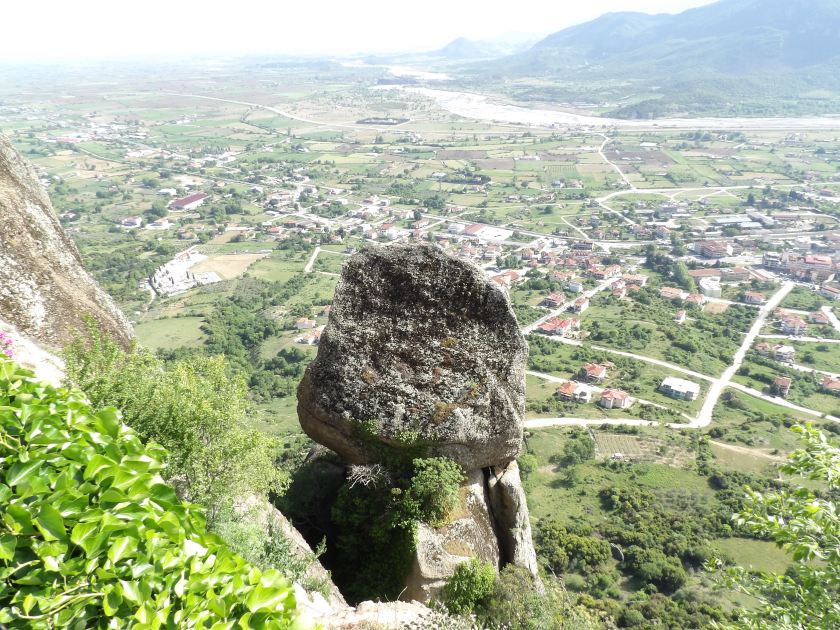
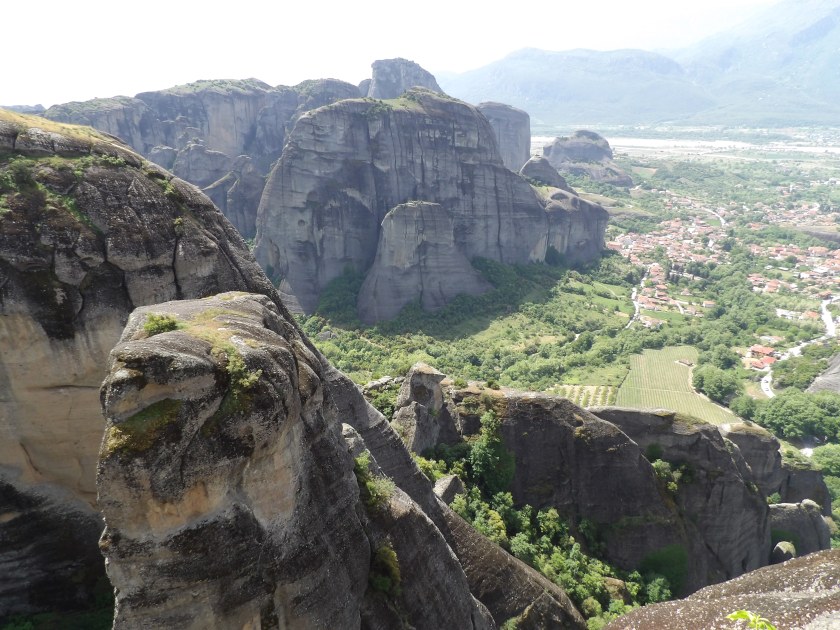
 Day Two – Meteora Hike