Now that the meat-eating revel of Easter is over, people’s thoughts are turning towards showing up on the beach in a swimsuit. New season tomatoes are making their appearance, so what better than a traditional horiatiki salad, made with tomatoes, cucumber, thinly sliced onions and peppers, and cubes of feta cheese. A bit of olive oil and a sprinkling of oregano, and you’ve got a light, nutritious lunch.
And for something more substantial, many turn to fish.
Fried white bait or little red mullet are delicious, but not particularly slimming – the best is a whole fish, simply grilled and accompanied by olive oil beaten with plenty of aromatic lemon juice.
When fish is fresh, sauces disguise its flavor, so unless you are in some fancy restaurant, you will usually get your fish plain. And yes, cooked with the head on, seeing as the best bits are the cheeks and the nape of the neck. A lot of non-Greeks find this gross, but it’s not as gross as another delicacy, the head of the Easter spit-roasted lamb! (from which I, personally, refrain.)
Having said that Greeks mostly eat their fish without sauce, I discovered that the ancients had invented a concoction called garum, a fermented fish sauce used as a condiment in the cuisines of Ancient Greece, Rome, and Byzantium. It probably originated in Carthage, and Plato was the first to describe its disagreeable ‘rotten’ smell.
The preparation of garum is described in Roman and Byzantine texts. Small fish, left whole with their intestines, were mashed with salt and set to ferment in the sun. The mixture was occasionally stirred with a stick and finally filtered through layers of fine cloth, to make a condiment used to flavor meat and game, as well as fish and seafood.
Archaeological digs have brought to light garum production plants on the coast of North Africa, Portugal and elsewhere on the Mediterranean. These were placed far from inhabited areas because the smell was horrendous! The finished product, however, was supposed to have a pleasant, spicy odor. Garum was also known as liquamen, or hallex, and prices varied according to quality.
Apparently the nearest equivalent we have nowadays is Worcestershire sauce.
How’s that for the irrelevant information of the day?
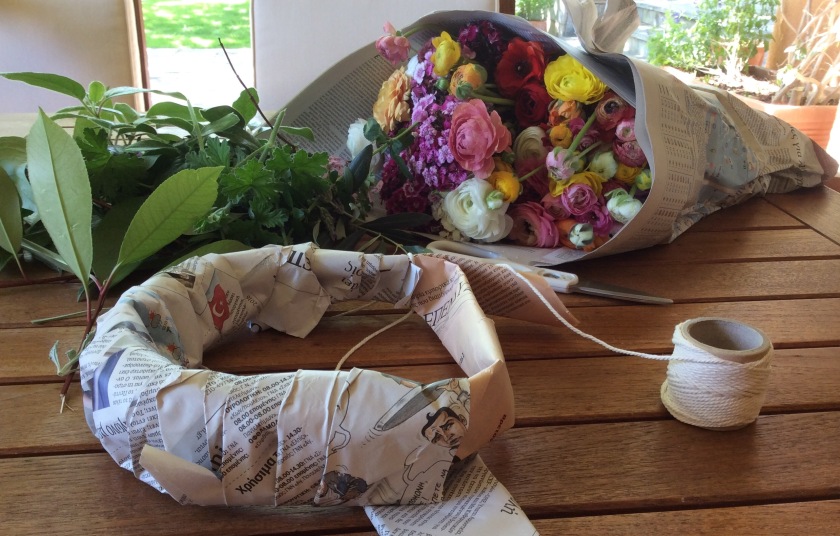
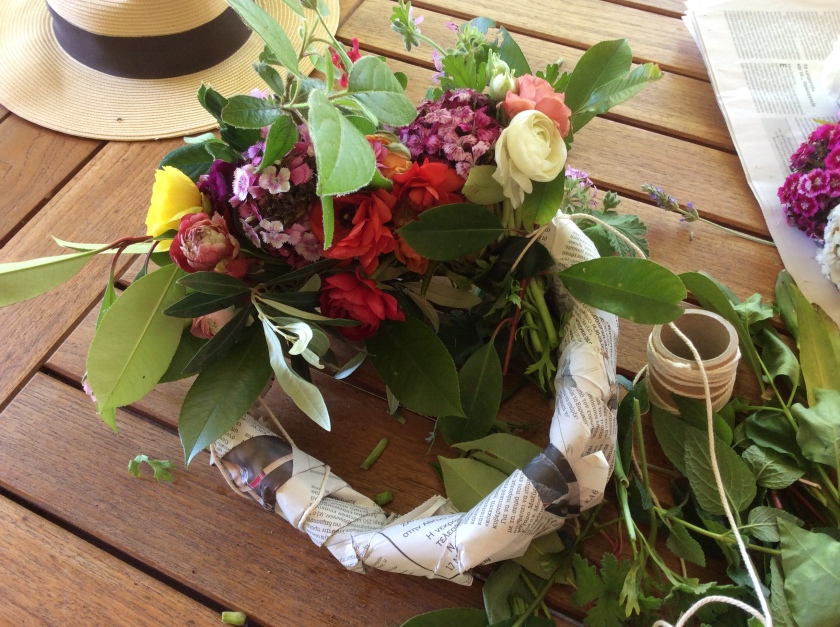
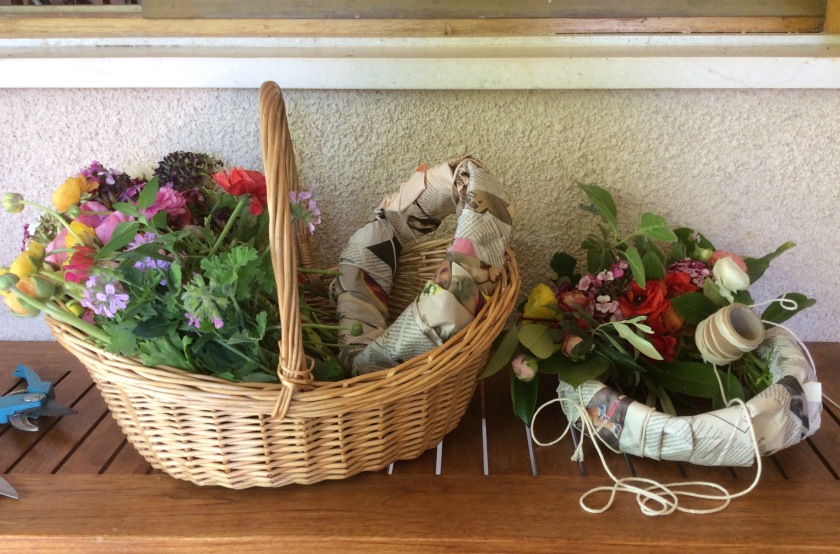
Solveig Werner very kindly asked me to take part in her ‘Discovering traditions‘ series, so I wrote a piece about the first of May, when Greeks make a flower wreath which they hang on their balcony or front door to celebrate the coming of spring.
This year May 1st coincided with Easter, so we had an abundance of celebrations. I took some photos of our wreath-making process, and I encourage everyone to visit Solveig’s blog to read my masterpiece – and, mainly, to discover all the lovely stuff she posts there!
Today, is the first of May, a day that is widely celebrated and that has various traditions attached to it. I am happy to have M. L. Kappa as my special guest for Discovering Traditions. You can find a list of all guest post that have appeared on my blog so far here, and you can find the previous guest post for Discovering Traditionshere.
May 1st and the Making of the Wreath by M.L.Kappa
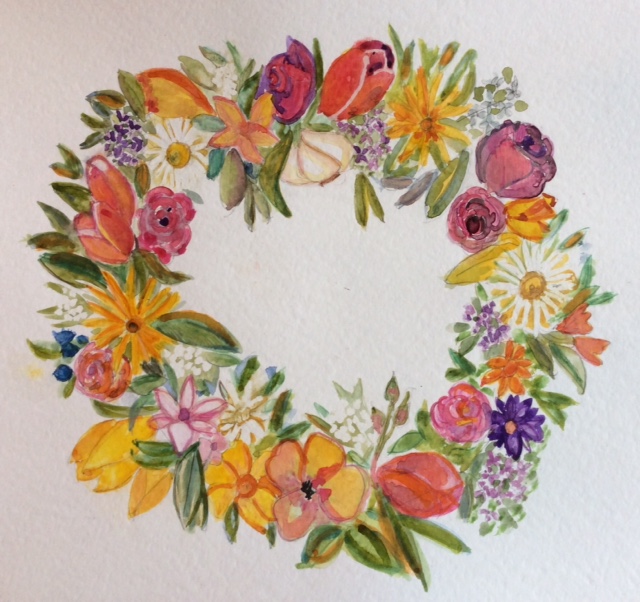
May Wreath by M.L.Kappa
One of the most fun Greek traditions is the making of the May Wreath. We call it Μάης (pronounced Màïs).
May 1st is universally known as Labor Day since 1886, when the Chicago Syndicates rebelled, asking for better working conditions. But celebrating it is not actually a 19th century tradition—it has roots in Antiquity, when festivities were held in honor of Demeter, goddess of the harvest, and
Celebrated by even the most secular of Greeks, Easter is for us the biggest holiday of the year. Yes, even bigger than Christmas. Everyone joins in the church rituals and there are lots of other traditions as well. To top it all, this year Greek Easter falls on the first of May, which is, in itself, another popular holiday.
I thought I’d begin by explaining why Easter is a ‘mobile’ holiday: the determination of the date of Easter is governed by a computation based on the vernal equinox (the point at which the ecliptic and the celestial equators intersect) and the phase of the moon. According to the ruling of the First Ecumenical Synod in 325, Easter should fall on the Sunday which follows the first full moon after the vernal equinox (invariably, March 21). If the full moon happens to fall on a Sunday, Easter is observed the following Sunday.
These complicated calculations do not always end up with the same Easter Sunday for all Christian churches, for the simple reason the churches use different calendars: Greek Orthodox use the Julian Calendar and western churches the Gregorian.
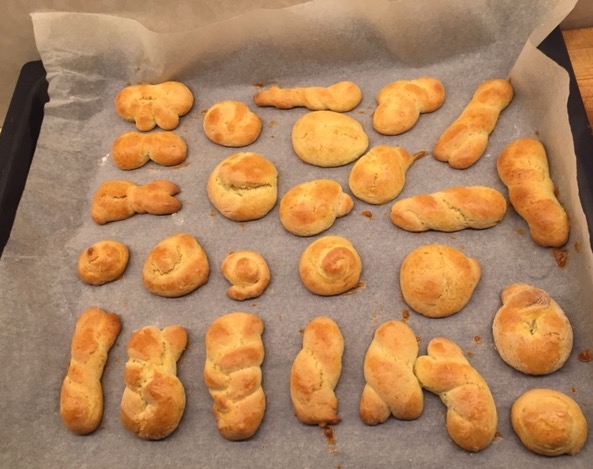
Easter preparations begin on Holy Thursday when the traditional Easter bread, τσουρέκι (tsoureki), is baked. Tsoureki is like a brioche or challah bread in the shape of a plait and is eaten all year round. Some people also bake Πασχαλινά κουλουράκια (pashalina koulourakia – Easter cookies). Eggs are dyed red, to symbolize the color of life and the blood of Christ) and sometimes they are incorporated for decoration in the tsoureki. In the evening, church services include the reading of the 12 Gospels.
Kids love shaping these
Holy Friday is a day or mourning. Traditionally, women and children take flowers to the church to decorate the symbolic bier of Christ, the Epitaphios. The Service of Lamentation mourns the death of Christ and the bier, lavishly adorned with flowers and bearing the image of Christ, is carried on the shoulders of the faithful in a procession through the community to the cemetery, and back. All the congregation follows, carrying candles and repeating the refrain of a beautiful Byzantine hymn. The candles on Holy Friday are yellow, made of natural beeswax.
On Holy Saturday, the Eternal Flame is brought to Greece by military jet from Jerusalem and is distributed to waiting priests who carry it to their local churches.
In the morning, preparations begin for next day’s Easter feast. Dishes that can be prepared in advance are made, and the traditional μαγειρίτσα (magiritsa) soup is prepared, which will be eaten after the midnight service, to break the Lenten fast.
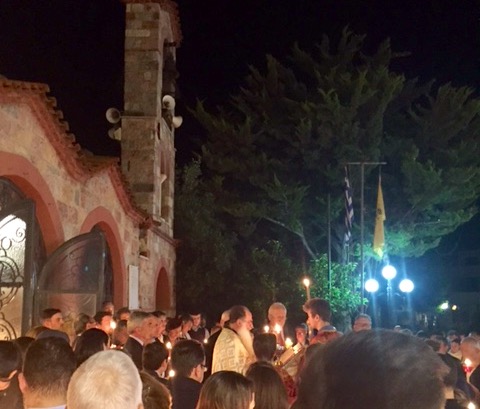
At night everyone, including children, attends the midnight Service of the Resurrection, each holding a white candle. Traditionally, children are given the candle by their godparents, and many are lavishly decorated. Churches fill to overflowing and most people gather outside where the service is broadcast by loudspeaker. Anticipation mounts; shortly before midnight, all lights are extinguished and churches are lit only by the Eternal Flame on the altar. When midnight sounds, the Priest calls out “Christos Anesti” (Christ is risen), and passes the flame, the light of the Resurrection, to those nearest him. The flame is then passed from person to person, and soon the church and courtyard are filled with flickering candlelight. The night air is filled with the singing of the Byzantine Chant “Christos Anesti,” and kisses and wishes are exchanged. The traditional exchange is ‘Χριστός Ανεστη’ (Christos Anesti – Christ is risen) answered by ‘Αληθώς Ανέστη’ (Alithos Anesti – He is truly risen). As is the custom, as soon as “Christos Anesti” is called out, church bells ring joyously non-stop, ships in ports all over Greece sound their horns, floodlights are lit on large buildings, and great and small displays of fireworks and noisemakers are set off. Cars passing by on the road also honk loudly.
People then carry the Eternal Flame home. The sight of hundreds of candle flames moving from churches to homes on that night is beautiful, indeed.
Once home, the flame from the candle is used to make the sign of the cross on the top of the door frame in smoke. The mark is left there throughout the year, to symbolize that the light of the Resurrection has blessed the home. The candles are then put on the table for the midnight meal. Everyone gathers around the table to break the fast; the feast includes magiritsa soup, tsoureki, and the red eggs. But before the eggs are eaten, there’s a traditional game to be played: ‘τσούγκρισμα’ (tsougrisma) – holding your egg, you tap the end against the end of your opponent’s egg, trying to crack it. It’s a game enjoyed by children and adults alike. Eggs are often dyed in large quantities since the game continues on the next day with more friends and family. In large gatherings, someone can usually be found cheating with a wooden egg!
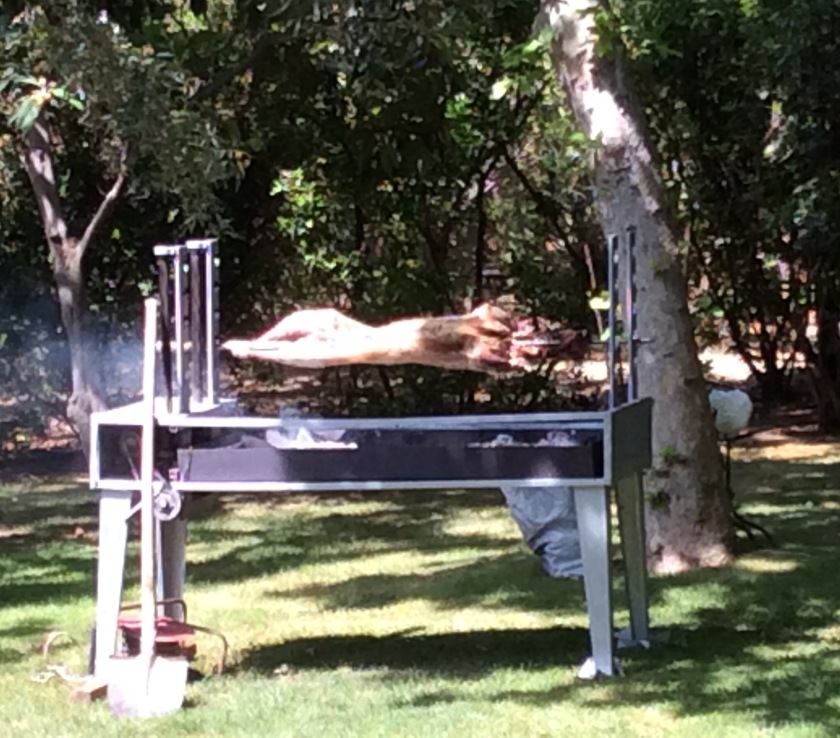
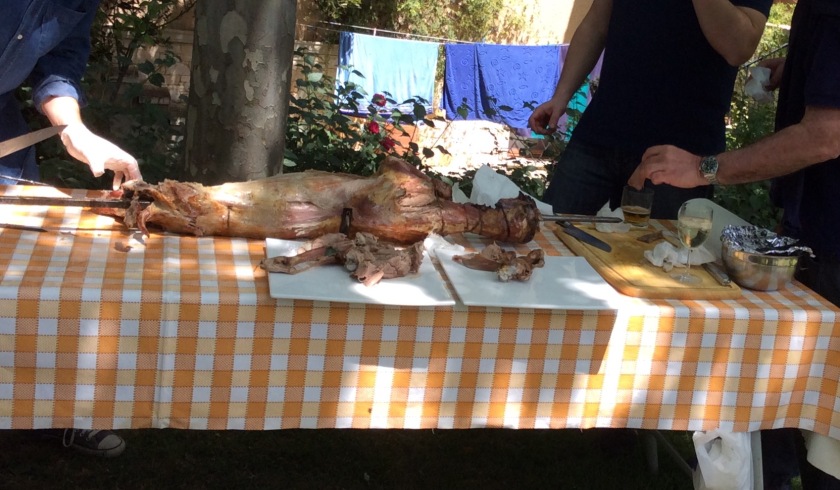
At dawn on Easter Sunday, spits are set to work, since all over the countryside, the menu of the day is whole spit-roasted lamb or kid, to represent the Lamb of God. Also on the spit is another delicacy, kokoretsi, seasoned lamb or goat organ meat, wrapped in caul fat and then in yards of cleaned intestines. This recipe originated from the need to use up all parts of the lamb that was slaughtered for Easter, and not let any go to waste (the rest being used in the magiritsa soup). Delicious to many people in the Balkans, but definitely an acquired taste…Some people prefer lamb or kid dishes grilled or baked in the oven, according to various local recipes. With these come all the trimmings, like roast potatoes and salads, with ouzo, beer and wine flowing freely. Preparations for the meal turn into festive celebrations even before the eating begins. These gatherings of family and friends often last all day and sometimes long into the night.
Many places in Greece have their own Easter traditions, such as the ‘rocket war’ of Chios, and special celebrations on Corfu, which are particularly impressive. Easter in Corfu is a huge festival, in which various components come together harmoniously: the Orthodox Christian faith, pagan traditions, the powerful presence of Saint Spiridon, the Roman Catholic community, the Venetian influence, genuine Corfiot humor, the music of the philharmonic bands and of course, the spring atmosphere.
And finally, although I doubt many of you will attempt it but – just for the fun of it – here’s a recipe on how to roast a whole lamb on the spit. Greek Easter is not ideal for vegans, nor for the faint-hearted!
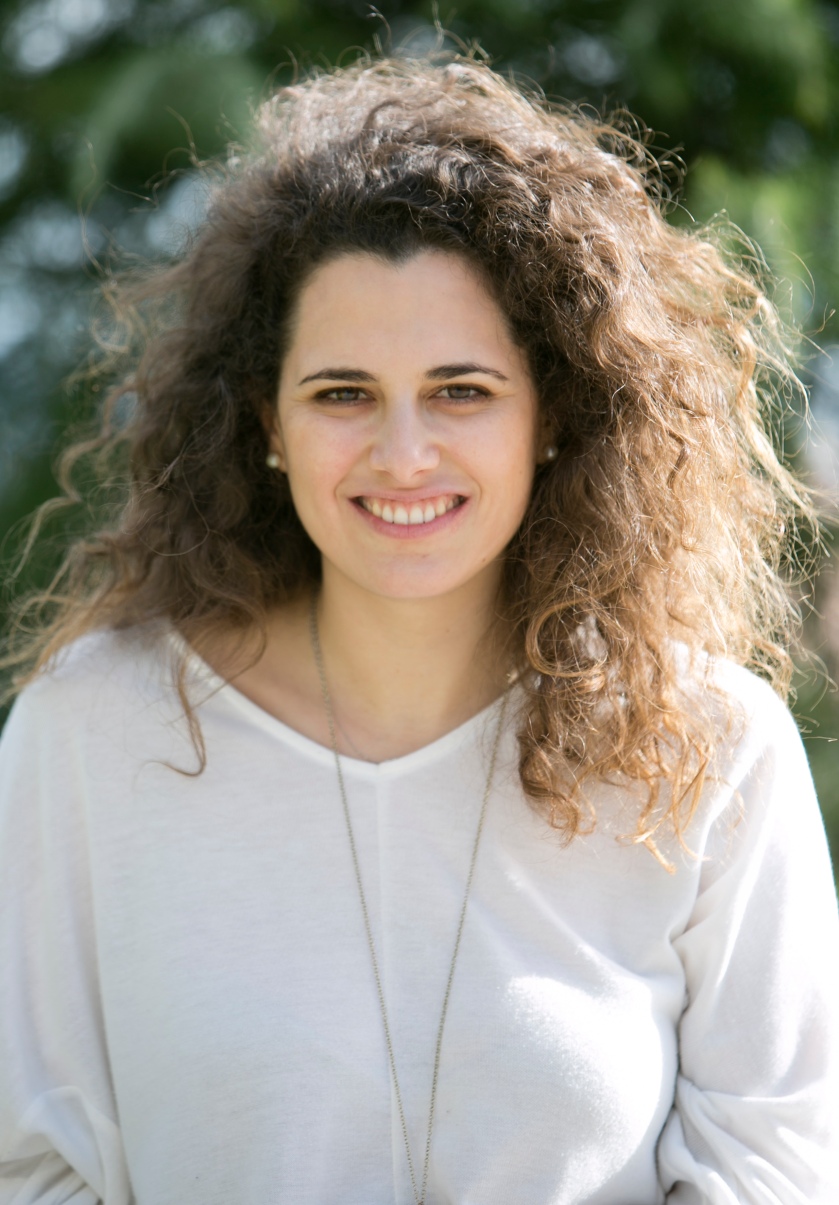
Alexia Vasdeki is a model for self-reliance. In today’s economy where youth unemployment is over 50%, she had no trouble in finding a job and, to top it all, she loves it! She is just back from Vietnam, where she and other volunteers helped build a school.
Tell us a little about yourself
I grew up in Athens and studied at the Athens University of Economics and Business. During my studies, I was an active member of AIESEC, a global student organization, whose aim is to activate and develop the leadership potential of young people. After I finished my term in the National Committee of AIESEC in Greece, I went on their voluntary program in Brazil to teach English in a small-town school. Upon my return to Greece, I decided that I wanted to learn more about education so I completed a degree in pedagogy at my old Alma Mater. Following this, I worked on a project concerning education and social entrepreneurship and for the last year and a half I’ve been working for a company, Krataion Consulting, that is involved in consulting, project management and training. It’s something that I really enjoy because every day is a challenge and I feel I’m learning so much!
My passions are sports, traveling and volunteerism.
What were the major difficulties you’ve faced in the last five years?
I’ve been lucky, since my activities while at University gave me the means to find a job easily and to work in an environment I love. I have yet to send out a CV!
Did anyone in particular inspire you or help you?
Yes, a lot of people have inspired me. One who stands out is Spyros, the owner of the company where I work. He’s a very special person because he combines some unique characteristics. He’s intelligent, extremely ethical and cares for those around him. He’s always trying to give us opportunities to develop and evolve as human beings; something significant he’s also taught me is the importance of self-knowledge. To me this person is a real leader and this reflects on all our team since each day we look forward to going to the office to work, laugh, play (yes, we play games at the office), and eat lunch all together. When there’s real trust within a team there’s no need for timetables, each takes care of his responsibilities. And since we love what we do the results are always great.
What are your hopes/plans for the future?
My biggest dream would be to help change the educational system in Greece. When I was in Brazil I understood at first hand what is said about education being the most sustainable way to solve the greatest problems in the world. I came to really believe this, so upon my return I studied pedagogy not because I was interested in being a teacher but I wanted to find out exactly how the educational system functions both in Greece and abroad.
What are your hopes for Greece? What changes do you hope to see happen?
In truth I’m not expecting to see change coming from the state, but rather from the new generation. I’ve learnt that if I want something in life, I must not wait around but go out and get it. Of course it would be my sincere hope and a major help if at some point proper structures and procedures were put in place so that things worked smoothly. Moreover, my dream would be the creation of a good educational system which would not chop and change but instead evolve.
Have you considered leaving? If so, where would you like to go, and why?
I’m considering going abroad for a while either to do a post-graduate course or to work in a country where I could learn things that would benefit my own country upon my return. I’d really like to see the government begin to encourage young people to stay here.
Are you actively doing anything to help with the situation? Is there something you would like to do?
In my job I have the good fortune to work on projects that are meaningful. One of these, which we’re working on as a team, is a project called ReGeneration, an initiative of the World Economic Forum Global Shapers Athens Hub, whose object is to combat youth unemployment in Greece but also the ‘brain drain’ which sees so many young people leave the country each year.
This is a program of paid internships which aims to help recent graduates take their first step into the work market, by offering them a 6-month paid internship in either a multinational or a smaller company, as well as a training program to help them acquire the necessary skills to take this step.
The program, which is sponsored by Coca-Cola and the The Hellenic Initiative, has been very successful so far: in 2014 we found jobs for 55 people, 80% of whom have had their contracts renewed, and in 2015 internships were found for 105 people, 70% of whom were kept on.
How do you see Greece in 5, 10 years?
I believe that in 5-10 years the situation Greece will have taken an upturn – not because the state will have made any fundamental alterations, although I sincerely wish they will, but because people will have taken the initiative to bring about the necessary changes. In my opinion the basic ingredient for this to become possible is solidarity.
How do you cope with obstacles and frustrations in your everyday life?
Truth is that I have been working a lot since I believe that frustration and anxiety can cause many problems and I have seen it happening often. Therefore, what I have been doing is working on self-knowledge in order to understand better who I am, what frustrates me and what matters most to me. It’s not always easy but I love it when there is a crisis and without getting anxious or nervous, I calmly manage it and solve it.
What are the positive sides of living in Greece? Have you had any good experiences lately?
I love living in Greece! I believe that it is, if not the only, one of the few countries which combine sun, sea, mountains, amazing weather & climate, delicious food, hard working people who at the same time are very kind and know how to have fun and enjoy life. One super simple great experience that I had lately was that after work I went by the sea and had coffee with my friends, and these are the small joys of life.
On the island of Crete, which lies nearer to the coast of Africa than to the Greek mainland, a brilliant civilization flourished from approximately 3650 to 1400 BCE. It was rediscovered at the beginning of the 20th century through the work of British archaeologist Arthur Evans and refers to the mythic King Minos. Minos was associated in Greek myth with the labyrinth and the Minotaur, which Evans placed at the largest Minoan site, Knossos.
The Minoans were the first Europeans to have a literate civilization. They were traders who built a colossal fleet and exported their products all over the Mediterranean: timber, wine, currants, olive oil, saffron and honey, herbs, exquisite pottery, jewellery, wool and cloth. They imported alabaster, precious stones, copper, ivory, gold and silver, as well as artistic ideas and techniques.
They built astonishing palaces decorated with amazing murals; the palaces, unusually, were lacking in fortifications since their choice of site provided natural protection. Also it is thought the Minoans managed to live for many centuries in contact with all the major civilizations of the time without being significantly threatened.
Urged by my grandchildren who are studying the Minoan civilization at school, we went on a two-day excursion to visit the ancient ruins at Knossos and Phaistos. Not nearly enough time to enjoy all that Crete has to offer, it was nevertheless a very interesting and enjoyable trip.
History was brought to life by our excellent guide, Maria, who illustrated the Minoans’ customs and answered every question. The kids were especially interested in the relationship of myth to history.
“Was the Minotaur ‘real’?”
“Where exactly was the labyrinth?”
On the way to Knossos from the airport they treated us to the entire story of the Minotaur, Daedalus and Icarus, etc. with a special focus on the gory bits, of which there are plenty!
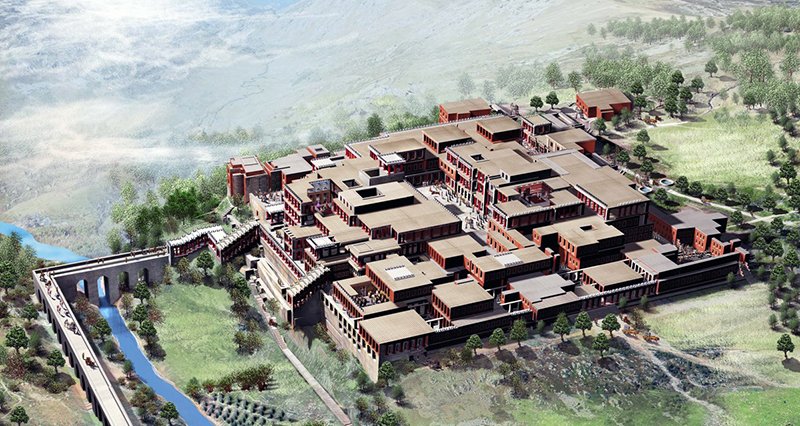
Knossos was a huge palace (700 rooms over 5 floors have been excavated out of an estimated total of 1300-1500) with very complicated architecture (hence the labyrinth?) and enjoyed superb views over the surrounding countryside and the sea. Its walls were painted in bright colors and the floors and wainscoting were made of alabaster imported from Egypt.
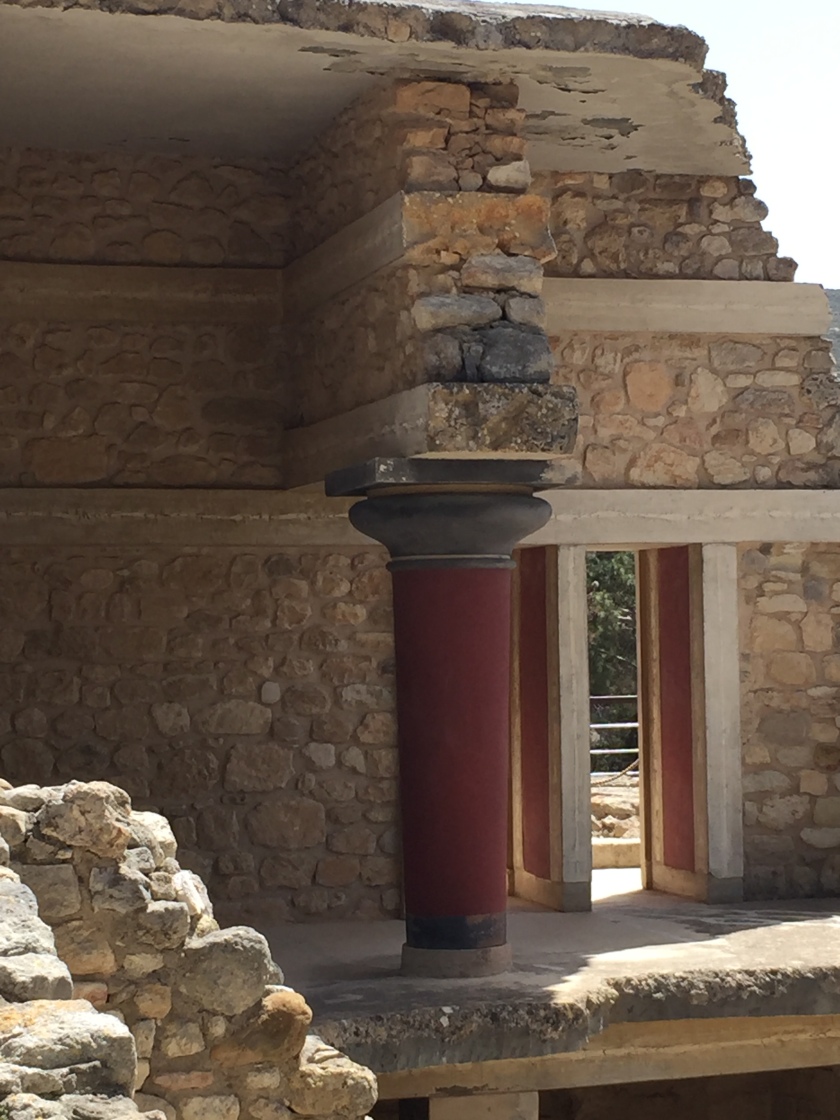
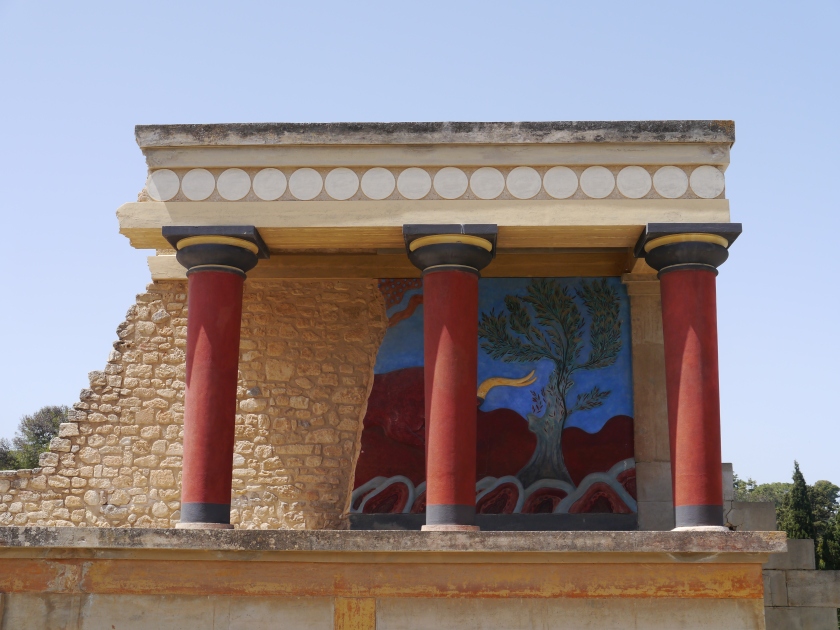
The columns, made of cypress trunks, were wider at the top than the base.
The palace has been reconstructed in some parts to give visitors an idea of its former splendour.
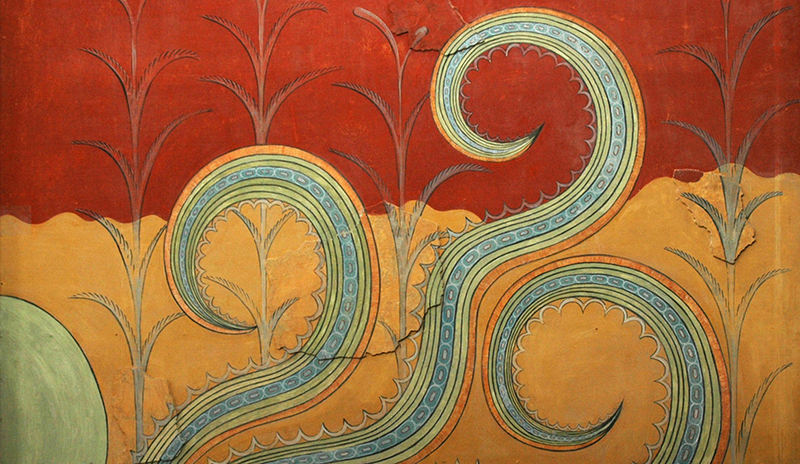
The appartment walls were decorated with wonderful murals.
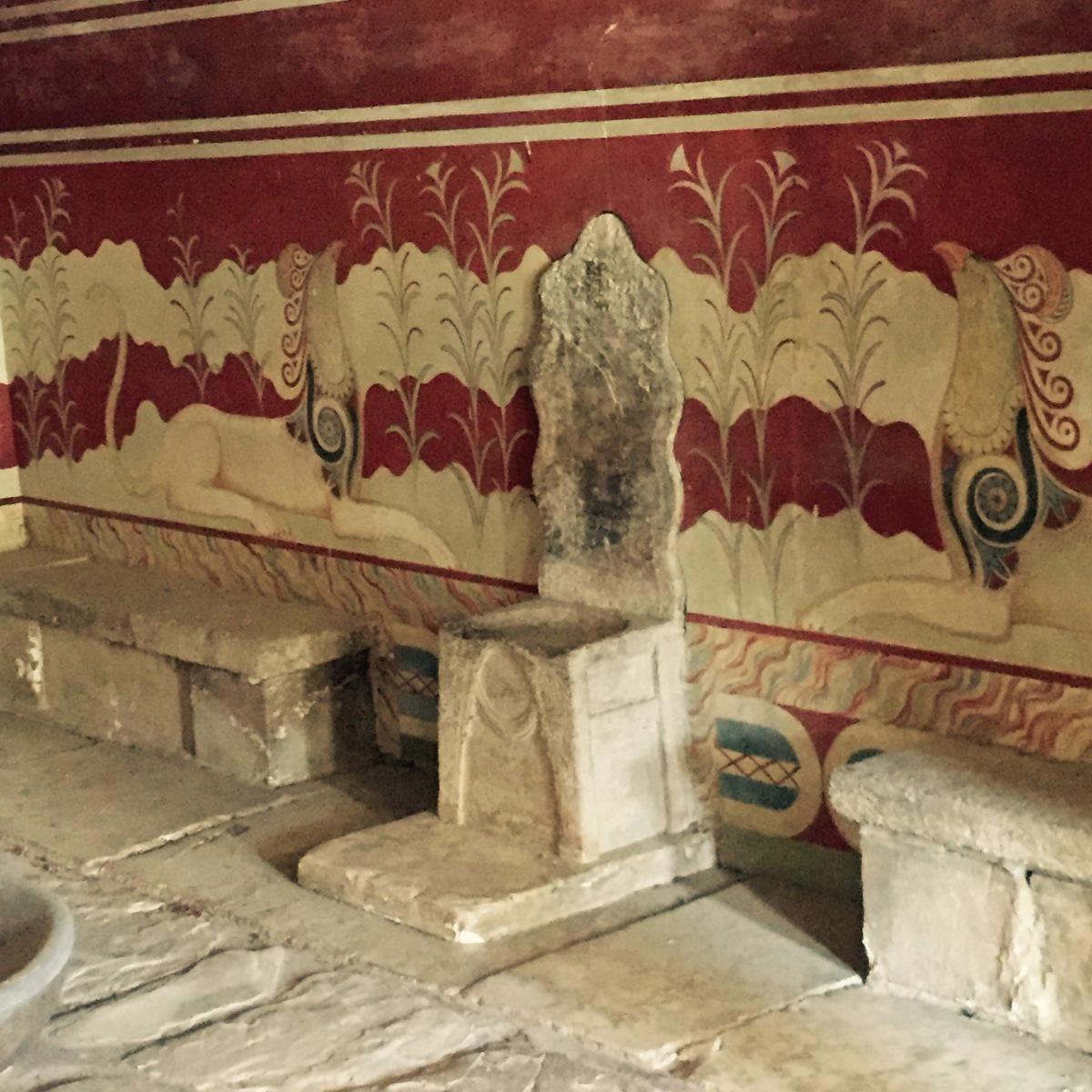
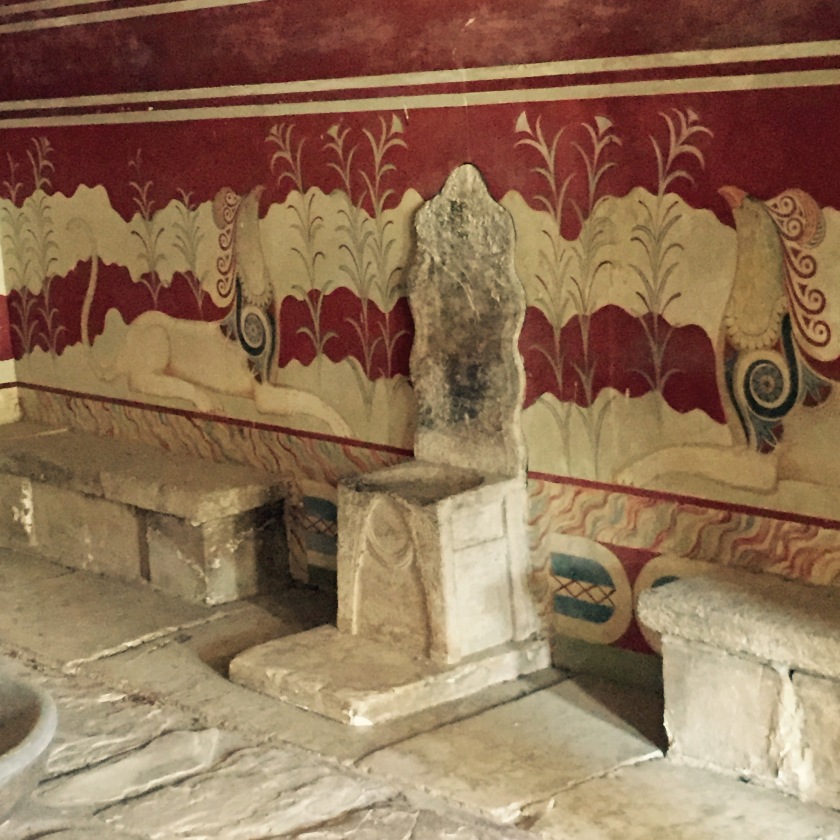
This is the throne room, with images of griffins on the walls.
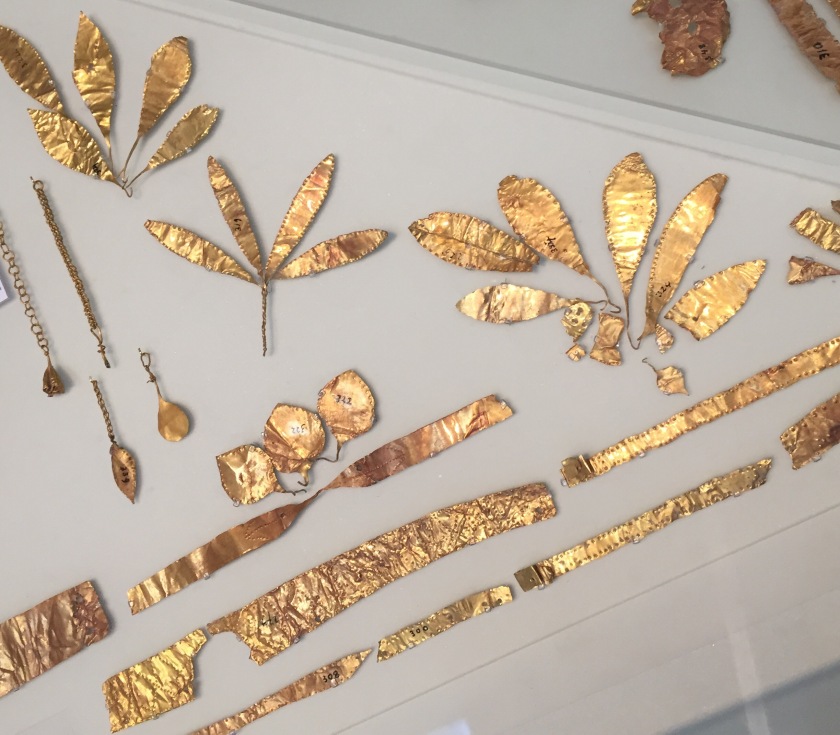
The Minoans had workshops which made delicate jewellery.
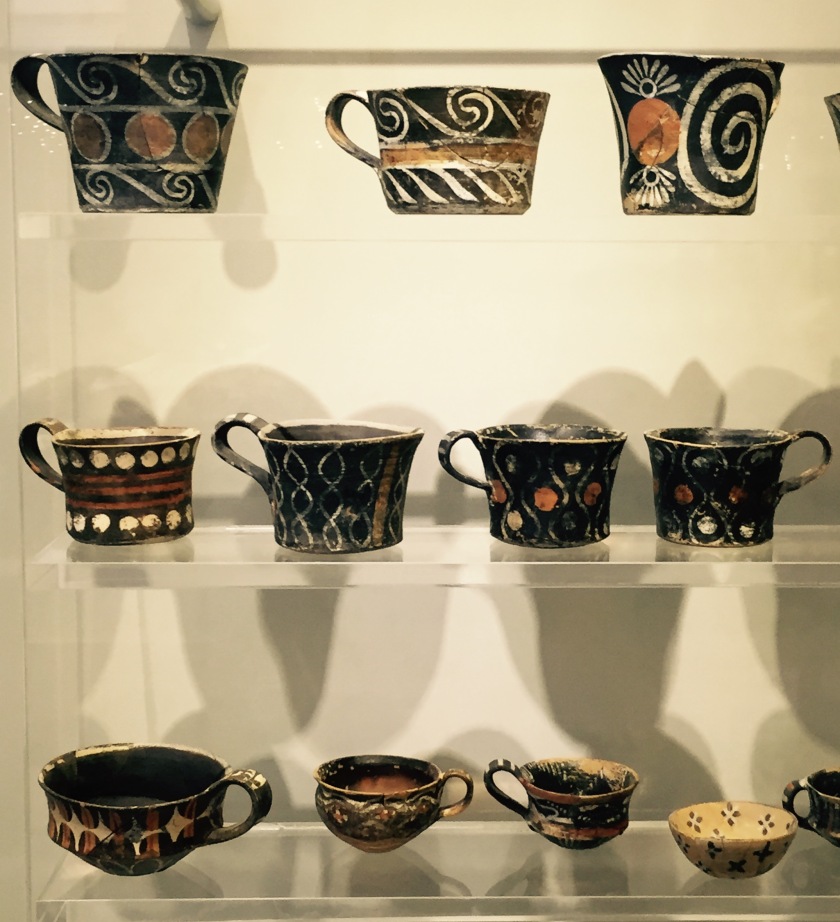
And even more delicate porcelain, known as Kamares vessels. (Καμαραϊκά αγγεία)
They had a theatre,
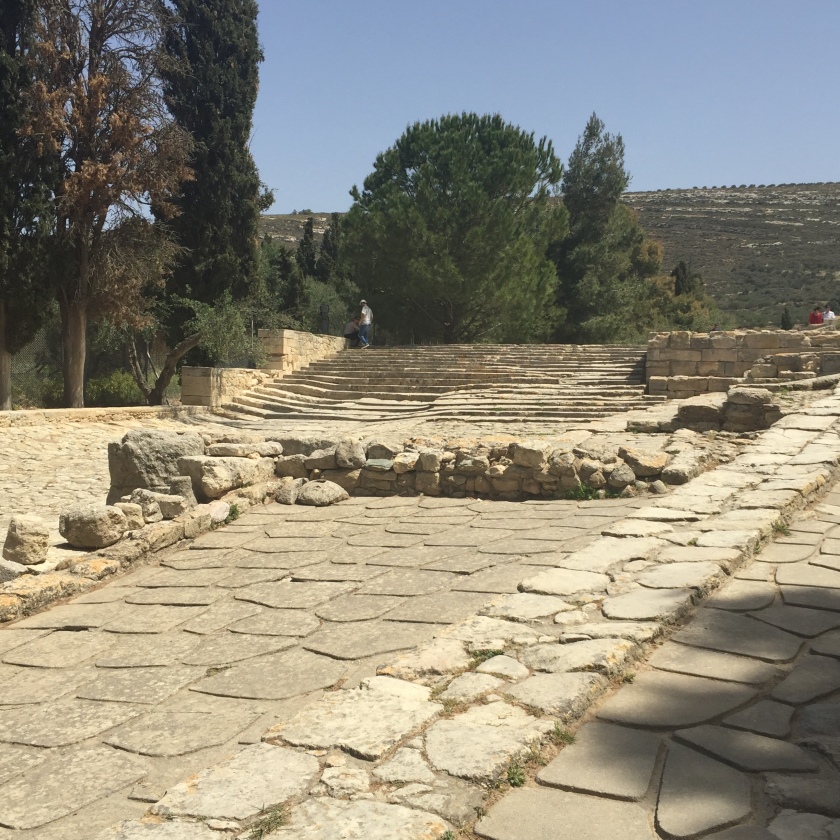
View of the theatre with a royal box (upper right hand corner) and, in the foreground, one of the oldest paved roads in Europe.
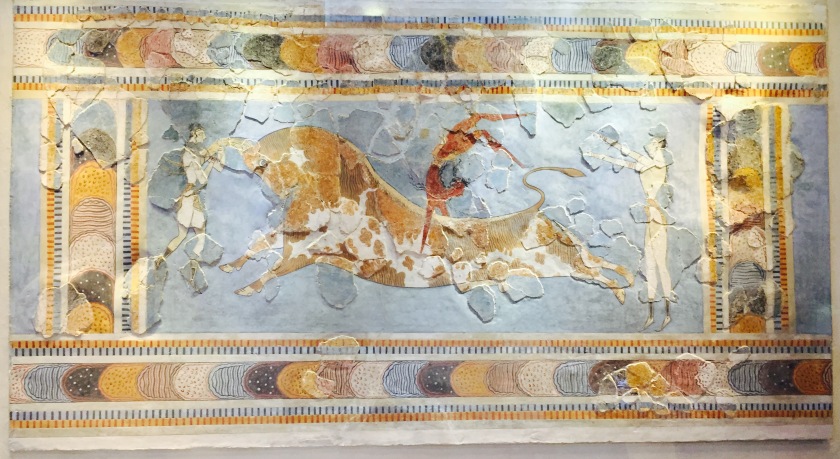
and a central courtyard where the famous bull games took place. These involved both boys and girls somersaulting over a bull, which was not killed at the end of the games (as in Spanish bullfights). It probably ended up being sacrificed to the gods, though.
Two girls and a boy showing the sequence of actions In the bull games. This is where the expression “to take the bull by the horns” came from!
The Minoan palaces also had plumbing – running water and sewage – even on the top floors (something not seen again until the Romans, 2000 years later). Also the orientation of each room made for perfect ventilation; we visited on a hot day, and the temperature indoors was several degrees lower than outside.
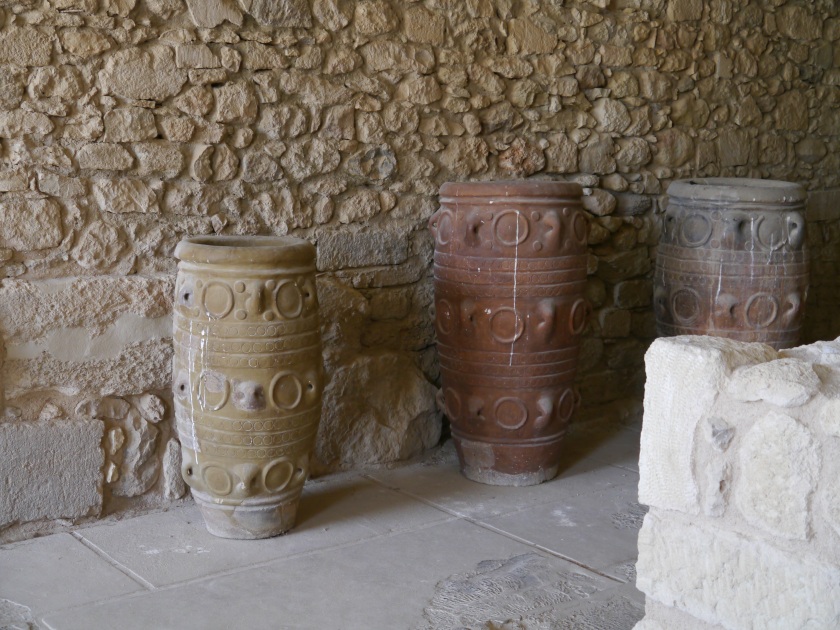
Wonderful jars in which they stored oil, honey and other produce
We continued with a visit to the Irakleion museum, which has been totally refurbished and contains all the important artifacts.
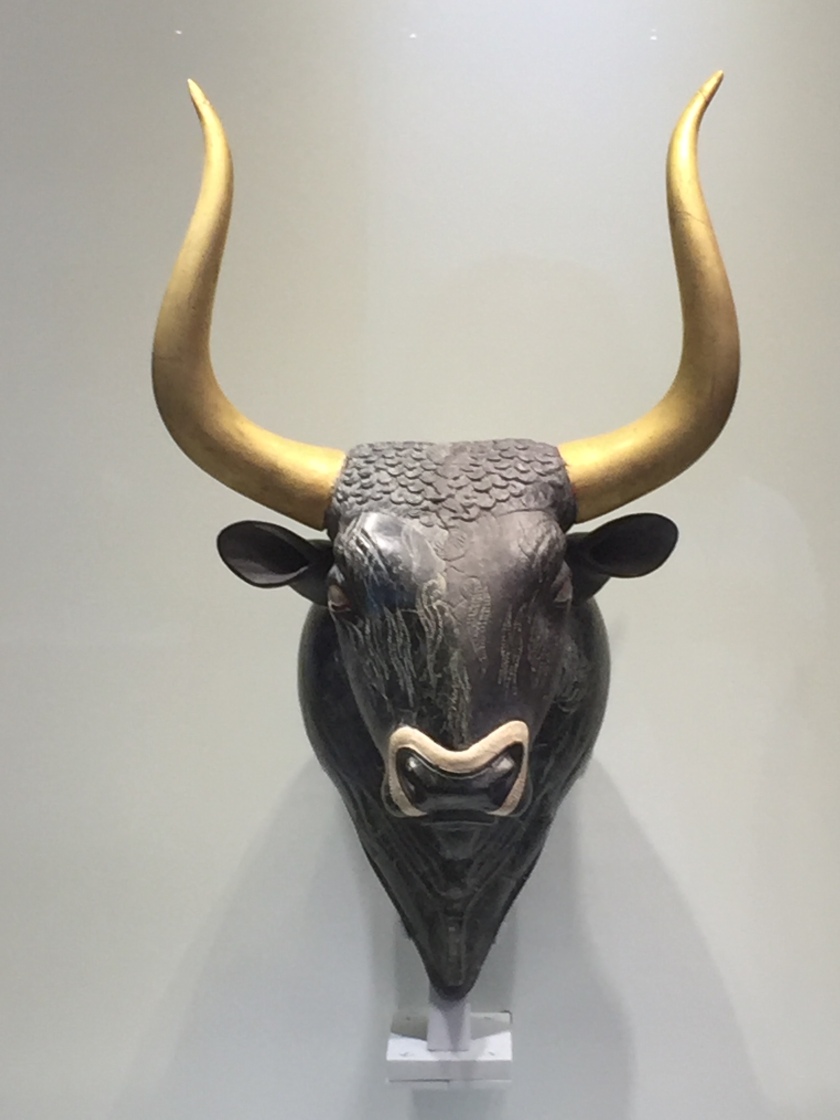
The bull was worshiped as a symbol of strength and thus portrayed in many ways.
Bull’s head made of steatite with mother-of-pearl nose, gilded horns and eyes of rock crystal
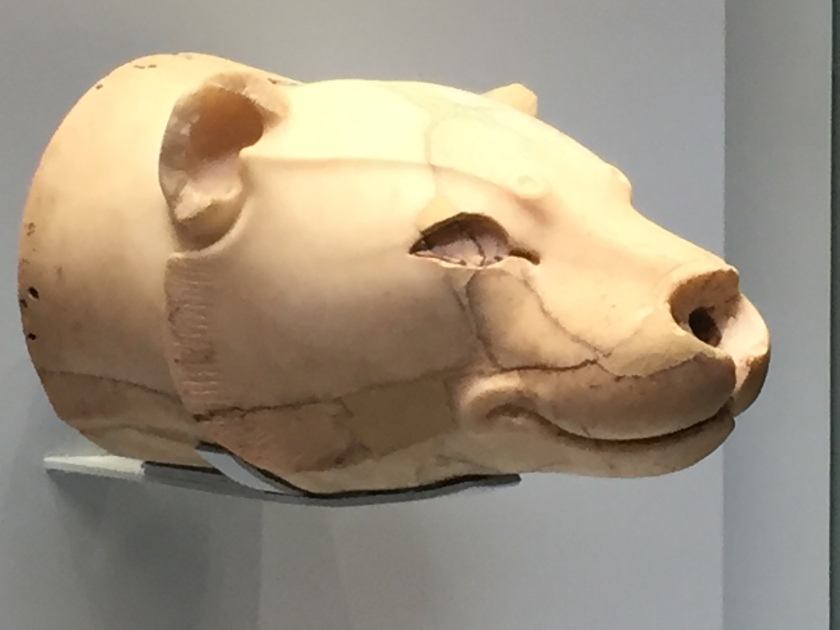
Head of a lioness made of alabaster. It used to have eyes of amber and a nose of rose quartz.
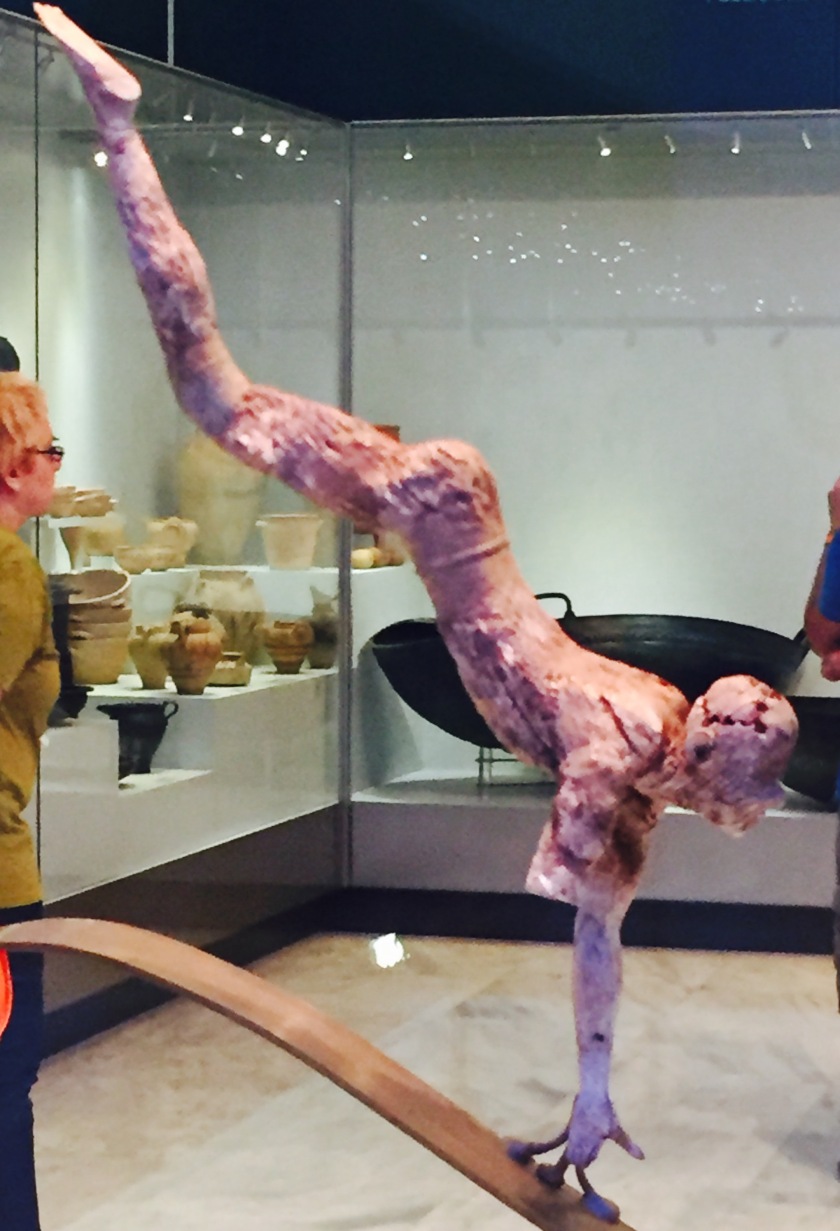
Statue of an acrobat in the bull games, made of ivory
We finished the day with a cooling swim in the sea, and the next morning set off for Phaistos, and hour and a half away through lovely scenery. The mountains were covered with Cretan ebony, small bushes covered in pink flowers. They looked a little like overgrown thyme, but apparently their seeds produce very vivid black dye, used in ancient times and still today.
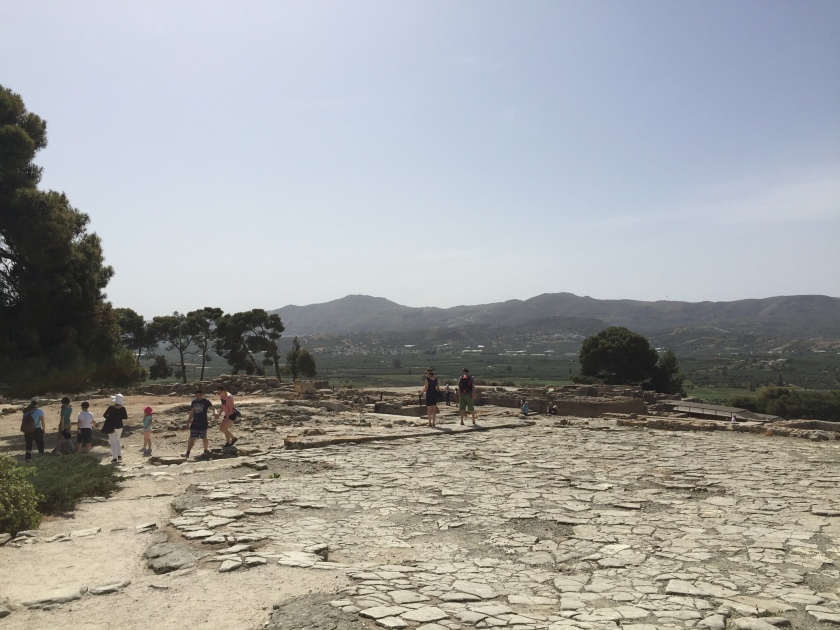
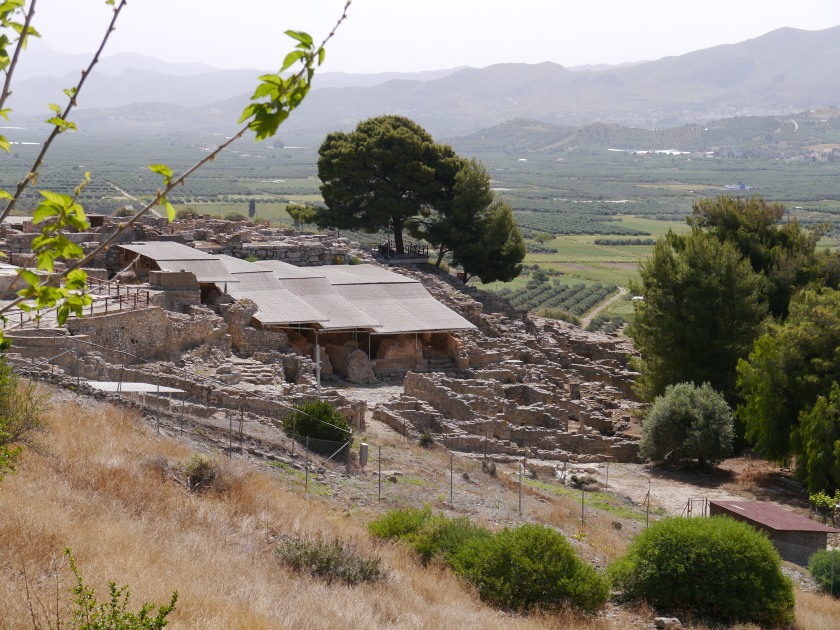
The palace of Phaistos is much smaller than Knossos (around 700 rooms), but still impressive, built on a lovely site overlooking fertile plains.
It faces north and thus also has superb ventilation, as well as plumbing and workshops. One of the trades first practiced there is that of metallurgy.
It also has a theatre,
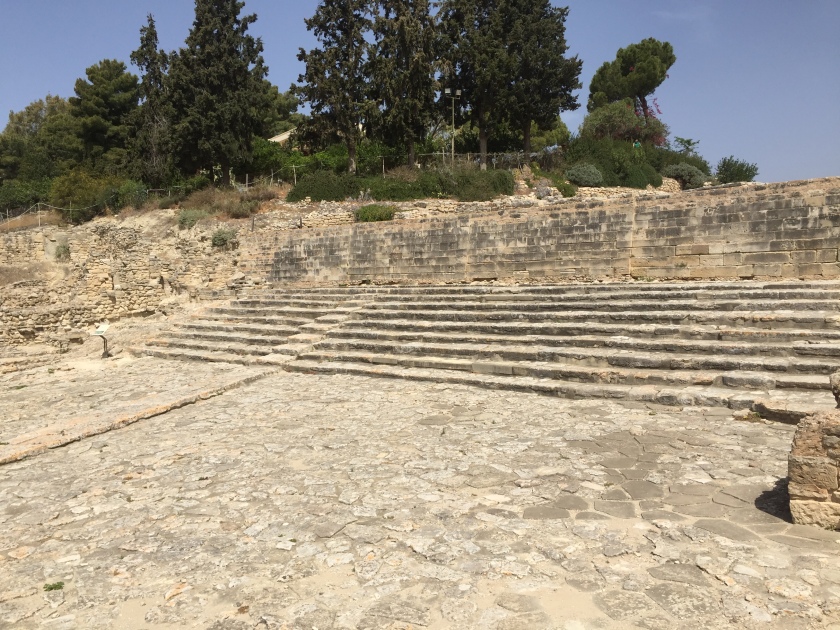
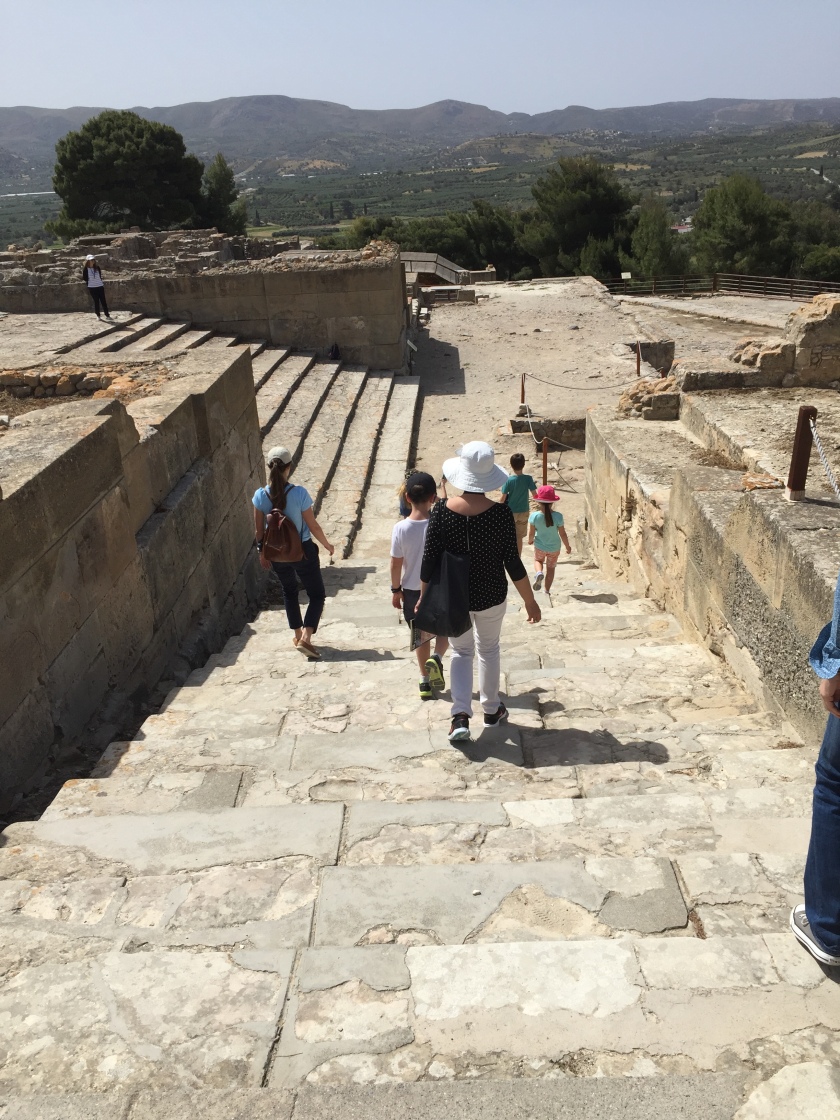
And wide stairways.
Feeling famished after our visit, we stopped off for lunch at a little taverna down the road. We were welcomed by a lone man who did not speak Greek well. Fearful it would take forever to get served, we made the kids all have the same thing. However, things started arriving on our table in a delicious sequence – salads of delicious tomato and cucumber, little spinach pies melting in the mouth, saganaki (grilled cheese), the most aromatic spaghetti bolognaise for the kids and, for the adults, a chicken tagine with saffron and prunes. I’d thought the man was Egyptian but he proved to be a Moroccan. Having finished serving, he sat down next to us for a chat and told us he’d been a cook on the ships, had stopped off in Crete on leave 30 years ago and stayed. But, he said, placing his hand on his heart, it was his mother who’d taught him to cook. She must have been one hell of a chef!
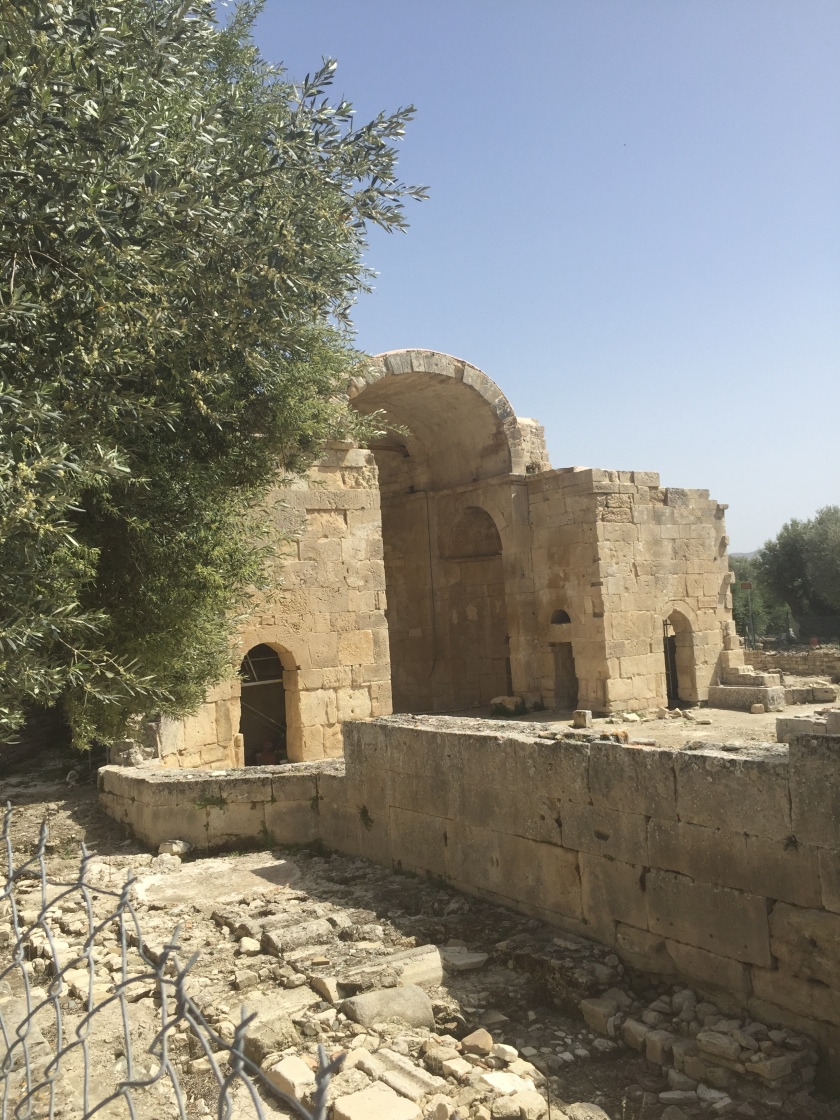
Having some time to spare before our flight, we stopped off at Gortyna, the site of a beautiful domeless Byzantine church
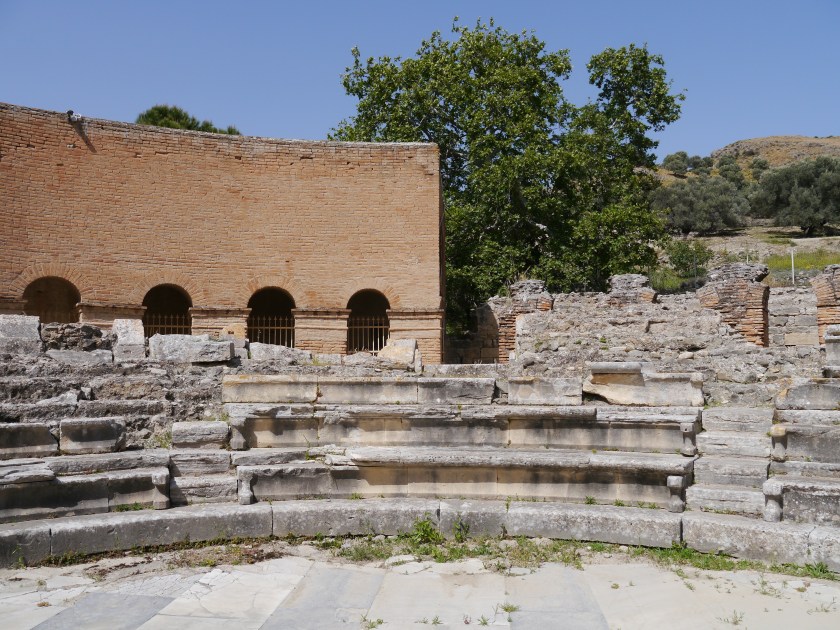
And a Roman Odeon
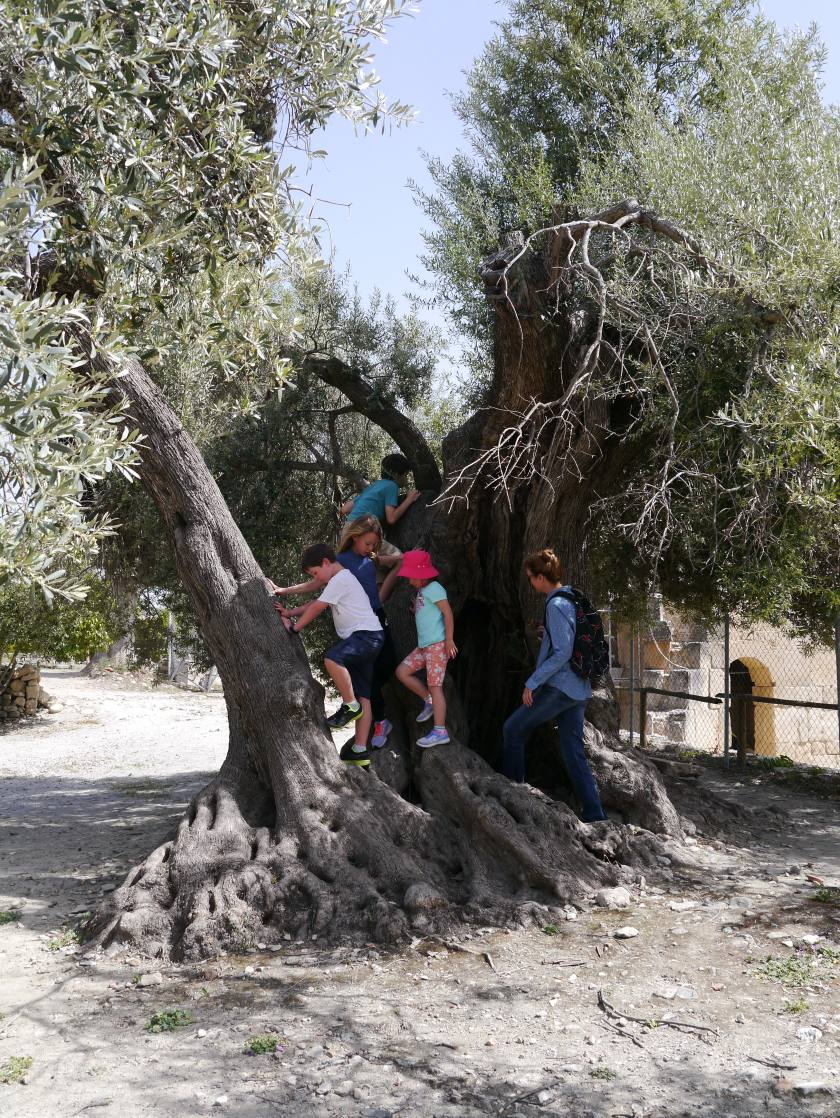
The surrounding land contained ancient olive trees, one of which was around 700 years old;
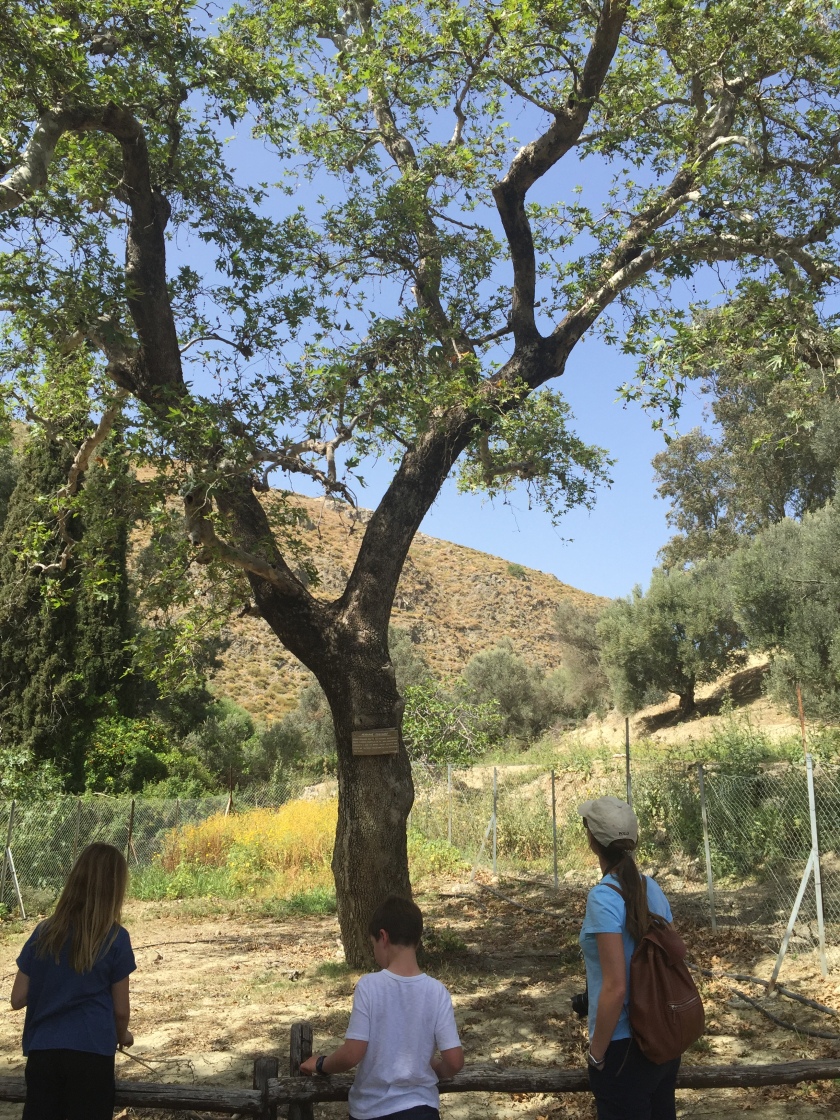
as well as the descendant of the plane tree under which the union was consummated between Zeus and Europa which would produce King Minos and his siblings, Radamanthes and Sarpedon.
The peculiarity of this tree is that it is the only plane tree that is not deciduous – it keeps its leaves in winter!
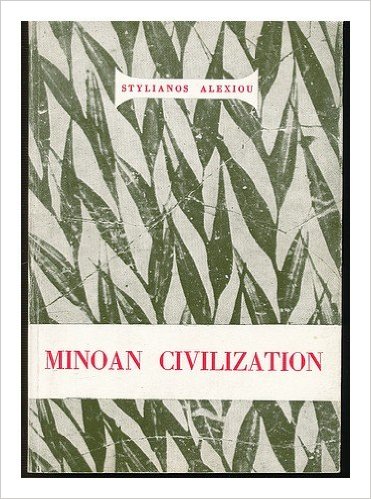
Obviously, this is just the description of a family trip. I’m no historian, so for anyone interested in finding out more about the Minoan civilization, I can recommend the excellent book written by Stylianos Alexiou.
Some days ago Pope Francis made a surprise visit to the island of Lesvos.
The Pope was met at Mytilini airport by Greek Prime Minister Alexis Tsipras, Patriarch Bartholomew, the spiritual head of the world’s Orthodox Christians, and Archbishop of Athens Ieronymos.
The three religious leaders visited the refugee camp at Moria which holds around 3.000 people.
In his speech at the camp, Patriarch Bartholomew told the residents: “The world has not forgotten you. The world will be judged by the way it has treated you.” Archbishop Ieronymos decried “the bankruptcy of humanity and solidarity” that Europe has shown migrants lately. Pope Francis called on the international community to respond to the crisis “in a way worthy of our common humanity.”
The three religious leaders then signed a declaration urging the international community to protect human lives and extend temporary asylum to those in need.
In a symbolic gesture, the Pope took 12 refugees back with him to the Vatican.
In 2013, the Pope had made a similar trip to the island of Lampedusa, to visit the refugees arriving there from Libya.
Visits such as these serve to highlight this humanitarian disaster, as do visits from celebrities. They have no political clout; the Vatican was at pains to point out the Pope’s visit was “humanitarian and religious in nature.”
One question remains – why do Muslim leaders not feel the need to make similar gestures? After all, most of these refugees are Muslims who could derive a lot of comfort from such a visit.
The response of ordinary Muslims to the refugee crisis has been great. Surrounding countries host the bulk of the Syrian refugee population. Many of the neighbouring countries – Lebanon, Jordan, Turkey, Iraq and Egypt – have shown remarkable spirit in taking, altogether, millions of refugees. Unfortunately, some of the most affluent Muslim countries have not followed suit.
I also find it strange that Muslim leaders are not more concerned in showing the world that Muslims are not necessarily terrorists, a self-evident fact which is getting buried by the fear generated by the proliferation of Islamist terrorist attacks. Perhaps there is something here I don’t know – I would welcome any feedback anyone might have on the subject.
Charity can be a double-edged sword, especially when practiced by people who are celebrities. It is true that their notoriety helps to highlight the issue they’re concerned with and bring it to the attention of the public, but how much difference does it make in actual fact? And how much of it is also used for their own advancement, the feeding of their own fame?
The latest example of this is Chinese artist Ai Weiwei’s espousal of the refugee crisis. He thought it a good idea (“art”?) to take a photo of himself lying on a pebbly beach, recreating the image of drowned infant Alan Kurdi that in 2015 became the defining symbol of the plight of Syria’s refugees.
This was seen as tasteless by many, as was his suggestion that high-profile celebrities don thermal blankets and take selfies at a gala event for the Cinema for Peace, for which he also wrapped the columns of Berlin’s Konzerthaus with 14,000 salvaged refugee life vests on Feb. 13.
At Idomeni camp on the Greek-Macedonian border, the dissident artist set up a piano in the middle of a muddy field and invited aspiring Syrian pianist Nour Al Khzam, from the city Deirez Zor, Syria, to play it.
The photographs of this event are a bit incongruous, since a light drizzle necessitated someone to hold a piece of plastic over girl and piano. The reviews I read were mixed – some characterized the event as ‘beautiful’ some as ‘ridiculous’.
It’s difficult to gauge the overall improvement in the victims’ situation resulting from such antics. If you’re stuck in a camp, cold and wet and uncertain about your future, are you overjoyed to see Angelina Jolie (another visiting celebrity), or would you rather have a hot meal?
That is why I admire people offering help on the ground, as it were. Small gestures sometimes, but which make a big difference. One would not even hear of them, were it not for some journalists seeking out these stories and writing about them.
Free Wi-Fi at Idomeni
One such article by journalist Lina Giannarou, written for the Kathimerini daily paper, tells of Ilias Papadopoulos, who decided to provide free Wi-Fi for the refugees trapped at Idomeni, on the Greek frontier. The border has been shut, these people are desperate for news, they need to communicate with their families; some have been separated from relatives on the way and want to look for them through social media.
Ilias Papadopoulos, a Greek electrical engineer who lives in Thessaloniki, a city about an hour’s drive south of Idomeni, built the necessary infrastructure inside an old trailer donated by the church in September 2015. He spent more than €5000 of his own money.
“I had the idea for free Wi-Fi at the beginning,” said Papadopoulos, who first went to the camp in August 2015 to see how he could help. “People had mobile phones, but no roaming, so they could not use them. They couldn’t communicate with their families.” He also found out hotels were asking people €5 to recharge their phones, so he showed up with large professional 80-slot plug boards, which he powered first with batteries and later using generators. In order to organize internet access, since phone signals in the mountainous area are weak, he borrowed two telephone lines from a local Evzone (army) unit and connected wirelessly to Idomeni.
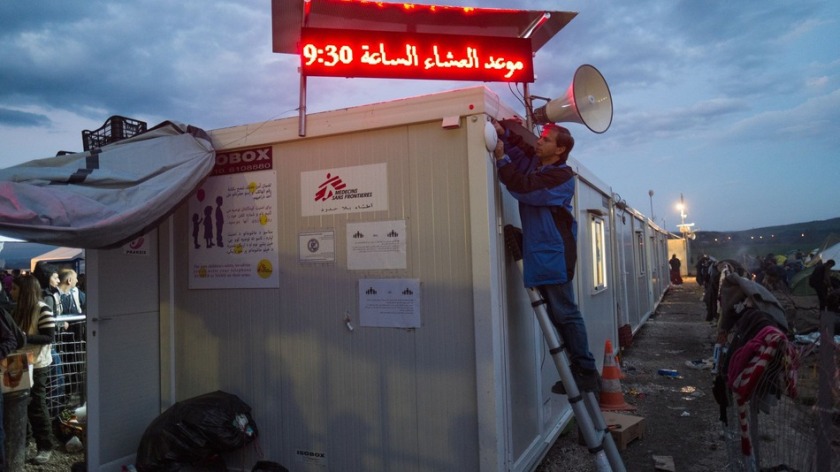
Papadopoulos setting up. Photo from Mashable.com
Today his installation covers about 2/3 of the camp area. There’s still a problem, since the network’s capacity is for up to 900 simultaneous users, while thousands are trying to connect at any given moment. But, if you go near one of the eight antennas or try late at night, it’s easier. Using the network is free, but it is controlled – Ilias has blocked sites that are unsuitable for children or connected to criminal activities. He is now proposing to the authorities and the NGOs to use his network for information purposes, since he’s noticed a lot of the refugees don’t know what their options are and are still hoping the border will open soon.
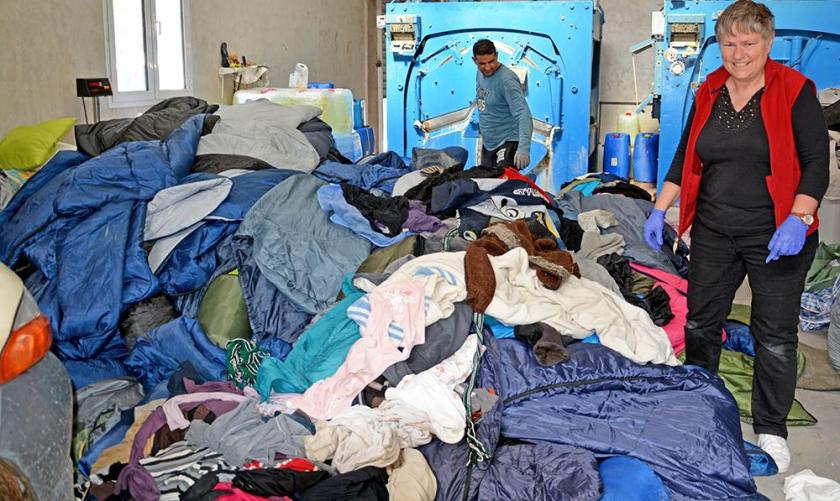
When the refugees arrive on Lesvos in unstable, overcrowded boats, they are drenched with sea water. They are given new clothes and their perfectly good, but wet clothes are discarded and have mostly been trashed , adding to the environmental problems of landfill on Lesvos. Now Dirty Girls collect the clothes and have them laundered at a commercial laundry. They are sorted and distributed so they can be reused. Because of monetary donations, from people all over the world who want to help, we have been able to recycle many thousands of items of clothing.
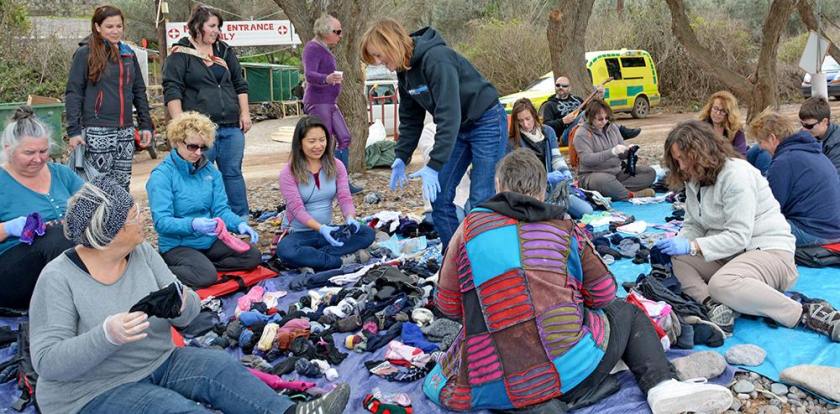
Sorting socks! Photo from their Facebook page
Dirty Girls is the brainchild of Alison Terry-Evans, an Australian who has been going to Lesvos for years. Alison saw the littered beaches as an opportunity to recycle and simultaneously provide a service.
Local volunteers gather the dirty clothes from the sand and rocks, place them in bags, label them, and leave them by the side of the road. Alison’s team picks them up, gets them washed and dried, and then distributes the garments to the camps and outposts cropping up along the coast. Even heavy-duty blankets and shoes are sanitized so they can be put to good use.
Alison has always loved doing laundry. She says: “Sorting for me has always been a near meditation; so much satisfaction for little actual elbow grease. And finding a mate for the odd sock or shoe is super satisfying. So visiting the huge washing and drying establishment, Ermes, owned and run by Peter Mylonas, was thrilling.”
Peter saw Alison collecting clothing on the beach and heading home to wash and dry. He generously offered his assistance, and the rest is history.
Everyone on Lesvos loves Dirty Girls: the locals, the arrivals, the NGOs. Alison keeps the washing machines spinning thanks to private contributions. Want to help? Find Dirty Girls of Lesvos on Facebook.
Piles of laundry. Photo from their Facebook page
Recycling to make bags for refugees
One of the often overlooked side effects of the refugee crisis in Europe is the massive amount of waste piling up on the islands at the frontline of the crisis.
Thousands of news arrivals are pouring onto the islands daily, leaving behind them on the beaches piles of rubber dinghies and thousands of life jackets.
Volunteers on the island of Lesbos have developed a novel approach to dealing with some of the waste by upcycling the rubber from the boats and the straps from the life vests into waterproof bags.
Twenty-four-year-old Amsterdam native Floor Nagler had been volunteering on the island helping people disembark from boats when she noticed a need for bags, since many people had lost theirs along the route.
Nagler brought some of the material back to Amsterdam, where she is studying textiles, and worked with a fellow Dutch artist until they up with a solution. Then they took the concept back to Lesvos where they held workshops outside the Moria reception center near the capital city, Mytilini.
The bags are made from one folded piece of discarded material from the boat, held together with rivets and clipped shut with buckles from life vests. The bags costs around $3 to make and can be assembled by hand.
Floor gives a demonstration. Photo Amos Chapple/RadioFreeEurope
This is not the first project that Nagler and others have set up in upcycling materials on the island that were once destined for landfills.
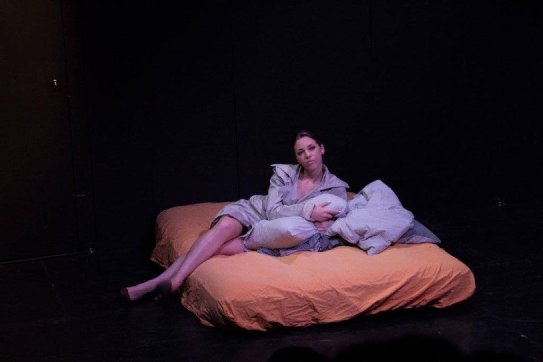
Back in January, Nagler was making mattresses out of the life jackets that were left behind. Along with a group of volunteers, she founded the It Works initiative to bring empowering skills to the refugees who arrive on the island.
You can watch Floor making her bags on YouTube, below:
Emerging opera singer Marilena Chrisochoidi kindly took the time to answer questions about her life and career. She has lately appeared in the opera The Merry Widow in the role of Olga, and she stars in Andonis Karatzikis’s new opera, Eleni. She is also rehearsing for concerts featuring Vivaldi’s ‘Gloria’ and Charpentier’s ‘Te Deum’.
Tell us a little about yourself.
I was born in Athens but my family originates from Asia Minor. I’ve known since childhood that the only thing I wanted to do in my life was music and singing. I started playing the piano in primary school, then I went to a musical high school. I was taught the piano, the santur (a kind of zither) and the tambourás (a kind of traditional stringed instrument that developed into the bouzouki) both at school and at the Conservatory. My love for the piano and even more, the santur, contributed in winning prizes and scholarships. In high school I started taking voice lessons at the Conservatory, which led me to study opera. After school I exclusively studied monody (lessons in opera) and I watched every opera performance I could. My melodrama teacher at the Conservatory encouraged me to study theatre and so I graduated from the Karolos Koun Art Theatre Drama School, while at the same time getting my diploma in monody. Today I teach the zither and voice lessons in conservatories while taking my first steps as a soloist and an actor in opera and theatre.
What were the major difficulties you’ve faced in the last five years?
I’d say the main difficulties are of a financial nature, since in our discipline you know you have work for the current month but the following you’re unemployed and waiting for the next concert or performance. At the same time, taxation for freelancers is hard to bear.
Did anyone in particular inspire you or help you?
The work and the collaborations within it are in themselves a source of inspiration, while the rhythm of performances helps you escape from the difficulties of reality and the problems of daily life. It’s important that the arts continue to evolve in difficult times and that we promote culture and civilization.
What are your hopes/plans for the future?
My aim is to continue doing what I love and to keep improving, with the objective not only to be emotionally uplifted by my art but also to contribute to its safeguard and development.
What are your hopes for Greece? What changes do you hope to see happen?
The difficulties of the Greek situation are clear to me. However, I hope the Greek people will manage to resurrect themselves from the ashes as they so well know how, so that there will be space for a cultural renaissance beyond the improvement of daily life, and so that as a country we can prove worthy of our cultural inheritance. I also wish for the refugees who arrive on our shores a rapid end to the agonizing struggle for survival they experience daily. I hope that Greece will prove to have been an aid in their future lives.
Have you considered leaving? If so, where would you like to go, and why?
I have not decided to leave Greece permanently. However, international activities promote the career and development of an artist. Therefore, I too try to find collaborations in countries where opera is flourishing.
Are you actively doing anything to help with the situation? Is there something you would like to do?
All contemporary artists in Greece are contributing in concrete ways to the continuity of art, by investing emotionally and practically, given the low level and erratic frequency of compensation. I consider the organization of an increasing number of charitable performances and concerts all over the country of extreme importance, both for the support of the vulnerable and for the diffusion of art in general.
How do you see Greece in 5, 10 years?
The truth is that the future seems difficult. But it is up to us to reverse this trend with hard work, humanitarian and cultural education, solidarity and fundamental change. Our people must regain the sense of pride they had in the past and stop trying to be a pale copy of western civilization. Greece is a country full of treasures from coast to coast. I consider it imperative to exploit our material riches (products and foods with controlled designation of origin) as well as our cultural riches (theatre, education, archaeological heritage). Surely this would make for a strong start.
A poster from one of the shows Marilena performed in
How do you cope with obstacles and frustrations in your everyday life ?
I try not to let the difficulties I meet be an obstacle to my objectives. I prefer to focus on pleasant events from which I draw joy and strength to go on.
What are the positive sides of living in Greece? Have you had any good experiences lately?
Greeks continue to fight at all levels, showing exemplary patience and faith. Despite the difficulties due to the drop in living standards, there’s always a spark of optimism. That is the positive side of life in Greece. In And in my own discipline, we also remain active while keeping our standards high.
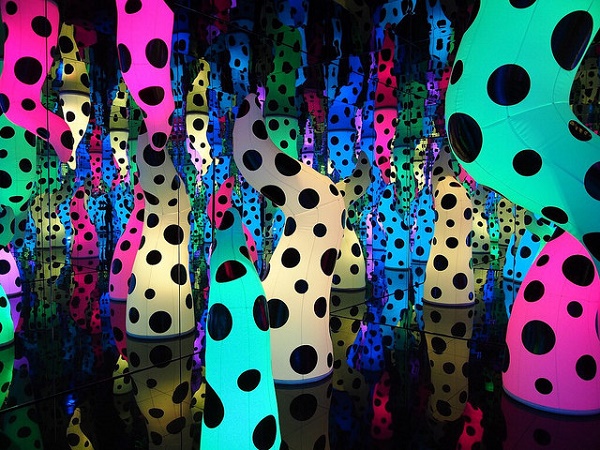
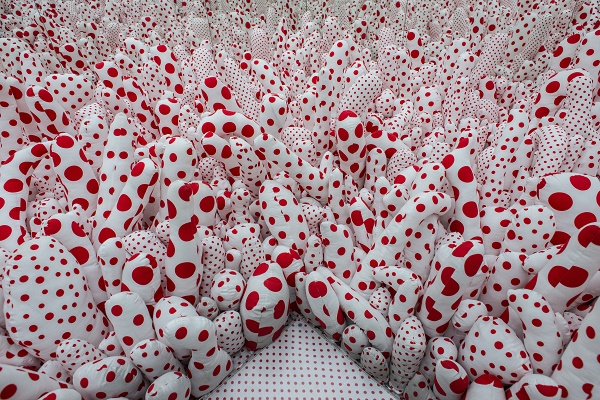
I’m a fan of Yayoi Kusama’s psychedelic eccentricity and gaily polka-dotted work. The Japanese artist is 87 today, and for the past 20 years has been living in a Tokyo mental hospital, from where she has continued to produce artworks in a variety of mediums, as well as launching a literary career by publishing several novels, a poetry collection and an autobiography.
She famously said: “My art originates from hallucinations only I can see.”
Yayoi Kusama, Love is Calling (2013) Image: M_Strasser via Flickr Creative Commons
In the sixties, Yayoi Kusama was part of the New York avant-garde scene, having her works exhibited alongside the likes of Andy Warhol, Claes Oldenburg and George Segal.
Yayoi Kusama, Gleaming Lights of the Souls (2008) Photo: Jim Dyson/Getty Images
In her honor, Artnet News has published a lovely article entitled:
14 Yayoi Kusama Quotes on Her 87th Birthday (Article by Alyssa Buffenstein)
You can find it here. (I borrowed the photographs from them, many thanks.)
One of our main national celebrations in Greece is March 25, which commemorates the start of the 1821 Greek Revolution against the Ottoman Empire, a revolt whose motto was the cry “Freedom or death.”
Following the fall of Constantinople in 1453, Greece remained under Turkish occupation for four centuries. After a number of unsuccessful attempts at revolt, the War of Independence started in 1821. Despite many reversals, this would lead to the establishment of a Greek sovereign state with the London Protocol of 1830, signed by England, France and Russia – the allies who intervened to help win the war. The Greek struggle had elicited strong sympathy in Europe, and many leading intellectuals had promoted the Greek cause, including the English poet Lord Byron. At the naval Battle of Navarino, the combined British, French, and Russian forces destroyed the Ottoman-Egyptian fleet.
In 1838 King Otto, the first king of the new state, declared the beginning of the revolution was to be commemorated each year on March 25th with a national holiday; celebrations were held in the presence of the heroes of the revolution, who were eulogized by the crowds. Fires were lit on the Acropolis, a service was held in the church of Saint Irene and a flaming cross placed on mount Lycabettus.
The day was chosen to coincide with the Greek Orthodox Church’s celebration of the Annunciation to the Theotokos (Mother of God), when the Archangel Gabriel appeared to the Virgin Mary and told her that she would bear the son of God.
The blessing of the revolutionary flag – Theodoros Vryzakis(1819-1878) – Oil on canvas
On this day, towns and villages throughout Greece hold a school flag parade, during which schoolchildren march in traditional Greek costume and carry Greek flags. There is also an armed forces parade in Athens.
In folk tradition, the day also marks the beginning of spring and the return of the swallows. And of course, there is a special dish to go with all this: μπακαλιάρος σκορδαλιά (bakaliaros skordalia), cod fried in a beer batter and accompanied by a garlic sauce, made with potato, olive oil and sometimes walnuts. During Lent, fish is only allowed twice, on March 25th and on Palm Sunday. On the islands people cook fresh cod, but elsewhere it is usually the custom to use salt cod, which was introduced in Greece in the 15th century. You will find a recipe here, and I can vouch it is delicious.



 May Wreath by M.L.Kappa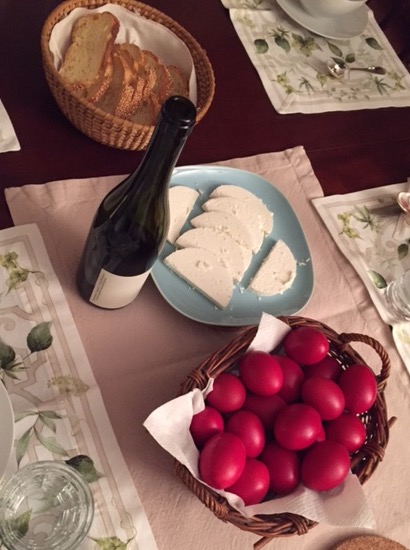







 Letters from Athens