A poem to read after watching the news or reading the papers.
Humans are really a race of hawks and warmongers—they have an inherent need to exterminate each other. History has taught us nothing—we have achieved huge improvements in technology, but none in human nature. Anyone who doubts that should read Herodotus’s Histories.
Of course not everyone fits into that category—humans are also capable of great feats of invention, creativity and cooperation. Sadly, the warmongers will usually prevail, since they are prepared to go to lengths peacemakers won’t. It is amazing how excessive power and wealth will corrupt almost everybody.
We are constantly bombarded with too much information, most of it of a disagreeable or horrifying nature. Corpses, ruins, starving children, shootings and stabbings, unspeakable politicians. I read the headlines, but avoid watching the news on television. One cannot take the whole world’s misery on one’s shoulders, and it is useless to worry about things one can do nothing about. But of course I do worry—it is impossible not to be anxious about the world we are leaving our descendants.
However, there is still so much beauty on this earth, it is good to seek it out as much as possible. Being lucky enough to live in the country, I revel in nature’s bounty. At this time of year, life is bursting out everywhere. Bees buzz, birds sing, cherries ripen on the trees.
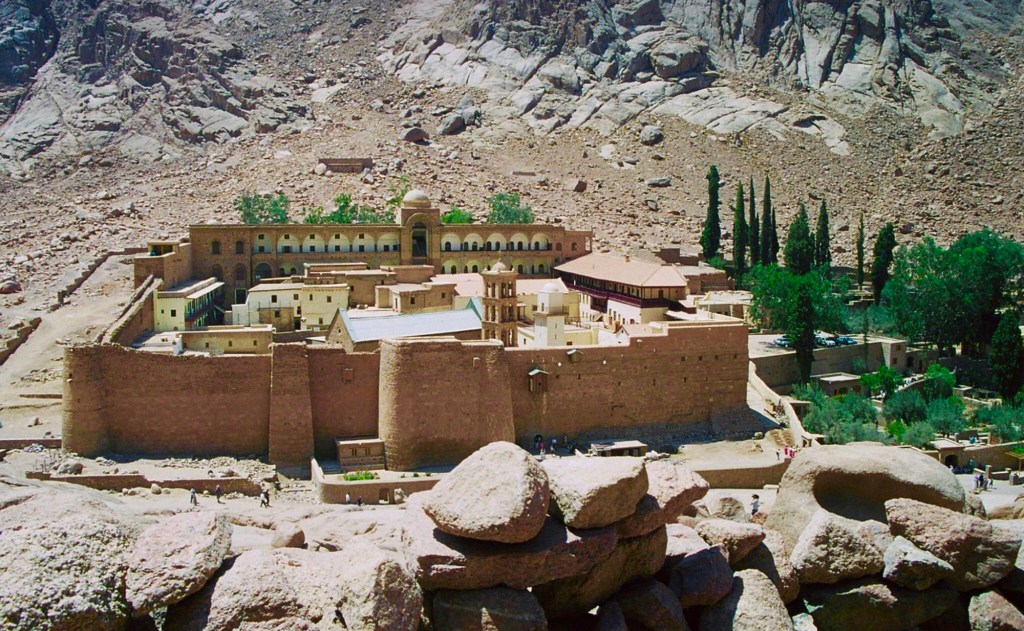
There is great alarm in the Greek Orthodox Church about the fate of Saint Catherine’s Monastery, which is situated at the foot of Mount Sinai, in Egypt.
The monastery, built in the 6th century by the order of the Byzantine Emperor Justinian the First, is the oldest monastery in Christendom. Continually inhabited by monks, it contains what is thought to be the Burning Bush seen by Moses and possesses numerous rare works, such as the Codex Sinaiticus and the Syriac Sinaiticus, as well as a wonderful collection of early Christian Icons and illuminated manuscripts.
The site is considered sacred by the three major Abrahamic religions: Judaism, Christianity and Islam. It became a World Heritage site in 2002.
Last week an Egyptian court ruling decided the lands around the monastery should revert to Egypt, and there were even rumours that Egypt intends to turn the monastery into a museum. These rumours were swiftly denied, however the uncertainty about the monastery’s status quo remains.
A delegation from Greece has met with their Egyptian counterparts and discussions are under way, which are delicate due to the many legal complications as well as the interests involved. The Church obviously wants to preserve the status quo, but the Greek government (heavily criticised by the opposition for delays in solving the issue which has been looming for a while) also wishes to preserve good relations with Egypt.
If the ruling stands, the monastery risks losing the lands around it which are essential to its daily functioning and, ultimately, its survival, including gardens with water springs, orchards and olive groves. Unfortunately, these lands are coveted for touristic expansion.
As in all such cases which have to deal with geopolitical issues as well as financial interests, much politicking will be going on, with each side trying to gain as many advantages as possible.
The hegoumen of Saint Catherine’s, Archbishop Damianos, has been very active in his leadership of the monastery, including organising a digital archive of the monastery’s manuscripts, establishing the first Greek University in Egypt, fostering interfaith dialogue and preserving the monastery’s rich spiritual and cultural traditions.
Archbishop Damianos (b. 1973)
In 2004, the Benaki Museum in Athens organised a wonderful exhibition of masterpieces from the monastery, including icons, mosaics and manuscripts. These were also later shown at the Metropolitan Museum in New York. After the opening of the exhibition, there was a small diner in an Athenian restaurant, where I had the honour to be seated next to Archbishop Damianos.
I have to confess I was a little overwhelmed at first. An Orthodox priest—long black robes, long black beard, long black hair tied in a bun, embroidered vestments and a gold cross. What on Earth would we find to talk about for the next two hours? Well, I soon changed my mind. He was the most wily, charming, educated, well-travelled and well-read man, as well as a superb raconteur. A dinner I will never forget. I hope he gets to keep his monastery.
Noted by his contemporaries for his powerful preaching, expert knowledge of scripture, and undying love and devotion to the poor and the sick, Saint Anthony of Padua (1195-1231) was one of the most quickly canonized saints in church history, being canonized less than a year after his death.
Born in Portugal of wealthy and noble parents, Anthony joined the Church early on and ended up in Italy after his ship was blown off course on a return journey from Morocco.
Although he died at 35, Anthony led a busy and varied life, preached in many places in Italy and France and performed many miracles. One can easily read about his life (there is a lengthy Wikipedia entry) but the reason I am writing about him is that I came, entirely by chance, upon this weird and wonderful detail of a mural in the Basilica di Sant’Antonio da Padova, of him preaching to a bunch of fish.
Just look at the expressions on those fish faces. Priceless
The story of Anthony “preaching to the fish” originated in Rimini, where he had gone to preach. When the Cathar heretics there treated him with contempt, Anthony was said to have gone to the shoreline, where he began to preach at the water’s edge until a great crowd of fish was seen gathered before him. The people of the town and even heretics flocked to see this marvelous thing and were moved to listen to Anthony’s preaching.
There are other paintings of this event, but this one has a special flavour to it.
There is an interesting exhibition on at the moment close to us in Trouville, at the Villa Montebello, a small museum housed in an old villa built in 1865 by the Comtesse de Montebello. After a chequered past, it was acquired by the city of Trouville and became a museum in 1972.
The exhibition is mainly devoted to the artist Charles Mozin (1806-1862), who was a Parisian but built a house and settled in Trouville in 1939.
He was one of many artists who left Paris (a polluted and stinking, overpopulated city) to seek cleaner skies and beautiful landscapes in Normandy. Why Normandy, and why Trouville? Well, it was close to Paris, a mere 4 days by the diligence (stagecoach) and there were beautiful beaches, wonderful light and fresh fish.
In the early 19th century, sea bathing became fashionable, starting in Dieppe, which had old ties with England where this activity began. And then Trouville was discovered, at the time a small, simple fishing village.
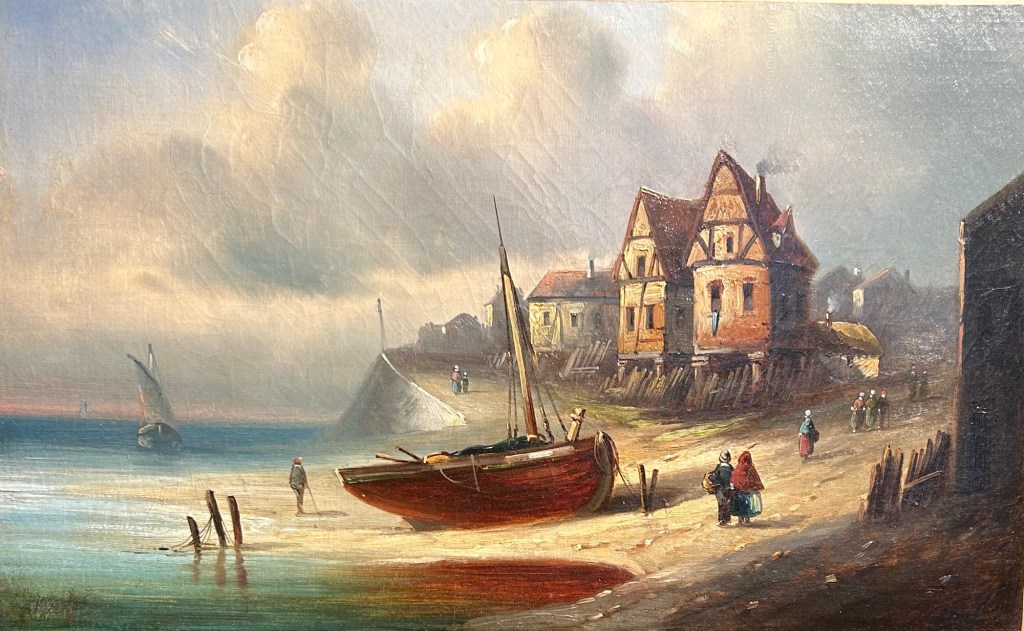
Early painting by Eugène Isabey
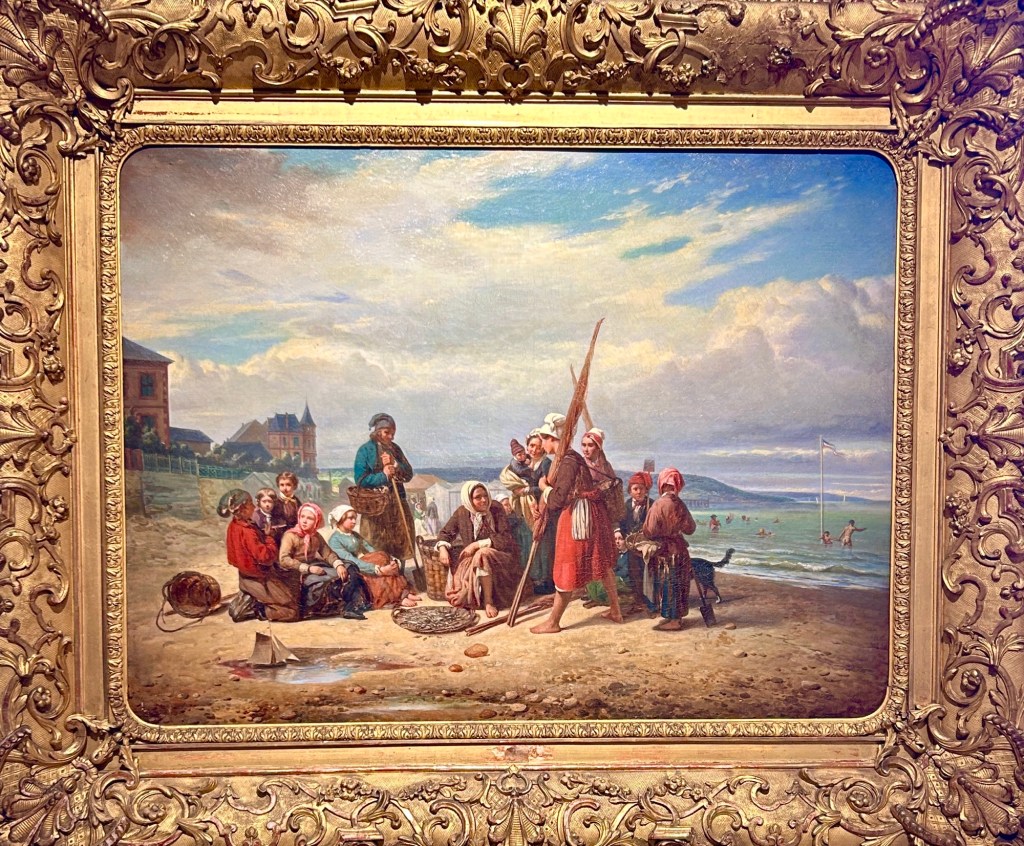
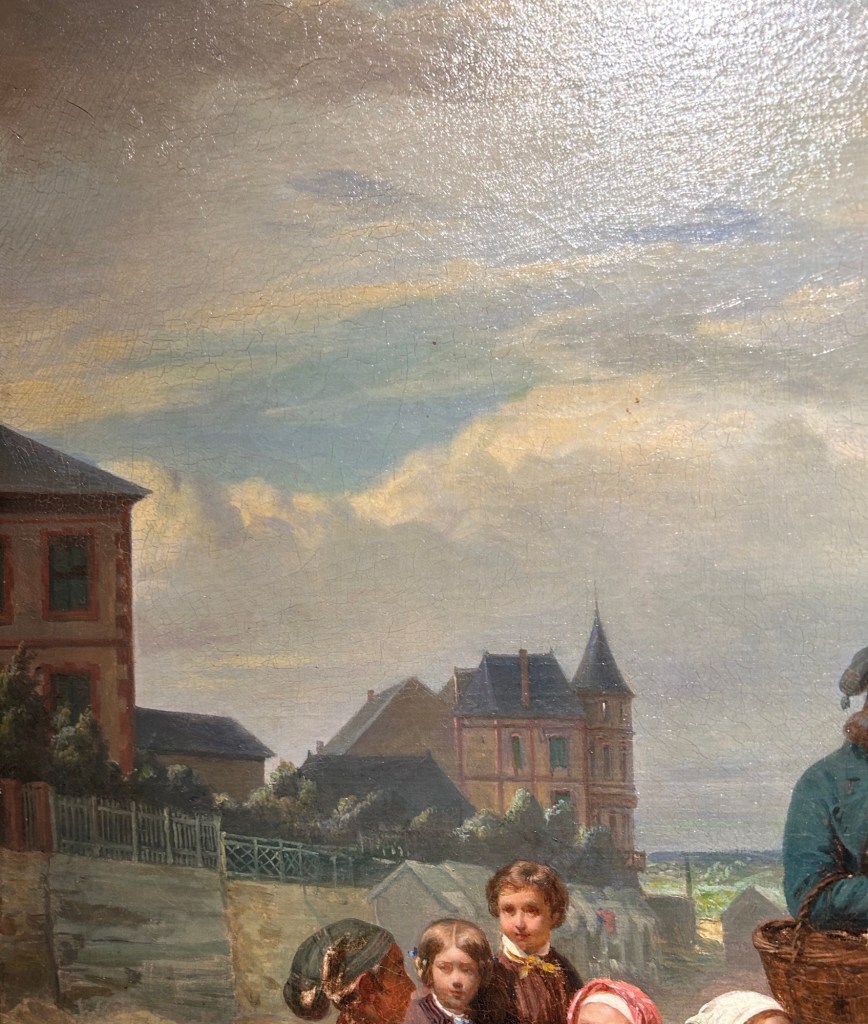
Around 1820, artists such as Eugène Isabey, Charles Mozin, Camille Corot and Richard Parkes Bonnington came to Normandy to paint and then exposed their works in grand Parisian exhibitions. People saw, were enchanted and came to visit. Rapid development followed and Trouville became a busy port as well as a station balnéaire. In the painting below, by Pierre Duval le Camus, one can see the juxtaposition of the old way of life with the new: a group of fishermen’s wives and their children are gathered on the beach, in a pause of their daily activities. It was a rough life—while the men were at sea, the women, aided by the children as soon as they were old enough, gathered mussels and sprats, mended nets, sold the fish their men caught in the market. They were hardworking and poor.
Pierre Duval le Camus, Trouville, Les Bains de Mer, 1851
Behind them to the right, one can glimpse bathers—people of a higher social class and better means, the tourists of the day.
Detail
On the left, the buildings are not fishermen’s cottages, but vacation homes. The one on the right still exists, albeit in a very different setting.
Charles Mozin was the artist who best captured the progress of this development, about which he had very mixed feelings. He shunned society and much preferred the old, simple way of life. He was a very clever draughtsman, who captured details in his many sketchbooks and then went back to his studio in Paris to work on the large paintings.
In the background between the ships one can see the lights of the market, still busy at nightfall
A beautiful view of the Touque by moonlight. La Touque is the river which flows to the sea at Trouville. Ships sailed up the Touque to the port.
Above is an example of Mozin’s accurate and very detailed sketches.
Two ships entering the port
This huge painting shows how much sea traffic there was, and the difficulty of entering the port, especially in rough seas. The vessel on the left is a passenger ship, which sailed regularly from Le Havre and was the main way of reaching Trouville. On the right a fishing boat is trying to manoeuvre in the narrow passage. Sometimes there were accidents, and there is a story of a ship which, encountering strong winds and currents, floundered and sank, drowning everyone on board, despite people rushing to the rescue in small boats. Only a dog survived and, when it was fished out of the sea, it was found to have in its mouth its master’s jacket.
In this painting, also by Mozin, one can see the new bridge connecting Trouville with what was going to become Deauville. At the time the land was marshy, and the Trouvillais used to ford the river before the bridge was built to graze their cattle on the près salés (salt meadows). The small building on the right was a customs house.
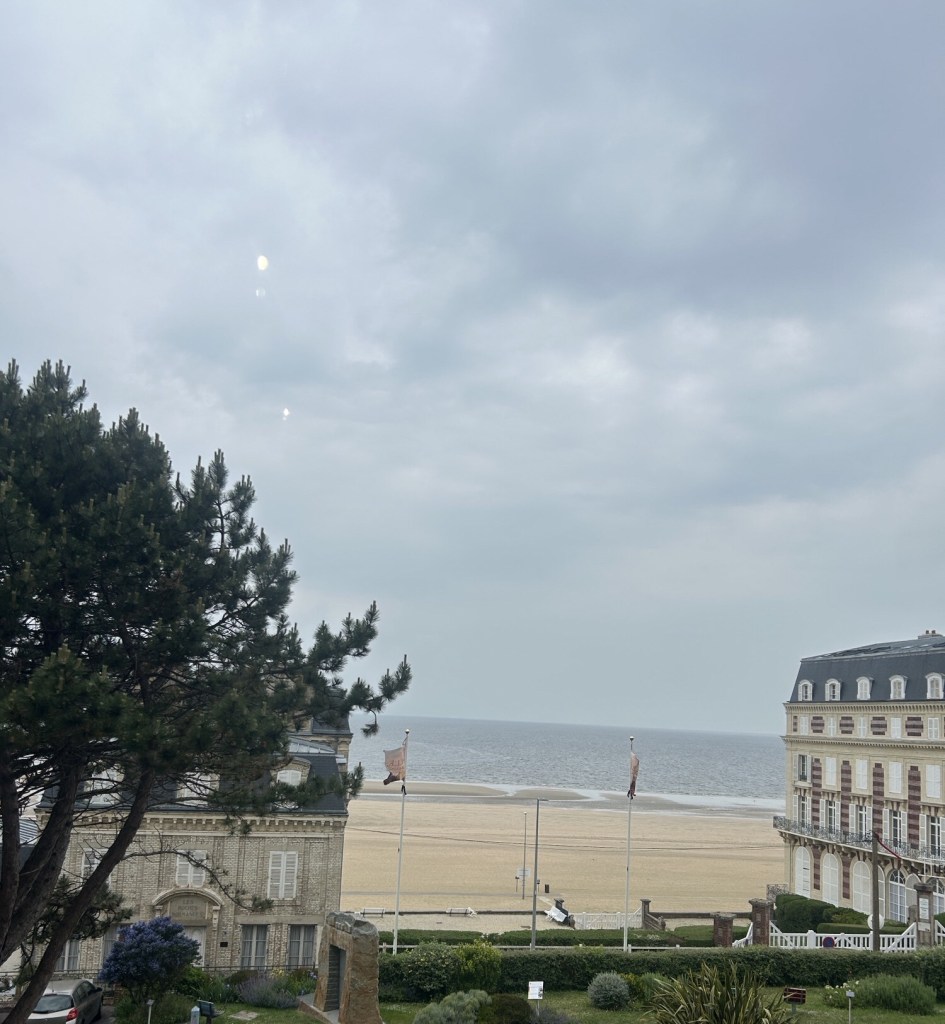
Below is a photo of the view from the Villa Montebello
And finally, a view of Trouville today, at low tide. A lovely place, well worth visiting.
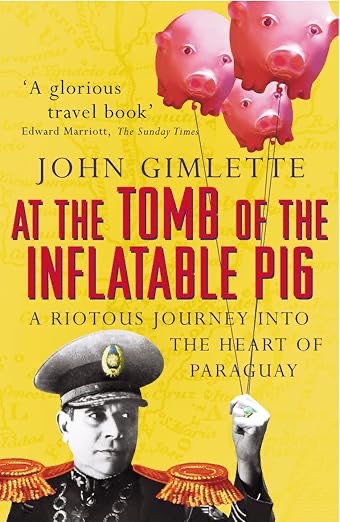
“Reading the book is like watching a Komodo dragon eat a tethered goat. Paraguay, as Gimlette portrays it, is . . . completely bizarre. . . . Conquistadores and Nazis, whores and cannibals, all of them rather awful, all of them splendidly rendered. . . . Graham Greene would have approved.” –National Geographic Adventure
I seem to be on a roll of recommending favourite books. This one is in a category of its own, a crazed travelogue on Paraguay, one of the most exotic, captivating and eccentric countries in the world, according to writer John Gimlette. Even the title of the book is insane.
I have never been to Paraguay, nor are there any Paraguayans amongst my South American friends, so I cannot pretend to have a personal opinion on the veracity of his observations. I can only say the book enchanted me, with its descriptions of hellish jungles, Germanic villages, missionaries, utopian experiments and coups. Apparently the Paraguayans venerate Princess Diana and, if they deem it necessary, will call in Scotland Yard.
Here’s an excerpt from Chapter 1:
I had a room on the second floor. It was a vast, mildewed space that might once have been used for dancing classes. It had floor-to-ceiling louvred shutters that were so seized up with drifts of green paint that they’d become petrified in the open position, admitting scalding blasts of dust and roasted corn from the street below. I shared this great green tropical ballroom with two others, for whom it was, in its own way, heavenly. The first was an Englishman called Kevin Pluck who’d come to South America to give some long and careful thought to the question of whether or not he should ever get a job. He had an opening in the car factory at Luton, but the delicious, orange-blossomed lassitude that overwhelmed Asunción ensured that he wasn’t going to hurry the decision. He’d at least made up his mind to return to Luton with a suntan and so he spent a lot of time and effort trying to go brown. For some reason his skin remained determinedly cheesy.
I have given this book to various people as a gift, but I never followed up on whether they had read it and liked it, as I don’t believe in gifts with strings attached. I do however, consider it a fine aid to armchair travel. You will become lost in a world so exotic that it will make you feel like Alice in Wonderland.
In yet another ineffectual effort to put some order into my bookshelf I came upon one of my favourite books of all time, The Worst Journey in the World, by Apsley Cherry-Garrard (1886 -1959).
This is an account of Robert Falcon Scott’s ill-fated expedition to discover the South Pole in 1911, written by the youngest member of the team, who was just 24 at the time. A memoir, in a completely immersive style, by someone who had never written a book before, nor wrote another in his entire life.
I came upon the book by chance many years ago, browsing in the wonderful Heffers bookshop in Cambridge. Just the cover of the hardback, the shape and heft and compact size of the wonderful Picador Travel Classics edition and I was sold. I bought the thing as an object, but then I started reading it and became hooked on the subject and, most unlikely for me, Polar exploration in general.
The old-fashioned, unreal feel of the whole organisation, the details and lists of supplies and packing, the endless debates of dogs versus ponies versus men hauling the sleds. Why would anyone want to put themselves through such an ordeal, but in fact, many did. They vied to get on the expedition crew. They felt it was heroic and, being British, even more heroic to combine the race to the South Pole with scientific projects such as geologising, which meant carrying about bags of rock samples, as well as going on a winter trip in the middle of the endless dark of the Antarctic winter (the Worst Journey in the title) in order to collect Emperor penguin eggs from their impossible to reach breeding grounds. Cherry was one of three men who went on that little pleasure trip, and it is a miracle how they survived, especially since their tent was blown away in a storm one night.
Apsley Cherry-Garrard with frostbitten nose
In fact it was a miracle any of them survived, because they had miscalculated the supplies and equipment needed. Scott and his team of four all died, from scurvy and cold and hunger, having faced the most bitter of disappointments. They had lost the race—finally arriving at their destination to find the Norwegian flag already planted there. Because of course, Roald Amundsen had no interest in penguins or rocks. He and his team were highly skilled on skis and used dogs to pull the sleds and got there in a ruthlessly efficient manner, five weeks before Scott. They also had a better diet of fresh meat and so did not suffer from scurvy.
Both Amundsen and, more importantly, Scott’s wife, learned of his death more than a year later, which in our era of instant communications, seems weirdly shocking.
Photo from Wikipedia
There have been many books written on polar exploration, about the exploits of Amundsen and Shackleton and others. I have read quite a few and watched films, especially the 1985 seven-part series called The last place on Earth. I find it all quite fascinating, more so since it is something I would never dream of attempting myself. I think it amazing that still, especially now that there is nothing left to ‘discover’, there are people still doing it—such as Sir Rannulph Fiennes, who, amongst other expeditions, was the first person to visit both the North Pole and the South Pole by surface means and the first to completely cross Antartica on foot.
Be that as it may, the book is engrossing and will make you travel into a different world. What is particularly interesting is the minutiae of daily life and the relationships between the men facing such difficult conditions. Highly recommended.
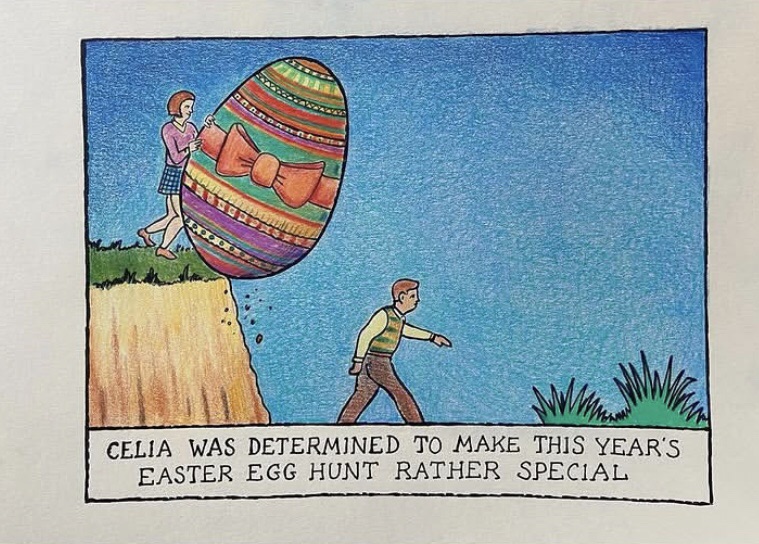
Due to complicated calculations concerning the Vernal Equinox, the split between the Roman and Byzantine Empires and their different calendars and the division of the Christian Church into Orthodox and Catholic (look it up, people, I can’t be bothered to explain further) usually there are two Easters, one for each church. Sometimes, though, they coincide—and this year they do (the last time was in 2017).
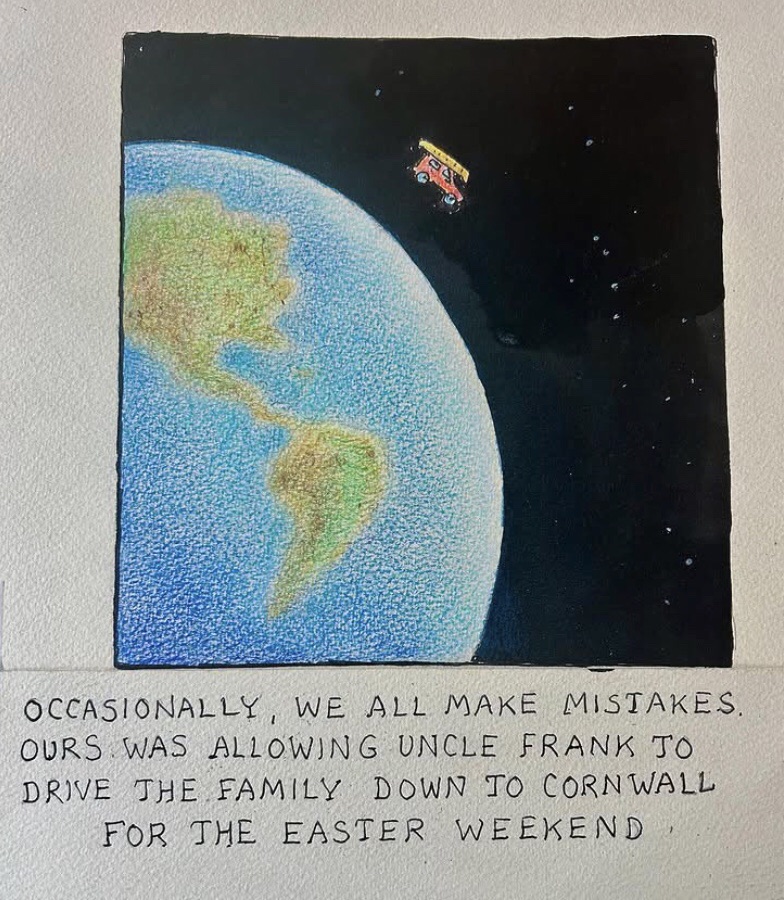
Therefore I am in the happy position to wish you all a Happy Easter, wether you smash red eggs or wait for the Easter Bunny. Enjoy your lamb on the spit, your Hot Cross buns, your Easter Bonnet Parade (is that still a thing?), your egg hunts and your indigestion. Or anything else in your local or family traditions.
I’d read her books years ago while still at school. I wonder why, since I was at Greek school and she could hardly have been on the curriculum. Probably browsing my mother’s bookshelves, where I was allowed a free run. At the time it was difficult to find foreign books in Athens and she was member of a book club – cloth-bound volumes arrived by post every month or so: Agatha Christie, Georgette Heyer, Ian Fleming, Neville Shute. I still have most of them. The thrill of it, the anticipation of receiving a new book, before the instant gratification of Amazon (I almost miss it—still prefer Amazon, though.)
But I digress. I recently came upon a BBC dramatisation of some of Pym’s books on Audible and downloaded it on impulse.
Very old-fashioned cover, isn’t it?
Barbara Pym wrote a series of social comedies in the 50s, but by the 70s her work was deemed too old-fashioned and was rejected by several publishers. Still, she kept writing, and forged a friendship with the poet Philip Larkin, who championed her work. When both he and the critic Lord David Cecil nominated her as the most underrated writer of the century, her career was revived. Her book Quartet in Autumn was nominated for the Booker Prize.
Pym was a shrewd observer of a certain type of English middle-class behaviour. Spinsters, bored housewives, academics and, in particular, vicars and curates, all came under her sharp and ironic scrutiny.
Of course I did not recall details of the books but I seemed to remember amusing and straightforward stories of village life and church goings-on. Via the dramatisation I am now discovering a narrative full of undertones, sexual innuendo and a delightful disregard for morality. Respectable wives go out to lunch with their friends’ husbands, spinsters plot to entrap men into marriage, older women meddle in everything. County housewives obsess over the new curate as they would today over the Kardashians. And all of it delivered in posh cut-glass accents you never hear any more because people are careful to disguise them even if they spent their childhood at Eton.
Probably this is not to everyone’s taste—I don’t think the young would appreciate it—and even for me there is no element of nostalgia, since it is set before my time. But it is an excellent production and I am deriving considerable amusement from listening in the car.












 Letters from Athens