The joy of beautiful prose

Being a bookworm from a young age, I read as the mood takes me, across a wide variety of genres: literary fiction, memoir, historical fiction and non-fiction, travel books, short stories, thrillers and crime. I have now arrived at an age where, if a book does not draw me in, I abandon it. So many books, so little time…And it has long ago ceased being homework. I read to be entertained, but also to be drawn into different worlds.

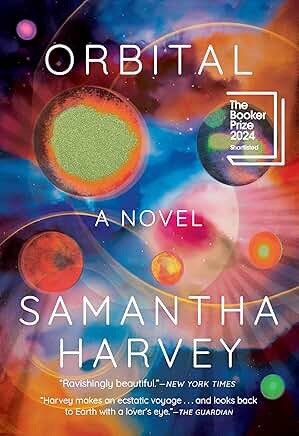
Into this last category come atmospheric books, such as the Booker Prize shortlisted Stone Yard Devotional, set in a religious community, or the winner, Orbital, set in space. The pace can be slow, but it is a delight to find oneself in a place one will never visit. The opposite of a thriller or police procedural, where you are waiting with bated breath to find out whodunnit.

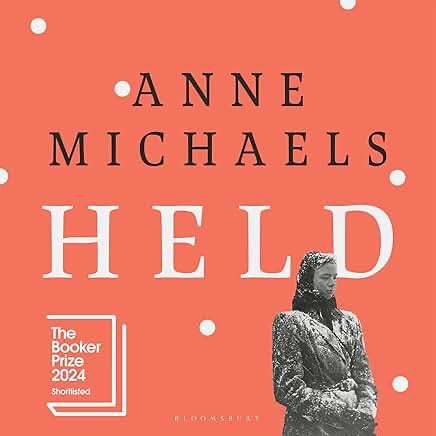
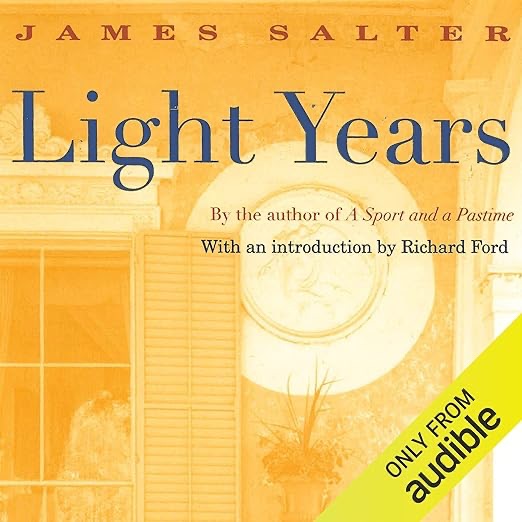
Occasionally, though, I come across a book where the plot does not matter, because the writing itself is so beautiful that I relish every sentence. I have lately, by coincidence, read two books of that calibre: Held, by Anne Michaels and Light Years, by James Salter.

Anne Michaels is an award-winning poet, which is perceptible in this fragmented tale of four generations of women. It explores the trauma of loss and the impact of love, shifting between times and viewpoints. You get submerged in the power of language, which is simply exquisite—lyrical and vivid. Like poetry, like music.

The second book is the story of a marriage, between two people who have privilege, charm but also flaws.

It describes the brittleness of happiness, the chinks in the perfect facade, the pull between contentment and desire. The inability to enjoy what one has, the longing to escape, the lure of something different. Restlessness, unfocused dissatisfaction. Voices heard, details of clothing, music, food. Flashes of landscape, the beauty of nature, subtle thoughts and feelings. The prose is lucid, the style is impressionistic, flawless.

Neither of these books have much of a plot, and ultimately perhaps this is not enough. A few of the reviewers complain about this and of course, liking a book or not is entirely subjective. It also much depends on one’s mood. Occasionally, however, it is a joy to luxuriate in wonderful language, where every sentence is a asks to be re-read. I loved both books and highly recommend them.

A matter of perspective

Here in deepest Normandy I don’t think we have seen the sun—or a pale imitation thereof—more than twice in the last few months. I might exaggerate a bit, but not much.

8.30 a.m.

When I take the puppy out in the morning, it is pitch dark. Once or twice when the sky was overcast I even had to use a torch! I wrap up in boots, scarf, hat and gloves.

However, I would rather have rain, sleet, fog and ice than wildfires. Having lived through a number of those in Greece, there are few things worse. A vision of hell.

My thoughts are with the people of California who are dealing with this at the moment. Many have lost their homes, their livelihoods and some their lives. I sincerely hope the fires will be brought under control soon…

And a Happy New Year

What is it that makes the turn of the year fill us with hope? It is a totally fictitious concept. Nothing changes in reality—it is just another day. And yet…most of us think of it as a new start.

A snowy landscape

Looking at the year’s photos that are published around this time in the papers, there is not much to make the heart glad. Wars, poverty, natural catastrophes, displaced populations—the list never ends. But one could focus on this kind of thing every day of every year, or find images to lift the spirits. Wonderful landscape and wildlife photos, reminding us we live on a beautiful planet, very much worth preserving. Images of everyday life, music, art and performances. It always makes me hopeful for humankind when I see how many people enjoy going round exhibitions or pay good money to watch concerts and plays.

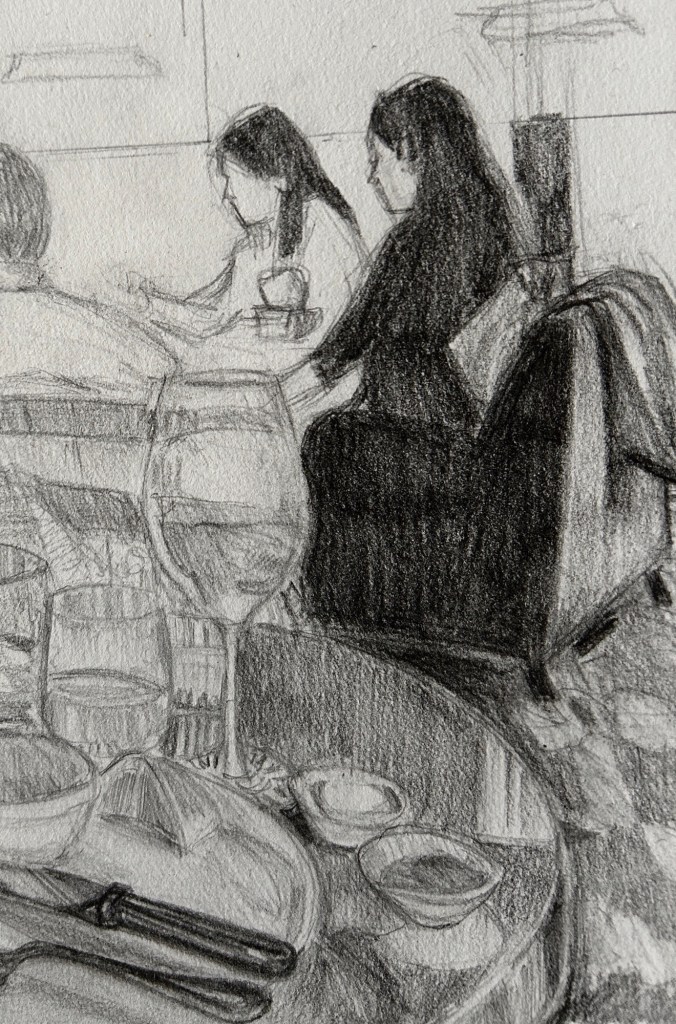
A good time to go out with friends (pencil on paper WIP – detail)

So let us take this opportunity to see a few good friends, spend time with family (if one can stand them, obvs!), perhaps make a donation somewhere, make a couple of (un-followable) resolutions, drink a glass of bubbly. Us Greeks will be baking or buying a Vassilopita, the traditional cake which we cut on New Year’s Day (or for months afterwards! – because one has to be eaten in every office, business, association or club as well as in every family) and devouring sugar-dusted kourabiedes or syrup-soaked melomakarona.

Out at 7.30 a.m.

My Christmas wishes were very belated this year, due to a technical glitch, but they were heartfelt, and so are my wishes to all of you, for a wonderful 2025. Health, joy and may the world be a better place.

Morning walk with puppy

An Intervention

Artist duo Elmgreen&Dragset were invited to exhibit their work in the iconic sculpture gallery of the Musée d’Orsay.

They called this installation, consisting of a number of boyish figures engaged in incongruous—in the context—pursuits, L’Addition.

Michael Elmgreen (born 1961 in Copenhagen, Denmark) and Ingar Dragset (born 1969 in Trodheim, Norway) have worked together as an artist duo since 1995, exploring the relationship between art, architecture and design.

Elmgreen&Dragset live and work in Berlin. They are known for art work that has wit and subversive humour, and also addresses social and cultural concern. Their work is too varied and prolific to be described in a short post, but anyone interested can look them up on Wikipedia—and they are, indeed, interesting.

For the first time in its history, the Musée d’Orsay invited someone to intervene in the museum’s permanent display of 19th century sculpture, which has remained the same for nearly 40 years.

As quoted in the museum’s site: In a trans-historical encounter between past and present, L’Addition highlights themes of evolving masculinities, solitude, and the magic of everyday situations. There is a certain beauty to be found in each of the fleeting moments captured in the works, whether it is in the pause before jumping from a diving board, the split second before a drone is sent off from a child’s hand, or a glimpse through the lens of a camera.

The figures are made of bronze, stainless steel and laquer. Boys waiting to dive, taking pictures from the mezzanine, setting off drones or just lounging upside down on the ceiling. It was all pretty cool, and an extra treat combined with the Caillebotte exhibition.

Gustave Caillebotte at the Musée d’Orsay

Amongst the lesser-known of the Impressionists, for the simple reason he was wealthy and did not need to sell his paintings in order to live, Gustave Caillebotte (1848-1894) is nevertheless a most interesting artist, because he had a unique take on things, using perspective and composition in original ways. He was very ‘modern’ for his time as well as more realistic in his technique than some of the others.
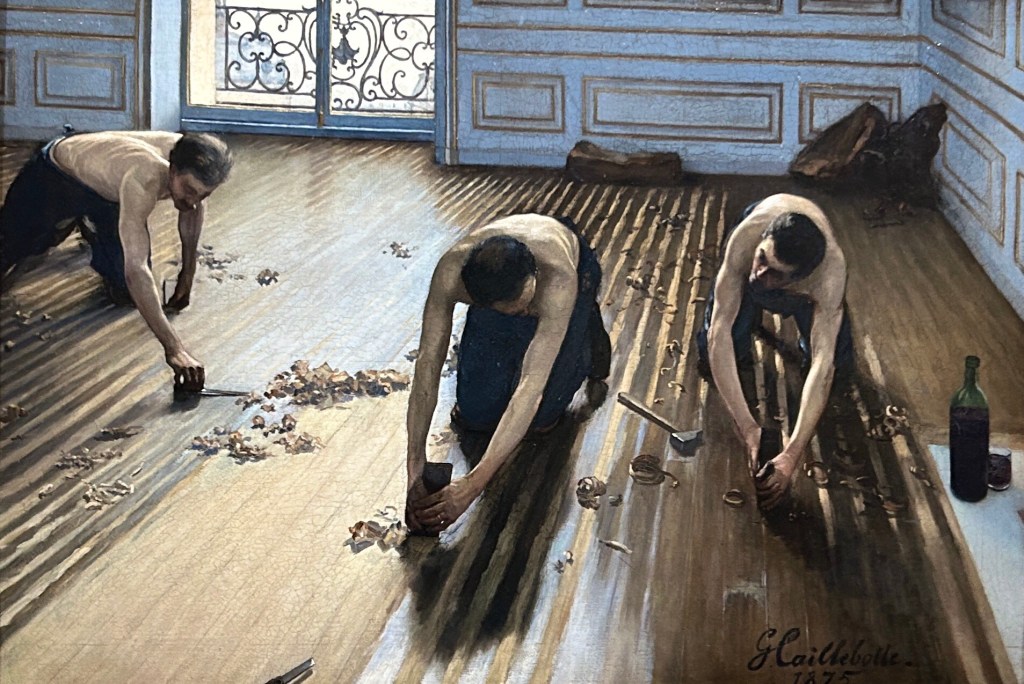
A lawyer and engineer, he fought in the Franco-Prussian war and upon his return frequented the Académie des Beaux Arts, as well as befriending several artists. The first painting he exhibited, of labourers working on a wooden floor, was criticised as “vulgar” (sweaty men doing a menial job) and rejected by the Salon of 1875. It is a masterpiece, if only for the light and perspective.

Rabatteurs de parquet, 1876 (détail)

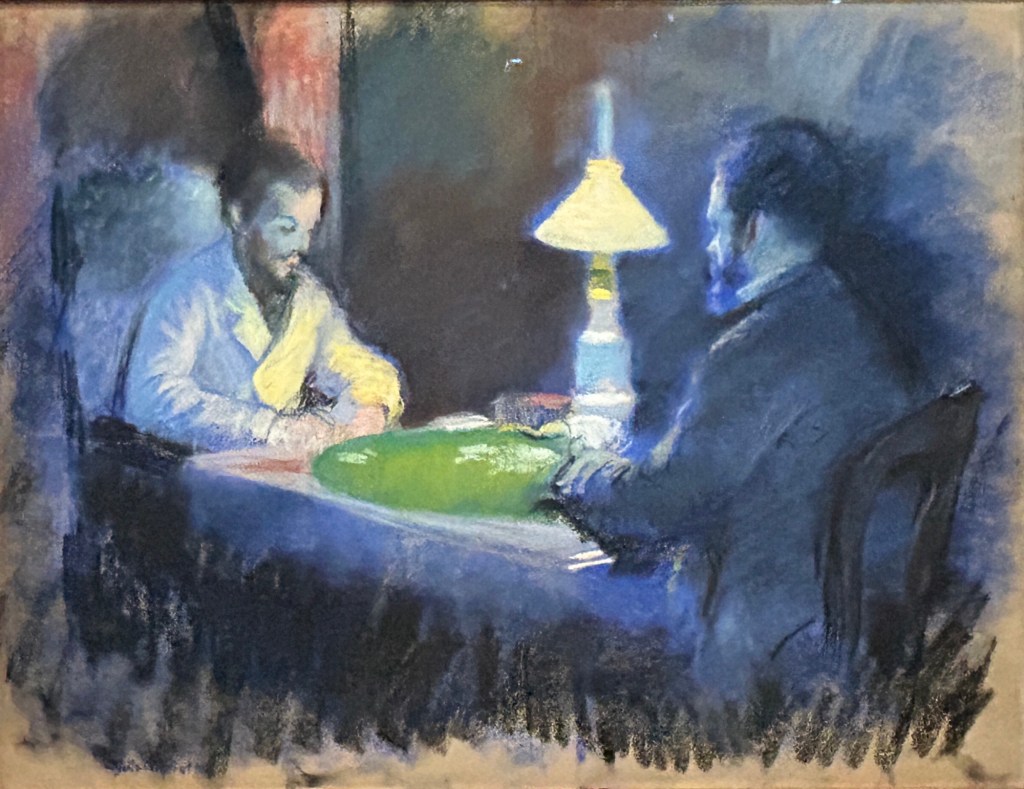
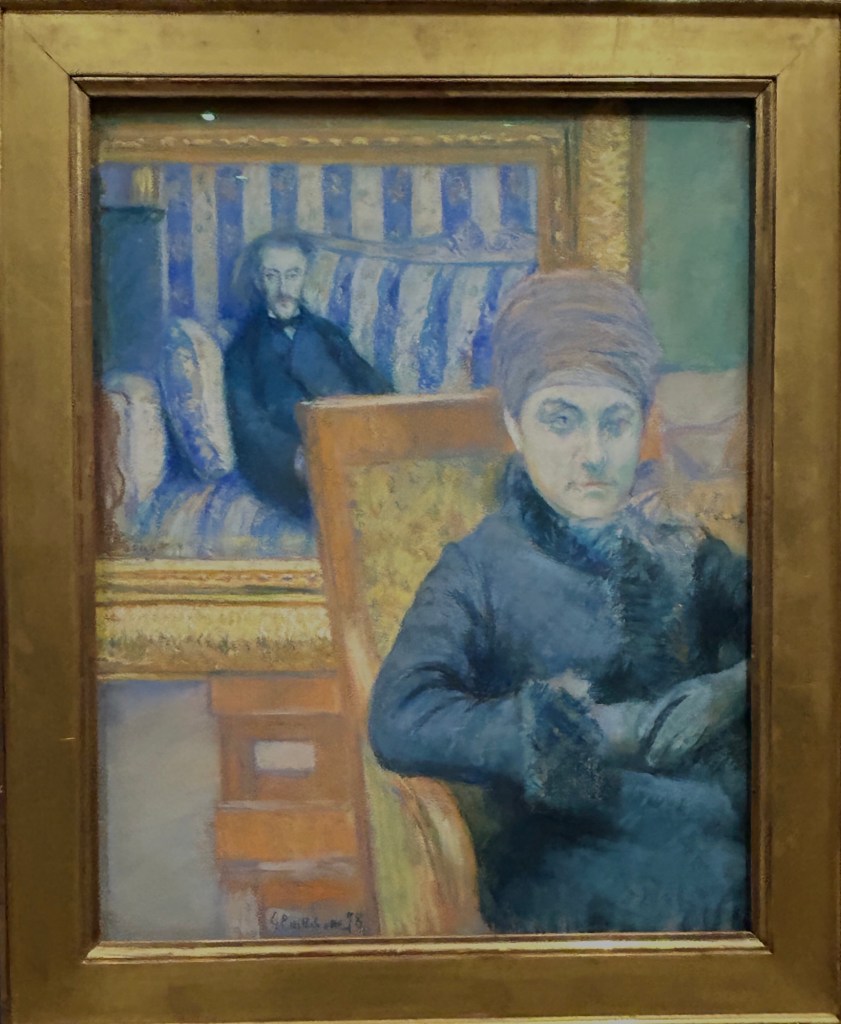
Caillebotte painted many domestic scenes, depicting his family and friends in everyday pursuits.

A beautiful pastel, which does not really show to advantage in a photo

I love the composition in this painting, the frame of the portrait replicated in the chair’s back, the diagonal made by the blue clothes…

He also loved sport and painted people rowing or sailing at the family’s Yerres estate. His technique of cropping or zooming in is original and gives a lot of movement to his scenes.

If I had painted this, I don’t think I would have thought to chop off the front of the first canoe, which is just sliding out of the picture.

In this view the boats are coming towards us

And here, seen from the back.

I love this gentleman, who is not rowing for sport, only taking himself on a little jaunt in his city clothes.

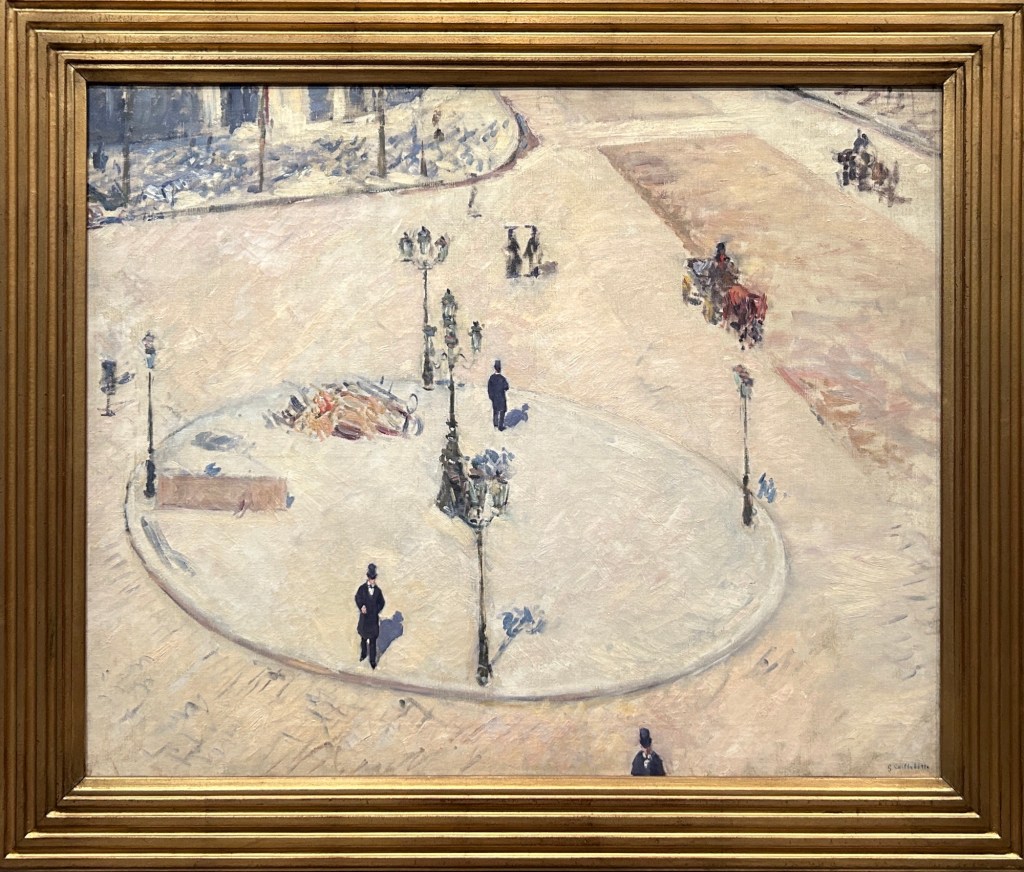
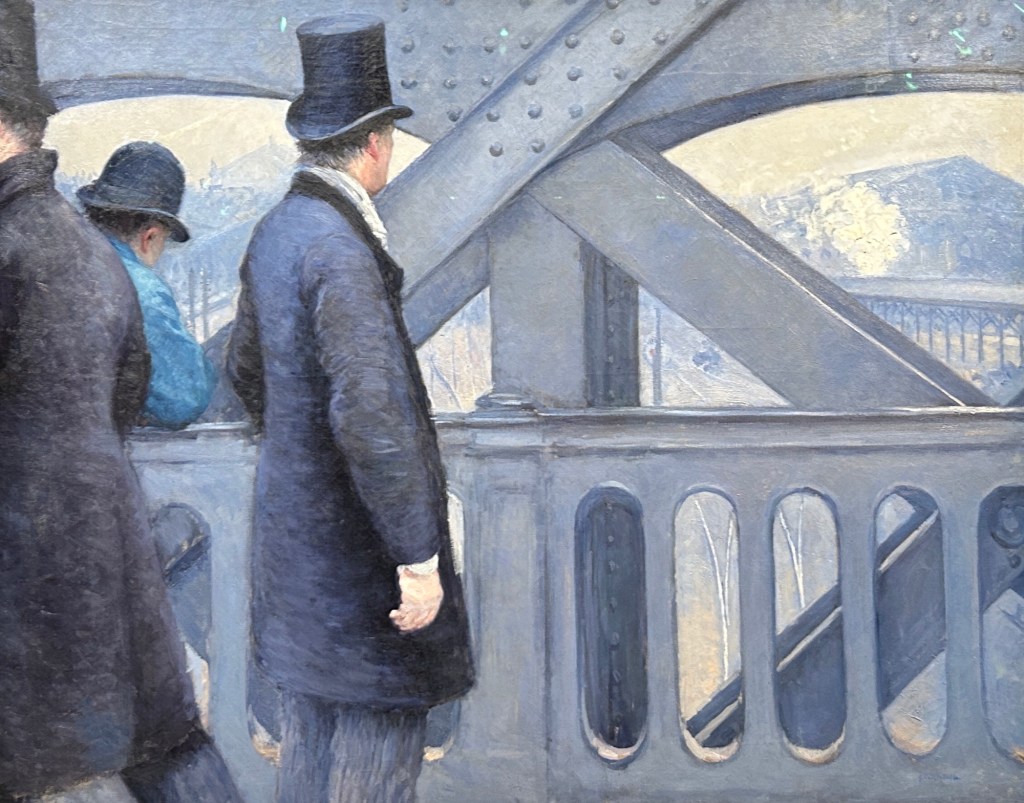
Caillebotte also did many urban paintings, some from an elevated perspective, such as the one below.

His paintings of Paris give off a very special flavour of the city.

Two of the artist’s friends looking out towards the Boulevard Haussmann in this painting entitled Balcon (circa 1880)

Le pont de l’Europe (1877)

He also made realistic studies of the human body and his paintings of males nudes were considered revolutionary, depicting ‘real’ men in domestic settings, instead of heroes in allegories.

Homme au bain, 1884 (note the wet footprints on the floor!)

Caillebotte used his wealth to support many of his fellow artists, notably Renoir—who was a close friend—Monet and Pissarro, amongst others. He died young, at the age of 45, of pulmonary congestion. He left behind an impressive body of work and bequeathed a large and varied collection—he had acquired many works from his fellow artists—to the French government. Here he is below, in one of those funny hats they all wore to row on the river. He looks like a jolly good sort.

Self portrait in a summer hat (circa 1873)

I was very lucky to visit the exhibition before the crows swarmed in, with a friend who is a Friend of the museum and holder of a card allowing early entry. A most impressive artist.

A wonderful collection

In 2004, the descendants of the Senn family made a donation of 205 pieces of art to the MuMa Museum in Le Havre. The collection, of mostly Impressionist and Fauve artists, was amassed by Olivier Senn and further embellished by members of his family. It includes works by such icons as Delacroix, Boudin, Monet, Renoir, De Chirico, De Staël and others. On the 20th anniversary of this major donation, the museum curated a major exhibition of the works.

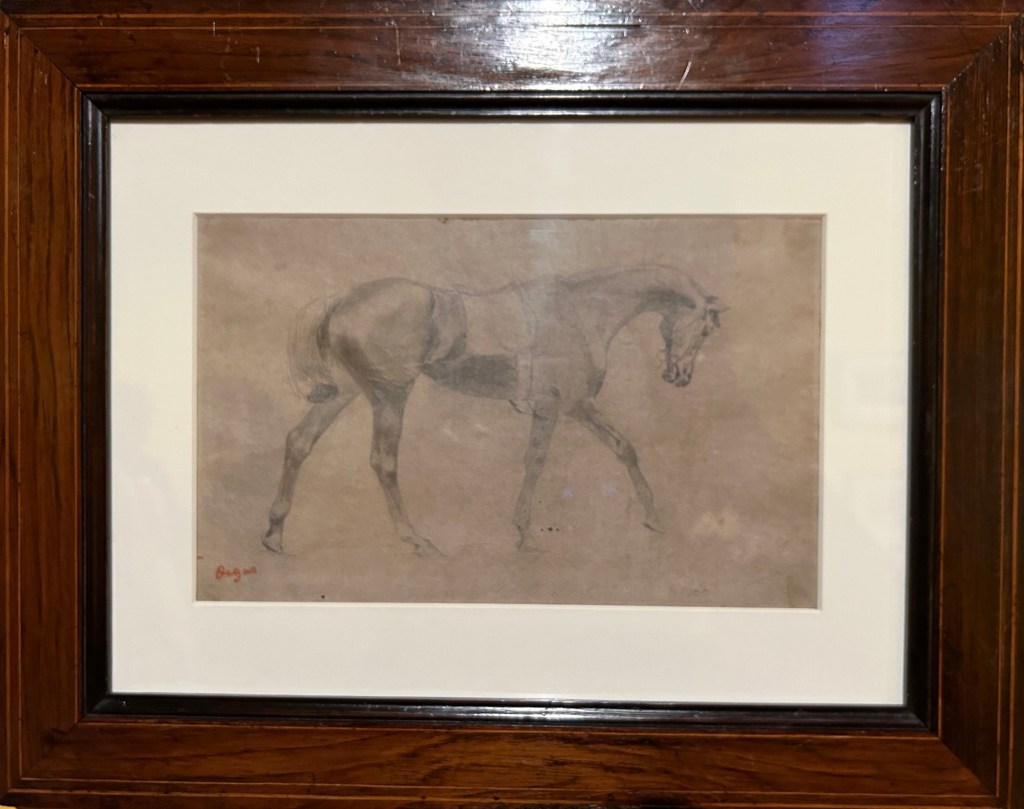
Edgar Degas, pencil on paper

Born in Le Havre in 1864, Olivier Senn studied law and, after marrying, joined his father-in-law’s cotton business. Once he’d made his fortune, he started buying art. The Senns and their descendants and relatives by marriage were all art and music lovers, as well as generous donors.

Yesterday’s vernissage of the exhibition drew a large and very appreciative crowd, which thankfully spread out around the museum rooms, making it pleasant to wander about, admiring the works. The collection was too large to describe in full, so I will linger over some particular favourites, a set of lovely pencil drawings by Edgar Degas.

Degas, circa 1859-1861.
This drawing, along with the one above and several others, were studies for a large oil painting titled Alexandre et Bucéphale

Another interesting work, probably in pastel, is the study below, for a painting called Semiramis building Babylon

Further little treasures among the works on paper were the small charcoal studies below, by Henri-Edmond Cross. A lesson in conveying much with but a few simple strokes.

Here’s a link for anyone who would like to see more:

https://www.muma-lehavre.fr/fr/expositions/les-senn-collectionneurs-et-mecenes

And the winner is…

Orbital, the book about six astronauts in space I recently reviewed, has won the Booker Prize.

I admit I have not read the other books on the short list—or rather, I am in the process of reading Rachel Kusk’s Creation Lake. I like her writing, and loved The Mars Room, but I’m finding this one slow going. Some of the others are tempting, though, and I will get to them eventually.

Photo: bdnews24.com

Nevertheless, even though I lack comparison, I think this book is a very worthy winner, being at once original, lovely to read and beautiful in every way.

Samantha Harvey nearly gave up writing the book at some point, because she felt like an impostor, never having been in space. But then she took it up again, during the pandemic, and watched hours and hours of streaming video from the International Space Station while writing. Thus she could observe Earth from space, actually completing whole orbits and describing what she saw. The result is nothing short of miraculous.

In her acceptance speech, Harvey said she wanted to dedicate the prize “to everybody who does speak for and not against the Earth; for and not against the dignity of other humans, other life; and all the humans who speak for and call for and work for peace.”

Harvey, 49, is the author of four previous novels, including “The Wilderness,” about a man with Alzheimer’s, which was longlisted for the 2009 Booker Prize, and 2018’s “The Western Wind,” about the mysterious death of a village’s wealthiest resident in medieval England. She also wrote “The Shapeless Unease: A Year of Not Sleeping,” a 2020 memoir about her struggles with insomnia.I’m tempted to try one or two.

Of course, a few people thought it a good idea to publish articles panning Orbital in comparison to the other books on the short list. Although of course everyone is entitled to their opinion—and all art appreciation is subjective—I thought it was in poor taste to do so today. It smacks of sour grapes. Let the woman enjoy her day of glory—they are hard enough to come by. So, congratulations, Samantha Harvey!

Orbital: a book review

A day in the life of six astronauts, bobbing around inside the International Space Station which is in orbit around earth. The spaceship orbits the Earth sixteen times in a day, during which the astronauts witness sixteen sunrises and sunsets. In fact, as Samantha Harvey describes it in this luminous novel, “the whipcrack of morning arrives every ninety minutes” and the sun is “up-down-up-down like a mechanical toy”.

The astronauts clock up time on the treadmill in order to preserve their body mass and go about their numerous chores: laboratory tasks, monitoring microbes or the growth of cabbages, tending to lab mice, endless cleaning. But they never tire of floating over to the observation windows, and their awe of our planet never dims.

There’s the first dumbfounding view of earth, a hunk of tourmaline, no a cantaloupe, an eye, lilac orange almond mauve white magenta bruised textured shellac-ed splendour.

Russian, British, Japanese, American, Italian: they each have their individual pasts and preoccupations, their different countries and cultures, but together they form a sort of whole, collective being. The two Russians go off to their “decrepit Soviet bunker”, but geopolitical divisions are hard to maintain when moving at 17,000 miles an hour. 

It is a strange, confusing existence which makes them at times question everything—is it day or night? Which era, year, decade are we in?

In order to avoid total confusion, a strict artificial order is imposed. Earth time (Earth time at take-off point?) is kept. Bedtimes, rising times, mealtimes—unconnected to the dawns and sundowns succeeding each other. Every continent, every mountain and river and desert and city, comes around again and again.

The past comes, the future, the past, the future. It’s always now, it’s never now.

The astronauts float around the gravity-free module at will. They remember their past lives, think of their loved ones, consider the future. One of them makes lists to keep things in perspective. They hate being so far from home and yet there is nowhere they’d rather be. They’re obsessed with space. The details of this unnatural existence are faithfully recorded:

When you enter your spacesuit and try to habituate yourself to the difficulty moving, the painful chafing, the unscratchable itches that might persist for hours, to the disconnection, the sensation of being buried inside something you cannot get out of, of being inside a coffin, then you think only of your next breath, which must be shallow so as not to use too much oxygen, but not too shallow, and even the breath after that is of no concern, only this one.

This image is one of the most widely known photographs of Earth, taken by the crew of the final Apollo mission (Apollo 17), as the the crew made its way to the Moon on Dec. 17, 1972. NASA dubbed this photo the ‘Blue Marble.’

And meanwhile, on earth, things are going on: wars, cities sending their innumerable lights into space, an approaching tornado. Some descriptions are terrifying:

Every swirling neon or red algal bloom in the polluted, warming, overfished Atlantic is crafted in large part by the hand of politics and human choices. Every retreating or retreated or disintegrating glacier, every granite shoulder of every mountain laid newly bare by snow that has never before melted, every scorched and blazing forest or bush, every shrinking ice sheet, every burning oil spill, the discolouration of a Mexican reservoir which signals the invasion of water hyacinths feeding on untreated sewage, a distorted flood-bulged river in Sudan or Pakistan or Bangladesh or North Dakota, or the prolonged pinking of evaporated lakes, or the Gran Chaco’s brown seepage of cattle ranch where once was rainforest, the expanding green-blue geometries of evaporation ponds where lithium is mined from the brine, or Tunisian salt flats in cloisonné pink, or the altered contour of a coastline where sea is reclaimed metre by painstaking metre and turned into land to house more and more people, or the altered contour of a coastline where land is reclaimed metre by metre by a sea that doesn’t care that there are more and more people in need of land, or a vanishing mangrove forest in Mumbai, or the hundreds of acres of greenhouses which make the entire southern tip of Spain reflective in the sun.

We are given numbers too large to fit into most human brains, condensed into readability.

Some eighty million miles distant the sun is roaring.

Shortlisted for the Booker Prize, Harvey’s book is a writing tour de force. Wonderfully imaginative, full of subtle humour and descriptions overflowing with colour and movement. If reading a book is opening a door into another world, this novel is a supreme example of it.

Grand Marin

I came upon this 2023 film by chance (the English title is Woman at Sea), but I’ve watched it twice, which is something I almost never do. I wanted my husband to see it—he loved it as well, and I appreciated details I had not noticed the first time. It is an underrated gem of a movie.

Photo: Google

Based on a book by Catherine Poulain, is a quiet movie, with almost no plot or dialogue, but don’t let this put you off. You become totally immersed in a world that is as strange to outsiders as it is real. The directorial debut of Dinara Drukarova, who also stars, it is the story of a young woman seeking to escape her past by looking for a job on a fishing vessel in Iceland.

She appears at the port, seeking employment in a strictly masculine world. We know nothing of her background or her motives for coming here. She has not fished before but, for some unexplained reason, she is determined to try. She appears frail but is tough and keen to earn her place amongst the men.

Adopted by a greying sea wolf who calls her Sparrow, she joins a team of men from different cultures, who will be closeted together on the boat for the duration of the trip.

Beautifully simple and incredibly evocative, the film is a powerful exploration of identity and individuality. It also showcases the loneliness of a life where people forced into intimacy by their circumstances, slowly coalesce into a team where they look out for each other, only for the partnership to dissolve when they reach land and each goes his own way to the next available job.

The cinematography is wonderful, depicting the high drama of life at sea and the brutal realities of commercial fishing, as well as the short moments of respite and rest where each can find it. The characterisation of the fishermen is subtle but well-developed, and the acting by all the cast is superb.

Here’s the trailer:

https://youtu.be/foDCXZo7w3I?si=FfmZnrGu8u0Crfd5

The film is worth watching on every level, and if only for the final scene (no spoilers), of fishing for king crabs in Alaska at night.

You will never look at a piece of cod on your plate the same way again!

*I watched it on Amazon Prime, but it also streams on other channels.