(This is a translation of an actual poster in France)
After entering this church, you may hear “the call of God”. However, it is unlikely he will call you on his mobile. Thank you for turning off your phones.
If you wish to talk to God, by all means do so. Come in and choose a quiet place.
If you wish to see Him, send a text while driving.
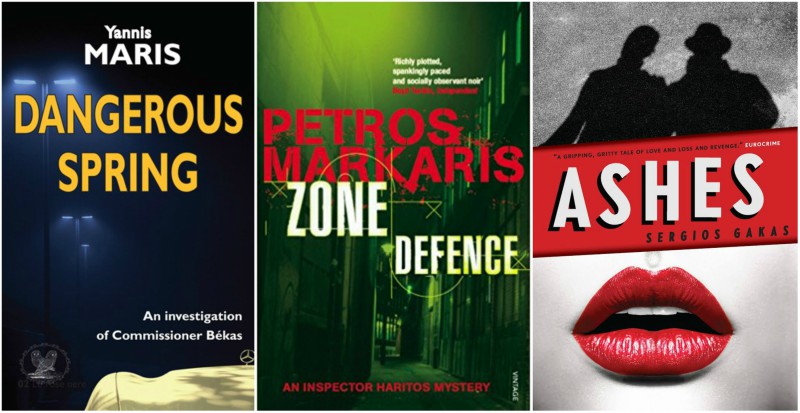
This is my favourite article from the time I wrote for the Greek News Agenda public diplomacy magazine. It combines my two big loves: travelling in Greece and crime litterature. Here, I am proposing six mystery novels that will inspire you to discover three Athenian neighborhoods and will guide you to another three breathtaking holiday destinations. The article had many unique visits but the most wonderful part for me was that it was descovered and promoted by the authors themselves through their social media.
Follow the “patriarch” of the Greek crime literature and descover the secrets of the Athenian high society. Yannis Maris is the author who established the crime novel genre in Greece in the ‘50s. His main character, Commissar Békas is depicted as an everyday man who nevertheless is not afraid to defy the rich and powerful in…
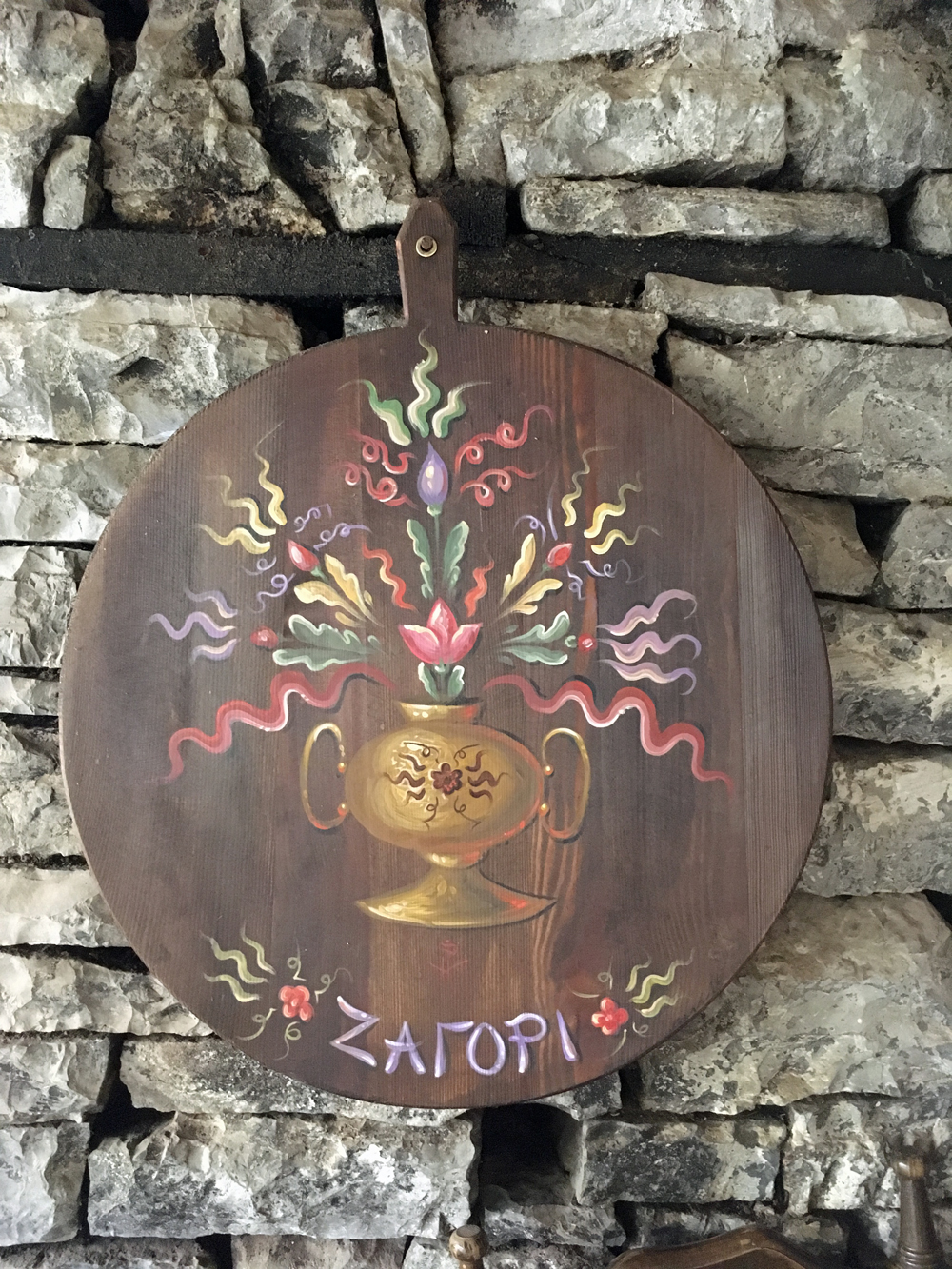
I was away from my kitchen for the first part of the month. We were on holiday in Epirus, northern Greece, in the Pindos mountains, an area known as Zagoria. Just to remind us where we were, painted folk art on a plastiri (πλαστήρι), a traditional round board for rolling out thin sheets of homemade phyllo, spells it out. Not only was it pretty, it was symbolic of one of the notable culinary elements of Zagori food – the pita or pie, often made with homemade phyllo. I have two recipes for pies from this region to share when I get the chance – blatsaria (μπλατσαριά) and tembelopita (τεμπελόπιτα) – although neither of these uses phyllo.
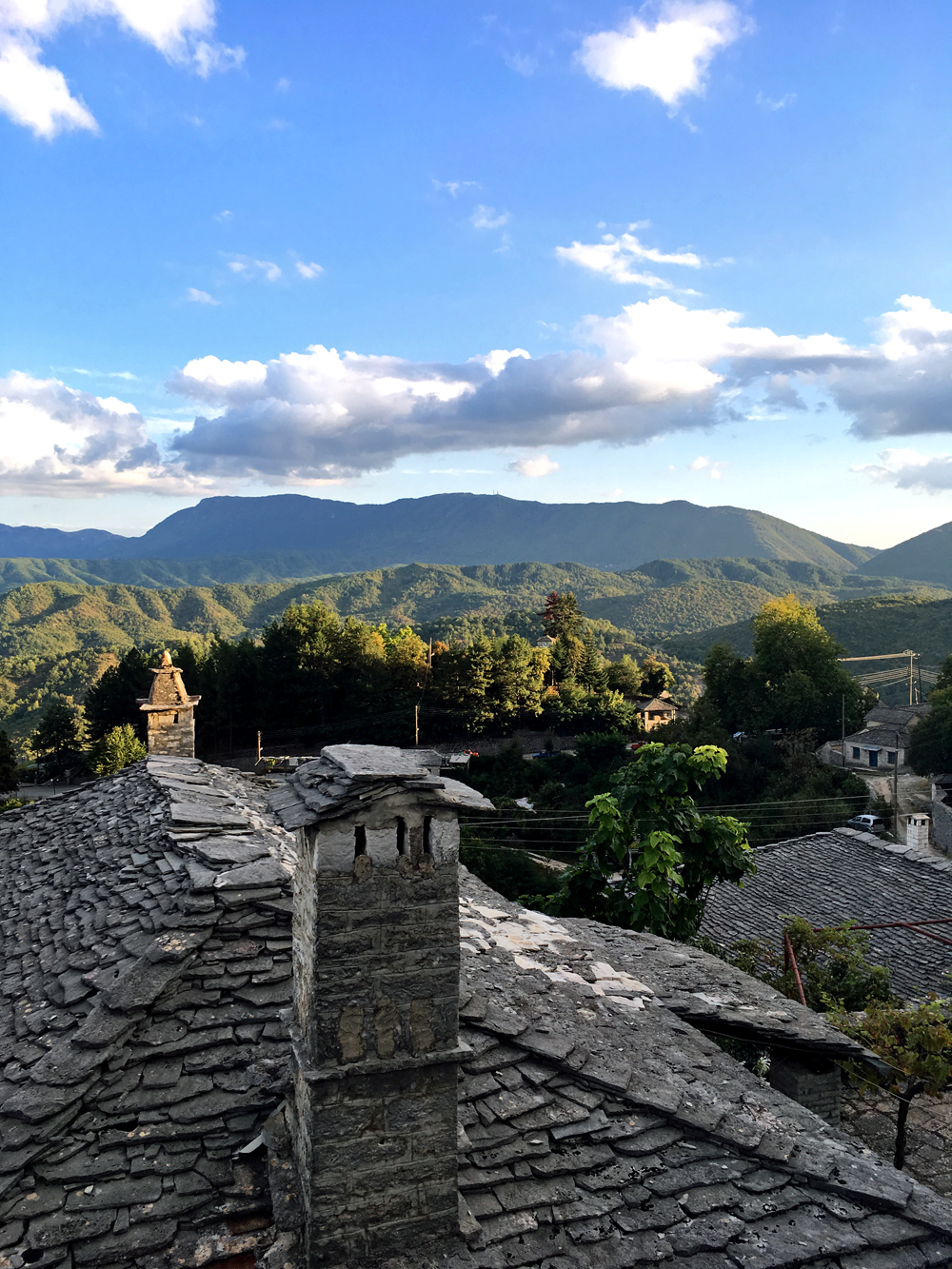
We were staying in the central Zagori village of Vitsa with its mountain views and stone roofs.
Rhythms of life in the mountain villages begin with the morning bread delivery in the van. After…
I think these are marvelous! It’s fantastic when artists use their imagination to overcome shortcomings such as lack of funds or other materials. This type of recycling is done a lot by African artists such as El Anatsui, about whom more to come.
IN THE age of the Greek crisis, some artists look further towards alternative methods of creativity and materials. Most traditional art materials are expensive, but there are also options that are free, and everywhere: arte povera was a movement that pioneered this approach in a conceptual manner, back in the Sixties and Seventies. Today, Lefki Christidou has found some contemporary ‘poor materials’ of her choice, using them in a more decorative style, especially the Coca-Cola tin, which adds a slightly more pop aesthetic to her work.It’s also in line with how artists today combine the art process with recycling. She manages to transform this everyday object into flowers, cats, people, landscapes and more, at Athens’s Gallery 7, in an exhibition entitled ‘Debt relief programme – developments’. Opens on September 25 (runs till October 13).
After yesterday’s post about a boy who went from being a refugee to playing basketball in the Greek A1 league, I could not avoid mentioning our ‘Greek Freak,’ Giannis Antetokounmpo.
Giannis is not an immigrant himself, but his parents were. They are Nigerian, and came to Greece from Lagos via Turkey, in 1991.
Three years later, on December 6, 1994, Giannis was born in Athens. Even though he and three of his four brothers were born in Greece, they did not automatically qualify to receive full Greek citizenship. For the first 18 years of his life, Giannis had no papers from Nigeria or Greece, and only officially became a Greek citizen in 2013.
Antetokounmpo grew up poor, in the Athens neighborhood of Sepolia. Like many other immigrants, his parents struggled to find work, so Giannis and his older brother, Thanasis, helped out by hawking items such as watches, bags and sunglasses. But Antetokounmpo’s father, Charles, was a former Nigerian association football player, while his mother, Veronica, is a former high jumper. Giannis was tall and athletic, and loved basketball, and by 2009 he was playing competitively for the youth squad of the Greek team Filathlitikos.
With his family, in Sepolia
In 2012, Antetokounmpo joined the senior squad of Filathlitikos and played for them in Greece’s second-tier basketball league, the Greek A2 League, during the 2012–13 season.
In December 2012, just days after turning 18, Antetokounmpo signed a four-year deal with Spanish club CAI Zaragoza. However, he never ended up playing in Spain, nor with the Greek A1 league.
He made himself eligible for the 2013 NBA draft and was selected 15th overall by the Milwaukee Bucks.
Since then, he’s set many personal career heights.
At 22 years and 74 days old, he became the youngest player in franchise history to start in an All-Star Game. He also became the first Greek NBA All-Star, and his special talents earned him the nickname ‘Greek freak.’ The awards he has collected are too numerous to mention and he has legions of fans.
Giannis is very family-oriented, and his brothers are all athletic. Despite the problems he encountered in his childhood, he lauds his adopted country wherever he goes, and has represented Greece multiple times. He served a reduced military service, as all Greek men who permanently live abroad are allowed to do.
Here’s a peek at what Giannis can do:
Is there a moral to this? Only that a lot of us have ancestors who had to move, due to different circumstances, such as poverty or war, to another country, leaving behind all they knew. Most countries owe a lot to immigration, and totally closed societies die off eventually. At the moment we are facing an unprecedented crisis, and, in my opinion, it is up to us to deal with it in a way that will enrich our communities.
Greek prime minister Alexis Tsipras hailed it as a ‘day of liberation ‘ and the ‘end of a modern day Odyssey’: after about nine years of unbearable austerity, Greece has exited the bailout program.
“Greece has managed to stand on her feet again,” the prime minister’s office announced last week, describing receipt of a final €15bn bailout loan as “The last act in the drama. Now a new page of progress, justice and growth can be turned.”
However, celebrations are premature: not only in my opinion, but according to several experts, the bailout was a disaster for Greece, since the loans were designed to help Northern European banks, not the Greek government, nor the Greek people.
Photo from Benaki Museum Archives
If their purpose was to support the Greek economy, the emergency loans must be considered a failure. Greece is now the fourth poorest country in the EU behind Bulgaria, Croatia and Romania. In an economy that has contracted by 26%, a fifth of the working population – two-fifths of young people – have been left unemployed, while about 500,000 people have fled, mostly to EU member states in Europe’s wealthier north.
Although Greece might be now able, after many years, to borrow again at market rates, and Tsipras is at pains to play down outside supervision, we will still be subject to a regime of enhanced surveillance. Further pension cuts are in store.
Also, a return to borrowing has been made much more difficult because of market turbulence caused by financial problems in both Italy and Turkey. In the midst of his triumphant pronouncements, Tsipras has nevertheless warned of “fresh battles ahead” as the country prepares its first budget measures following the end of its international bailout.
The country faces decades of austerity since, contrary to widely held beliefs, less than €10 billion or a fraction of less than 5% of the overall programme went to the Greek fiscal budget. In contrast, the vast majority of the money went to existing creditors in the form of debt repayments and interest payments. Athens will be repaying a €322bn debt mountain for next 42 years.
Scary? If you talk to Greeks who’ve had to sell their house, whose kids have left for a better life abroad, whose businesses have gone bankrupt, who have zero faith in their leaders, I can assure you not many of them will be opening the champagne just yet.
I’d like to thank all of you who sent me words of commiseration and encouragement over the last two days. I was touched by all the positive energy, sometimes from people I hadn’t spoken to in years.
I’m finding it difficult at this moment to answer each and every one separately, while the news are still full of updates, tragic stories and horribly depressing photos. Even worse, there are still a lot of people missing—I can’t imagine what their families and friends are going through.
I’m so sad Greece has again made the front pages for such a dreadful reason—it seems our troubles are never ending.
The beach below is Kokkino Limanaki (the little red port) where we often go to swim. It had beautiful pine trees above a red cliff and a lovely view of the island of Euboea. Many people tried to escape from there.
When the wind is blowing, fire changes direction with the speed of lightning. Sometimes there are only a few meters between hell and safety.
For any of you headed to Mykonos, you could take a break from swimming or partying to see this fascinating exhibition. From one of my favorite art blogs, Art Scene Athens.
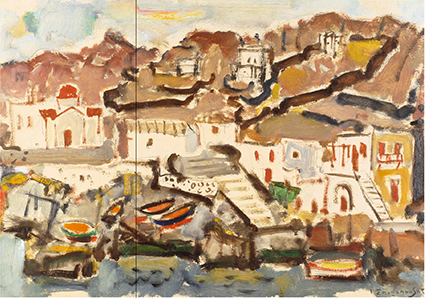
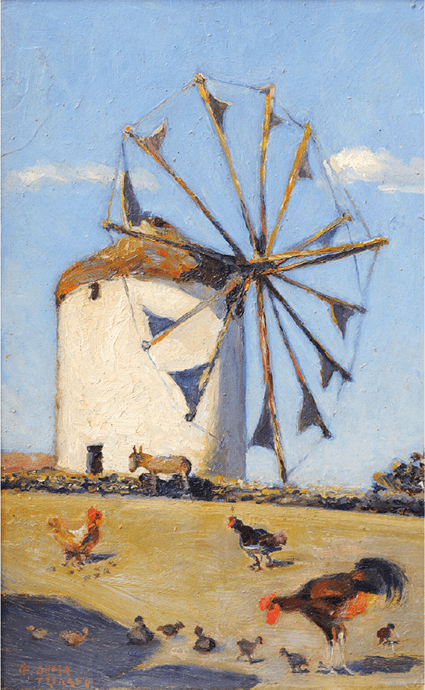
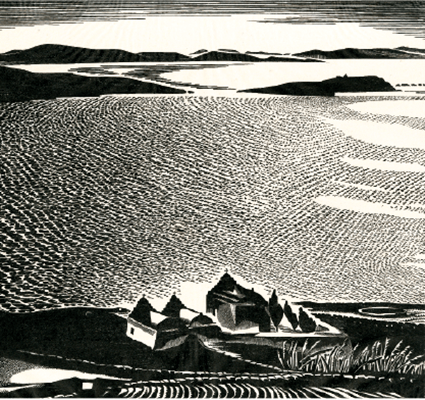
“MY SOUL is often a back street on Mykonos when night begins to fall”, wrote Surrealist artist/poet Nikos Engonopoulos back in 1939. I imagine those back streets were pretty quiet in those days, and nothing like they are today, since Mykonos became Greece’s party island par excellence. But this island does have an arty side to it too, for it is here that the Athens School of Fine Arts had set up its first annex, back in 1932. The ‘island of the winds’ had already been pulling a cultured crowd from the early 20th century, due to its close proximity to Delos, and the antiquities there, excavated by the French School of Athens (between the years of 1873-1913).
The current exhibition at the Municipal Gallery of Mykonos (runs till July 31), entitled ‘Mykonos through the Gaze of the Artists. From the Interwar years to 1960’, sheds light on the unique…
For anyone planning to visit the beautiful island of Crete, here is a book that could be of use. From the blog of Kritsa, who has written a book about Crete herself, a novel called Kritsopoula, girl of Kritsa.
One of my favourite travel writers, Richard Clark has a new book out focusing on my favourite region of Crete. Well, I live there so I cheerfully admit my bias. Richard has a knack of taking you on a journey through his eyes that either makes you nod in appreciation with a ‘Yep, that’s what I thought/saw about that place’ or ‘Mmm, I must visit there.’
Many guidebooks about Crete are unfortunately out of date and only skim the places they mention. Richard brings a fresh approach, and gives more detail while encouraging your own exploration. I’m proud to say I was able to make a small contribution to the book and thoroughly recommend it.
The photo on the book cover was taken in Elounda and I’m looking forward to standing right there to soak in the view. Congratulations, Richard for capturing…
We frequent our local fish shack all winter, too, when the interior is cosy and your clothes end up smelling of fried fish, and sometimes salt spray hits the windows. But now they’ve put their tables out, by the rocks.
Its name is Xypolitos, meaning ‘barefoot’.
Fishbones and wine. When darkness falls, they switch on the lights.
A blue evening. Around fifteen minutes away from where we live. Worth the drive?





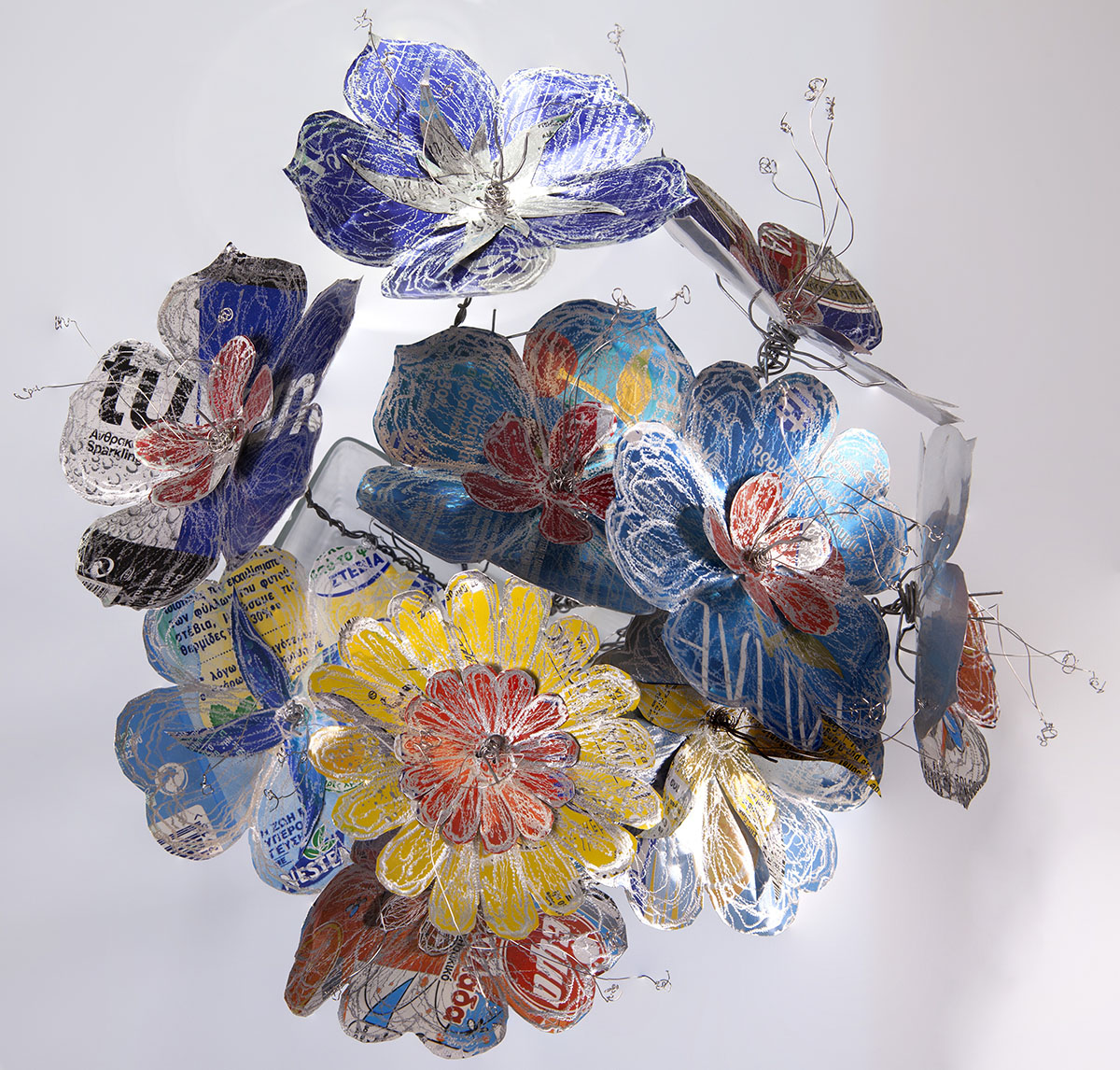

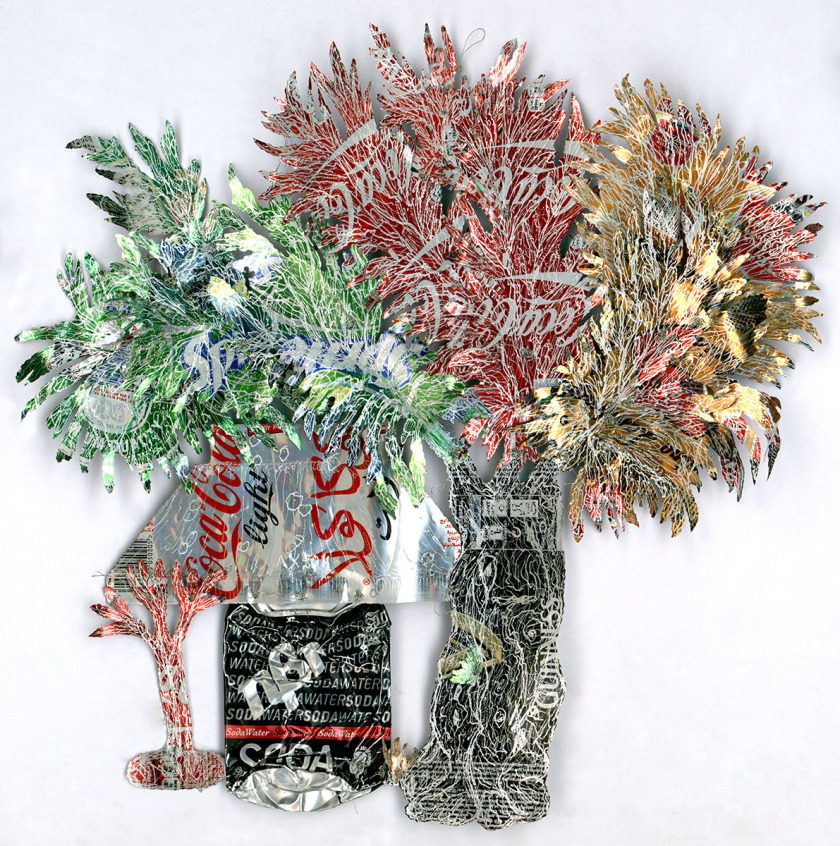
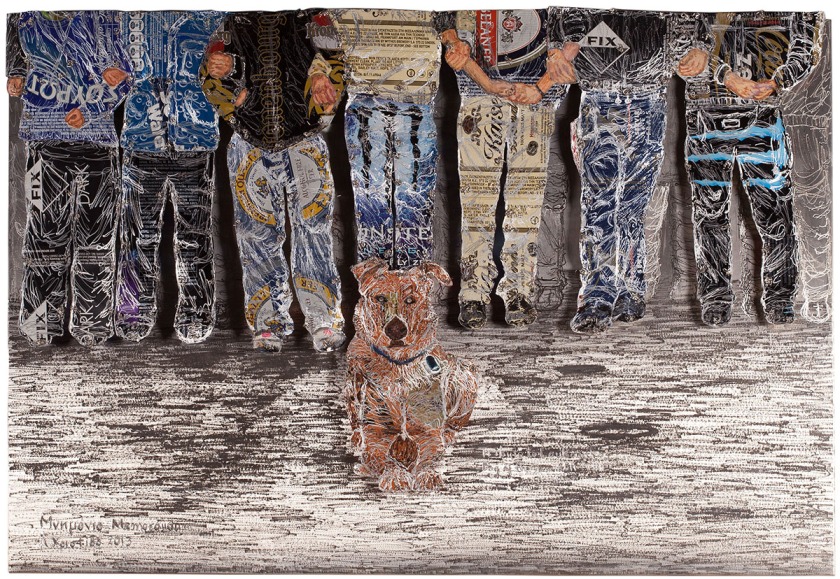 It’s also in line with how artists today combine the art process with recycling. She manages to transform this everyday object into flowers, cats, people, landscapes and more, at Athens’s Gallery 7, in an exhibition entitled ‘Debt relief programme – developments’. Opens on September 25 (runs till October 13).



 One of my favourite travel writers, Richard Clark has a new book out focusing on my favourite region of Crete. Well, I live there so I cheerfully admit my bias. Richard has a knack of taking you on a journey through his eyes that either makes you nod in appreciation with a ‘Yep, that’s what I thought/saw about that place’ or ‘Mmm, I must visit there.’


