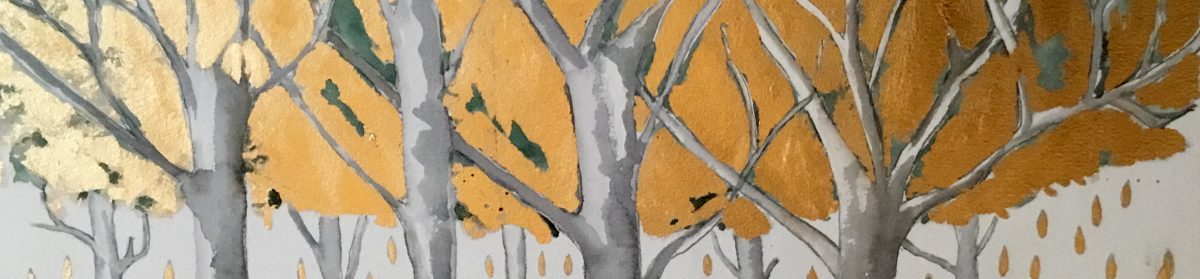
The more perspicacious amongst you might have noticed an extra page in the menu bar of my blog entitled MY ART.
AthensLettersArt. My Etsy shop logo
Since I seem to be spending more and more of my time painting, I decided to add some information about this aspect of my life. It is a change in lifestyle which makes me happy. Art is fun and great therapy! As Picasso put it, ‘Art washes away the dust of everyday life.’
Click on MY ART to find out more. I have no idea how this will develop, we shall see.
Also, bowing to popular demand (drum rolls and applause), I have set up an Etsy shop, AthensLettersArt, for my smaller watercolors. I invite those interested to take a look.(Click here)
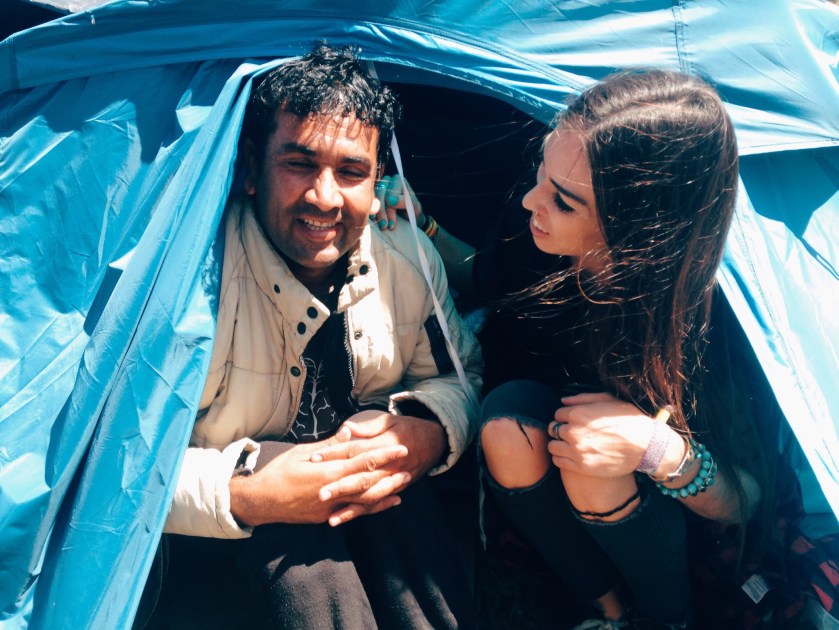
The O’Hara siblings used to work, respectively, in fashion and advertising. Then they visited the Jungle, a large refugee camp near Calais. They’d been hearing little bits about it, mostly about how it was affecting holiday makers by delaying the trains going across the English Channel.
They became interested, because their parents were already involved in the long and complicated process needed to foster a refugee. Since it wasn’t so far from their home in Kent, they decided to go over for the day and take a look.
Two years later, they have acquired two new brothers, one of whom comes from Eritrea and the other from Afghanistan. And they have founded the Worldwide Tribe.
The first time they visited Calais, there weren’t many volunteers about yet. They were, of course, shocked by the conditions there, and by the fact that there weren’t many people helping at all. However, what made the greatest impression, was, in Nils’s words, ‘How nice and welcoming the refugees were to us. Everyone wanted to share what little they had, to feed us and make us tea.’ People were polite, smiling, and full of optimism. The siblings went home, feeling very emotional about what they’d seen, and Jaz wrote about it on her Facebook page. The post went viral. Overnight, people started sending donations, both physical and monetary. In a short amount of time, they’d gathered a lot of clothes, shoes and food, as well as money.
Jaz and Nils soon realized that in the long run they weren’t best placed for managing warehouses and dealing with the distribution of donations – others were better at it. What they felt they were good at was telling people’s stories. They started diverting donations and volunteers towards other organizations, and they created the Worldwide Tribe.
They see their organization not so much as a charity, but as a platform for people to share their stories.
Jaz concentrates on content creation and writing, setting up talks in schools and universities and organizing different events. Both siblings manage the production of documentaries, of which the latest is the film DIASPORA.
Meanwhile, Nils and two friends have been setting up WiFi in camps. This is very important to refugees as it is the only way they can keep in contact with what’s left of their families, and also get information about their status, prospects, etc. This activity has resulted in the creation of a product which has generated commercial interest, which they believe has the scope to get bigger, and maybe result in the generation of funds towards their projects.
I was curious about the two boys the O’Hara parents are fostering. One, Mez, comes from Eritrea, which he fled because his only choice was to spend his life in the Army, where his brother already is. Having arrived in England aged 14 speaking not a word of English, he has now done all his GCSEs and is heading to college. He still has family in Eritrea and keeps in touch with them. In the beginning things were difficult because the cultural differences are huge but he managed to adapt quite quickly and has done ‘incredibly well’, according to Nils.
The other boy, Arash, is Afghani. He saw some of his family killed before his eyes, has lost all contact with them and doesn’t know if his mother is still alive. Speaking to Nils, I found it hard to imagine how difficult it must have been for this family to open their home – and how ultimately rewarding. I asked Nils how the two got on and he laughed and said: ‘They get on OK – but they are classic teenage boys.’
The O’Haras’ vision for the Worldwide Tribe is to inspire as many people as possible to share and contribute in any way they can, whether by volunteering, sharing a post or just talking about things. They hope this will create change from the ground up, while pointing out that their platform is not at all political.
Nils hopes the WiFi project will take off – if they manage to commercialise the product, it will earn money they can then plough back into the Worldwide Tribe, to help more people across Europe and the Middle East.
I asked Nils if it was hard to keep positive at all times. His answer was that they do see a lot of misery and it’s difficult not to take it home. What helps them is that although they spend a lot of time in the camps, in Greece, Turkey and Lebanon, they are not there all the time, so they manage to get some distance. Of course, they have seen bad things, and violence, but they have mostly been inspired by the positivity and humanity they encounter. They feel they’ve learned a lot and are awed by the human spirit, and the incredible stories they’ve heard. They are amazed by how people in such difficult circumstances keep trying and finding resources, and they reckon the experience has generally been far more positive than negative.
You should go on their site, and read some of the incredible stories there. Such as the one about Noor, who’s in a wheelchair but is determined to become a judge, or Besh, who, with his four younger brothers, searched practically every refugee camp in Europe to find his mother, and then miraculously located her in Dunkirk. You can also follow Jaz on Instagram or Facebook.
Young people spreading good will – perhaps it will offset some of those intent on spreading havoc…
Well, it’s been a busy week, but I was determined not to fall behind on the WorldWatercolor Monthchallenge, so I mostly resorted to quick sketches at bedtime.
Day 8: Seagulls. I seem to be inspired by birds lately, and it is the summer and beach weather. After making a quick and splashy background, I drew the seagulls in ink and added oil pastel for highlights.
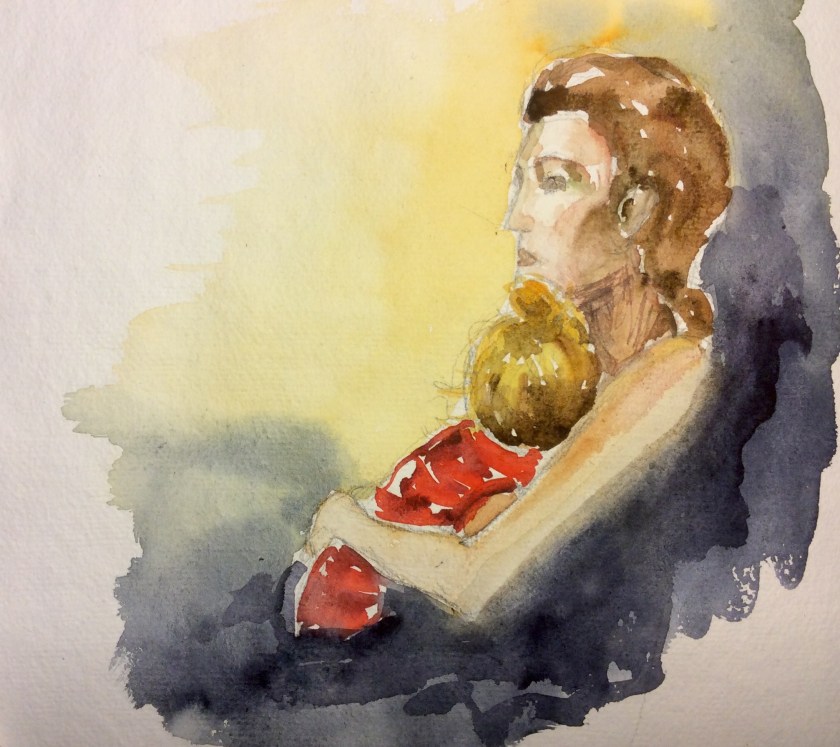
Day9: Mother and child. I have to force myself to draw people (not my strongest point, so I need the practice). I had a little more time tonigh, and I found an appealing photo as a reference – it would have been better drawn from life, but no models available (sigh…)
Day 10: Garden produce. I’d gone out to pick some lettuce, onions and cauliflower, so I just dumped them on the kitchen table (I used a tea towel not to get dirt onto the table, and that proved quite a useful addition to the sketch!)
.
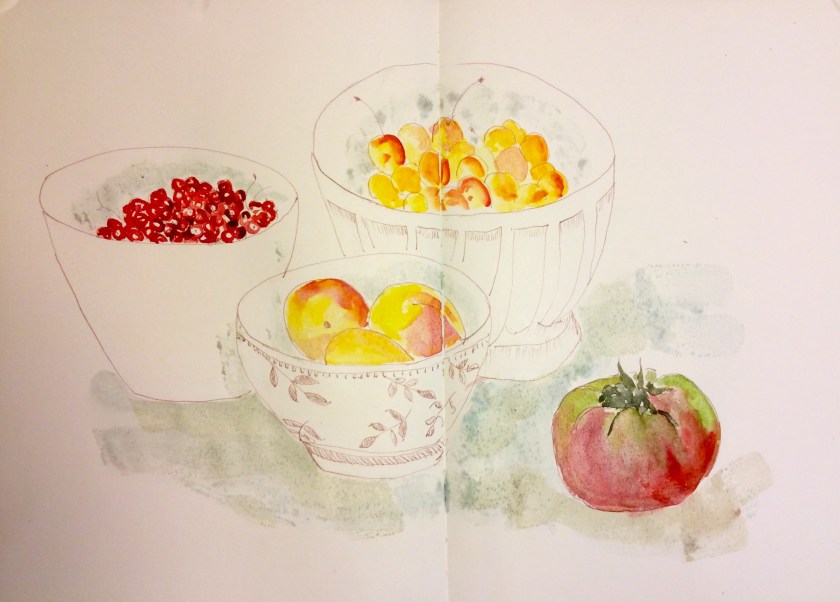
Day 11: Three bowls of fruit and a tomato. I do love summer fruit. These are peaches, yellow cherries and red currants. What could have been more inspiring than to make a sketch of them in a large Moleskine journal.
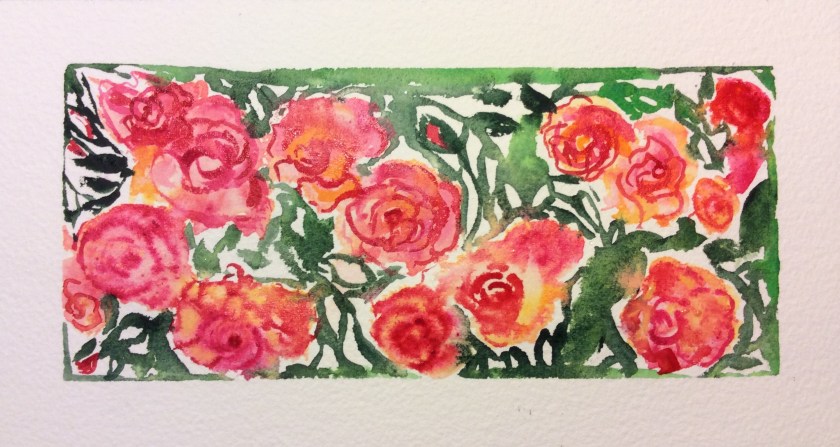
Day12: Roses. Really no time tonight, so I just sloshed some paint around and doodled on top. It was a good way to test some new Daniel Smith watercolors, too (Quinacridone Rose, New Gamboge and Deep Sap Green).
Meanwhile, I’ve been putting the finishing touches on my bird project, ‘Sandhill Cranes In Flight’. This is watercolor, oil crayon and gold leaf on two large sheets of Arches paper (100x60cm). It has now been packed off to the recipient, who I hope will be happy with it. I’m a rotten photographer, only use my iPhone and couldn’t get the light right, but you get the idea (I blue-tacked it to the wall to take the picture, but the left side was in shadow).
Day13: Three-panel study of floral painting. This is my new project, so I started making some studies to help me decide how to proceed. It will be based on plein air sketches of irises, tulips and hyacinths I made when they were in flower in the garden. Always gives a better result than painting from photos.
Day14: Six-panel study. Another version, using six pieces of paper instead of three. I probable prefer the first one.
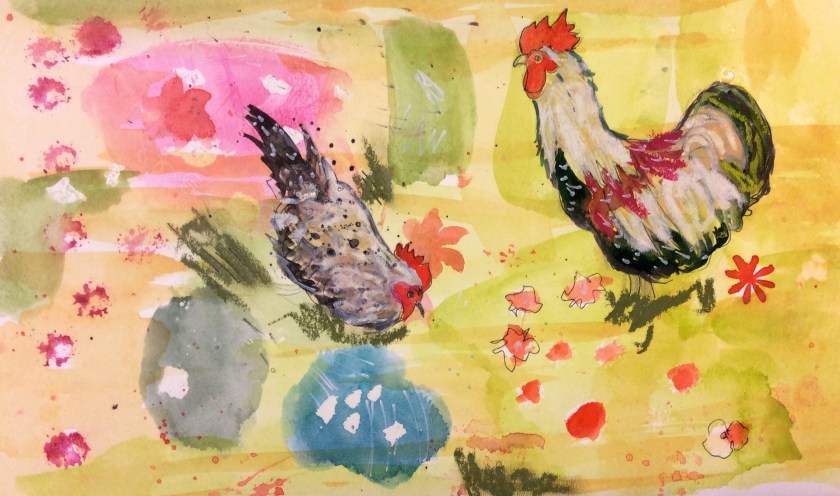
Day15: Chickens. Really got back late today, so when I came upon a piece of paper on which I’d been testing color mixes and some flower stencils, I just added a rooster and a hen on top.
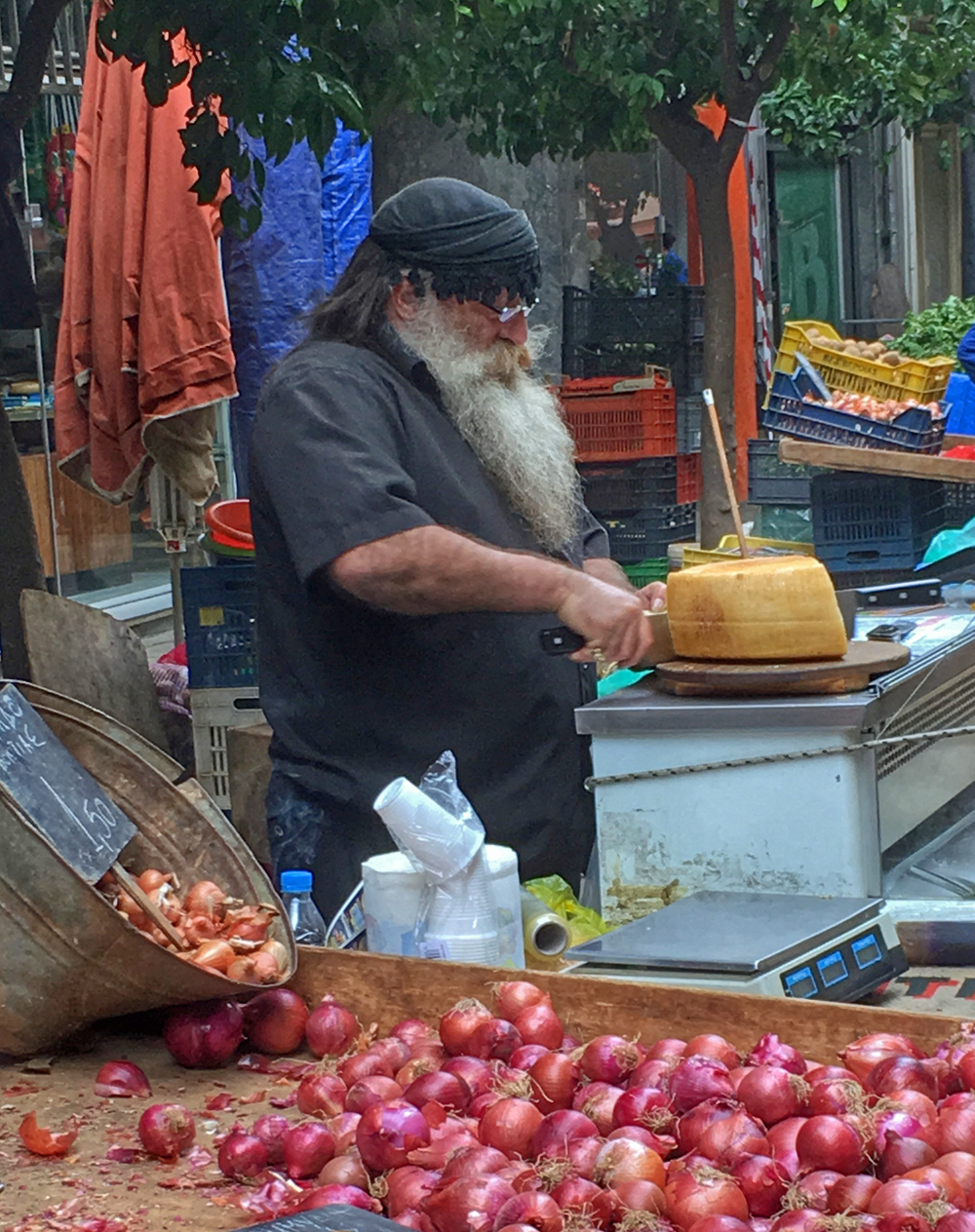
No poetry could do my local market – laiki – justice, or at least the kind of poetry that I might come up with. That said, I am sure that many others who are gifted wordsmiths could create a beautiful ode. In fact, Michael Llwellyn-Smith, in his 2004 travel book Athens, in Signal Book’s ‘Imagined Cities’ series, has eloquently described (albeit in prose) our Friday laiki:
It is one of the most vivid displays of everyday life in the city, with its regularity, the personal encounters with neighbours, the cheerful noise of the vendors crying their wares, the quiet purpose of the shoppers stocking their trolleys and baskets.
What I can offer is a photo essay from images I’ve taken in the market over the past year. The great majority of the photographs I have taken record the seasonal produce, but every once in a while, people catch…
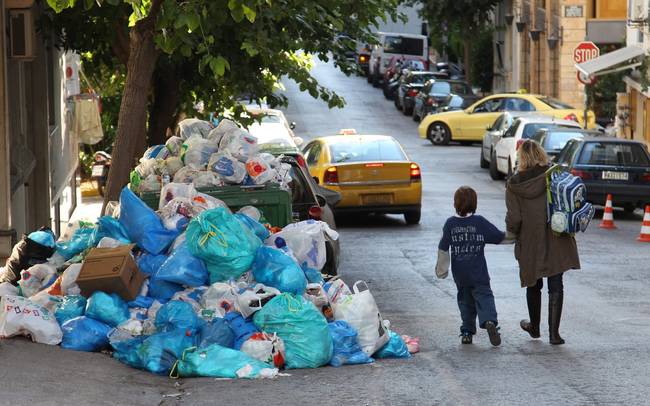
While we are awaiting a major heatwave in Greece, we are surrounded by piles of rubbish, since garbage collectors have decided to go on strike. In fact, they have been on strike for some time and, following days of protests, rallies, occupation of public car parks and camping outside city halls, yesterday they voted to carry on, unhappy with the terms of their employment. The government, as usual, is dithering, wavering between the country’s needs and the demands from the Troika, while every decision taken is delayed by the usual bureaucratic tape.
As neighborhoods are being asphyxiated by piles of bin bags, some cities – such as Thessaloniki, which boasts a very active mayor – are looking to hire private firms to do the job, something which is not looked upon kindly by the syndicates. The impact on tourism is incalculable.
A street in the town of Tripoli (source: Google)
Meanwhile, citizens already suffering from heatstroke and inhalation of toxic fumes are to be dealt another major blow: taxes for employees, farmers, pensioners and the self-employed are due another whopping rise, since they will now be calculated in a different, ‘new’ way. Speaking of which, the government has taken to inventing creatively named ways of fleecing the population – such as the ‘claw-back’ and the ‘solidarity tax’. I leave it to your imagination to make out their meaning.
This is the result of demands for more and more money from our lenders, which will go to paying back what we owe. But the well is running dry, and the economy, instead of being revived, is being driven underground. I know a lot of people who already use barter – the dentist putting fillings in the plumber’s teeth in return for having the shower fixed, and so on. Back to basics, I suppose…
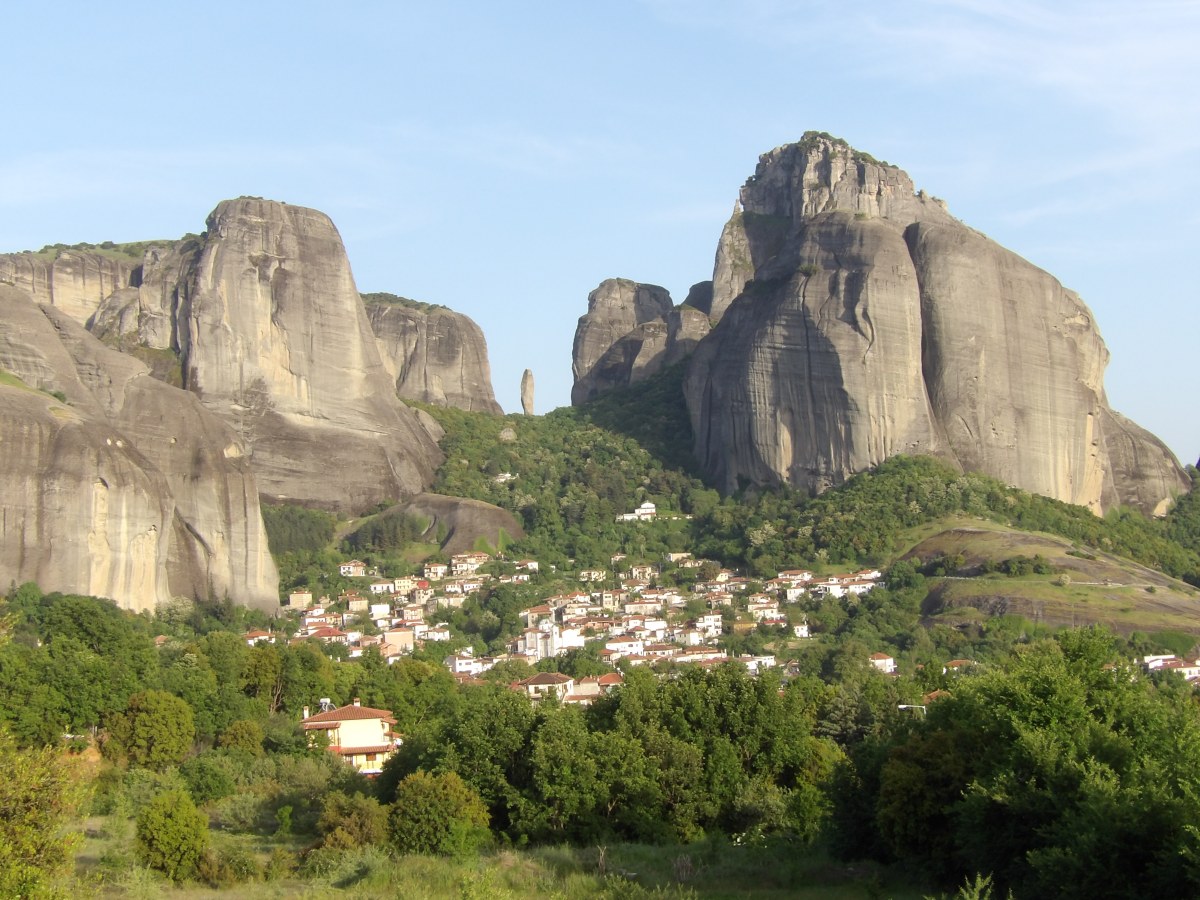
I know I’ve written about the Meteora before (https://athensletters.com/2015/10/31/road-trip-to-meteora/) but I find this place magical, and enjoyed reading a post on the blog Kritsa, at the heart of it all, written by Yvonne, who shares her time between the U.K. and Crete. Take a look, it might inspire you to visit!
In early May we set off on a road trip around central Greece…what an adventure.
We drove aboard the overnight Minoan car ferry from Heraklion, Crete to Pireaus, the main port near Athens. Bright and early next morning found us zooming up the excellent motorway on a four hour trip to odd peaks named Meteora. Our aim was to see the monasteries that ‘balance’ between heaven and earth. For the Greek Orthodox faith, this Holy area is second only to Mount Athos.
After checking in to the Kastraki Hotel for two nights ‘Wow’ was a common term.
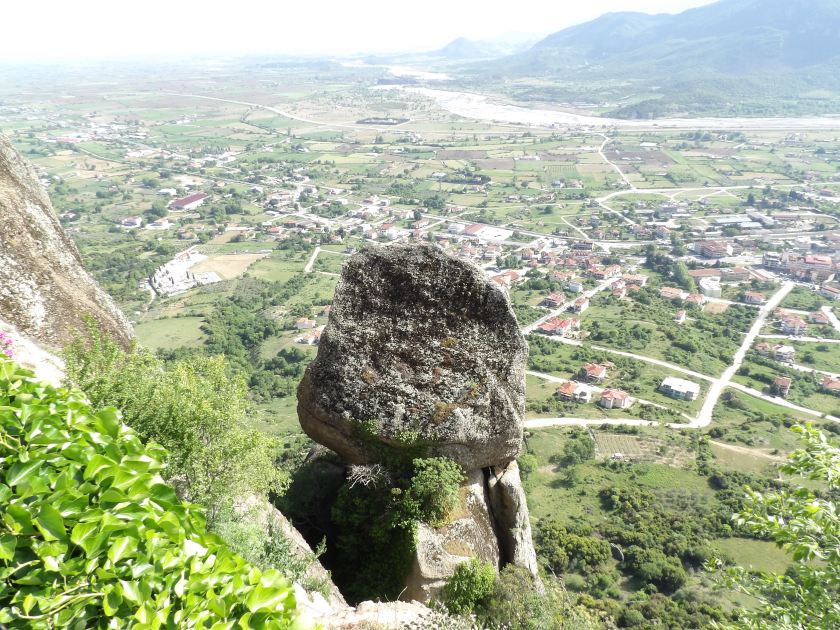
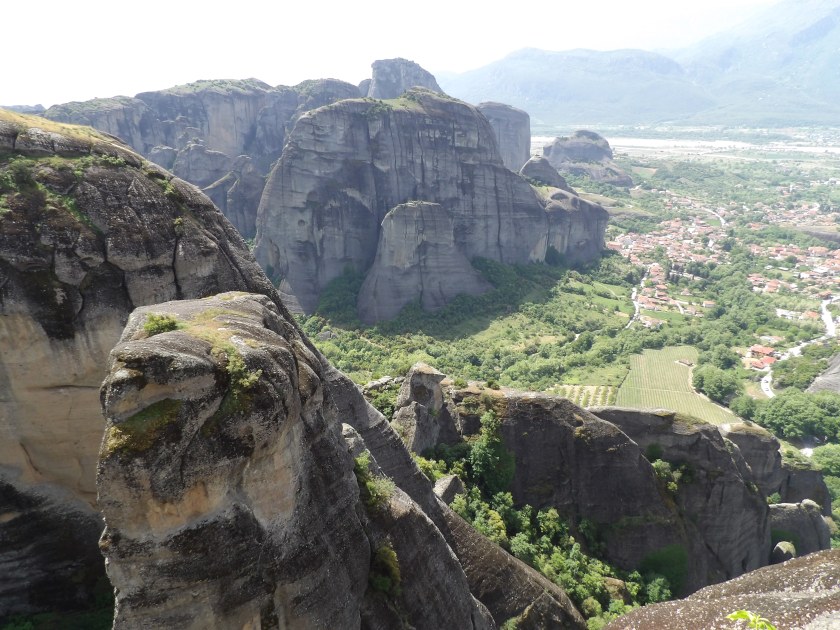
I’d pre booked asunset tour and it proved to be an excellent way to see many of the monasteries perched atop the peaks. Hard to believe the top of the rocky towers were once the bottom of a lake. Close up you can see they’re an aggregate of mud and rocks.
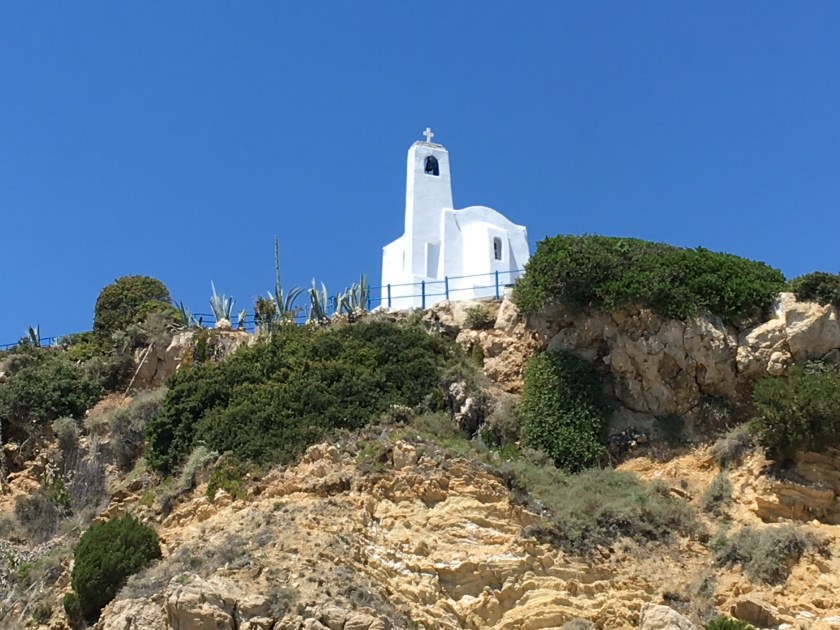
On Saturday, just two days after the ‘monsoon’, the day dawned bright and beautiful. Fishing boats bobbed about in the port of Rafina, near Athens,
overlooked by a picturesque chapel, white against a pure blue sky.
Motor boats and yatchs waited for their owners to take them out.
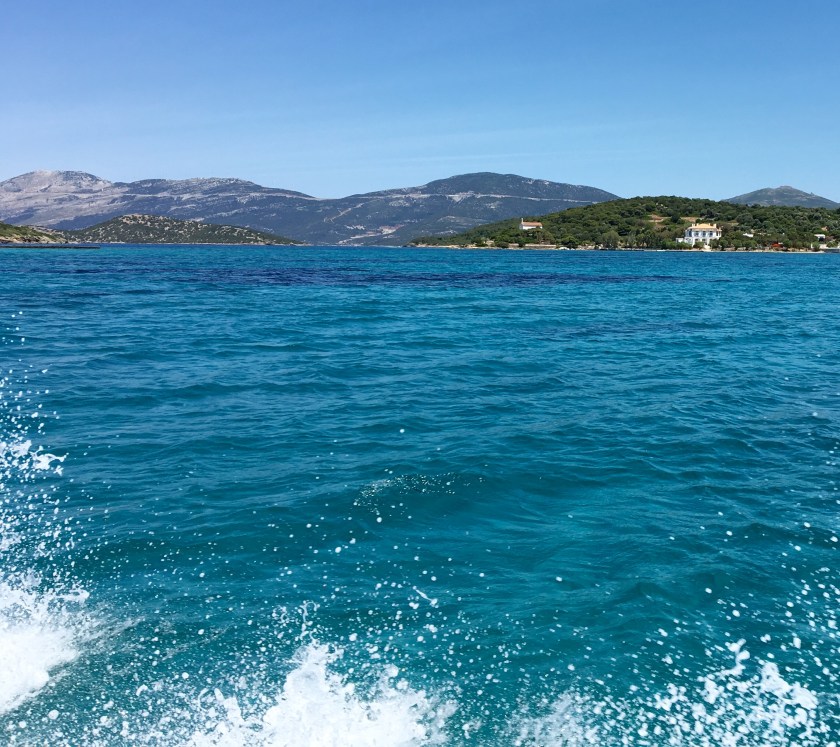
A short boat ride away is the large and beautiful island of Euboea. Euboea (or Evia, as we call it), is the second largest island in area and population in Greece, after Crete, and separated from the mainland by the narrow Euripus straight. It has stunning mountains as well as lovely beaches.
Here we indulged in a freezing but invigorating swim in the turquoise waters.
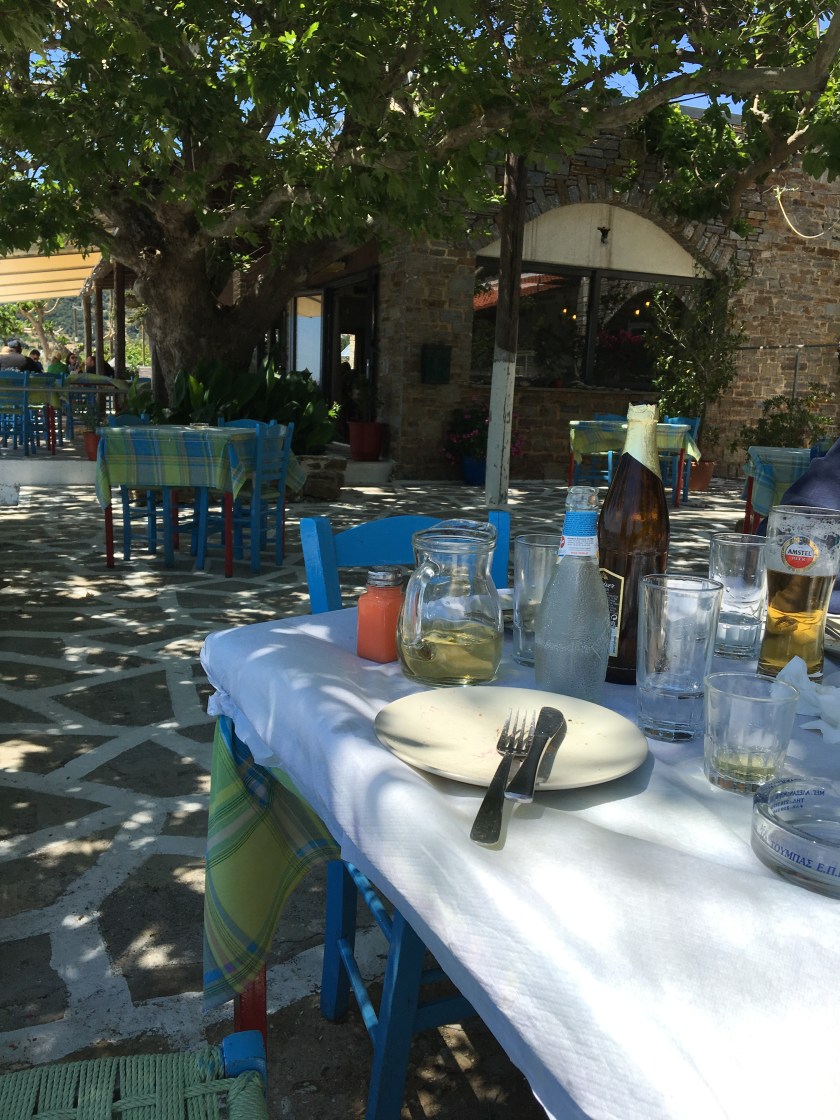
Then lunch in a nearby taverna called Platanos,
Where the tables were set under the plane trees.
The owner had caught this fish (a type of grouper) himself that very morning. He’s a keen fisherman and regaled us with the story of his other catch, which weighed 14 kilos! Ours was preceded by his deliciously crispy cheese pies, salad with tomatoes and feta cheese, was accompanied by hand-cut fries, and followed by yoghurt drizzled with honey.
The port of Rafina is around 30′ from the centre of Athens. For the boatless, there is a regular ferry-boat and this taverna, remote as it looks on the photos, is a few minutes away from landing.
An easily accessible day out and one of many such options for escape from Athens. It beats being downtown where two out of every three shops are shut. I suppose that’s one of the reasons why we can bear to stick it out. (Sigh…)
I’m a great fan of nature and animals, and today is International Endangered Species Day. Well, I didn’t know that, but it seems a lot more worthy than International Cupcake Day, or some of the other Days we are bombarded with. So, having come upon this very interesting article I decided to share. As an added bonus, it is illustrated with some beautiful mosaics, something else I’m partial to. Enjoy!
I’ve been offline for a while, having been rather busy, but also because there’s been nothing I particularly wanted to write about. I had planned to go and visit another part of the Documenta Art Fair, but a general strike put a stop to that. To top it all, the weather has been foul; a hot wind dumping packets of dust upon us straight from Africa and, since yesterday, rain. We’re usually glad of a bit of rain at this time of the year, since everything is drying up fast, but today it’s like a monsoon, pouring down from a grey sky. The dog is refusing to go out, and I’m dreading a pile of poop will materialize next to the kitchen door…
Aaargghh.
Looking out on a watery world
Catching up on the news is doing nothing to improve my mood. The endless political bickering is intolerable. I wish they’d buckle down and do some work, instead of spending their time blaming each other for the ills that are besetting us.
As the endless negotiations between the Greek Authorities and our European controllers are winding towards a resolution, things continue to look grim. The constant quest for more money is centred on two things – raising taxes again (they are already sky-high) and cutting pensions further. Of course, there doesn’t seem to be any intention of cost-cutting in the public sector.
Consider the following figures:
Against a population of 3.5 million people in full employment, there are 1.4 million unemployed and more than 2.5 million pensioners. Nearly half of those are getting a pension below the poverty level. An average net salary is around 815 euro while around half a million people work part time for less than half that amount. Many are getting paid with a delay of three to five months.
Meanwhile, over 400.000 people have emigrated in search of better opportunities, mostly those with high qualifications.
Even if my figures are a little off (it’s hard to know which articles are credible), they paint a bleak picture of the future. The professional classes have been decimated and there is a real danger that a large part of the population will slip into permanent poverty. The collapse of the productive and technological framework also seems impending.
It beggars belief how the powers-that-be can think that a country can be resurrected by selling off the national assets and impoverishing the population. They’re in a mad hunt for cash in total disregard of any other consideration. The cash will disappear into the usual black holes and then what? And who will benefit from all this? – because, surely, as always, someone will.
It was this bleak mood which tempted me into ‘borrowing’ today’s title from Kate Atkinson’s marvellous crime novel. For those of you who haven’t read it, I highly recommend it (it’s the third of a trilogy).
As I’m writing this, my chair has been jolted by an earthquake. A single tremor. Could it be an omen? But of what?
To vent my frustrations I will now go and slosh some paint around.
Today I would like to welcome Mark Stephenson, who wrote a very interesting post for me some time ago, about books set in Greece (read it here). His own debut, a thriller set partly in Crete, has just been published. Having read an early draft, which I found a real page-turner, I’m eagerly anticipating discovering the final version. Meanwhile, Mark has described for us how he got his inspiration. In his own words:
I’ve always dreamed of being a writer and while working in investment banking in the City of London, I started to write a novel which was set in Greece. The half-written manuscript sat in my desk drawer for over twenty years. It told the story of a student called Andreas who was killed by the police in the famous Athens Polytechnic riots of November 17th 1973. It is a quest by his girlfriend, who was carrying Andreas’ child at the time of the killing, to find out the truth. It is also a fight between two brothers, one of whom was responsible for the murder and now deeply regrets what has happened. There were many plot holes in the manuscript and the pressures of my job did not allow me enough free time to finish. A novel involves a huge amount of work and I’ve got great admiration for those who do a day job and still manage to write in the evening. Christopher Hitchens once said: “Everybody does have a book in them, but in most cases, that’s where it should stay.” I was determined to let mine out into the world, but whether I have any talent for story-telling remains to be seen.
To find out, I retired from my job a few years early and decided to follow my dream. The first thing I did was to enrol in an MA in Crime and Thriller writing at City University in London. I was not trying to write literary fiction so this course seemed to be the right thing to do. A requirement of the MA was to complete a novel so it provided excellent motivation to get the novel finished. My hopes were set back when my tutor told me that the novel I’d started to write all those years ago was not topical enough for a mass market and suggested that I try something else. I took the advice, but could not throw away my desire to write a novel set in Greece. I’ve been going to Greece for over forty years and fell in love with the country and most of all the people. I’ve always been a big admirer of the novels of Nikos Kazantzakis and his wonderful Report to Greco which steered me towards setting my novel in Crete.
The novel has two interlocking time shifting narratives. The first tells the story of Callidora, a young Cretan shepherdess, during the German invasion of Crete in 1941. She discovers an ancient Christian scroll which has been revealed, buried under a church’s foundations, after it is destroyed during an air raid. Callidora meets Hans, a German paratrooper who helps her understand the significance of what she has found. Her friendship with Hans does not go down well with Callidora’s family and fellow villagers, who make accusations of collaboration with the enemy and disown her. Meanwhile, Hans’ commanding officer, Captain Wolfgang Kohlenz, will stop at nothing to force Callidora to reveal the scroll’s secret.
The plight of Callidora’s fictional village of Tirata reflects the truth that many Cretan villages were destroyed during the occupation by the Germans. One of the most famous is Kandanos in the White Mountains. I wanted to see for myself what the village was like and, although it has been rebuilt, at least I could see the location and visit the monument to those Cretans who were executed. My experience on that trip into the mountains typifies why I admire the Greek people so much. I am told that there is no word in Greek for stranger and I have certainly seen that over the many years I’ve been going to the country. I think the way they have helped the refugees in islands like Lesbos illustrates that point better than my story but I’ll tell it anyway.
On the road to Kandanos with my wife, I made the wrong turning and ended up on a stone track. Foolishly, I kept going and as we began to climb I decided to turn back. I needed to reverse a little but got stuck in a ditch and couldn’t move the car. Thanking God for good mobile reception in the mountains, I telephoned the car hire company who were not best pleased. When I said that the car was not damaged and just needed some help, the car hire lady said that she thought she knew somebody who might help and would phone me back. A few minutes later she came back to tell me that a friend from the fire service was coming and that we should start walking back to the main road. In less than twenty minutes, a large fire truck appeared manned by two handsome young firemen, much to my wife’s evident pleasure after being fed up with her husband for getting stuck. The men towed us out of the ditch. They refused my offer of recompense for their help and went on their way.
We drove on and found Kandanos, visiting the monument which was moving in its simplicity. There was a strange feeling about the village which, although rebuilt, seemed still in mourning for what had been lost. I came away feeling inspired to complete my novel. Many tourists never get much past the Cretan coast line but in the mountains, you see the true resilience and spirit of Zorba.
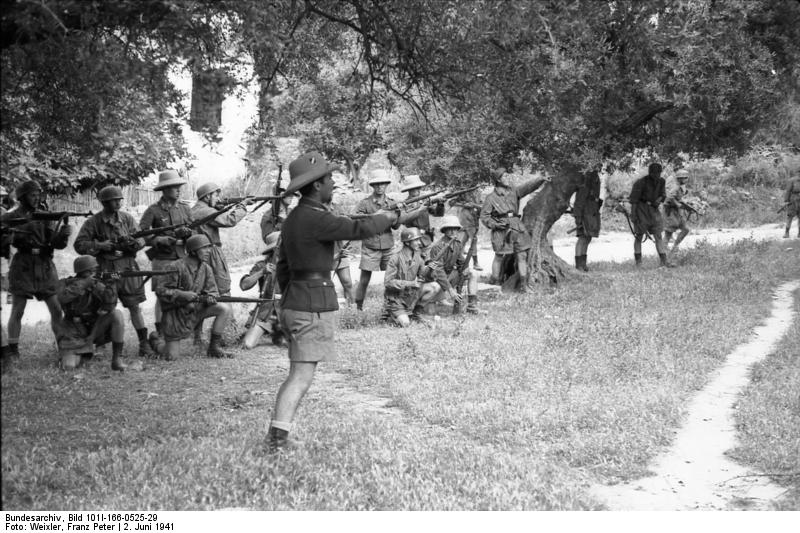
The fierce resistance by ordinary Cretans took the Germans by surprise. The Parachute regiment known as the Fallschirmjager were expecting an easy victory but were horrified by the way that the resistance started within the first hour of the invasion. Every member of the parachute regiment received a copy of its own ten commandments. The ninth commandment said: “Against a regular enemy fight with chivalry, but give no quarter to guerrillas.”
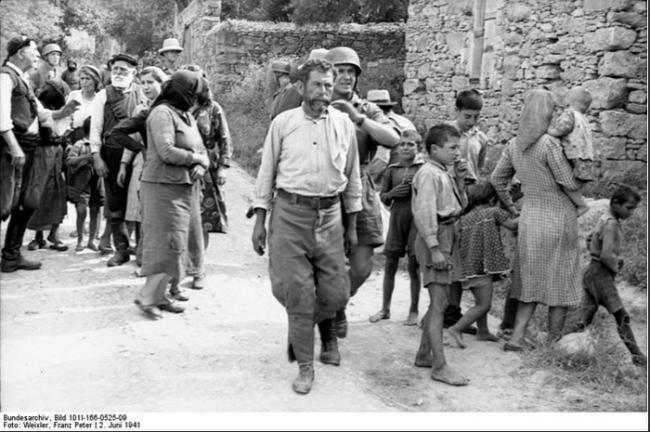
These so-called guerrillas included boys, old men, women and even priests and monks fighting with any weapon they could get their hands on including antiquated rifles used to shoot ducks, pick axes, scythes and spades. On the first day, the Germans lost over 2000 paratroopers, many who were killed by the irregular army of Cretans. The pictures and the video below illustrate the massacre at Kontomari where a similar war crime was committed and where the paratroopers had their revenge.
Apart from Callidora’s story, the other narrative tells the story from the perspective of Richard, a British MI6 intelligence analyst caught up in the London bombings of 2005. The two stories are linked by Richard’s search for the truth about his father, who is presumed dead and yet being hunted by both the CIA and Al Qaeda. He discovers a family secret which draws him into a conspiracy of global significance. The conspiracy relates to words of the Cretan scroll discovered by Callidora in 1941. Terrorists want its secret revealed but the CIA, Mossad and MI6 want it destroyed.
My novel is called The Last Messenger and is intended to be the first book in a trilogy. I received quite a few positive comments from agents about the strength of my writing but all said that there was no demand for conspiracy thrillers. Therefore, it is with a streak of bloody-minded and perhaps misguided optimism that I decided to publish the book myself. I certainly don’t expect to make any money from publication, but I’ll be thrilled if someone I don’t know tells me that they enjoyed reading it.
The attached link will lead you to a free sample of the novel and has links to purchase either the paperback version or the Kindle version.
I do hope you will consider adding it to your reading list. If you do read it then please let me know what you think on my website.
There is much more on the background themes of the novel on the website.
The modern narrative set in 2005 would suit readers who enjoyed I am Pilgrim whereas the World War Two story explores themes similar to Captain Corelli’s Mandolin.
Thank you, Marina, for giving me the opportunity to guest on your blog and to relate some of the inspirations behind setting my first novel in Greece. Readers of Letters from Athens will be pleased to see scenes from the novel set in that wonderful city, in the district of Exarchia.










 Day Two – Meteora Hike