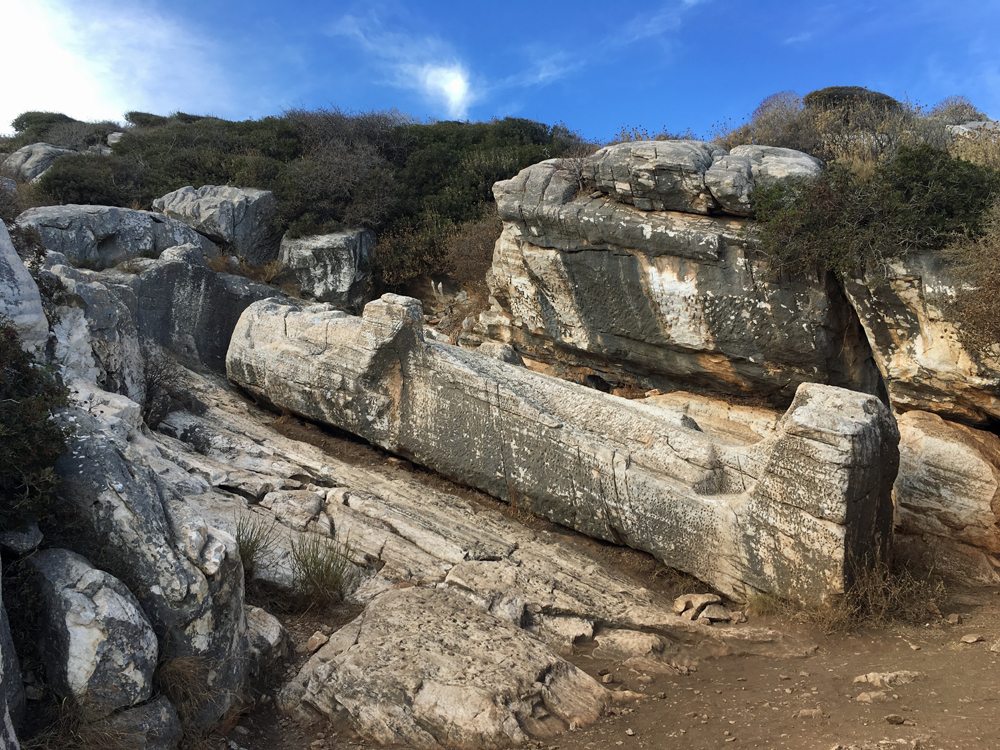
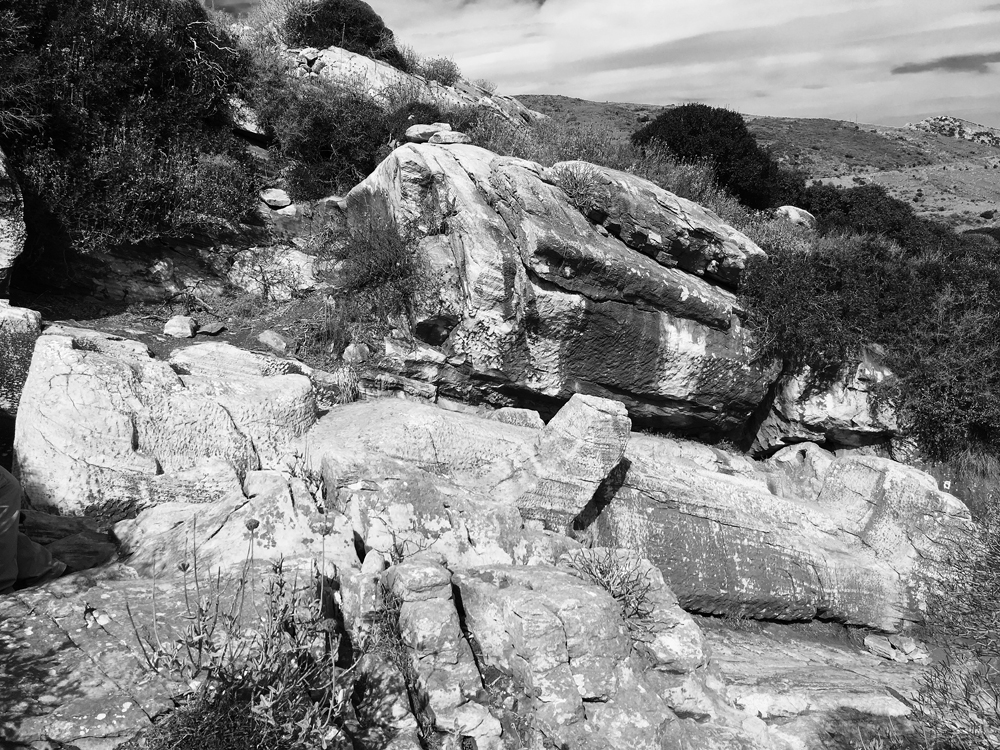
On a hillside on the northern coast of the Cycladic island of Naxos rests a blue grey marble colossus, rough hewn and almost complete. Sadly, something went wrong in the rough carving and he was abandoned in solitude. He has been resting here, set in his quarry bed for well over two and a half millennia.
Visitors come and go. I’ve seen early pre-19th century travel sketches and watercolours, old late-19th century black and white photographs, and many more recent tourist snaps of this giant unfinished statue.
He is almost 11 metres in length. The Kouros of Apollonas (the ancient town nearby) was his original name. But in the mid-19th century he was identified as the Greek god Dionysus, so is now called the Colossus of Dionysus. Whatever his name, he perpetually lies in his stone bed gazing out to sea.
Solitude: The Daily Post’s Weekly Photo Challenge.
I know I keep harping on about the refugee crisis – most of you must be heartily sick of me by now. But it is something that I don’t feel the world as a whole can ignore – and not only in reference to the humanitarian aspect, but because it is a problem that, give the present situation, we will all have to face in the future, one way or another. And I don’t believe building fences everywhere is a solution.
4.1 miles is a short documentary made by Daphne Matziaraki, a Greek filmmaker who lives and works in the San Francisco Bay Area. ‘4.1 miles’ refers to the distance between Turkey and the island of Lesvos, where she followed a coast guard captain for three weeks as he pulled family after family, child after child, from the ocean and saved their lives. All the events in this film were shot on a single day, October 28, 2015. Two additional rescues happened that same day but were not included.
She says: ‘The Greek Coast Guard, especially when I was there, has been completely unprepared to deal with the constant flow of rescues necessary to save refugees from drowning as they attempt to cross to Europe from Turkey. When I was there filming, Lesbos had about 40 local coast guard officers, who before the refugee crisis generally spent their time conducting routine border patrols. Most didn’t have CPR training. Their vessels didn’t have thermal cameras or any equipment necessary for tremendous emergencies.
Suddenly, the crew was charged with keeping the small bit of water they patrolled from becoming a mass grave. Each day, thousands of refugees crossed the water on tiny, dangerous inflatable rafts. Most of the passengers, sometimes including whoever was operating the boat, had never seen the sea. Often a motor would stall and passengers would be stranded for hours, floating tenuously on a cold, volatile sea. Or the bottom of a dinghy would simply tear away and all the passengers would be cast into the water. The coast guard felt completely abandoned, they told me, as if the world had left them to handle a huge humanitarian crisis — or allow thousands to drown offshore.’ (Excerpt taken from a NYT article, sept 28, 2016.)
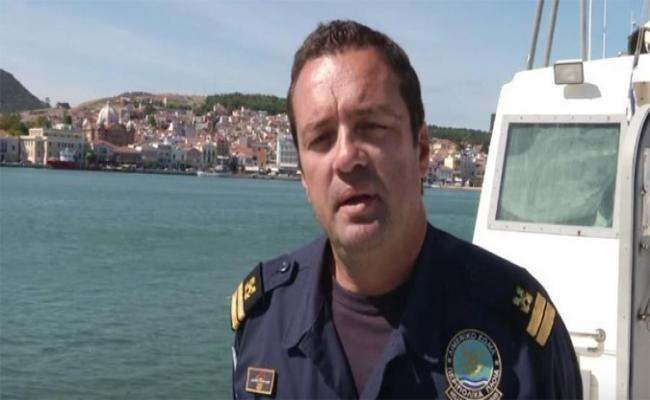
The coast guard captain in question is KyriakosPapadopoulos (photoabove), a naval officer who, after working on freight ships for a few years, decided to come back and settle on his beloved island of Lesvos, where he dreamed of a quiet life. Little was he to imagine what was in store for him and his crew, on the by now legendary coast guard launch “602”.
The first sea rescue in Lesvos took place in September 2001, when they picked up ten Afghans off the coast. This became the talk of the island. The war in Syria changed all that. In 2014 around 50-100 people washed up on the island daily; and, by the beginning of 2015, this number had risen to thousands every day. More than half of the one million refugees who arrived in Greece that year came to Lesvos, and most of those were picked up by Kyriakos’s boat.
Usually, rescues take place in bad weather conditions. Kyriakossays: ‘We come upon boats that are half sunk – we know we need to act fast, people can drown before our eyes. We need to pull around 60 people into our boat in less than five minutes. It’s a huge responsibility.’ Psychologically, this is tough, and has taken a toll on him and his crew. Kyriakos has two daughters, aged 15 and 7,5. At sea, he sees their faces in the faces of the children who lift up their arms to be saved. ‘You can never get used to this. However, none of us has entertained the thought of giving up. Saving people gives us the strength to continue. Especially the smiles of the children, when they see us.’ (Translated from an article in Kathimerini, January 28, 2017).
Kyriakos has been given an award for his work by the Academy of Athens, and the documentary has been nominated for an Academy Award. What pleases him most, though, is the fact that through the screening of the documentary, his friends and family have seen for themselves what he and his crew are going through. Because they find it impossible to talk about this to anyone; they only discuss it amongst themselves, on the advice of psychiatrists – to exorcise the images they’ve had to witness. He also hopes the world will see the film, and offer some help.
I watched the film, and I warn you it is harrowing. An incongruous thought kept going through my mind: at least there are no killer sharks in Greek waters.
I’m reblogging this post from one of my favorite blogs, Champagnewhisky, because saving wildlife for our children and grandchildren is a subject close to my heart. I also thought the pictures were wonderful!
I recently came across the word Tsundoku which I find greatly amusing. According to Wikipedia:
“Tsundoku” (n.) is the condition of acquiring reading materials but letting them pile up in one’s home without reading them. “Tsundoku” originated as Japanese slang (積ん読) “tsun-doku”. 「積ん読」 came from 「積んでおく」 “tsunde-oku” (to pile things up ready for later and leave) and 「読書」 “dokusho” (reading books).
I’ve always been addicted to books, and like to be surrounded by piles of them, just in case I run out of – horrors – reading matter. And since the time when, on a trip, I finished my book and found myself with no access to a library or bookshop, I’ve also collected a number on Kindle. These are a safety measure, but lack the heft and presence of print.
In my defense, I do read them. I always have two or three on the go. But I will never get through my unread pile in my lifetime, especially since I occasionally like to re-read favorites. But have a clear out? Never!
As they say ‘So many books, so little time’ – or, ‘tsundoku‘!
Despite everything, the end of the year is always a sort of celebration, as it heralds a new beginning. Why should things change, just because the date does? They probably don’t, but there is a feeling that they just might. Hope springs eternal!
However, today we woke to the news of yet another carnage, in Turkey. Wars are raging in many places. It is hard to feel optimistic. Still, life goes on, and rituals have a soothing effect on the soul.
In Greece we observe many traditions for the New Year, which I described last December in my post ‘Ringing in the New Year In Greece.’ It was all about smashing pomegranates on our doorstep, cutting the Vasilopitta (Basil’s cake) to find the lucky coin, about fireworks and gambling! For those of you who joined this blog recently, you might like to take a look (here).
Looking back through my year’s output, I thought it would be fun to see which posts were the most popular each month, based on likes (a rather random method most probably, but the only one available.)
In January, the honors went to GreekCuisine, featuring many delicious specialities (here).
In February, people loved ThefirstsignsofSpring, with its photographs of anemones and almond blossom (here).
In March, the most popular post was about the old tradition of CleanMonday, subtitled ‘A sky full of kites’ (here).
In April, TheMinoans, about a very ancient civilization, proved interesting to a good many people (here).
In May, DayTriptoMycenae, about another enthralling Ancient Greek civilization, took top honors (here).
In June, Brexit – Grexit, whatelse? captured the popular vote, the only political commentary to do so (here).
In July, you were very complimentary on my completing the WorldWatercolorMonth dare – a watercolor each day for a month. The post was entitled I didit! (here)
In August, the most popular post was MidsummerBlues – photos of lavender, figs, a cat and the sea (here).
In September, the MonthlyQ&A, of poet SofiaKioroglou, was the first to be most popular post in a month (here). This feature is always well received, but never made it to the top before. It was followed closely by ‘A short meditation on walls’ and ‘Messing about with clay.’
In October, everyone fell for Aubergines – thenewsuperfood (here). This was quite a productive month, as I also wrote about seahorses, an inspired chef, and the colors of fall.
In November, a lot of interest was shown in the TheAncientsGreeksandtheTerracottaArmy, a fascinating theory about an incredible work of art (here).
In December, people were captivated by the SisterhoodoftheTravellingSketchbook (here).
So, moving on, what does this tell me? That you love food, art, photos of flowers and lovely landscapes, history, finding out how people live in another country… These are the things I write about, anyway, so the survey is somewhat irrelevant, especially since there were no huge differences in the number of likes. But still fun!
Regarding the number of posts, my aim was to post about twice a week, so around 8 per month. I’ve achieved an average of 7 per month, so not too bad…
And so, 2017 has started. Happy New Year, everyone!
As the year draws to an end, many among us are reflecting how happy we’ll be to see it go. It has been a very turbulent year, to say the least. A violent year, too, full of wars, terrorist attacks and mass shootings. The situation world-wide is precarious, with Europe teetering after Brexit and America about to embark on a potentially dangerous adventure. Elsewhere, dictators and virtual dictators rule. In the third world, populations are exploding, without the backup to ensure all these people can be fed and employed, thus making the immigration question loom ever larger.
Whether due to man-made climate change or natural causes such as storms on the sun, weather has been both strange and excessive. Floods, earthquakes, tempests and unseasonal heatwaves have been wreaking havoc in many places.
The distribution of wealth is also out of control. Disproportionately huge sums are being earned by some (even, shockingly, by people who work for charities) and spent at art auctions, on racehorses, yachts and other luxury items, while the middle classes are struggling to maintain a reasonable standard of living. Many public institutions are going bankrupt, perhaps because funds have been squandered or misappropriated for years. It is always disturbing to see people sleeping in the streets next to luxury shops in the capitals of the western world – and apparently now 25% of the population of Europe faces slipping below the poverty line. A quarter of the population – it seems incredible.
In Greece, this number is 35%. Between the incapacity of the government and the misguided (self-interested?) handling of the European ‘lenders’, I feel things are going from bad to worse. I see no incentives given for a re-start of the economy, and measures taken to combat corruption and bolster institutions are implemented extremely slowly.
The refugee crisis also remains acute – and will continue to do so, as long as wars and atrocities do not abate. The situation of most of these people is dire – and, because they need to survive somehow, microcosms are formed with a dynamic of their own (for example, the Jungle in Calais) which pose problems to the host country and can only be dismantled at huge cost to all involved. It is frightening to think of the future (or lack of) faced by so many children on our planet in the 21st century. Displaced, dispossessed, uneducated – in a time where normally health and opportunities have improved and should still be improving.
Another worrying development is a rise in intolerance related to immigration but not only. I was shocked to read the following excerpt, from an article in UK newspaper The Daily Telegraph: “Some of Britain’s leading universities are becoming no-go zones for Jewish students because anti-Semitism is rife, the first ever higher education adjudicator has claimed. Baroness Deech, a cross-bench peer, said that institutions may be failing to combat hatred against Jews because they were “afraid of offending” potential benefactors from Gulf states.”
I will make no comment on the above.
This year has also been catastrophic for the music industry and its fans and followers, with the deaths of such icons as David Bowie, Prince, George Michael, and Leonard Cohen, to name the most prominent. Also of other bright names, such as actors Alan Rickman, Carrie Fisher and Gene Wilder, as well as Mohamed Ali, Fidel Castro and astronaut John Glen.
However, the year cannot have been all bad – or bad for everyone. There were successes (for example, I don’t think Usain Bolt is complaining), babies born, art and music made, things built. When I Googled ‘Good things that happened in 2016’, I got the following:
– A few animals came off the endangered list (however, quite a few others went on, so I don’t know how it balances up.)
– A solar powered plane circumnavigated the world.
– A number of scientific advances were made (especially in curing disease), including the 3-parent family (look it up, guys!)
– 70,000 Muslim clerics declared a fatwa against ISIS (about time, I should think)
-AND….wait for it…there was the launching of Pokémon Go! I joke not – this was mentioned on various sites as a major event of 2016…
This was my – no doubt biased – view of things. But maybe some of you can add to the list?
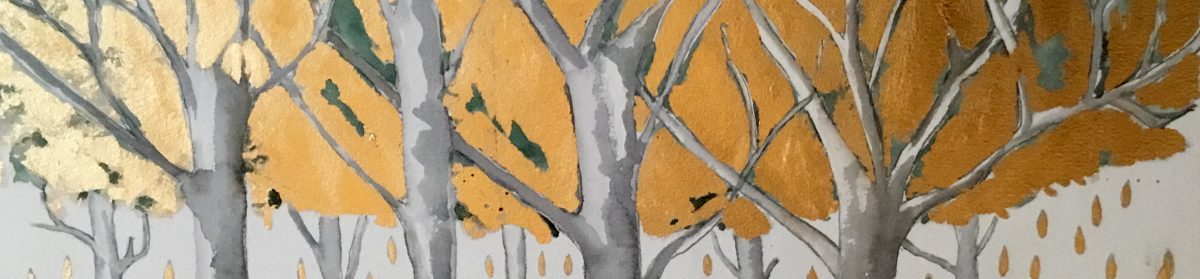
Above is a painting I’m doing for the December ArtDare which is set by RISD professor Clara Lieu at art.prof. The theme is ‘2016’. I’m trying to portray the year as I saw it – troubled and violent, as I said above. Still a work in progress.
With warmest wishes to all my readers and loyal followers, whether celebrating the Winter Solstice, Christmas, Hanukkah or any other rite, ritual or feast. Thank you for dropping by and for commenting.
For those of you who have joined the blog recently, last year I wrote a post about celebratingChristmas in Greece. You can read about it here. You can also find a recipe for the delicious butter cookies we call kourabiedes (κουραμπιέδες) here. Enjoy!
If you like reading stories, my friend Solveig Werner (https://solveigwerner.com) has organized an Advent Calendar of short fiction by various writers. Drop in and take a look. This is my own contribution, a reconstructed fairytale. Just for fun!
Little Red fumbled at the door latch with clammy hands. It seemed stuck. Behind her she could hear panting as her grandmother struggled with the heavy blankets. She’d always hated the bristly old thing, who had doggy breath and long fingernails like claws, but she’d never felt afraid of her before. What the hell was happening?
“We are at the turn of the 19th Century. Napoleon is pondering the risk of invading England. He decides that it is not a very good idea. Instead he invades Egypt, wresting it from Turkish authority. The Turks don’t appreciate this at all. They break off diplomatic relations with France. They also declare war. Britain decides that this is a dandy time to appoint an Ambassador to Turkey.
Enter Lord Elgin. It is he who gets the job. He has just married pretty Mary Nisbett and is finishing his fine country house. Its architect tells him of the wonders of Greek architecture and sculptures, and suggests it would be a marvellous idea to make plaster casts of the actual objects in Athens. “Marvellous, indeed,” says Elgin. He sets about organising a group of people who could make architectural drawings, headed by a worthy painter, who turns out to be Giovanni Lusieri, an Italian painter.[…]
Elgin’s staff of artists arrive in Athens. To control Athens the Turks have assigned two governors, one civil, the other military. Much has been said and continues to be said of what little concern the Turks had for the Acropolis treasures. Yet, it took six months for the Elgin staff to be allowed access. But they worked it out; five pounds a visit into the palm of the military governor. This inaugurated a procedure of bribery and corruption of officials that was not to stop until the marbles were packed and shipped to England.
Yet, when scaffolding was erected and moulds were ready to be made, suddenly came rumours of French preparation for military action. The Turkish governor ordered the Elgin staff down from the Acropolis. Five pounds a visit or not, access to the Acropolis was verboten . There was only one way to get back up there again; for Lord Elgin to use his influence with the Sultan in Constantinople, to obtain a document, called a firman , ordering the Athens authorities to permit the work to go on.[…]
No sooner was the firman delivered to Athens, than a feverish, terrifying assault is made upon an edifice that, until today, many consider the purest, the most beautiful of human creation…”
Pediment statue which is in the British Museum
The above text is part of a long speech made by Melina Merkouri – a beautiful and powerful woman, a well-known singer, actress and politician who, at that time, had been appointed minister of culture – to the Oxford Union in 1986. The topic on debate was the return of the Parthenon Marbles to Greece. She ended her speech thus:
“You must understand what the Parthenon Marbles mean to us. They are our pride. They are our sacrifices. They are our noblest symbol of excellence. They are a tribute to the democratic philosophy. They are our aspirations and our name . They are the essence of Greekness.
We are ready to say that we rule the entire Elgin enterprise as irrelevant to the present. We say to the British government: you have kept those sculptures for almost two centuries. You have cared for them as well as you could, for which we thank you. But now in the name of fairness and morality, please give them back. I sincerely believe that such a gesture from Great Britain would ever honour your name.”
Melina Merkouri with her husband Jules Dassin
The Parthenon Marbles, designed and executed by the sculptor Pheidias to adorn the Parthenon, are perhaps the greatest of all classical sculptures. When, in 1801, Lord Elgin, then ambassador to the Turkish government, had chunks of the frieze sawn off and shipped to England, these were seized by Parliament and sold to the British Museum to help pay off Elgin’s debts.
Greece has sought the return of the sculptures ever since victory in the War of Independence in 1832. During the war, Greek fighters even gave bullets to Ottoman soldiers besieged on the Acropolis because they were damaging the Parthenon by removing lead fittings to make ammunition after running out. However, the British Museum has so far refused to consider the request, on the grounds that the marbles had been legally acquired. Greece does not accept this, arguing that the firman giving Lord Elgin permission to take the marbles was never actually produced, and that in any case, it was issued by an occupying force.
The British Museum also maintained that Athens did not possess a fitting place to house the marbles. It is true that until recently the Acropolis museum was a small and cramped place (I remember the boredom of tramping around it on school trips – dusty statues lined against the walls) but the fact is that the marbles which remained in Athens are in much better shape today than those in London, having been restored by cutting-edge laser technology. Meanwhile, the ones in the custody of the British Museum have suffered both deliberate and accidental damage, a fact acknowledged by Dr Ian Jenkins, chief curator of the museum.
As for lack of fitting space, this argument has been emphatically trumped by the opening in 2009 of the New Acropolis Museum whose innovative design, the work of Swiss-born architect Bernard Tschumi, offers a sweeping 360-degree view of the Acropolis. In a Times article dated August 27, the museum was described as “one of the most beautiful exhibition spaces in modern architecture”.
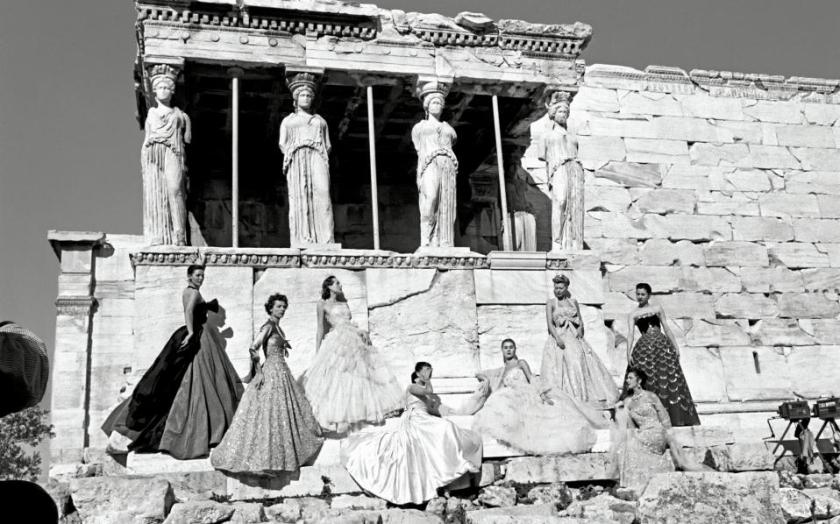
The Caryatids in the Acropolis Museum (NAM, AKTOR, 29JUN2009)
While government is still prevaricating, the British people are more relaxed about returning the marbles (today, a majority supports reunification.)
In 1983, in response to Melina Merkouri’s appeal for repatriation of the marbles, a campaigning body called the British Committee for the Reunification of the Parthenon Marbles was set up. Eleni Cubitt, its secretary, says: “The Parthenon Sculptures deserve to be housed in the New Acropolis Museum. Currently they are a fragmented piece of art, yet as one significant piece, visitors will be able to see the whole as it ought to be seen, in context, at the foot of the Acropolis itself.”
The English writer Christopher Hitchens also joined the fight in 1983, by writing an article on the subject for the Spectator. In 1987 he wrote his polemic, The Elgin Marbles, now retitled The Parthenon Marbles: The Case for Reunification. Hitchens insisted the Greeks have “a natural right” to the sculptures, and that they belong on the hill of the Acropolis – “in that light, in that air. Pentelic marble does not occur in the UK.”
While both Mercouri and Hitchens have since died, the battle goes on, under the benign leadership of the Acropolis museum director, Professor Demetrios Padermalis.
In a recent article in the Kathimerini daily paper, Padermalis explains that his strategy is strictly scientific, avoiding fanfare, and instead using low key discussions and thoughtful reasoning. He maintains a scientific dialogue with the British Museum, in keeping with his credo that the Acropolis Museum is before all a place of learning. Of course, the matter of the return of the marbles has always had a political dimension; in 2014 the Greek government hired the high-profile human rights lawyer Amal Clooney and her colleagues to secure the return of the Parthenon Marbles – a momentous mission. However, they have since backed off, fearing a negative decision by the courts would permanently wreck Athens’ chances of having the marbles returned. Financial considerations also played a part in this decision, given the country is in an acute state of crisis.
The French Romantic poet Alphonse de Lamartine once described the work as “the most perfect poem ever written in stone on the surface of the earth”.
Meanwhile, in 2008, in a gesture of goodwill, Italy returned a fragment, a 14-by-13-inch artifact consisting of a foot and part of a dress hem from a sculpture of Aphrodite, the goddess of love. The 2,500-year-old section of marble was presented to the Greek government by Italy’s president, Giorgio Napolitano.This is not the first piece from the Parthenon sculptures to be returned, since another, smaller piece was offered by Heidelberg University two years previously.
Padermalis remarks that politics are not within the museum’s sphere of influence. The feeling I got from reading the Kathimerini article is that Padermalis disapproves of the bombastic tones the government used in this matter, believing that this does not help the cause. He prefers the viewer – the millions of visitors coming to the museum – to see for himself the esthetic problems caused by the fragmentation of the marbles. The unity of a wonderful work of art has been broken, by being divided between Athens and London.
Padermalis uses concrete examples to reinforce his point of view. In one part of the frieze, a centaur is grabbing a Lapith woman by the waist, in a violent scene of rape. But the woman’s foot is in the British museum, where a visitor can never comprehend, by seeing this lone foot, the dramatic tension of this scene. In another part, Kekrops, the first mythical king of Athens, had a snake by his feet, to symbolise the fact that he was indigenous to Athens (the snake was a guardian of the natives). But the snake is in London – another fragmented scene, which thus loses much of its impact.
The new Acropolis museum is a magical place, meriting a trip to Athens just for its own sake. It is full of light and wonderful perspectives. Walking in, one finds oneself stepping onto a glass floor, through which can be seen the ruins of the ancient city of Athens. There are treasures on view at every step, and the top floor is an exact replica in shape and size of the Parthenon so that the metopes can be seen as close to their original form as possible. The walls are glass, through which the Parthenon can be admired, a short distance away. Light streams in, making for an unforgettable experience.
The entrance of theAcropolis Museum
I have had the pleasure and of meeting professor Padermalis, and his enthusiasm and passion for his work are infectious. He never tires of showing people around and explaining his latest projects, one of which is reconstituting the colors of the statues (on replicas, not on the original statues!) Minute quantities of paint remain on the statues, enabling a close approximation, which appears shockingly garish to the modern viewer, who is used to the beauty of the bare marble.
The case is ongoing: this year, a cross-party group of British MPs has launched a fresh bid to return the marbles to Greece on the 200th anniversary of the British Government’s decision to buy them — a move that campaigners said could help the UK secure a better deal during the Brexit talks with the EU. But the matter also provokes an interesting debate: should all works of art be returned to their country of origin? Would this cause a huge upheaval in major museums? Personally, I don’t think one can generalize – it should be a case by case matter, depending on the rarity of the work, the situation in the home country (Palmyra comes to mind, but could Palmyra have been transported elsewhere?) and other factors.
International organizations can and are helping with the preservation of monuments where possible. Casts and copies can be made. Also, in some cases, such as Greek and Roman antiquities, there are so many of them that more could foreseeable be loaned to museums around the world rather than stay unseen in storerooms.
I read this article on The Alk3R Post, a cool blog which always posts interesting things. These sponge divers were a particular breed of men, very brave, and very famous in Greece. I have some of these sponges – in the sea they look black, and have to be treated and bleached to reach their final form.