Waterloo Teeth

Going to the dentist is not my favourite outing, as one can imagine. Coming out of this morning’s visit, my mouth numb on one side, I nevertheless felt grateful to have been born in the twentieth century—in ealier ages, surely by now I would have had but a few teeth left, if any at all. The torture of toothaches and dentures must have been unbearable in those days.

In old portraits, people almost never smile. Smiling might have been considered uncouth and awkward, a serious face more dignified and also easier to get a likeness from, but another reason was that many people had bad or even missing teeth. Not very flattering, even if the subject was clad in velvet and lace.

However, vanity (and practicality) made people look for solutions, starting in ancient times. The earliest known dentures—made by the Etruscans circa 700 BC, also found in Egypt and Mexico—consisted of human or animal teeth tied together with wires. Other ancient people use carved stones and shells to replace lost teeth.
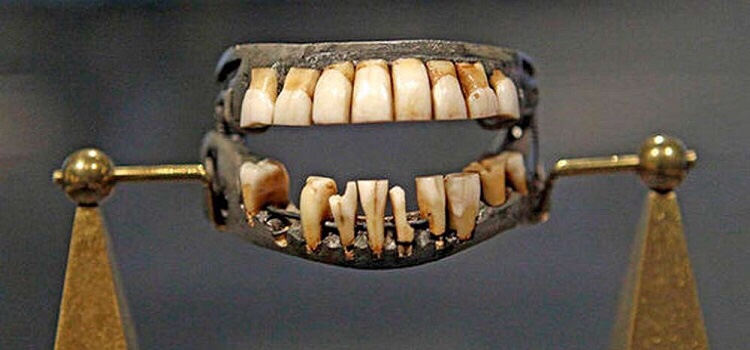
In the 1700s materials improved with the introduction of walrus, elephant and hippopotamus ivory. But of course the best replacement was a real human tooth—acquired from people willing to sell them (these were difficult to find, because someone had to be desperately poor to give up his teeth) or, more easily, from corpses. Surgeons and professional grave robbers had access to these, but of course the most plentiful source was war. To get an idea of how many teeth were taken from battlefields, consider that they were sold by the barrel!

After the Battle of Waterloo there was a glut of teeth on the market. The French emperor, Napoleon, had lost 25,000 men, the Duke of Wellington’s mixed force had suffered 15,000 casualties and Blucher’s Prussians some 8,000. Viewed in the grey light of dawn the battlefield must have been a dreadful sight. But almost worse than the carnage must have been the arrival of an army of scavengers stripping dead soldiers (and some not so dead) of their valuables; coins, clothes, weapons and their teeth. Before long cartloads of teeth were heading for the Channel ports (I find this image hard to picture.)

There was already a well-established European export market for teeth, which had been started by one of George Washington’s dentists, John Greenwood, who in 1805 returned from Europe with a barrel load of human teeth from one of Napoleon’s earlier battles. George Washington suffered from tooth problems all his life, having lost his first tooth at 22; and he only had one of his own teeth left by the time he became president. He had several sets of dentures made, from various materials—but none, as popular belief has it, from wood (that is an urban legend). Some might even have been taken from slaves, another possible method for acquiring human teeth in those days.

The vast numbers of teeth flooding the London market became known as “Waterloo Teeth”. The belief that the teeth going into one’s dentures had once belonged to a brave young soldier had great commercial appeal.

However, there were already some alternatives to human teeth: The first porcelain teeth had been made in Paris by an Italian dentist in 1808. Despite that, and given that these alternatives had various flaws to start with, the demand for ‘Waterloo Teeth’ continued well into the second half of the 19th Century. At some point, due to the unbelievable slaughter of the American civil war, with over half a million deaths, the tooth trade was reversed, with millions of American teeth coming to Europe.

As for the dental health of the celebrities concerned, the Emperor Napoleon died in exile on St Helena in 1821 at the age of 52 still with all but four of his own teeth; and the Duke of Wellington lived until 1852, never having expressed a wish to acquire a set of Waterloo teeth for himself, despite having lost a few of his own.

Even as late as the 20th century, good dentistry was not available everywhere. Doris Lessing, whose parents moved to Zimbabwe (then Rhodesia) when she was five, remembers seeing her mother secretly sobbing with pain: both her parents had all their teeth removed and replaced with dentures before going to Africa.

So hurrah for modern dentistry. And apologies for the gruesome tales and photos, but I found it interesting how difficult it has been to develop something we now take for granted. I’m sure the same goes for eyeglasses—Samuel Pepys suffered much from failing eyesight, and had to read holding tubes of paper or cardboard to his eyes. But that is another story.
Erasing history

The news these days are full of stories of social unrest. Something that has been brewing for a while, as society divides become greater, rather than narrower.
However, I find myself perplexed by the practice of tearing down statues of people who were slave traders or racists, along with their other attributes, for which they were celebrated.


History is built in shades of grey: unfortunately human nature is such that the strong often prey on the weak.
Alexander the Great built wondrous libraries in his glorious conquest of the ‘known world’, but also massacred plenty of ‘barbarians’ along the way. In the democracy of classical Athens, there were slaves, who did not have a vote—and neither did women, or foreigners.
The men who hauled blocks of marble to build the Parthenon were not blessed with paid holidays and health care. Should we tear down the Pyramids, because they were built in sweat and blood?
Religions and sects have persecuted, burnt, and tortured people who did not share their beliefs. Should we tear down the churches and temples?
Some of the slave traders were black themselves, preying upon their own kind. And racism is not confined to blacks—many others have borne the brunt of it. Native Americans, Maoris, Armenians, Jews, Tutus, the list is long—anyone who found themselves in the minority in the place they lived in. Human nature.


Here is an anecdote: I recall, when visiting one of the Balkan countries during Communism—I think Bulgaria—being shown around a monument by a local guide. It consisted of a large circle dug into the ground, two stories below. It was open to the sky and, all around the perimeter, stood a row of larger-than-life bronze statues representing workers: one held a scythe, another a plow, a third a hammer, and so on. The whole thing was rather ghastly but, was was weirder still, was that when I asked the guide who was the sculptor who made them, she answered, ‘We don’t know.’
‘How can you not know? This is not antique, it’s recent.’
She hemmed and hawed, then she said: ‘He fell out with the regime, and his name was erased from the books.’
Such a narrow minded way of looking at things.


Things that happened, happened. Should we try to erase the past? I think it’s better to reserve our energies for improving the present—with more efficient laws, and with reform, not destruction. Thousands of people are slaves still, in the 21st century—and they’re not all black. There’s a huge immigration crisis, worldwide. There are people now, today, who have made fortunes exploiting others, but everyone sucks up to them, because their money gives them power, and they also take good care to make large donations to charities and universities. There are huge corporations operating on the returns of sweatshops and the like.

Is it a solution to stop reading Rudyard Kipling, or showing Gone With The Wind?

I’m curious to know what everyone thinks about all this.

Old Athens

Today Athens is a large, bustling city with a population – suburbs included – of over three million. It has its own particular Greek flavor, of course, but it also has many common characteristics with other European capitals: a lot of traffic, pollution, the usual ubiquitous shops, restaurants, cafés, museums, opera houses, theatres, squares and parks.

Athens, however, is a relatively new city, which evolved, in the 19th century, from a regional town of the Ottoman Empire to the capital of the new Kingdom of Greece. After the liberation from the Turks, it was a ruined and semi-abandoned town. But King Otto, the young Bavarian prince sent over by the Allies, declared it a capital, and in 1834 its reconstruction began, under architects Stamatis Kleanthis, Edouard Shaunert and Leo von Klenze, the king’s counsel.

It was then that the neo-classical buildings which even now give the city distinction were erected, starting with the Royal Palace, which was paid for by King Otto’s father, the king of Bavaria, as a personal loan to his son. In 1934, after extensive renovation following two fires (the royal family had meanwhile moved to a new palace), the building became the House of Parliament.


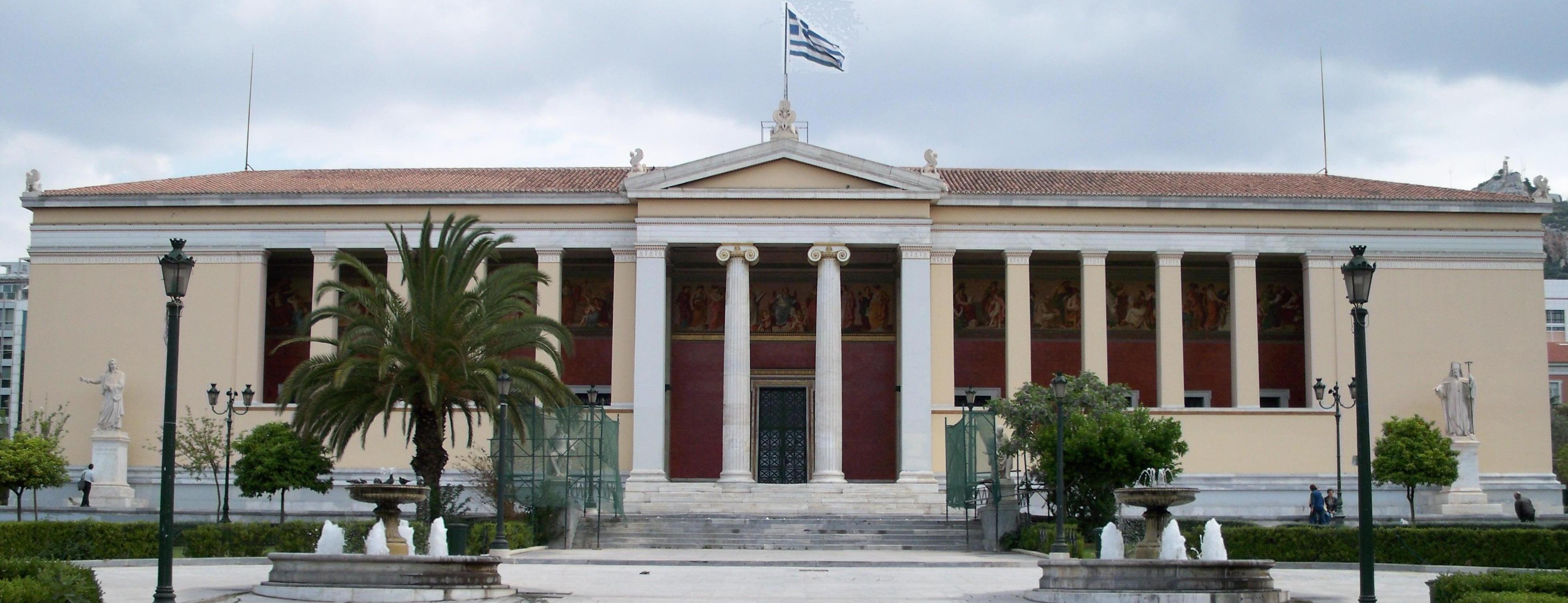
The University of Athens was designed by the Danish architect Hans Christian Hansen and built with financial support from the king, the king of Serbia and various prominent Greeks.


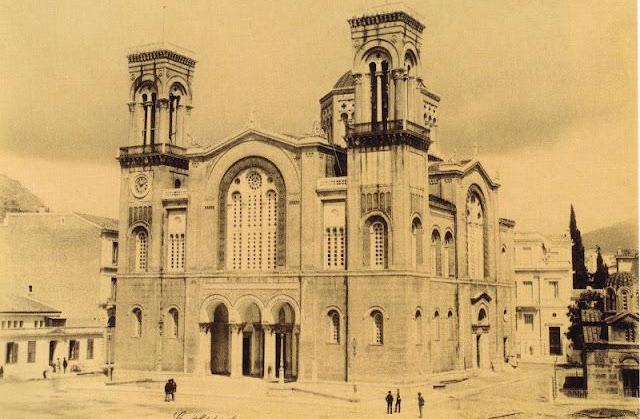
The Athens Cathedral was also initially designed by Hansen, but finished by Greek architect Dimitris Zezos, who added Byzantine aspects. The church was partly built using material from abandoned Byzantine churches.


There were many other public buildings built at that time, as well as private residences.

Fast forward to circa 1917, after the first war, when the following photos were taken by our French Allies.

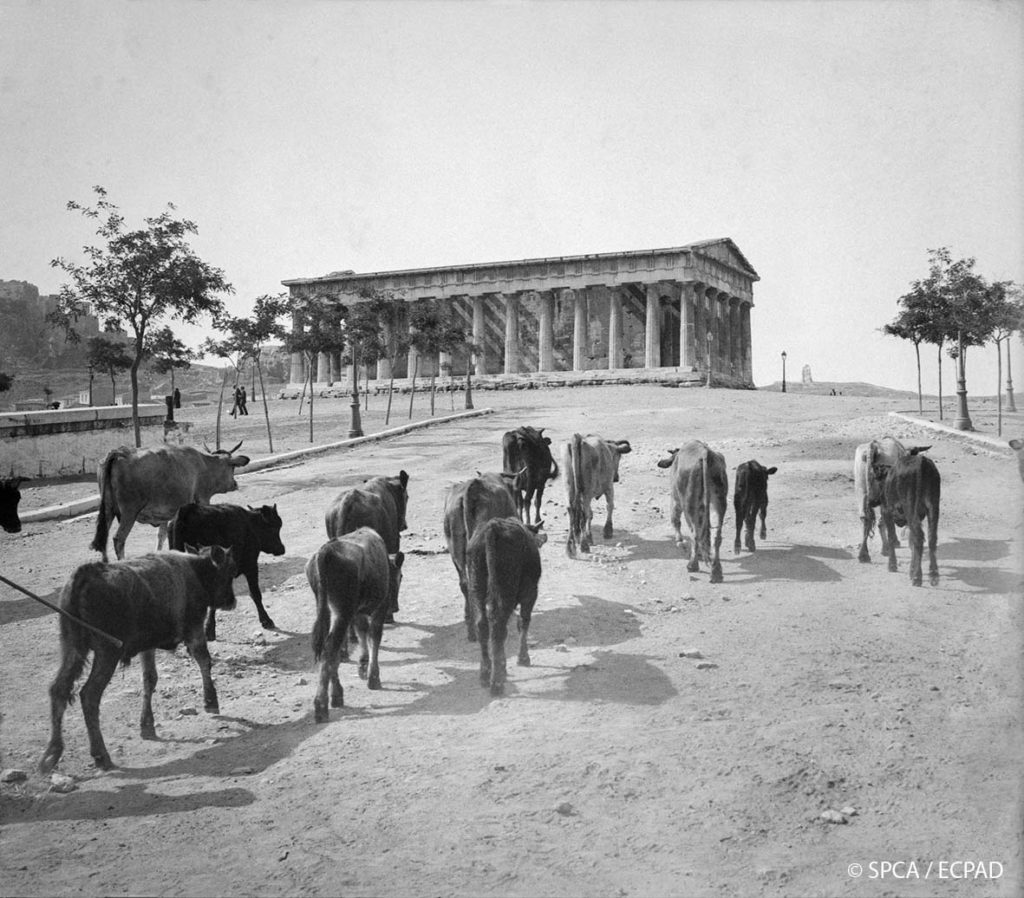
Cattle at the temple of Hephaestus.


Cooking with a view of the Acropolis.


A neighborhood near the center.


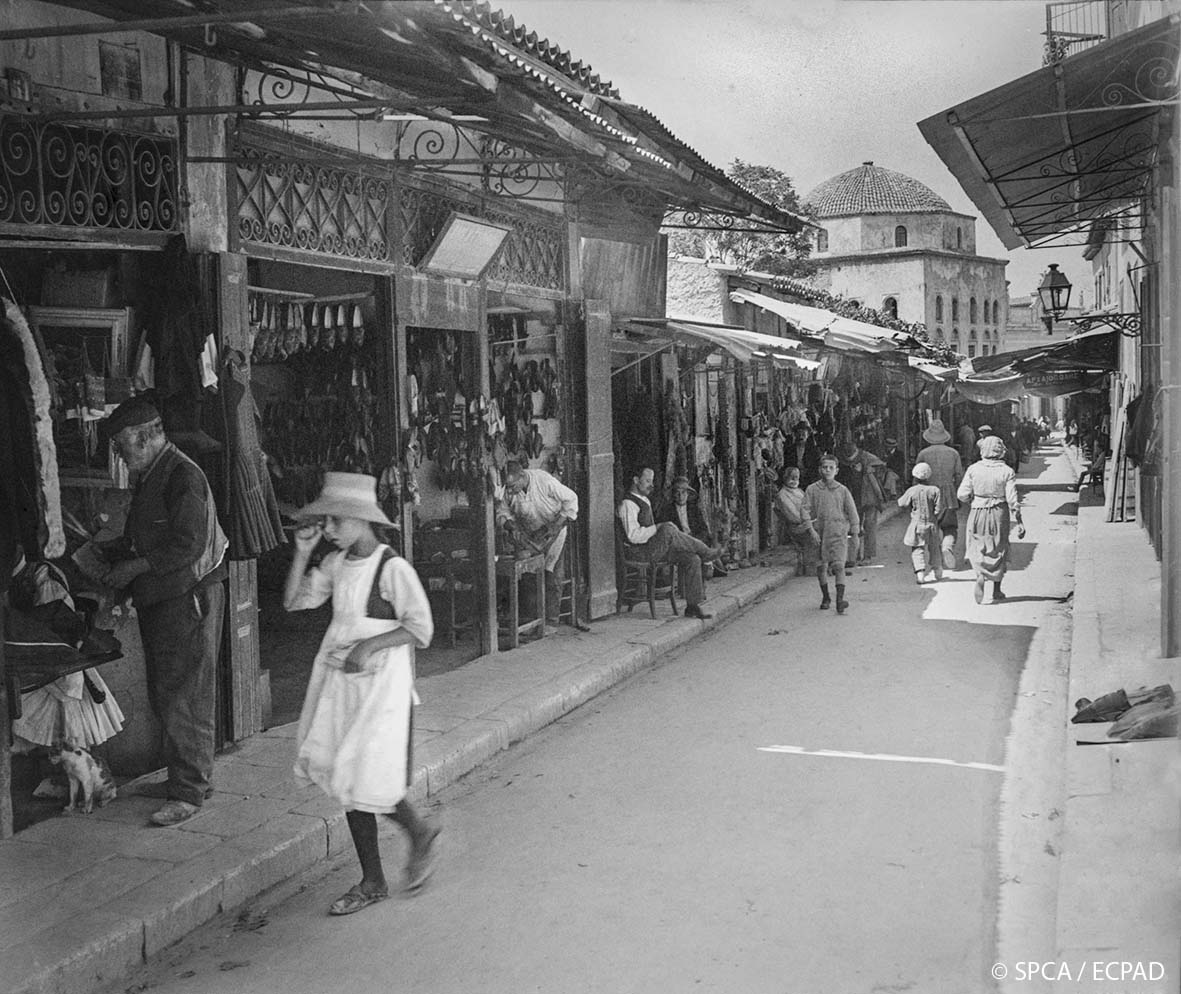
A shopping street with a mosque in the background.


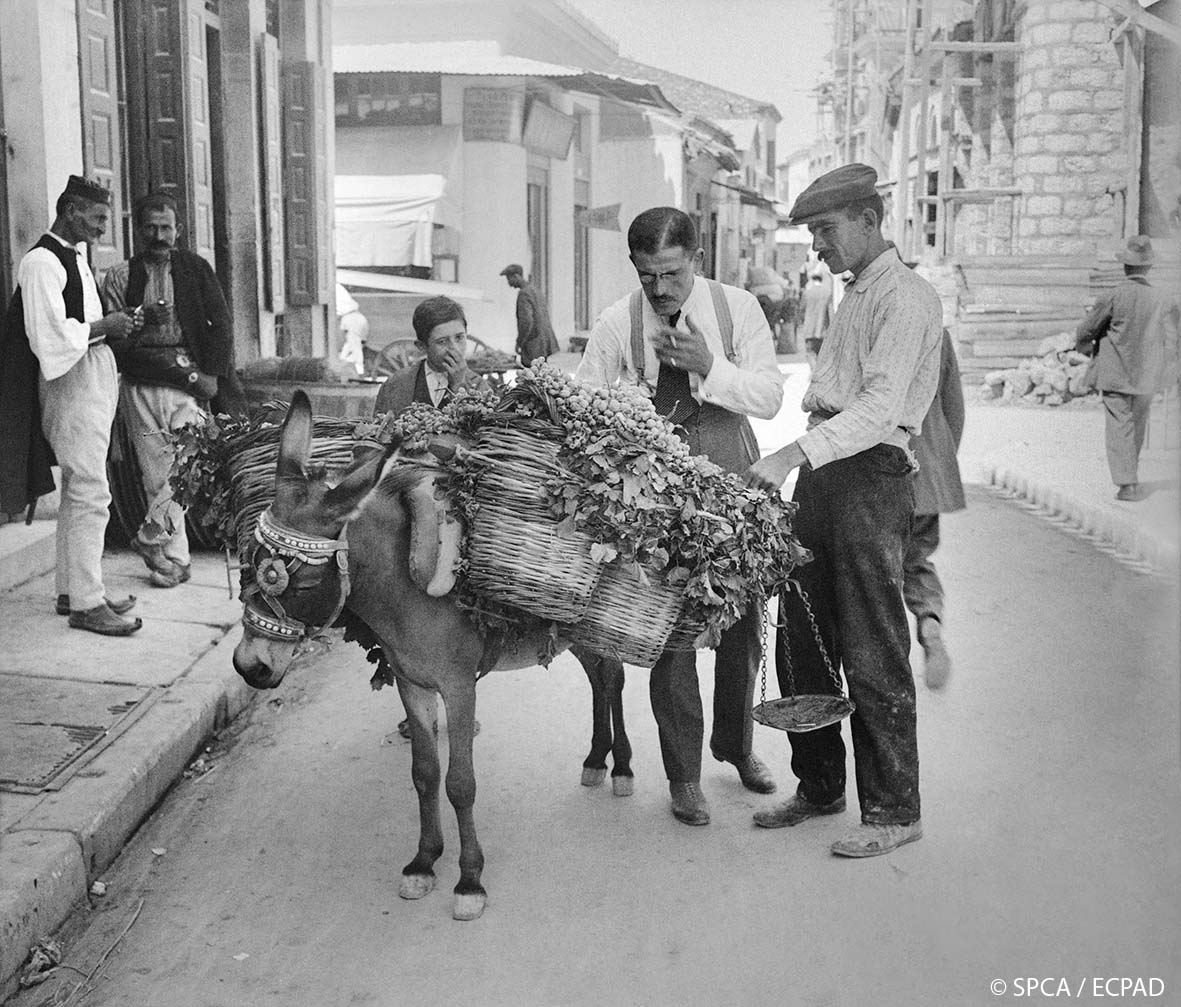
Buying grapes. Some men still wore traditional clothing.


Children playing in the streets of Plaka, beneath the Acropolis.


Coffee in the garden of Zappeion. In the early twentieth century, Athens was still a provincial town of circa 180.000 people.


Constitution Square: The large white building on the right was built in 1842 and since 1874 houses the Grande Bretagne Hotel, where history has been written many times over and  which is still  today one of the  great luxury hotels in the world. In 1888 it was one of the first buildings in Athens to have electricity installed.


One of the main commercial thoroughfares, Stadiou Avenue, in 1935.


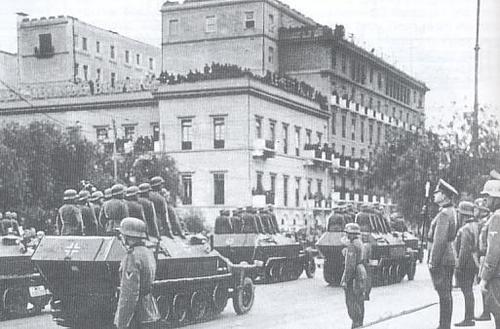
During WWII, Athens came under German occupation.


German tanks in Athen.

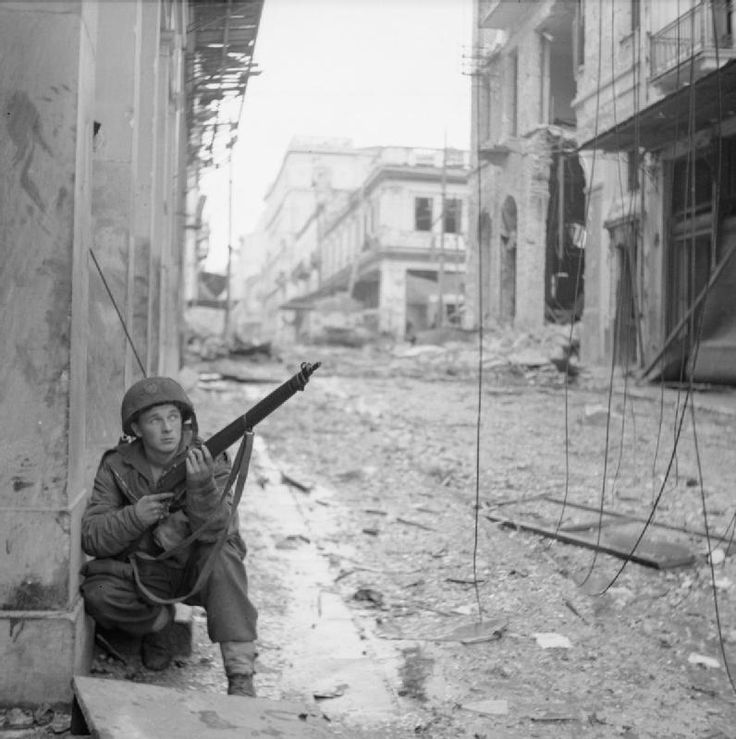
The city suffered great destruction and famine, exacerbated by the civil war which exploded following liberation from the Germans, and which raged until 1949 (my parents always told us this was much worse than the German occupation).


A British soldier in Athens during the civil war.


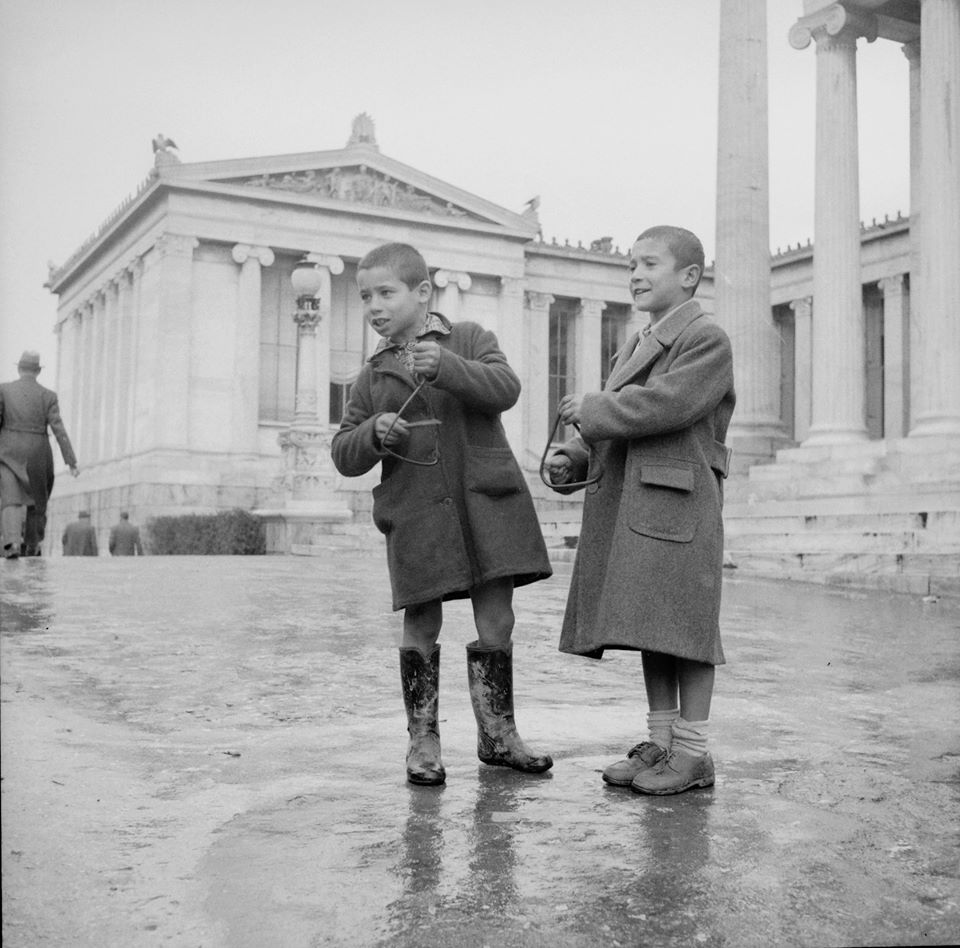
Children singing carols in the early 1950s. Ill-fitting coats, heads shaven against lice, but at least these two have shoes on.


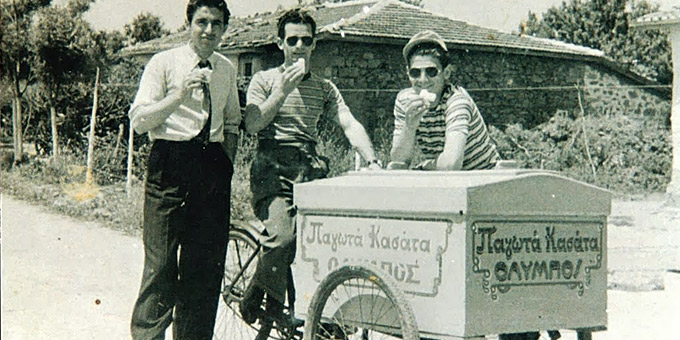
The ice-cream man. Many years later, a man on a bike pushing an icebox still came into the park where we played when I was a child. I vividly remember our excitement, and the smell of the ice as the heavy lid was lifted, and we bent over the box to make our choice: vanilla or chocolate, on a stick or in a cup. It was a real treat.

This is far from pretending to be a comprehensive overview of the long and complicated history of Athens. I just happened upon these old pictures and thought they gave off a charming aroma of time passing.

Syntagma  (Constitution Square) then…

And now…

All images are from Google. Since most are old, it was difficult to attribute credit.