An online petition has been made by the grassroots campaign group, Avaaz, on behalf of the residents of the Greek islands who have been rescuing, feeding and sheltering hundreds of thousands of desperate migrants arriving at their shores.
This is the text of the petition: “Ordinary residents of Greek islands and other volunteers have been on the front lines of Europe’s refugee crisis for months, opening up their hearts and homes to save hundreds of thousands fleeing war and terror. For their compassion and courage, for treating those in danger with humanity, and for setting an example for the rest of the world to follow, we citizens around the world, nominate these brave women and men for a Nobel Peace Prize.”
Nearly 1 million migrants entered Europe in “irregular arrivals” last year, most fleeing conflict, persecution and poverty in the Middle East and Africa, according to the International Organization for Migration. These tidal waves of humanity have made the Mediterranean “the deadliest route for migrants on our planet,” the IOM’s Director General William Lacy Swing has said, with nearly 3,700 people drowning in its waters last year. And more are continuing to drown on a daily basis, especially in the last weeks, when the weather has turned to winter at last, and the sea is freezing cold.
According to an article in the Guardian (Sunday 24 January, 2016), “of the 900,000 refugees who entered Europe last year most were received – scared, soaked and travelling in rickety boats – by those who live on the Greek islands in the Aegean Sea.
The islanders, including fishermen who gave up their work to rescue people from the sea, are in line to be honoured with one of the world’s most esteemed awards. Eminent academics from the universities of Oxford, Princeton, Harvard, Cornell and Copenhagen are drafting a submission in favour of awarding the prize to the people of Lesbos, Kos, Chíos, Samos, Rhodes and Leros.”
The article goes on to say that “it must be noted that a people of a country already dealing with its own economic crisis responded to the unfolding tragedy of the refugee crisis with “empathy and self-sacrifice”, opening their homes to the dispossessed, risking their lives to save others and taking care of the sick and injured.”
At the time of posting, the petition had amassed 313,975 signatures
To cheer up a cold January evening, I thought I’d reblog of of my favourite posts from my friend Margaretha’s blog. Who knows, it might inspire some of you to plan a little retreat for next summer!
Kyriakos Mitsotakis won the New Democracy leadership election in a fairly tight vote on Sunday. This was seen by most as an upset (Mitsotakis was lagging in the first round) or a reversal.
I see it more as a correction. It has remained a source of astonishment for me how the old guard politicians, having failed dismally at everything they had promised, have the gall to continue promising things they almost certainly have no intention of delivering. At last, the voters saw reason. Whatever one may think of Mitsotakis, let’s give him a chance!
Reactions in the foreign press have also been positive, pointing out that now Tsipras will no longer be ‘the only game in town’. Continue reading “Quick news update”
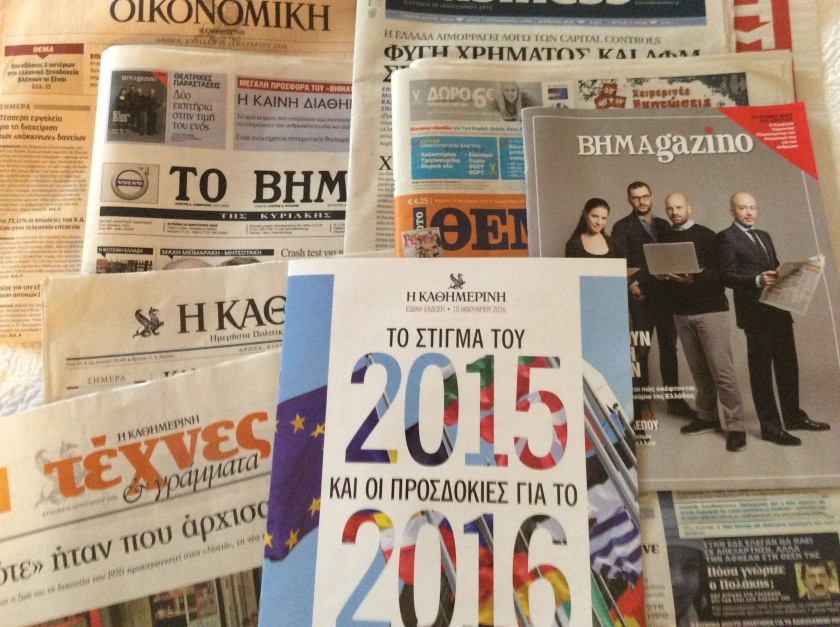
Today is the second Sunday of the new year. Time for stocktaking – what are the prospects before us?
I took a look at the main Sunday papers. Although of different political persuasions, the themes they deal with are the same.
THE ECONOMY
The problematic state pension scheme, the constantly increasing taxes, and the difficult measures that have to be taken in order to satisfy our lenders. Depressing, to say the least!
THE NEW DEMOCRACY ELECTIONS
The second round of voting to choose a leader for the New Democracy party (the main opposition party) takes place today. It is between Mr. Meimarakis, a member of the old guard, and Mr. Mitsotakis, much younger and more modern, but a member of an old political – and often controversial – family. Is there, in actual fact and despite what they’re proclaiming, much to choose between the two? Voters who turned out in decent numbers for the first round are, so far today, exhibiting election exhaustion.
THE REFUGEE ISSUE
European countries are complaining about the number of refugees allowed into Europe but, let’s not forget, most of those are still in Greece (to say nothing of the vast numbers stuck in Turkey). It is clear the situation is totally out of control. Today the articles were about increasing instances of fights amongst the refugees themselves, especially between groups with different religions; abuse of women and children; cases of women selling themselves in order to pay the traffickers; extortion; black markeering in cellphones, fake documents and other goods.
In a horrifying statistic given out by the organization “Missing Children Europe“, 50% of unaccompanied children arriving at one of the refugee centers disappear within 48 hours never to be found again.
Very few of the refugees are actually in the centers – the rest are wandering around, penniless, hungry, hounded by the police.
Meanwhile, the trafficking business is thriving, starting from Syria itself, where allegedly there are special ‘schools’ coaching people how to reach Europe.
In Bulgaria, the police has issued a warning to hunters to be careful what they shoot at in the woods, in case the prey is not a wild boar but some refugee hiding from the authorities.
However, in a different article, there are glowing reports from various workers from the NGOs working on the island of Lesbos. This is close to the Turkish coast and has received huge numbers of refugees. The NGOs are doing a great job, but they’re also full of praise for the islanders, who have been welcoming the refugees to the best of their ability. People collect food, prepare formula for babies, grandmothers are even knitting little sweaters. Many volunteers from all over the world have also arrived, some giving up their vacation to help, others declaring their willingness to stay ‘until the war ends in Syria.’
Another, more curious, article deals with the refugees who have arrived with their pets. As a general rule, this has been well received by the Greeks, who think it a very human touch. In some other countries, however, (apparently Slovenia is one,) the refugees’ pets have become an object of political pressure, as well as a business: border controls confiscate cats and dogs, even those with passports, microchips and the correct vaccinations, and put them in quarantine, demanding for their keep and release exorbitant amounts (up to €2000). Otherwise the animals are euthanized…
FOOD
The Sunday supplements have the usual restaurant reviews: a new Italian in Kolonaki, an Asian street food bar, a tacos place. And two great salad recipes, to detox after the festive overeating. My favorite? A rocket salad with roasted beetroot, walnuts and orange.
The political situation remains unstable, and thing are not looking good yet. But the start of a new year always feels like a new start, and there is a tiny whiff of optimism in the air.
In other, unrelated, news , as Anita Kunz put it: ‘As if everything else this past year weren’t enough , now Kim Jong-un shows up again.’
She’s doing a cover of him as a baby playing with toy missiles, for the New Yorker.
Please feel free to join in with other pleasant surprises awaiting us in 2016!
I always like to have a couple of books on the go – something light to read at bedtime, like a crime novel or a book of short stories, and something more challenging for when I’m not falling asleep after one page. Not that there are rules – it all depends what mood I’m in, how busy I am, etc. Sometimes I almost long to get the flue so I have an excuse to stay in bed all day with a book!
One hefty tome I’m picking my way through is the Herodotus Histories. Written around 450 B.C., in the Ionic dialect, it is a record of the ancient traditions, politics, geography and clash of cultures of the then ‘known world’ – Western Asia, Northern Africa and Greece. Its main theme is the rise of the Persian Empire and the causes of the Greco-Persian wars.
Herodotus portrays the conflict as one between the forces of slavery (the Persians, whom he calls ‘barbarians’) on the one hand, and freedom (the Athenians and the confederacy of Greek city-states which united against the invaders) on the other. His aim is to preserve the memory of this clash of two worlds and also of the ‘works of man’ that he so admires. In doing so, he is sometimes a strict historian, sometimes almost a poet. Embed from Getty Images
Herodotus, a contemporary of Socrates, was born in Halicarnassus, Caria (modern-day Bodrum, Turkey) and lived in the fifth century BC. Widely referred to, notably by Cicero, as “The Father of History“, he was the first to treat historical subjects as a method of investigation, by collecting his materials systematically and critically.
He travelled widely in the known world, looked at everything with insatiable curiosity, asked questions and wrote down the answers. We must remember this was in a time when an embassy would set out from Athens and, even traveling with all the facilities available to official missions, arrive in Sousa in Persia after three months! Herodotus went as far as Assyria and Babylon, Persia and Egypt. He sailed up the Nile. He went north to Kolchis, describing the snows of the Ukraine. He travelled the whole of Greece, and visited Sicily. His work can be described as a sort of historical and geographical encyclopaedia.
This treasure-trove of anecdotes sometimes seems to waver between history and myth; and yet, Herodotus of Halicarnassus both coined the term, ‘historia,’ and invented the genre. History can therefore be anything that he, the very first historian, pleases. And ‘historia’ – Ιστορία – to Herodotus, meant ‘enquiry’ or ‘investigation.’ Also, many of the stories which were considered fantastic have, with later discoveries, been proven to be true.
Histories was, in the Alexandrine period, divided into the nine books that appear in modern editions, named after the nine Muses. I’m currently in the middle of book III, Thalia. I’m reading it in Modern Greek – the excellent Angelos Vlahos translation.
For English speakers, there are many translations, such as the Robin Waterfield one below.
Histories is a highly entertaining read, with amazing stories of emperors and kings, e.g., the tale of Gyges, a mere bodyguard who, after being forced by King Candaules to peek at his beautiful wife as she is undressing, murders the king, marries his wife and becomes tyrant of Lydia; or wealthy Croesus, King of Lydia, who keeps pestering the Delphic oracle, finally learning that if he attacks Persia, a Great Empire will fall – a riddle that Croesus does not understand until he has been ensconced on his own funeral pyre by Cyrus, King of Persia.
Herodotus also tells of the poet Arion, saved from drowning by a dolphin who carried him safely ashore; he relates that the Egyptians hunted crocodiles, respected their elders, and slept in huts that were on stilts to escape being bitten by mosquitoes which hovered near the ground.
Reading Herodotus is like taking a trip back in time, and discovering an ancient world in the company of an intelligent, observant and amusing guide. Highly recommended.
On January 6, the last day of the festive season, Greeks celebrate the Epiphany, the baptism of Christ by Saint John the Baptist in the Jordan River. We call it Θεοφάνια (Theophania) or Φώτα (Fota) – the Feast of Lights.
Celebrations start the day before, on the 12th day of Christmas. It is a day of fasting – the devout don’t eat meat, fish or dairy products, and not even olive oil is allowed. In Crete they make a special dish called Παπούδια (Papoudia) or Φωτοκόλυβα (Fotokolyva): wheat is boiled with different dried pulses such as lentils, chickpeas and beans, which they eat with salt, bread and maybe an onion and a few olives. They also used to feed this to their chickens and other livestock.
After the morning church service, priests go around the houses in their parish in order to bless them by sprinkling holy water around the rooms. They are also asked to go and bless shops and offices and, in the countryside, stables and livestock. This is known as Μικρός Αγιασμός (mikros agiasmos) or small blessing and, in the old days, it was thought to chase away the Kallikanzaroi, the malevolent gnomes who come out of their holes to plague households over the Christmas period. Now they flee before the priest, and disappear for the rest of the year. Until next Christmas!
Today also those who have burned the Χριστόξυλο (Christ-wood) during the twelve days of Christmas will gather the ashes and spread them around the house, stables and fields to exorcise evil spirits.
The next morning, January 6, after a special service, a procession is formed through towns, starting at the church and leading to the sea, a river, or even a reservoir.
The priests lead, followed by the the local authorities, the villagers or townspeople, schoolchildren and, in large towns, the army. Sometimes there is a band. The size and brilliance of this procession is in accordance with the size of the town, the most impressive ceremonies taking place in ports. In the port of Pireas, the procession is attended by members of the government.
When the procession reaches the water, the priests recite a blessing, and white doves are released. Then a large cross is thrown in the sea, to symbolize the blessing of the waters. A band of local men, the Βουτιχτάδες (voutihtades – divers) plunge into the icy waters to retrieve it. It is considered both a great honour and a sign of good luck to be the one who brings back the cross to the priest.
The church bells ring, the ships’ sirens boom. The faithful drink a few sips of holy water, and take some home to bless their houses and livestock.
This ceremony symbolizes cleansing, purifying and, in a dimension that has its roots in ancient, pre-Christian times, riddance from demons.
During the Epiphany, other customs are revived that go back to Dionysian festivals or to the Turkish occupation.
Groups of people, wearing costumes and masks and holding wooden swords and bells, wander the streets or go from house to house singing and demanding money in return for chasing away evil spirits. The costumes and routines vary from place to place, as does the name of this custom. Μωμόγεροι (Momogeroi), Ραγκουτσάρια (ragoutsaria) , Ρουγκατσάρια (rougatsaria) are all different manifestations of this tradition.
In the town of Galatitsa in Halkidiki, they even construct a camel, activated by six men, to commemorate the 19th century story of the abduction of a beautiful young girl by the son of the local Turkish official. Her fiancé and his friends thought up the camel costume with which they gained entry into the Turkish household, hiding the girl inside the camel to sneak her out and back home where she married her intended before the Turks could get her back!
In some places, there is a custom called ‘the washing of the icons’: people take the icons they have in their houses and wash them in the nearest river.
Later, everyone repairs home for another festive meal, usually of pork, which can be baked with celery, or with quinces. On the island of Skyros, housewives make traditional pies filled with spiced pumpkin, called μαρμαρίτες (marmarites). They bake them on tiles inside the fireplace, taking care they are not stolen by the Kallikanzaroi, who have the ability to make their arms as long as they like, and can thus reach down the chimney to steal the pies!
The December Q&A involves two people – the sister-and-brother team of Sofia and Nikos Pattakos. Like a lot of young people nowadays, they decided to use technology to start their own business, wordigs.com, an online application for the study of English vocabulary. To understand the importance of this, one must know that all forward-thinking Greeks put a huge premium on learning foreign languages, since not many outside Greece speak their own.
Tell us a little about yourselves:
Sofia: We grew up in Athens in a pleasanty protected social environment, but then, everything used to be like that in Greece at the time… more simple. I studied French Literature at the National Kapodistrean University of Athens, then went abroad to get a postgraduate degree in Marketing Management, and finally started working in the communications sector. For years I was in corporate marketing in telecommunications, and ended up in COSMOTE (a leading telecommunications company in Greece) where I was fortunate to get involved in many extensive and special projects, both commercial and charitable. I like to spend my spare time with people I’m close to, doing things that help me escape everyday stress, such as climbing and music… always in good company!
Nikos: I studied Chemistry in Athens and worked in sales of pharmaceuticals to multinational companies. In 2012 I completed an i-MBA at the Athens University of Economics and Business. In my spare time I play tennis, read and watch movies. Also, having grown up in the noisy environment of Fokionos Negri street in the 80s I’m an extrovert who never misses a chance to be out and about in Athens, always in a crowd of friends, of course!
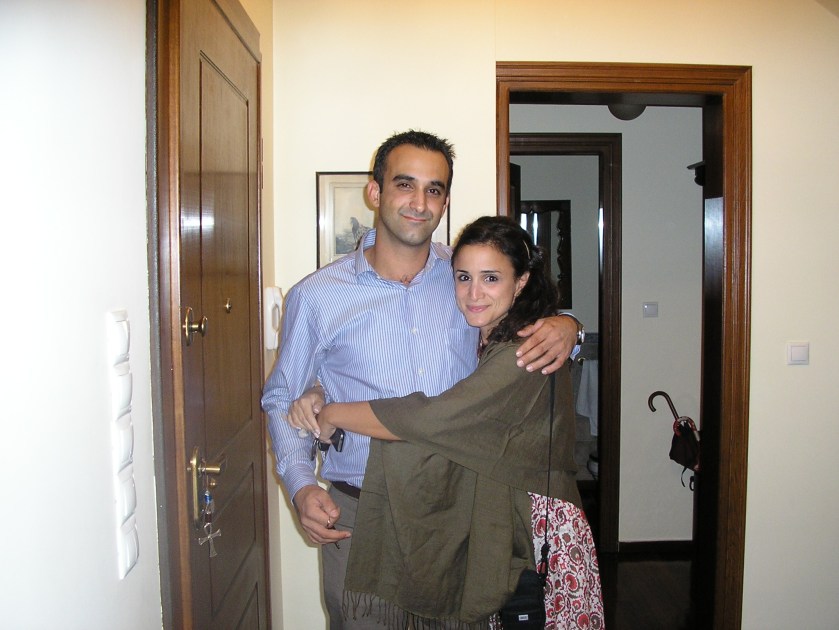
Sofia and Nikos
In 2014, the two of us started our first collaboration as brother and sister with the founding of wordigs.com, an innovative online learning tool for English vocabulary.
What were the major difficulties you’ve faced in the last five years?
The last five years have been a time of major upheaval and decision-making for us. Times are difficult and, while both of us had jobs in large and ‘safe’ companies, we were becoming increasingly worried, each for his own reasons, by the professional and psychological daily stress. Then Nikos had an idea and we started looking into it, to see if we could make it work despite the risks involved. We both had some savings from our work and so we started researching and developing wordigs. Our aim was the creation of an educational tool that would allow students of all levels to learn English vocabulary in a creative and entertaining manner.
Did anyone help or inspire you?
The idea for wordigs was discussed widely amongst our close circle of family and friends, as well as with several English language teachers. The positive response we got was the main motivation for going on with the project.
What are your hopes/plans for the future?
Our plan is work… a lot of work so that wordigs will thrive and reach the people it is aimed at, that is, everyone who is learning English. Our hope is that all this effort will bear fruit in a healthier social environment, that it will coincide with our country’s emerging from the crisis. Our dream is that at some point our efforts will bring some balance to our lives.
What are your hopes for Greece? What changes do you hope /would you like to see?
That’s a difficult question! There are days when all of us wake up with dreams and expectations for changes in Greece and other days when reality pulls us back. In our case, we left ‘safe’ jobs to start a new business in Greece, taking a huge financial and psychological risk. Because we believe that in this country there are a lot of people like us, who have dreams, who are hard-working and persistent. We want to believe that, in the end, all of them – all of us – will manage to change the prevailing climate so that action and movement in every sector win out over remaining idle and blaming others. Because, truth be told, only work will work!
Have you considered leaving? If so, where would you like to go, and why? If you have decided to leave what would make you stay?
Sofia: Personally, in the past I’ve often cried ‘Why did I ever come back?’ But that was years ago. Having grown older and reviewed my priorities I’ve come to the conclusion that, for me, most important are the people surrounding me, from whom I draw energy. So I’ve decided to work as hard as I can in an environment where I’m surrounded by people close to me… In my mind, there are no geographical constrains.
Nikos: Leaving Greece would be a last resort decision for me. As long as I can earn a living in my country my place is here, near my family and my close friends. If I was forced to leave I’d prefer a Mediterranean country. Of course, in life, never say never!
Are you actively doing anything to help with the situation? Is there something you would like to do?
What we actually do is very little compared to what we dream of doing. Collecting clothes and supplies or simple money donations to various movement that help people in dire straits… is all we can do for the moment, given we have been working incessantly the last two years and have no time to volunteer. Our immediate plan is to make our educational tool available for free to kids who cannot afford to buy it, while in our more optimistic moments we dream of having the time to involve ourselves in more voluntary projects.
How do you see Greece in 5, 10 years?
Nikos: 5-10 years is not long enough for really significant change in a country that needs to change from its roots. I believe that a general reorganization of the educational system would be a good start towards developing a collective conscience in each new generation – so that Greeks move from thinking about ‘I’ toward thinking about ‘we’.
How do you cope with obstacles and frustrations in your everyday life ?
Inconsistency and failure to assume responsibility! These are the two characteristics that we find hard to understand, process and manage! The truth is that we have to face them on many different levels. I can’t understand why so many people have this fear, when a simple “My fault”/ “I’ve no time”/ “I don’t know” would solve so many problems and avoid confrontation.
What are the positive sides of living in Greece? Have you had any good experiences lately?
Sofia: Family and friends! Daily moments you can share so easily when your friends are close by! And something that moved me this year… the support for my new venture by old colleagues. Proof that hard work and cooperation do not go unappreciated.
Nikos: Greece is a very vibrant country with a lovely climate while despite all the difficulties it has remained a very safe place with low criminality. With the exception perhaps of Athens, in Greece you can live relatively cheaply and enjoy all its natural beauties. The mountains, the sea, magnificent islands, nightlife, extroverted people and, most important, a huge cultural heritage.
A lovely recent experience was a hike I did with friends on Parnitha. Five hours of climbing, fresh oxygen and plenty of laughs were an ideal escape from my demanding daily routine!
Today I would like to share my favourite Christmas poem, The Christmas Tree, by Cecil Day Lewis (1904-72), a man who lived for poetry. He was poet laureate, a member of the poetry panel of the Arts Council, a fellow of the Royal Society of Literature and a director of the English Festival of Spoken Poetry.
The Christmas Tree
Put out the lights now!
Look at the Tree, the rough tree dazzled
In oriole plumes of flame,
Tinselled with twinkling frost fire,
Tasseled with stars and moons – the same
That yesterday hid in the spinney and had no fame
Till we put out the lights now.
Hard are the nights now:
The fields at moonrise turn to agate
Shadows as cold as jet; in dyke and furrow
In copse and faggot
The frost’s tooth is set;
And stars are the sparks whirled out by the north wind’s fret
On the flinty nights now.
So feast your eyes now,
on mimic star and moon-cold bauble;
Worlds may wither unseen,
But the Christmas tree is a tree of fable,
A phoenix in evergreen,
And the world cannot change or chill what its mysteries mean
To your heart and eyes now.
The vision dies now: candle by candle
The tree that embraced it
Returns to its own kind,
To be earthed again and weather as best it
May the frost and the wind.
Children – it too had its hour; you will not mind
If it lives or dies now.
In the Greek Orthodox tradition, Christmas ranks second to Easter, but it is still a very important holiday. For the devout it is preceded by a period of fasting so food, unsurprisingly, plays a major role in the festivities. But more of that later.
In Greece, Santa Klaus or Father Christmas is Agios Vasilios (Saint Basil) – so gifts are opened on his name day, January first.
On Christmas Eve and Christmas Day children go from house to house singing the Kalanda (carols whose name comes from the Roman calendae, the first days of the month) and accompanying themselves on small metal triangles and sometimes harmonicas. They knock on doors asking ‘Na ta poume?’ – ‘Shall we say them?’ They are rewarded with money, sweets and sometimes dried figs and other fruit. Then the householders wish them ‘Kai tou xronou’ – ‘Again next year’. They will do the same on New Year’s Eve and New Year’s Day, but the carols are different.
Of course, the quality of the singing varies a lot. I’ve opened my door to blond little angels with voices to match, tinkling away on their triangles – and, a few minutes later, to hulking, spotty teenagers who expected to be paid for playing the Kalanda on their smartphones!
As far as decorations are concerned, there is the yearly debate of the Christmas tree versus the wooden ship. Changing fashion tends towards one or the other. The modern Christmas tree came to Greece with the country’s first king, Otto of Bavaria, who ascended to the throne in 1833; it did not, however, become popular before the 1940s. Some Greeks still consider it a foreign import, although use of decorated greenery and branches around New Year is recorded as far back as Greek antiquity, and there is evidence that some sort of Christmas tree existed in the Byzantine empire.
The ship, by contrast, is viewed as a quintessential Greek symbol. Greeks have been seafarers for thousands of years and the country is still one of the world’s leading shipping nations. Children on the islands sang – and are still singing – Christmas carols holding illuminated model boats.
The Christmas ship is made of paper or wood, decorated with small, colorful lamps and a few, simple ornaments. It is usually placed near the outer door or by the fire with the bow pointing to the interior of the house. There are many symbolic connotations attached to it: love of the sea, welcome to those returning from a voyage or honouring of those away at sea and a token offering for their safe return. With golden objects or coins placed in it, the ship also symbolizes a full load of riches reaching one’s home. However, it also has connotations of partings and absent husbands and fathers, and that perhaps is why the tree has found favor with many.
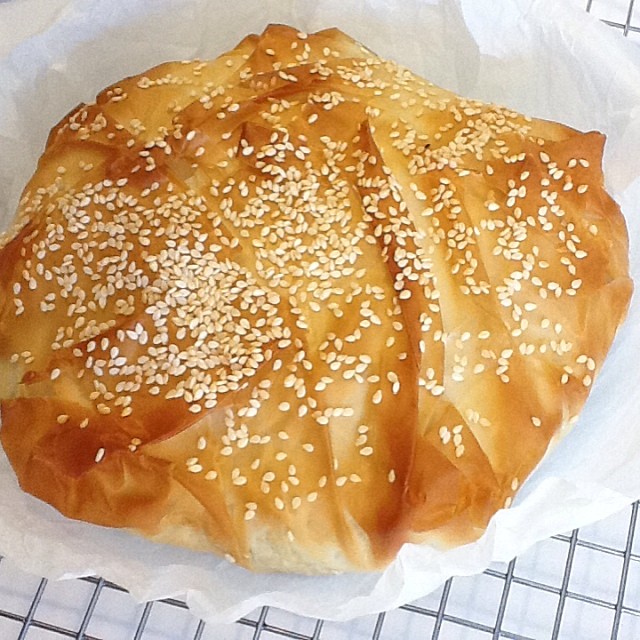
Spanakopita – spinach and cheese pie
Some households still display the traditional shallow wooden bowl of water with a sprig of basil wrapped around a wooden cross. Once a day, the cross and basil are dipped into holy water and used to sprinkle each room of the house. This ritual is believed to keep the Kallikantzaroi away from the house. Kallikantzaroi are ugly and malevolent sprites which emerge from underground to bring trouble to families.
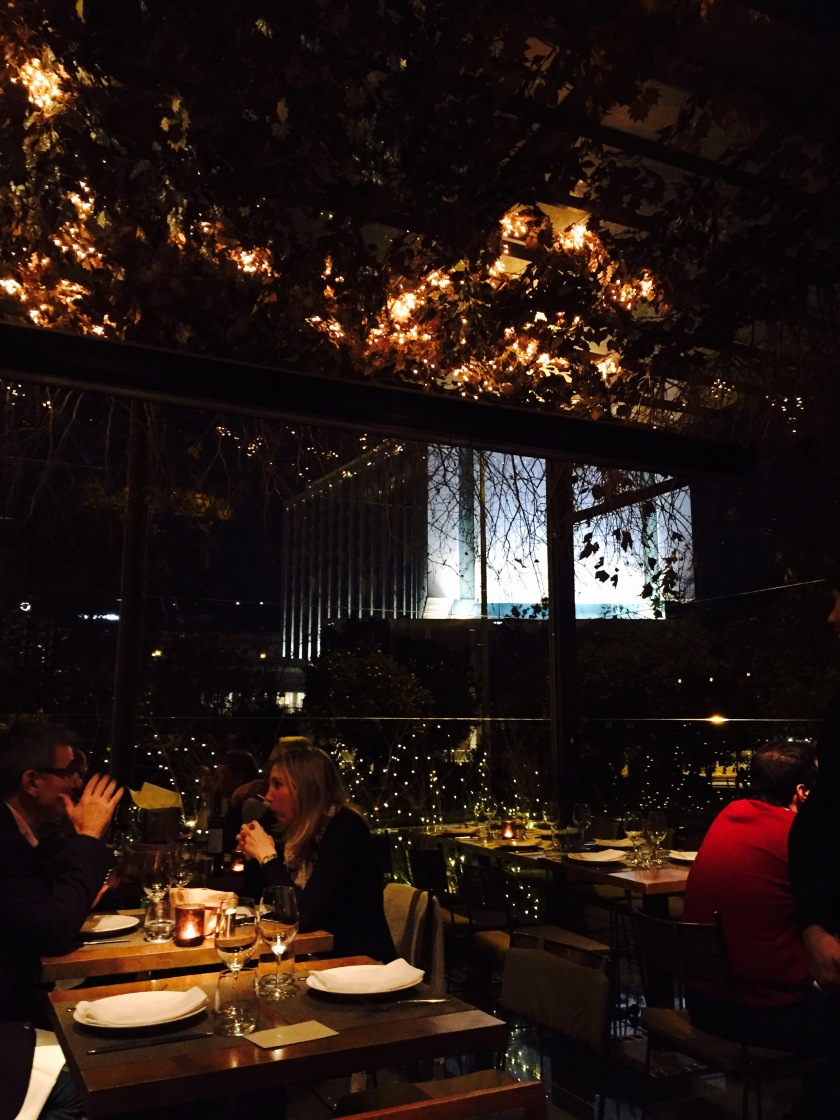
Outdoors, streets, stores and homes are decorated with garlands of lights and illuminated ships or trees. Town streets are full of people doing their last minute shopping of presents while carols are played everywhere, adding to the festive mood. In most major towns, there are concerts, theatrical performances and other cultural events promising wonderful entertainment.
Each region tends to have its own Christmas traditions. For example, in the villages of northern Greece, the man of the house chooses the sturdiest pine or olive tree branch he can find. This, named Christoxylo (Christ-wood) is put in a newly cleaned fireplace to slowly burn over the whole twelve days of Christmas. This is symbolically meant to warm the baby Jesus in his cold stable, and also to keep out the Kallikantzaroi who supposedly come down the chimney.
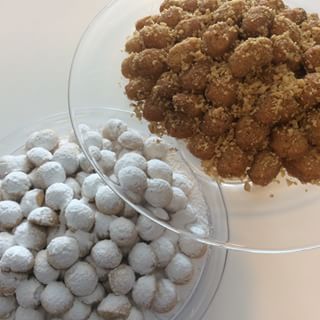
Kourambiedes and melomakarona
A lot of the traditions have to do with food, of course. The Christmas feast is looked forward to with great anticipation by adults and children alike, and especially by those who’ve followed the 40-day Advent fast.
On almost every table there will be a round loaf of Christopsomo (Christ Bread), decorated on the top with a cross, around which are dough symbols representing whatever it is people do in life. Fishermen will decorate the bread with fish, farmers with lambs, and so on.
For starters you might get a fresh, colorful salad of green leaves and red cabbage sprinkled with pomegranate seeds; a lemon-chicken soup called Avgolemono; home-made pies and pastries made with spinach and feta, pumpkin, or meat; or cabbage leaves stuffed with meat and rice, in an egg-and-lemon sauce.
The main dish is pork or lamb, cooked following some regional recipe, or perhaps wild boar; or a roast turkey with a mince, pine nut and chestnut stuffing.
In most parts of Greece, pork was the meat of choice at Christmas, a pig being slaughtered specially for the occasion and cooked in many different ways according to the traditions of the area.
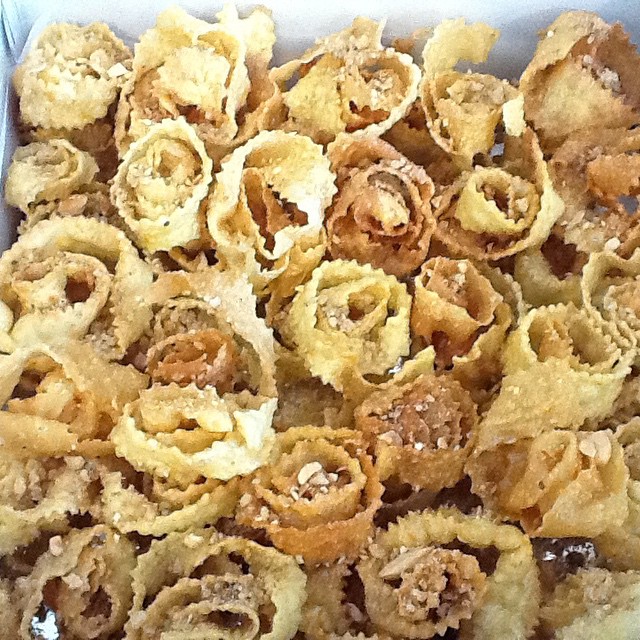
Diples
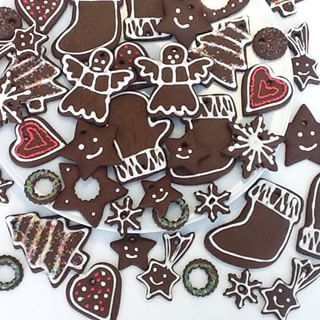
Last, but not least, are the sweets: Diples, crisp fried pieces of dough drizzled with a honey syrup; Melomakarona, made with semolina, cinnamon and cloves, dipped in honey and sprinkled with chopped nuts; Loukoumades, deep-fried puffs of batter also served with honey; and Kourambiedes, buttery, crunchy bites flavored with rose water and dusted with flurries of icing sugar. In the islands they also serve Amygdalota, a kind of almond cookie.
After the meal, at night, some people choose to stay home and watch a Christmas show while others prefer to party the night away in nightclubs and bouzouki joints.
For some great traditional Christmas recipes, click here.
The photographs of the lovely food were kindly supplied by Cake&Cookie co, who make all kinds of delicious cakes, cookies and deserts, and also do catering for various festivities. Go on their site and your mouth will water!
 Continue reading “Nobel Prize nomination for Greek islanders?”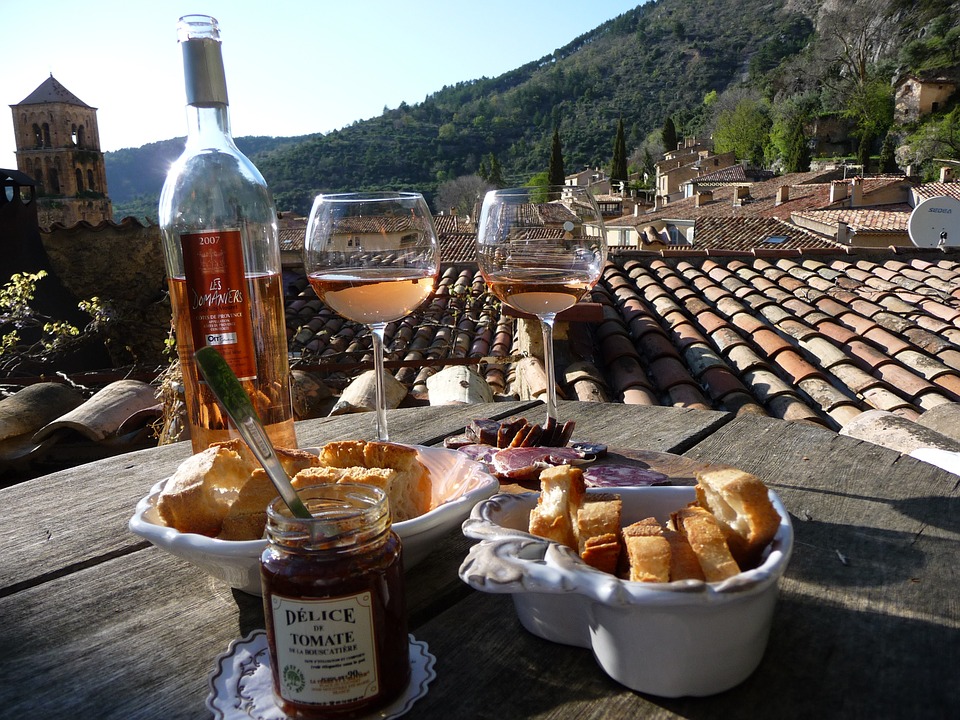




 How do you see Greece in 5, 10 years?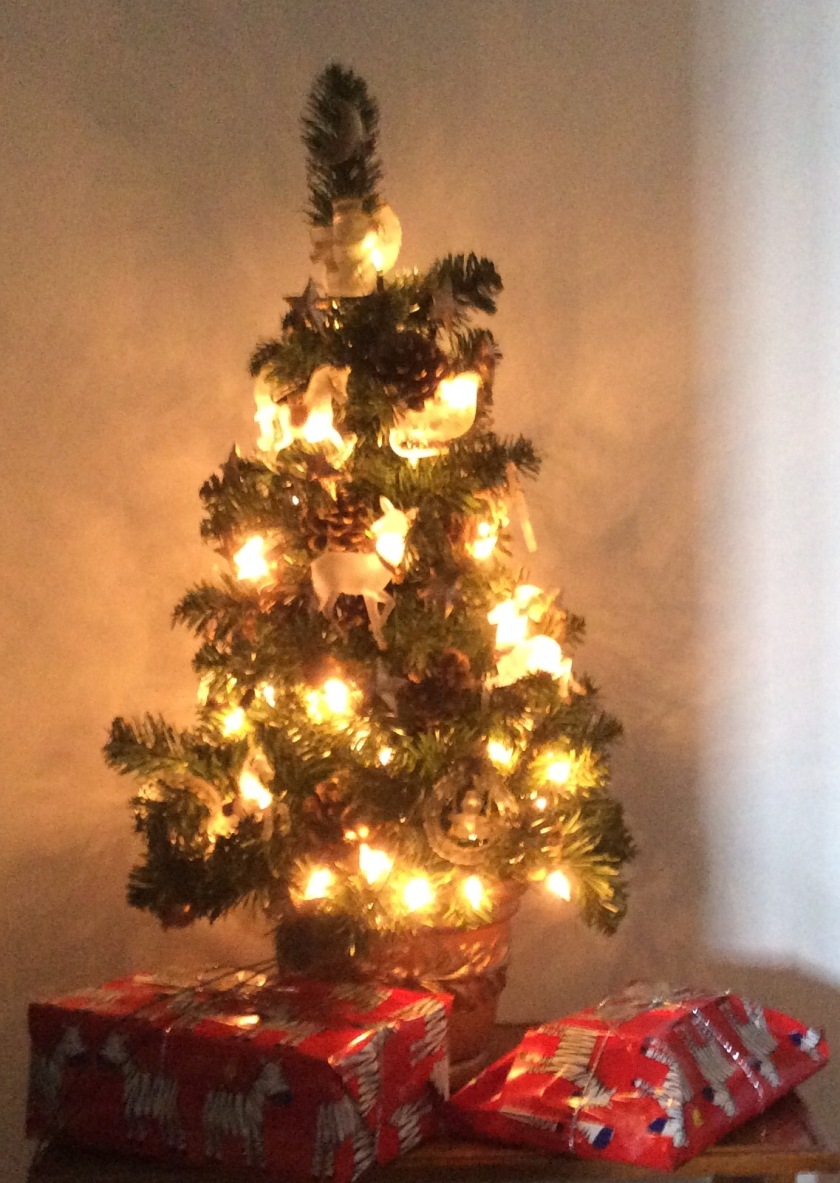
 As far as decorations are concerned, there is the yearly debate of the Christmas tree versus the wooden ship. Changing fashion tends towards one or the other. The modern Christmas tree came to Greece with the country’s first king, Otto of Bavaria, who ascended to the throne in 1833; it did not, however, become popular before the 1940s. Some Greeks still consider it a foreign import, although use of decorated greenery and branches around New Year is recorded as far back as Greek antiquity, and there is evidence that some sort of Christmas tree existed in the Byzantine empire.