Goodbye, Tom Stoppard

Talk about leaving something behind! Tom Stoppard, who has just died, aged 88, wrote—over the course of five decades—35 stage plays (including seven translations or adaptations of foreign work), 11 radio plays, 6 television plays, and 14 film and television adaptations of books and plays. An opus which will keep his memory fresh for years to come.

I am not about to write an obituary complete with all his life details. Every newspaper has done that, and writer, journalist and magazine editor Tina Brown, who knew him personally since she was a teenager (he lived close to them and was friends with her father) has posted a lovely eulogy on Substack.

Stoppard wrote great theatre because he wrote great dialogue, witty and argumentative. In his own words, ‘Writing plays is the only respectable way of contradicting oneself.’

Here is a description of him, from an obituary in the Guardian:

A tall and strikingly handsome man, with a long, bloodhound face, a thick tangle of hair and a casually assembled wardrobe of expensive suits, coats and very long scarves, Stoppard cut an exotic, dandyish figure, a valiant and incorrigible smoker who moved easily in the highest social and academic circles, a golden boy eliding into middle-aged distinction and never losing the thick, deliberate accent of his origins, even though he never spoke Czech. He carved out his career in his own always carefully chosen words. He was often thought to be “too clever by half,” but never patronised audiences by talking down to them, even if they had to work hard to keep up.

Stoppard lived a charmed life in England, something he was always grateful for, considering a large part of his family died in the camps. This part of his personal history he only got to research in later years.

In my case, I credit Stoppard for instilling in me an eternal love of the theatre. Not living in England, I sadly did not manage to see all his plays, but I made it a point to see as many as I could, and they remain vivid in my memory. The wit, the irony, the sarcasm, the erudition and, above all, the sheer enjoyment.

Rozencrantz And Guidenstern Are Dead, The Real Inspector Hound, Arcadia, India Ink…The list goes on. Wonderful actors, such as Bill Nighy and the incomparable Felicity Kendall, fantastic sets. A great director, for a lot of them, in the shape of Peter Wood.

He’s always been number one in my list of people to invite to an imaginary dinner party. May you rest in peace, Mr Stoppard, and thank you.

Photo: Scott Gries—Hulton Archive/ Getty Images

An afternoon at the Musée d’Orsay

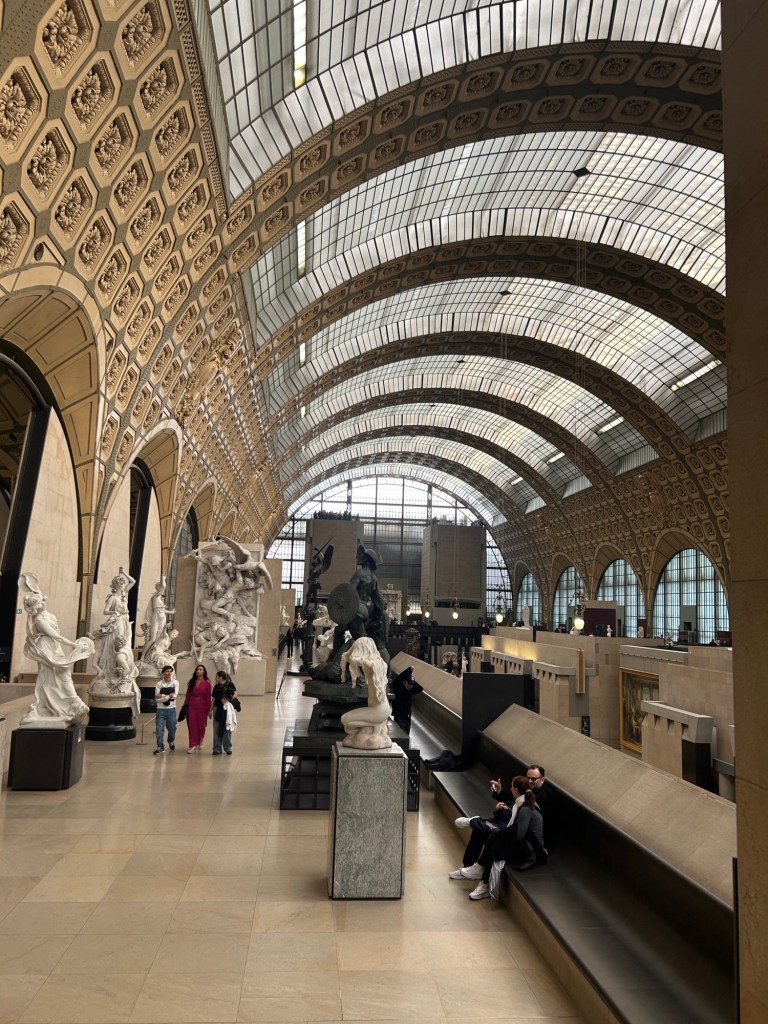
A few days ago I went to Paris to visit a friend, who lives right next to the Musée d’Orsay, in a bustling neighbourhood on the Left Bank. After a delicious lunch that she had prepared for me, we wandered over to the museum, which has always been a great favourite.

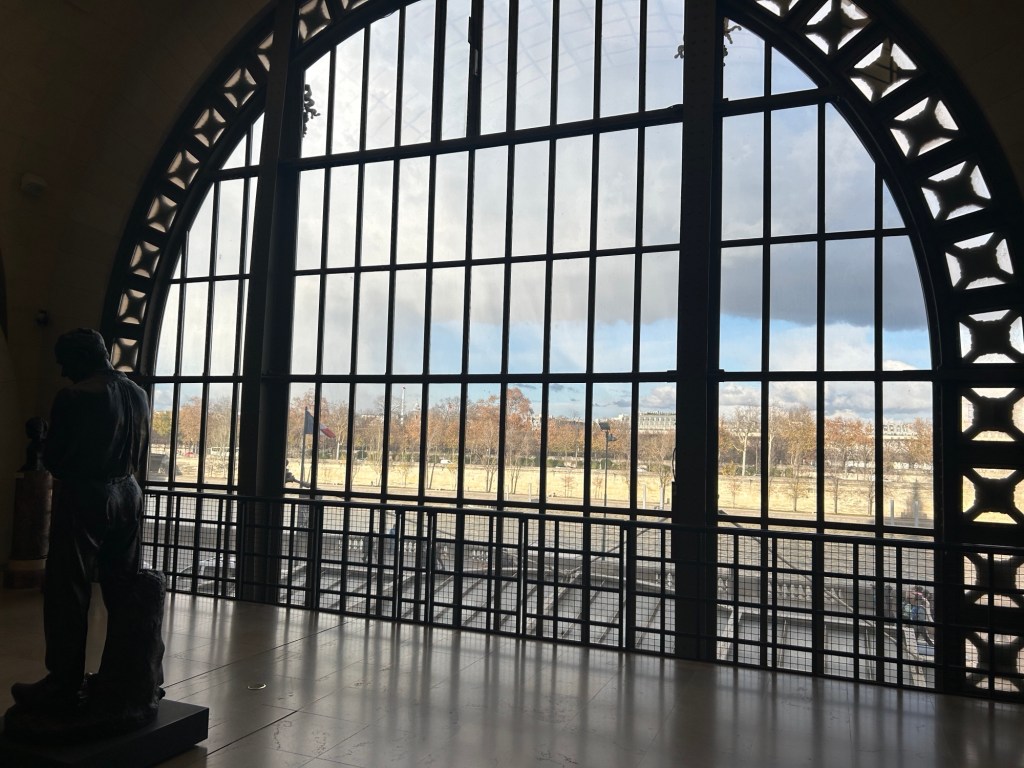
A conversion of the Gare d’Orsay, a Beaux-Arts railway station built in the late 19th century, the building itself is amazingly beautiful, with stunning views of Paris out of every window. Regular readers will know I visit as often as I can, and have written about exhibitions by Picasso, Caillebotte and others (for those interested, putting “Musée d’Orsay” in the finder will lead you to them).

The permanent collection is full of treasures, and every time I go I discover something new amongst the old favourites. My friend and I walked around, admiring the Gaugin paintings some of which I had read about in Sue Prideaux’s biography,Wild Thing (reviewed in a recent post).

The Meal, also known as The Bananas. 1891

Another lovely painting, the portrait, by Odilon Redon, of Baronne Robert de Domecy

Odilon Redon, 1900

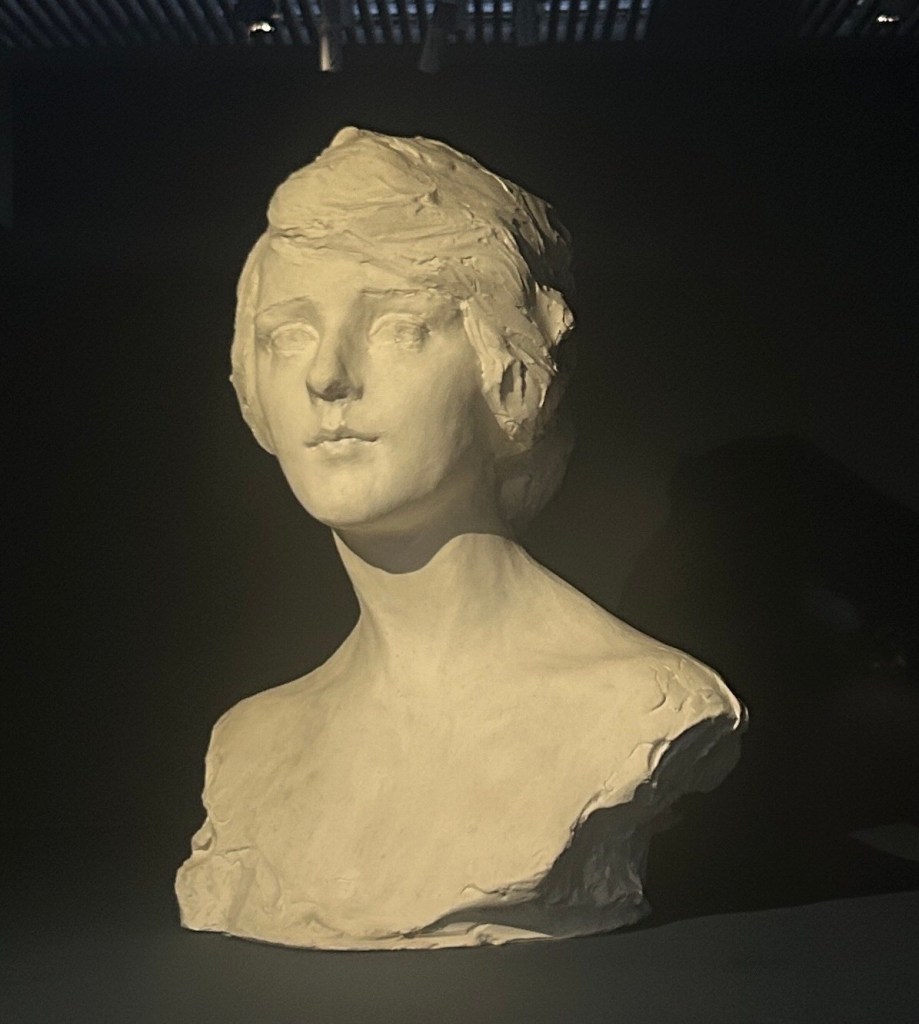
This time the temporary exhibition was of the previously unknown to me sculptor Paul Troubetzkoy (1866-1938).

Troubetzkoy, who was an iconic figure of his time, was the illegitimate child of a Russian diplomat and an American singer and pianist. He was acknowledged by his father at the age of five, trained in Milan and started his career in Moscow and St Petersburg, where he was well received by the local elite, despite speaking virtually no Russian. Having a wonderful facility of capturing people’s likeness in clay (which he then cast in bronze) he sculpted numerous portraits of the aristocracy, but his masterpiece of that period was the portrait of Tolstoy, a vegetarian who made a profound impression upon him (and converted him to the cause).

In 1906, when Russia was racked by the first throes of revolutionary unrest, Troubetzkoy left for Paris, where he quickly won over Parisian society. Bohemian and eccentric, he walked his domesticated wolves in the Bois de Boulogne, and hobnobbed with the city’s cosmopolitan elite, earning numerous portrait commissions. He perfected the genre of portrait statuettes that would make him famous—Anatole France, George Bernard Shaw, Auguste Rodin, Baroness de Rothschild and Roland Garros were amongst those who posed for him.

In his studio, with wolves and statuettes

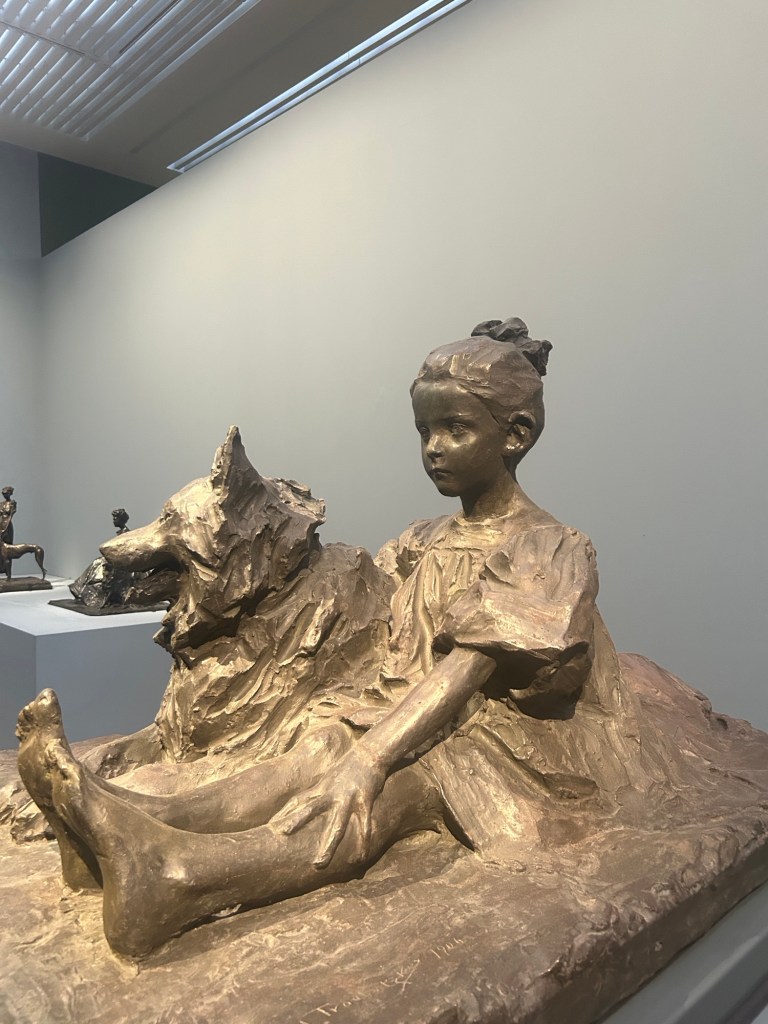
He also loved to depict children and animals. His passion for the latter was the reason he became a vegetarian.

A little girl and her dog

He suffered unbearable tragedy when his only son, Pierre died at the age of two and a half—just after he had sculpted a moving portrait of him with his mother, Paul’s wife Elin.

Troubetzkoy also had much success in America, where he travelled three times between 1911 and 1912, then stayed for almost seven years (1914-1920), again attracting numerous commissions.

Franklin D. Roosevelt, 1911, commissioned by his godmother when he was elected senator of the state of New York.

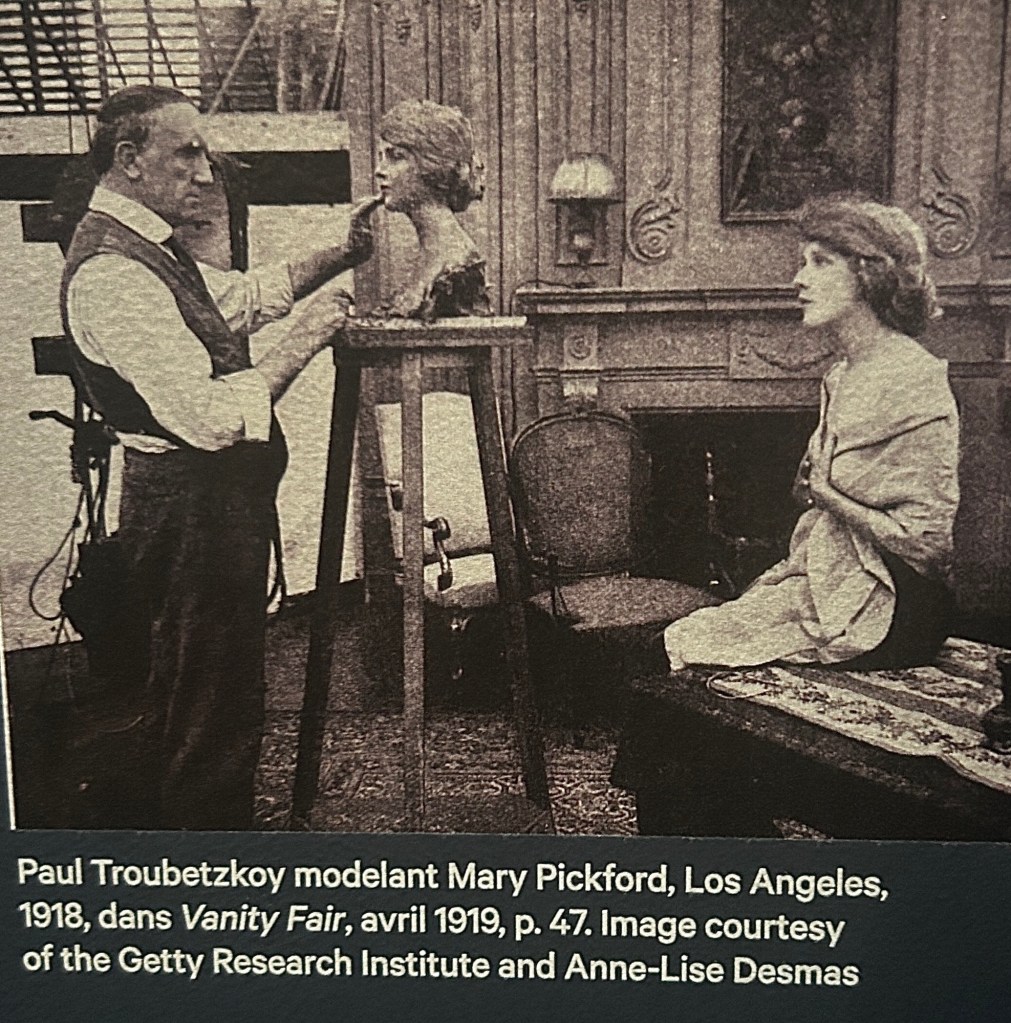
Here he is sculpting the actress Mary Pickford. Amazing how he works in a waistcoat, shirt and tie! He also had a magnificent comb-over…

And the finished portrait.

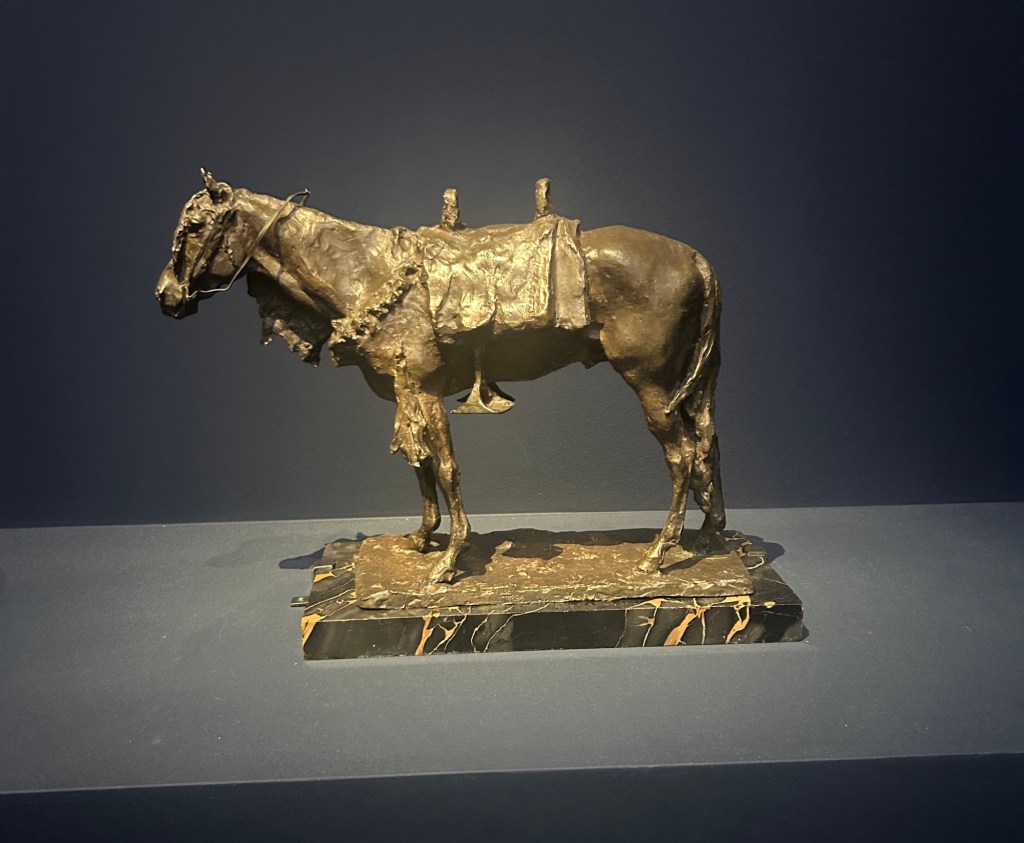
I adored this lovely statuette of an Arabian horse.

Troubetzkoy returned to Europe in 1920, where he settled in France and stayed until his death in 1938 at the age of 72, travelling often to Italy and continuing to sculpt portraits of political figures and representatives of cosmopolitan high society in both countries.

Jean Bugatti, circa 1930

Art on a rainy afternoon

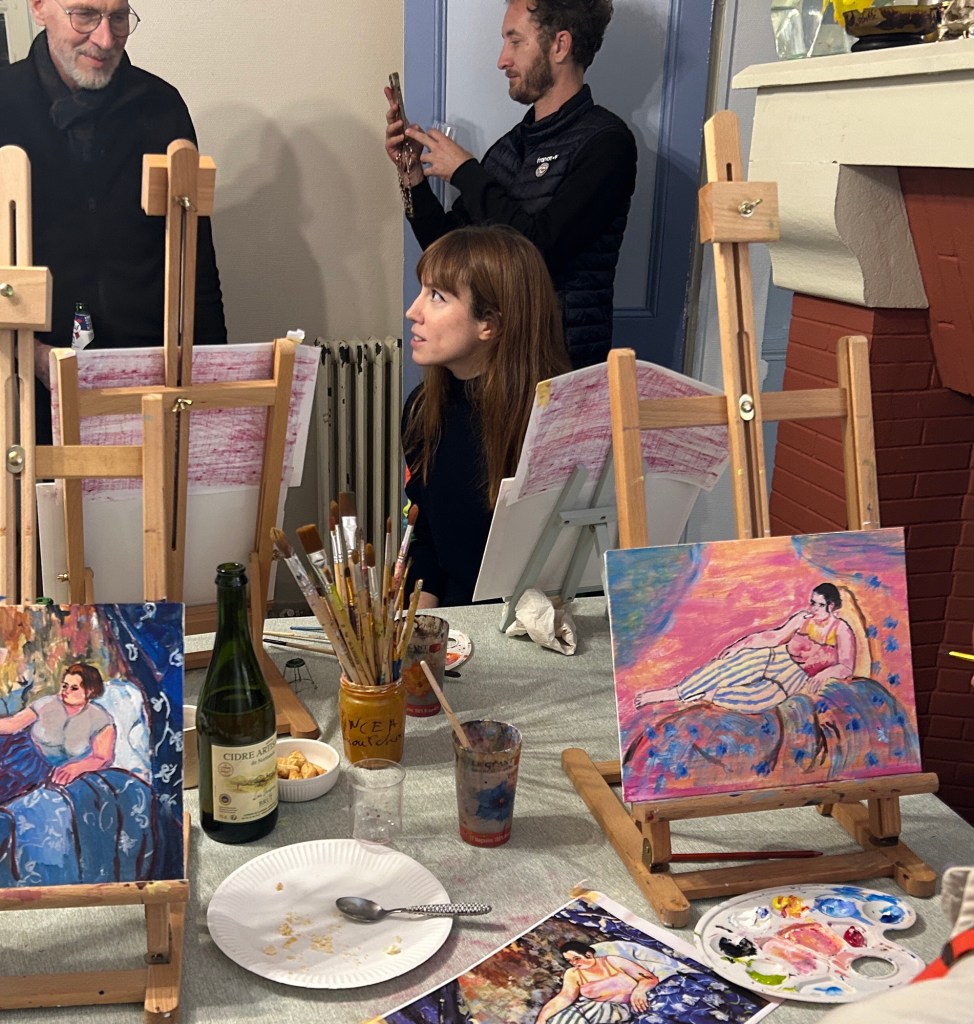
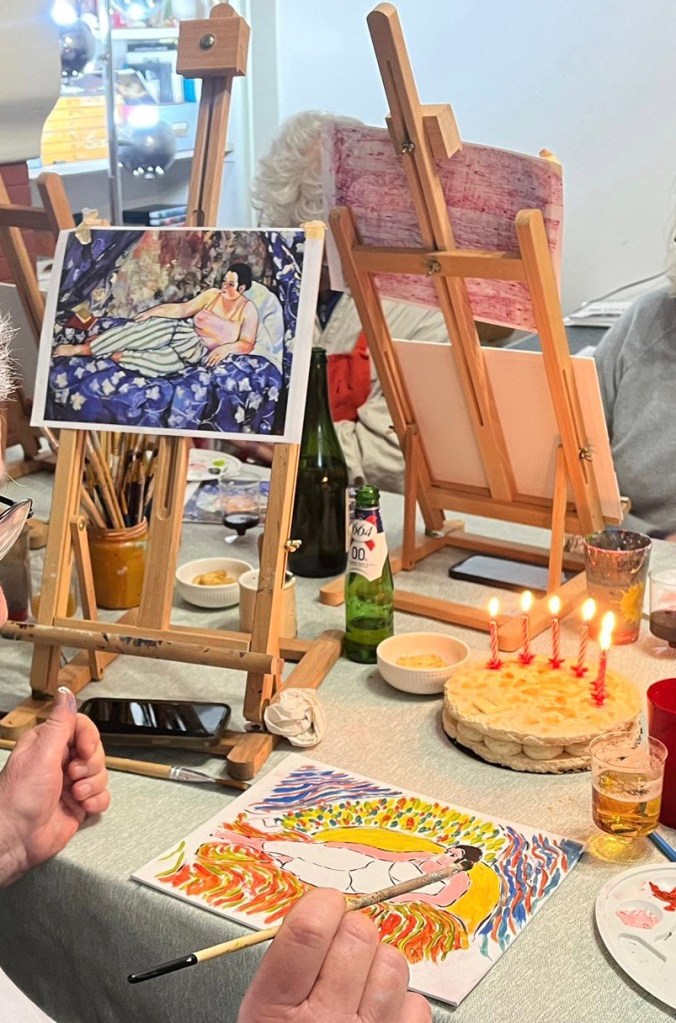
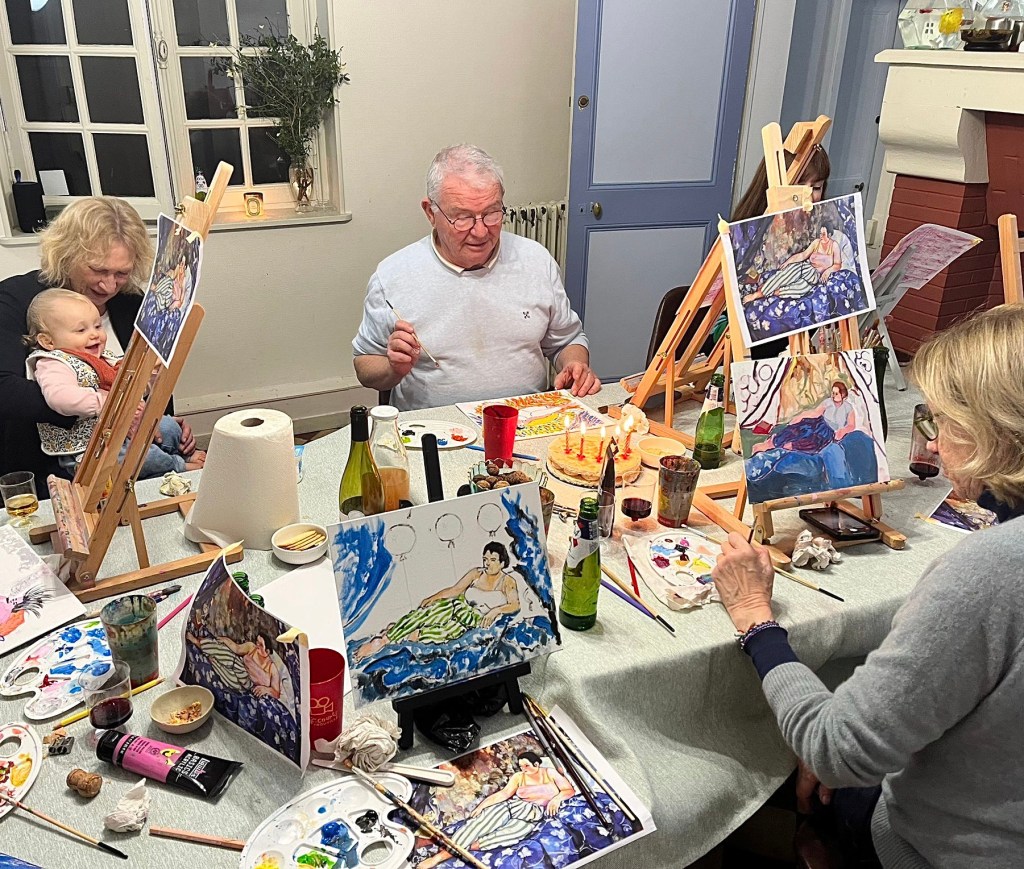
Josepha, the young woman who runs the art studio I attend on Mondays and (when possible) Tuesdays, has set up a Saturday afternoon painting session she calls apéro peinture. The idea is to attract outsiders who are beginners and just want to try painting, but this has had mixed results. Attendance varies. So, a group of the usual suspects decided to take over yesterday, to while away a rainy afternoon.

The idea is not to take ourselves seriously, but interpret the subject as the fancy takes us. We all sit around a table set with small easels, boards and acrylic paints and we all paint from the same model, provided by Josepha. We are fuelled by apple cider, wine and tidbits.

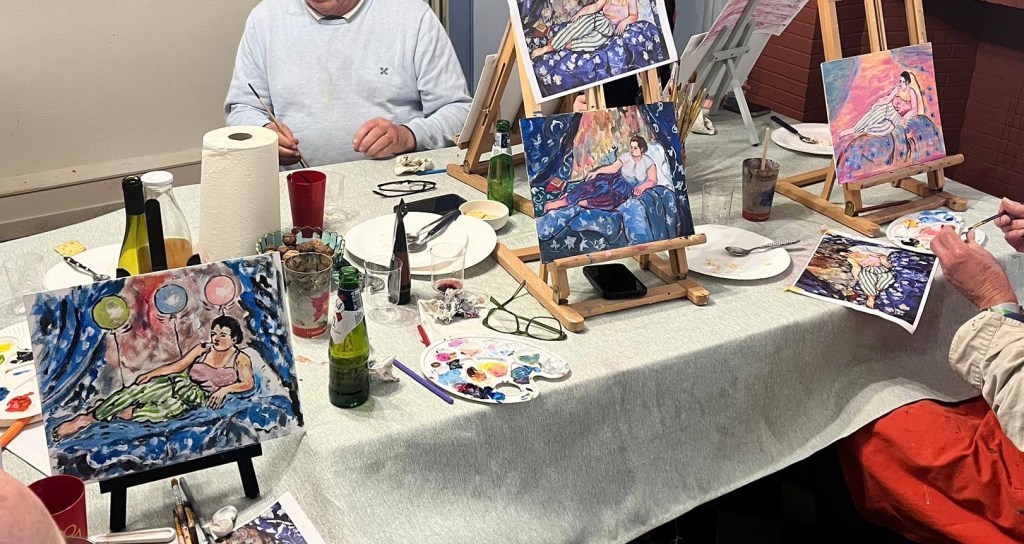
Yesterday the inspiration was a work by Suzanne Valadon (1865-1938), a French painter who in 1894 became the first woman painter admitted to the Société Nationale des Beaux-Arts. She was also the mother of painter Maurice Utrillo. The painting is of a, shall we say, corpulent woman lying on a couch, smoking.

What is always interesting in such situations, is how differently people interpret the same subject. In barely two hours we were supposed to finish a small painting (acrylics dry fast), and this was accomplished amid a lot of banter. We always mock each other mercilessly and have to defend our choices.

Note the birthday cake. With candles 🎂

Christophe and I decided to omit the cigarette, on the pretext that smoking is unhealthy and Non-PC; Philippe on the contrary gave the woman a spliff and drew her levitating above the couch, with three balloons hovering above; and Nathalie actually put her in a bathtub!

Josepha was accompanied by her baby, Garance, her mother (to look after Garance who has just learned to walk), her dog Odin (who is a frequent visitor to the studio) and her partner Tommy who is a journalist and does not draw of paint. His first effort was quite creditable.

Needless to say, a merry afternoon was had by all. However, the artistic benefits are not to be understated, as this type of exercise allows one to let go of rules like perspective and colour values and give free rein to one’s imagination.

My finished version. Cigarette apart, I did not stray too far from the original.

Wild Thing—a book review

Wild thing is a life of the artist Paul Gaugin. Sue Prideaux does her subject proud—she is a sympathetic and judicious biographer who writes like a novelist and has researched her subject from different angles.

The biography contains information which was new to me. Gaugin had an extremely varied and interesting life, knowing both riches and poverty.

I will not reveal too much detail because it is a book well worth reading. But did you know that Gauguin:

Paul Gaugin, Tahitian landscape

-Spent the first seven years of his life in Peru, which left indelible impressions of colour, heat and life in him? To my mind, this explains a lot about his palette and use of colour.
-That he then led a very bourgeois existence, working at the Bourse in Paris and becoming extremely wealthy? Even as he started painting and married, he lived luxuriously, spending without a thought for the future.

Then the Bourse failed in 1882 and for the rest of his life he was poor, living a hand to mouth existence, begging and borrowing from friends. He often did not have enough to eat.

La vision après le serment, 1888

-That he had a very complicated and close relationship with Vincent Van Gogh, which continued up to his death. Read the book to find out details of the famous ear-cutting episode.

-That Vincent’s brother, Theo Van Gogh, was Gauguin’s agent.

-That he was deeply affected by attending a public execution in Paris: the death by guillotine of a mysterious murderer.

-That he was greatly inspired by the colonial exhibits at the 1889 Exposition Universelle in Paris, where the Eiffel Tower, built for the celebration, soared heavenward, lit by electric light. Round its feet sprang recreations of the colonies and their treasures, from which he borrowed elements and incorporated them into his art. For this Camille Pissarro called him a bricoleur, a cobbler-together of second-hand ideas.

Self portrait

The book details his marriage and relationship to his children, and his friendships and dealings with prominent men of his world, such as André Gide, Pierre Loti, August Strindberg, Frederick Delius and others. One of his main supporters in hours of need was Edgar Degas. The biography is full of delicious anecdotes of this crowd of supremely talented men.

Finally we get an account of his latter years in Tahiti, where he ended up almost by chance. Gaugin’s life is one of the richest in the history of wester art, and Sue Prideaux does it full justice.

Les ancêtres de Tehamana, 1893 (portrait of Tehura).

Highly recommended.

Kerry James Marshall at the Royal Academy

On a flying visit to London I took the opportunity to see an outstanding exhibition of the work of American artist Kerry James Marshall.

2009. Acrylic on PVC panel. Notice the painting by numbers on the wall?

I had never before seen his paintings in person, and they are very powerful indeed.

Untitled (Studio) 2014. I love the bright pots of paint—the yellow seems to have dripped onto the dog under the table.

Marshall is an artist possessed of a vivid imagination, and his work is full of references which span art history, civil rights, comics, science fiction, his own memories and more.

Untitled (the Cove)

There is a very wide range of work on display, and I cannot say I liked it all, but the large paintings—some just huge sheets of canvas pinned to the wall—were fascinating. They are vivid, acrylic works full of signage, collage and hidden references; they are realistic, but also contain allegory and symbolism.

Many Mansions 1994. Acrylic on paper

Every painting tells a story—and every time you look, you notice another detail. Sheets of music, code numbers, letters and words, flowers and animals. There are references to historic events, especially concerning Black history and slavery, but he also celebrates daily life and imagines optimistic futures.

This was an enormous roll of canvas pinned to the wall. I love the people’s postures and their bright clothes

An artist and professor, Kerry James Marshall was born in Birmingham, Alabama, in 1955, and is probably one of the most influential painters working in America right now. In 2017, Marshall was included on the annual Time 100 list of the most influential people in the world.

For some reason most of the photos I took were crooked, so I had to crop them before posting.

His subject matter is African-American life and history. If you zoom in on the photos, you will notice a lot more detail.

Untitled (Underpainting) 2018. Monochrome work (literally an underpainting) of Black kids on a museum trip

Despite his often bleak subject matter, Marshall’s work is joyful and optimistic—due to his vivid palette, but also because his subjects appear to be enjoying themselves.

Keeping the Culture, (2010, Oil on board) depicts an Afrofuturistic household where the future merges with the past.

In a 1998 interview with Bomb Magazine, Marshall observed:

Black people occupy a space, even mundane spaces, in the most fascinating ways. Style is such an integral part of what black people do that just walking is not a simple thing. You’ve got to walk with style. You’ve got to talk with a certain rhythm; you’ve got to do things with some flair. And so in the paintings I try to enact that same tendency toward the theatrical that seems to be so integral a part of the black cultural body.”

Sou Fujimoto – A fascinating architect

In more news of my trip to Japan, one afternoon we went to the Mori Art Museum expecting to see contemporary art, only to find there was an exhibition on the architect Sou Fujimoto.

This proved to be fascinating, because he was inspired by the shapes in nature to create buildings which are both avant garde and pleasing to the eye.

Okayama smoking area. 2022

The exhibition consisted of maquettes of a variety of mostly public buildings, some of which had actually been built, while other had not, due to practical or financial considerations.

This is a plan (below) for an urban hub to be built along the Sava river in Belgrade, where ‘the building converts flows of people into architecture, creating a “cloud” of slopes that converge in a spiral.’ Pretty cool, no?

Béton Hala Waterfront Center. 2011 (conceptual) Belgrade

There was one mock-up, The Grand Ring for Expo 2025 Osaka, Kansas, which was impressive if one considered the scale.

A number of Fujimoto’s sketches on display gave insights into his thought processes, as did a video where he is interviewed and talks about his inspirations.

There was even a futuristic city made up of spherical units which ‘function as “breathing devices” rather than mere structures.’

‘In this future city, we define space not merely as a container, but rather a place where different values and life forms can meet and converse with each other.’ Perhaps we will have a need of cities like these when we have polluted our planet beyond redemption…

The art of Kintsugi

Meet Sanga, our overgrown and over enthusiastic puppy. In one day he ate my slippers, shredded my favourite pashmina and broke the lovely little plate above.

Butter wouldn’t melt…

Having got over my extreme annoyance and digested the fact that both slippers and pashmina were shot, I thought it would be an opportunity to try something which has intrigued me for a while: the ancient Japanese art of Kintsugi.

Kintsugi, which probably originated in the 15th century, is a method of repairing broken pottery by mending it with urushi lacquer dusted or mixed with powdered gold. People became so enamored of the new art that some were accused of deliberately smashing valuable pottery so it could be repaired with the gold seams of kintsugi. Sometimes a pottery piece was chosen for deformities then deliberately broken and repaired, instead of being discarded.

Kintsugi means “to join with gold” and it serves as reminder to stay optimistic when things fall apart and to celebrate the flaws and missteps of life.

Kintsugi encompasses a profound meaning and philosophy beyond mere repair, namely the idea of embracing imperfection and impermanence and transforming them into something valuable. It reflects an aesthetic perspective on the way people live, since from this perspective our life is like a vessel.

Not bad for a first try

A good Kintsugi vessel can be very expensive, because it requires months of intricate work. My plate was only broken neatly in two pieces, and I used glue mixed with gold powder (courtesy of YouTube) but I can assure you it is a messy and delicate procedure which ended in my kitchen looking as if a gold storm had hit it.

I am too impatient for the real thing, I’m afraid. Look at this:

And here’s an interesting video on the real thing

Preaching to fish

Noted by his contemporaries for his powerful preaching, expert knowledge of scripture, and undying love and devotion to the poor and the sick, Saint Anthony of Padua (1195-1231) was one of the most quickly canonized saints in church history, being canonized less than a year after his death.

Born in Portugal of wealthy and noble parents, Anthony joined the Church early on and ended up in Italy after his ship was blown off course on a return journey from Morocco.

Although he died at 35, Anthony led a busy and varied life, preached in many places in Italy and France and performed many miracles. One can easily read about his life (there is a lengthy Wikipedia entry) but the reason I am writing about him is that I came, entirely by chance, upon this weird and wonderful detail of a mural in the Basilica di Sant’Antonio da Padova, of him preaching to a bunch of fish.

Just look at the expressions on those fish faces. Priceless

The story of Anthony “preaching to the fish” originated in Rimini, where he had gone to preach. When the Cathar  heretics there treated him with contempt, Anthony was said to have gone to the shoreline, where he began to preach at the water’s edge until a great crowd of fish was seen gathered before him. The people of the town and even heretics flocked to see this marvelous thing and were moved to listen to Anthony’s preaching.

There are other paintings of this event, but this one has a special flavour to it.

More Easter Nonsense

In homage to Glen Baxter

Born in Leeds in 1944, Glen Baxter is an English draughtsman and artist, known for his absurdist drawings and a general ambience of literary nonsense.

I have always loved his insane and incongruous sense of humour and his old-fashioned drawing style, and own a few of his books.

Here is a sample, for those who have survived the excesses of the day and are in need of a laugh.

Should you enjoy this kind of thing, you can look him up on Instagram:

https://www.instagram.com/glenbaxterartist/

An Intervention

Artist duo Elmgreen&Dragset were invited to exhibit their work in the iconic sculpture gallery of the Musée d’Orsay.

They called this installation, consisting of a number of boyish figures engaged in incongruous—in the context—pursuits, L’Addition.

Michael Elmgreen (born 1961 in Copenhagen, Denmark) and Ingar Dragset (born 1969 in Trodheim, Norway) have worked together as an artist duo since 1995, exploring the relationship between art, architecture and design.

Elmgreen&Dragset live and work in Berlin. They are known for art work that has wit and subversive humour, and also addresses social and cultural concern. Their work is too varied and prolific to be described in a short post, but anyone interested can look them up on Wikipedia—and they are, indeed, interesting.

For the first time in its history, the Musée d’Orsay invited someone to intervene in the museum’s permanent display of 19th century sculpture, which has remained the same for nearly 40 years.

As quoted in the museum’s site: In a trans-historical encounter between past and present, L’Addition highlights themes of evolving masculinities, solitude, and the magic of everyday situations. There is a certain beauty to be found in each of the fleeting moments captured in the works, whether it is in the pause before jumping from a diving board, the split second before a drone is sent off from a child’s hand, or a glimpse through the lens of a camera.

The figures are made of bronze, stainless steel and laquer. Boys waiting to dive, taking pictures from the mezzanine, setting off drones or just lounging upside down on the ceiling. It was all pretty cool, and an extra treat combined with the Caillebotte exhibition.