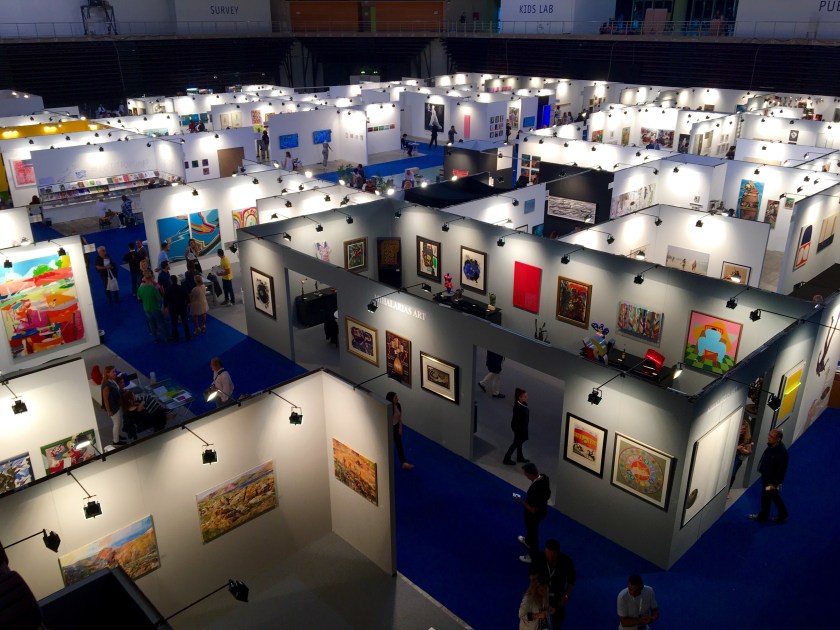
There is plenty of art on show in Athens these days. As well as the Documenta project, which is spread all over town, from May 26 to 28 there was also Art Athina, a three-day fair open to the public.
Fifty eight galleries, mostly from Greece but quite a few from abroad (Paris, Istambul, Vienna, Zurich, and even as far away as Dubai, Australia and Mexico) offered modern art for sale in a wide range of prices.
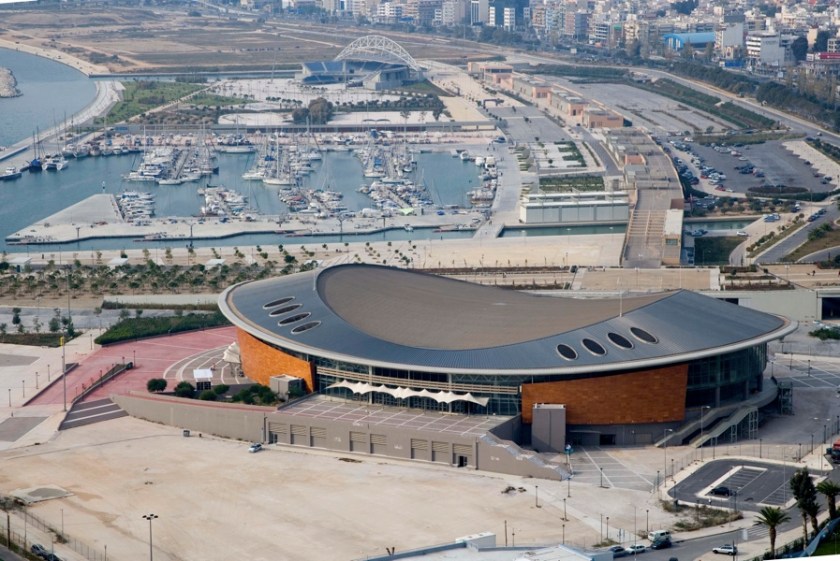
Art Athina venue: the Olympic Tae Kwon Do stadium (photo from Google)
The fair was held at the Tae Kwon Do Stadium in Faliro, on the coast not far from the center of Athens, a venue built especially for the 2004 Athens Olympics. It is a modern and spacious structure benefiting from a wonderful location next to a marina full of yachts. Nowadays it is used for various purposes, such as concerts, and even provided shelter to refugees at the worst of the crisis.
Inside, the galleries had set up their booths, and it was fun wandering around looking at the art on offer.
The view from the top floor
Sadly, I was extremely dismayed, if not disgusted, by the state of the building’s interior. I decided not to post any photos, thinking it too depressing. But I was aghast at the unpainted, stained walls, the dirty floor, the missing or broken fixtures… I don’t understand how some funds could not be raised to at least freshen it up a little.
Whimsical pen and ink drawing by Greek artist Leonidas Giannakopoulos
The whole issue of the Olympic venues is shameful. Most have been left to rot – and when I think of what Greek taxpayers forked out for them (they were grossly overpriced) it makes me grind my teeth. What’s more, the labyrinthine governmental system means that any attempt at exploiting them is resisted. Apparently the National Shooting Federation wanted to take on the Olympic Shooting complex and keep it functioning and upkept, but their offer was refused. The racetrack and equestrian centre have become totally decrepit, despite racing being a potentially profitable business. Etc, etc. – and we are talking about state-of-the-art, modern installations that could benefit Greek athletes who usually have to train in less than ideal conditions. It beggars belief.
Another by the same artist, called Sky Adventures
I can only console myself with the thought that, thanks to the Olympics, we have at least got a new, very functional airport, a good subway and a much improved road system. These had been planned for over twenty years (!) but had never materialized and would not have been finished but for the games. Part of the problem being that, wherever you dig, you find antiquities, and work has to stop until the Archaeological Society decrees what is to be done. A couple of museums were filled with what was found on these sites – but that is another story!
Outside, a band was tuning up for one of the performances on offer
If you are interested in more detail about Art Athina, pop over to the ArtinAthens blog, there is a very interesting article here.
An altered book by a Greek artist whose name, unfortunately, I did not note. I loved his work, though
In a surprising move, Adam Szymczyk, Documenta’s Artistic Director, transplanted half this year’s exhibition to Athens, where it is sprawled over 40 venues, showing 160-odd artists, with the working title ‘Learning from Athens’. Documenta is an exhibition of contemporary art which takes place every five years in Kassel, Germany. It was founded by artist, teacher and curator Arnold Bode in 1955, in an attempt to bring Germany up to speed with modern art.
Here in Athens, the heart of the exhibition resides in the large available spaces—the Athens School of Fine Arts, Benaki Museum Pireos Street Annexe, the former Athens Conservatoire, and the EMST Contemporary Art Museum which, due to government mismanagement, has only just opened after years of delays. But the rest of it is spread around the many small galleries about town.
The program also includes a radio station that broadcasts 28 commissioned sound pieces in multiple formats, art films screened on Greek television, a vibrant education program, and a jam-packed schedule of live performances.
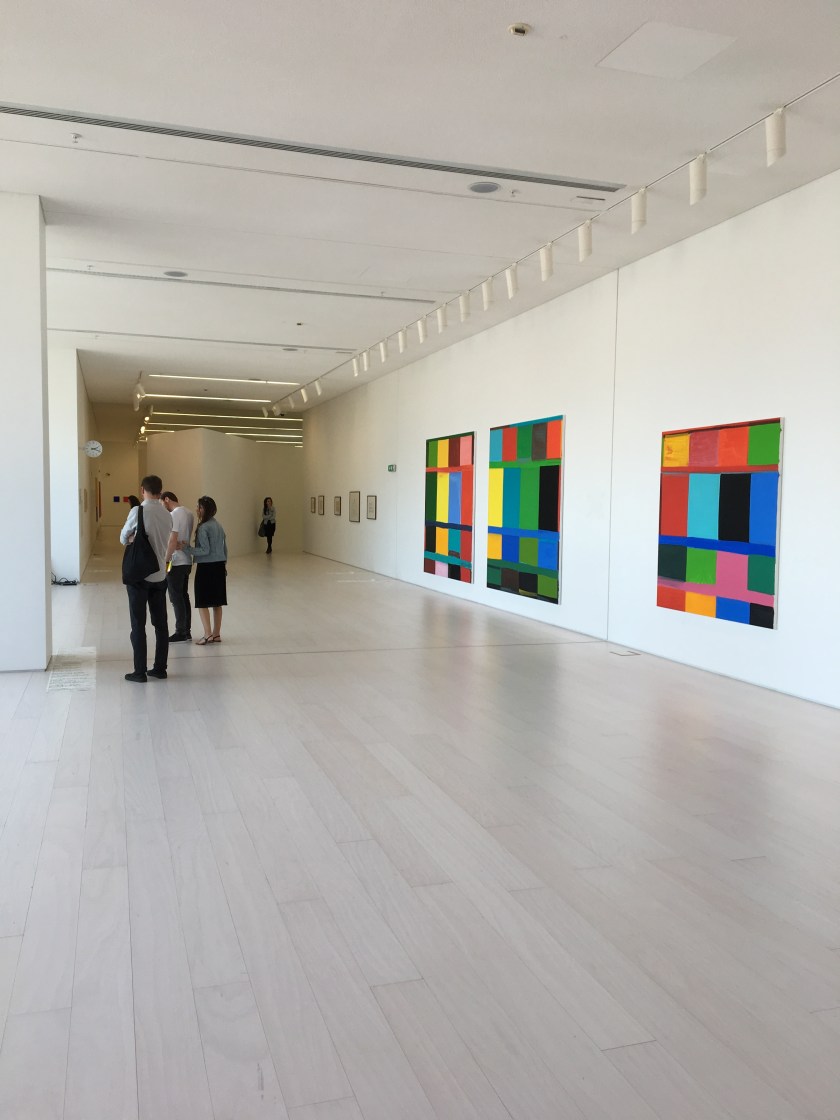
It was difficult to know what to tackle first, so we decided to start with the National Museum of Contemporary Art (EMST), which is a converted beer factory, and thus an interesting space in itself.
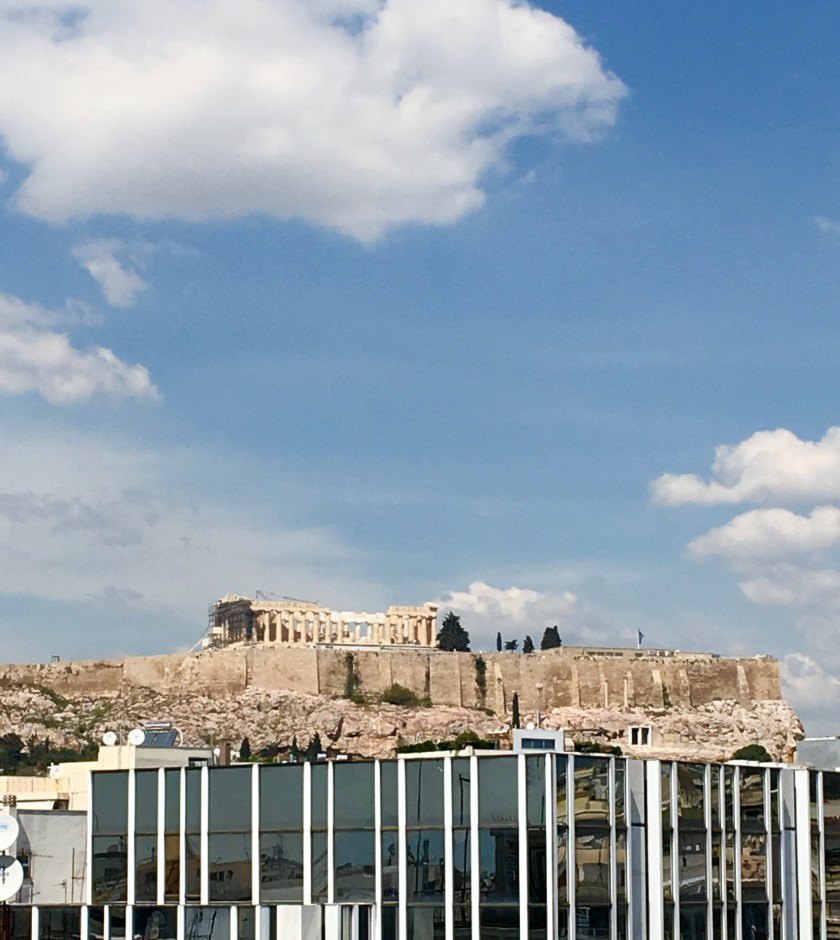
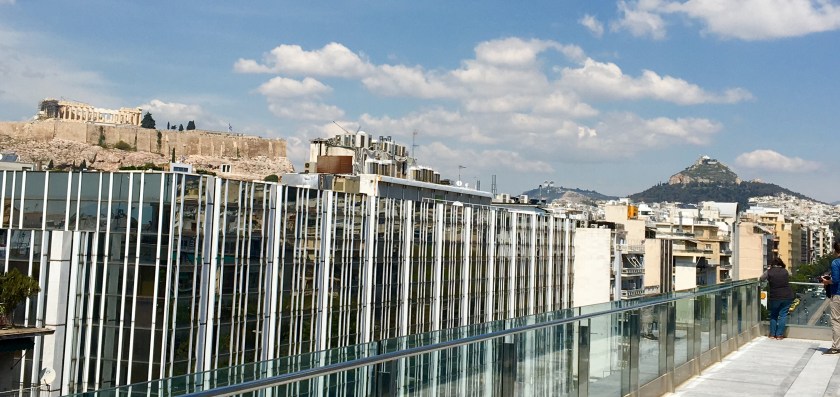
The building does not disappoint – it has been beautifully converted, provides an amazing background to showcase art, and has stunning views on the Acropolis, Mount Lycabettus, and the Philopappos hill.
The art itself, however, and although it did include some stunning pieces, left me somewhat underwhelmed. There were a number of very plain sketches which would have been better placed on Instagram, and installations which, while being creative and sometimes original, inevitably brought to mind the question: This is clever/imaginative/fun, but is it art?
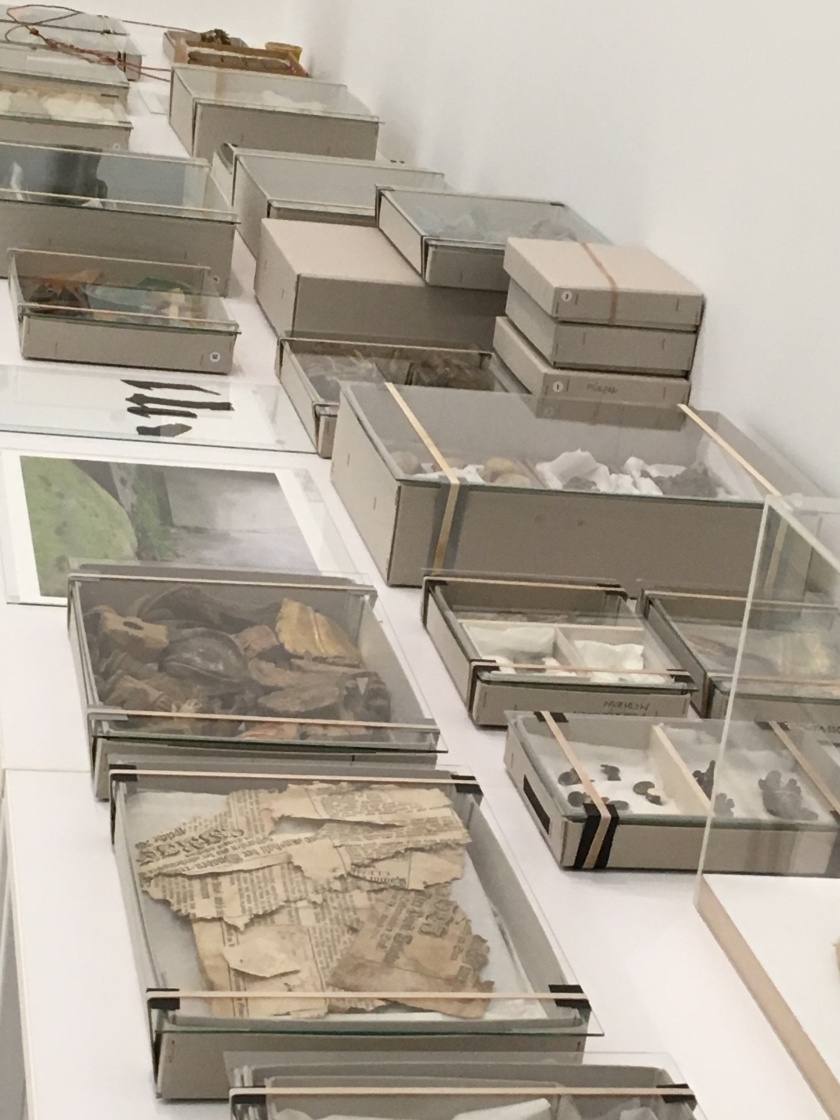
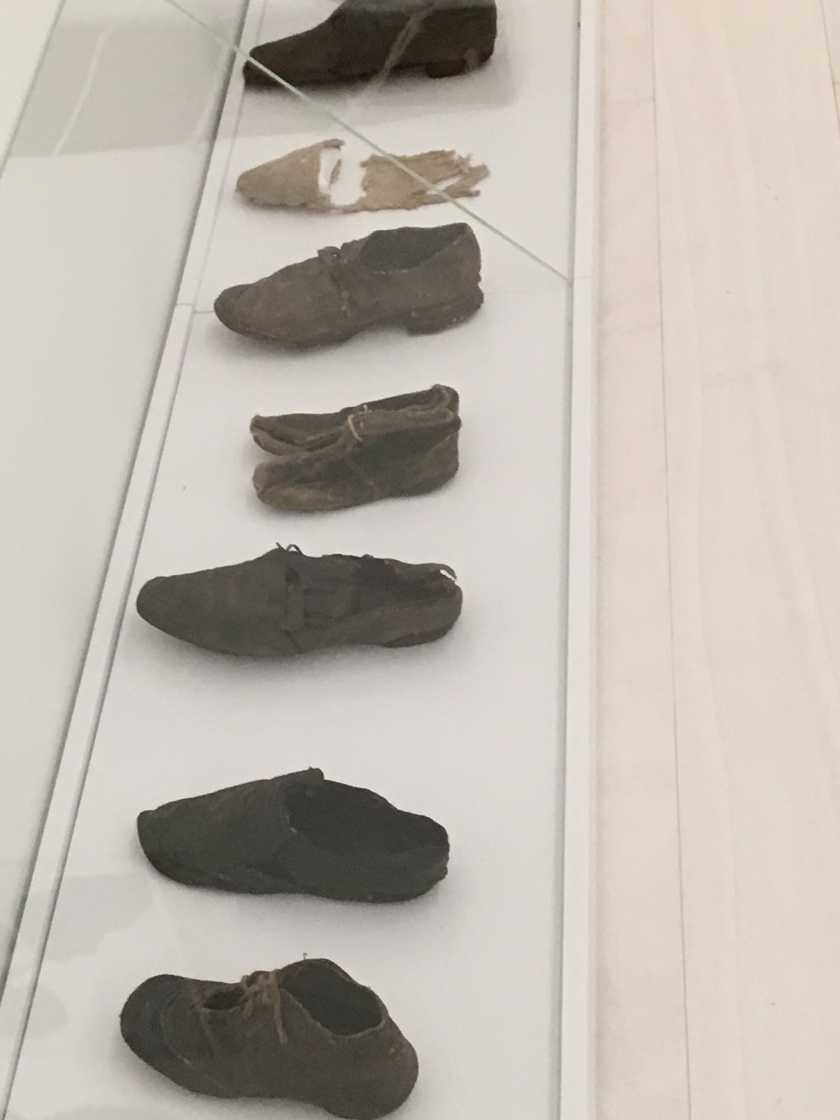
Austrian artist Lois Weinberger had packed old objects ‘excavated’ from under the Weinberger family’s old farmhouse floorboards – animal skulls, broken crockery, bits of torn paper, scraps of wood – into cardboard boxed with plexiglass tops. There was even a line of old shoes.
Strangely, the labels for the whole exhibition were located on the floor – they were just work titles on paper and handwritten artist’ names on small, rectangular blocks of marble that looked like paperweight (apparently a number have already disappeared – perhaps purloined as souvenirs).
Another installation comprised a few desks strewn haphazardly in an empty space, as if an office had been abandoned in a hurry. On them were objects described on a list: i.e. ‘a piece of A4 paper.’
Art is very subjective and encompasses a wide range of creativity, yet there are still some some things I don’t get – but perhaps there is nothing to get. Just sayin’. The most creative part here, it seems to me, has been getting people to believe this is worthy of a place in Documenta.
Moving on, among the video installations was one I found engrossing, from the collaboration of artists Nashashib and Skaer – a group of women and children in a house and courtyard, complete with dogs and chickens – which revisited Gaugin’s images of Tahitian women. Another, called ’15 hours’, by Chinese filmmaker WangBing, showed the repetitive work in a Chinese sweatshop – and there was an unbearable one, by Iranian director ForoughFerrokhzad. Called ‘The House is Black’, it documented life in a leper colony. I could only watch a tiny bit – in fact, I’ve noticed that visitors seldom have the patience to watch the whole of a video installation, which, in some instances, is probable a shame.
One aspect of the exhibition I liked was the variety of artists represented, from all over the world. Many from Eastern Europe, and some from unusual destinations – artists from as far away as Mongolia, or belonging to the Sami people from the Arctic regions of Norway. On the other hand, who wants to see a series of portraits of Hitler, even if they do have socio-political connotations? (paintings by McDermott & McGough from their series ‘Hitler and the Homosexuals’.)
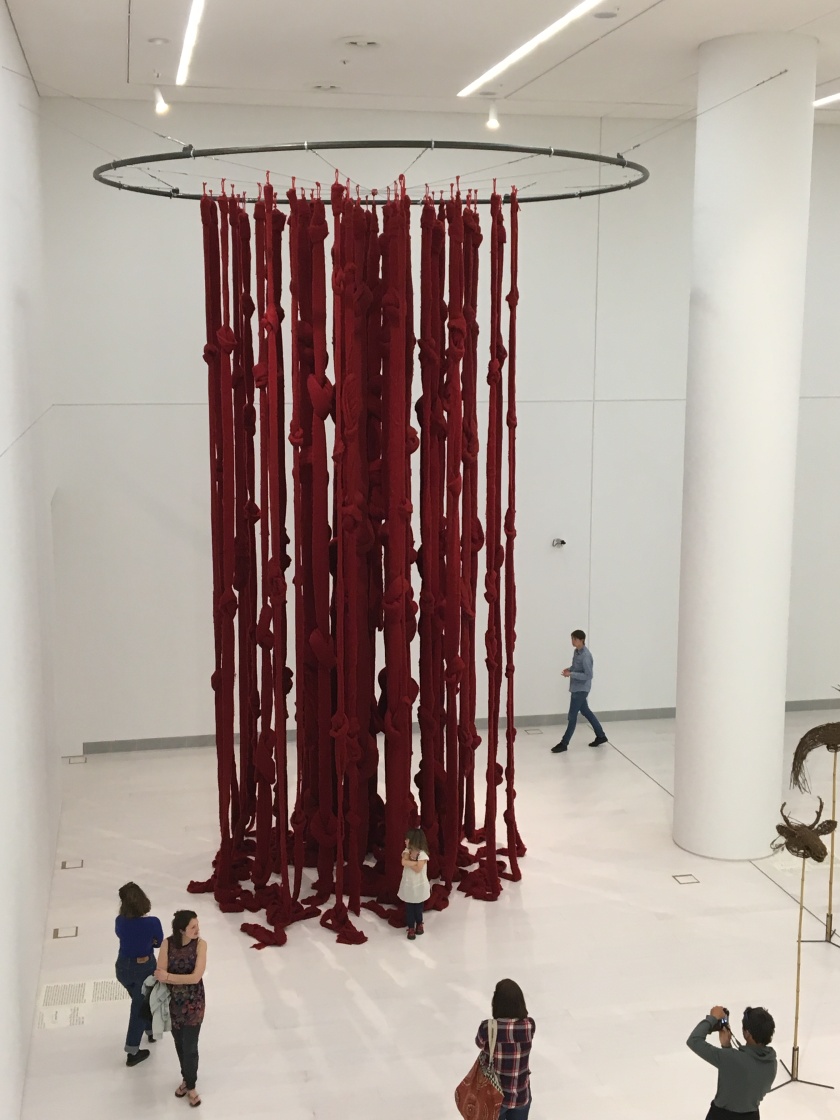
Cecilia Vicuña ‘Quipu Womb’ The Story Of The Red Thread, dyed wool
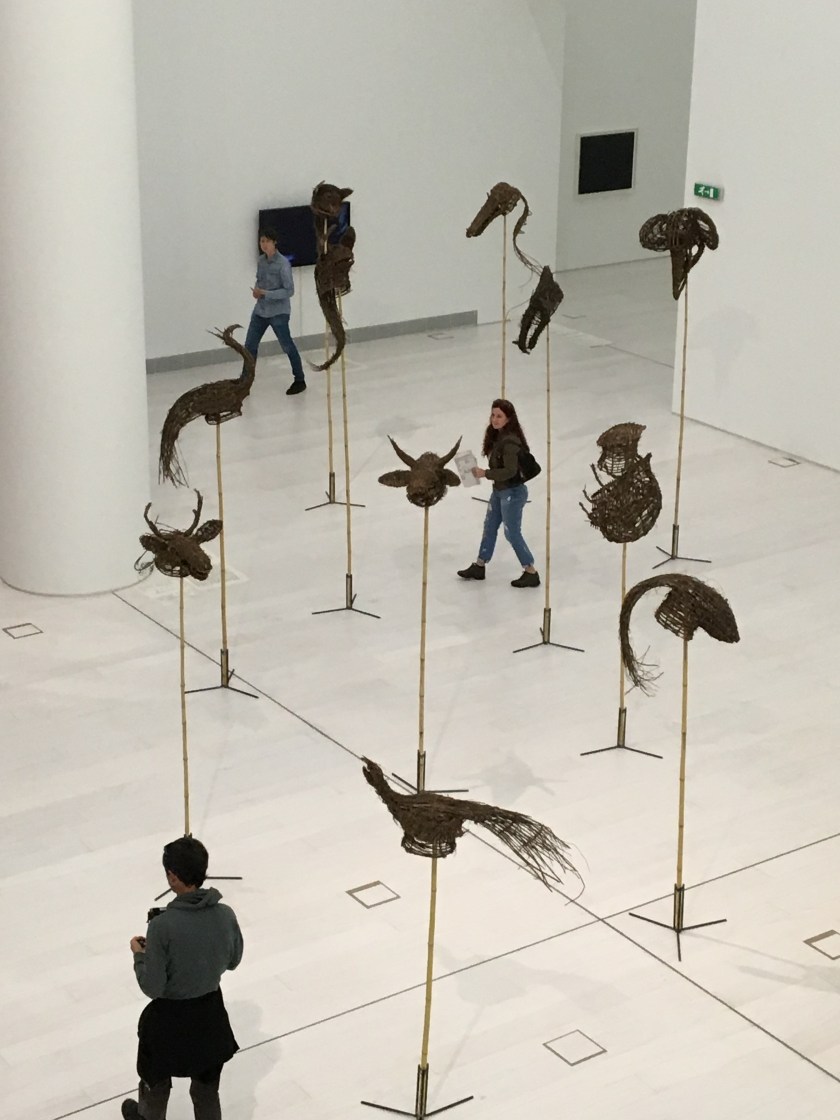
At the end of our tour, we came upon two impressive installations, especially since our first glimpse of them was from above.
A circle of masks made of woven vines by KhvaySamnang.
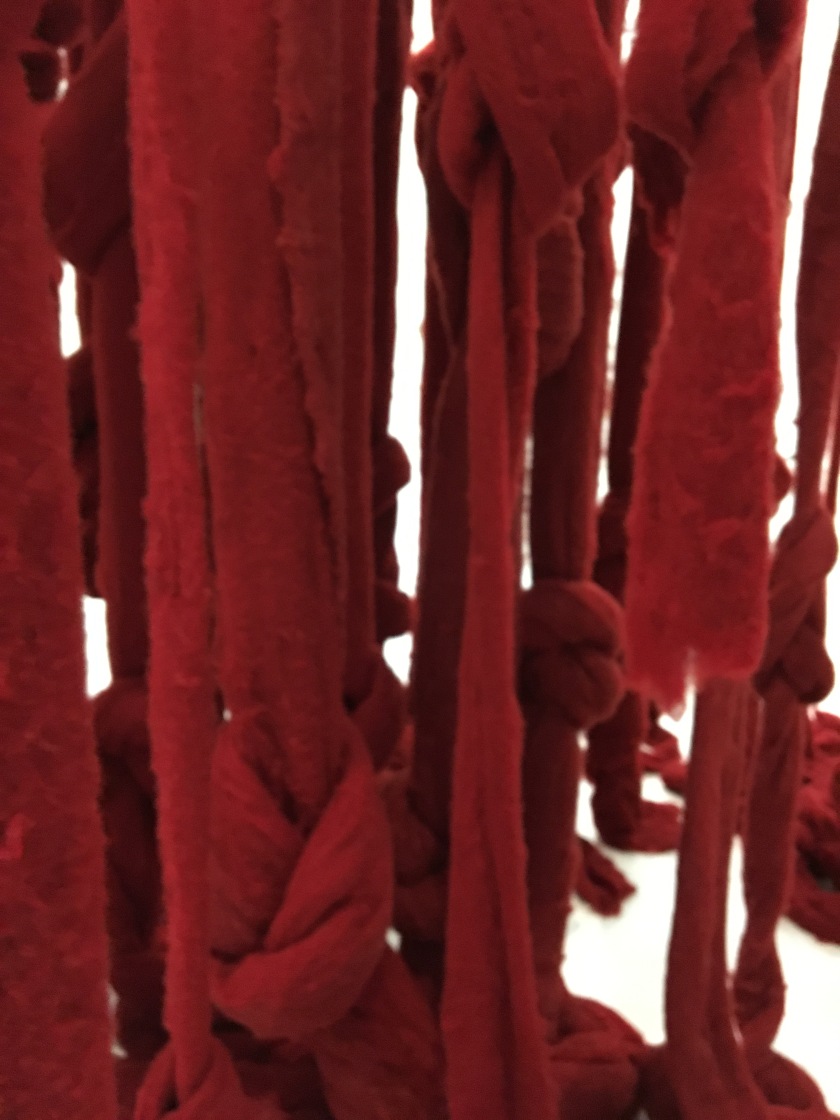
And I loved QuipuWomb (Story Of The Red Thread) by CeciliaVicuña. The ancient art of Quipu is a pre-Colombian form of writing involving intricate knotting patterns. Here, untreated wool was sourced from a local Greek provider and dyed red.
It is made of wool, and it’s hard to stop oneself from touching it or sneaking inside the strands
Art is rampant all over town, and one of the positive effects of Documenta is that it has attracted a lot of visitors from abroad. Documenta has been called a ‘culturalpeaceoffering‘ from Germany to Greece by some, a ‘Trojanhorse’ by others. It so vast and diverse that it is intimidating: one has to make up one’s own mind in the end. The dialogue continues.
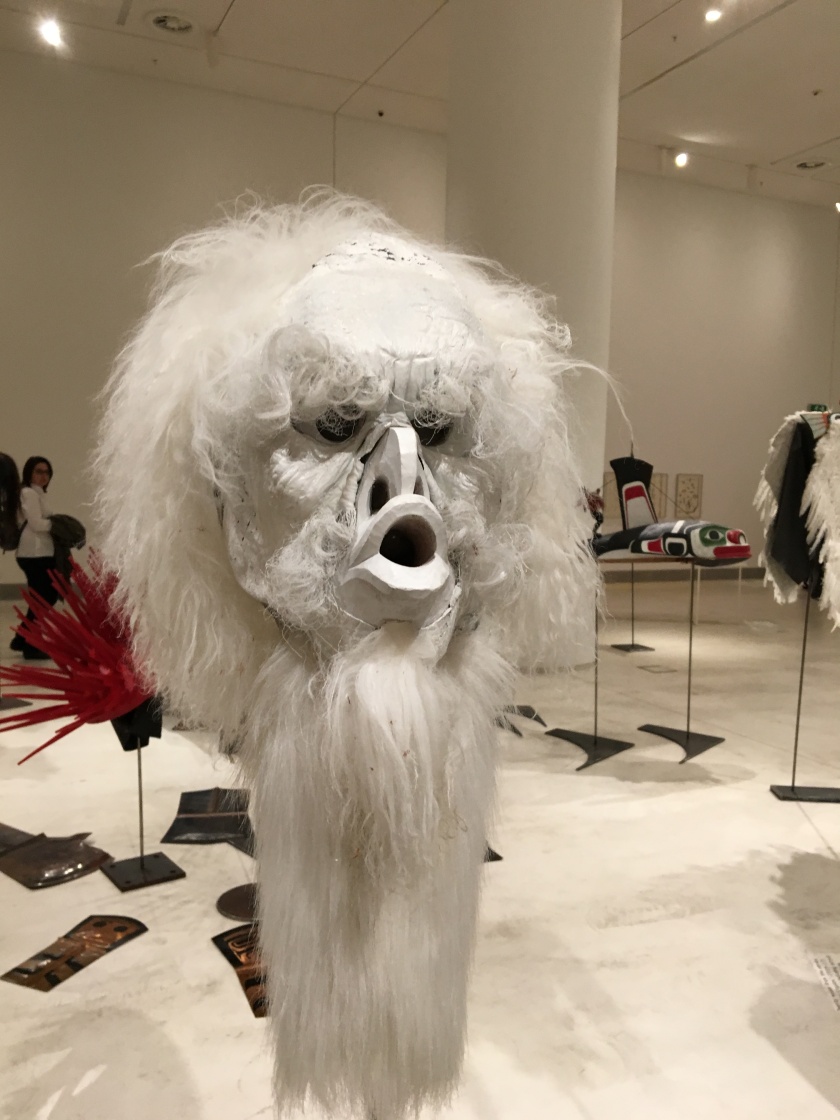
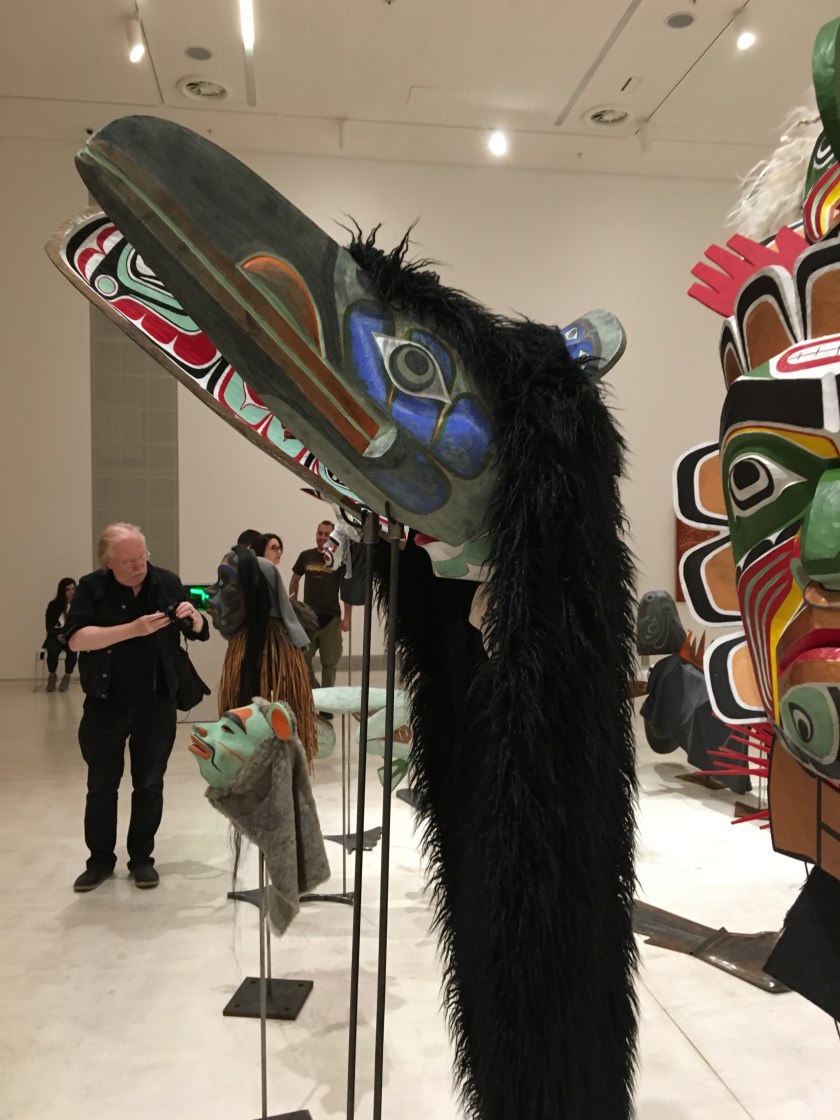
A set of twenty ‘tribal’ masks, by the late British Colombian artist Beau Dick
Documenta is on for 100 days, so I will certainly be seeing more of it. For anyone interested in more detail, however, or for those of you living in Greece, I recommend browsing Art Scene Athens, a blog I have often referred to before. There are several detailed posts on the subject, a lot more erudite and objective than my own biased view!
In Greece, this is the last weekend of Carnival, and little kids are roaming the streets dressed in those ghastly plastic Superman costumes with fake abs. This year, trending among little girls is ‘Policewoman’, complete with holster and gun (I found this vaguely disconcerting), closely followed by ‘Pocahontas’ and ‘Skeleton’.
The end of Carnival heralds Clean Monday, a day of flying kites and feasting on delicious seafood and other delicacies to mark the beginning of Lent. For those of you who missed it, I wrote about this holiday last year, and you can read the post here.
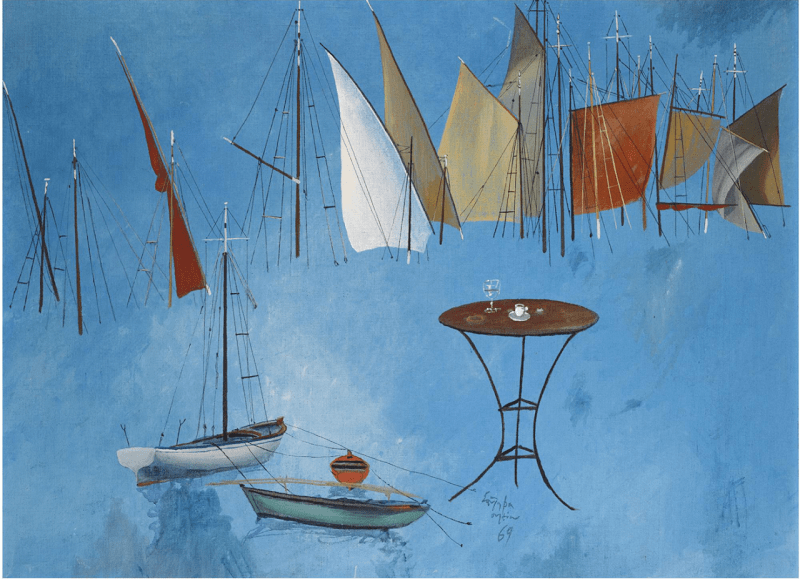
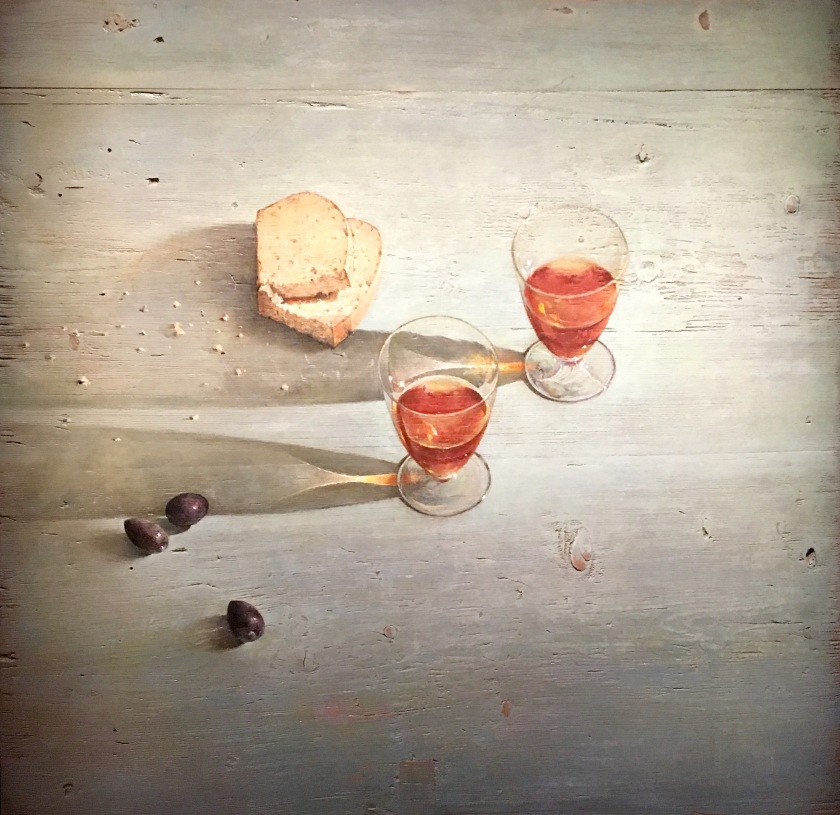
Since I’ve been on a roll regarding Greek artists, I realized that the iconic images about Clean Monday and other holidays are often by SpyrosVassiliou ( Σπύρος Βασιλείου; 1903-1985), a Greek painter, printmaker, illustrator, and stage designer.
Vassiliou painted the objects that define special moments: the May wreath, the little table by the sea with its glasses of ouzo and plate of olives. And landscapes with fishing boats, and little white chapels, and the blue of the sky and sea.
The townsmen of Galaxidi, where Vassiliou was born, collected money to send him to Athens in 1921, to study at the Athens School of Fine Arts under the famous painter Nikolaos Lytras.
Vassiliou started becoming recognized for his work in the 1930s, when he received the Benaki Prize from the Athens Academy. The recipient of a Guggenheim Prize for Greece (in 1960), his works have been exhibited in galleries throughout Europe, in the United States and in Canada.
Spyros Vassiliou became recognized as a painter of the transformation of the modern urban environment, depicting with an unwavering eye the sprawl of urban development that surrounded his home in Athens, under the walls of the Parthenon. He combined monochrome backgrounds with the unorthodox positioning of objects, and paid homage to the Byzantine icon by floating symbols of everyday Greek life on washes of gold or sea-blue color, very much like the religious symbols that float on gold in religious art.
For many years, Vassiliou taught theatre, and designed sets and costumes for the stage. He also worked in film. During the years of the German occupation of Greece (1941-1945), when painting supplies were scarce, Vassiliou turned to engraving and woodcuts.
I once visited Vassiliou in his studio, for a ‘lesson’; this was organized by a well-meaning friend of my parents who knew I loved to paint. Vassiliou was a tiny, rotund old man, and I was a hulking, awkward teenager who literally towered over him. He let me paint on one of his monochrome backgrounds – I had never painted in oils and produced an indifferent fish – but, although he was very amiable, I was too shy to pick his brains or even snoop around amongst his canvases and we did not establish a rapport. But he did ask me to visit a theatre where he was making the scenery for a play, and I have fond memories of both occasions. I still have that small canvas with a boring fish on it somewhere.
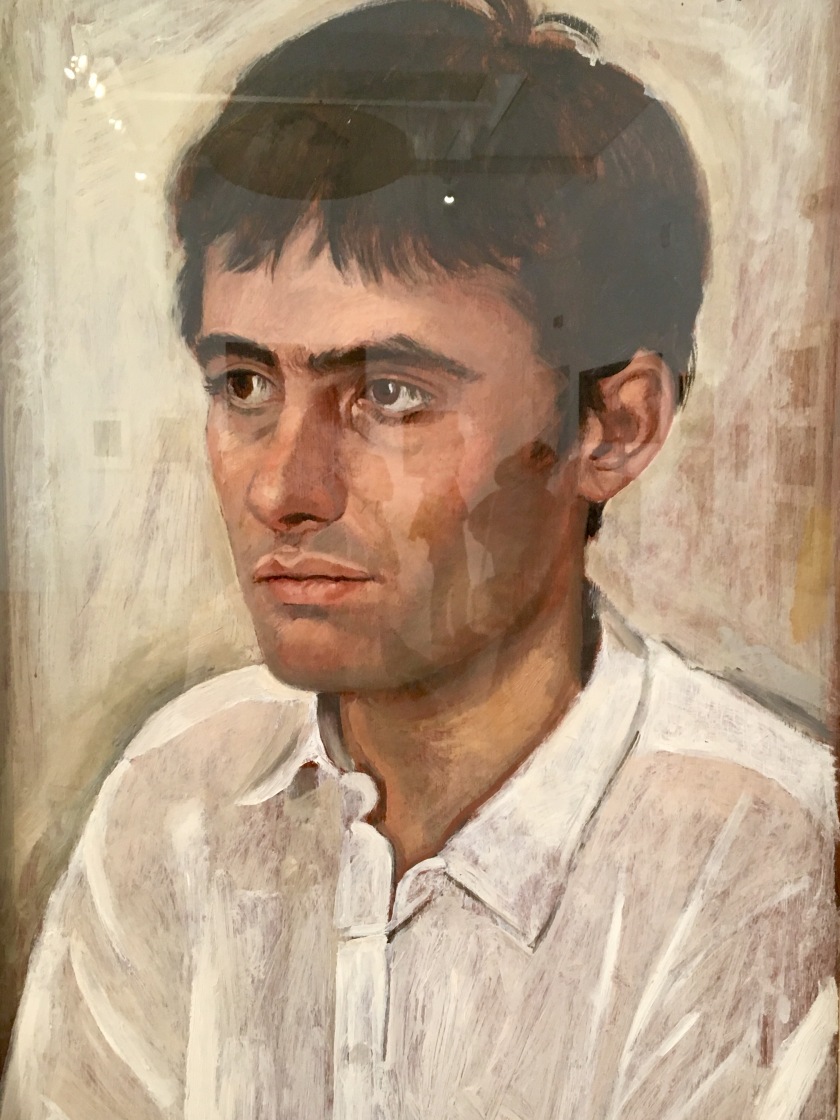
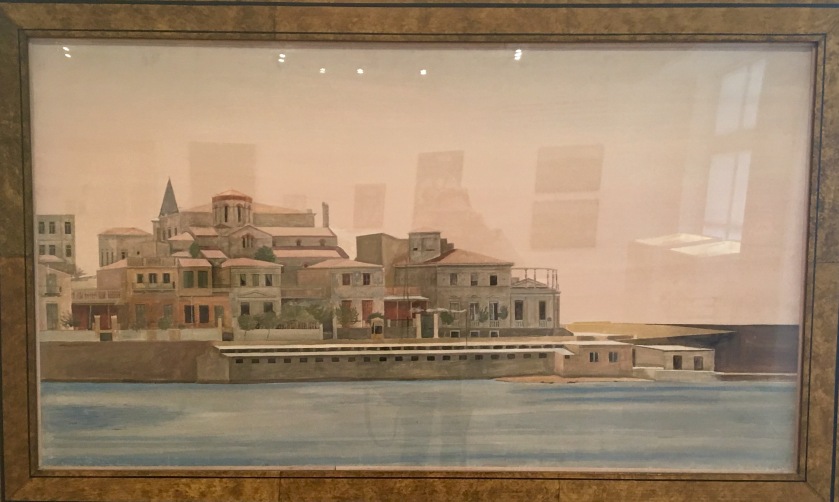
The BenakiMuseum in downtown Athens was an interesting destination last week since it concurrently held exhibitions of two major Greek artists.
YannisTsarouchis was born Piraeus in 1910; he died in 1989 in Athens. The exhibition was curated on the occasion of the publication of a book on his life.
Tsarouchis studied at the Athens Academy of Fine Arts under the painters Vikatos and Parthenis and was initiated into Byzantine art by the famous hagiographist Kontoglou (1931-1934). Between the wars he travelled to Izmir, Istanbul, and Paris, where he became familiar with impressionism, cubism, and surrealism. He returned to Greece in 1940 and fought on the Albanian front.
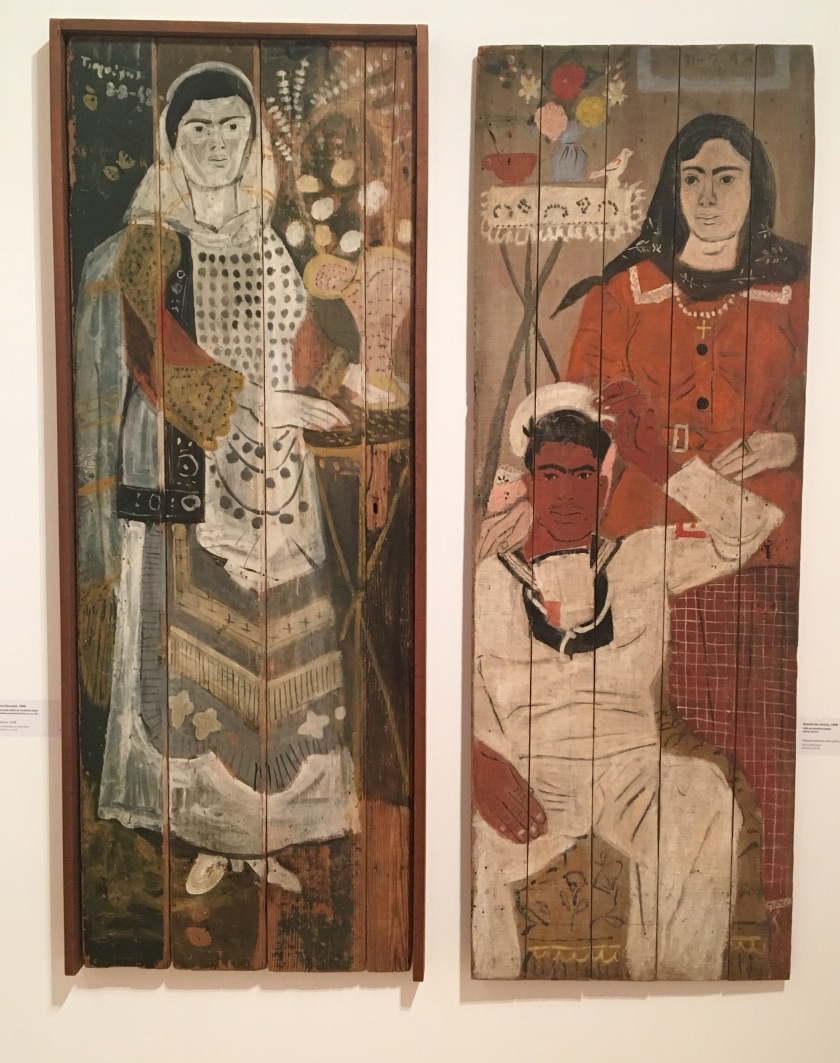
Going into self-imposed exile with the advent of the Dictatorship in Greece, Tsarouchis lived in a small studio in Paris from 1967 to 1980. He met many artists, such as Giacometti, and was inspired by Courbet, Manet, Matisse, and cubism. He combined these influences with the teaching of his Greek masters, Parthenis and Kontoglou, the Karagiozi shadow theatre, the Fayum portraits, and the work of the primitive painter Theofilos. The result is a richness of form and colour, with a focus on the human figure, and especially the male nude.
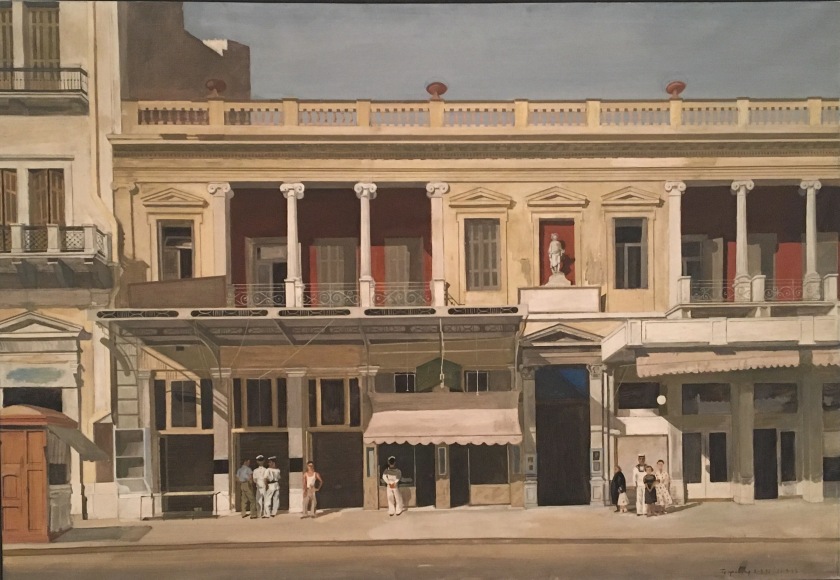
Tsarouchis liked to paint men in uniform, especially sailors. He liked to paint them naked, and sometimes he gave them angels’ wings. He also liked to paint the neoclassical buildings of Athens, which are frequently portrayed as an autonomous presence, rather than as subsidiary narrative elements.
Tsarouchis had a long collaboration with the well known gallery owner Iolas. He designed stage sets and costumes for the National Theatre, the Art Theatre, La Scala in Milan, the Dallas Opera, the Olimpico Theatre in Vicenza, and Covent Garden in London; and designed sets and costumes for films by Dassin and Kakoyannis. He also turned his attention to weaving, and illustrated a number of books (collections of poetry by Seferis, Elytis, and others). His style has influenced many Greek artists.
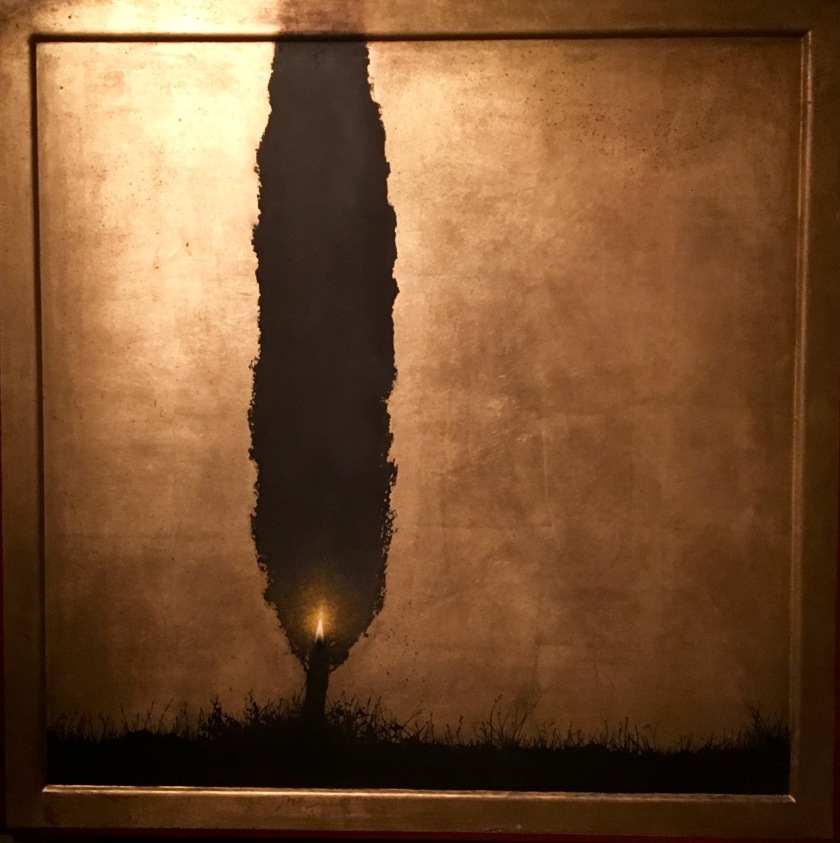
Although much younger than Tsarouchis – he was born in 1956 – ChristosBokoros is perhaps the less modern of the two.
Bokoros studied law at the Democritus University of Thrace (1974-1979) and later he joined the Athens School of Fine Arts (1983-1989), where he studied painting under D. Mytaras.
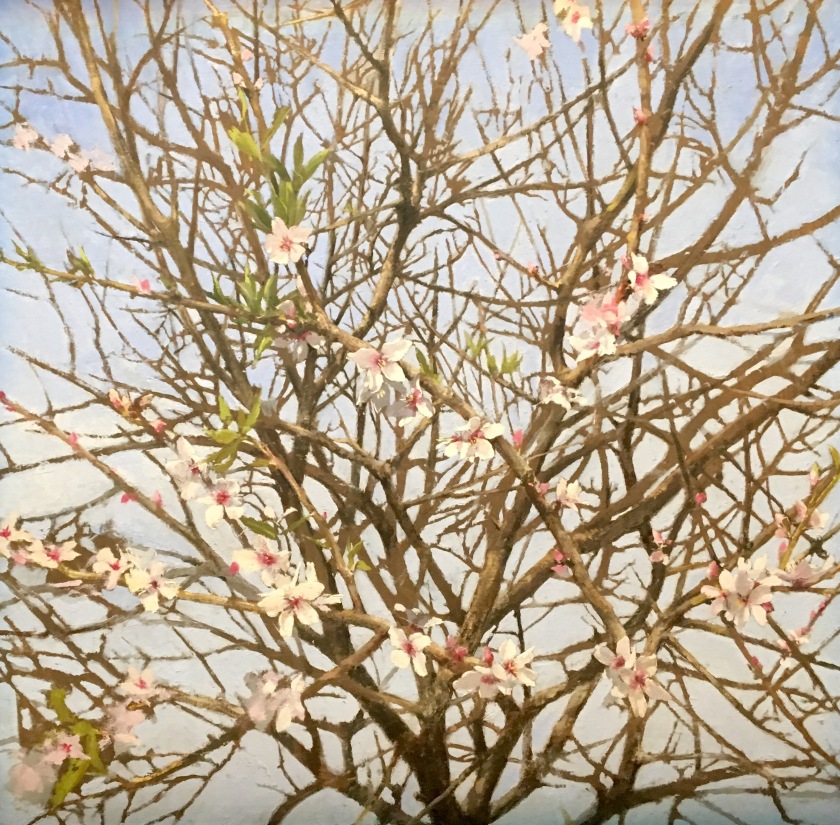
At the beginning of his career he employed traditional painting techniques, and drew his subjects from everyday life. The most striking feature of his early works was the extremely accurate and persuasive depiction of the visible world, a characteristic that governs his entire oeuvre. With time, he introduced allegorical or symbolic content to the depiction of simple things, contemplating their connotations; he began to integrate miscellaneous materials in his work (mainly old pieces of wood), and to combine his paintings with three-dimensional constructions and installations.
Bokoros loved the Greek countryside. He grew up far from the sea, in the tobacco fields of Agrinio, and was inspired by the earth and its produce: almond blossom, loaves of bread straight from the oven, rustling leaves and wild flowers.
He felt unable to identify with the major artworks he saw in foreign museums, and turned instead to the simple inspirations of provincial Greece.
The key feature of his later oeuvre, i.e. the ritualistic repetition of certain motifs such as the flame, plays upon the correlation of the tangible with the intangible, the individual with the universal and the past with the present, sometimes interacting poetically and sometimes semantically.
Like Tsarouchis, Bokoros also worked as stage designer, in theatrical productions of Greek plays (1995-2007).
He has presented his work in solo and group exhibitions in Greece and abroad, participating in international events, and he has been awarded many prizes.
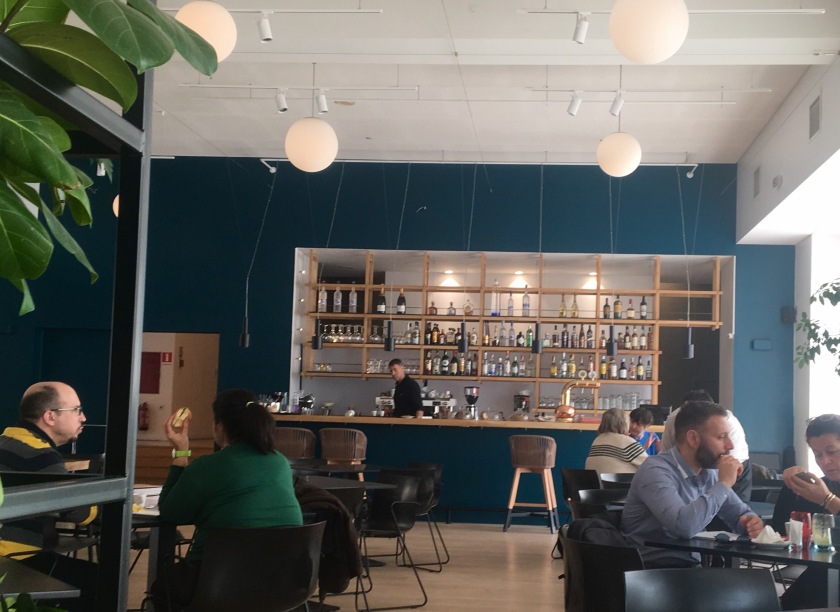
The visit ended with lunch in the museum’s cosy bar.
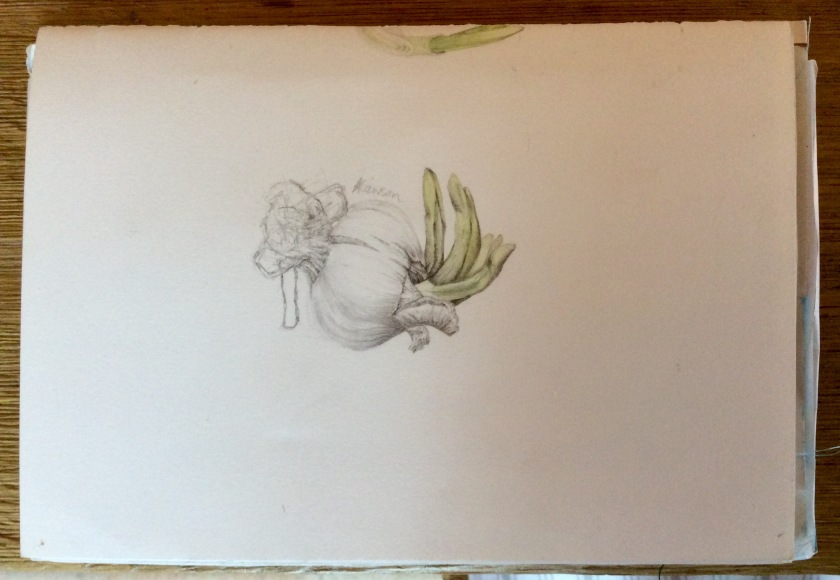
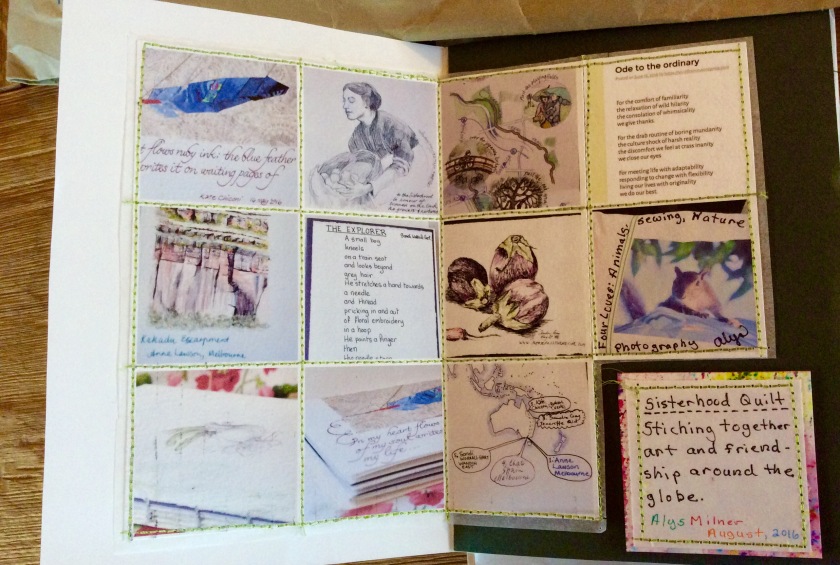
For those of you who read my post TheSisterhood of theTravellingSketchbook, I have finished my contribution and I’m ready to pack it off to the next person on the list, Constanze, in Munich, Germany.
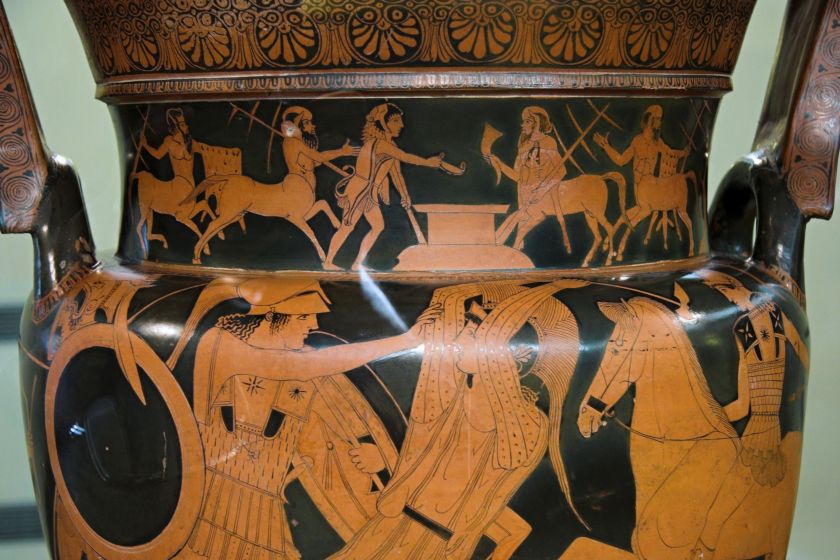
Centauromachy 460 BC. (Source:Wikimedia Commons)
I wanted to do something referring to Greek history, so what better than the myth about the naming of Athens, which I’ve already written about, in my post Homage to the olive tree. To make the drawing I took my inspiration from the ancient black and red pots from which one can glean amazing details about life in Ancient Greece – the food, the sport, the fashion, the rituals and the stories. They feature a large cast of gods, goddesses, demi-gods and mere mortals, nymphs, centaurs and satyrs, athletes and animals, as well as household objects, furniture and accessories. A fascinating study.
And now feast your eyes on my masterpiece below:-)
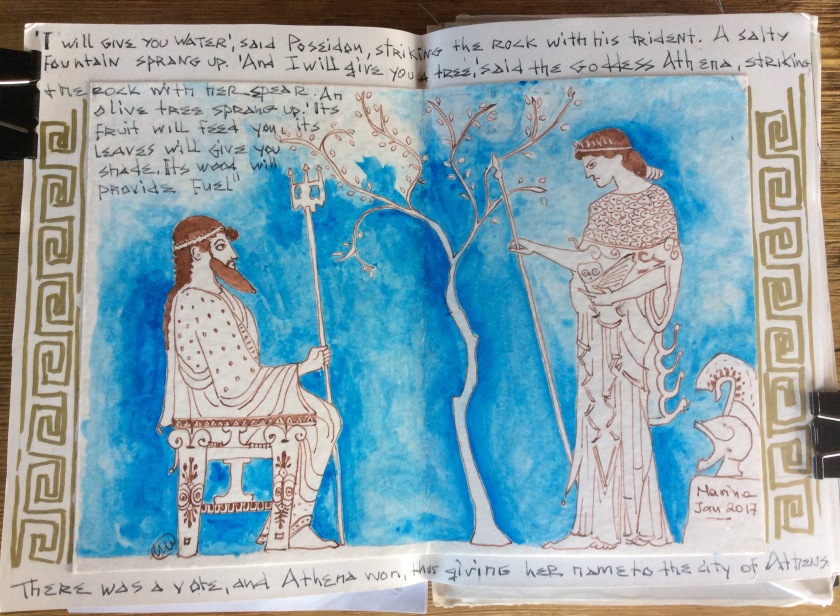
My drawing in the Sketchbook
Standing on the Acropolis rock is Athena, having taken her helmet off, with a belligerent expression on her face. She has just produced an olive tree, using her spear. Poseidon, seated on an elaborate throne, has a rather sheepish look on his face, having lost the contest to a woman, albeit a goddess…
This has been a very amusing project, and I’m curious to see the remaining contributions. So tomorrow I will regretfully pack up the Sketchbook and bid it BonVoyage.
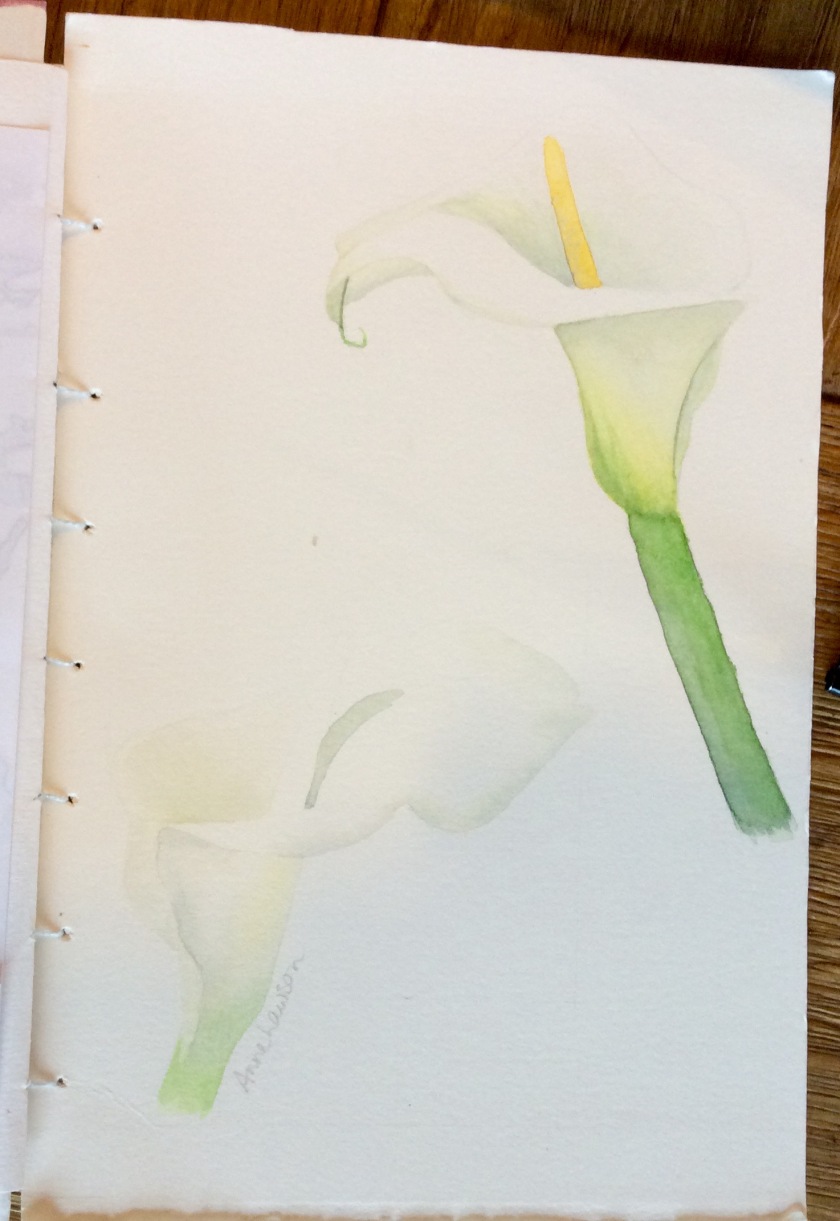
On April 14, 2016 Anne Lawson, a botanical artist who lives in Melbourne, posted this on her blog: ‘Oh I do love a good idea, and this is one of the best! A travelling sketchbook!’
So she made a sketchbook, drew her own contribution in it, and posted it to the first person on the list of those who’d signed up for the project.
There are 15 of us, and each is to ‘add to the sketchbook when it comes in the post to you. Draw, write, collage, sew, paste in a photograph ~ whatever you would like to contribute. There would be no rules, no themes, just a heartfelt contribution.’
(You can read the whole post here)
I was number 9 on the list. Imagine my excitement when I received a package from Indiana, USA, and opened it to see this:
Anne had drawn on the cover, and inside the back cover,
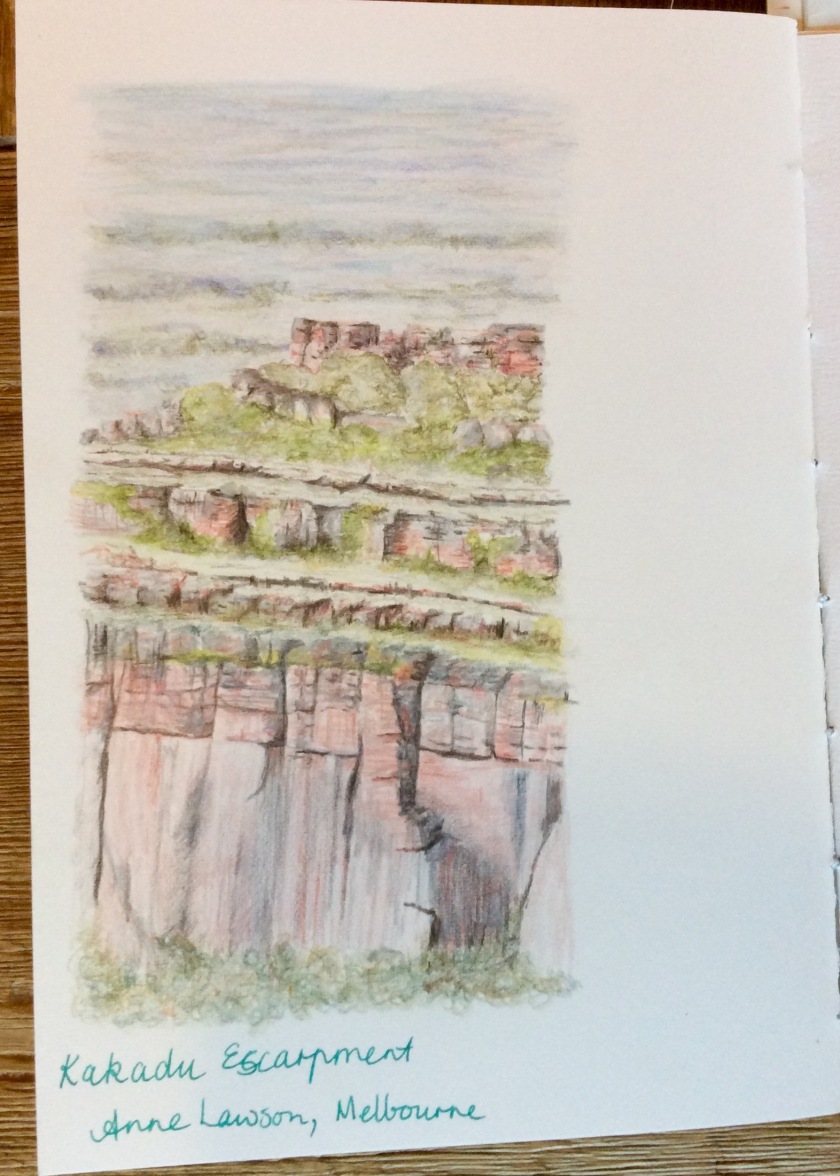
and her contribution was a delicate drawing of the Kakadu Escarpment in Melbourne.
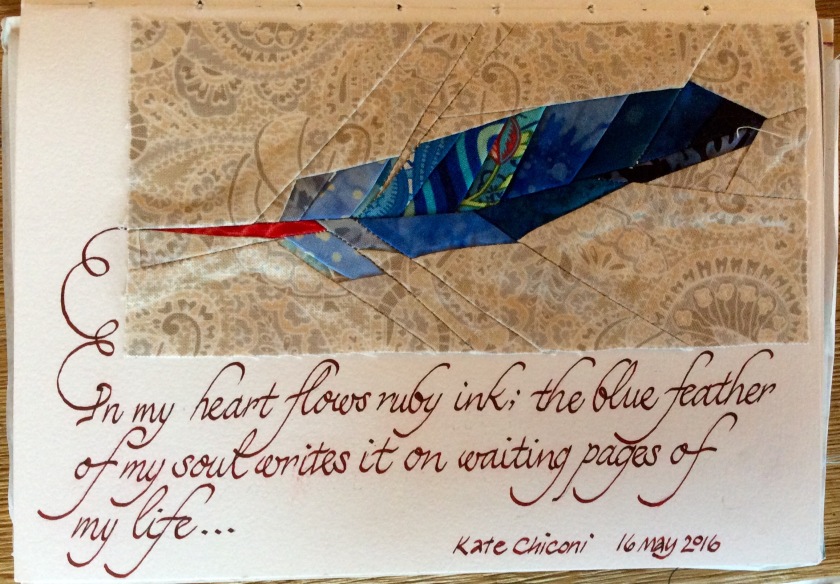
Next was Kate Chiconi from Baker’s Creek, QLD. (See her blog here) Kate makes the most amazing quilts, so this is what she came up with:
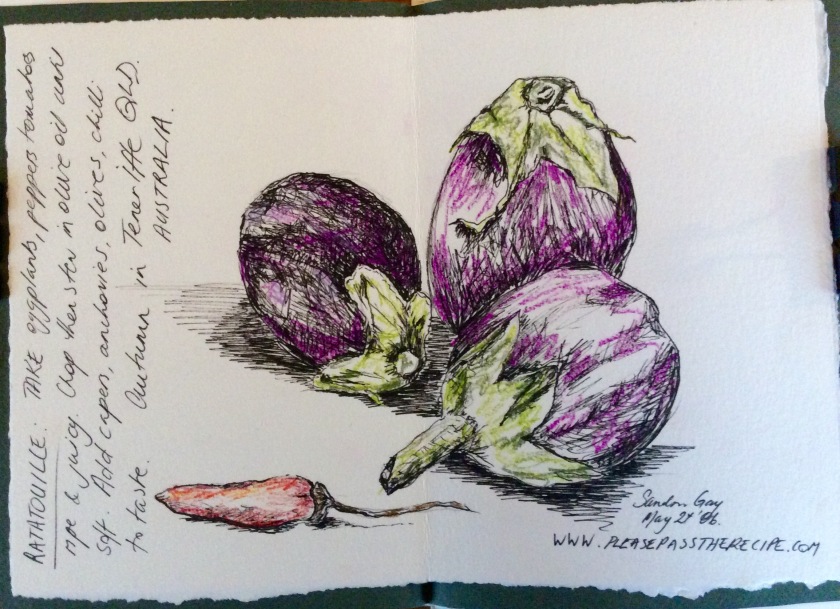
After Kate, Sandra Gay from Ténériffe, QLD (blog here), added an illustrated recipe for ratatouille!
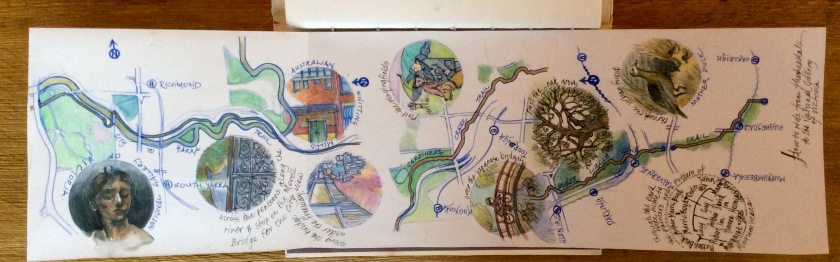
In number 4, we have the stunning drawings of MeganPower from Caulfield, VIC (blog here) – she made a map of the cycling trails in the city, leading to the National Gallery of Victoria,
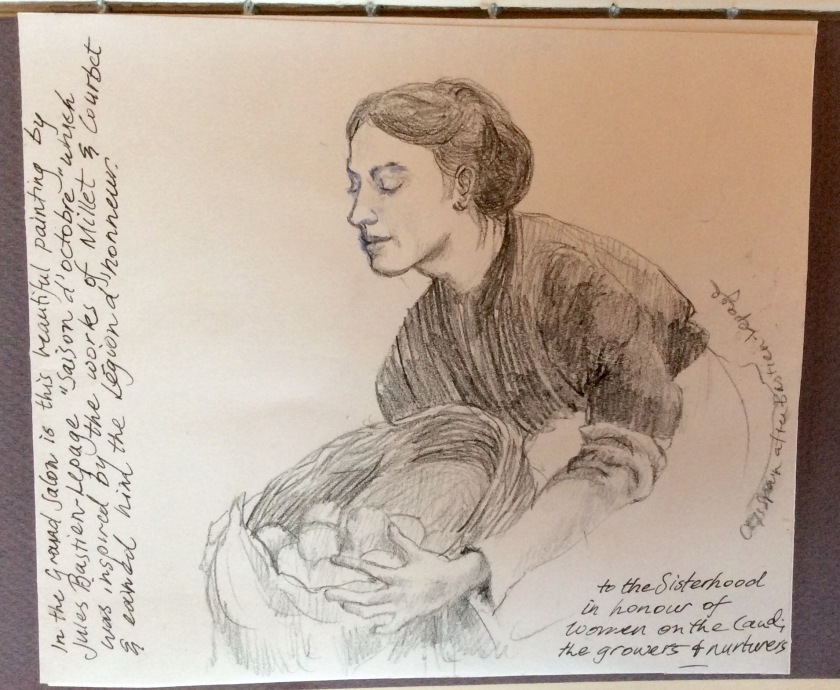
as well as a beautiful drawing inspired by a painting by Jules-Bastien Lepage, which is exhibited in the gallery.
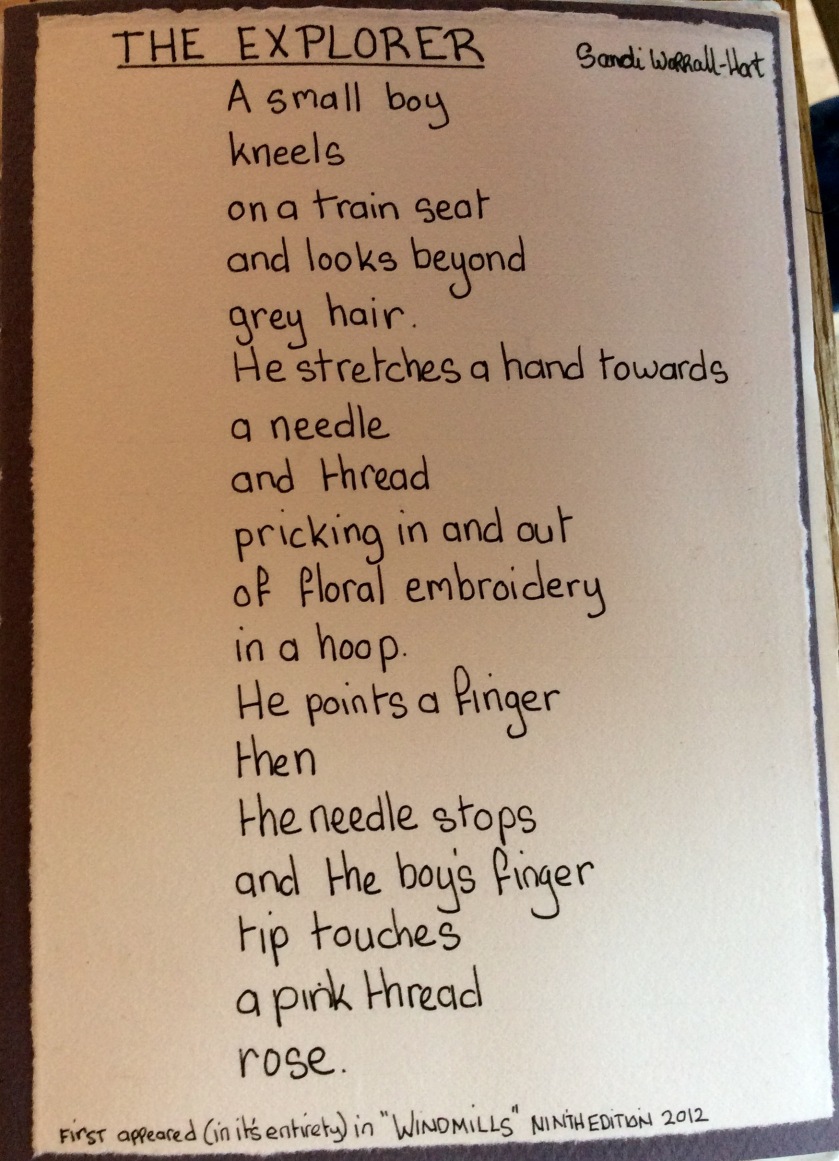
Then a poem, by Sandi Worrall-Hart, of Wnadin East, VIC.
Next, the Sketchbook travelled from Australia to the US, where AlysMilner from SAN Jose, California, (blog here) made an imaginative collage ‘quilt’ from all the previous contributions!
Followed by two more stunning mini quilts by SueBrown of Mount Vernon, WA (blog here).
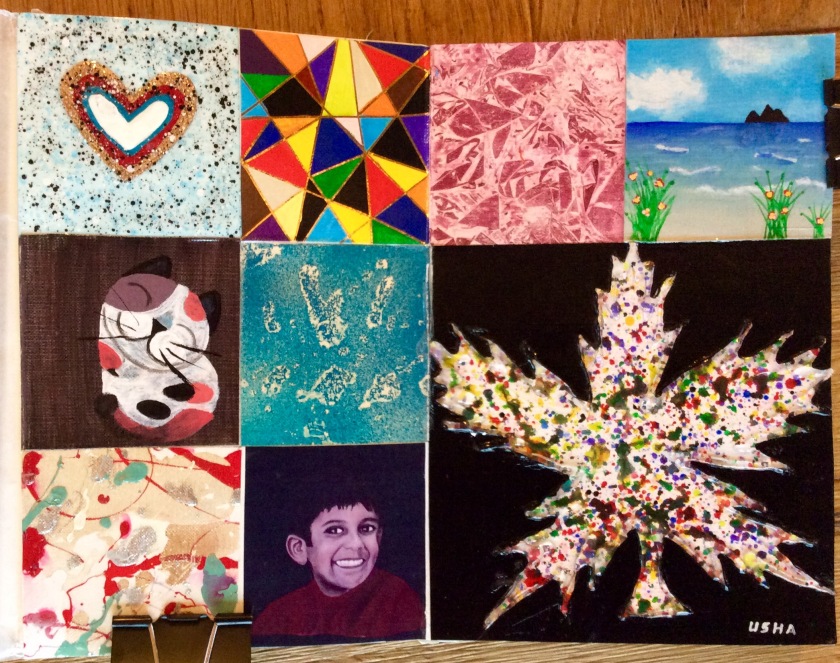
Then, just before me, UshaGudipalli from Indianapolis (blog here) added another, very colorful, collage. Again a quilt theme, which I assume has been so popular as it symbolises unity and friendship.
Now the Sketchbook has travelled to Europe – first stop, Athens, Greece! When I’m done I will send it on to Germany, since there are five more memers of the Sisterhood, two in Germany, one in France, and two in the U.K. Finally, it will go to one more contributor in Australia, then at last back to Anne – we are thinking of maybe scanning it, so each of us has a memento of her own.
I have already thought about my own contribution, of course, but my lips are sealed for the moment, so stay tuned!
(To be continued)
Yesterday’s post was getting a bit long, so today I will do a follow-up on the new Acropolis Museum. The video below offers a virtual tour, where you can get a fair idea of the treasures on offer: the glass floor at the entrance through which you can see the ruins of the ancient city beneath your feet; the airy space allowing you to walk all around the statues; the Caryatids in all their glory; and the beautiful top floor mirroring the Parthenon where the marbles are exhibited.
The museum has a café and restaurant with a stunning view on the Acropolis. The food uses products and recipes from all over Greece and is served by smiling and kid-friendly staff. Go on their site for more information here. (Plan a trip to Athens! Totally worth it.)
For those interested in the campaign for reunification of the marbles, below is another short video, where you can also meet Professor Padermalis.
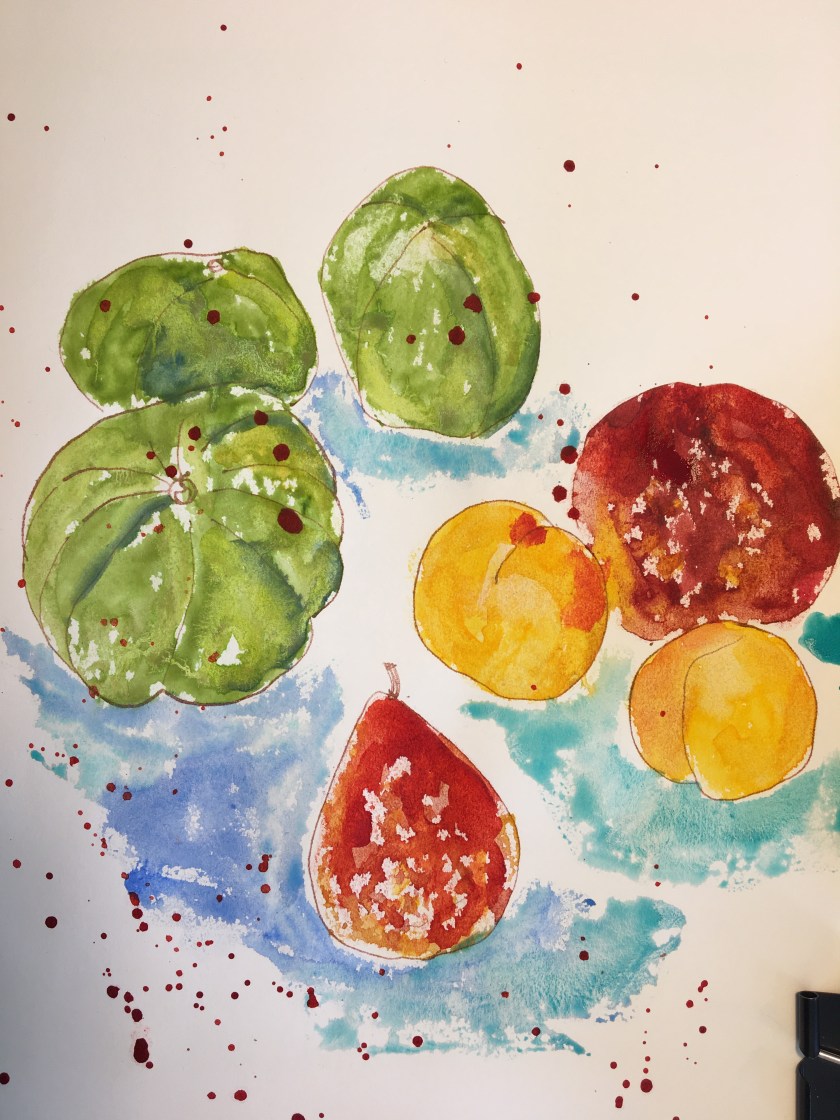
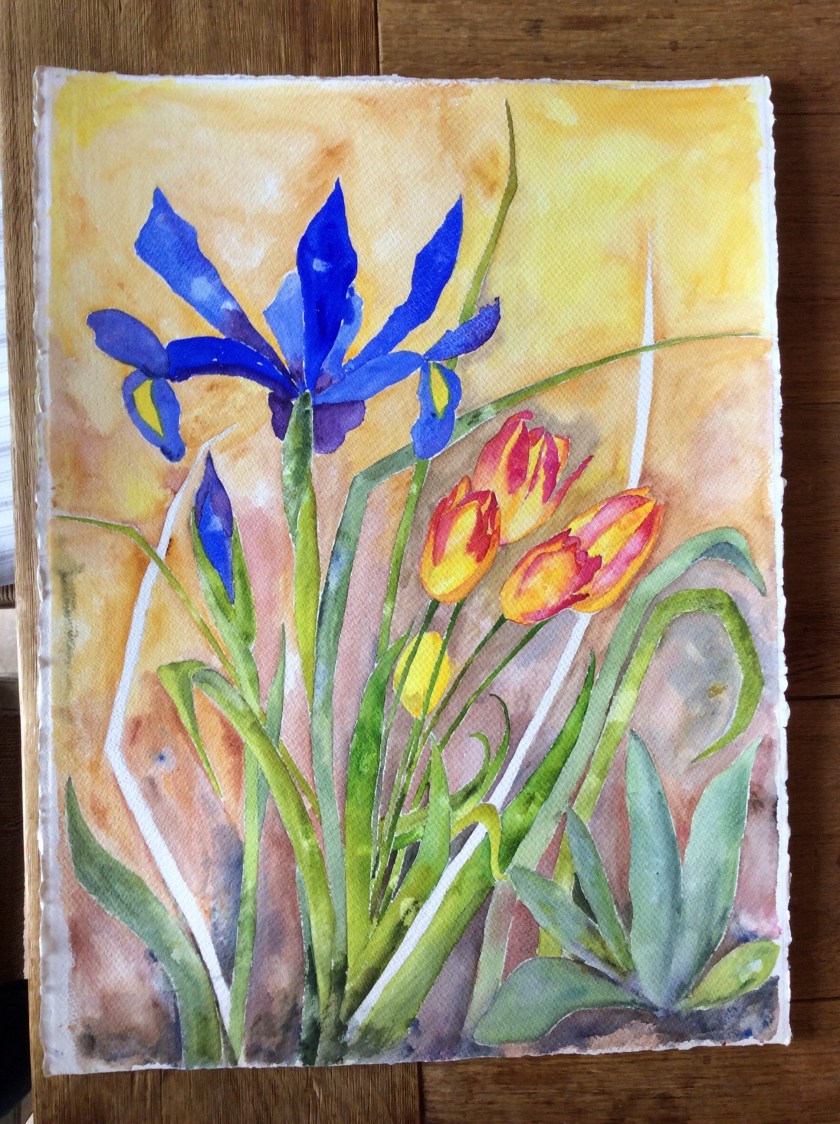
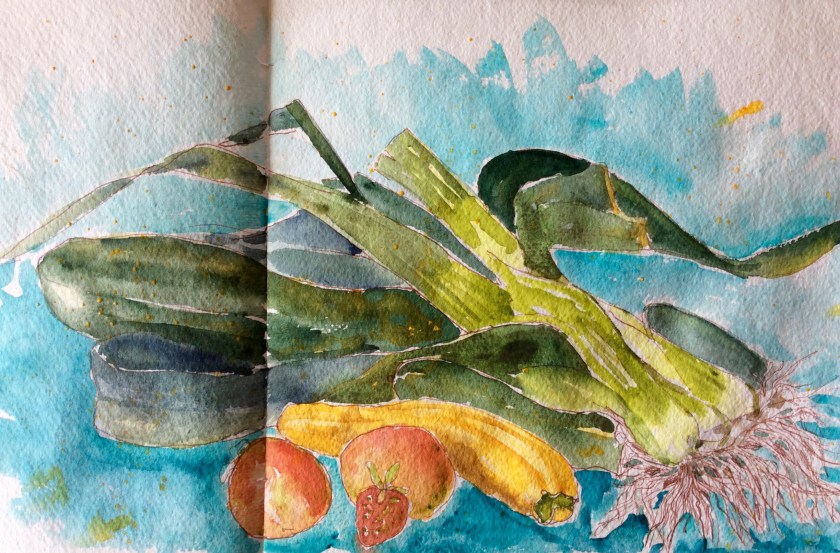
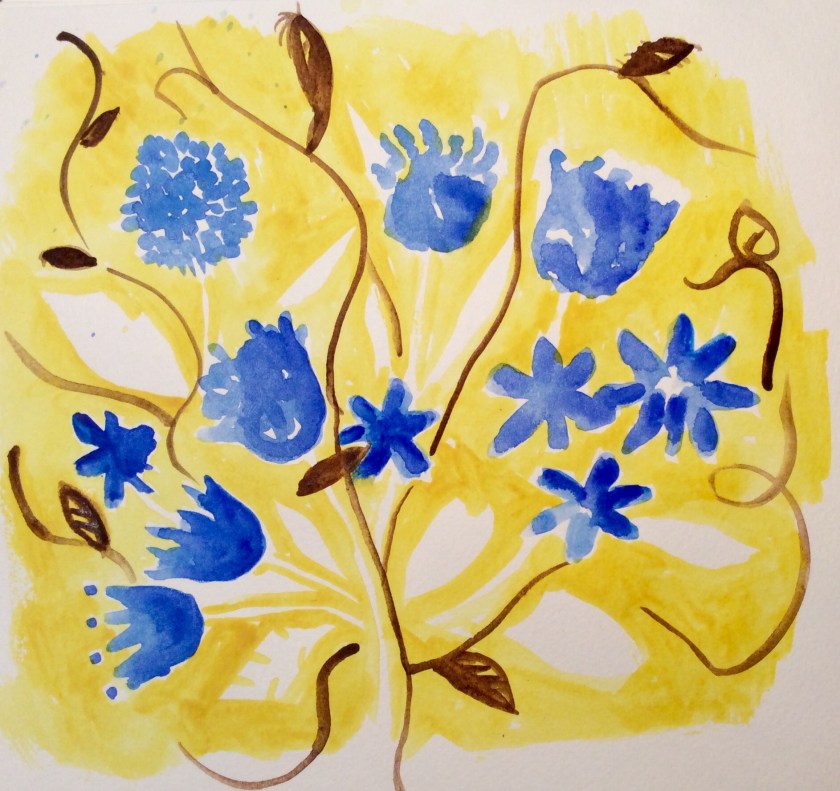
We are on the last day of July, otherwise known as World Watercolor Month. I joined the challenge of making one painting each day, and I’m happy to say I managed it, with very little cheating! (I only posted a couple that I’d actually started before…) I’m rather pleased with myself, and also glad that Charlie O’Shields, whose brainchild this is, egged me on.
Charlie’s great at encouraging people to join in, and also at showcasing the work of other artists. If you haven’t been to see his blog yet, go check it out, it’s fun even for people who don’t paint. It’s called Doodlewash (click here).
This has been a fun challenge – it made me try different things, and also get on with my dog alphabet. Only three to go now, and that baby will have a cheerful wall to look at!
It was also nice seeing the work of the hundreds of other artists who joined in the challenge. I’ve followed quite a few. If anyone is interested in looking at all my efforts, I’ve posted them on Instagram, at @athensletters.
It’s a month to inspire people to paint with watercolor (watercolour, aquarelle) while raising awareness for the importance of art and creativity in the world. Anyone can join the celebration, from master watercolorists to artists just starting out with watercolor!
Best of all, this first year of the celebration will be about raising awareness for children in need of art supplies and art education around the globe. Art is an important aspect of child development and paves the way for a successful future. What would the world be without art?
How could I resist? I’m joining the 31-day challenge – a watercolor each day. Some might be just doodles, some only dabs (abstract dabs?), but it will be fun. It will be motivation to pick up a brush each day, to try new things; and an opportunity to meet other artists. I will be posting on Instagram(athensletters). Below is my first contribution:
I’m a fan of Yayoi Kusama’s psychedelic eccentricity and gaily polka-dotted work. The Japanese artist is 87 today, and for the past 20 years has been living in a Tokyo mental hospital, from where she has continued to produce artworks in a variety of mediums, as well as launching a literary career by publishing several novels, a poetry collection and an autobiography.
She famously said: “My art originates from hallucinations only I can see.”
Yayoi Kusama, Love is Calling (2013) Image: M_Strasser via Flickr Creative Commons
In the sixties, Yayoi Kusama was part of the New York avant-garde scene, having her works exhibited alongside the likes of Andy Warhol, Claes Oldenburg and George Segal.
Yayoi Kusama, Gleaming Lights of the Souls (2008) Photo: Jim Dyson/Getty Images
In her honor, Artnet News has published a lovely article entitled:
14 Yayoi Kusama Quotes on Her 87th Birthday (Article by Alyssa Buffenstein)
You can find it here. (I borrowed the photographs from them, many thanks.)