An Intervention

Artist duo Elmgreen&Dragset were invited to exhibit their work in the iconic sculpture gallery of the Musée d’Orsay.

They called this installation, consisting of a number of boyish figures engaged in incongruous—in the context—pursuits, L’Addition.

Michael Elmgreen (born 1961 in Copenhagen, Denmark) and Ingar Dragset (born 1969 in Trodheim, Norway) have worked together as an artist duo since 1995, exploring the relationship between art, architecture and design.

Elmgreen&Dragset live and work in Berlin. They are known for art work that has wit and subversive humour, and also addresses social and cultural concern. Their work is too varied and prolific to be described in a short post, but anyone interested can look them up on Wikipedia—and they are, indeed, interesting.

For the first time in its history, the Musée d’Orsay invited someone to intervene in the museum’s permanent display of 19th century sculpture, which has remained the same for nearly 40 years.

As quoted in the museum’s site: In a trans-historical encounter between past and present, L’Addition highlights themes of evolving masculinities, solitude, and the magic of everyday situations. There is a certain beauty to be found in each of the fleeting moments captured in the works, whether it is in the pause before jumping from a diving board, the split second before a drone is sent off from a child’s hand, or a glimpse through the lens of a camera.

The figures are made of bronze, stainless steel and laquer. Boys waiting to dive, taking pictures from the mezzanine, setting off drones or just lounging upside down on the ceiling. It was all pretty cool, and an extra treat combined with the Caillebotte exhibition.

Gustave Caillebotte at the Musée d’Orsay

Amongst the lesser-known of the Impressionists, for the simple reason he was wealthy and did not need to sell his paintings in order to live, Gustave Caillebotte (1848-1894) is nevertheless a most interesting artist, because he had a unique take on things, using perspective and composition in original ways. He was very ‘modern’ for his time as well as more realistic in his technique than some of the others.

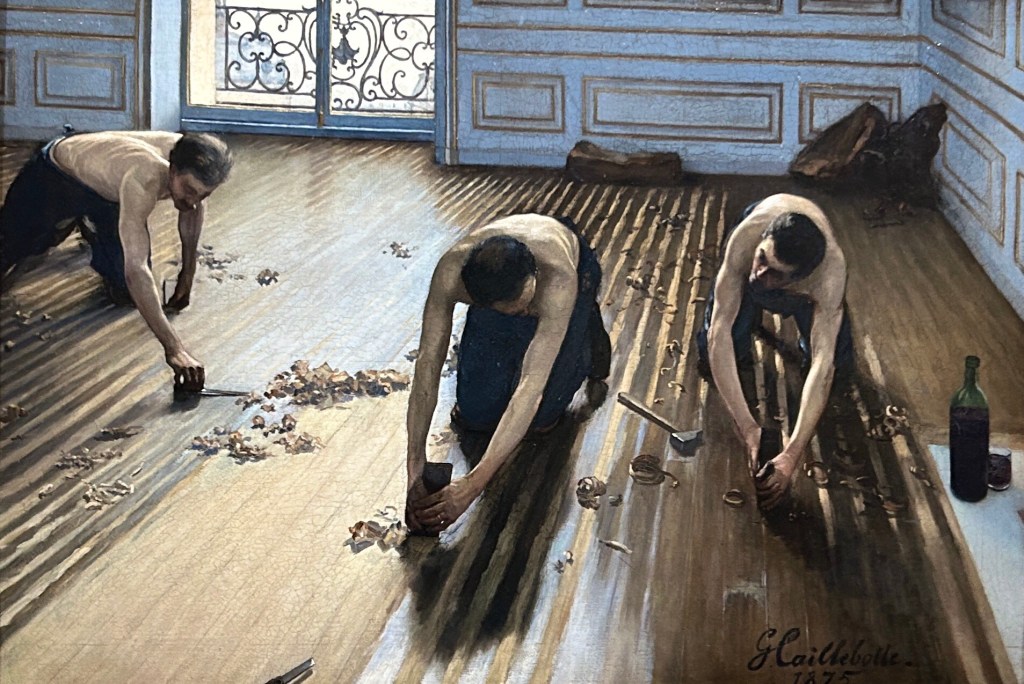
A lawyer and engineer, he fought in the Franco-Prussian war and upon his return frequented the Académie des Beaux Arts, as well as befriending several artists. The first painting he exhibited, of labourers working on a wooden floor, was criticised as “vulgar” (sweaty men doing a menial job) and rejected by the Salon of 1875. It is a masterpiece, if only for the light and perspective.

Rabatteurs de parquet, 1876 (détail)

Caillebotte painted many domestic scenes, depicting his family and friends in everyday pursuits.

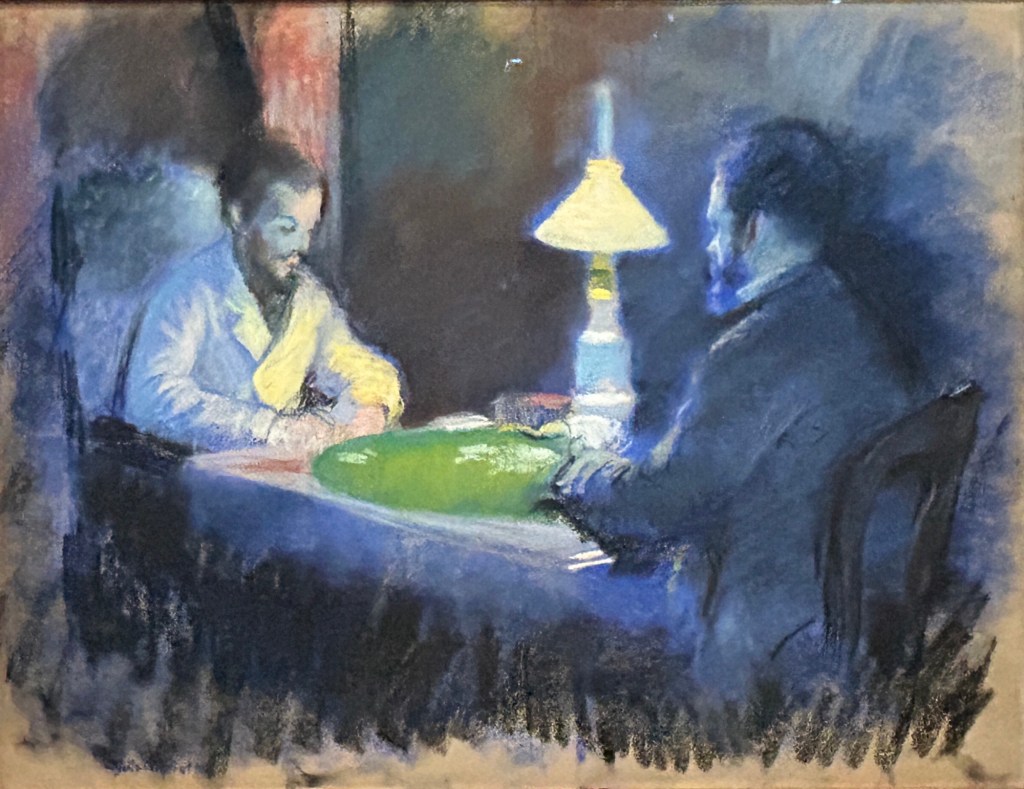
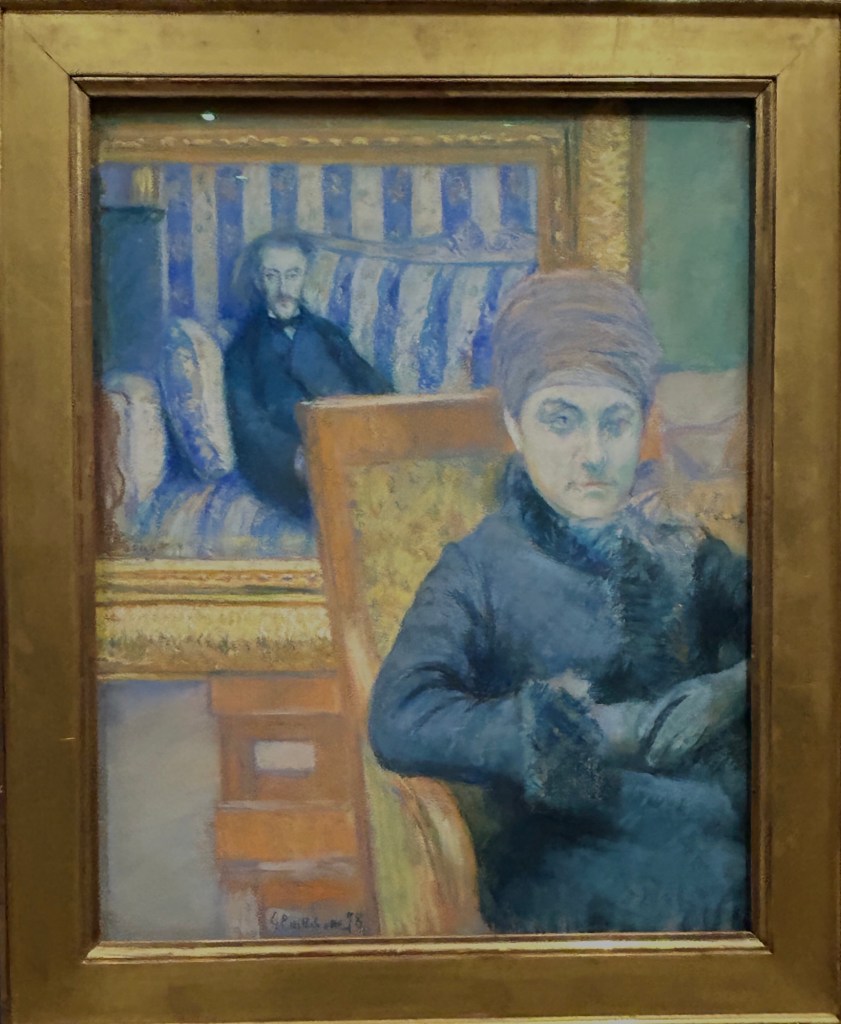
A beautiful pastel, which does not really show to advantage in a photo

I love the composition in this painting, the frame of the portrait replicated in the chair’s back, the diagonal made by the blue clothes…

He also loved sport and painted people rowing or sailing at the family’s Yerres estate. His technique of cropping or zooming in is original and gives a lot of movement to his scenes.

If I had painted this, I don’t think I would have thought to chop off the front of the first canoe, which is just sliding out of the picture.

In this view the boats are coming towards us

And here, seen from the back.

I love this gentleman, who is not rowing for sport, only taking himself on a little jaunt in his city clothes.

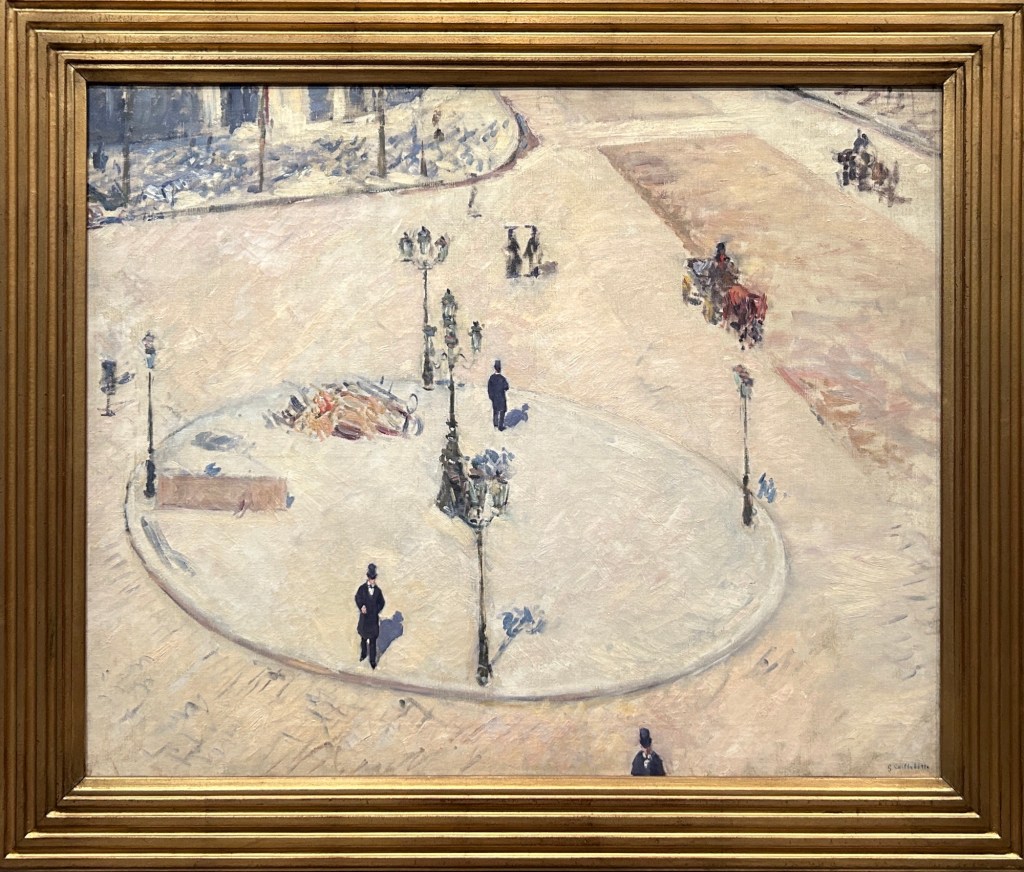
Caillebotte also did many urban paintings, some from an elevated perspective, such as the one below.

His paintings of Paris give off a very special flavour of the city.

Two of the artist’s friends looking out towards the Boulevard Haussmann in this painting entitled Balcon (circa 1880)

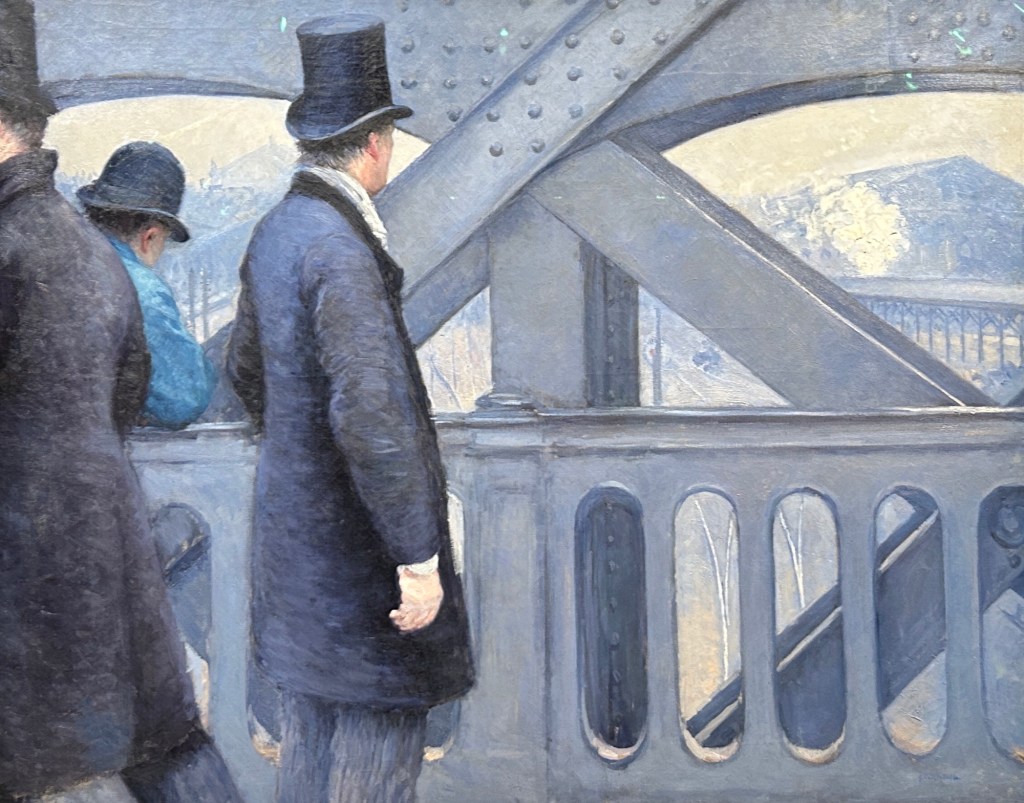
Le pont de l’Europe (1877)

He also made realistic studies of the human body and his paintings of males nudes were considered revolutionary, depicting ‘real’ men in domestic settings, instead of heroes in allegories.

Homme au bain, 1884 (note the wet footprints on the floor!)

Caillebotte used his wealth to support many of his fellow artists, notably Renoir—who was a close friend—Monet and Pissarro, amongst others. He died young, at the age of 45, of pulmonary congestion. He left behind an impressive body of work and bequeathed a large and varied collection—he had acquired many works from his fellow artists—to the French government. Here he is below, in one of those funny hats they all wore to row on the river. He looks like a jolly good sort.

Self portrait in a summer hat (circa 1873)

I was very lucky to visit the exhibition before the crows swarmed in, with a friend who is a Friend of the museum and holder of a card allowing early entry. A most impressive artist.

A wonderful collection

In 2004, the descendants of the Senn family made a donation of 205 pieces of art to the MuMa Museum in Le Havre. The collection, of mostly Impressionist and Fauve artists, was amassed by Olivier Senn and further embellished by members of his family. It includes works by such icons as Delacroix, Boudin, Monet, Renoir, De Chirico, De Staël and others. On the 20th anniversary of this major donation, the museum curated a major exhibition of the works.

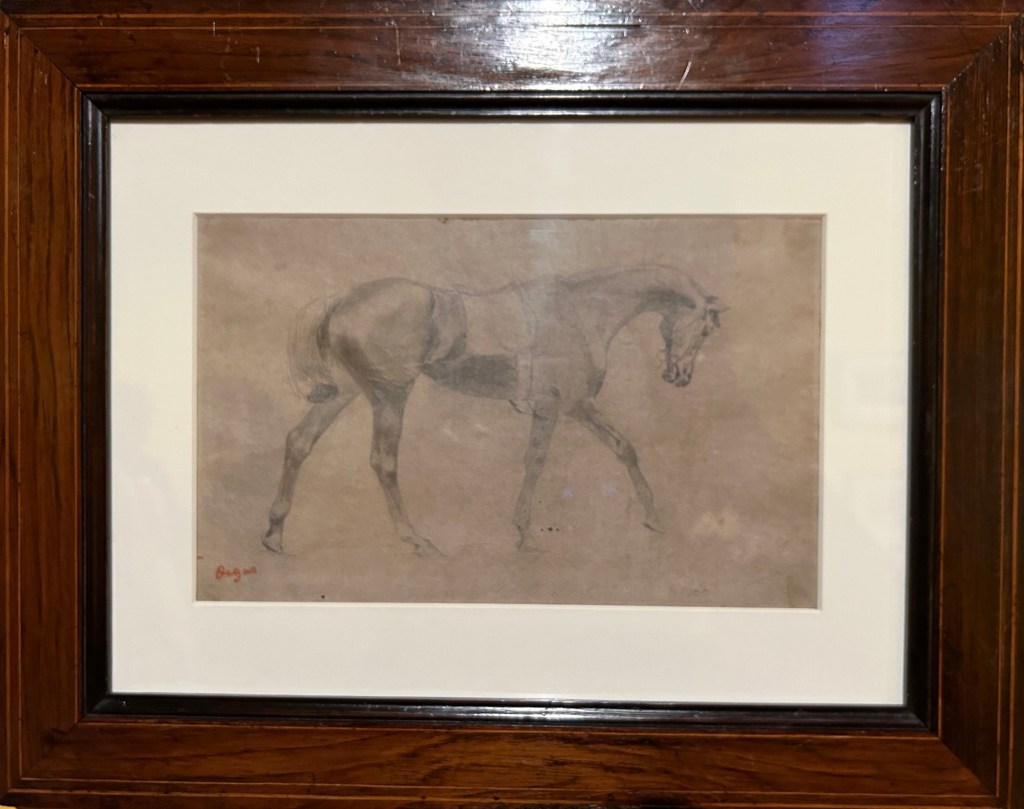
Edgar Degas, pencil on paper

Born in Le Havre in 1864, Olivier Senn studied law and, after marrying, joined his father-in-law’s cotton business. Once he’d made his fortune, he started buying art. The Senns and their descendants and relatives by marriage were all art and music lovers, as well as generous donors.

Yesterday’s vernissage of the exhibition drew a large and very appreciative crowd, which thankfully spread out around the museum rooms, making it pleasant to wander about, admiring the works. The collection was too large to describe in full, so I will linger over some particular favourites, a set of lovely pencil drawings by Edgar Degas.

Degas, circa 1859-1861.
This drawing, along with the one above and several others, were studies for a large oil painting titled Alexandre et Bucéphale

Another interesting work, probably in pastel, is the study below, for a painting called Semiramis building Babylon

Further little treasures among the works on paper were the small charcoal studies below, by Henri-Edmond Cross. A lesson in conveying much with but a few simple strokes.

Here’s a link for anyone who would like to see more:

https://www.muma-lehavre.fr/fr/expositions/les-senn-collectionneurs-et-mecenes

Grand Marin

I came upon this 2023 film by chance (the English title is Woman at Sea), but I’ve watched it twice, which is something I almost never do. I wanted my husband to see it—he loved it as well, and I appreciated details I had not noticed the first time. It is an underrated gem of a movie.

Photo: Google

Based on a book by Catherine Poulain, is a quiet movie, with almost no plot or dialogue, but don’t let this put you off. You become totally immersed in a world that is as strange to outsiders as it is real. The directorial debut of Dinara Drukarova, who also stars, it is the story of a young woman seeking to escape her past by looking for a job on a fishing vessel in Iceland.

She appears at the port, seeking employment in a strictly masculine world. We know nothing of her background or her motives for coming here. She has not fished before but, for some unexplained reason, she is determined to try. She appears frail but is tough and keen to earn her place amongst the men.

Adopted by a greying sea wolf who calls her Sparrow, she joins a team of men from different cultures, who will be closeted together on the boat for the duration of the trip.

Beautifully simple and incredibly evocative, the film is a powerful exploration of identity and individuality. It also showcases the loneliness of a life where people forced into intimacy by their circumstances, slowly coalesce into a team where they look out for each other, only for the partnership to dissolve when they reach land and each goes his own way to the next available job.

The cinematography is wonderful, depicting the high drama of life at sea and the brutal realities of commercial fishing, as well as the short moments of respite and rest where each can find it. The characterisation of the fishermen is subtle but well-developed, and the acting by all the cast is superb.

Here’s the trailer:

https://youtu.be/foDCXZo7w3I?si=FfmZnrGu8u0Crfd5

The film is worth watching on every level, and if only for the final scene (no spoilers), of fishing for king crabs in Alaska at night.

You will never look at a piece of cod on your plate the same way again!

*I watched it on Amazon Prime, but it also streams on other channels.

Going into winter

It is not cold yet, but the days are drawing short, and when I take the puppy out at 7.30 a.m. I wear a jacket and sometimes a woolly hat. The leaves are turning and some days there is mist on the ground.

We do get some brilliand days, though, and the beach is magic.

There are still flowers in the garden, and a few tomatoes. The crab apples are red, and the apples are ripening also.

The summer went by too fast, as usual, and the weather was not very inspiring—however, we did not get heatwaves, or a water shortage, or forest fires, as in Greece or other southern countries.

The puppy likes crab apples

We are fortunate to live near Deauville, which is a beautiful and lively town, with plenty going on at all times. Racing, polo, film festivals, exhibitions and more. We have lately acquired a cultutal center called Les Franciscaines, the conversion of an old nunnery, and there is always something on.

Back in March they put on an exhibition by the abstract artist Zao Wou Ki. It was a real treat to be able to see some of his paintings within 15’ of my house. I’ve written about him before. Here: https://athensletters.com/2018/09/25/awed-by-the-abstract/)

One of the highlights of the summer was an exquisite concert by the Japanese neoclassical composer Koki Nakano. I did not know what to expect, having never heard of him before, and in fact had never heard anything like it before—immersive soundscapes somehow combined with melody. In the La Chappelle, the small theatre placed in the former nunnery’s chapel, a grand piano was the only thing on the stage, its lid open and adorned with electronic devices. It was flanked by an electric keyboard.

Nakano played his own compositions, a mixture of electric and acoustic piano and I can honestly say one was more beautiful that the previous. The concert was called Oceanic Feeling. Sometimes he was accompanied by a dancer, the wonderful Tess Voelker from Chicago, since he is fascinatedby the relation between music and the human body.

This is the clip he had made of his music

The simplicity of the setup, the magical lighting, the elegant musician himself who addressed the audience between the pieces and even spoke in French, all made for a truly memorable evening.

Tokei(Tokyo) by Akira Yamagoshi. An aerial view with enchanting details. Zoom in to enjoy.

At the same time the centre put on an exhibition relating how the impressionists were inspired by Japanese art, which contained a few treasures.

Micro Fuji by Tiger Tateishi (1941-1998)

To finish off, sadly we could not see the northern lights which appeared over Europe. I have seen them once, in Iceland, and they were mostly green and yellow, whereas these were quite pink. So for your enjoyment I am posting a wonderful photograph by Deborah M. Zajak on her lovely blog Circadian Reflections (https://circadianreflections.com/2024/10/13/something-for-sunday-northern-lights/#respond) I urge you to take a look, she posts great photographs of birds and other stuff.

An artsy picnic

Some days ago I was happy to be invited to a picnic organised by a Paris art gallery, the Galerie Jocelyn Wolf, at a manor house in deepest Normandy. This was a very old building, renovated over the course of a few years by the gallery owner, Jocelyn, in order to provide a venue for artist residencies and a framework for exhibiting artworks, including outdoor sculptures.

After passing the Pont de Normandie, always a treat as driving over it is the next best thing to flying, I took a road winding through beautiful countryside and arrived literally in the middle of nowhere, where thankfully a small sign with PARKING on it gave a hint I was in the right place (to outward appearances, a rustic farm with various agricultural implements scattered around).

A gravel road led to the house itself, fronted by an orchard where I came upon a group of people sitting on the grass under the beautiful, ancient apple trees.

I joined them and someone thoughtfully provided me with a glass. Each group of three or four people shared a wicker basket of the most delicious local food: a loaf of fresh country bread, a variety of cured meats and cheeses, small radishes, a jar of rillettes, a brioche, punnets of berries—washed down with cool cider. Dogs and kids ran about.

Painting by Sosthene Baran

As we were finishing, a few drops of rain (it being Normandy, after all) made us gather up the remains and congregate for coffee in the kitchen, after which I went to explore the house. This has been left in a very primal state, with beautiful old doors renovated but unpainted, stone and brick exposed, and gallery-style electrics installed on wire tracks.

Windows on every side open on pristine, unspoilt countryside and there is a huge open space attic. The whole thing is in impeccable taste and a fitting framework for all sorts of art.

Sculptures by Christof Weber

The rain having stopped, I went for a tour of the garden to see the sculptures installed there, some actually in the pond behind the house.

Sculpture by Francisco Tropa

The afternoon concluded with a performance by two artists represented by the gallery, Prinz Gholam, who struck poses taken from famous sculptures while wearing a series of fascinating masks.

Art Website Reveal

Some time ago I subscribed to a site called Artwork Archive, one of a several available tools for managing artwork.

At first I just entered my drawings and paintings indiscriminately, using hastily made photographs, in order to keep track of the work I had, what had been given to people as gifts, and what had been sold. I never took the time or the trouble to use the multiple features offered, such as adding up expenses, generating invoices, or setting up a public profile.

The work can be organised as a portfolio, in the order of one’s choice, or sorted into collections

Then when I started entering art for online exhibitions or competitions, I kept getting asked for my website address, so I decided I now needed my own art website. After wasting numerous hours trying to choose between Word, Winx and Squarespace, and more hours attempting to navigate their sites, I belatedly realised the Artwork Archive Public Profile would do the job more than adequately.

It would save me from paying for another site, plus their client support is excellent.

Here is a random page showing the tools offered, and how the work looks in the portfolio mode

So if I have not posted anything here for a while, it is because I’ve been working on taking better photos, deciding which pieces to put on the public platform, and entering any relevant information. All this takes an inordinate amount of time…

Viewed as a portfolio

But here it is! Although it is still a work in progress, and will continue to be one as I make new work and improve my presentation and other parameters, I am now proud to reveal it to you.

Viewed as Collections

If you are interested in actually going on-site, here is a link.

Suggestions welcome!

https://www.artworkarchive.com/profile/marina-marinopoulos

Life? Or Theatre?

Can one have a horrible life, punctuated by difficulties and tragedies and ending in extermination at Auschwitz, yet leave behind work that, despite its disturbing themes, is poignant, breathtaking and uplifting in its luminosity and colour?

This is the case of Charlotte Salomon, the only Jewish artist who died in the Holocaust to leave behind such a large body of work. It consists of 769 works painted between 1941 and 1943—a mere two years—while she was hiding from the Nazis in the South of France. In October of that year, 5-months-pregnant Salomon was captured and deported to Auschwitz where she was immediately killed.
Born to a prosperous and well-assimilated Jewish family in Berlin, Charlotte was 16 when the Nazis came to power. By 1938 it became too dangerous for her to continue her studies, so she left the art school she was attending, and after Kristallnacht she was sent to live with her grandparents in Nice; her father had been interned and, when her stepmother succeeded in freeing him, they left for Amsterdam. Her mother, suffering from depression, had committed suicide when she was eight.

After several attempts, her grandmother also succeeded in killing herself and Charlotte remained with her grandfather, who it appears was abusive. To escape him, she went to Saint-Jean-Cap-Ferrat where—in order to recover her mental sanity—she started painting; stating that she was driven by the question, “whether to take her own life or undertake something wildly unusual”.

Painting obsessively, in less than two years she produced more than 1.300 gouaches, amongst which she chose the 769 which she numbered and edited, adding text, captions and transparent overlays, to make a kind of autobiography outlining the main events of her life—speaking of herself in the third person, altering all the names and adding elements of imagination.

In 1942 she was obliged, due to her residence permit, to join her grandfather in Nice. Shockingly, shortly after, she poisoned him with a Veronal omelette, then drew him as he lay dead (the drawing exists). She made a 35-page confession which she sent to a former lover who, however, never received it; it remained a secret until much later.

In 1943, as the Nazis closed in, she packed up her paintings and gave them to a local doctor with instructions to forward them to Otillie Moore, a wealthy American who was her protector and sponsor. At war’s end, the package found its way to her remaining family.

In 1943, Charlotte had married Alaxander Nagler, another German Jew refugee, with whom she had been confined in Otillie Moore’s house for a while. Soon after their marriage, they were both deported and murdered.

I find it beyond me to talk about her work, which is based on film-making techniques and is extremely layered and complex; and one must also follow the narrative, in its dream-like dimension. It is, in some ways, a precursor to the graphic novel as we know it today. Although Salomon has always been classed as a Holocaust artist, her work—save for very few drawings—is not about the Holocaust: it is about her childhood, her very disfunctional family, her life and her loves. In the final pages of her book, two sentences stand out. She writes, ‘And with dream-awakened eyes she saw all the beauty around her, saw the sea, felt the sun, and knew; she had to vanish for a while from the human plane and make every sacrifice in order to create her world anew out of the depths.’

I have seen her paintings live in a couple of exhibitions, and they are simply wonderful. I have a book published by the Royal Academy of Arts, with colour reproductions, which I highly recommend.

More information:

Charlotte is a biography by David Foekinos, which I have not read yet, but which has excellent reviews. This is the Amazon link to the English version (the original is French).

https://amzn.eu/d/gqzWlAf

Also there is a very interesting article in the New Yorker with more information than I have given on both her life and her work, and great images. Link below:

https://www.newyorker.com/culture/culture-desk/the-obsessive-art-and-great-confession-of-charlotte-salomon

Festive Greetings!

To all my faithful readers, my best wishes for a very Merry Christmas, together with a seasonal poem.

Collage and watercolour on paper

Christmas Carol

BY SARA TEASDALE

The kings they came from out the south, 

   All dressed in ermine fine; 

They bore Him gold and chrysoprase, 

   And gifts of precious wine.

The shepherds came from out the north, 

   Their coats were brown and old; 

They brought Him little new-born lambs— 

   They had not any gold.

The wise men came from out the east, 

   And they were wrapped in white; 

The star that led them all the way 

   Did glorify the night.

The angels came from heaven high, 

   And they were clad with wings; 

And lo, they brought a joyful song 

   The host of heaven sings.

The kings they knocked upon the door, 

   The wise men entered in, 

The shepherds followed after them 

   To hear the song begin.

The angels sang through all the night 

   Until the rising sun, 

But little Jesus fell asleep 

Before the song was done.

Portraits

On a trip to London my fondness for portraits drew me, first, to the refurbished National Portrait Gallery. A few highlights below.

The Duke of Wellington, by Sir Thomas Lawrence
Henry James, by John Singer Sargent
Lucian Freud’s portrait of Irish writer Caroline Blackwood, after they had eloped to Paris together.
A wonderfully quirky self-portrait by Raqib Shaw, The Final Submission in Fire on Ice. The detail is amazing if you zoom in.
The beautiful Zadie Smith, by Toyin Ojih Odutola

Onwards to the National Gallery, to see the Franz Hals exhibition. One of the most important 17th-century Dutch artists, Hals was a portraitist par excellence, a virtuoso who painted mostly a la prima, without a preliminary sketch (this is difficult to imagine, given his assured brushstrokes and beautiful detail.)

His portraits possess a unique liveliness of expression, and he painted his subjects smiling or laughing, something few painters dared to attempt.

The Laughing Cavalier, one of his most famous paintings

He also portrayed people in informal positions, especially his friends…

…and was sought after by couples and families for his seemingly casual, yet carefully posed compositions, where the affection between the subjects is apparent.

The portrait of the young girl below was one of my favourites, due to the sweetness of her expression.

He was also great at painting hands, one of my predilections.

The lace cuff, the pearl bracelet…

My one caveat is that his sitters are not particularly attractive, if I may be permitted to say so. A fact impressed upon me as, going out of the exhibition, I came upon a portrait of a young man by Titian.

And another by Bronzino. Were Italians better looking than the Dutch, or did the painters idealise them more?

I then wandered into a small but stunning exhibition of the idiosyncratic painter Jean-Etienne Liotard. Born in Geneva, he travelled widely and was a master of pastel, a very delicate and subtle medium.

In 1754 he produced a masterpiece, The Lavergne Family Breakfast, which he sold to William Ponsonby, Viscount Duncannon, for the then princely sum of 200 guineas. Upon the latter’s invitation he went with him to Constantinople, where he stayed for four years, growing a long a bushy beard, adopting Turkish dress and calling himself the ‘Turkish Painter.’

I really find this lovely – the detail, the expression on the faces…

Having not seen his painting for twenty years, he then went back and made an exact replica in oil. This is the first time the paintings have been exhibited together.

On the left in oil, and on the right the original in pastel

Liotard sounds like a very amusing fellow, as well as being a most accomplished artist. However, having met the love of his life, he shaved off his beard, this being a condition of the marriage. He made numerous portraits in pastel, such as the one below of Lady Anne Somerset, looking much older than her fourteen years, with her cascading locks and plunging neckline.

I will end this post with the portrait of a horse, the beautiful Arabian stallion Whistlejacket, by George Stubbs. One of my favourite pictures in the National Gallery.