A walk in the park

On a chilly, overcast morning we set out to visit the new jewel in the crown of Athens: the Stavros Niarchos Foundation Park and Cultural Centre. Athens, having grown exponentially and without proper planning in the last decades (a plan was made, but was ignored by successive governments for reasons I shall not go into here) is a city with the lowest per capita green space in Europe. The only relief is the easy access to the sea on all sides – otherwise it is drowning in urban concrete.
When the racecourse was moved from the bay of Phaliron to the town of Markopoulo on the occasion of the Athens Olympics, a large area was liberated. The Stavros Niarchos Foundation stepped in with a project, designed by the architectural firm Renzo Piano Building Workshop (RPBW), that includes the new facilities of the National Library of Greece, and of the Greek National Opera, as well as the Stavros Niarchos Park.

The Stavros Niarchos Foundation (www.SNF.org) is one of the world’s leading private international philanthropic organizations, making grants in the areas of arts and culture, education, health and sports, and social welfare.The SNF Cultural Center is the Foundation’s largest single gift, for a total budget of $867mil (€630mil). This huge investment is a testament and a commitment to the country’s future, and also hopes to be an engine of economic stimulus in the short and middle term.
 

img_0241

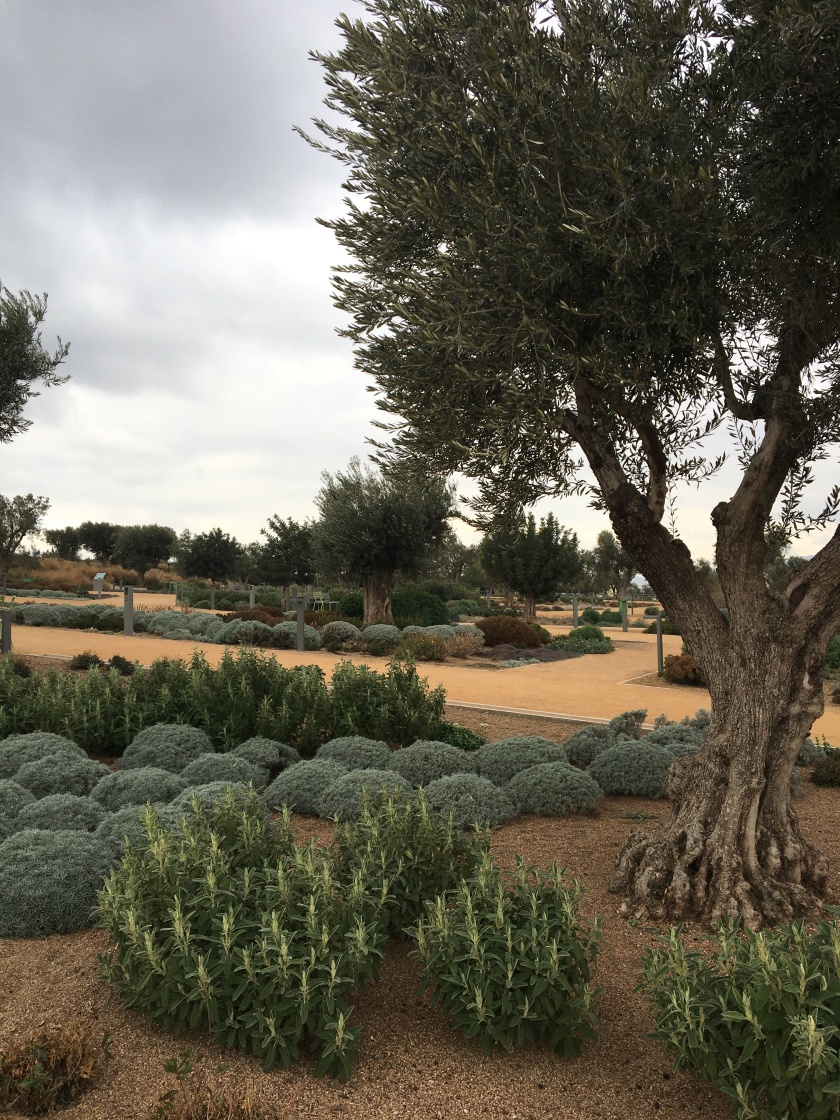
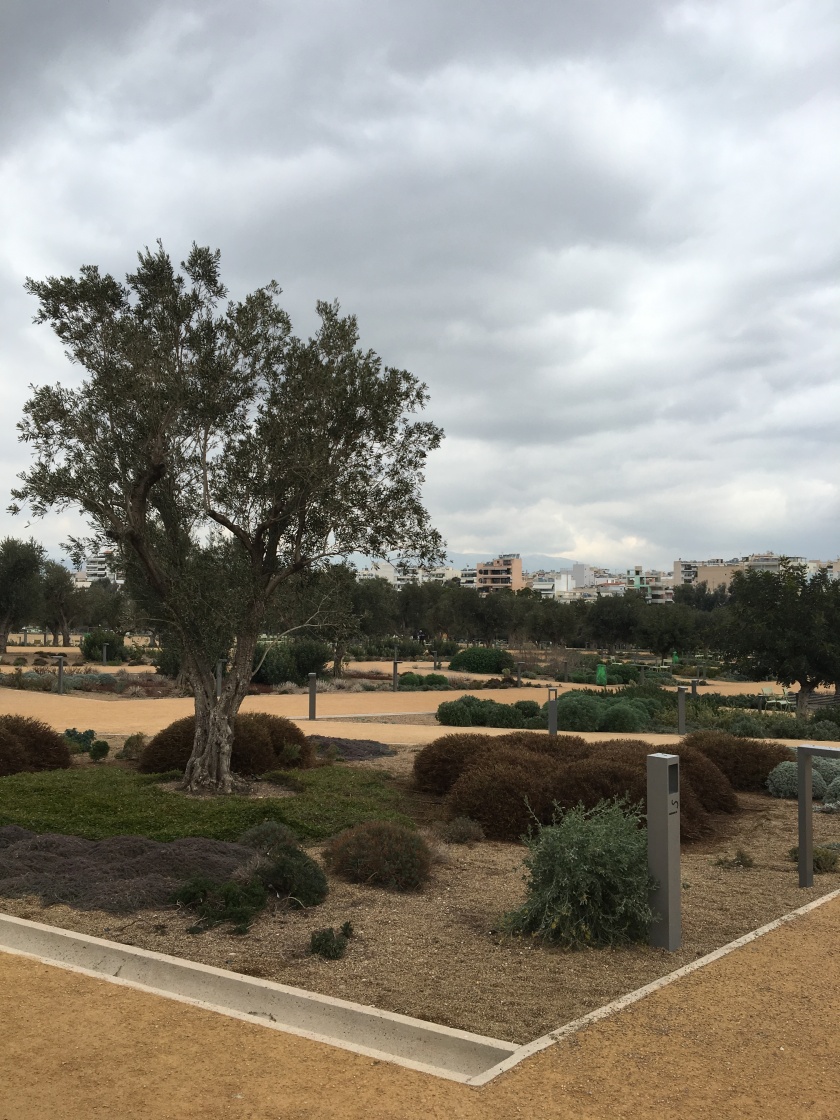
Although this is not the best season to visit gardens, it was immediately apparent that the whole park has been beautifully planted in a way that celebrates Greece’s horticultural tradition: the open, sunlit Mediterranean Garden.
 

img_0244

Each month is meant to bring a new color, and each season to introduce a different combination of flowers or foliage. Each visit should be a sensual pleasure, with the proliferation of evergreen and other endemic plants such as boxwood, coronilla, cistus, and lentisc, salvia, oregano, thyme, lavender, rosemary, roses and euphorbias.
 

img_0250


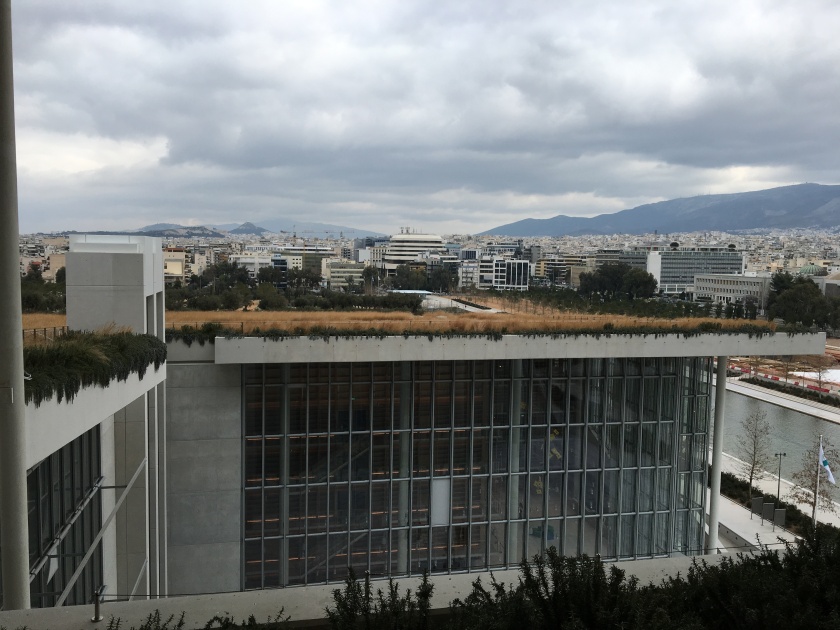
From the Mediterranean Garden, curving landscaped pathways wend their way up a gentle grade to the 32 m high summit of an artificial hill.  Beneath the earth is the building that houses the Library and Opera House, making the hill the green roof for the structure. One of the largest in Europe, the green roof significantly reduces air-conditioning requirements.
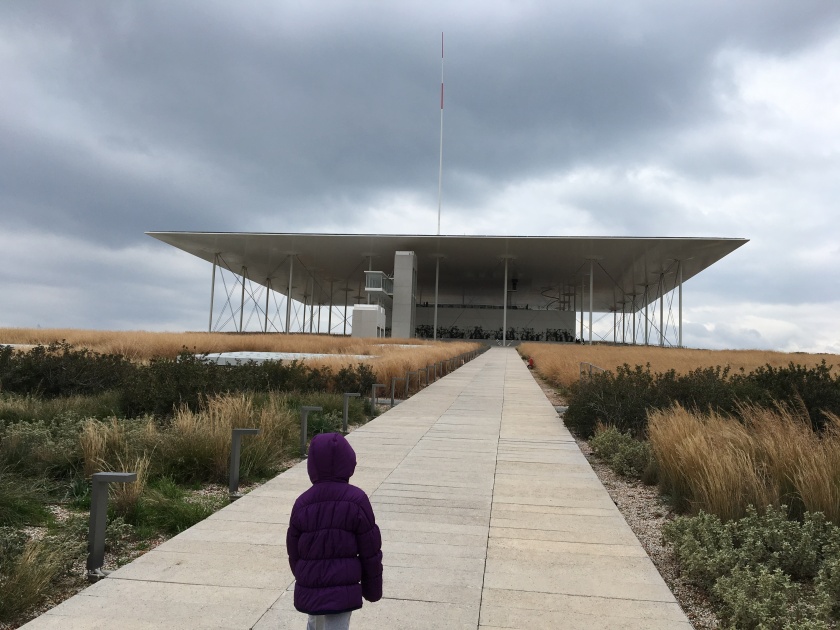
 

img_0248


Architect Renzo Piano envisaged the SNFCC rising out of the ground like a dislodged piece of the earth’s crust. Soaring 14 m above the summit, a 100m x 100m photovoltaic canopy extends outward from its perimeter. A marvel of engineering and construction, supported by 40 sinewy metal pillars, it will meet the buildings’ energetic needs, as well as making a fascinating addition to the city skyline.
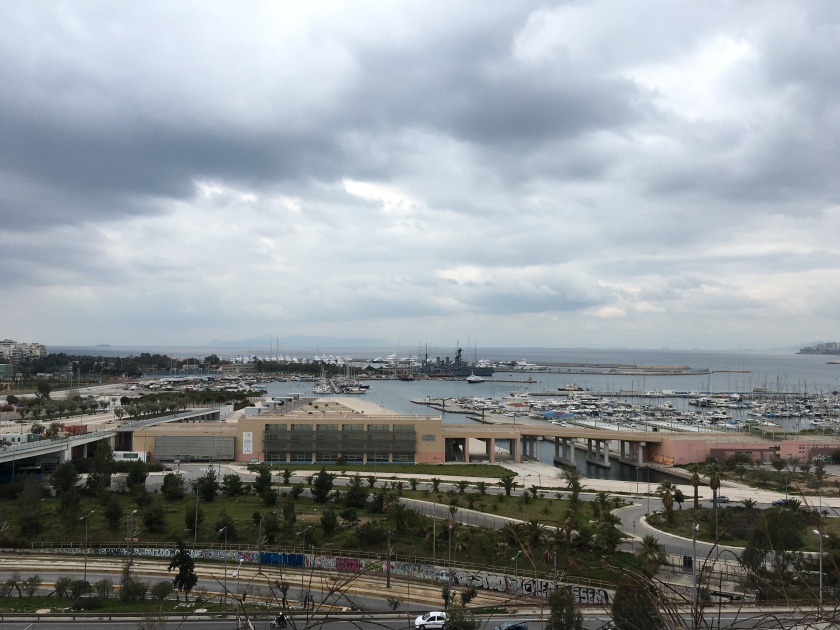
 

img_0254


The summit offers spectacular 360-degree views of the sea to the west, the Acropolis to the east, and the cultural and educational park below. It certainly is breathtaking, although it did strike me how loud the traffic noise was, even up here!
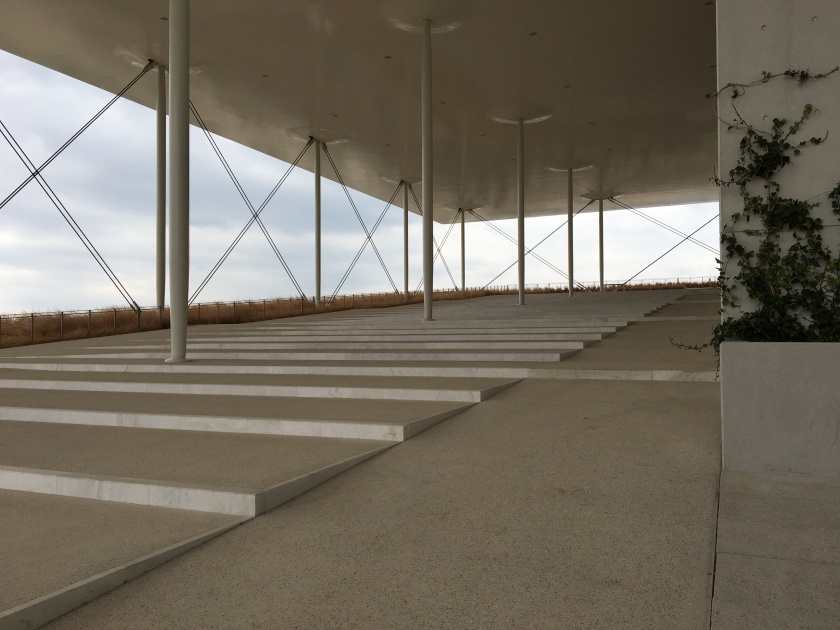
 

img_0251


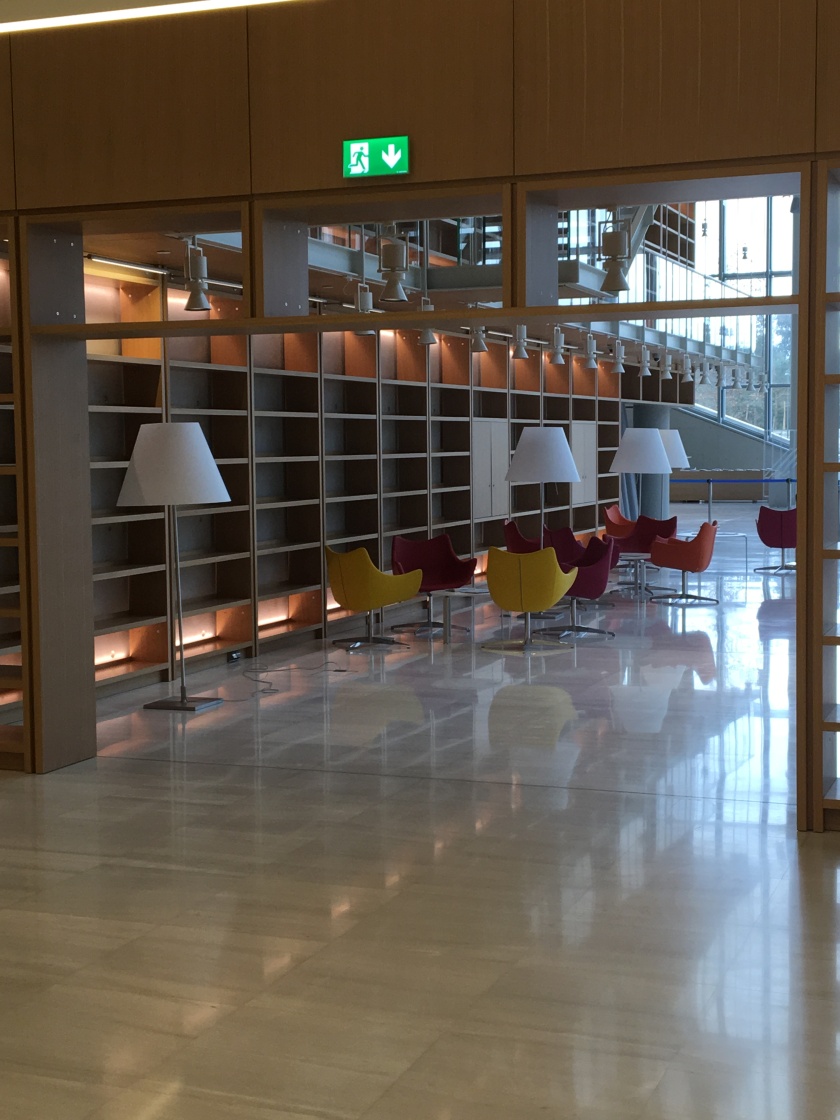
Berneath the green roof is the enormous Library, built on several levels around an open atrium.
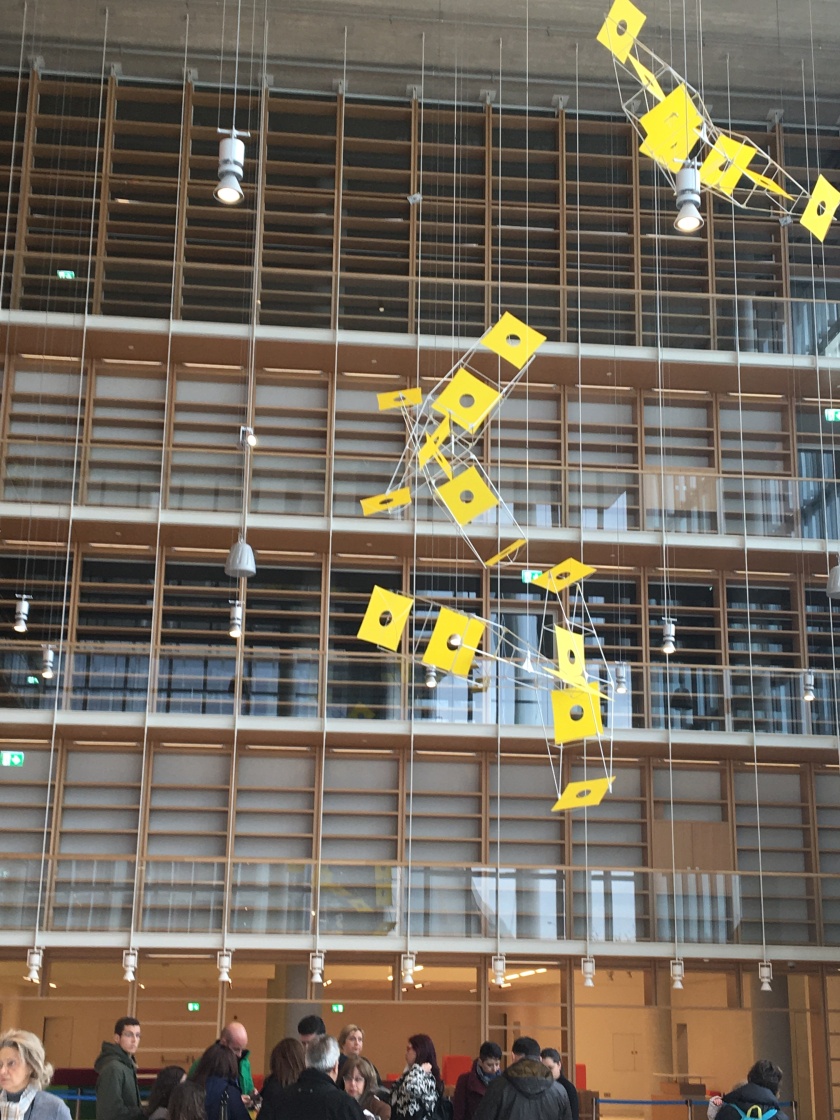
 

img_0237


The shelves are still empty of books, but imagine when they are full! I loved the mobile suspended from the vertiginous ceiling.
 

img_0234


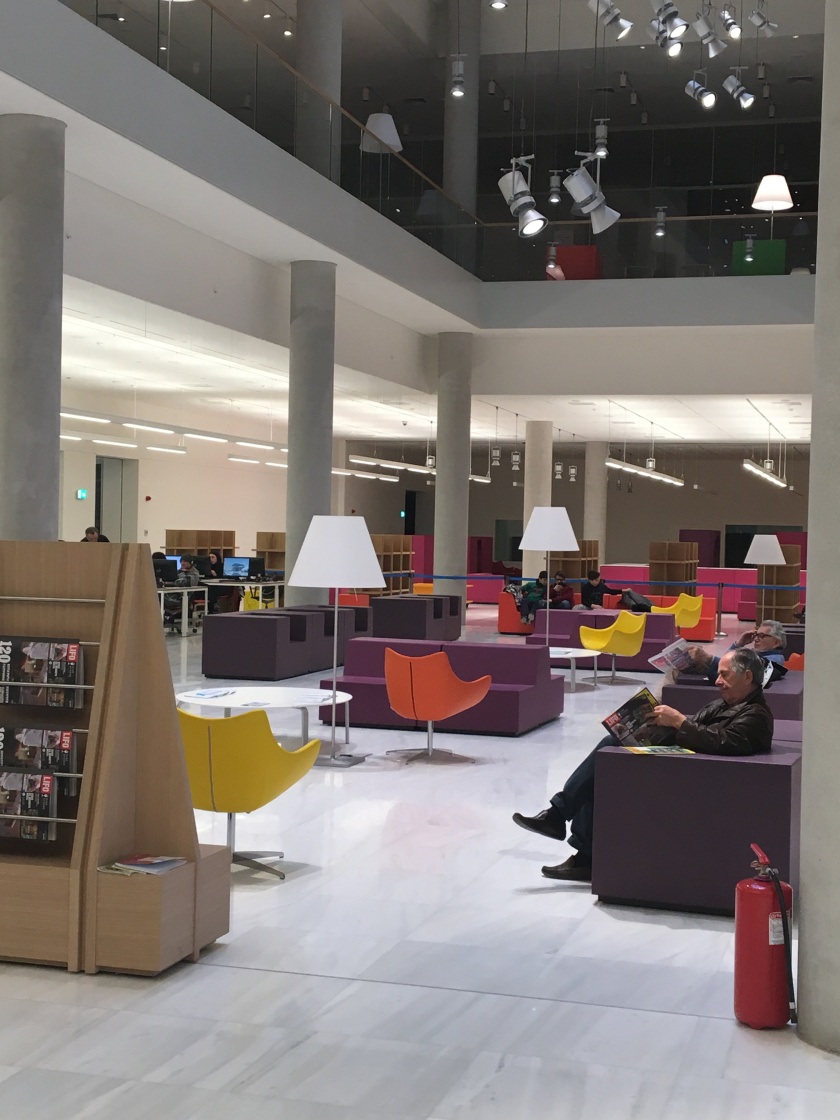
Cosy reading corners abound, and there are stands stacked with daily papers and magazines in different languages.
 

img_0233


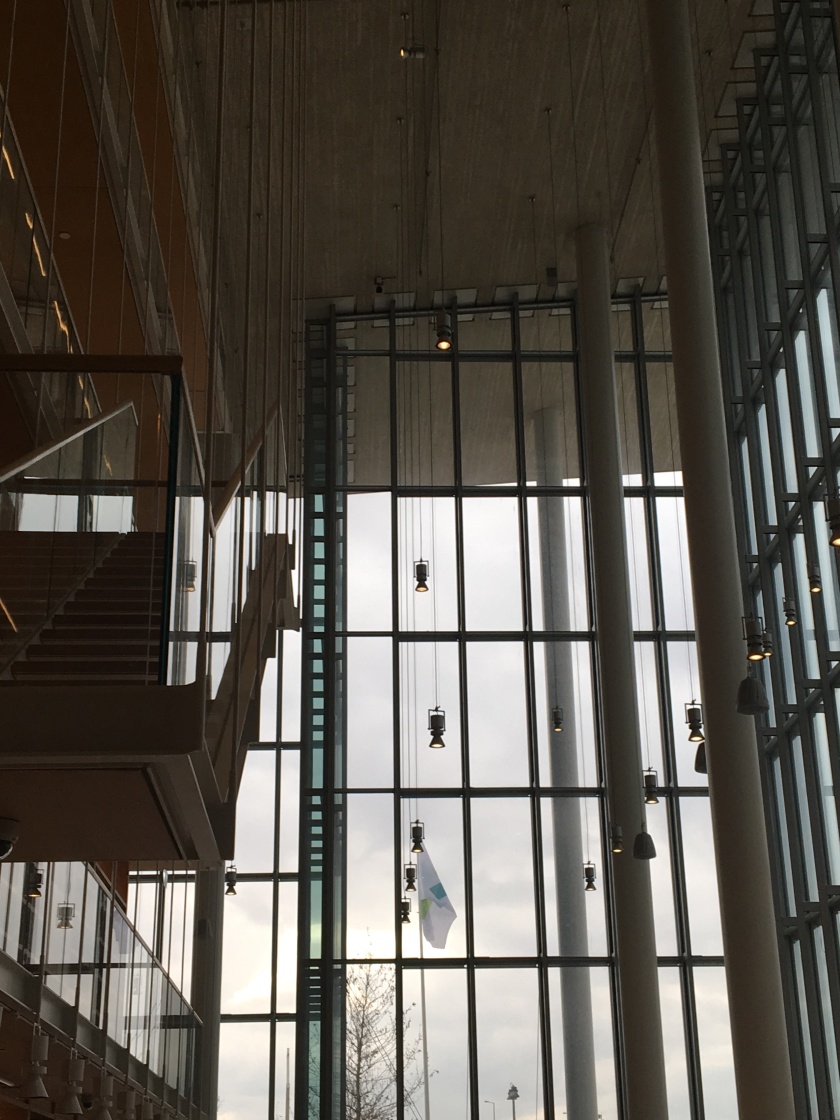
Enormous windows flood the library with light.
 

img_0235


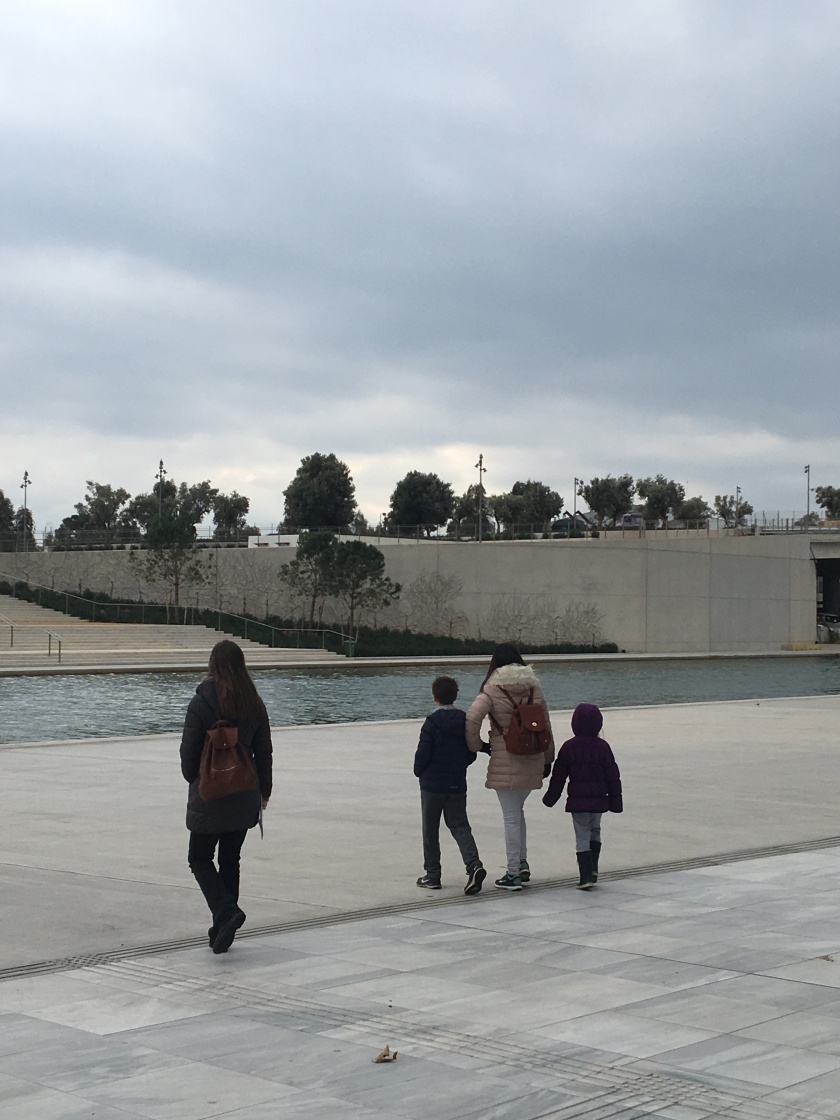
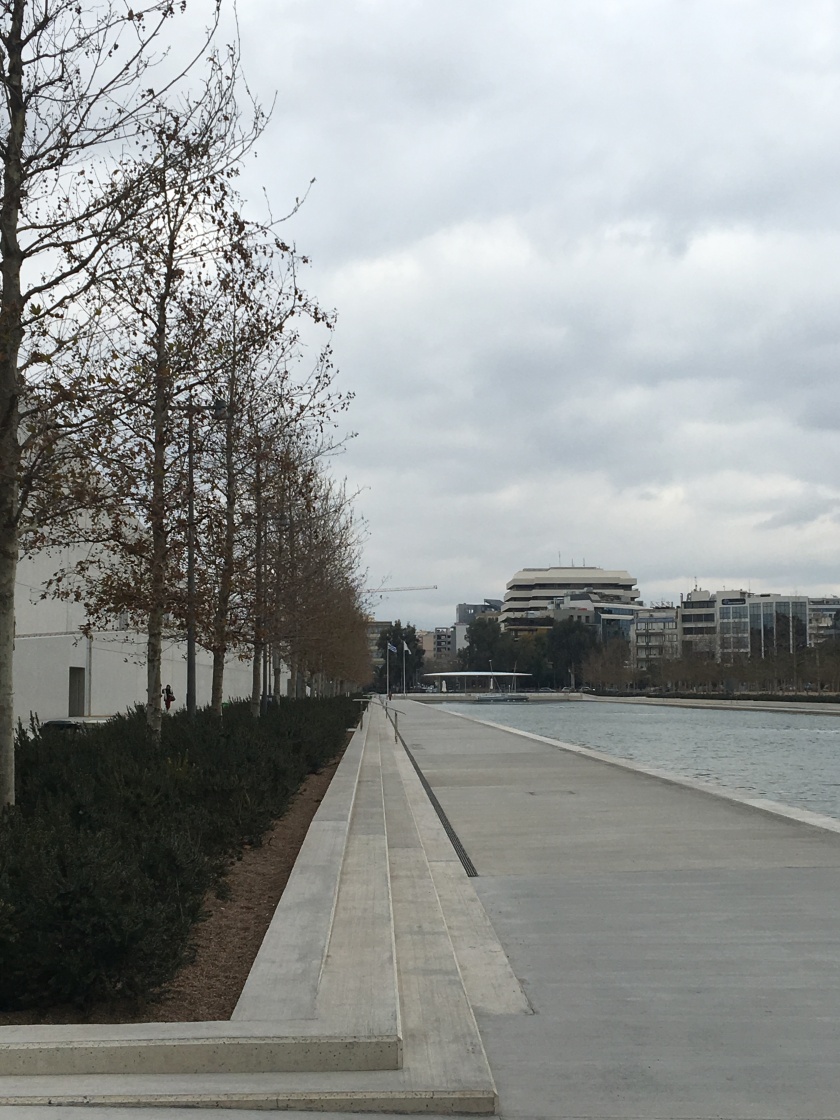
Walking out of the library, one comes out into the Agora, with its impressive water feature.
 

img_0239


This is a huge space, where a multitude of events can be staged.
 

img_0240


We did not visit the National Opera, because you can only go in if you join the guided tour, and they were fully booked. It is not totally operational, and has only staged a few experimental performances so far.

This is a huge undertaking and it is not entirely completed yet. One can only imagine how impressive it will be when it is functioning on all levels – mature gardens, well-stocked library shelves, a program of performances of all types. The only thing that worries me is that there is a plan for the complex to be donated to the Greek state in 2017 – in the present climate of disintegration, i wonder if it will be upkept and used to its full potential?

It remains to be seen. Meanwhile, for any of you planning a trip to Athens, be sure to add it to your list, together with the Acropolis Museum. Well worth a visit.
The Sketchbook travels again

For those of you who read my post The Sisterhood of the Travelling Sketchbook, I have finished my contribution and I’m ready to pack it off to the next person on the list, Constanze, in Munich, Germany.


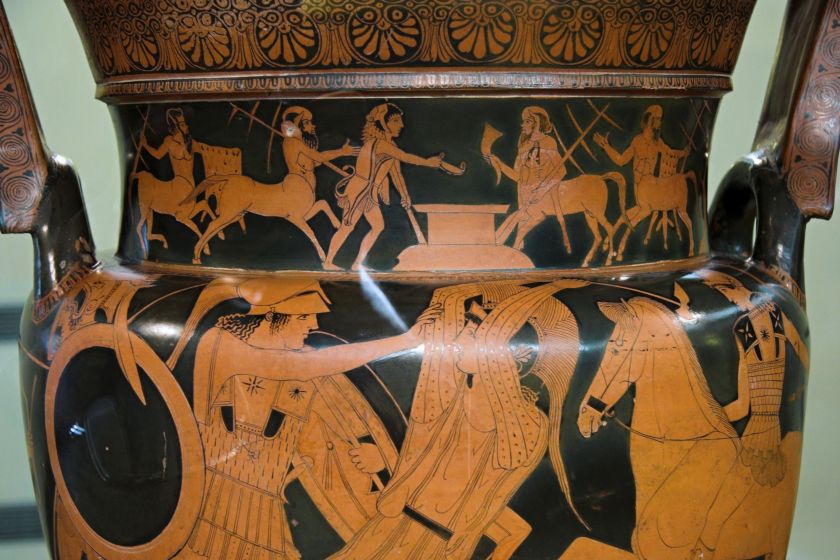
Centauromachy 460 BC
Centauromachy 460 BC. (Source:Wikimedia Commons)


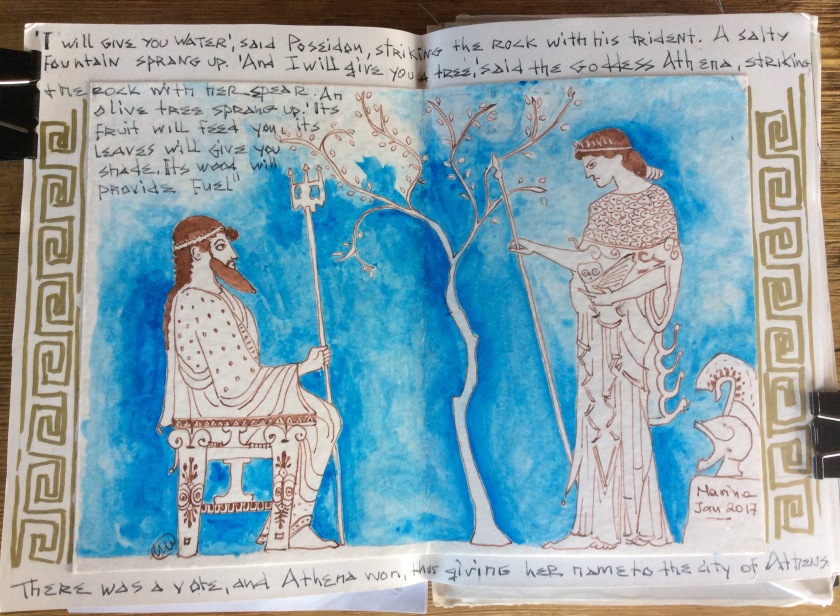
I wanted to do something referring to Greek history, so what better than the myth about the naming of Athens, which I’ve already written about, in my post Homage to the olive tree.  To make the drawing I took my inspiration from the ancient black and red pots from which one can glean amazing details about life in Ancient Greece – the food, the sport, the fashion, the rituals and the stories. They feature a large cast of gods, goddesses, demi-gods and mere mortals, nymphs, centaurs and satyrs, athletes and animals, as well as household objects, furniture and accessories. A fascinating study.

And now feast your eyes on my masterpiece below:-)


img_4358
My drawing in the Sketchbook

Standing on the Acropolis rock is Athena, having taken her helmet off, with a belligerent expression on her face. She has just produced an olive tree, using her spear. Poseidon, seated on an elaborate throne, has a rather sheepish look on his face, having lost the contest to a woman, albeit a goddess…

This has been a very amusing project, and I’m curious to see the remaining contributions. So tomorrow I will regretfully pack up the Sketchbook and bid it Bon Voyage.

The Sisterhood of the Travelling Sketchbook

On April 14, 2016 Anne Lawson, a botanical artist who lives in Melbourne, posted this on her blog: ‘Oh I do love a good idea, and this is one of the best! A travelling sketchbook!’

So she made a sketchbook, drew her own contribution in it, and posted it to the first person on the list of those who’d signed up for the project.
There are 15 of us, and each is to ‘add to the sketchbook when it comes in the post to you. Draw, write, collage, sew, paste in a photograph ~ whatever you would like to contribute. There would be no rules, no themes, just a heartfelt contribution.’
(You can read the whole post here)

I was number 9 on the list. Imagine my excitement when I received a package from Indiana, USA, and opened it to see this:

img_4283


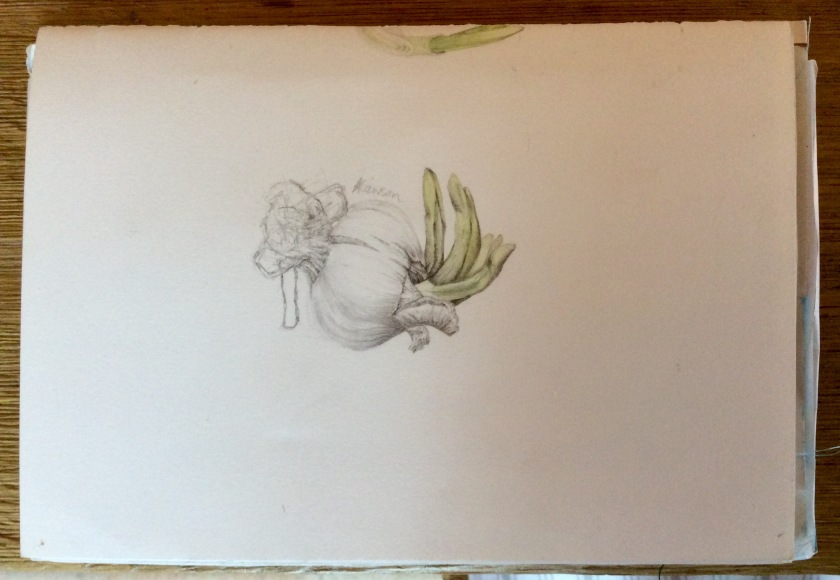
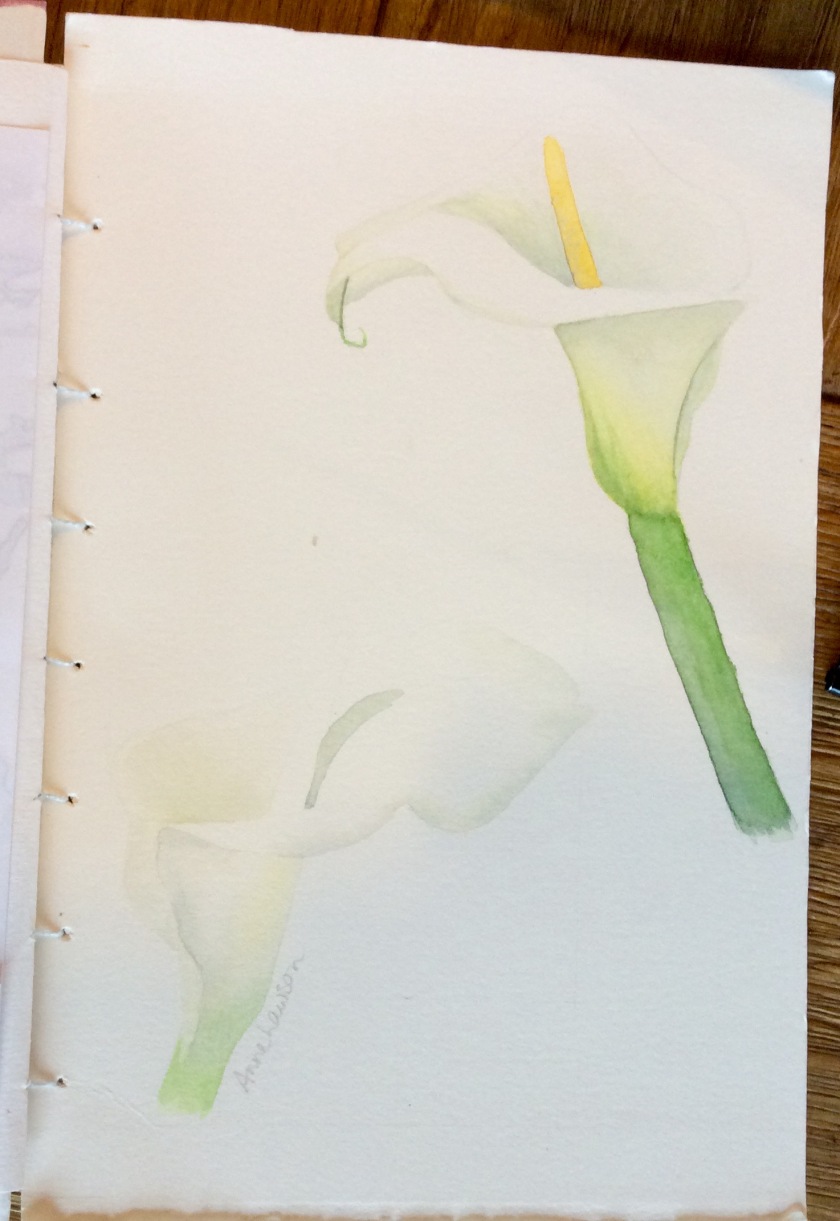
Anne had drawn on the cover, and inside the back cover,

img_4293


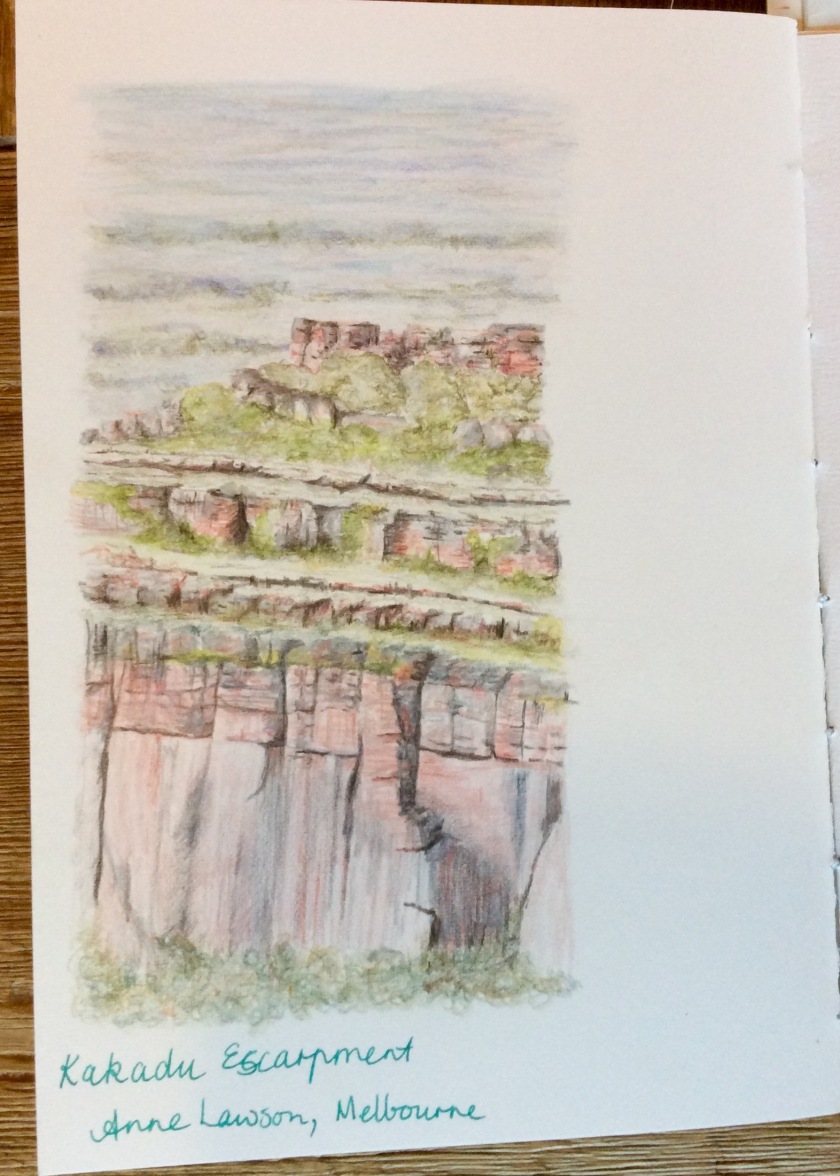
and her contribution was a delicate drawing of the Kakadu Escarpment in Melbourne.

img_4291


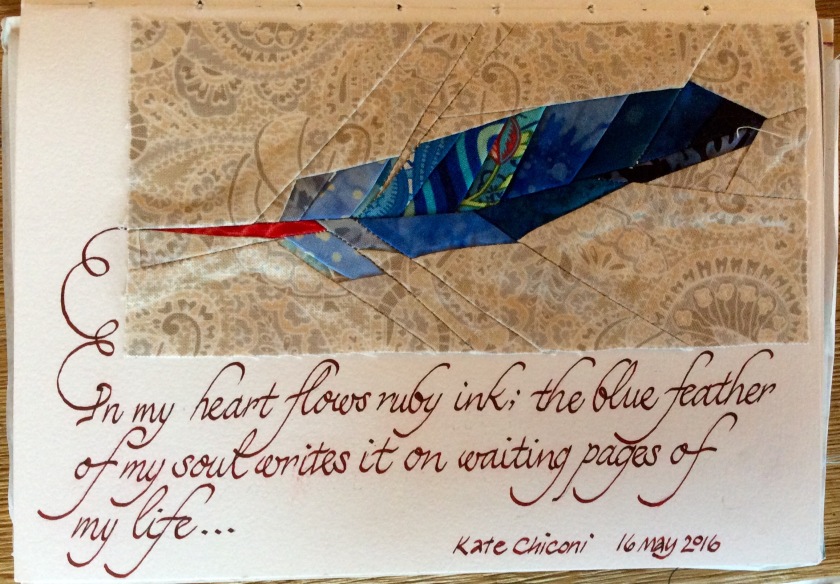
Next was Kate Chiconi from Baker’s Creek, QLD. (See her blog here) Kate makes the most amazing quilts, so this is what she came up with:


img_4284


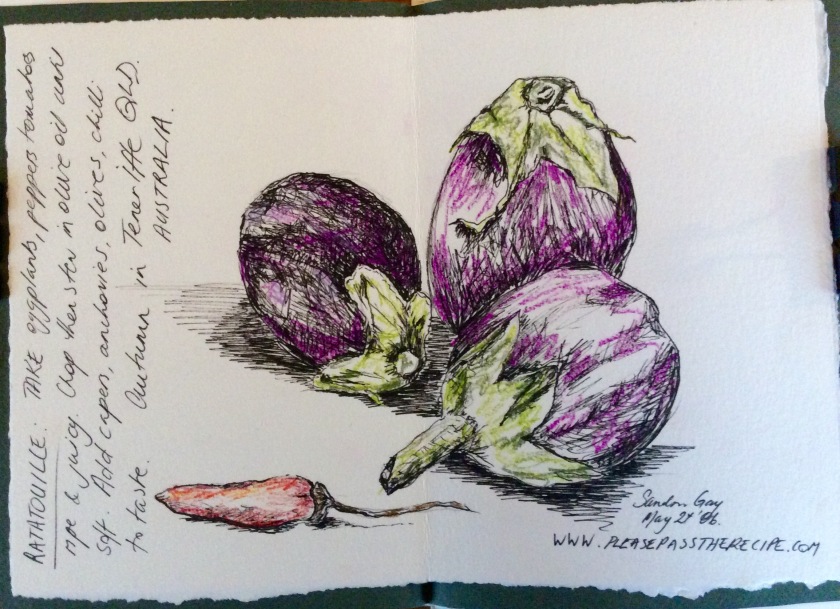
After Kate, Sandra Gay from Ténériffe, QLD (blog here), added an illustrated recipe for ratatouille!


img_4289


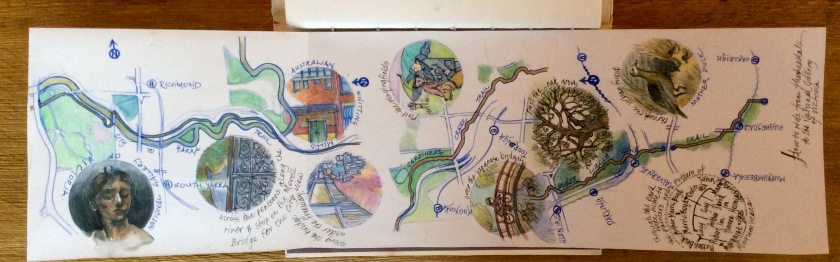
In number 4, we have the stunning drawings of Megan Power from Caulfield, VIC (blog here) – she made a map of the cycling trails in the city, leading to the National Gallery of Victoria,


img_4287

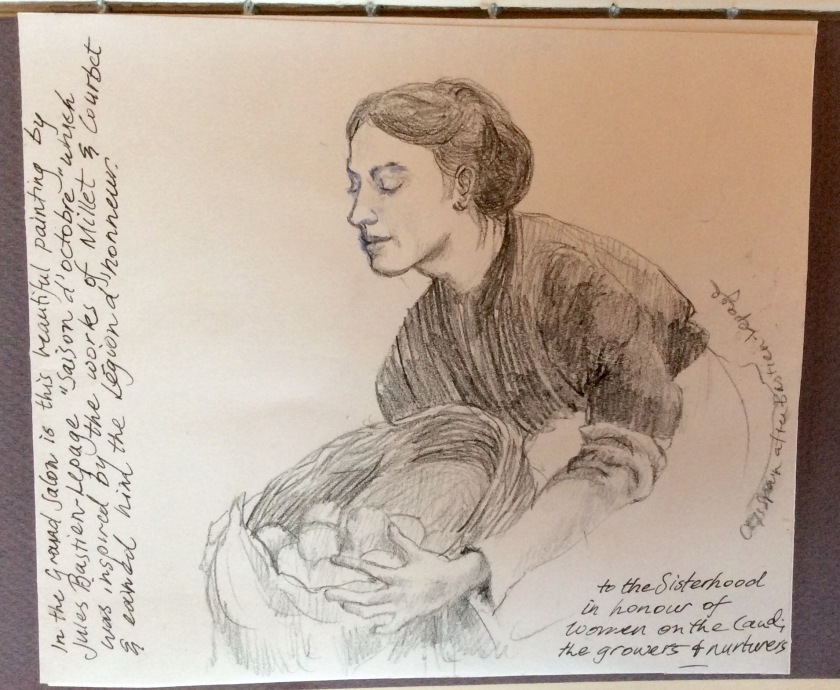
as well as a beautiful drawing inspired by a painting  by Jules-Bastien Lepage, which is exhibited in the gallery.


img_4286


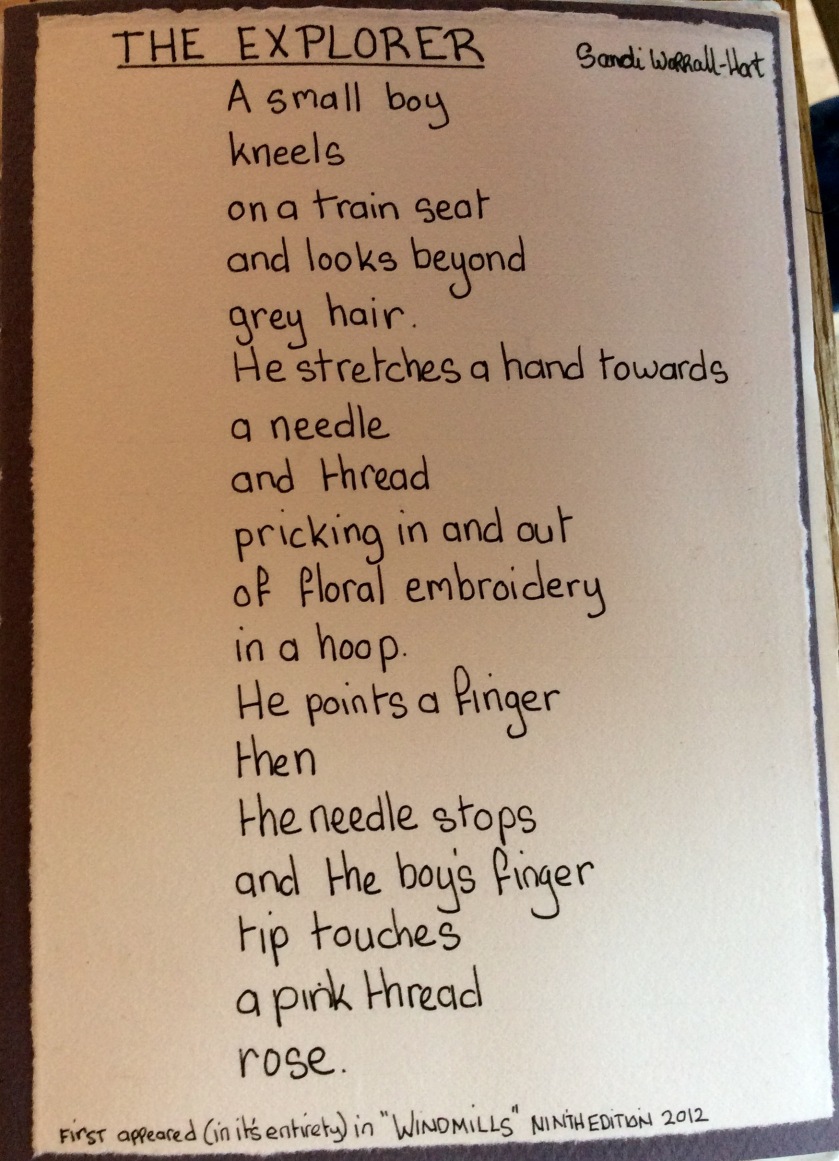
Then a poem, by Sandi Worrall-Hart, of Wnadin East, VIC.

img_4285


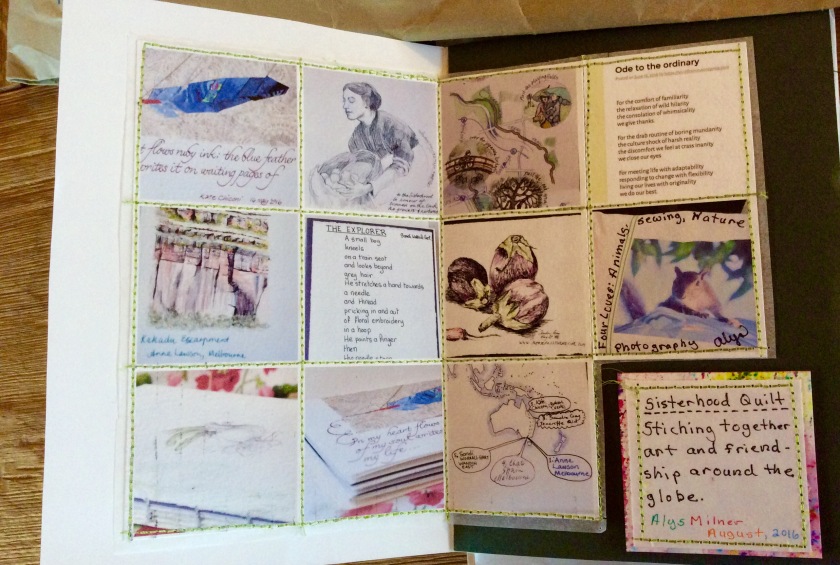
Next, the Sketchbook travelled from Australia to the US, where Alys Milner from SAN Jose, California, (blog here) made an imaginative collage ‘quilt’ from all the previous contributions!


img_4288


Followed by two more stunning mini quilts by Sue Brown of Mount Vernon, WA (blog here).

img_4290


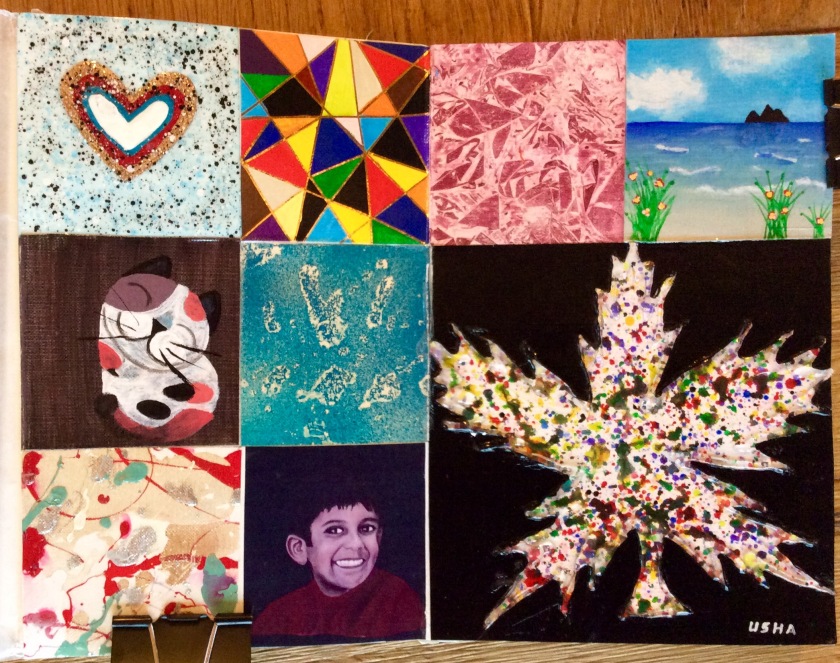
Then, just before me, Usha Gudipalli from Indianapolis (blog here) added another, very colorful,  collage. Again a quilt theme, which I assume has been so popular as it symbolises unity and friendship.

img_4292


Now the Sketchbook has travelled to Europe – first stop, Athens, Greece! When I’m done I will send it on to Germany, since there are five more memers of the Sisterhood, two in Germany, one in France, and two in the U.K. Finally, it will go to one more contributor in Australia, then at last back to Anne – we are thinking of maybe scanning it, so each of us has a memento of her own.

I have already thought about my own contribution, of course, but my lips are sealed for the moment, so stay tuned!
(To be continued)

The new Acropolis Museum

Yesterday’s post was getting a bit long, so today I will do a follow-up on the new Acropolis Museum. The video below offers a virtual tour, where you can get a fair idea of the treasures on offer: the glass floor at the entrance through which you can see the ruins of the ancient city beneath your feet; the airy space allowing you to walk all around the statues; the Caryatids in all their glory; and the beautiful top floor mirroring the Parthenon where the marbles are exhibited.


The museum has a café and restaurant with a stunning view on the Acropolis. The food uses products and recipes from all over Greece and is served by smiling and kid-friendly staff. Go on their site for more information here. (Plan a trip to Athens! Totally worth it.)

For those interested in the campaign for reunification of the marbles, below is another short video, where you can also meet Professor Padermalis.


Olympic Games trivia

Now that the fanfare is over, and the frenzy of the medals tally, and the usual grubby IOC scandals; now that the Rio Olympics have been declared, by IOC president Thomas Bach, “the people’s Games, the most happy Games ever, the beautiful Games, the passion Games” (how do they think up this rubbish? but of course London and Sydney had already been voted the “best ever Games”, so he was obviously running out of superlatives); now that the green diving pool and the sewage floating in the sea have been conveniently forgotten and the Brazilians left to deal with the aftermath and the cost; I thought it would be fun to post some random facts about the greatest sporting show on earth. Not so much facts, actually, as human stories, which is what I always find the most fascinating.


Three runners. Wikimedia commons.
Three runners. (Wikimedia commons)


The ancient Olympic Games, primarily part of a religious festival in honor of Zeus, were a series of athletic competitions among representatives of city-states. The games were staged every four years, starting in 776 BC, in Olympia, a sanctuary site for the Greek deities in the Peloponese. They reached their zenith in the 6th and 5th centuries BC, but then gradually declined in importance as the Romans gained power and influence in Greece. It is believed they ended in the 4th century AD, when emperor Theodosius I decreed that all pagan cults and practices be eliminated.

During the celebration of the games, an Olympic Truce was enacted between warring cities so that athletes could travel to the games in safety through hostile territory.

Athletes competed naked, and victors were rewarded by a kotinus, or olive branch wreath, and a large number of amphorae full of olive oil, which they most probably sold.

Only Greeks could compete. Greek men. No women, slaves or foreigners were allowed.


Fencing before the king of Greece - 1896 Summer Olympics. By André Castaigne ( died 1929)
Fencing before the king of Greece – 1896 Summer Olympics. By André Castaigne ( died 1929)


The Olympics were revived in 1896 by the International Olympic Committee (IOC), which had been created by Pierre de Frédy, Baron de Coubertin, and were held in Athens, Greece, from 6 to 15 April. Women were still not allowed to compete, because de Coubertin felt that their inclusion would be “impractical, uninteresting, unaesthetic and incorrect”.

However, one woman, Stamata Revithi, ran the marathon course on 11 April, the day after the men had run the official race. Although she was not allowed to enter the stadium at the end of her race, Revithi finished the marathon in about five hours and 30 minutes, and found witnesses to sign their names and verify the starting and finishing times. Revithi intended to present this documentation to the Hellenic Olympic Committee, hoping that they would recognise her achievement. It is not known what happened in the end – nor, sadly, could I find any photos of her.

Alfréd Hajós (Wikimedia commons)

The undisputed star of the swimming events at these Games was Hungarian architecture student Alfréd Hajós. Battling the elements on a cold April day – with 4m waves crashing around him – the 18-year-old Hajós served up majestic victories in both the 100m and the 1,200m freestyle events, to become the youngest champion of the inaugural Olympic Games.

While attending a dinner honouring the Olympic champions, the Crown Prince of Greece asked Hajós – who had been dubbed “the Hungarian Dolphin” by the Athenian press – where he had learned to swim so well. “In the water,” was his laconic response!

Hajós later showed himself to be an extremely versatile athlete, winning Hungary’s 100m sprint, 400m hurdles and discus titles. He also played as a centre forward in the Hungarian national football championship and was a member of the Hungarian team for its first ever international. He became a prominent architect specialising in sport facilities.


Spiridon Louis (Wikimedia Commons)

Because of its close connection with Greek history, the public desperately yearned for the marathon to be won by one of their countrymen. Spiridon Louis, a Greek water-carrier, rewarded their expectations, thereby becoming a national hero. When Louis arrived in the stadium, which erupted with joy, two Greek princes – Crown Prince Constantine and Prince George – rushed to meet him and accompanied him on his final lap for a finishing time of 2:58:50.

Louis’s victory set off wild celebrations, and the king offered him any gift he would care to ask of him; but all Louis could think of was a donkey-drawn carriage to help him in his water-carrying business!

Louis lived a quiet life thereafter, but his legacy includes an expression in Greek: “yinomai Louis” (γίνομαι Λούης – “I becοme Louis,”) which means to flee, or “disappear by running fast.”

The silver cup given to Louis at the Olympic Games was sold for 541,250 pounds ($860,000) in London on 18 April 2012, breaking the auction record for Olympic memorabilia. Breal’s Silver Cup stands just six inches tall and was offered for sale at Christie’s by the grandson of the victor, and bought by the Stavros Niarchos Foundation.


Spiridon Louis. Colored photograph by Albert Meyer
Spiridon Louis. Colored photograph by Albert Meyer (1857-1924)


Over the years, there are many of these stories to be told, showing the resilience of the human spirit, the will to overcome difficulties and deal with failure as well as success. Driven by the megalomania prevalent in the IOC, and the political and financial interests present in any such endeavor, the Olympic Games have turned into an overblown media circus, bankrupting most countries brave enough to stage them. But still, time after time, these stories surface, and we get to witness amazing feats and riveting drama.

International Lighthouse Weekend

Who knew this was ILLW, or International Lighthouse Lightship Weekend?

Well, in Greece the Navy has opened 30 Lighthouses to the public, who can visit and find out about their history and the way they work.


image

Lighthouses are used to mark dangerous coastlines, hazardous shoals, reefs, and safe entries to harbors. They can also assist in aerial navigation. However, the number of operational lighthouses has declined due to the expense of maintenance and use of electronic navigational systems.

Older lighthouses, especially half-ruined ones, are romantic structures, having about them the whiff of history – stories connected to lonely lives, pirates and derring do at sea.

Before the development of clearly defined ports, mariners were guided by fires built on hilltops. To improve visibility, the fires were placed on a platform, a practice that led to the development of the lighthouse.

The most famous lighthouse structure from antiquity was the Pharos of Alexandria, built by the Ptolemaic Kingdom between 280 and 247 BC. One of the Seven Wonders of the Ancient World, it was between 120 and 137 m tall, and one of the tallest man-made structures in the world for many centuries, until badly damaged by three earthquakes between AD 956 and 1323.


Drawing by archaeologist Hermann Thiersch (1909)
Drawing of the Phoros of Alexandria by archaeologist Hermann Thiersch (1909)

So if there is a lighthouse near you, perhaps today would be a good time to visit.
I did it!

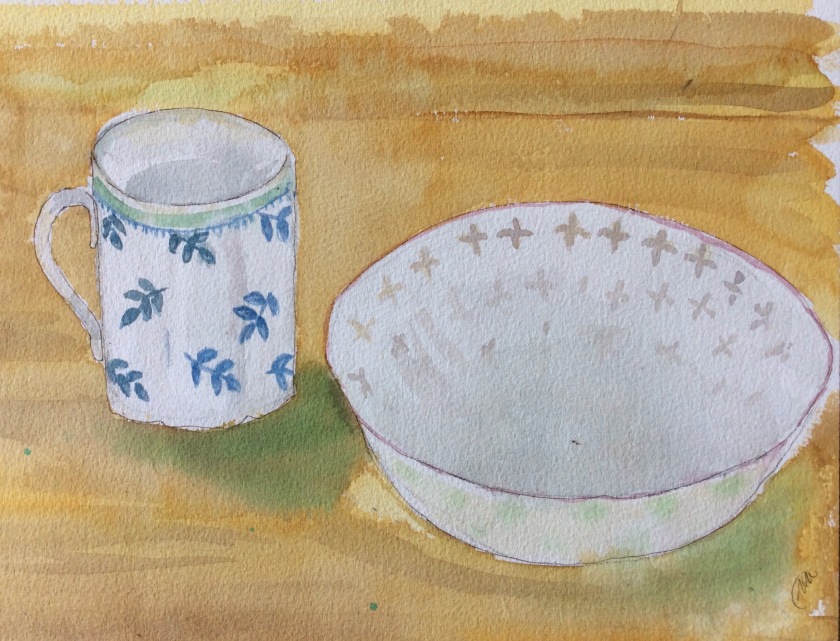
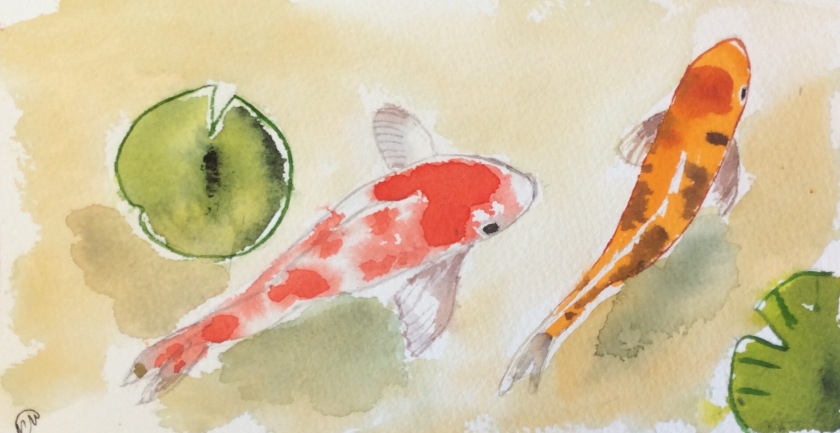
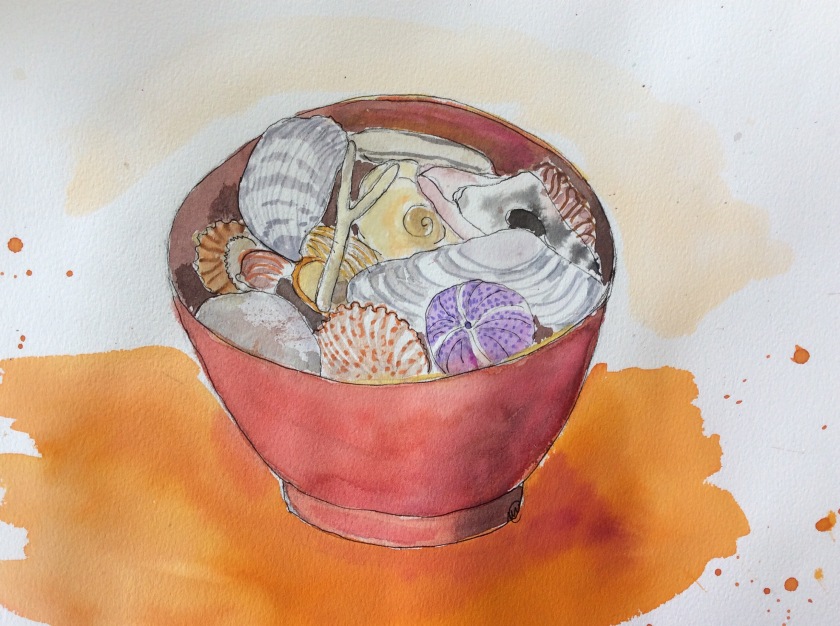
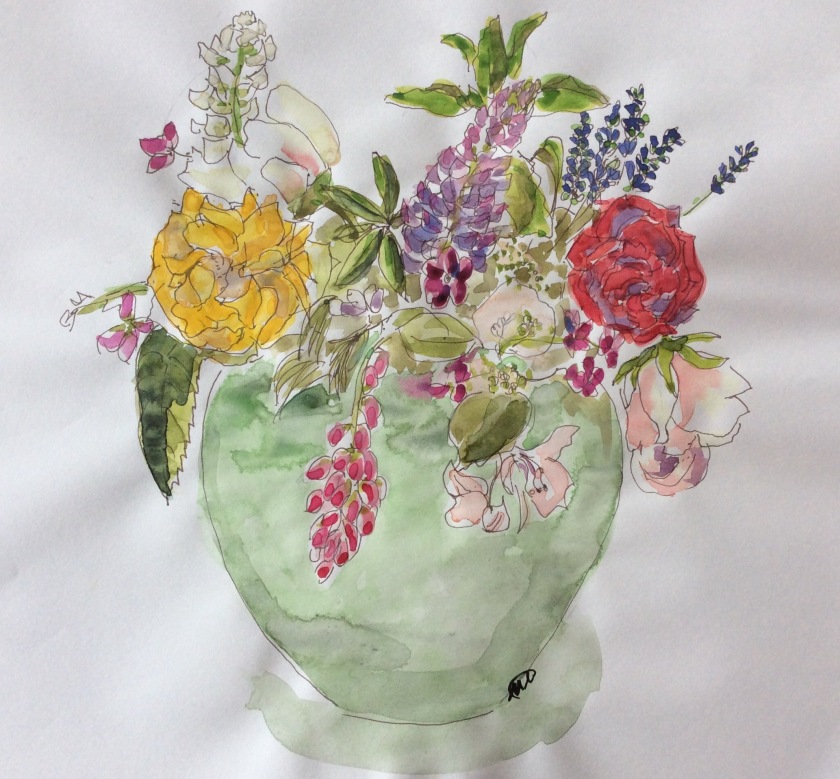
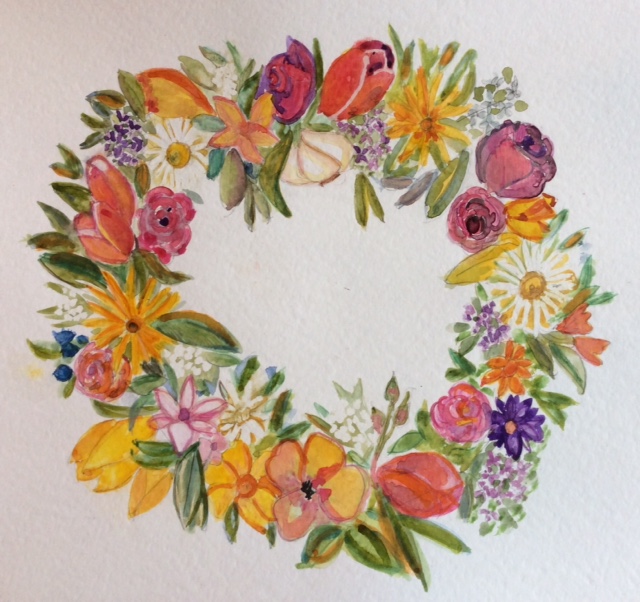
We are on the last day of July, otherwise known as World Watercolor Month. I joined the challenge of making one painting each day, and I’m happy to say I managed it, with very little cheating! (I only posted a couple that I’d actually started before…) I’m rather pleased with myself, and also glad that Charlie O’Shields, whose brainchild this is, egged me on.


image


Charlie’s great at encouraging people to join in, and also at showcasing the work of other artists. If you haven’t been to see his blog yet, go check it out, it’s fun even for people who don’t paint. It’s called Doodlewash (click here).


image


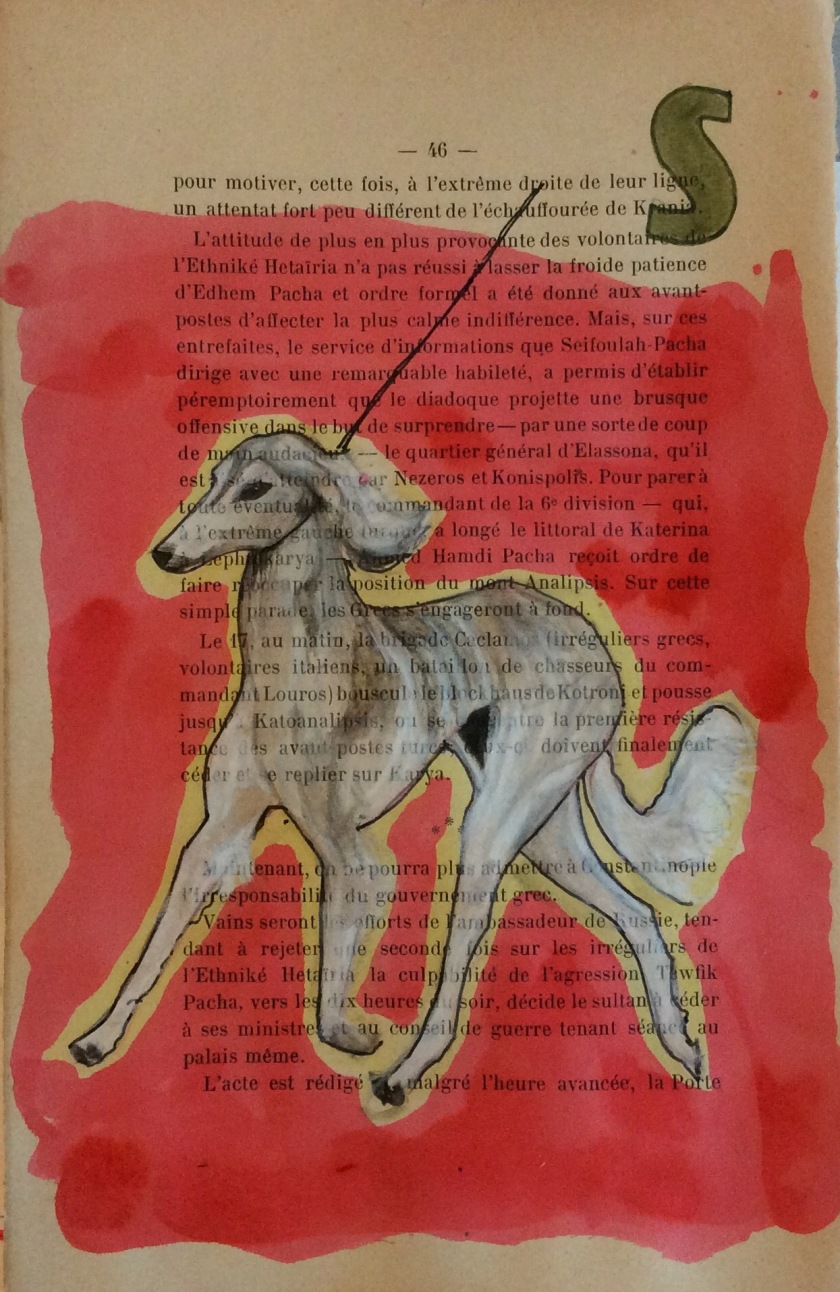
This has been a fun challenge – it made me try different things, and also get on with my dog alphabet. Only three to go now, and that baby will have a cheerful wall to look at!


image


It was also nice  seeing the work of the hundreds of other artists who joined in the challenge. I’ve followed quite a few. If anyone is interested in looking at all my efforts, I’ve posted them on Instagram, at @athensletters.


image

World Watercolor Month

What’s World Watercolor Month?

It’s a month to inspire people to paint with watercolor (watercolour, aquarelle) while raising awareness for the importance of art and creativity in the world.  Anyone can join the celebration, from master watercolorists to artists just starting out with watercolor!


image

Best of all, this first year of the celebration will be about raising awareness for children in need of art supplies and art education around the globe. Art is an important aspect of child development and paves the way for a successful future. What would the world be without art?


image


How could I resist? I’m joining the 31-day challenge – a watercolor each day. Some might be just doodles, some only dabs (abstract dabs?), but it will be fun. It will be motivation to pick up a brush each day, to try new things; and an opportunity to meet other artists. I will be posting on Instagram(athensletters). Below is my first contribution:

Day 1: Sketch of flowers past their prime.
image

Discovering Traditions: May 1st and the Making of the Wreath by M.L.Kappa

image


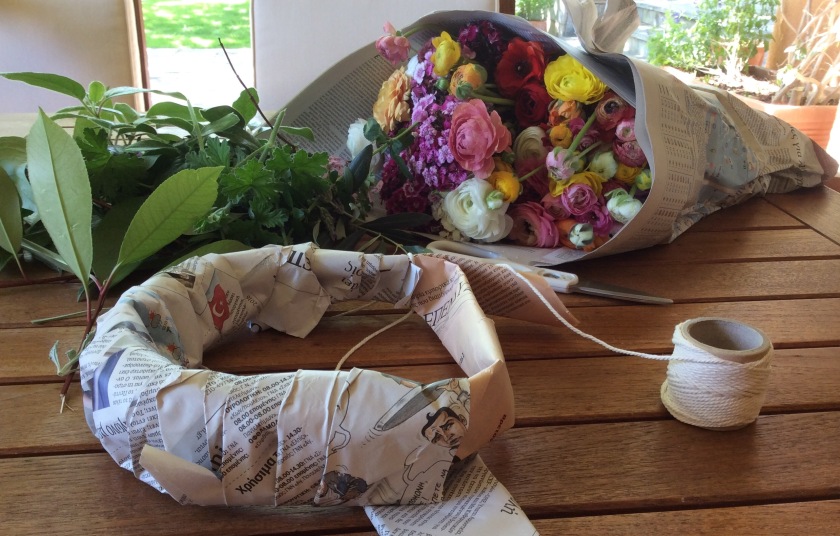
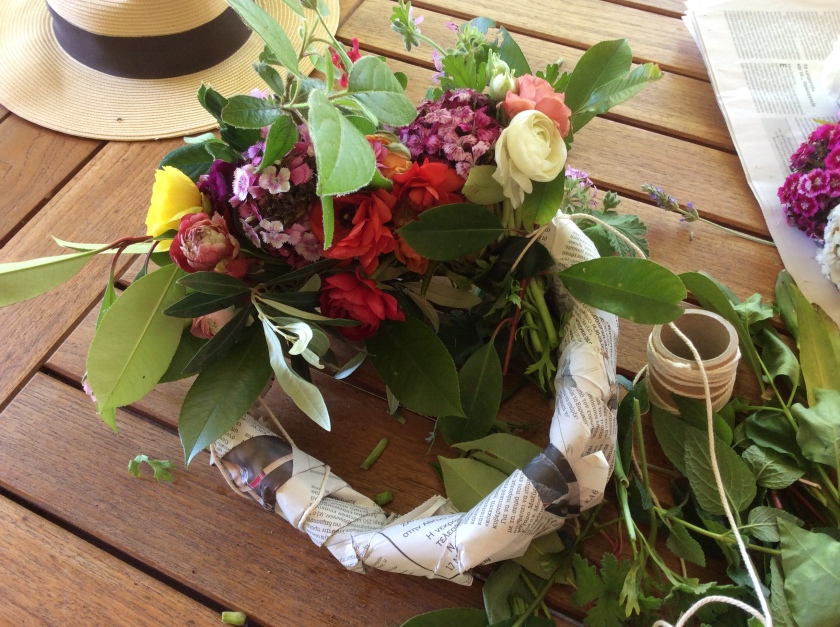
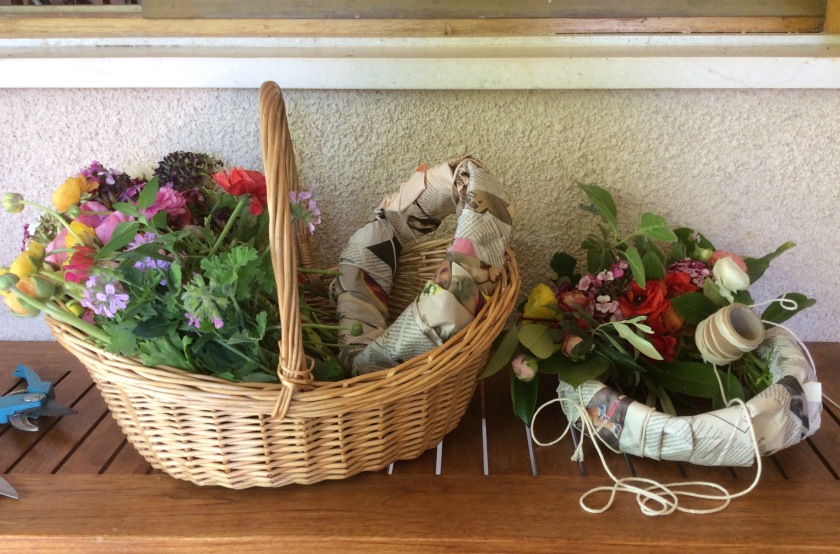
Solveig Werner very kindly asked me to take part in her ‘Discovering traditions‘ series, so I wrote a piece about the first of May, when Greeks make a flower wreath which they hang on their balcony or front door to celebrate the coming of spring.

This year May 1st coincided with Easter, so we had an abundance of celebrations. I took some photos of our wreath-making process, and I encourage everyone to visit Solveig’s blog to read my masterpiece – and, mainly, to discover all the lovely stuff she posts there!


image image

Solveig's avatarSolveig Werner

Discovering Tradition

Today, is the first of May, a day that is widely celebrated and that has various traditions attached to it. I am happy to have M. L. Kappa as my special guest for Discovering Traditions. You can find a list of all guest post that have appeared on my blog so far here, and you can find the previous guest post for Discovering Traditionshere.

May 1st and the Making of the Wreath by M.L.Kappa

FullSizeRender May Wreath by M.L.Kappa

One of the most fun Greek traditions is the making of the May Wreath. We call it Μάης (pronounced Màïs).

May 1st is universally known as Labor Day since 1886, when the Chicago Syndicates rebelled, asking for better working conditions. But celebrating it is not actually a 19th century tradition—it has roots in Antiquity, when festivities were held in honor of Demeter, goddess of the harvest, and

View original post 548 more words

Happy Birthday, Yayoi Kusama!

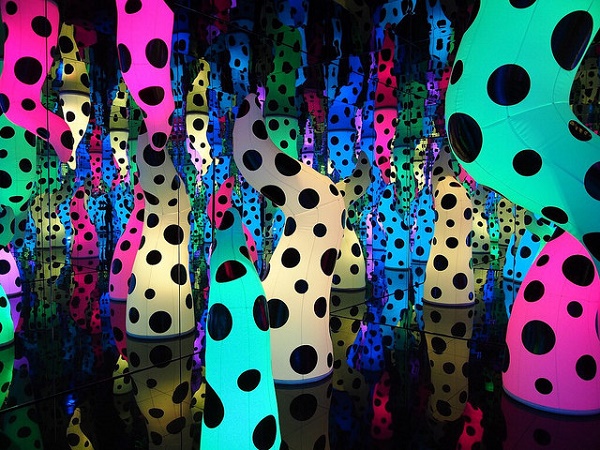
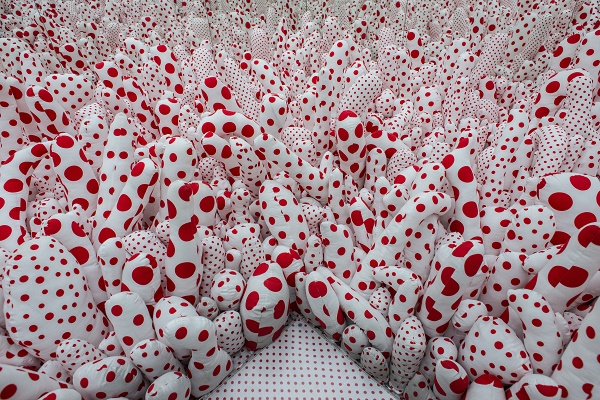
I’m a fan of Yayoi Kusama’s psychedelic eccentricity and gaily polka-dotted work. The Japanese artist is 87 today, and for the past 20 years has been living in a Tokyo mental hospital, from where she has continued to produce artworks in a variety of mediums, as well as launching a literary career by publishing several novels, a poetry collection and an autobiography.
She famously said: “My art originates from hallucinations only I can see.”


image
Yayoi Kusama, Love is Calling (2013) Image: M_Strasser via Flickr Creative Commons


In the sixties, Yayoi Kusama was part of the New York avant-garde scene, having her works exhibited alongside the likes of Andy Warhol, Claes Oldenburg and George Segal.


image
Yayoi Kusama, Gleaming Lights of the Souls (2008) Photo: Jim Dyson/Getty Images


In her honor, Artnet News has published a lovely article entitled:

14 Yayoi Kusama Quotes on Her 87th Birthday (Article by Alyssa Buffenstein)

You can find it here. (I borrowed the photographs from them, many thanks.)


image
Yayoi Kusama, Infinite Obsession (2013) Photo: YASUYOSHI CHIBA/AFP/Getty Images