What is it that makes the turn of the year fill us with hope? It is a totally fictitious concept. Nothing changes in reality—it is just another day. And yet…most of us think of it as a new start.
A snowy landscape
Looking at the year’s photos that are published around this time in the papers, there is not much to make the heart glad. Wars, poverty, natural catastrophes, displaced populations—the list never ends. But one could focus on this kind of thing every day of every year, or find images to lift the spirits. Wonderful landscape and wildlife photos, reminding us we live on a beautiful planet, very much worth preserving. Images of everyday life, music, art and performances. It always makes me hopeful for humankind when I see how many people enjoy going round exhibitions or pay good money to watch concerts and plays.
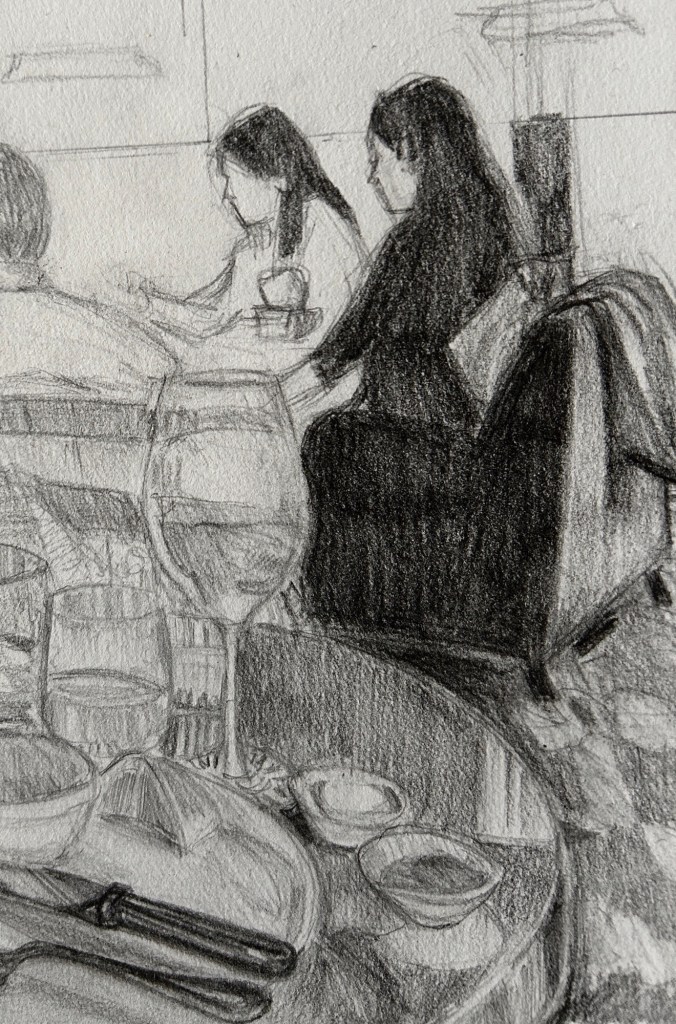
A good time to go out with friends (pencil on paper WIP – detail)
So let us take this opportunity to see a few good friends, spend time with family (if one can stand them, obvs!), perhaps make a donation somewhere, make a couple of (un-followable) resolutions, drink a glass of bubbly. Us Greeks will be baking or buying a Vassilopita, the traditional cake which we cut on New Year’s Day (or for months afterwards! – because one has to be eaten in every office, business, association or club as well as in every family) and devouring sugar-dusted kourabiedes or syrup-soaked melomakarona.
Out at 7.30 a.m.
My Christmas wishes were very belated this year, due to a technical glitch, but they were heartfelt, and so are my wishes to all of you, for a wonderful 2025. Health, joy and may the world be a better place.
Artist duo Elmgreen&Dragset were invited to exhibit their work in the iconic sculpture gallery of the Musée d’Orsay.
They called this installation, consisting of a number of boyish figures engaged in incongruous—in the context—pursuits, L’Addition.
Michael Elmgreen (born 1961 in Copenhagen, Denmark) and Ingar Dragset (born 1969 in Trodheim, Norway) have worked together as an artist duo since 1995, exploring the relationship between art, architecture and design.
Elmgreen&Dragset live and work in Berlin. They are known for art work that has wit and subversive humour, and also addresses social and cultural concern. Their work is too varied and prolific to be described in a short post, but anyone interested can look them up on Wikipedia—and they are, indeed, interesting.
For the first time in its history, the Musée d’Orsay invited someone to intervene in the museum’s permanent display of 19th century sculpture, which has remained the same for nearly 40 years.
As quoted in the museum’s site: In a trans-historical encounter between past and present, L’Addition highlights themes of evolving masculinities, solitude, and the magic of everyday situations. There is a certain beauty to be found in each of the fleeting moments captured in the works, whether it is in the pause before jumping from a diving board, the split second before a drone is sent off from a child’s hand, or a glimpse through the lens of a camera.
The figures are made of bronze, stainless steel and laquer. Boys waiting to dive, taking pictures from the mezzanine, setting off drones or just lounging upside down on the ceiling. It was all pretty cool, and an extra treat combined with the Caillebotte exhibition.
Amongst the lesser-known of the Impressionists, for the simple reason he was wealthy and did not need to sell his paintings in order to live, Gustave Caillebotte (1848-1894) is nevertheless a most interesting artist, because he had a unique take on things, using perspective and composition in original ways. He was very ‘modern’ for his time as well as more realistic in his technique than some of the others.
A lawyer and engineer, he fought in the Franco-Prussian war and upon his return frequented the Académie des Beaux Arts, as well as befriending several artists. The first painting he exhibited, of labourers working on a wooden floor, was criticised as “vulgar” (sweaty men doing a menial job) and rejected by the Salon of 1875. It is a masterpiece, if only for the light and perspective.
Rabatteurs de parquet, 1876 (détail)
Caillebotte painted many domestic scenes, depicting his family and friends in everyday pursuits.
A beautiful pastel, which does not really show to advantage in a photoI love the composition in this painting, the frame of the portrait replicated in the chair’s back, the diagonal made by the blue clothes…
He also loved sport and painted people rowing or sailing at the family’s Yerres estate. His technique of cropping or zooming in is original and gives a lot of movement to his scenes.
If I had painted this, I don’t think I would have thought to chop off the front of the first canoe, which is just sliding out of the picture.In this view the boats are coming towards usAnd here, seen from the back.I love this gentleman, who is not rowing for sport, only taking himself on a little jaunt in his city clothes.
Caillebotte also did many urban paintings, some from an elevated perspective, such as the one below.
His paintings of Paris give off a very special flavour of the city.
Two of the artist’s friends looking out towards the Boulevard Haussmannin this painting entitled Balcon (circa 1880)Le pont de l’Europe (1877)
He also made realistic studies of the human body and his paintings of males nudes were considered revolutionary, depicting ‘real’ men in domestic settings, instead of heroes in allegories.
Homme au bain, 1884 (note the wet footprints on the floor!)
Caillebotte used his wealth to support many of his fellow artists, notably Renoir—who was a close friend—Monet and Pissarro, amongst others. He died young, at the age of 45, of pulmonary congestion. He left behind an impressive body of work and bequeathed a large and varied collection—he had acquired many works from his fellow artists—to the French government. Here he is below, in one of those funny hats they all wore to row on the river. He looks like a jolly good sort.
Self portrait in a summer hat (circa 1873)
I was very lucky to visit the exhibition before the crows swarmed in, with a friend who is a Friend of the museum and holder of a card allowing early entry. A most impressive artist.
In 2004, the descendants of the Senn family made a donation of 205 pieces of art to the MuMa Museum in Le Havre. The collection, of mostly Impressionist and Fauve artists, was amassed by Olivier Senn and further embellished by members of his family. It includes works by such icons as Delacroix, Boudin, Monet, Renoir, De Chirico, De Staël and others. On the 20th anniversary of this major donation, the museum curated a major exhibition of the works.
Edgar Degas, pencil on paper
Born in Le Havre in 1864, Olivier Senn studied law and, after marrying, joined his father-in-law’s cotton business. Once he’d made his fortune, he started buying art. The Senns and their descendants and relatives by marriage were all art and music lovers, as well as generous donors.
Yesterday’s vernissage of the exhibition drew a large and very appreciative crowd, which thankfully spread out around the museum rooms, making it pleasant to wander about, admiring the works. The collection was too large to describe in full, so I will linger over some particular favourites, a set of lovely pencil drawings by Edgar Degas.
Degas, circa 1859-1861. This drawing, along with the one above and several others, were studies for a large oil painting titled Alexandre et Bucéphale
Another interesting work, probably in pastel, is the study below, for a painting called Semiramis building Babylon
Further little treasures among the works on paper were the small charcoal studies below, by Henri-Edmond Cross. A lesson in conveying much with but a few simple strokes.
Here’s a link for anyone who would like to see more:
Orbital, the book about six astronauts in space I recently reviewed, has won the Booker Prize.
I admit I have not read the other books on the short list—or rather, I am in the process of reading Rachel Kusk’s Creation Lake. I like her writing, and loved The Mars Room, but I’m finding this one slow going. Some of the others are tempting, though, and I will get to them eventually.
Photo: bdnews24.com
Nevertheless, even though I lack comparison, I think this book is a very worthy winner, being at once original, lovely to read and beautiful in every way.
Samantha Harvey nearly gave up writing the book at some point, because she felt like an impostor, never having been in space. But then she took it up again, during the pandemic, and watched hours and hours of streaming video from the International Space Station while writing. Thus she could observe Earth from space, actually completing whole orbits and describing what she saw. The result is nothing short of miraculous.
In her acceptance speech, Harvey said she wanted to dedicate the prize “to everybody who does speak for and not against the Earth; for and not against the dignity of other humans, other life; and all the humans who speak for and call for and work for peace.”
Harvey, 49, is the author of four previous novels, including “The Wilderness,” about a man with Alzheimer’s, which was longlisted for the 2009 Booker Prize, and 2018’s “The Western Wind,” about the mysterious death of a village’s wealthiest resident in medieval England. She also wrote “The Shapeless Unease: A Year of Not Sleeping,” a 2020 memoir about her struggles with insomnia.I’m tempted to try one or two.
Of course, a few people thought it a good idea to publish articles panning Orbital in comparison to the other books on the short list. Although of course everyone is entitled to their opinion—and all art appreciation is subjective—I thought it was in poor taste to do so today. It smacks of sour grapes. Let the woman enjoy her day of glory—they are hard enough to come by. So, congratulations, Samantha Harvey!
I came upon this 2023 film by chance (the English title is Woman at Sea), but I’ve watched it twice, which is something I almost never do. I wanted my husband to see it—he loved it as well, and I appreciated details I had not noticed the first time. It is an underrated gem of a movie.
Photo: Google
Based on a book by Catherine Poulain, is a quiet movie, with almost no plot or dialogue, but don’t let this put you off. You become totally immersed in a world that is as strange to outsiders as it is real. The directorial debut of Dinara Drukarova, who also stars, it is the story of a young woman seeking to escape her past by looking for a job on a fishing vessel in Iceland.
She appears at the port, seeking employment in a strictly masculine world. We know nothing of her background or her motives for coming here. She has not fished before but, for some unexplained reason, she is determined to try. She appears frail but is tough and keen to earn her place amongst the men.
Adopted by a greying sea wolf who calls her Sparrow, she joins a team of men from different cultures, who will be closeted together on the boat for the duration of the trip.
Beautifully simple and incredibly evocative, the film is a powerful exploration of identity and individuality. It also showcases the loneliness of a life where people forced into intimacy by their circumstances, slowly coalesce into a team where they look out for each other, only for the partnership to dissolve when they reach land and each goes his own way to the next available job.
The cinematography is wonderful, depicting the high drama of life at sea and the brutal realities of commercial fishing, as well as the short moments of respite and rest where each can find it. The characterisation of the fishermen is subtle but well-developed, and the acting by all the cast is superb.
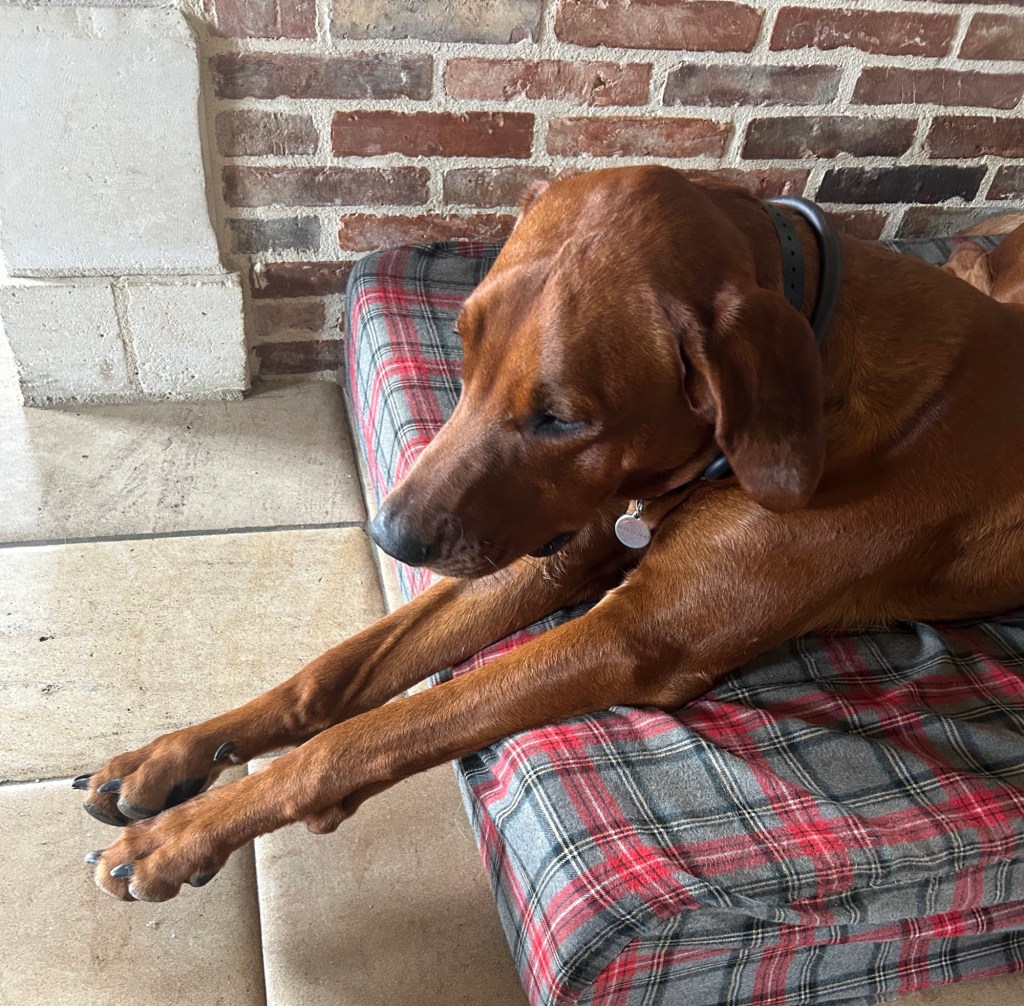
It is not cold yet, but the days are drawing short, and when I take the puppy out at 7.30 a.m. I wear a jacket and sometimes a woolly hat. The leaves are turning and some days there is mist on the ground.
We do get some brilliand days, though, and the beach is magic.
There are still flowers in the garden, and a few tomatoes. The crab apples are red, and the apples are ripening also.
The summer went by too fast, as usual, and the weather was not very inspiring—however, we did not get heatwaves, or a water shortage, or forest fires, as in Greece or other southern countries.
The puppy likes crab apples
We are fortunate to live near Deauville, which is a beautiful and lively town, with plenty going on at all times. Racing, polo, film festivals, exhibitions and more. We have lately acquired a cultutal center called Les Franciscaines, the conversion of an old nunnery, and there is always something on.
Back in March they put on an exhibition by the abstract artist Zao Wou Ki. It was a real treat to be able to see some of his paintings within 15’ of my house. I’ve written about him before. Here: https://athensletters.com/2018/09/25/awed-by-the-abstract/)
One of the highlights of the summer was an exquisite concert by the Japanese neoclassical composer Koki Nakano. I did not know what to expect, having never heard of him before, and in fact had never heard anything like it before—immersive soundscapes somehow combined with melody. In the La Chappelle, the small theatre placed in the former nunnery’s chapel, a grand piano was the only thing on the stage, its lid open and adorned with electronic devices. It was flanked by an electric keyboard.
Nakano played his own compositions, a mixture of electric and acoustic piano and I can honestly say one was more beautiful that the previous. The concert was called Oceanic Feeling. Sometimes he was accompanied by a dancer, the wonderful Tess Voelker from Chicago, since he is fascinatedby the relation between music and the human body.
This is the clip he had made of his music
The simplicity of the setup, the magical lighting, the elegant musician himself who addressed the audience between the pieces and even spoke in French, all made for a truly memorable evening.
Tokei(Tokyo) by Akira Yamagoshi. An aerial view with enchanting details. Zoom in to enjoy.
At the same time the centre put on an exhibition relating how the impressionists were inspired by Japanese art, which contained a few treasures.
Micro Fuji by Tiger Tateishi (1941-1998)
To finish off, sadly we could not see the northern lights which appeared over Europe. I have seen them once, in Iceland, and they were mostly green and yellow, whereas these were quite pink. So for your enjoyment I am posting a wonderful photograph by Deborah M. Zajak on her lovely blog Circadian Reflections (https://circadianreflections.com/2024/10/13/something-for-sunday-northern-lights/#respond) I urge you to take a look, she posts great photographs of birds and other stuff.
Some days ago I was happy to be invited to a picnic organised by a Paris art gallery, the Galerie Jocelyn Wolf, at a manor house in deepest Normandy. This was a very old building, renovated over the course of a few years by the gallery owner, Jocelyn, in order to provide a venue for artist residencies and a framework for exhibiting artworks, including outdoor sculptures.
After passing the Pont de Normandie, always a treat as driving over it is the next best thing to flying, I took a road winding through beautiful countryside and arrived literally in the middle of nowhere, where thankfully a small sign with PARKING on it gave a hint I was in the right place (to outward appearances, a rustic farm with various agricultural implements scattered around).
A gravel road led to the house itself, fronted by an orchard where I came upon a group of people sitting on the grass under the beautiful, ancient apple trees.
I joined them and someone thoughtfully provided me with a glass. Each group of three or four people shared a wicker basket of the most delicious local food: a loaf of fresh country bread, a variety of cured meats and cheeses, small radishes, a jar of rillettes, a brioche, punnets of berries—washed down with cool cider. Dogs and kids ran about.
Painting by Sosthene Baran
As we were finishing, a few drops of rain (it being Normandy, after all) made us gather up the remains and congregate for coffee in the kitchen, after which I went to explore the house. This has been left in a very primal state, with beautiful old doors renovated but unpainted, stone and brick exposed, and gallery-style electrics installed on wire tracks.
Windows on every side open on pristine, unspoilt countryside and there is a huge open space attic. The whole thing is in impeccable taste and a fitting framework for all sorts of art.
Sculptures by Christof Weber
The rain having stopped, I went for a tour of the garden to see the sculptures installed there, some actually in the pond behind the house.
Sculpture by Francisco Tropa
The afternoon concluded with a performance by two artists represented by the gallery, Prinz Gholam, who struck poses taken from famous sculptures while wearing a series of fascinating masks.
Although I have been multiple times to the Panathenaic Stadium or Kallimarmaro (beautiful marble) every new visit strikes a fresh chord.
A truly magical place under the pure blue Attica sky
Built entirely of white marble, the stadium was first constructed on the site of a simple racecourse by the Athenian statesman Lykourgos c. 400 BC, primarily for the Panathenaic Games. It was rebuilt in marble by Herodes Atticus, an Athenian Roman senator, by 144 AD it had a capacity of 50,000 seats. After the rise of Christianity in the 4th century it was largely abandoned, but was excavated in 1869 and hosted the Zappas Olympics in 1870 and 1875. After being refurbished, it hosted the opening and closing ceremonies of the first modern Olympics in 1896.
The reason for my visit, a few days ago, was a Taekwondo event within the framework of the Together in Sport program, titled Together in Taekwondo.
More than 400 young Taekwondo athletes, boys and girls, took part in a series of competitions and poomsae.
As I entered the stadium an impressive number of black-belted teenagers were literally flying about in breathtaking movements—it was like watching a Ninja movie.
On the side, smaller kids in helmets were performing more basic moves.
In the second part of the event, young refugees of all ages and from a myriad countries mingled with the Greek kids and got a chance to try the sport for themselves.
Some of the action
Emotions ran high, there was much laughter and bantering as big boys tried various kicks while tiny girls in skirts spun cartwheels around them.
The event was rounded up with speeches, awards and gifts and there was also an art exhibition titled ‘We are all on the same team’, sponsored by the High Comission for Refugees, with drawings, posters and comics by 1.800 students of all ages.
The President of the Teakwondo Federation declared that it was a dream come true for them to find themselves in the historic stadium.
Photo by Lina
Together in Sport is a European project implemented by METAdrasi, an NGO helping refugees, in cooperation with the Hellenic Olympic Committee and the German Olympic Sports Confederation (DOSB)
The main aim of the project is to use sports as a social medium to give the chance to asylum-seeking children (from 7 to 17) to learn about and take part in organized sports—but also through sports to develop relationships with their peers from the local communities. The project enjoys the support of Μunicipalities in Attica and the rest of Greece.
Amongst the aims of the project is to cultivate and promote values like mutual respect, team spirit and intercultural tolerance—as well as improve the everyday life of these kids and enhance their sense of belonging.
The programme also includes recreational and cultural activities of an educational nature (visits to museums, archaeological sites, sports facilities etc.)
Photo by Lina
The above is to give some general information, but what was wonderful about this particular event was the sense of enjoyment in all present and the appreciation of being in such a unique place as the sun fell.