Summertime living makes things seem less grim, especially if one can get away for a day or two. For Greeks, though, life continues to be a struggle, with ever-rising taxation, constantly changing rules and laws, and a failing infrastructure. A quick glance at the papers reveals the following:
– The dramatic worsening of the Italian economic crisis has put a damper on the government’s hopes to stage a smooth exit from the bailout program in August. The political earthquake in Italy has caused shivers in the whole of Europe, given that its economy is the third largest in Europe, and nearly ten times larger than that of Greece.
Consolation
– In Lesvos, refugee arrivals from Turkey have not abated, resulting in the hotspot of Moria being inundated by 7.300 people (for 3.000 places). There have been clashes between migrants from Arab countries and Kurdish residents over religious differences, and hundreds of people have dispersed over the island, sleeping rough in parks and woods. Fearing for their safety, they are refusing to return to state-run camps. Plans have been made for the creation of more reception facilities, but the local authorities have reacted forcefully against these. It is true the islanders have borne more than their fair share of this burden, but nevertheless immediate solutions must be found.
More consolation
-Meanwhile, the leader of the opposition Kyriakos Mitsotakis presented his business model for the country. His message was: No to more taxes and social contributions, yes to investments and new jobs, but also to healthy entrepreneurship. Amen to that? Well, I’m not getting my hopes up, we’ve heard this before. Many times, by all sides.
To end on a better note, there is something we can be proud of:
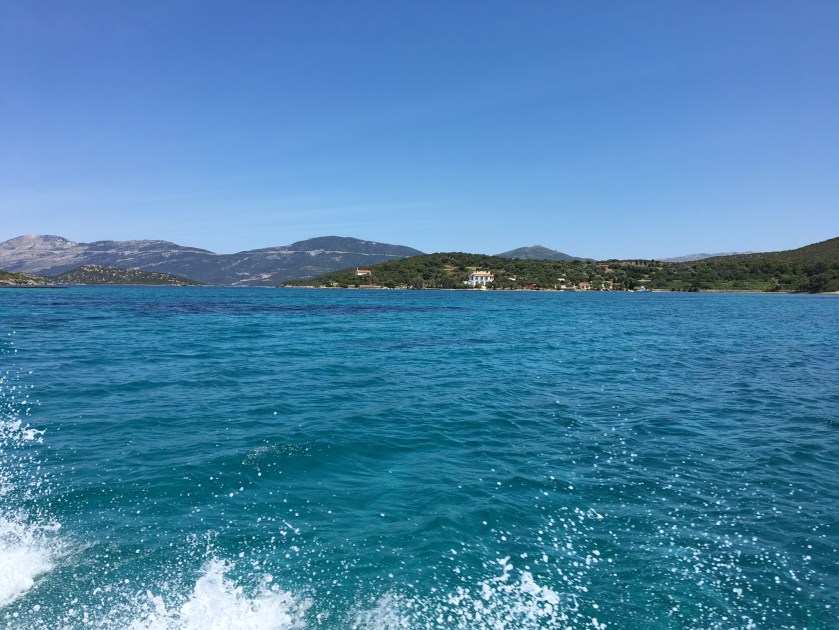
In its annual report, the European Environmental Agency has said that 95.9 per cent of all coastal bathing waters in Greece are of excellent quality. Off to the beach, then, to drown our sorrows in the crystal clear waters.
Having been invited to Amsterdam for the birthday of a dear friend, a group of us were lucky enough to visit a temporary exhibition at the Rijksmuseum entitled High Society.
The lovely Amsterdam architecture on one of the central canals
The exhibition features a collection of 35 full-length, life-size portraits of monarchs, aristocrats and rich citizens, by great masters in art history. It spans four centuries (from early 16th to the start of the 20th), and is styled as a party—featuring power, wealth, and massive egos. Because of the time and expense involved in painting such large canvases, this was a form of portraiture reserved for royal and noble subjects and, in later years, for what would now be known as ‘the one percent’.
It is also a timeless, fascinating, international fashion show, since people dressed in their best finery for the occasion. The paintings are full of symbols of the subjects’ wealth and power. Cloth of gold, lace, embroidery, large and intricate jewelry. There are also lots of accessories and plenty of dogs—lap dogs to show pampered luxury, fierce hunting dogs as symbols of strength.
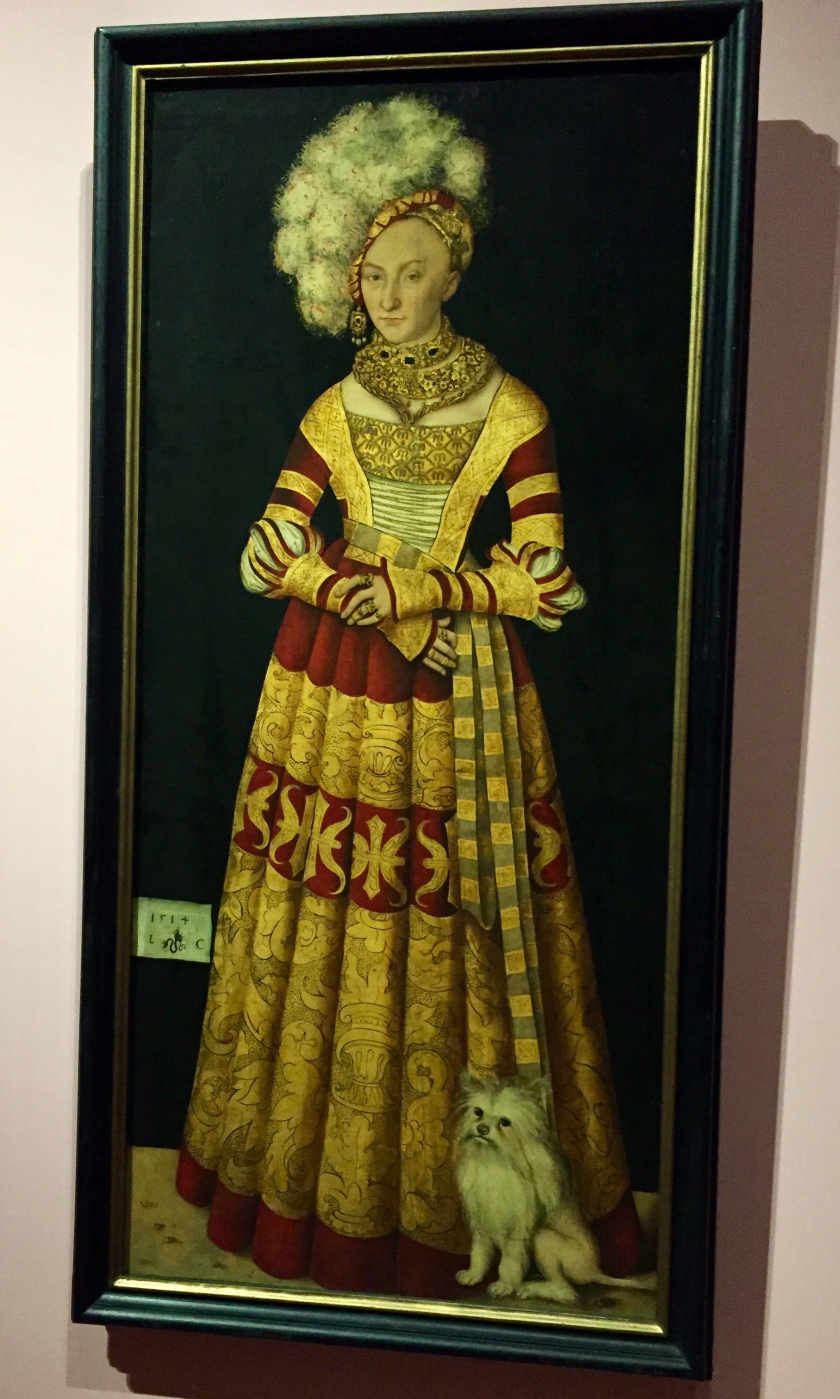
See, above and below, how the painter Lucas Cranach (c.1472-1553) portrayed, for the first time in Northern Europe, a couple standing, life-size, and full length. They were Catherine of Mecklenburg (1487-1561) and Henri the Pious, Duke of Saxony (1473-1541), and the painting was commissioned in honor of their marriage in 1512.
He wears a wreath of red and white carnations to show he is a groom and, surprisingly, he’s neither clean-shaven nor bearded, but sports a very modern stubble.
Then there are Rembrandt’s wedding portraits of Marten Soolmans and Oopjen Coppit – his only life-size, standing, full-length portraits. Painted in 1634, they were a joint 2016 purchase by the Kingdom of the Netherlands and the Republic of France from the Rothschild collection, and they have just been restored. They are not as handsome as the previous couple, but their wedding black is accessorized with the most intricate lace collars and matching flower belt buckles.
Source: Google
It must be noted that, at the time, the wearing of black showed ostentation, not restraint: black was the most expensive material, had to be laboriously dyed and was difficult to upkeep. It was therefore a symbol of status which could, moreover, show off silver buckles and lacework to advantage.
The most powerful man of Europe, Charles V, Holy Roman Emperor, (1500-1558), had himself painted life-size by Jacob Seisenegger (1505-1567), showing just how important this type of portrait had become. Note the very wide shoulders, another symbol of strength, and the hunting dog.
An austere and powerful portrait, of Don Pedro di Barberana y Aparregui (1579-1649) by Velázquez (1599-1660). Don Pedro moved in powerful circles in 17th-century Spain, was comptroller of the royal treasury and sat on the King’s secret council. Note the plain background, contrasting with others that are richly decorated, and the tip of the sword lifting his coat at the back.
In a looser mode, the enchanting portraits, by Veronese, of Count Iseppo da Porto (c.1500-1580) with his son Leonida. The Count was one of the most influential figures in the town of Vicenza in the 16th century.
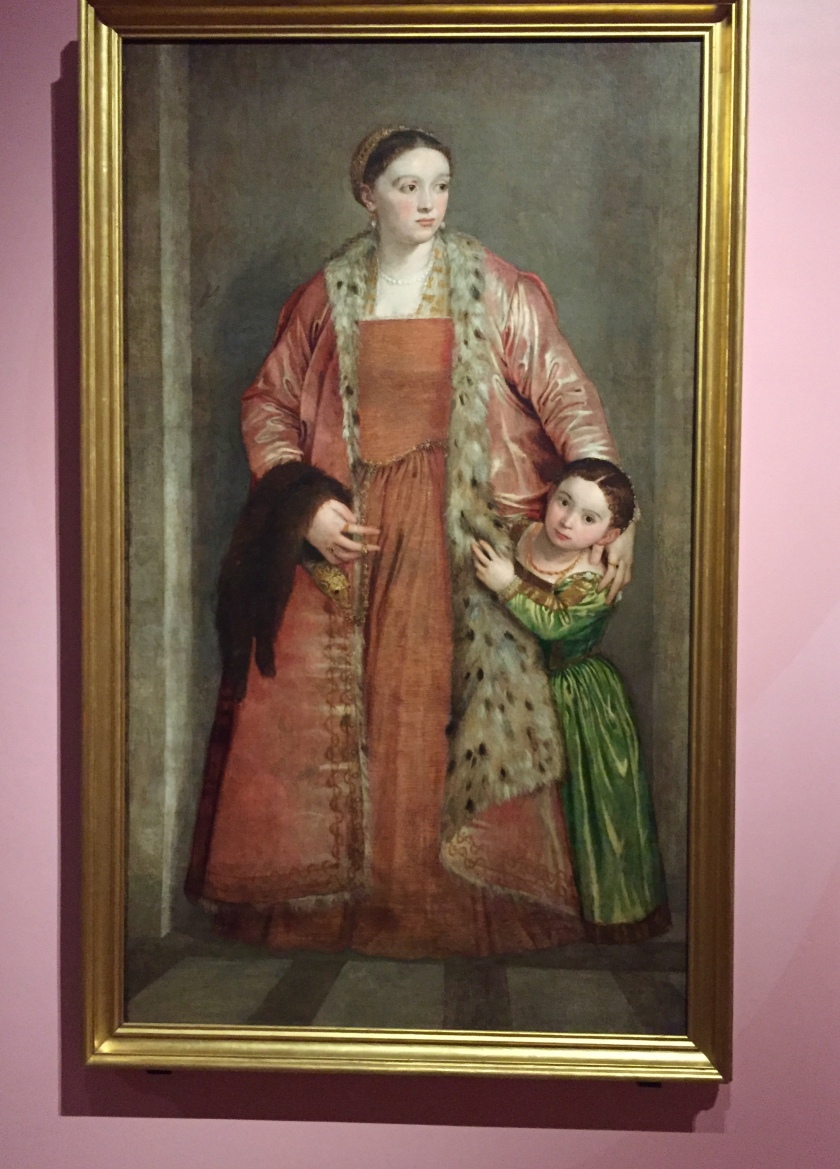
And that of his wife, Countess Livia da Porto Thiene, also descended from a noble family, and her daughter, Deidamia.
They are portrayed in ‘everyday’ clothes, which, although luxurious, are not too showy. It is rare these portraits can be seen together, since, sadly, his is in the Uffizi Gallery, while hers is in the Art Museum in Baltimore. A great shame, since being displayed next to each other greatly enhances the emotional import.
Moving on to more recent times, the portrait, by the English artist Gainsborough (1727-1788) of the beautiful Mary, Countess Howe dressed in what would have been the height of fashion in the mid-1700s. Her pale complexion is enhanced by the black ribbon on her wrist and her arsenal of expensive accessories also attest to her aristocratic status. Gainsborough only yearned to paint landscapes, but these would not earn him a living, so he was obliged to paint the local gentry, moving to another town with all his family in search of more clients, once he had finished one lot.
This portrait by John Singer Sargent (1856-1925) was a rare treat, as it is domiciled in Los Angeles, where women are said to swoon before it. It depicts the exceedingly handsome Dr. Samuel-Jean Pozzi (1846-1918), who was the founder of modern French gynaecology and an incorrigible womanizer. Sargent, an American artist who moved to Europe, appropriately painted him in a scarlet dressing gown and embroidered satin slippers. Pozzi was killed by one of his clients, a man whose impotence he had failed to cure. He nevertheless had a long and distinguished medical career, and consorted with many creative people, such as Sara Bernhardt, who was briefly his lover and remained a lifelong friend, and Marcel Proust.
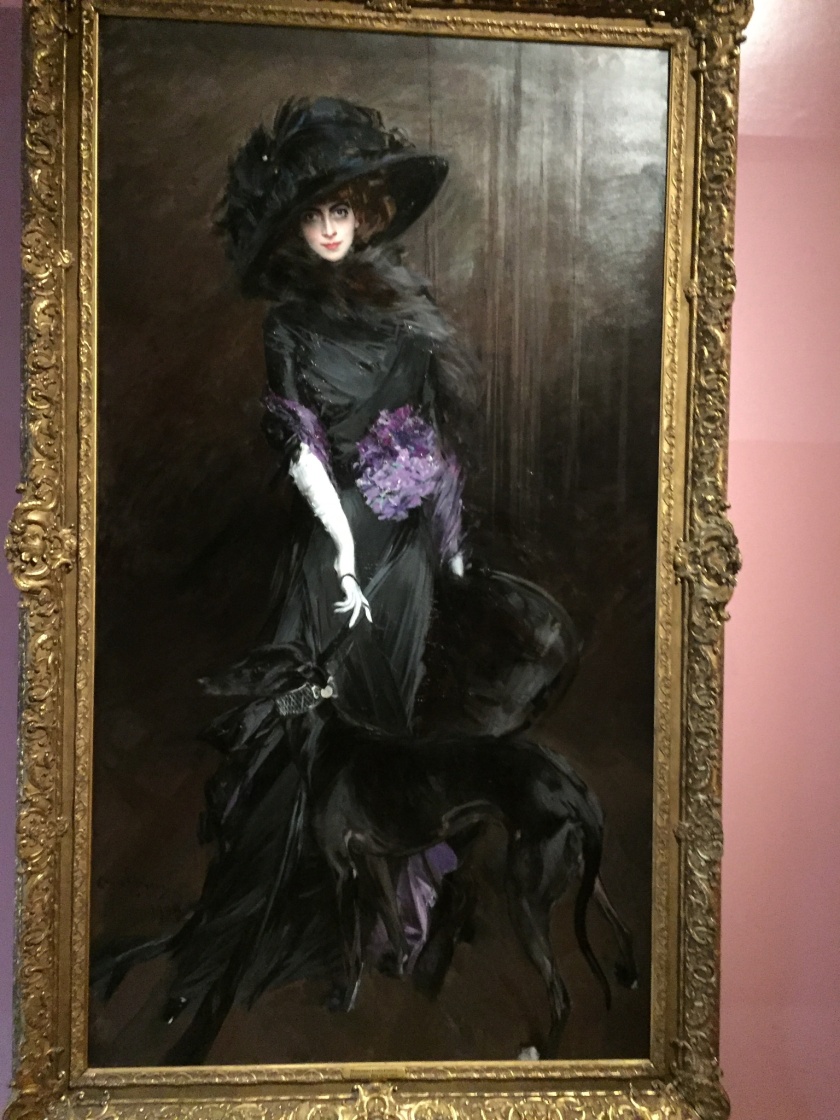
Giovanni Baldini’s Marchesa Luisa Casati with a Greyhound (1908) catches its subject in what is, for Casati, a relatively understated outfit: she once wore a dress of lightbulbs wired up to a generator. She was once described as the Lady Gaga of her day.
The card next to the painting says: Six feet tall and thin as a rake, and with bleached skin, heavily made up eyes and hair dyed either a fiery red or emerald green, Luisa Casati’s appearance was unforgettable. At the many legendary parties thrown by the flamboyant and eccentric marchesa the champagne flowed freely and there was no shortage of cocaine and opium. Boldini painted Casati wearing haute couture and accompanied by her favourite greyhound with his characteristic, ‘slashing’ brushstrokes.
A last highlight was the portrait, by Kees van Dongen (1877-1968), of Anna, Comtesse de Noailles (1876-1933), a writer and leading figure of Parisian society. The portrait was considered shocking, if not offensive, at the time, because of the plunging neckline revealing a hint of nipple, and the fact that she irreverently wears the ribbon of the Legion d’Honneur (a great honor conferred by the state) as a choker around her neck.
It was a rare treat to see these portraits assembled in one place—and fascinating to compare the mores and fashion of each era. To finish, I wanted to share a video of the Museum’s wonderful Shylights, a light installation created, out of silk, by Studio Drift.
If you click on the video, it will magically right itself, for some mysterious reason.
I’m still working on my next post—but, meanwhile, I thought any foodies or cooks amongst you might be interested in this post on one of my favorite blogs, Evolving Life. Sampling the food of the Minoans—some of you may have read my post on the ancient Palace of Knossos in Crete.
Recently we were invited to attend a demonstration on Minoan Cuisine – appropriately held near the Palace of Knossos on the island of Crete. Jerolyn Morrison, a trained archaeologist and one of the creators of Minoan Tastes, reenacted cooking techniques from ancient times. Minoan Tastes organises cooking events for people to (as she prints on her card) “experience the flavors of the land, sea, and sky of ancient Crete”.
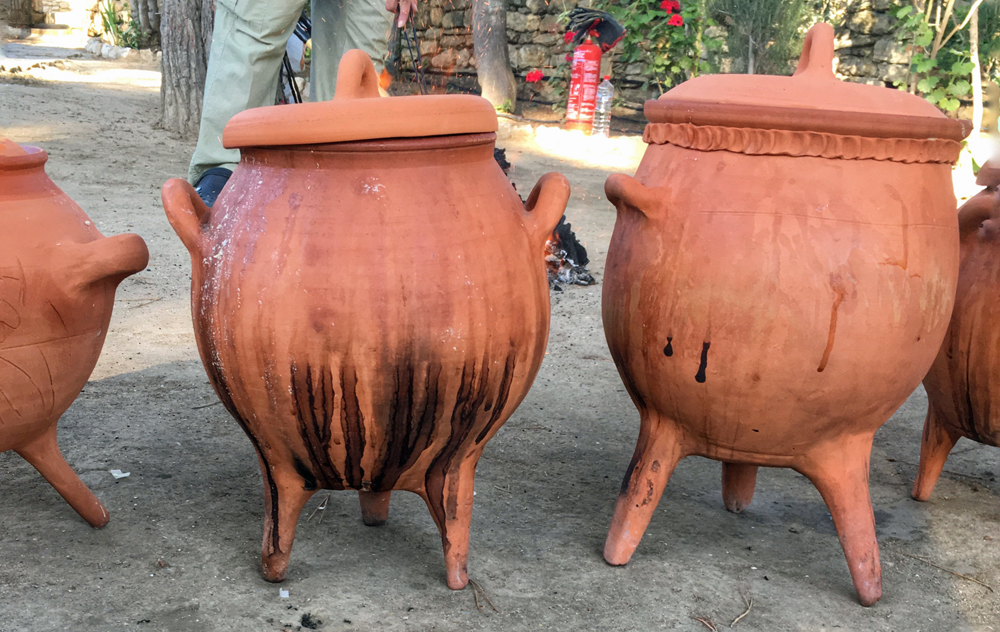
The cooking pots she uses are custom made on Crete, based on pot shapes and ceramic fabric found in archaeological contexts – including the iconic tripod cook pot of the Minoans.
Before cooking, the unglazed pots are prepped by soaking in water, and charcoal is heated to the white heat stage.
The pots are then surrounded with the hot charcoal and diligently monitored, adding more coals when required to sustain the long, slow cooking process.
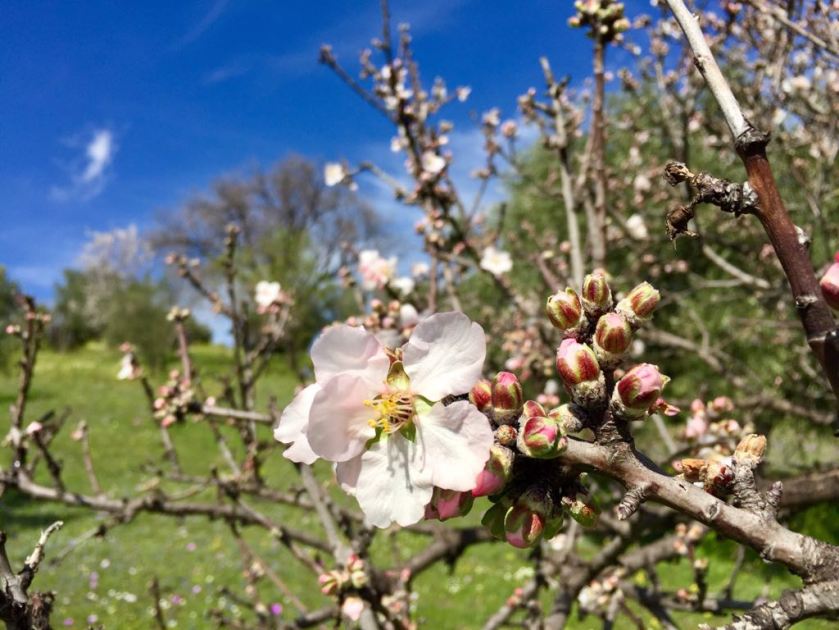
On this day, I would like to celebrate springtime, with flowers as a symbol of peace. My wish is for an end to warmongering.
Below find the two parts of a floral diptych – it is still a work in progress, but it is my offering for May first.
Also I wanted to share the latest remake of Bob Dylan’s Masters of War – no comments added.
Any Greeks still doubtful about climate change are becoming more convinced as yet another cloud of dust from the Sahara hits Greek skies.
Athens, known for the pure blue of its Attic sky, is covered in a yellow haze, and people are going around coughing or hiding their mouths behind handkerchiefs.
Source:Google
Things have been even worse in Crete, because its proximity to Africa means the dust is denser, turning the atmosphere bright orange.
Source:Google
We have always had this phenomenon when certain climatic conditions prevailed, but it would occur only occasionally. In the last few years it is becoming more common and happens several times per year. According to scientists, it will probably continue increasing with time, as climate warming becomes more intense.
The dust cloud is not toxic, but it is extremely unpleasant and can cause breathing problems in people suffering from lung conditions such as asthma.
This is what the sky should look like at this time of year!
When I wrote about the wonderful community of the Estia Agios Nikolaos, (click here if you missed it) the post became too long for me to include anything about the town of Galaxidi. In fact, this picturesque little town, with its fine natural port nestled in the gulf of Korinth, has a very interesting history.
Before Greece had acquired good roads, seaways were essential to trade, and, by 1775, the Galaxidi port, under the tolerant eye of Ali Pasha, the Ottoman ruler of Ioannina, was fourth in strength in Greece, with 60 large ship of a total tonnage of 10.000 and crews numbering 1.100 souls. The fleet operated on a system whereby each member of the crew owned part of the ship or its cargo – this fostered a spirit of active entrepreneurship, but also cultivated economy, frugality and common sense. The crews’ daily diet was dry bread, olives, salt fish and a little wine, and they were known for their endurance in adversity.
The captains of Galaxidi contributed greatly to the War of Independence of 1821 and, after liberation from the Ottoman Empire, the fleet was quickly rebuilt.
After 1840, there was a rapid rise in prosperity, with the shipowners of Galaxidi founding their own insurance companies, and shipyards which built around twenty vessels a year. In the 1870s, more than 350 sailing ships crisscrossed the Mediterranean, travelled to the Black Sea and as far away as the Atlantic.
Yachts are moored where the sailing ships used to be.
Sadly, by the end of the 19th century there came a steady decline , since the shipowners of Galaxidi insisted in staying true to their sailing vessels, and refused to covert to steam. They lost their competitive edge, and the town began to dwindle, while some families moved to Pireus. The coup de grace came with the German occupation.
Why did the traditional captains of Galaxidi fail to become modern cosmopolitan shipowners, like so many other Greeks did? It’s difficult to say. Maybe it was their insistence to cling to tradition, maybe it was their sense of independence which stopped them from forging the alliances needed to secure the necessary funds for converting the fleet. Be that as it may, their houses still stand as a reminder of their past glory. Neoclassical in style, they boast wonderful painted ceilings decorated by Italian artists the captains invited back with them, along with pieces of furniture and decorative objects bought on their voyages.
In Ancient Greek religion, Estia or Hestia (/ˈhɛstiə/; Greek: Ἑστία, “hearth” or “fireside”) is a virgin goddess of the hearth, architecture, and the right ordering of domesticity, the family, the home, and the state.
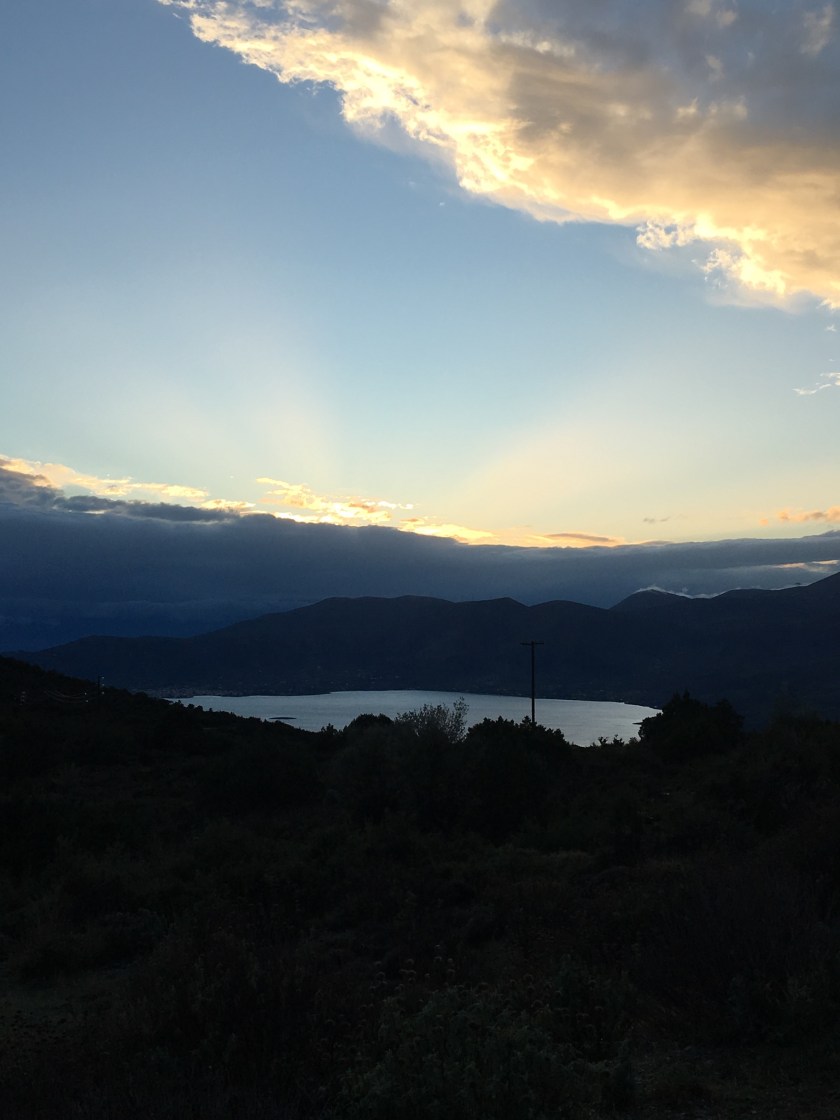
It was a difficult start to my road trip to the seaside town of Galaxidi. The rain poured down, washing out the view on all sides. A few bare branches were the only things visible as I tried to keep the car from aqua-planing on the turns. A two hour trip took a while longer but, as we emerged on the top of the mountains above Itea the sky cleared and a few rays of brilliant sunshine pierced the clouds.
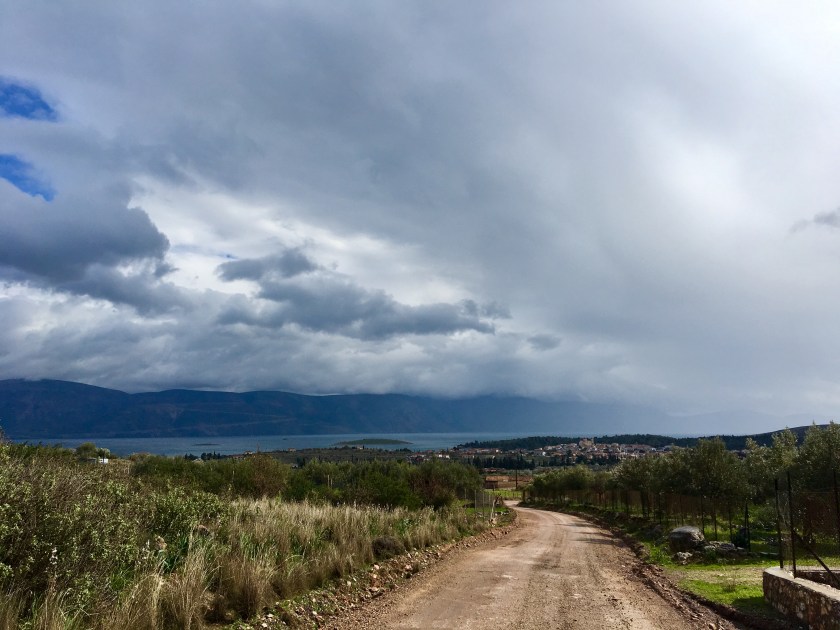
The view towards Galaxidi
The charm of Galaxidi was restored, and so was my mood, over a cup of mountain tea taken at the hotel with some of the other visitors. We were all here for the annual cutting of the traditional vasilopitta at the Estia Agios Nikolaos, (https://www.estia-agios-nikolaos.org), a community where adults with special needs live, work and share their free time together with those caring for them. In this, Estia Agios Nikolaos is quite unique, and not only in Greece. It is also one of the few such communities worldwide which is not affiliated to one particular religious faith, and this inclusiveness is the main point of attraction for people all over the world who come to live and work here, making Estia a vibrant and exciting place.
Our b&b, the Hotel Nostos
Everyone had dinner together at a wonderful seaside taverna. I sat next to Clara (German, speaking fluent Greek) and Maxime (French, having just signed up for his second year, rapidly improving Greek), two vivacious and inspiring young people, who talked about their work with enthusiasm. Also present were numerous locals, such as the pharmacist who donates all meds for the community, and a lady who provides fish from her fish farm once a week. And, making a star appearance, was Estia’s first baby, Mia, born to a couple who work as carers – a source of endless fascination and delight for all.
Next morning, after a delicious breakfast of home-made delicacies and a walk in the port, we drove to Estia, where everyone was gathered in the assembly hall.
Music and songs. The man playing the trumpet is the Estia gardener.
The festivities started with a couple of songs (this video might look as if it’s facing sideways, but it will right itself once you click it. The mysteries of technology…)
Then the cutting and sharing of the vasilopitta.
We visited the ceramics shop, where colorful creations were on offer.
The wonderful vegetable garden,
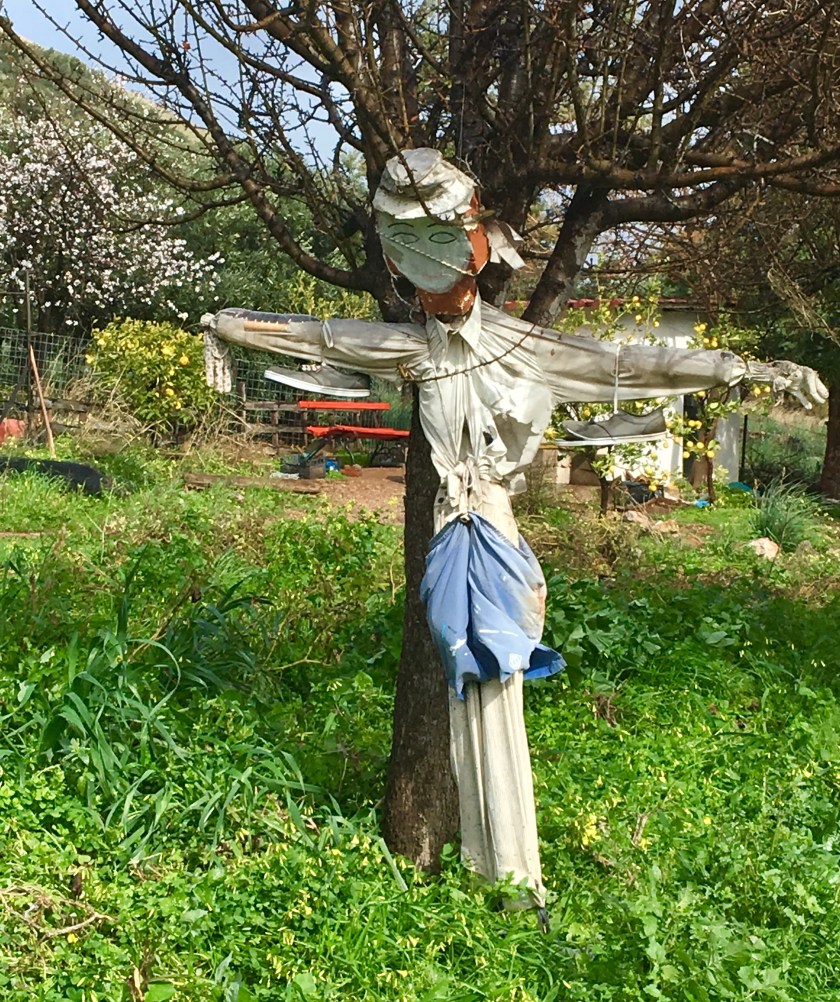
complete with scarecrow,
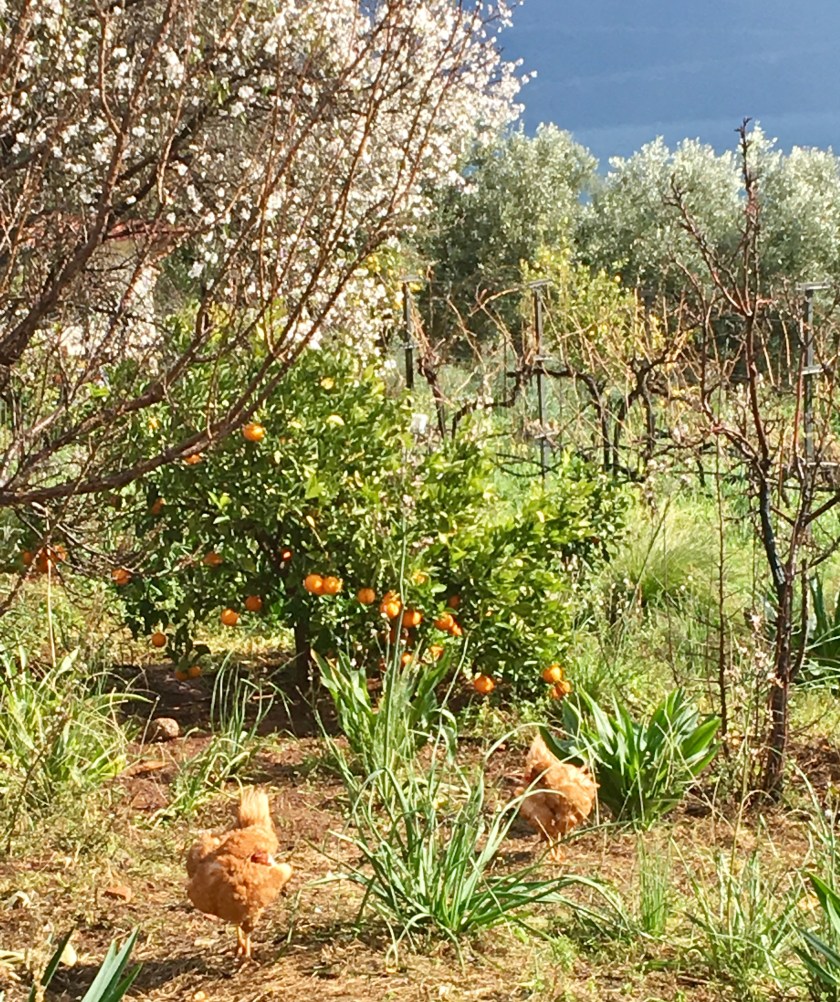
and free-range chickens.
And finally one of the four residences, which in total cater for 45 people, of whom 22 have special needs (at the moment there is space for two more.) In ‘Estia Agios Nikolaos’ all the members live in small family structures, which comprise 6-9 special needs guests, 2 to 3 professional caregivers and 2 to 3 volunteers.
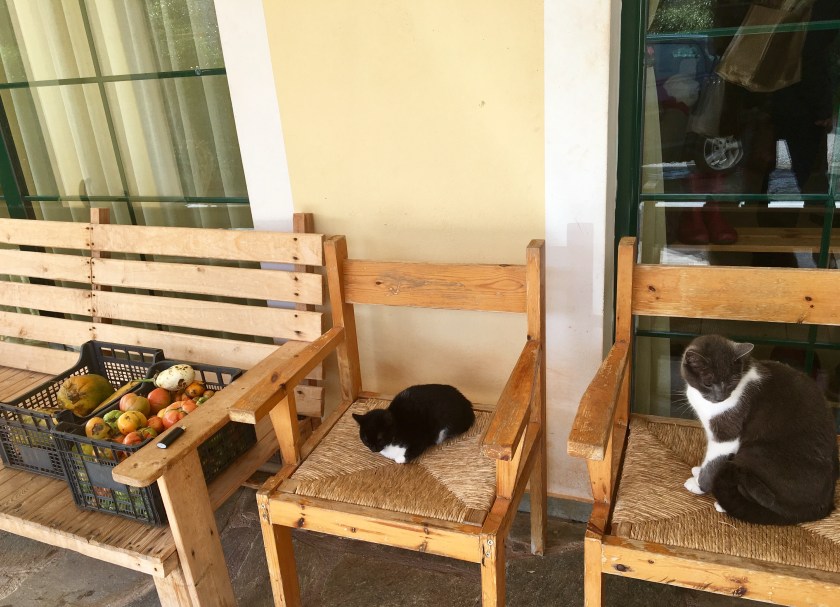
The entrance with its cats and box of fresh home-grown veggies.
A cozy living area
Complete with music corner
Fireplace
A large dining table for communal meals
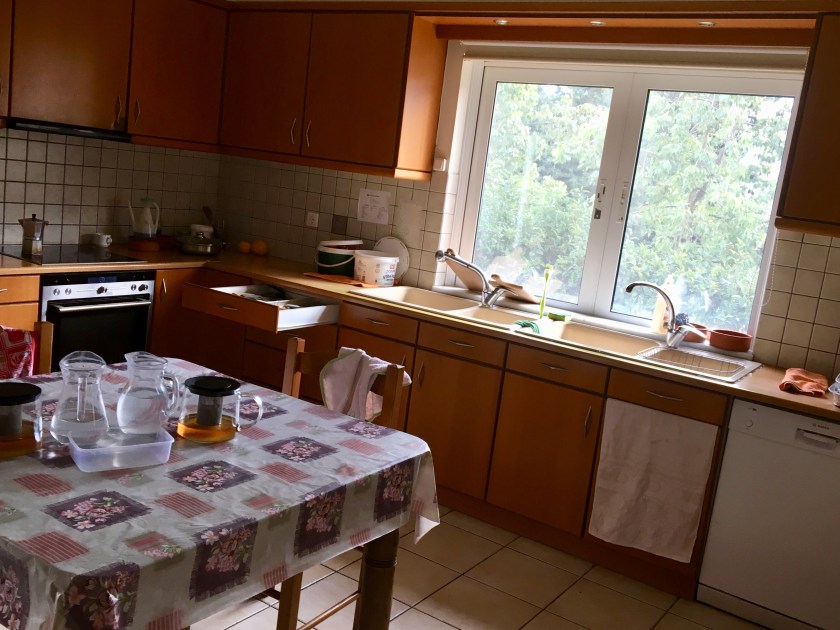
A lovely kitchen
And a well-stocked larder.
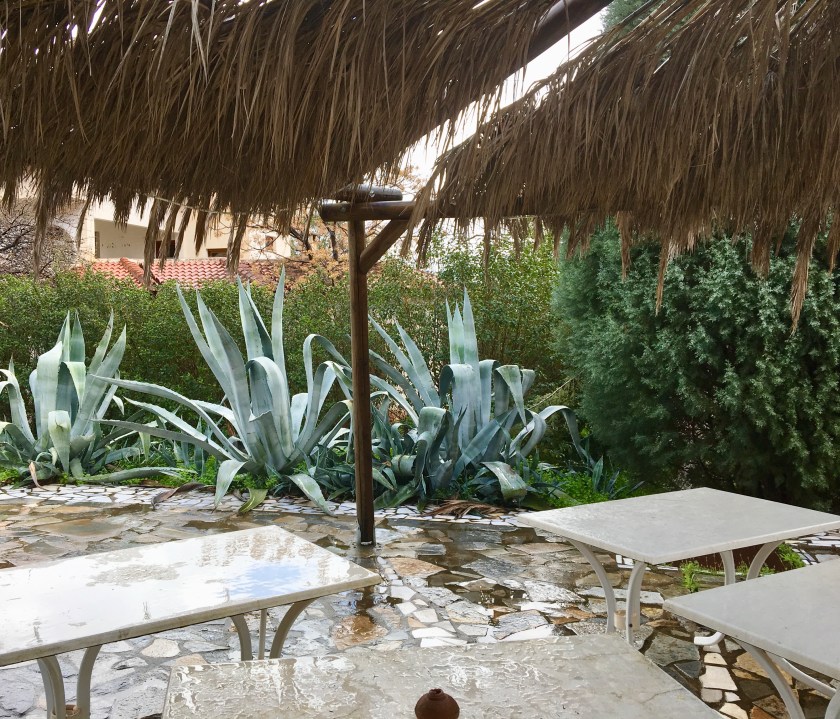
We went on to visit another building which is used for various activities, fronted by a shady terrace for barbecues and ad hoc concerts. This doubles as the Kafeneion (café), a gathering place for Sunday coffee with the locals and evening parties.
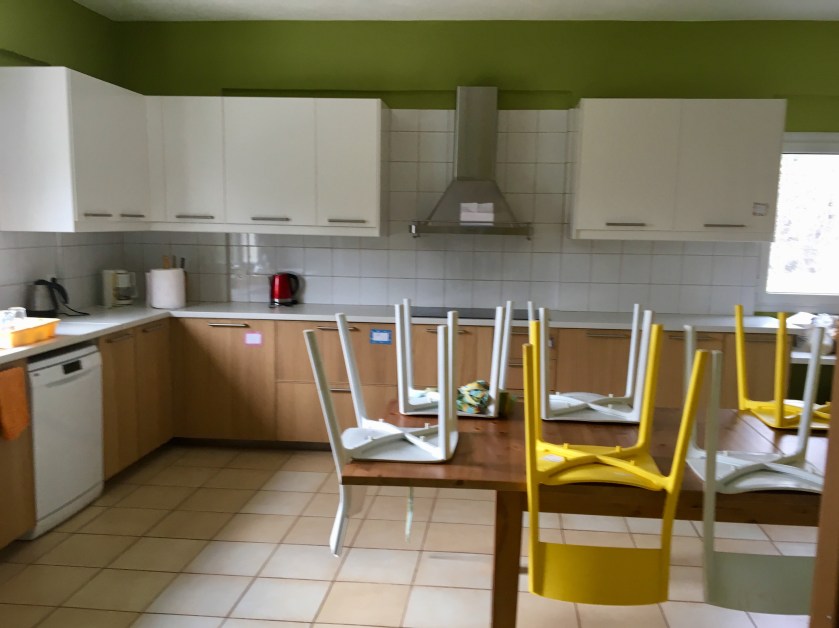
A brand new kitchen, designed by an architect friend and donated by IKEA (the floor had been freshly washed), will be used for the new bakery and pastry workshop.
And there is a loom for weaving
Maren, who is German, is responsible for one of the houses and took us on tour, while explaining that the residents really look forward to their activities each morning after breakfast: either working in the garden or in the pottery and jewelry workshops.
The afternoons are devoted to music, exercising, walking, and in the summertime, swimming in the sea nearby. Besides the staff, there are professionals (most of them on a volunteering basis) providing specific therapeutical activities such as art therapy, physiotherapy, gymnastics and music therapy.
During the weekends, individuals can choose the activities they would like to participate in. There are various artistic and spiritual pursuits on offer, in connection to the local communities, such as outings to musical events, theater and cinema, church attendance and participation in local celebrations. Every Sunday late afternoon, the entire community gathers in the Kafeneion for cake, music and games, often hosting visitors from the local community.
Each new resident is taken in for a month’s trial, to see how well he or she will fit in. Most adapt well, some don’t. After the extensive mutual screening there is a mandatory period of at least one month when the potential resident returns to his/ her home so that each side, resident, family and the Estia team can calmly make up its mind. Sometimes parents find they miss their child too much, and prefer to keep them at home.
Residents join in on outings and trips whenever possible and have even been abroad, which I found impressive, due to the logistic problems needing to be solved.
The cornerstone principle of ‘Estia Agios Nikolaos’ is that “each person is unique and can be helped to develop his or her unique capabilities in a nurturing environment via creative work, artistic stimuli and direct interaction with nature.” Efforts are made to treat each person as an individual – the girl who made a friend in town goes for sleepovers to her house and is allowed to invite her in turn, those who don’t like to sleep after lunch are not made to have a siesta, and so on. Such an anthropocentric approach is quite revolutionary in what remains, in essence, an institution.
The view from the entrance
Giovanna Kampouri, the president of the foundation which supervises the organizers, explained the community’s vision:
“For our residents with special needs, Estia Agios Nikolaos is often their only family and home. Many of them do not have a family that can care for them, and very sadly, most will face the trauma of losing their parents. It is our mission to be able to provide them with a lifelong, stable and loving home. The biggest challenge will come when the first residents will age (in the case of those with Down Syndrome, with dementia). We are now starting to study what it will take to build our 5th home, with special facilities for this group. We need to solve many issues for this, in addition to money, and particularly Greek legal requirements and infrastructure.
On a day to day basis, in the middle of the crisis, Estia has not only survived but managed to thrive, thanks to the love and generosity of an ever widening circle of supporters in Greece and abroad. I believe that this is thanks to its message of inclusiveness, which is filling a growing need in all our societies (to balance the opposite trend of nationalism and xenophobia) We are thankful for this, as we need to continue and to expand our possibility to provide life-long care for our residents. Due to the crisis, the ability of many of our residents to compensate for the patchy payments by EOPYY(social security) been reduced, and we have been able to fully cover this and to even offer full ‘scholarships’ to new residents from every part of Greece.”
And of course, the work is never done. There are plans for acquiring more animals, such as bees and a donkey, building a wood-fired oven, planting olive trees.
I left feeling invigorated and inspired – some truly remarkable work is being done here. If you want to know more, and meet the principals of this story, watch the wonderful video made by Marianna Economou.
After a surge of posts at the end of last year, things seem to have gone quiet. Or rather, I’ve been both very busy and a little uninspired. I see now I only managed a single post in January – horrors! So let me hasten to reassure you, I have not died or gone away.
However, I do find myself at some kind of crossroads with this blog. It’s difficult to write about Greece at the moment – things are no better, and do people want to keep reading about the refugees, the hopeless politicians and the unending financial crisis? I feel I’ve also covered the various traditions, feasts, etc – this is not supposed to be a travel guide, after all. Interviews seem to have dried up, a couple of people never having come up with the goods.
When I come across something amusing or worthwhile, or think of someone fun to interview, or have time for a road trip, or visit an art show, inspiration is easy. However, this does not make for regular output – on the other hand, I don’t want this blog to turn into a kind of homework, there’s no point to that.
So, suggestions are welcome. What would like to read about? Any special interests, more interviews, more art, less art?
Meanwhile, I am planning a trip next weekend, to visit a facility for people with special needs, in the beautiful seaside town of Galaxidi. The Estia Agios Nikolaos is a unique place, the beloved project of a good friend of mine, where people live in a family-style environment and are allowed to thrive at their own pace. They are having their vasilopitta, the Greek tradition of cutting a special cake each New Year. So there is a post to be written soon, which I feel sure will be interesting.
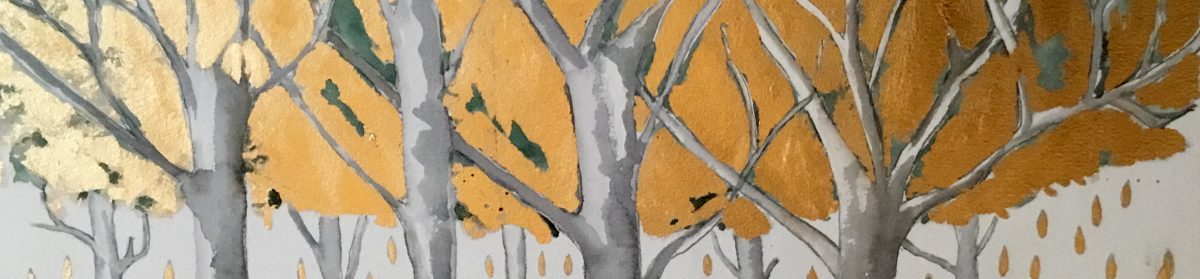
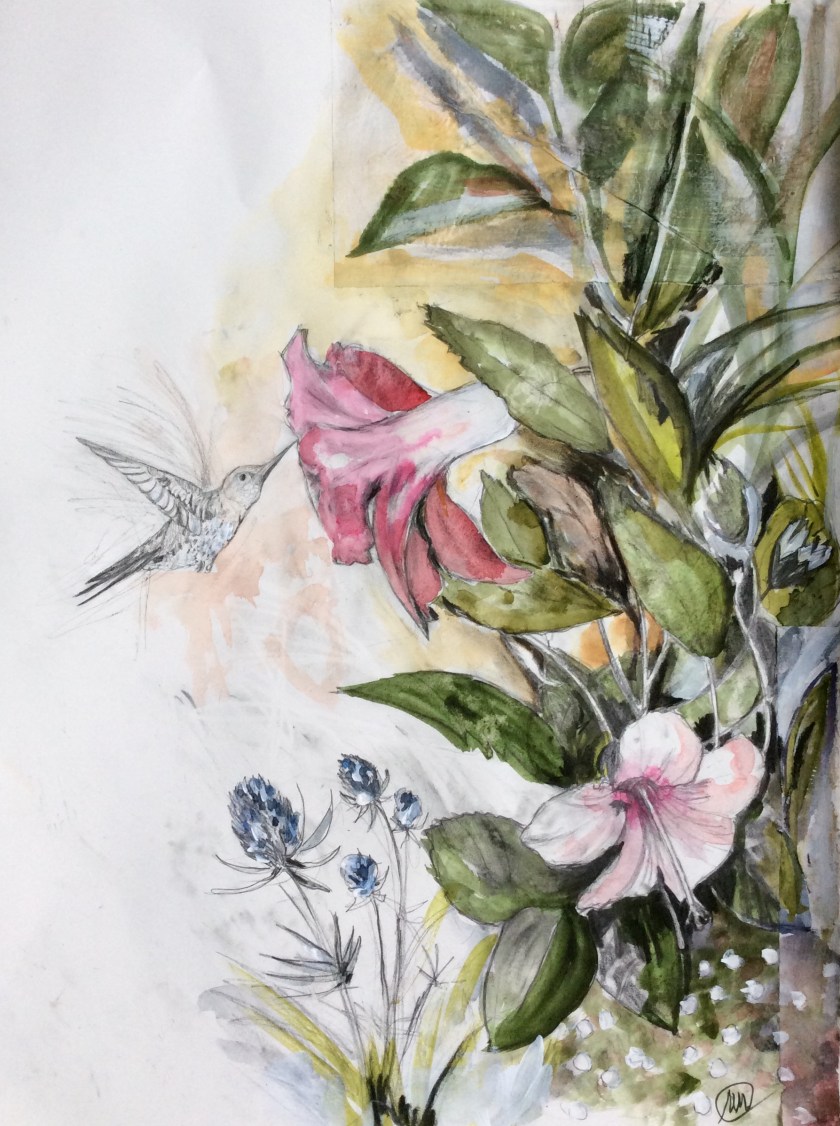
The photographs are of a series I’m working on at the moment, Feathers. They are small paintings, which will make up to a larger installation, and at the same time I’m using them to experiment with different techniques in mixed media. As well as working with watercolor, collage and gold leaf, I’m also layering pieces of newspaper and silver foil with paint and crumpled tissue paper in various combinations. Sometimes I draw or paint over the top, sometimes I gouge bits out with a cutter. It’s really fun to do, and I’m hoping to use these techniques on larger pieces eventually.
Don’t forget to comment and egg me on with your suggestions!
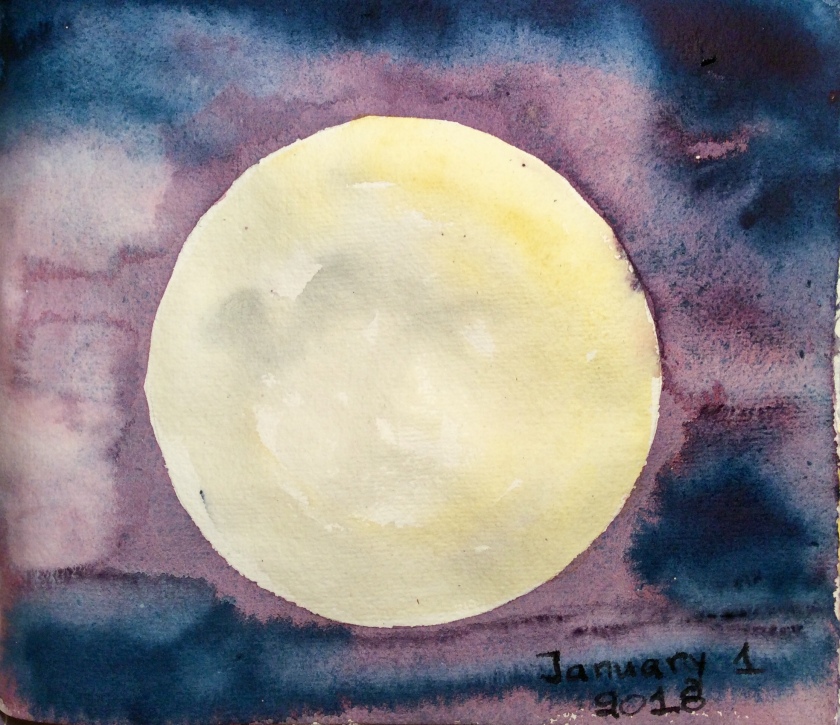
Stepping outside at night on January first and seeing a huge moon shining behind the clouds felt like a good sign – an omen of a great year ahead?
Best wishes to all of you who have been reading my ramblings all year.
But so as not to be too complacent, I will share a cartoon frrom the New Yorker that someone sent me.
Athens has put on its glad rags as a general effort is being made to celebrate the holidays.
SYNTAGMA (Constitution Square) decorated and lit up for Christmas. Photo: tornosnews.gr. Source:Google.
There is a lot going on, despite the continuing problems, which remain huge. Art shows, music, dance, parties – and people just walking the streets, enjoying the season. Athens remains one of the popular destinations for the winter holidays.
As always one must spare a thought (and perhaps a little money) for the people whose finances or personal circumstances make the holiday more of a worry than fun. Also the homeless and the refugees, who are spending another winter without heating or running water.
However, I would like to end this post on a positive note, and send my best wishes to all of you out there, who have been following and commenting all this time. I really appreciate your friendship (even when virtual!) and hope you will enjoy the days to come, with friends and family.
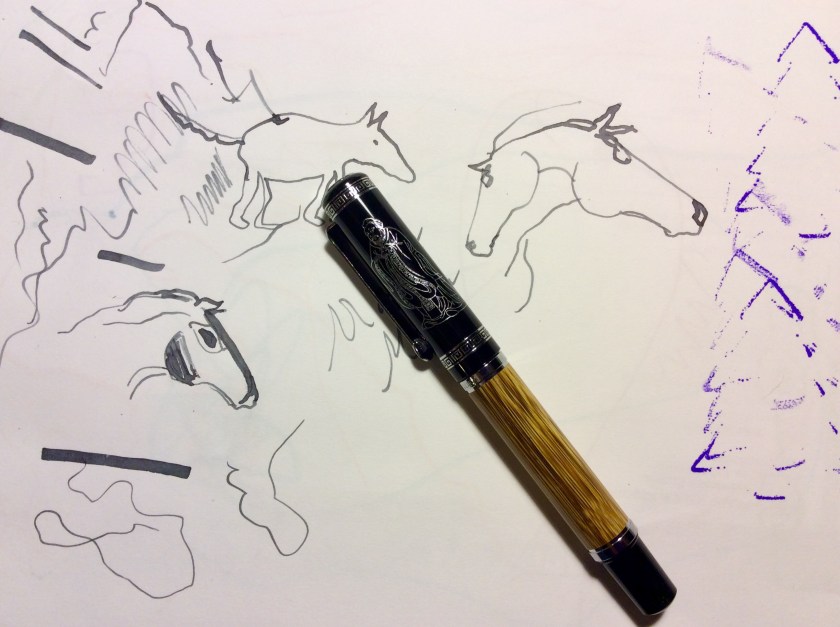
Christmas gift: Trying out a new toy, a Duke Confucius fountain pen – it makes the most interesting marks and is a lovely object in itself. Made from bamboo.
If any of my more recent followers are interested about Christmas celebrations in Greece, I wrote a post about it some time ago – you can find it here.

























 Letters from Athens