Celebrated by even the most secular of Greeks, Easter is for us the biggest holiday of the year. Yes, even bigger than Christmas. Everyone joins in the church rituals and there are lots of other traditions as well. To top it all, this year Greek Easter falls on the first of May, which is, in itself, another popular holiday.
I thought I’d begin by explaining why Easter is a ‘mobile’ holiday: the determination of the date of Easter is governed by a computation based on the vernal equinox (the point at which the ecliptic and the celestial equators intersect) and the phase of the moon. According to the ruling of the First Ecumenical Synod in 325, Easter should fall on the Sunday which follows the first full moon after the vernal equinox (invariably, March 21). If the full moon happens to fall on a Sunday, Easter is observed the following Sunday.
These complicated calculations do not always end up with the same Easter Sunday for all Christian churches, for the simple reason the churches use different calendars: Greek Orthodox use the Julian Calendar and western churches the Gregorian.
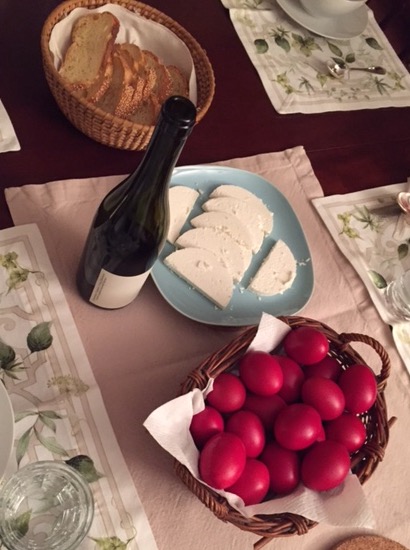
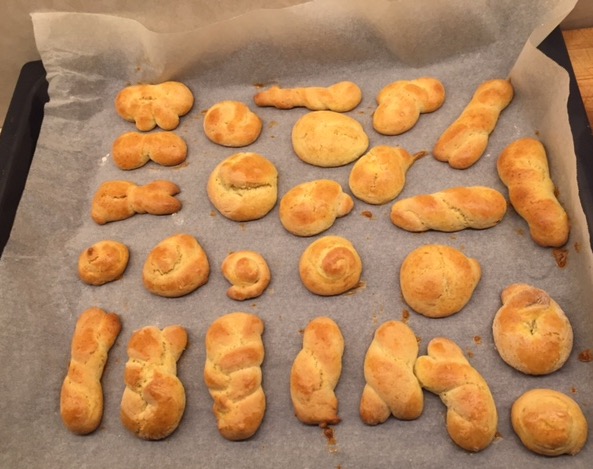
Easter preparations begin on Holy Thursday when the traditional Easter bread, τσουρέκι (tsoureki), is baked. Tsoureki is like a brioche or challah bread in the shape of a plait and is eaten all year round. Some people also bake Πασχαλινά κουλουράκια (pashalina koulourakia – Easter cookies). Eggs are dyed red, to symbolize the color of life and the blood of Christ) and sometimes they are incorporated for decoration in the tsoureki. In the evening, church services include the reading of the 12 Gospels.
Holy Friday is a day or mourning. Traditionally, women and children take flowers to the church to decorate the symbolic bier of Christ, the Epitaphios. The Service of Lamentation mourns the death of Christ and the bier, lavishly adorned with flowers and bearing the image of Christ, is carried on the shoulders of the faithful in a procession through the community to the cemetery, and back. All the congregation follows, carrying candles and repeating the refrain of a beautiful Byzantine hymn. The candles on Holy Friday are yellow, made of natural beeswax.
On Holy Saturday, the Eternal Flame is brought to Greece by military jet from Jerusalem and is distributed to waiting priests who carry it to their local churches.
In the morning, preparations begin for next day’s Easter feast. Dishes that can be prepared in advance are made, and the traditional μαγειρίτσα (magiritsa) soup is prepared, which will be eaten after the midnight service, to break the Lenten fast.
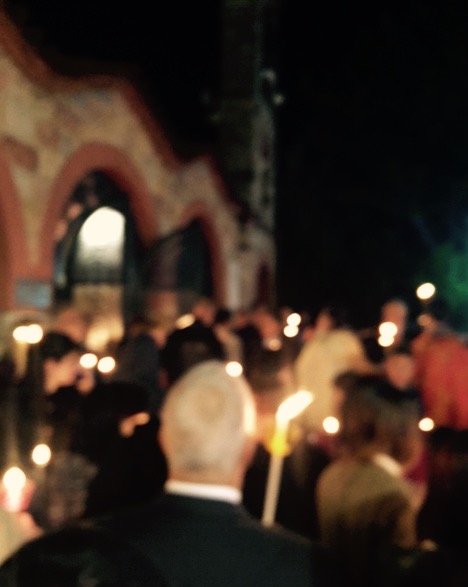
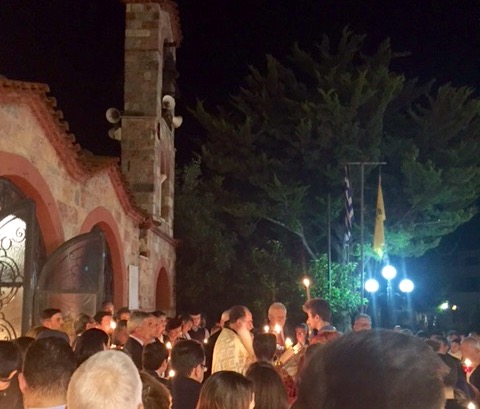
At night everyone, including children, attends the midnight Service of the Resurrection, each holding a white candle. Traditionally, children are given the candle by their godparents, and many are lavishly decorated. Churches fill to overflowing and most people gather outside where the service is broadcast by loudspeaker. Anticipation mounts; shortly before midnight, all lights are extinguished and churches are lit only by the Eternal Flame on the altar. When midnight sounds, the Priest calls out “Christos Anesti” (Christ is risen), and passes the flame, the light of the Resurrection, to those nearest him. The flame is then passed from person to person, and soon the church and courtyard are filled with flickering candlelight. The night air is filled with the singing of the Byzantine Chant “Christos Anesti,” and kisses and wishes are exchanged. The traditional exchange is ‘Χριστός Ανεστη’ (Christos Anesti – Christ is risen) answered by ‘Αληθώς Ανέστη’ (Alithos Anesti – He is truly risen). As is the custom, as soon as “Christos Anesti” is called out, church bells ring joyously non-stop, ships in ports all over Greece sound their horns, floodlights are lit on large buildings, and great and small displays of fireworks and noisemakers are set off. Cars passing by on the road also honk loudly.
People then carry the Eternal Flame home. The sight of hundreds of candle flames moving from churches to homes on that night is beautiful, indeed.
Once home, the flame from the candle is used to make the sign of the cross on the top of the door frame in smoke. The mark is left there throughout the year, to symbolize that the light of the Resurrection has blessed the home. The candles are then put on the table for the midnight meal. Everyone gathers around the table to break the fast; the feast includes magiritsa soup, tsoureki, and the red eggs. But before the eggs are eaten, there’s a traditional game to be played: ‘τσούγκρισμα’ (tsougrisma) – holding your egg, you tap the end against the end of your opponent’s egg, trying to crack it. It’s a game enjoyed by children and adults alike. Eggs are often dyed in large quantities since the game continues on the next day with more friends and family. In large gatherings, someone can usually be found cheating with a wooden egg!
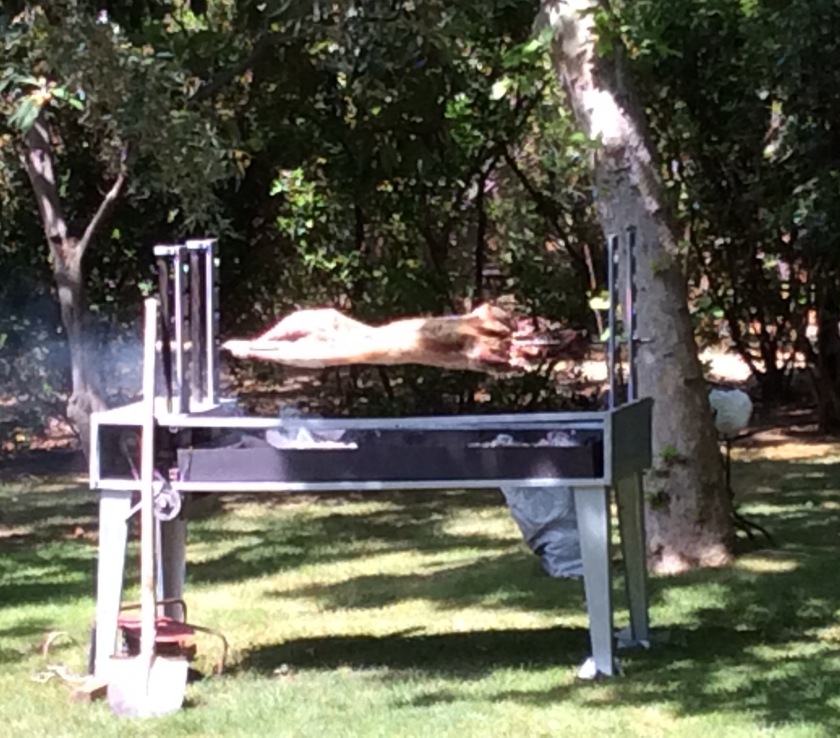
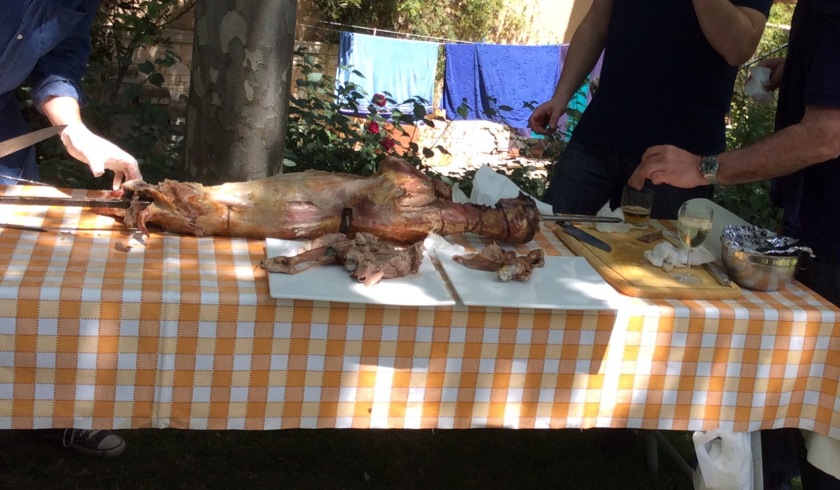
At dawn on Easter Sunday, spits are set to work, since all over the countryside, the menu of the day is whole spit-roasted lamb or kid, to represent the Lamb of God. Also on the spit is another delicacy, kokoretsi, seasoned lamb or goat organ meat, wrapped in caul fat and then in yards of cleaned intestines. This recipe originated from the need to use up all parts of the lamb that was slaughtered for Easter, and not let any go to waste (the rest being used in the magiritsa soup). Delicious to many people in the Balkans, but definitely an acquired taste…Some people prefer lamb or kid dishes grilled or baked in the oven, according to various local recipes. With these come all the trimmings, like roast potatoes and salads, with ouzo, beer and wine flowing freely. Preparations for the meal turn into festive celebrations even before the eating begins. These gatherings of family and friends often last all day and sometimes long into the night.
Many places in Greece have their own Easter traditions, such as the ‘rocket war’ of Chios, and special celebrations on Corfu, which are particularly impressive. Easter in Corfu is a huge festival, in which various components come together harmoniously: the Orthodox Christian faith, pagan traditions, the powerful presence of Saint Spiridon, the Roman Catholic community, the Venetian influence, genuine Corfiot humor, the music of the philharmonic bands and of course, the spring atmosphere.
And finally, although I doubt many of you will attempt it but – just for the fun of it – here’s a recipe on how to roast a whole lamb on the spit. Greek Easter is not ideal for vegans, nor for the faint-hearted!










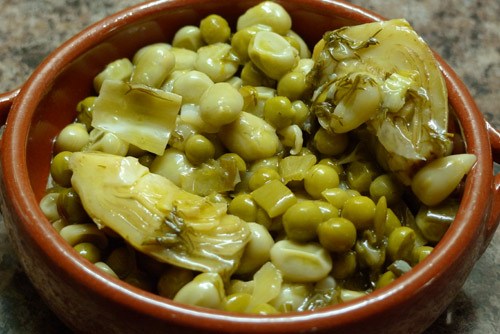
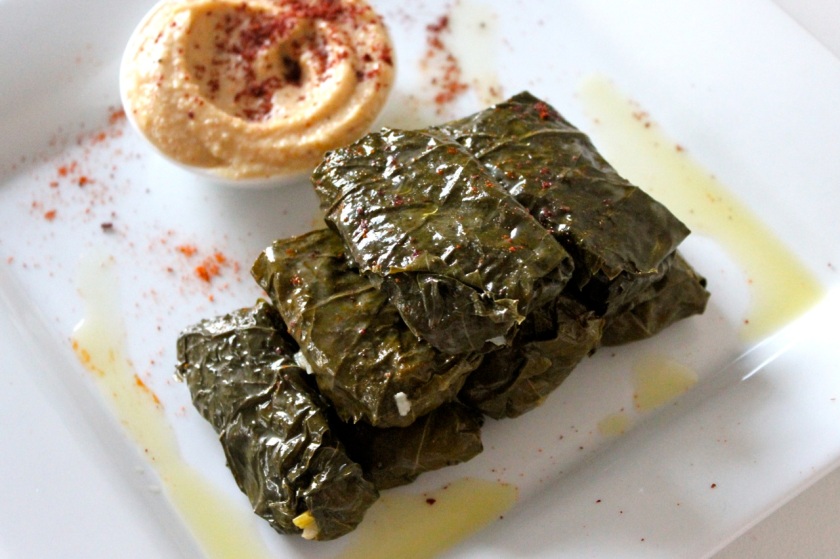
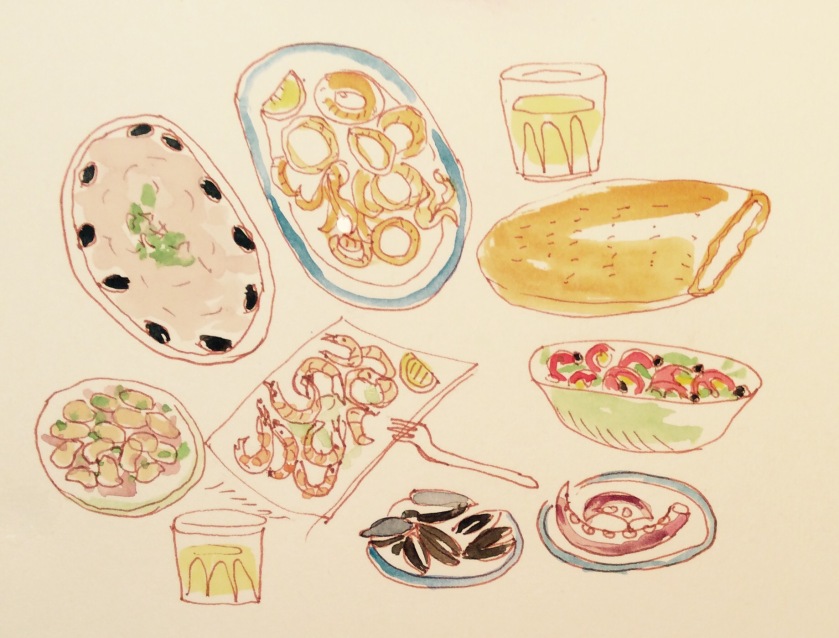
 However, the day is not only associated with eating, but also features many traditional celebrations held all over Greece. Municipalities organize concerts and other festivities with free food on offer. In the Borough of Athens, Clean Monday is traditionally celebrated on Philopappos, a hill situated southwest of the Acropolis. A beautiful 173-acre park, it is home to many indigenous birds and small animals, and open to all at all times of day or night.
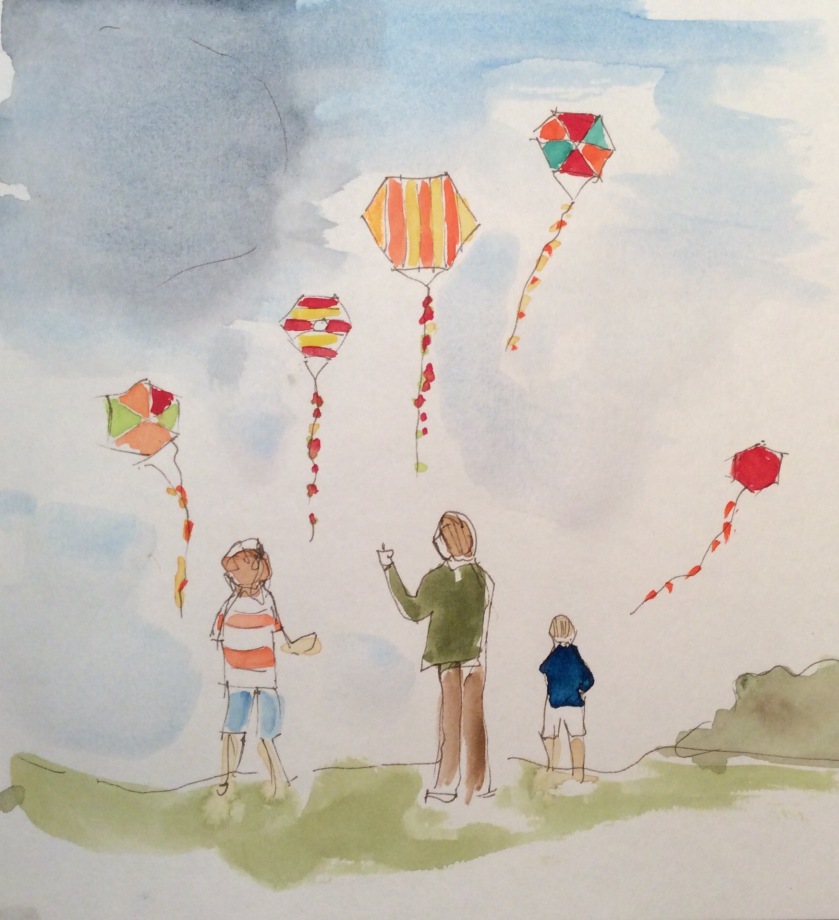
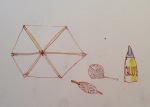 In my childhood, making your own kite was considered a very manly pursuit in some households. Fathers and uncles would carefully choose and cut their own bamboo sticks, split them lengthwise with their penknives and fashion them into a hexagonal frame with string. Over this would go glacé paper in bright colours (often in the colours of the maker’s favourite team), and then ‘ears’ and a tail made out of strips of paper. The trick was for the kite to have good equilibrium so that it would fly straight and true. A few balls of sturdy string would be carefully wound in a figure eight over a stout stick and the kite would be ready to go.