Any Greeks still doubtful about climate change are becoming more convinced as yet another cloud of dust from the Sahara hits Greek skies.
Athens, known for the pure blue of its Attic sky, is covered in a yellow haze, and people are going around coughing or hiding their mouths behind handkerchiefs.
Source:Google
Things have been even worse in Crete, because its proximity to Africa means the dust is denser, turning the atmosphere bright orange.
Source:Google
We have always had this phenomenon when certain climatic conditions prevailed, but it would occur only occasionally. In the last few years it is becoming more common and happens several times per year. According to scientists, it will probably continue increasing with time, as climate warming becomes more intense.
The dust cloud is not toxic, but it is extremely unpleasant and can cause breathing problems in people suffering from lung conditions such as asthma.
This is what the sky should look like at this time of year!
When I wrote about the wonderful community of the Estia Agios Nikolaos, (click here if you missed it) the post became too long for me to include anything about the town of Galaxidi. In fact, this picturesque little town, with its fine natural port nestled in the gulf of Korinth, has a very interesting history.
Before Greece had acquired good roads, seaways were essential to trade, and, by 1775, the Galaxidi port, under the tolerant eye of Ali Pasha, the Ottoman ruler of Ioannina, was fourth in strength in Greece, with 60 large ship of a total tonnage of 10.000 and crews numbering 1.100 souls. The fleet operated on a system whereby each member of the crew owned part of the ship or its cargo – this fostered a spirit of active entrepreneurship, but also cultivated economy, frugality and common sense. The crews’ daily diet was dry bread, olives, salt fish and a little wine, and they were known for their endurance in adversity.
The captains of Galaxidi contributed greatly to the War of Independence of 1821 and, after liberation from the Ottoman Empire, the fleet was quickly rebuilt.
After 1840, there was a rapid rise in prosperity, with the shipowners of Galaxidi founding their own insurance companies, and shipyards which built around twenty vessels a year. In the 1870s, more than 350 sailing ships crisscrossed the Mediterranean, travelled to the Black Sea and as far away as the Atlantic.
Yachts are moored where the sailing ships used to be.
Sadly, by the end of the 19th century there came a steady decline , since the shipowners of Galaxidi insisted in staying true to their sailing vessels, and refused to covert to steam. They lost their competitive edge, and the town began to dwindle, while some families moved to Pireus. The coup de grace came with the German occupation.
Why did the traditional captains of Galaxidi fail to become modern cosmopolitan shipowners, like so many other Greeks did? It’s difficult to say. Maybe it was their insistence to cling to tradition, maybe it was their sense of independence which stopped them from forging the alliances needed to secure the necessary funds for converting the fleet. Be that as it may, their houses still stand as a reminder of their past glory. Neoclassical in style, they boast wonderful painted ceilings decorated by Italian artists the captains invited back with them, along with pieces of furniture and decorative objects bought on their voyages.
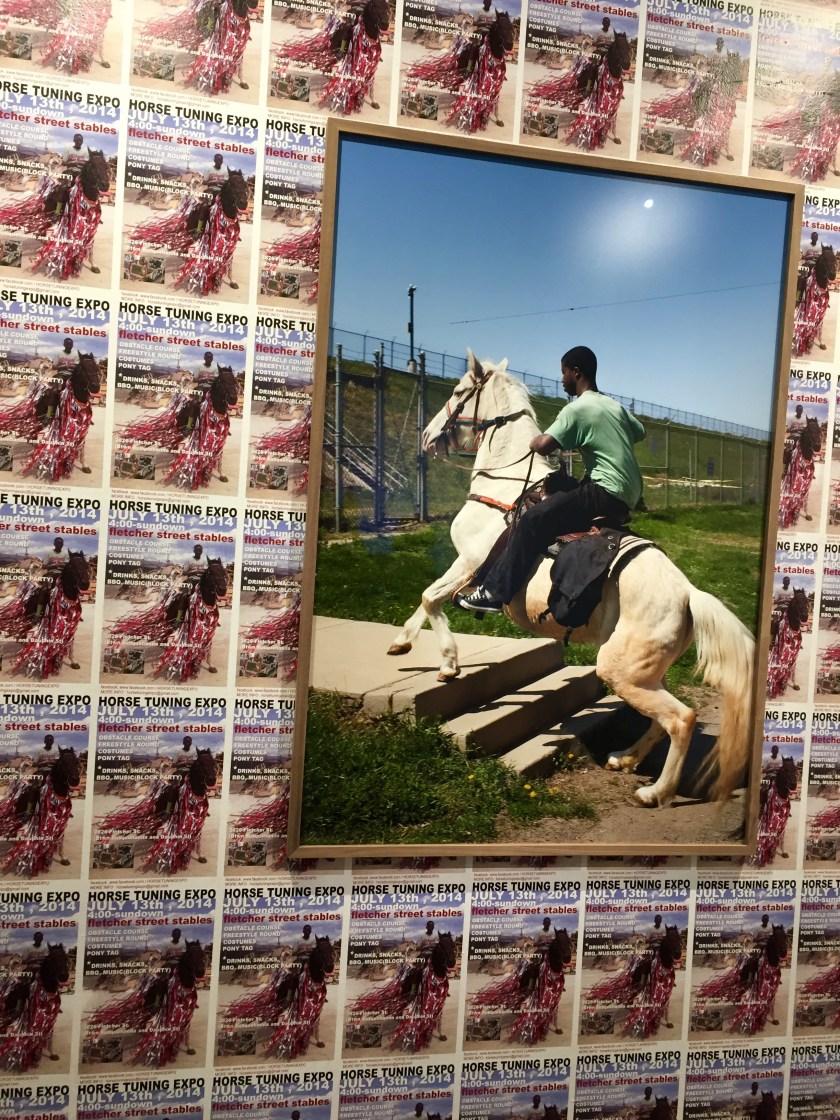
There’s a unique exhibition on at the moment at the Musée d’Art moderne de la Ville de Paris: it’s called ‘Urban Riders’, and it’s the work of Franco-Algerian artist Mohamed Bourouissa.
This is Bourouissa’s first solo exhibition in a French museum, although he has caught the critics’ eye many times before. In fact Bourouissa, who was born in Blida in 1979, is considered by many to be one of the major figures of his generation.
This particular project, which revolves around his film called ‘HorseDay’, was born when he became interested in the Fletcher Street community stables – based in the disadvantaged North Philadelphia neighbourhood of Strawberry Mansion – which he discovered thanks to the images of American photographer Martha Camarillo. Founded by African-American horsemen, the stables are a place of healing and support for local children and young adults and a refuge for abandoned horses (or horses destined for slaughter). Bourouissa addresses daily life at the stables, together with the myth and history of black cowboys and the conquest of wide open spaces, without, however, taking a documentary approach.
During an eight-month residency, he worked at making contact and sharing with the local community. As a result, the film offers a powerful account of an urban utopia.
For what Bourouissa called a ‘horse tuning’, riders teamed up with local artists to ‘customize’ their equine vehicles, lavishly outfitting them for a festive riding competition that serves as the climax to Horse Day. Below see some excerpts of the film (if the videos appear to be on their sides, just click on them, and for some mysterious reason they will right themselves).
Apart from the film, the exhibition presents many different items: on-the-spot sketches, preliminary drawings, storyboard, collages, ink roughs and watercolours which fill out the project’s origins and development; portraits of riders and of costumed horses and the actual costumes used on the day, as well as sculptural installations where images from the film are printed onto sections of car bodies.
Along with the seductive combination of horses and art, I do believe in the therapeutic effect of horses on the soul. So, after the exhibition, I was inspired to look up the site of the FletcherStreet Urban Riding Club, a place where local children (some from difficult backgrounds) can go to feel safe, empowered and free, even for a short while.
This is part of what’s on their page:
In the heart of downtown Philadelphia, among abandoned buildings and impoverishes neighborhoods where drugs and unemployment pervade, is a place called Fletcher Street. A block that upon first glance looks just like all the others, that is, until you see the horses and hear their hoof beats.
Horses? In the middle of the ghetto? Surprisingly, yes. They have been here for years, when the African American community thrived in Philadelphia, before drugs and unemployment steadily encompassed healthy neighborhoods and they disintegrated into urban war zones.
Despite it all, the horses have stayed, and they have because of the small, passionate, dedicated group of men determined to reclaim their neighborhood and their children. In this fight, they use the one thing that they know, love and trust, the horses.
Unsurprisingly, it hasn’t all been plain sailing for the non-profit organization. In 2008, clashes with animal-protection agencies led the city government (many say wrongly) to demolish the buildings that served as stables and a clubhouse on a patch of land called Fletcher Field. Despite this, the initiative survived thanks to the dedication of the horse enthusiasts. See it explained in the video below:
There is a similar setup of urban riding in Dublin, Ireland, I believe. There is fantastic work being done with horses and autistic kids, there is Riding for the Disabled, and there is a program for lifers working with mustangs in a prison in Nevada (and elsewhere, I think). All of this has to do with the restorative powers of nature and animals.
For any of you near Paris, the exhibition is on until April 22. Information about it here.
In Ancient Greek religion, Estia or Hestia (/ˈhɛstiə/; Greek: Ἑστία, “hearth” or “fireside”) is a virgin goddess of the hearth, architecture, and the right ordering of domesticity, the family, the home, and the state.
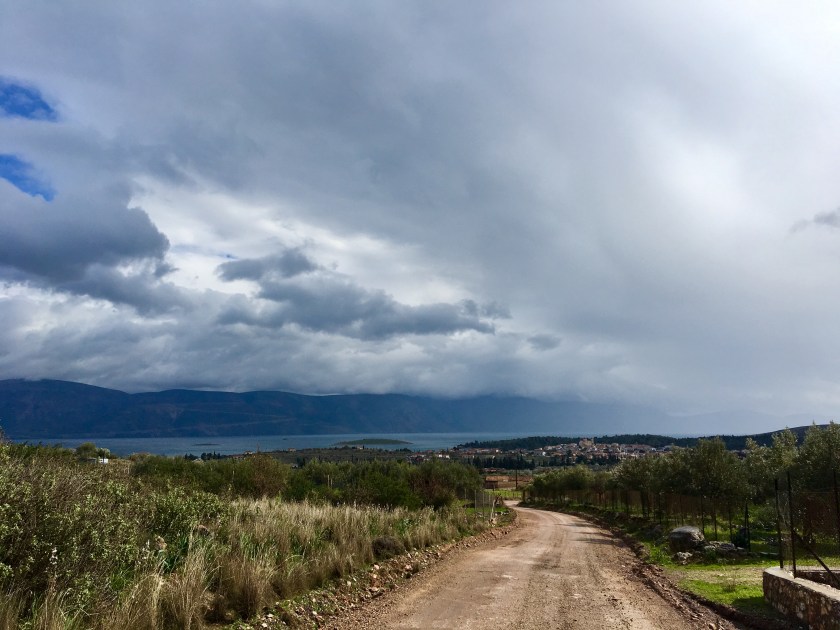
It was a difficult start to my road trip to the seaside town of Galaxidi. The rain poured down, washing out the view on all sides. A few bare branches were the only things visible as I tried to keep the car from aqua-planing on the turns. A two hour trip took a while longer but, as we emerged on the top of the mountains above Itea the sky cleared and a few rays of brilliant sunshine pierced the clouds.
The view towards Galaxidi
The charm of Galaxidi was restored, and so was my mood, over a cup of mountain tea taken at the hotel with some of the other visitors. We were all here for the annual cutting of the traditional vasilopitta at the Estia Agios Nikolaos, (https://www.estia-agios-nikolaos.org), a community where adults with special needs live, work and share their free time together with those caring for them. In this, Estia Agios Nikolaos is quite unique, and not only in Greece. It is also one of the few such communities worldwide which is not affiliated to one particular religious faith, and this inclusiveness is the main point of attraction for people all over the world who come to live and work here, making Estia a vibrant and exciting place.
Our b&b, the Hotel Nostos
Everyone had dinner together at a wonderful seaside taverna. I sat next to Clara (German, speaking fluent Greek) and Maxime (French, having just signed up for his second year, rapidly improving Greek), two vivacious and inspiring young people, who talked about their work with enthusiasm. Also present were numerous locals, such as the pharmacist who donates all meds for the community, and a lady who provides fish from her fish farm once a week. And, making a star appearance, was Estia’s first baby, Mia, born to a couple who work as carers – a source of endless fascination and delight for all.
Next morning, after a delicious breakfast of home-made delicacies and a walk in the port, we drove to Estia, where everyone was gathered in the assembly hall.
Music and songs. The man playing the trumpet is the Estia gardener.
The festivities started with a couple of songs (this video might look as if it’s facing sideways, but it will right itself once you click it. The mysteries of technology…)
Then the cutting and sharing of the vasilopitta.
We visited the ceramics shop, where colorful creations were on offer.
The wonderful vegetable garden,
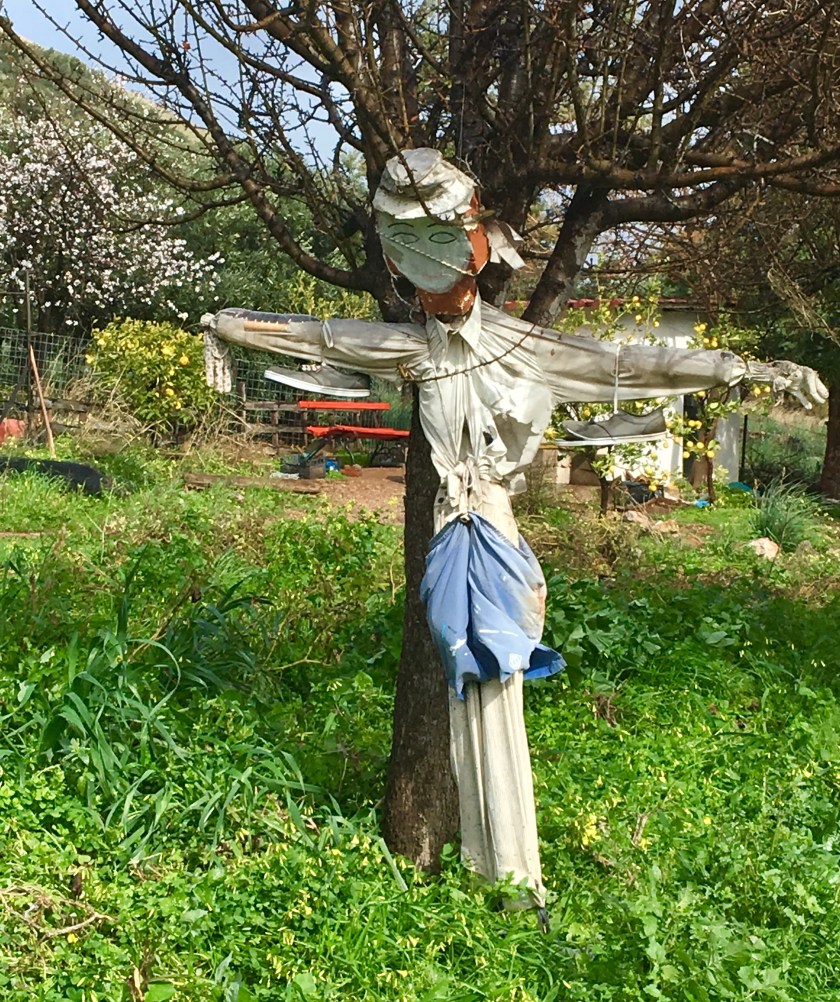
complete with scarecrow,
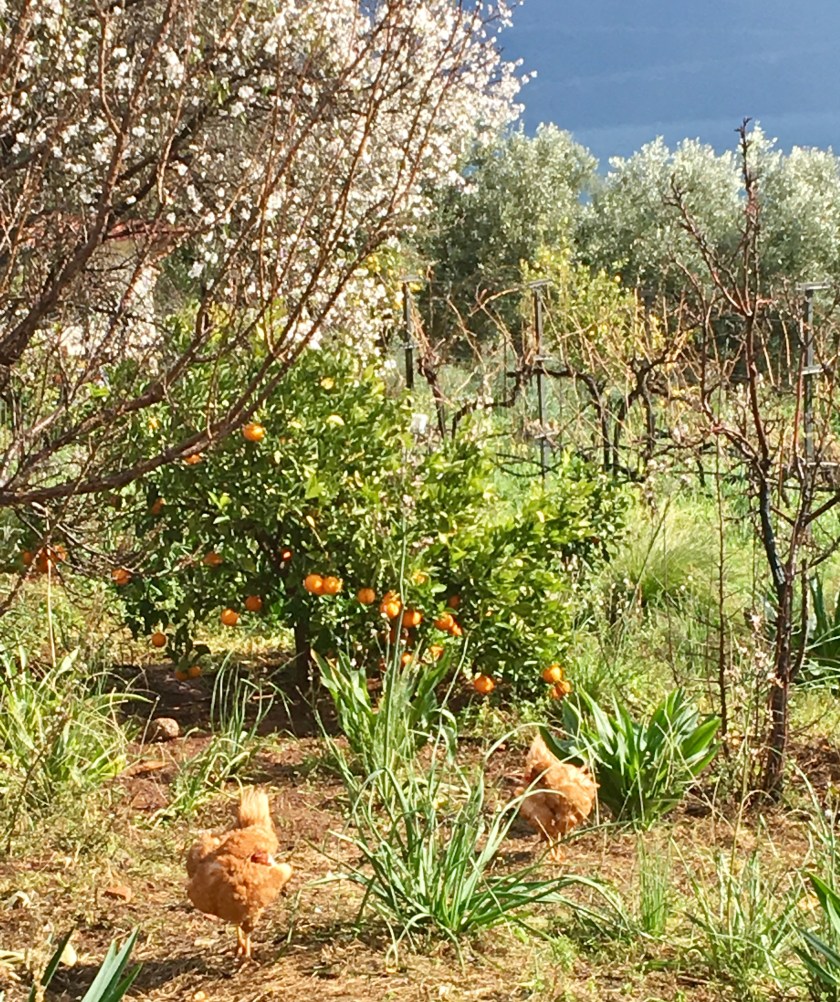
and free-range chickens.
And finally one of the four residences, which in total cater for 45 people, of whom 22 have special needs (at the moment there is space for two more.) In ‘Estia Agios Nikolaos’ all the members live in small family structures, which comprise 6-9 special needs guests, 2 to 3 professional caregivers and 2 to 3 volunteers.
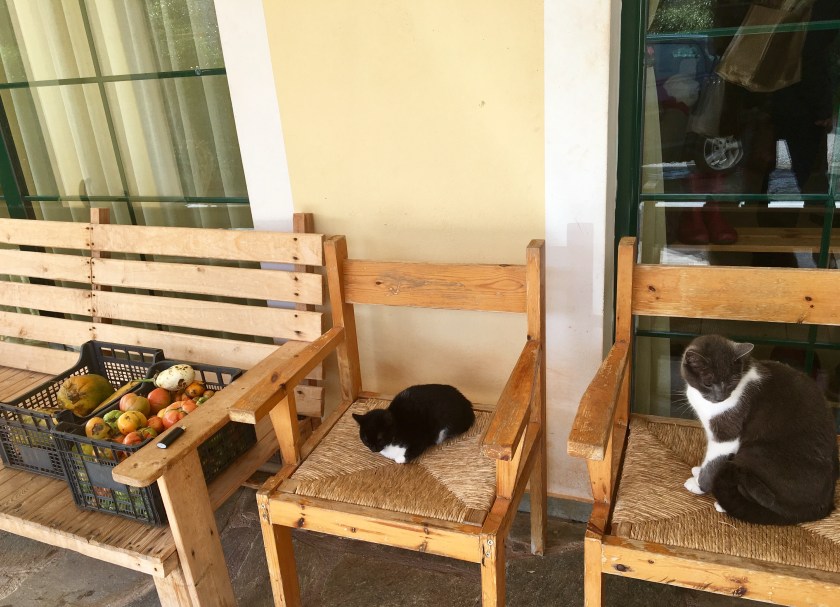
The entrance with its cats and box of fresh home-grown veggies.
A cozy living area
Complete with music corner
Fireplace
A large dining table for communal meals
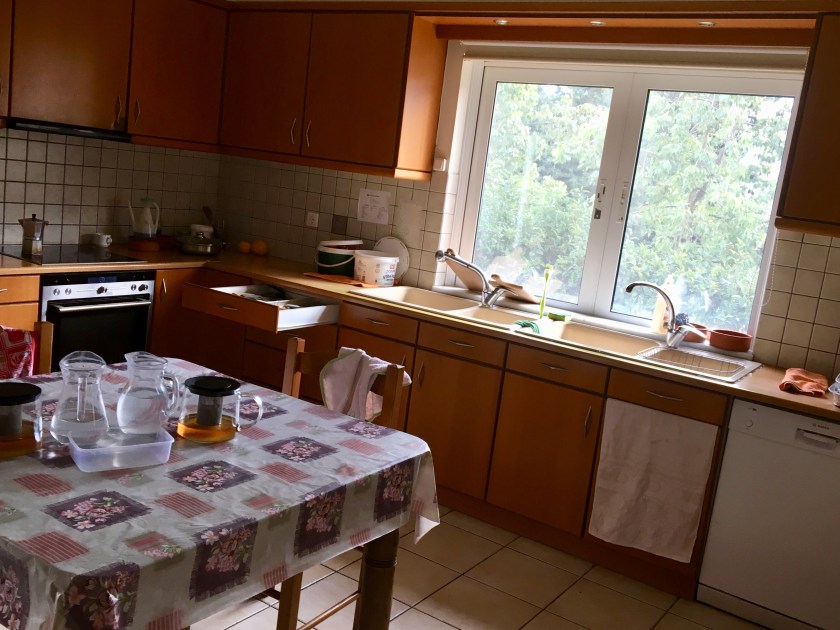
A lovely kitchen
And a well-stocked larder.
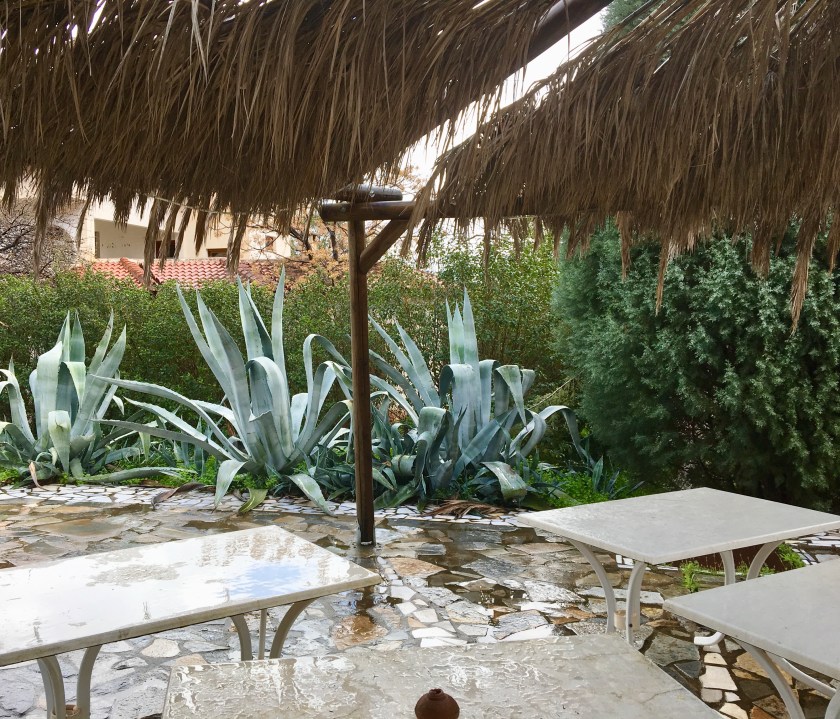
We went on to visit another building which is used for various activities, fronted by a shady terrace for barbecues and ad hoc concerts. This doubles as the Kafeneion (café), a gathering place for Sunday coffee with the locals and evening parties.
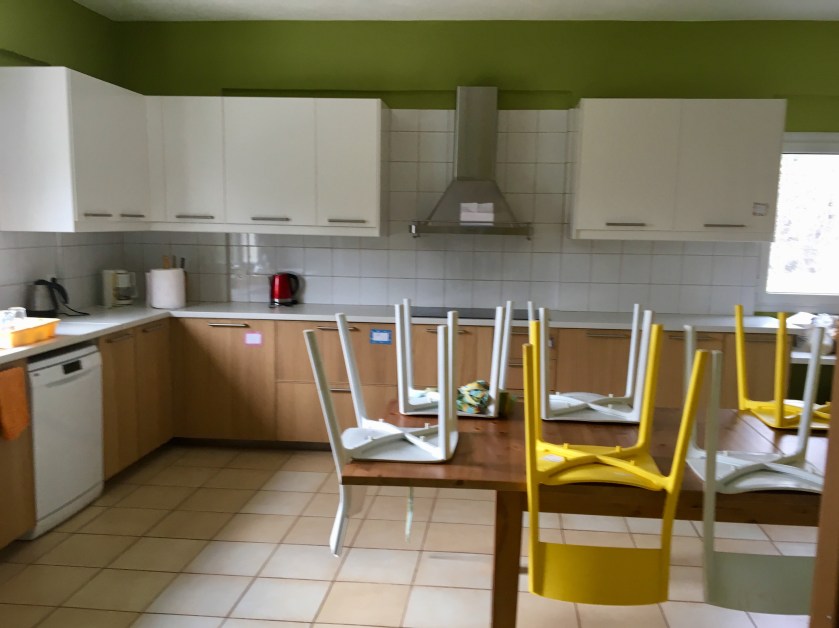
A brand new kitchen, designed by an architect friend and donated by IKEA (the floor had been freshly washed), will be used for the new bakery and pastry workshop.
And there is a loom for weaving
Maren, who is German, is responsible for one of the houses and took us on tour, while explaining that the residents really look forward to their activities each morning after breakfast: either working in the garden or in the pottery and jewelry workshops.
The afternoons are devoted to music, exercising, walking, and in the summertime, swimming in the sea nearby. Besides the staff, there are professionals (most of them on a volunteering basis) providing specific therapeutical activities such as art therapy, physiotherapy, gymnastics and music therapy.
During the weekends, individuals can choose the activities they would like to participate in. There are various artistic and spiritual pursuits on offer, in connection to the local communities, such as outings to musical events, theater and cinema, church attendance and participation in local celebrations. Every Sunday late afternoon, the entire community gathers in the Kafeneion for cake, music and games, often hosting visitors from the local community.
Each new resident is taken in for a month’s trial, to see how well he or she will fit in. Most adapt well, some don’t. After the extensive mutual screening there is a mandatory period of at least one month when the potential resident returns to his/ her home so that each side, resident, family and the Estia team can calmly make up its mind. Sometimes parents find they miss their child too much, and prefer to keep them at home.
Residents join in on outings and trips whenever possible and have even been abroad, which I found impressive, due to the logistic problems needing to be solved.
The cornerstone principle of ‘Estia Agios Nikolaos’ is that “each person is unique and can be helped to develop his or her unique capabilities in a nurturing environment via creative work, artistic stimuli and direct interaction with nature.” Efforts are made to treat each person as an individual – the girl who made a friend in town goes for sleepovers to her house and is allowed to invite her in turn, those who don’t like to sleep after lunch are not made to have a siesta, and so on. Such an anthropocentric approach is quite revolutionary in what remains, in essence, an institution.
The view from the entrance
Giovanna Kampouri, the president of the foundation which supervises the organizers, explained the community’s vision:
“For our residents with special needs, Estia Agios Nikolaos is often their only family and home. Many of them do not have a family that can care for them, and very sadly, most will face the trauma of losing their parents. It is our mission to be able to provide them with a lifelong, stable and loving home. The biggest challenge will come when the first residents will age (in the case of those with Down Syndrome, with dementia). We are now starting to study what it will take to build our 5th home, with special facilities for this group. We need to solve many issues for this, in addition to money, and particularly Greek legal requirements and infrastructure.
On a day to day basis, in the middle of the crisis, Estia has not only survived but managed to thrive, thanks to the love and generosity of an ever widening circle of supporters in Greece and abroad. I believe that this is thanks to its message of inclusiveness, which is filling a growing need in all our societies (to balance the opposite trend of nationalism and xenophobia) We are thankful for this, as we need to continue and to expand our possibility to provide life-long care for our residents. Due to the crisis, the ability of many of our residents to compensate for the patchy payments by EOPYY(social security) been reduced, and we have been able to fully cover this and to even offer full ‘scholarships’ to new residents from every part of Greece.”
And of course, the work is never done. There are plans for acquiring more animals, such as bees and a donkey, building a wood-fired oven, planting olive trees.
I left feeling invigorated and inspired – some truly remarkable work is being done here. If you want to know more, and meet the principals of this story, watch the wonderful video made by Marianna Economou.
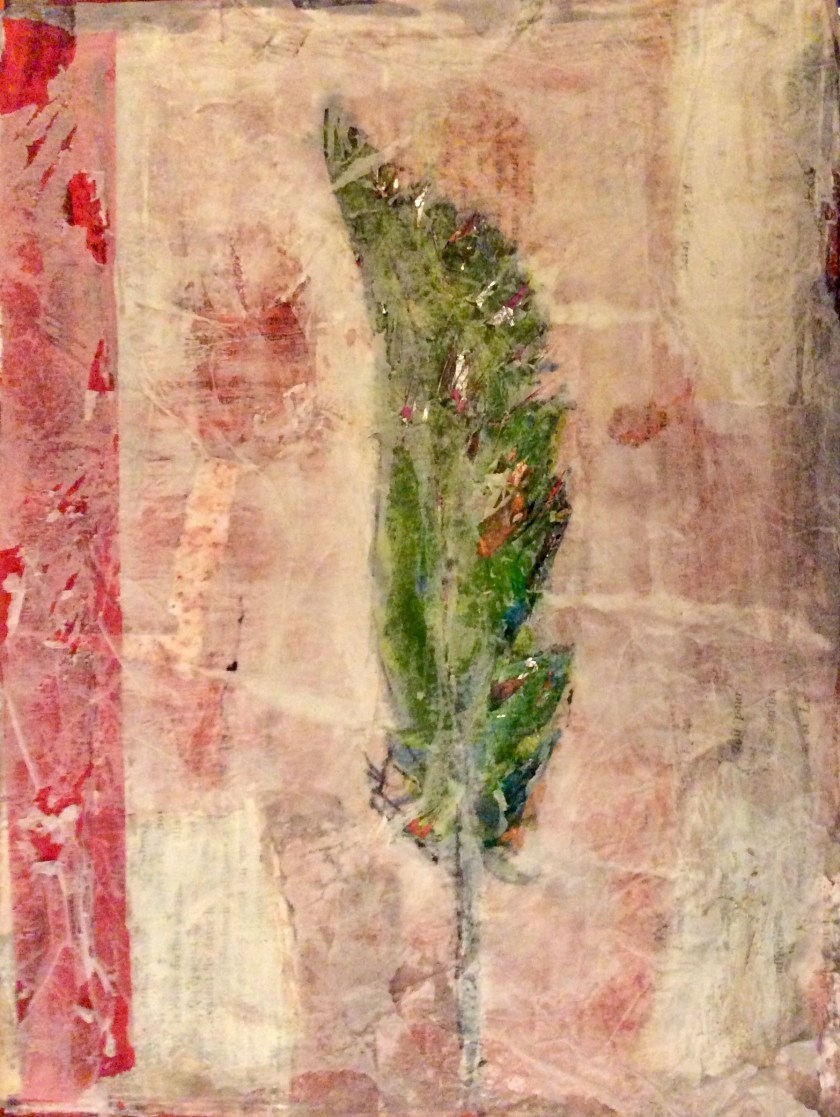
I have been continuing with my feather series, as you can see from my Instagram feed, but, due to popular demand (drumroll, please), I will now describe the process by which I create the layered ones. Here’s one:
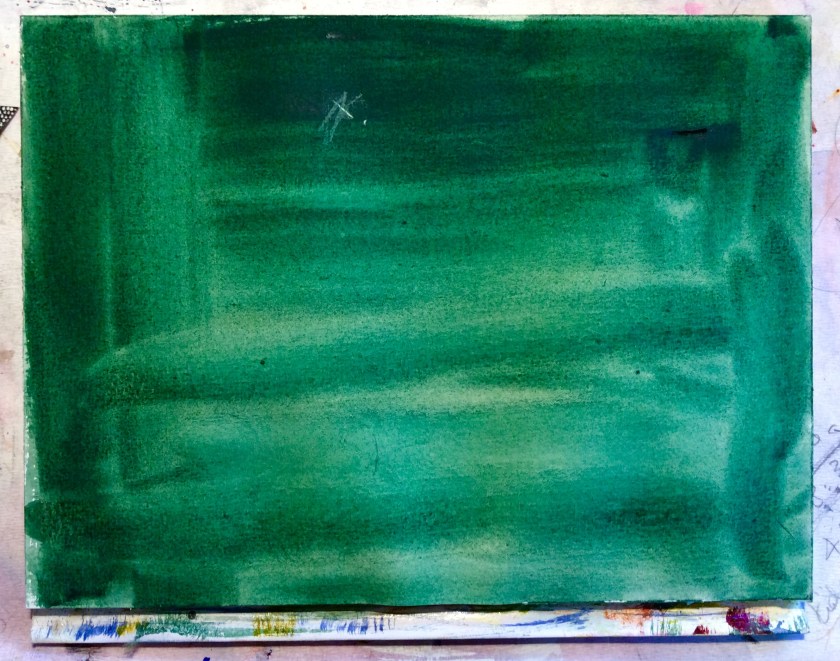
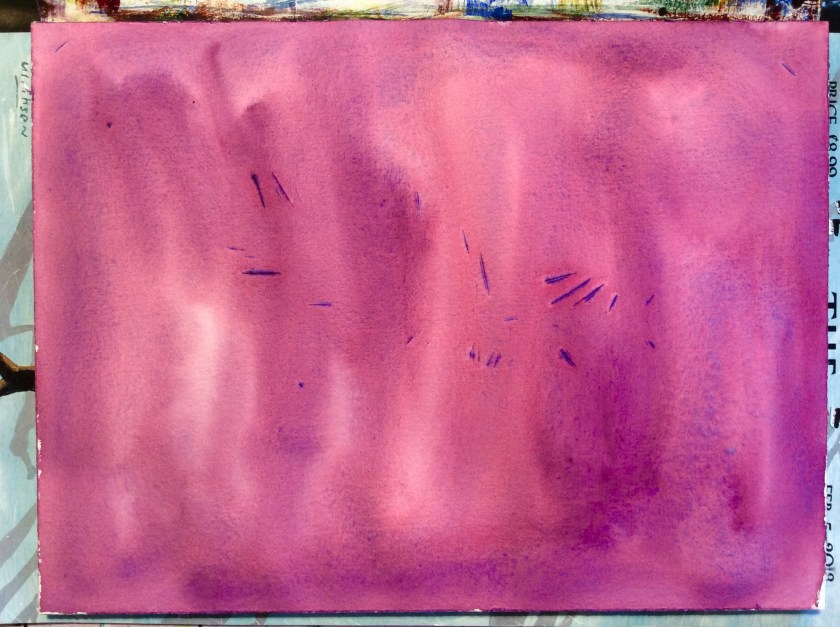
I started with watercolor on a piece of cold-pressed, 300gms paper.
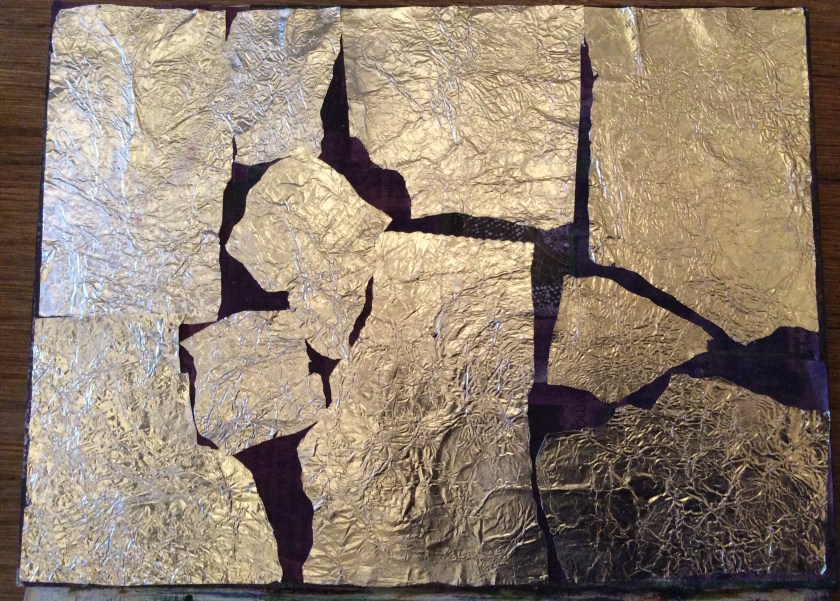
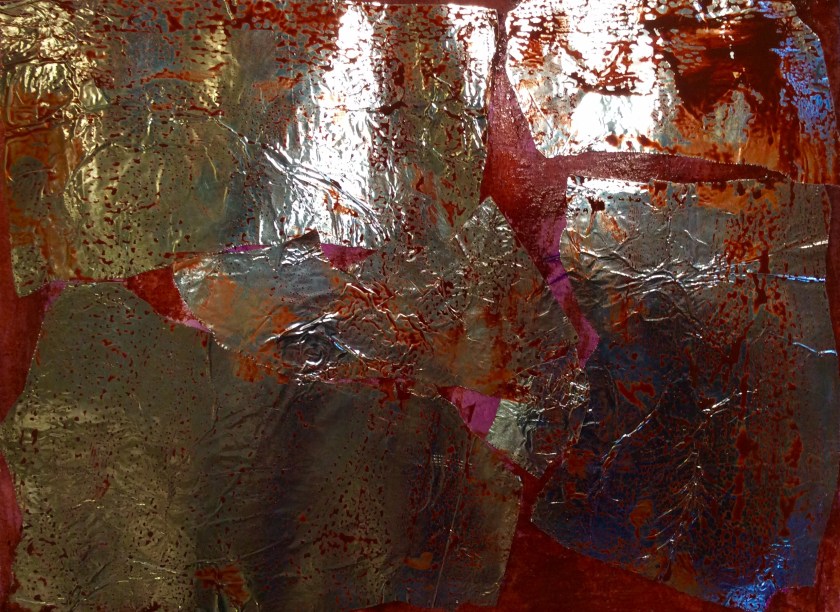
Added random pieces of aluminum foil, glued on with a glue stick.
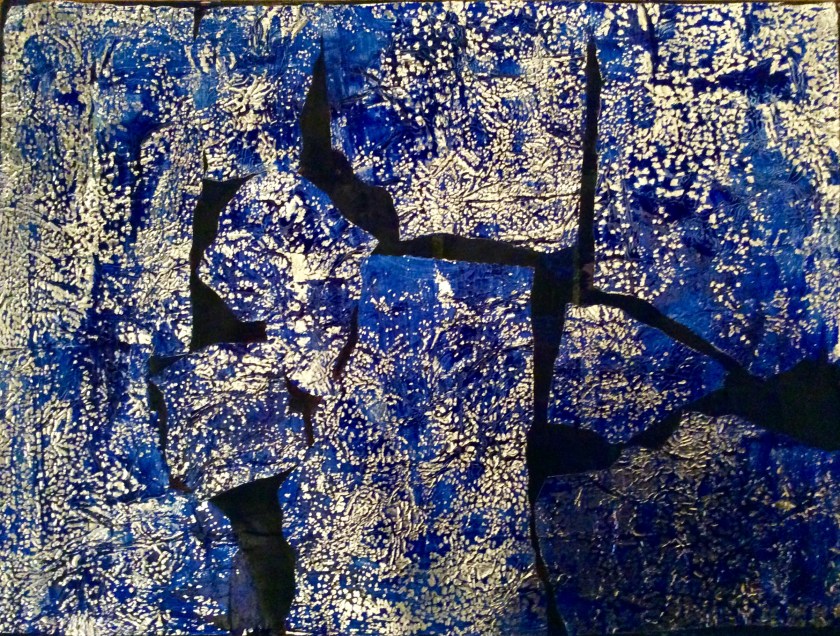
Which I painted over, with watercolor, so the paint is still transparent. Anything with foil is notoriously difficult to photograph, and I’m no photographer – I use my phone!
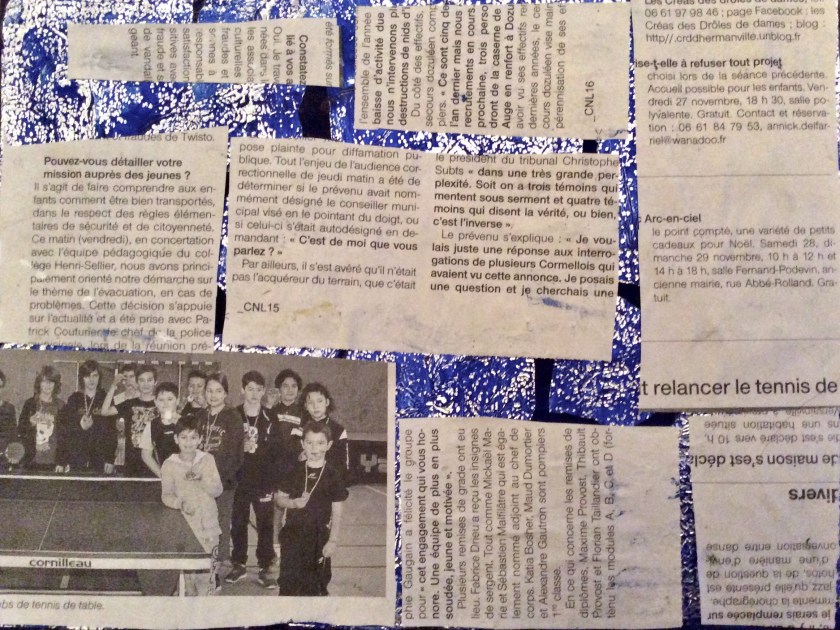
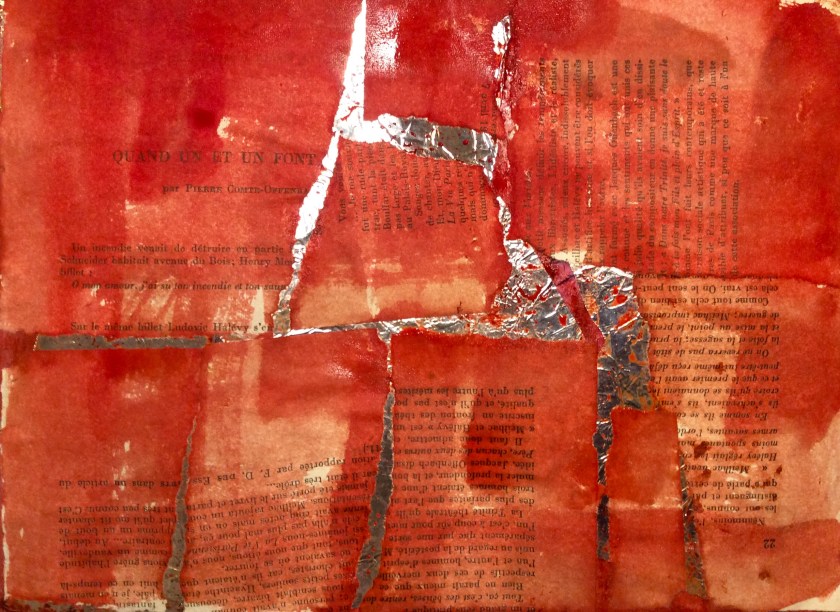
Then I added pieces of cut up newpaper
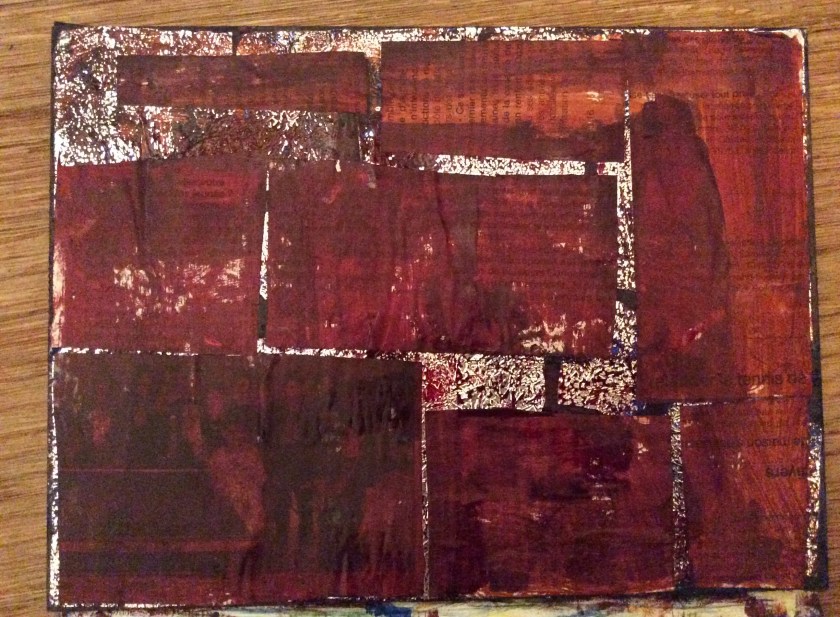
More paint
I glued on a sheet of crumpled tissue paper, which I painted over with white gouache.
Made a rough drawing of a feather
Added color, and another sheet of tissue paper. And now for the fun bit, gouging bits out with a cutter.
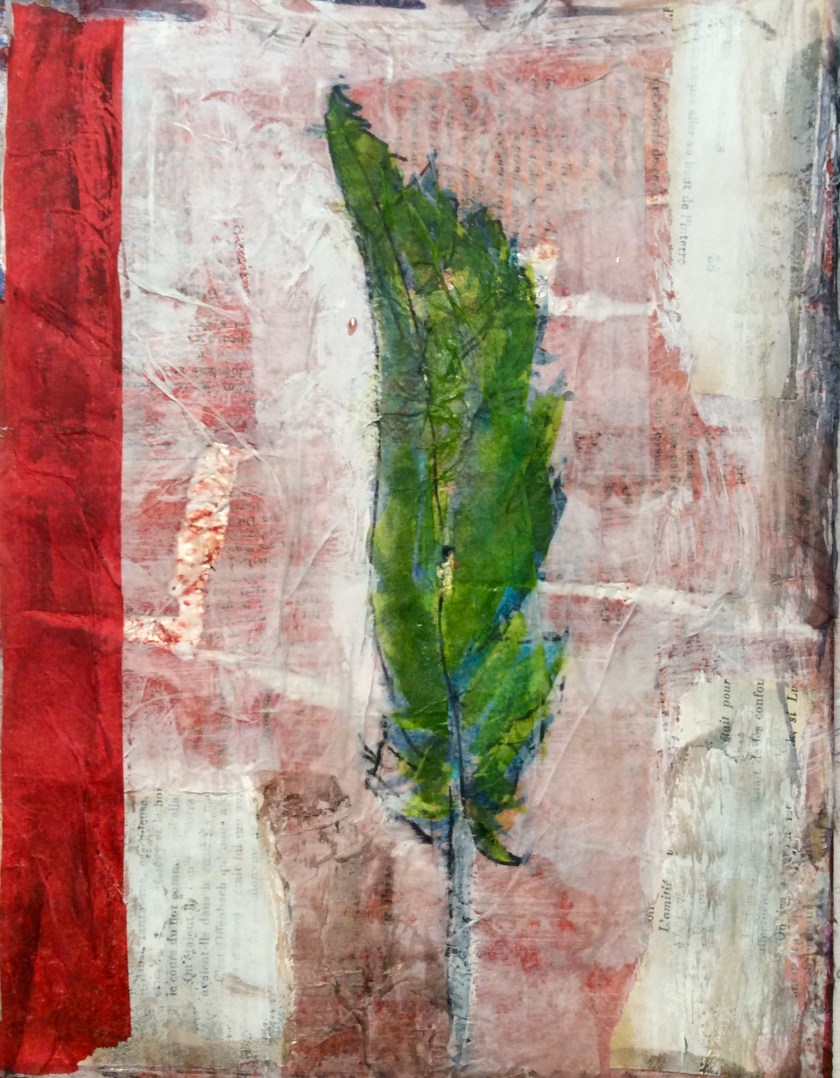
Ta-dah! (more drumrolls). You can zoom in to see more detail.
The process is quite random, since I follow my imagination and whim of the moment. I have lately been inspired by artists who use collage and layers, such as Anselm Kiefer, whose wonderful paintings I wrote about here. Sadly, I do not have the means to use molten lead, so I have to fall back on the humble aluminum foil.
Here’s a différend feather:
In this case I used torn bits of pages from an old book, and glued a strip of red tissue paper on the left side. I’m tentatively planning to create more feathers to make a up a large mosaic.
Other artists who have inspired me lately are Romare Bearden, Derek Fordjour and Njideka Akunyili Crosby. l was thinking of writing about them in a future post.
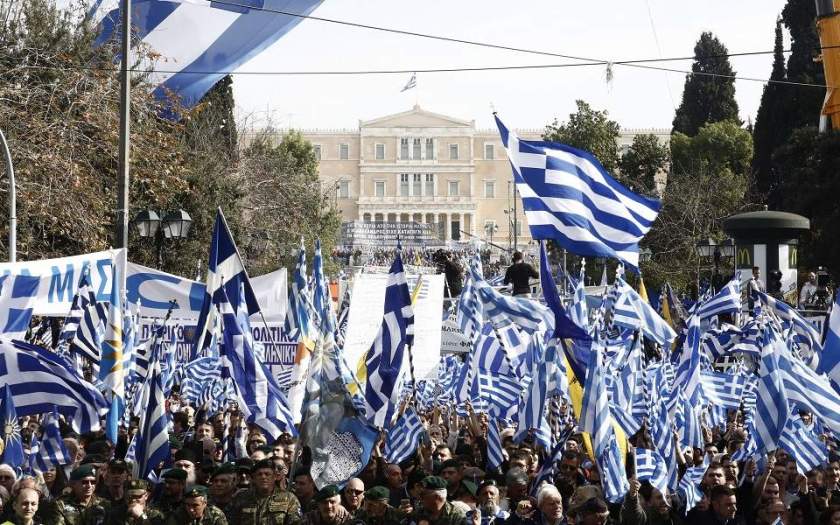
Yesterday a crowd gathered in the center of Athens, waving flags and chanting to protest a Greek compromise over the naming of a neighboring former Yugoslav republic. Macedonia, which is what the republic wants to call itself, is the ancient name of the region where Alexander the Great was born, and Greeks feel it belongs to them. Most call the republic by the name of its capital, Skopje.
The name dispute has been going on for years: it broke out after Macedonia gained independence from Yugoslavia in 1991. The country is recognized by international institutions as the Former Yugoslav Republic of Macedonia, even though about 130 countries refer to it simply as Macedonia.
Flags make for a pretty sight. Syntagma Square. Source: Kathimerini
Greece argues use of the name implies territorial claims on its own province of Macedonia. Officials in Skopje counter that their country has been known as Macedonia for a long time.
The easiest solution would be to add a modifier such as “New” or “North” to the republic’s name, but this proposal has triggered protests in both countries.
It is debatable how many people attended yesterday’s rally: the organizers claim to over a million, whereas the police estimated around 140.000 – not a small difference. Politicians of all parties had their say, 92-year-old legendary musician and former minister Mikis Theodorakis put in a appearance and called for a referendum [oh no – not another one…] Everyone accused the everyone else of using the event for their own interest, and of faking attendance numbers. Left-wing and anarchist protesters, bearing banners calling for Balkan unity, took the opportunity to set up a counter-demonstration nearby, which suspected far-right supporters attempted to attack. The riot police had a field day.
About 100,000 people attended a similar protest last month in the northern Greek city of Thessaloniki, the capital of Greece’s province of Macedonia.
What do I think about it all? Hard to say. I do think the choice of the name was provocative in the first place – surely they knew it would not please Greece, so why not opt for something else and avoid opening that particular can of worms. However, as usual the issue is obscured and transformed by political interest on both sides, and used to funnel people’s frustration and despair away from the real problems that desperately need to be solved. The endless squabbling is inelegant, to say the least. As to the referendum, no thanks – I’m sick of being dragged out to vote, knowing nothing will change in the long run. Let’s not forget that in the last referendum, we voted NO to stay in Europe, or YES to not leave Europe. Ridiculous.
After a surge of posts at the end of last year, things seem to have gone quiet. Or rather, I’ve been both very busy and a little uninspired. I see now I only managed a single post in January – horrors! So let me hasten to reassure you, I have not died or gone away.
However, I do find myself at some kind of crossroads with this blog. It’s difficult to write about Greece at the moment – things are no better, and do people want to keep reading about the refugees, the hopeless politicians and the unending financial crisis? I feel I’ve also covered the various traditions, feasts, etc – this is not supposed to be a travel guide, after all. Interviews seem to have dried up, a couple of people never having come up with the goods.
When I come across something amusing or worthwhile, or think of someone fun to interview, or have time for a road trip, or visit an art show, inspiration is easy. However, this does not make for regular output – on the other hand, I don’t want this blog to turn into a kind of homework, there’s no point to that.
So, suggestions are welcome. What would like to read about? Any special interests, more interviews, more art, less art?
Meanwhile, I am planning a trip next weekend, to visit a facility for people with special needs, in the beautiful seaside town of Galaxidi. The Estia Agios Nikolaos is a unique place, the beloved project of a good friend of mine, where people live in a family-style environment and are allowed to thrive at their own pace. They are having their vasilopitta, the Greek tradition of cutting a special cake each New Year. So there is a post to be written soon, which I feel sure will be interesting.
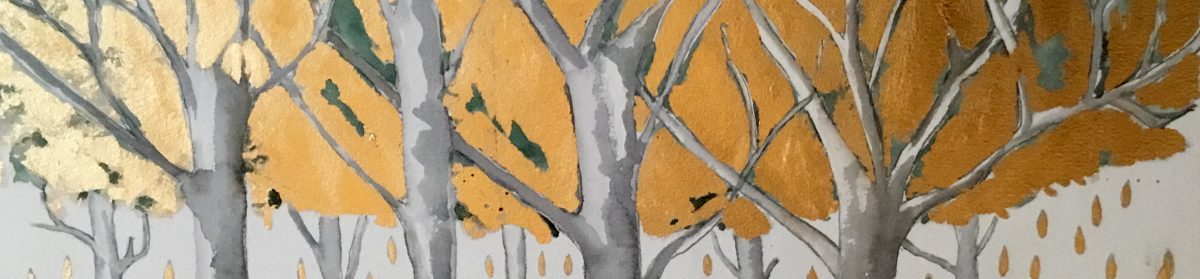
The photographs are of a series I’m working on at the moment, Feathers. They are small paintings, which will make up to a larger installation, and at the same time I’m using them to experiment with different techniques in mixed media. As well as working with watercolor, collage and gold leaf, I’m also layering pieces of newspaper and silver foil with paint and crumpled tissue paper in various combinations. Sometimes I draw or paint over the top, sometimes I gouge bits out with a cutter. It’s really fun to do, and I’m hoping to use these techniques on larger pieces eventually.
Don’t forget to comment and egg me on with your suggestions!
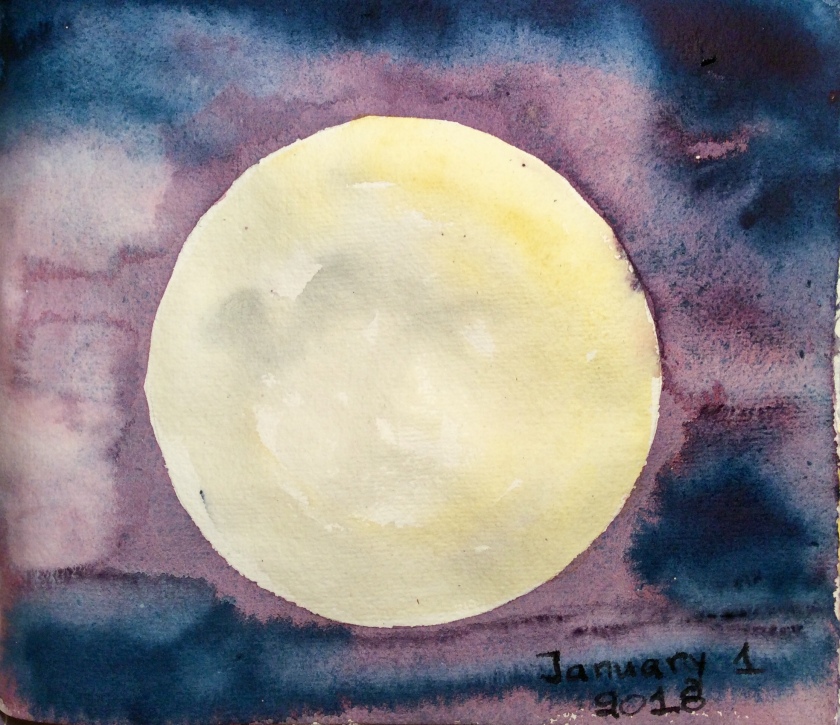
Stepping outside at night on January first and seeing a huge moon shining behind the clouds felt like a good sign – an omen of a great year ahead?
Best wishes to all of you who have been reading my ramblings all year.
But so as not to be too complacent, I will share a cartoon frrom the New Yorker that someone sent me.
Athens has put on its glad rags as a general effort is being made to celebrate the holidays.
SYNTAGMA (Constitution Square) decorated and lit up for Christmas. Photo: tornosnews.gr. Source:Google.
There is a lot going on, despite the continuing problems, which remain huge. Art shows, music, dance, parties – and people just walking the streets, enjoying the season. Athens remains one of the popular destinations for the winter holidays.
As always one must spare a thought (and perhaps a little money) for the people whose finances or personal circumstances make the holiday more of a worry than fun. Also the homeless and the refugees, who are spending another winter without heating or running water.
However, I would like to end this post on a positive note, and send my best wishes to all of you out there, who have been following and commenting all this time. I really appreciate your friendship (even when virtual!) and hope you will enjoy the days to come, with friends and family.
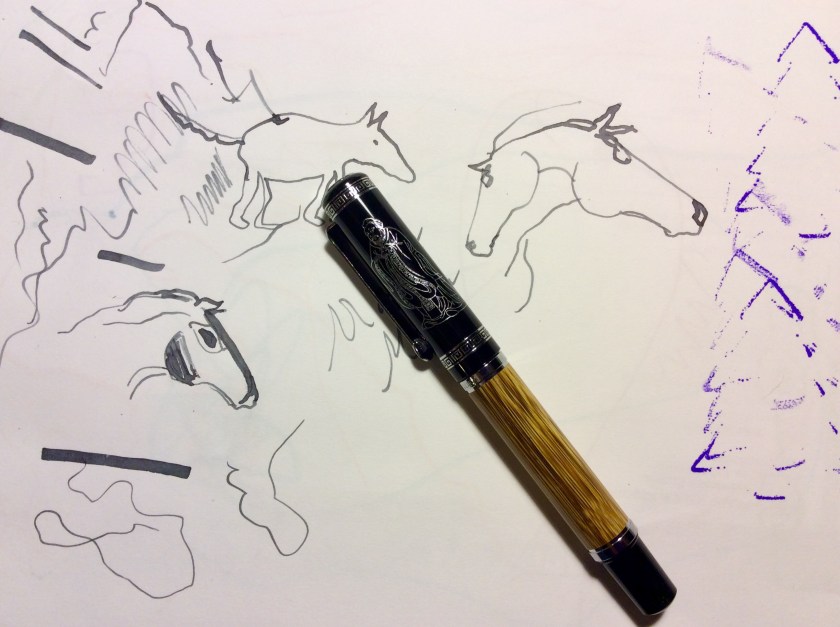
Christmas gift: Trying out a new toy, a Duke Confucius fountain pen – it makes the most interesting marks and is a lovely object in itself. Made from bamboo.
If any of my more recent followers are interested about Christmas celebrations in Greece, I wrote a post about it some time ago – you can find it here.





















 Letters from Athens