As a follow up to my post Old Athens, I thought I’d write a few words about EdwardDodwell (1767 – 1832), an Irish painter, traveller and archaeologist, who travelled widely in Greece, making exquisite paintings in the process.
Edward Dodwell was born in Dublin to an ancient and wealthy Irish family, and studied Classics and Archaeology at Trinity College, Cambridge. Being in possession of a large fortune and free from professional commitments, he dedicated himself to the study of Mediterranean cultures.
The dance of the dervishes at the Tower of the Winds in Athens, which was used as a tekije (dervish lodge). Sixteen ostrich eggs hang from the ceiling to avert the evil eye.
Dodwell travelled from 1801 to 1806 in Greece, which was then a part of the OttomanEmpire.
In 1801 he sailed to the Ionian Islands and the Troad with Atkins and the well-known traveller William Gell. In 1805 he visited continental Greece in the company of the painter Simone Pomardi, during which time they produced almost one thousand illustrations. These bring to life a vanished world that, since then, have enchanted European travelers and inspired their passionate pursuit of classical antiquity.
The village of Portaria on Mount Pelion
“Almost every rock, everypromontory, every river, is haunted by the shadows of themighty dead,” Dodwell wrote, conveying with aesthetic sensitivity the discovery of each place, the journey of exploration of an unknown landscape; and managing to combine monuments, history, and contemporary life.
Dodwell’s paintings contain an immense wealth of information on Greek public and domestic life during the years before the War of Independence. He was often invited to stay in the houses of prominent Greeks.
Dinner at Crisso, near Delphi, in the house of the bishop of Salona.
Apart from archaeological issues, he wrote about the dances, music and games of the Greeks, as well as about local insects and birds.
His observations are varied – he notes, for example, the presence of a number of black slaves in the town of Patras and elsewhere, writes of Ali Pasha’s extortions, and lists the products peculiar to each region.
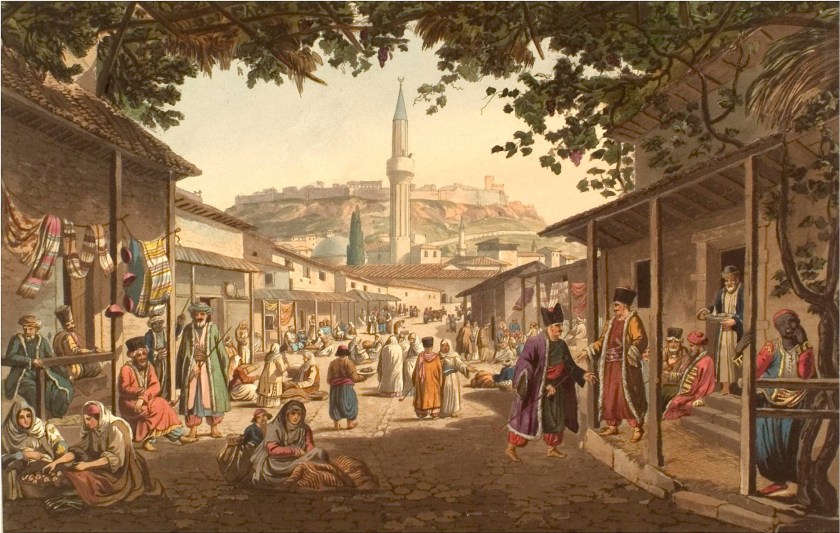
The bazaar of Athens. On the forefront, on the right, an emancipated African slave. On the doorway, the owner of the coffeehouse who is brigning a tray with coffee to the Ottoman governor Disdar Aga.
Dodwell was in Athens in March 1805, while Lord Elgin’s crews were pillaging the sculptures of the Acropolis monuments.
Removal of sculptures from the Parthenon by Lord Elgin’s men
Dodwell published A Classical and Topographical Tour through Greece (1819); Views inGreece, with thirty colored plates (1821); and Views and Descriptions of Cyclopian orPelasgic Remains in Italy and Greece (1834). These books are still of value to archaeologists today.
He subsequently lived in Naples and Rome, and married a woman thirty years his junior. Unfortunately he caught an illness and died in 1832, while exploring the mountains of Italy. His large archaeological collection, of coins, 115 bronzes and 143 vases, kept for a time in his house in Rome, was later sold to the Munich Glyptothek.
GARDEN PARTY is a weird and wonderful short film, which I discovered on SLIPPERY EDGE, a blog that, in their own words, is ‘focused on the exploration of beauty and creativity. As such our articles aim to showcase these qualities, and to do so we present you with a number of different contemporary professional artists, art students & creators from around the globe, in all domains of arts.’
It’s a great blog for discovering all sorts of new artists, and I urge you all to take a look. However, it is not a WP blog, so I could not discover how to re-post – I just managed to embed the film.
GARDEN PARTY is a short, animated film about two frogs who take over a deserted, if luxurious house. It has already picked up numerous awards. But I shall say no more, just let you discover it for yourselves. I’m curious to see what everyone thinks!
Congratulations to Kazuo Ishiguro for winning the Nobel Prize for literature this year. A subtle, quietly assured writer, he has always been one of my favorites. I admire him for possessing the combined powers of observation and imagination, and for his evocative but minimalistic style.
Photo source: Google/Goodreads
Ishiguro was born in Nagasaki and came to England with his parents at the age of five. He’s an immigrant, in other words, but I’m sure the English are proud to claim him as their own. One of his most famous novels, The Remains of the Day (Booker Prize of 1989) is written from the point of view of a quintessentially English character, a butler. I’m not making any particular point by writing this, I’m just fascinated by the combination of cultures and the ability of someone to imagine different worlds.
Ishiguro’s latest novel, The Buried Giant, was a wonderful example of this, being set in a a sort of medieval world, an England after the departure of the Romans. The Nobel committee praised it for exploring “how memory relates to oblivion, history to the present, and fantasy to reality”. Some people found it hard going, but I was totally mesmerized.
Ishiguro was surprised by his win, to the extent that at first he thought it was a hoax. He said: “Part of me feels like an imposter and part of me feels bad that I’ve got this before other living writers. Haruki Murakami, Salman Rushdie, Margaret Atwood, Cormac McCarthy, all of them immediately came into my head and I just thought wow, this is a bit of a cheek for me to have been given this before them. And because I’m completely delusional, part of me feels like I’m too young to be winning something like this. But then I suddenly realised that I’m 62, so I am average age for this I suppose.”
Ishiguro is also a musician and one of Bob Dylan’s greatest fans, so he is a fitting successor to last year’s surprise winner.
I’m now off to buy When We Were Orphans, which for some reason I haven’t read.
Click the link below to watch a video where Ishiguro explains how his wife made him scrap his latest novel after two years’ work.
The Ancient Greeks left their mark everywhere – everywhere in the known world, or Oecumene, a Greek geographical concept describing the inhabited parts of the world. They were merchants and traders, and they were the first to colonize Southern Italy, where they founded Magna Graecia, which included the island of Sicily. They first started living there in the 8th and 7th centuries BC and, since then, Sicily has seen the passing of many civilisations, the remnants of which form rich layers in the tapestry of the island. Greek, Roman, Byzantine, Arabic – they are intertwined in many ways.
In Palermo, a city which teems with the same variety of faces one probably came across all these centuries ago, driving is a hazardous affair. In the old town, the streets are so narrow that even a small car brushes the houses on either side, where open doors reveal the trappings of daily life – a woman ironing, a baby in a high chair – while tourists walk in the middle of the road gawping at the sights, and scooters edge past without slowing down at all. There are no sidewalks, and road signs are cheerfully ignored by all and sundry.
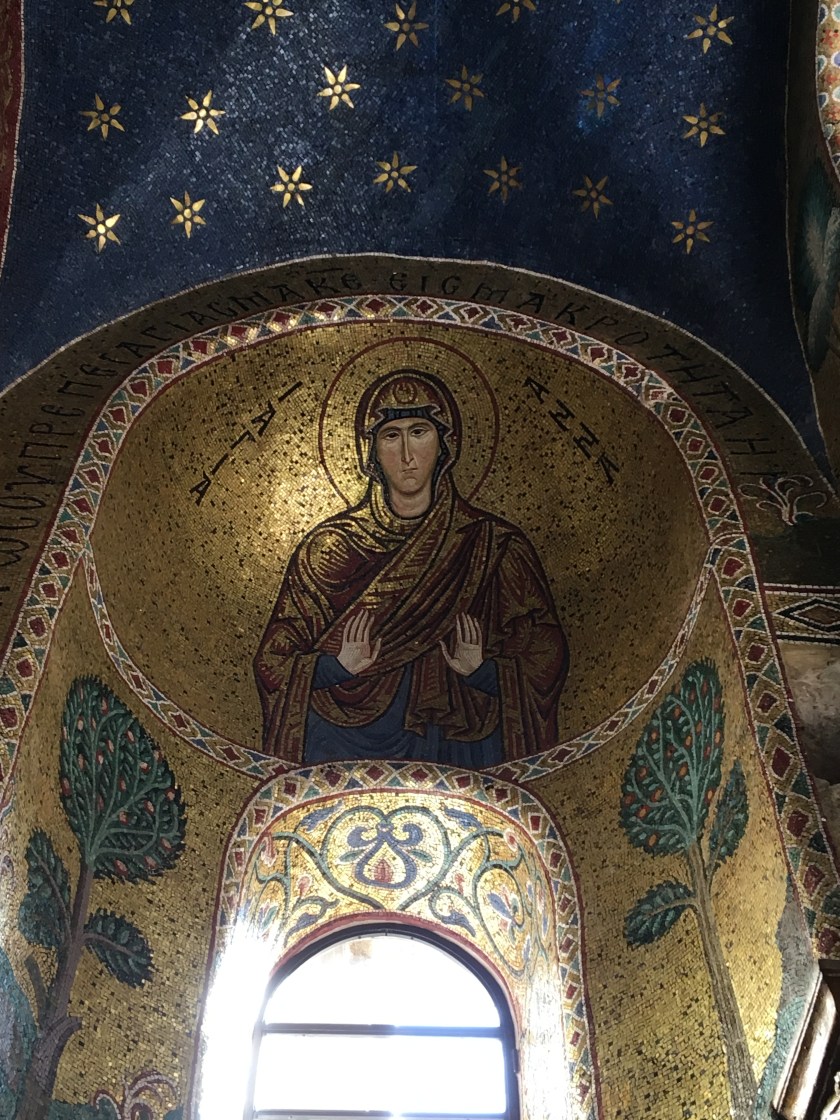
In the Piazza Bellini (above),three Churches surround a paved square. San Cataldo, an austere Norman structure made of grey stone (seen on the right), and SantaMargarita del Amiraglio, (on the left) whose enchanting interior combines astonishing Byzantine mosaics with an elaborate baroque centre.
View of the church with the baroque part at the altar
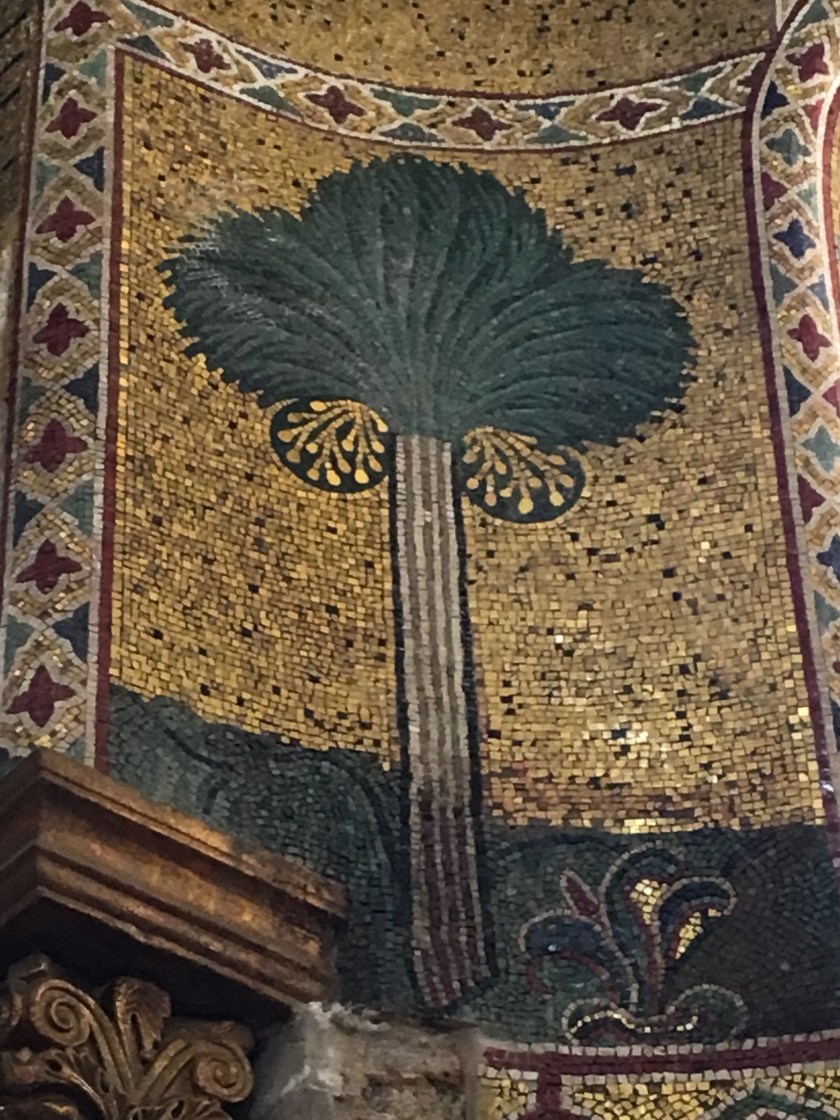
The mosaics are literally breathtaking.
Below is a view of the dome with mosaic of the Pantokrator.
The byzantines did like their gold!
And the decorative details are also beautiful.
Through the window can be glimpsed the façade of the third church, Santa Caterina, on the opposite side of the square. Its interior is a synthesis of Sicilian baroque, Rococo and Renaissance.
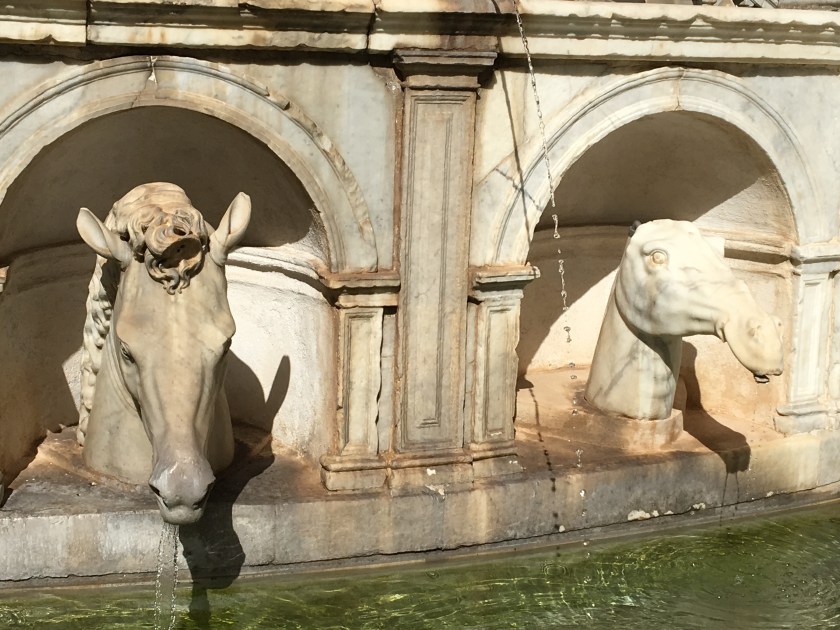
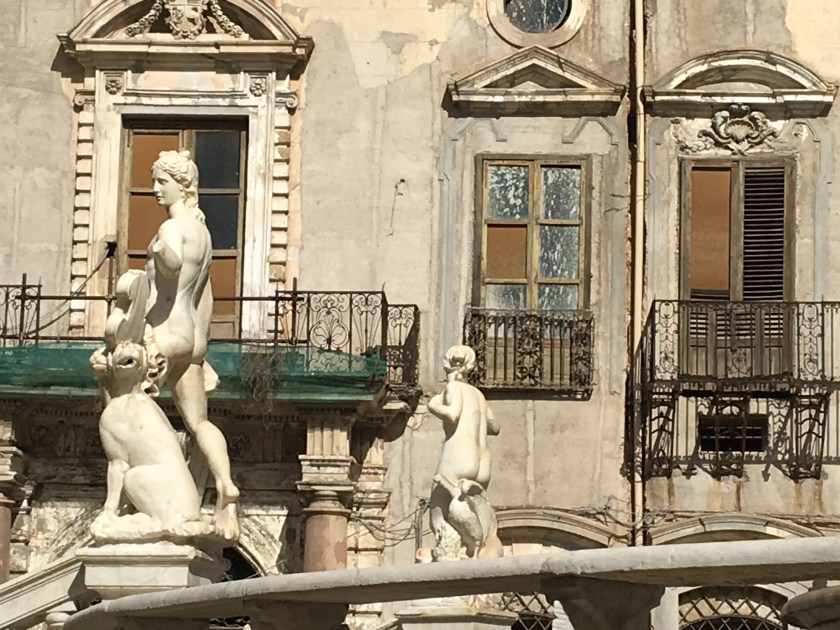
Behind Santa Caterina, Piazza Pretoria boasts a fountain which, while it is not Greek, I could not resist photographing, since it is decorated with a series of marvelous carved animals, all different and sporting exquisite expressions on their white marble faces.
Pretoria Fountain. Detail.
The Petoria Fountain was built in Florence, but was sold to Palermo in 1554.
Due to the nudity of the statues on the top of the fountain, considered shocking at the time, the square became known as Piazza Della Vergogna, or Square of Shame.
I love the contrast of the naked statues with the once-beautiful but decrepit building behind
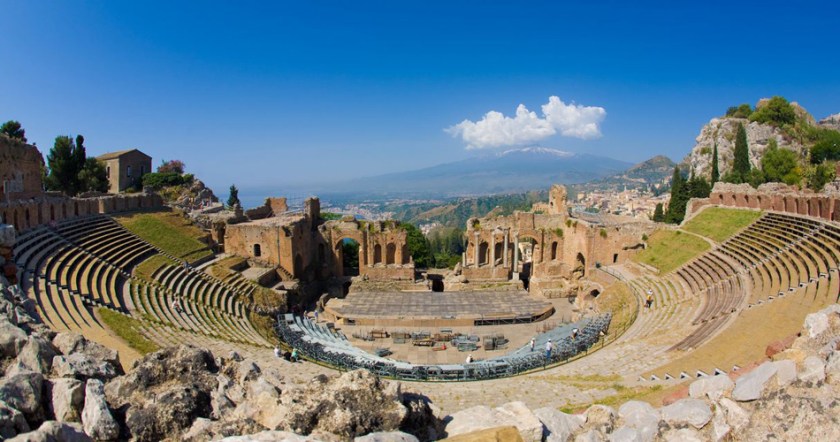
In Taormina, the Greek Theatre was built in the 3rd century BC. An incredible 100.000 cubic meters of rock were moved for its excavation, and it could seat over 5000 people. In Roman times it was renovated and enlarged and the brickwork of that era still survives today. As with all Greek theatres it has brilliant acoustics and is regularly used every summer for opera, concerts and plays.
The view from the gods includes brilliant sunsets and the majestic cone of the Etna volcano, which is the largest on the whole Italian peninsula, and the tallest volcano in Europe. The Greeks considered Etna to be the forge of Haephaistos (Vulcan) who used it to create thunderbolts for Zeus; it was also the home of the giant one-eyed monster, Cyclops.
Panoramic photo from Google
Syracuse (Συρακούσαι) and Selinunte (Σελινούς) were also cities founded by the Greeks, whose names were often mentioned in the reams of Ancient Greek text – Thucydides, if I’m not mistaken – which we had to translate at school, with a cheat sheet under the desk (bought at the local stationers’). All those complicated wars and sieges would have been brought to life if the school had organised a trip to Sicily for us.
In Selinunte, the temple dedicated to Hera is majestic, larger than most found in Greece.
The entrance to the site
It is difficult to imagine it painted in blue and red, as it was in antiquity.
Of the three temples on the religious site at Selinunte, this is the only one to have been partially restored.
Through the columns, one can glimpse wonderful views of the sea.
This is the smaller of the three temples on the site, the third and largest being probably dedicated to Zeus.
The columns have imploded and are tumbled in heaps, with greenery and brambles growing amongst them.
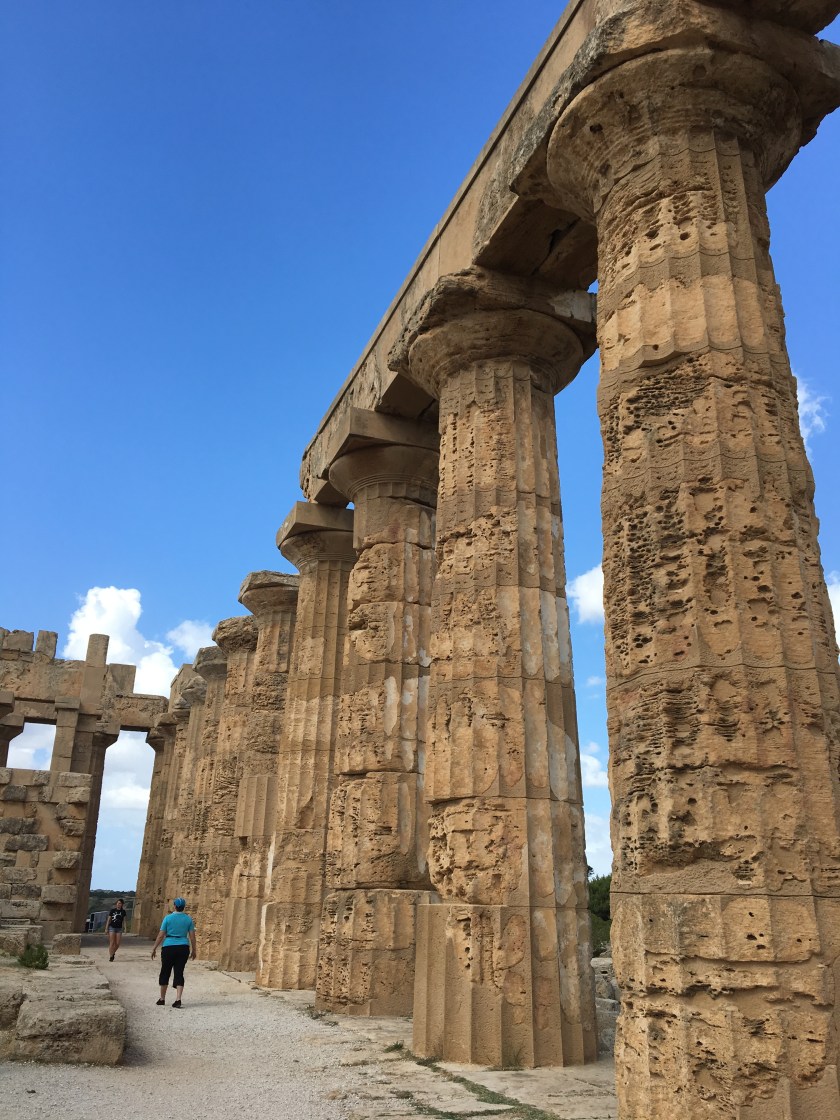
The photo below shows the sheer size of each hewn pillar.
Further from the religious site stand the remnants of the Acropolis and the old fortified city. Selinunte, whose name derives from the Greek selinon (Σέλινον) for the wild celery which grows abundantly here and whose image they used on their coins – was a thriving town comprising, at its peak, more than 30.000 inhabitants , excluding slaves. As was inevitable, they were involved a series of wars with their neighboring cities.
In 409 BC, the Segestans, with whom they had been fighting, asked for help from the Carthaginians, who were of Phoenician descent and based in Tunis. They crossed over in a fleet of 100.000 men and laid siege to the city. Finding the inhabitants unprepared for such an assault, they breached the walls, lay waste to the whole town and massacred 16,000 people. A further 5000 were taken into slavery. The survivors eventually came back but, despite various attempts to rebuild, Selinnte never regained its former status.
The ruins of the town. Main Street. Selinunte was built according to an urban plan dividing it into blocks.
Trying to imagine what it must have been like, looking over that beautiful sea and seeing the Carthaginian fleet appear over the horizon.
Sicily is a large island and there are many more places to visit, such as the Valley of theTemples in Syracuse. It is home to around five million inhabitants and is a melting pot of a variety of different cultures and ethnicities, including the original Italic people, the Greeks, Romans, Byzantines, Saracens, Normans, Swabians, Aragonese, Lombards, Spaniards, French, and Albanians, each having contributed to the island’s culture and genetic makeup. It also boasts stunning scenery, great beaches, friendly and hospitable people and fantastic food.
Foodie footnote: Apart from great olive oil, honey and tomatoes, Sicilian produce includes lemons and pistachios. The refreshing lemon granita is to die for, as is the pistachio ice-cream and semi-fredo. You are offered all kinds of fresh fish and shrimp, caponata made with their delicious aubergines, food with oriental touches such as chickpea fritters and, among the endless variety of pasta, a dish I’d never tried before: linguine with lemon and pistachios – absolute heaven on a plate. And a final unmissable – the cannoli: crunchy biscuits tubes filled with whipped ricotta in many flavors (including pistachio, of course!). And, last but not least, one must not forget the delicious local wines.
A visit to the Louis Vuitton Fondation of Contemporary Art inParisisamust, if only to admire (gape at!) the building, which was designed by famed architect Frank Gehry. Construction of the museum began in March 2008, and was plagued by many lawsuits and appeals from people who were against building in the Bois de Boulogne, the largest park in Paris. However, the permits were finally obtained and the museum opened in October 2014. Its cost was supposed to be $143 million, but, according to some sources, it finally rose to around $780 million.
Be that as it may, it is an extravagant structure which definitely adds to the must-see list of Parisian sights, and those responsible for its design and construction have won several architectural awards in France and the US.
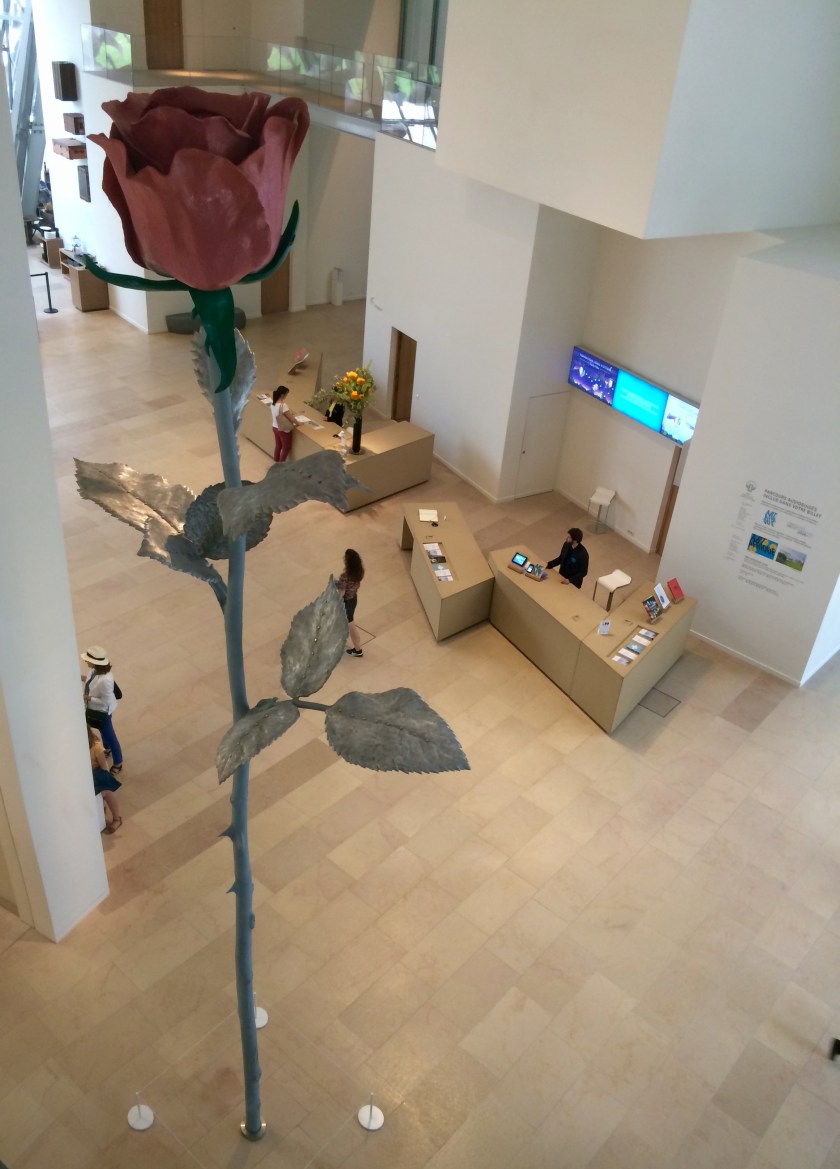
The building takes the form of a boat’s sails inflated by the wind. These glass sails envelop the “iceberg”, a series of shapes with white, flowery terraces; they are made of 3,584 laminated glass panels, each unique and specifically curved to fit the shapes drawn by the architect. The building incorporates interesting water features as well as commissioned site-specific installations by, amongst others, Ellsworth Kelly, Olafur Eliasson and Adrián Villar Rojas.
View of the lobby from above
The LVF houses an extensive permanent collection, including works by Jean-Michel Basquiat, Gilbert & George and Jeff Koons. This summer, a major temporary exhibition showcased art from sub-Saharan Africa, made up of three distinct exhibits: offerings from the foundation’s own archive, a selection from JeanPigozzi’s prestigious collection and an overview of the best in South African contemporary art.
It is obviously difficult for one exhibition to encompass the scope and variety of a continent made up of 54 different countries, but there was terrific work from artists we rarely see, or sometimes have never seen at all. Despite all the talk about the globalisation of the contemporary art world, art from Africa continues to be woefully under-represented.
I personally was galvanized and overwhelmed by what was on offer. Since I am no expert on the subject of African art, and it would be easy enough for anyone to look up any information needed, I will only attempt here to show a small sample of the works which enthused me.
Benin artist Romuald Hazoumé is of prestigious lineage, since his ancestor was a high priest of the Fâ at the court of the King of Port-Novo. His art reflects his close connection with his Yoruba culture, where masks hold center stage: his were made of recycled plastic cans and other household objects.
Rigobert Nimi is from The Congo and a lot of his work uses found objects. He had contributed enormous constructions resembling amazing imaginary spaceships.
Senegalese artist Seni Awa Kamara learnt pottery from her mother, who made everyday objects, but developed her own radically innovative style. She creates female figures to whom are attached many tiny statues meant to represent children, in animal or human form.
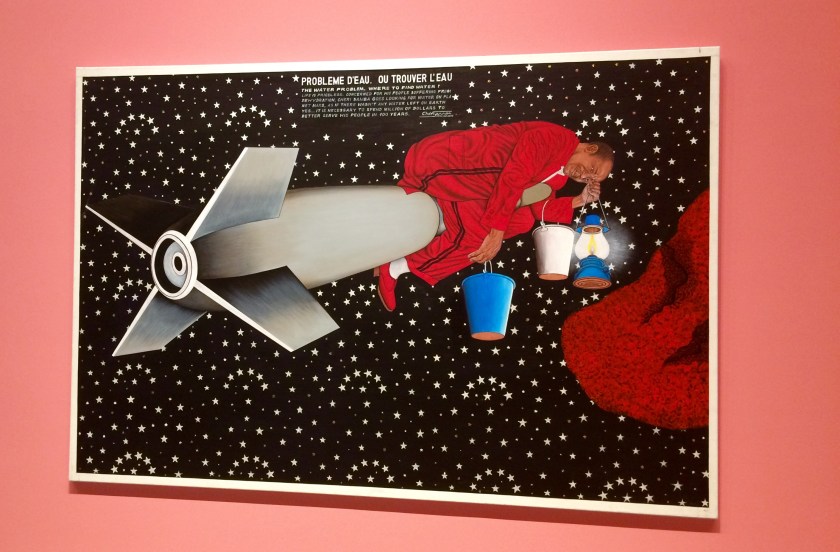
Activist Chéri Samba is inspired by everyday life and touches on a wide range of subjects from current political, economic, social and cultural events in Kinshasa – such as ecological problems, corruption, tragic events, etc. He incorporates text in his work, both in French and Lingala, as in the painting below, which highlights the problem of obtaining clean water.
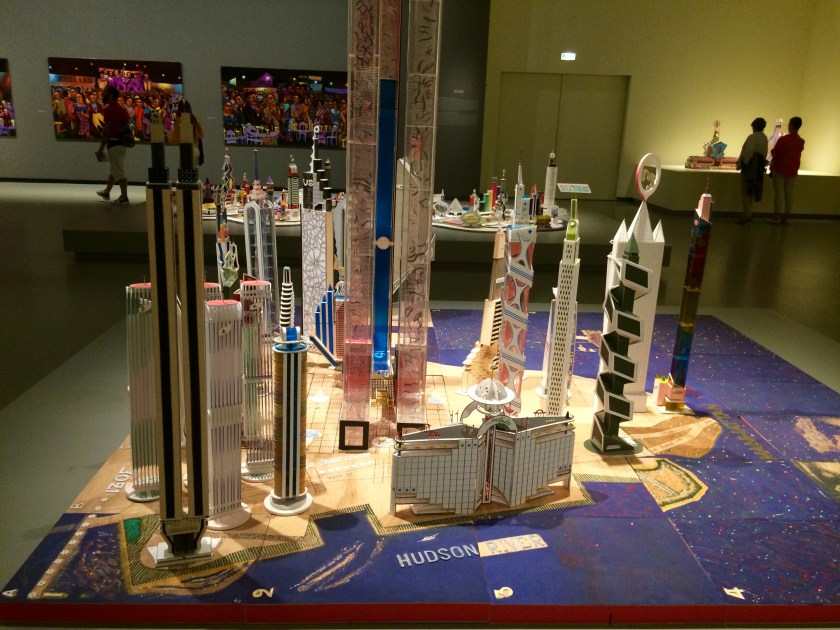
Bodys Isek Kingelez, who is from the Democratic Republic of the Congo, builds models of buildings with unusual shapes and bright colors, using recovered materials. Some are individual constructions, and some entire urban simulations, such as his enchanting rendering of an imaginary Manhattan, below.
Artist Abu Bakarr Mansaray, from Sierra Leone, taught himself chemistry, mathematics and electronics using school textbooks. In 1998 he fled the civil war and moved to the Netherlands where, in his art, he evokes the war and its traumas, but also UFOs and aliens of which he considers himself the interpreter. He draws upon his scientific knowledge to produce monumental drawings using pencil, ballpoint pen, felt-tip markers and colored pencils.
A Heath Robinson-esque contraption, and, below, a detail from another painting.
Artist John Goba was initiated by his grandmother into a secret female society. Inspired by this, he makes statues evoking traditional knowledges and tales of various ethnic groups, using wood and porcupine quills.
Benin artist Calixte Dakpogan comes from a family of ironmongers. He too reinvents the mask, either using found materials, or cheap everyday made in China objects, such as safety pins, beads, ballpoint pens etc.
Photographer Seydou Keïta (Mali, 1921-2001), is considered one of the greatest photographers of the late 20th century, and was one of the few artists whose work I’d seen before. Through a large number of exceptional portraits he painted a testimony of Malian society from the end of the Second World War through to Independence.
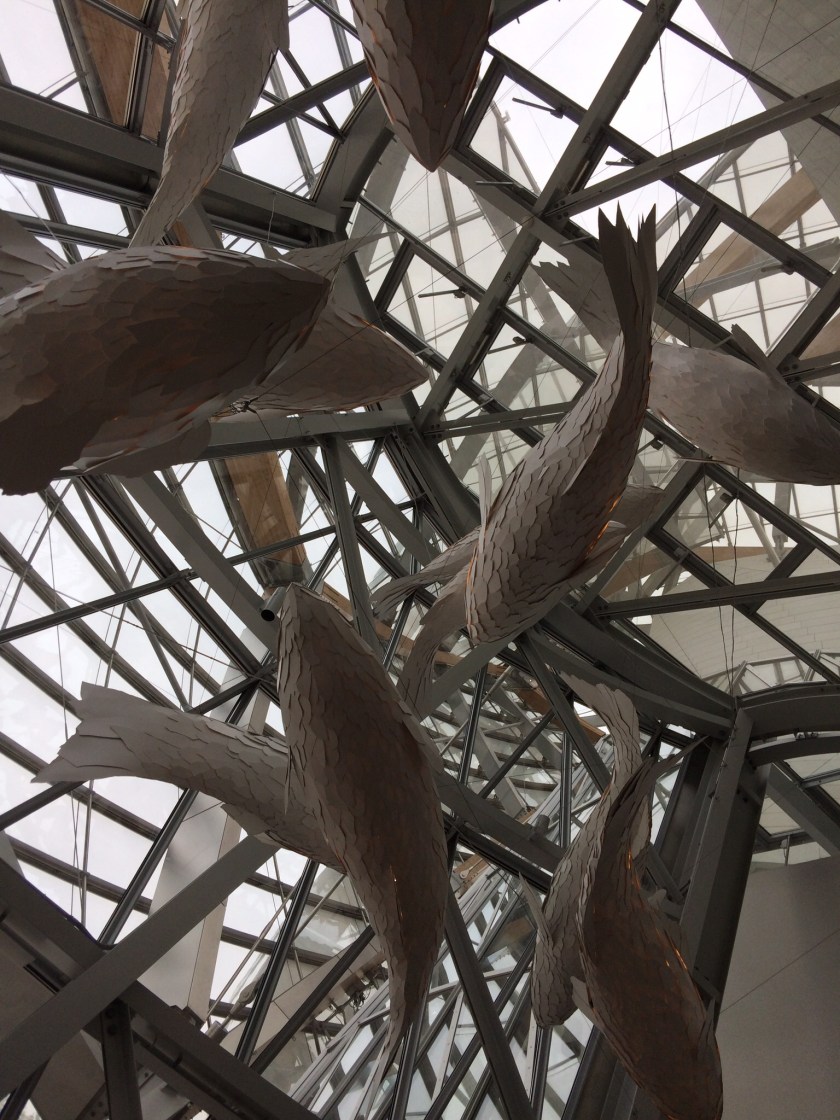
Even a short break for lunch was not devoid of artistic stimulation, since we sat under this lovely installation of paper fish in the restaurant.
After lunch I continued upstairs, to the part of the exhibition entitled Being There, showcasing some of the most important South African artists. Legends of art such as William Kentridge, Jane Alexander, David Goldblatt, David Koloane and Sue Williamson were featured – artists who helped shape the local art scene and also influenced the younger generation, many of whom were also exhibited here. Sadly, by then I was suffering from a surfeit of visual stimulation, so I skimmed over most of the works and only paused for a disturbing installation by David Koloane, whose work is devoted to the chaotic energy of Johannesburg. His art has distinct political and social overtones, and street dogs, ubiquitous in the townships, put in multiple appearances.
Last, but not least, I sat for a few minutes to watch the latest video production of WilliamKentridge, Notes Towards a Model Opera, which played simultaneously on three large screens (video below). Kentridge, an artist who experienced apartheid as a white man, has long been a favorite of mine.
It would have been nice to have been able to go back before the exhibition finished (on September 4), because it was impossible to take in such a wide range of extraordinary talent in detail and all at once. Even in this post it was too much to incorporate all the photographs I took, or present all the artists whose work I liked.
On a brief trip to Paris, I managed to squeeze in two art exhibitions, and it was really worth it.
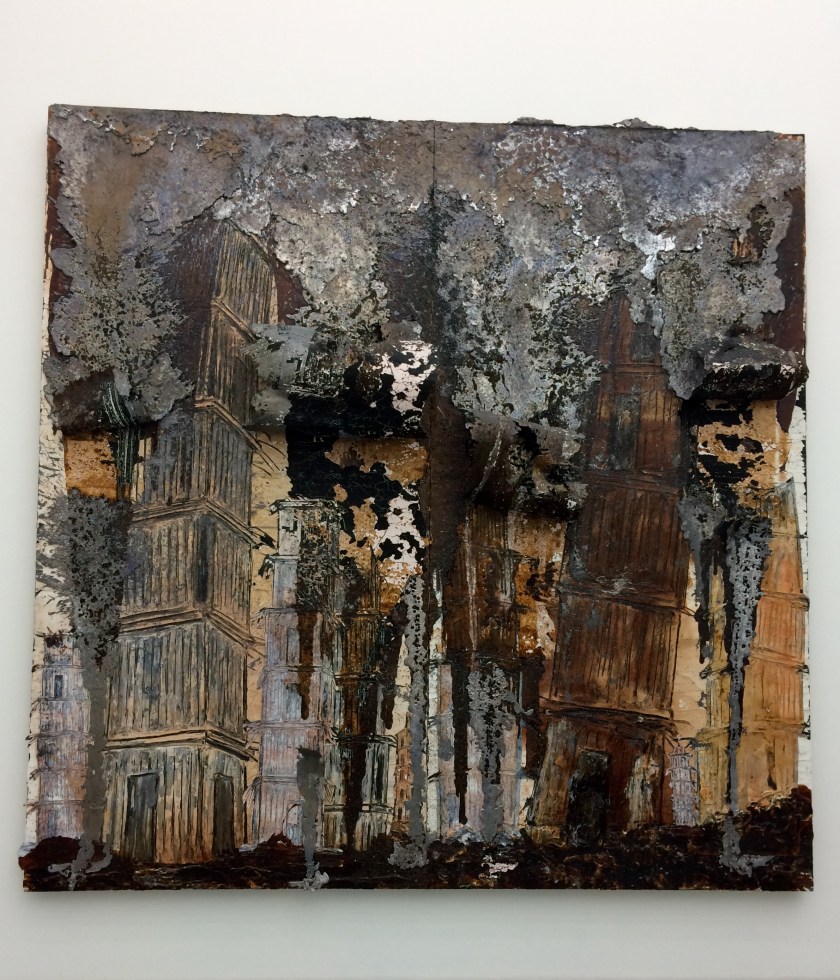
Les cathédrales de Frances. Painting by Anselm Kiefer
The first was at the Musée Rodin, where the German artist Anselm Kiefer was asked to produce art to mark the centenary of the death of Auguste Rodin. The idea was to invite the viewer to consider the aesthetic concerns shared by the two artists.
Anselm Kiefer was given the freedom to create a series of works incorporating debris that Rodin produced while making his sculptures, such as offcuts and discarded molds.To echo this, elsewhere in the museum displays were altered to present previously unseen plaster works by Rodin.
The Musée Rodin is housed in a 1730 building, the Hôtel Biron, which was initially a private residence, before being rented by the Society of the Sacred Hearts of Jesus. It was then taken over by the state and left vacant for years. In the early 20th century rooms were rented out for studios to artists such as Jean Cocteau, Isadora Duncan and Rainer Maria Rilke, amongst others. Henri Matisse rented space for his school of art, and then Rodin – after Rilke, who later became his secretary, let him know about the building – joined the group, and gradually took over the whole building, where he worked for years, until his death.
The building and gardens are beautiful and perfectly maintained. The main part of Kiefer’s work is presented in a room just inside the outer wall, which was built as a chapel for the needs of of the Sacred Hearts of Jesus Society.
Anselm Kiefer was born in 1945 and studied with Joseph Beuys and Peter Dreher during the 1970s. In his work, he unflinchingly confronts his culture’s dark past, and adresses controversial historical issues.
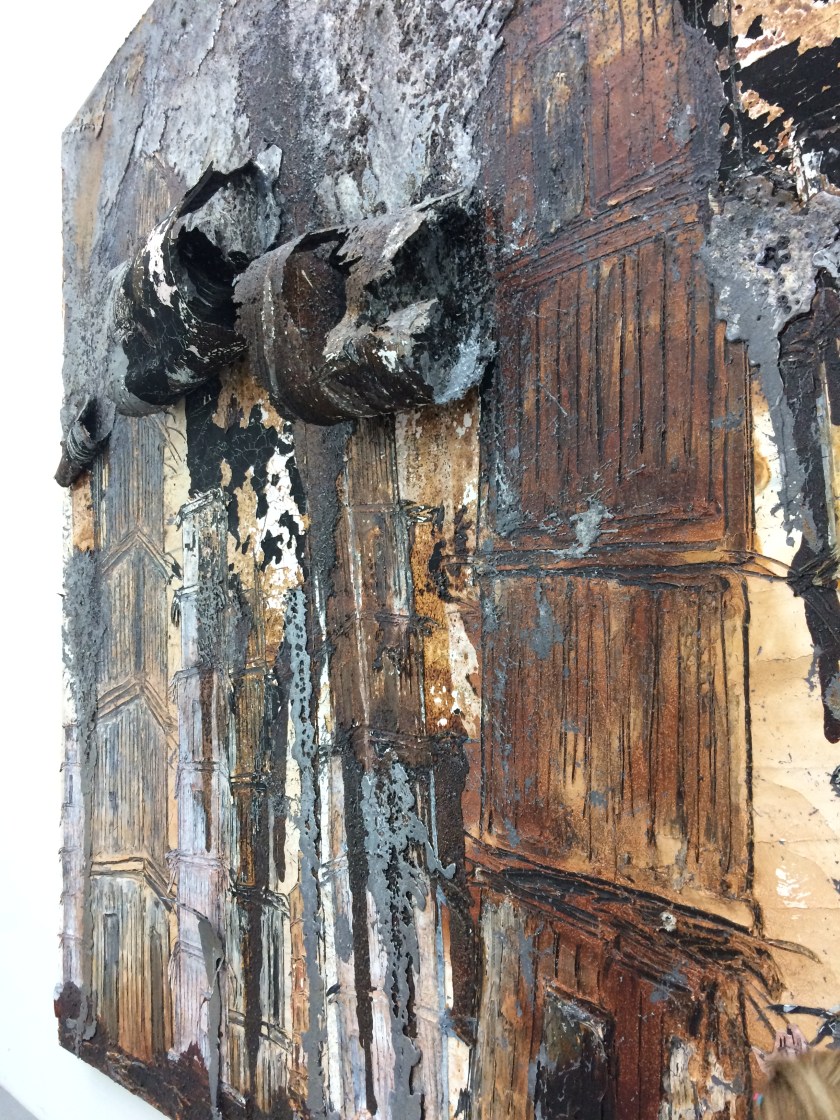
Kiefer is a romantic, with a huge visual vocabulary. He uses architecture, amongst other images, to convey the weight of history. The three paintings in the room are diptychs, large canvases whose surface is multi-layered and textured. Thick layers of gesso and paint have been mixed with other substances such as glass and clay to give them texture. Kiefer then scratches and carves into the surface to reveal the layers beneath. In these particular paintings, molten lead has been splattered on top, and parts of it have been bent and curled backwards to add a third dimension.
Detail: The lead has been curled back, still bearing the imprint of the layer beneath it, which it reveals.
The paintings are difficult to describe and photographs can never do them justice (even better ones than mine!). They have to be experienced – and, without the slightest exaggeration, I can say they are breathtaking.
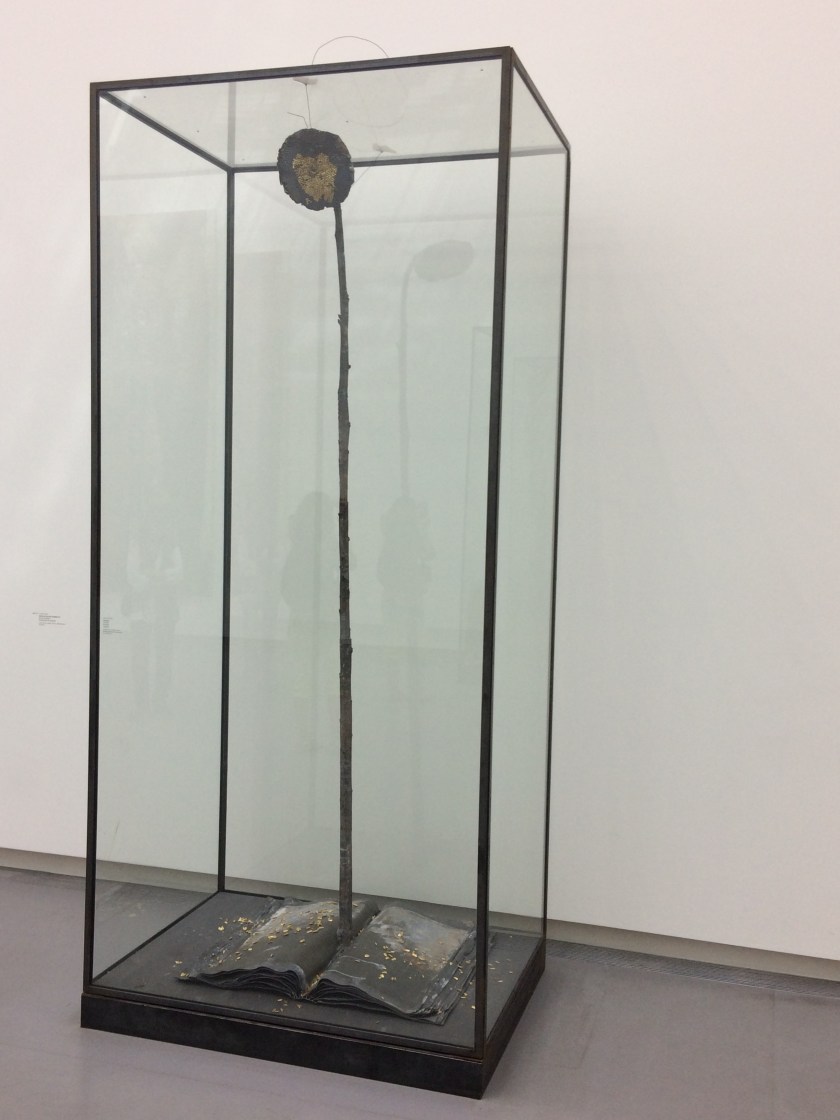
Kiefer also makes installations, in this case using dried sunflowers and branches, sunflower seeds coated in gold leaf, earth, stones and the aforementioned clay debris.
In my opinion, he is one of the greatest artists of our time, due to his enormous scope and erudition, his use of a huge variety of materials and his production of monumental works. I might not love everything he does – which I think is a good thing – but I never cease to be surprised and impressed every time I encounter another of his works.
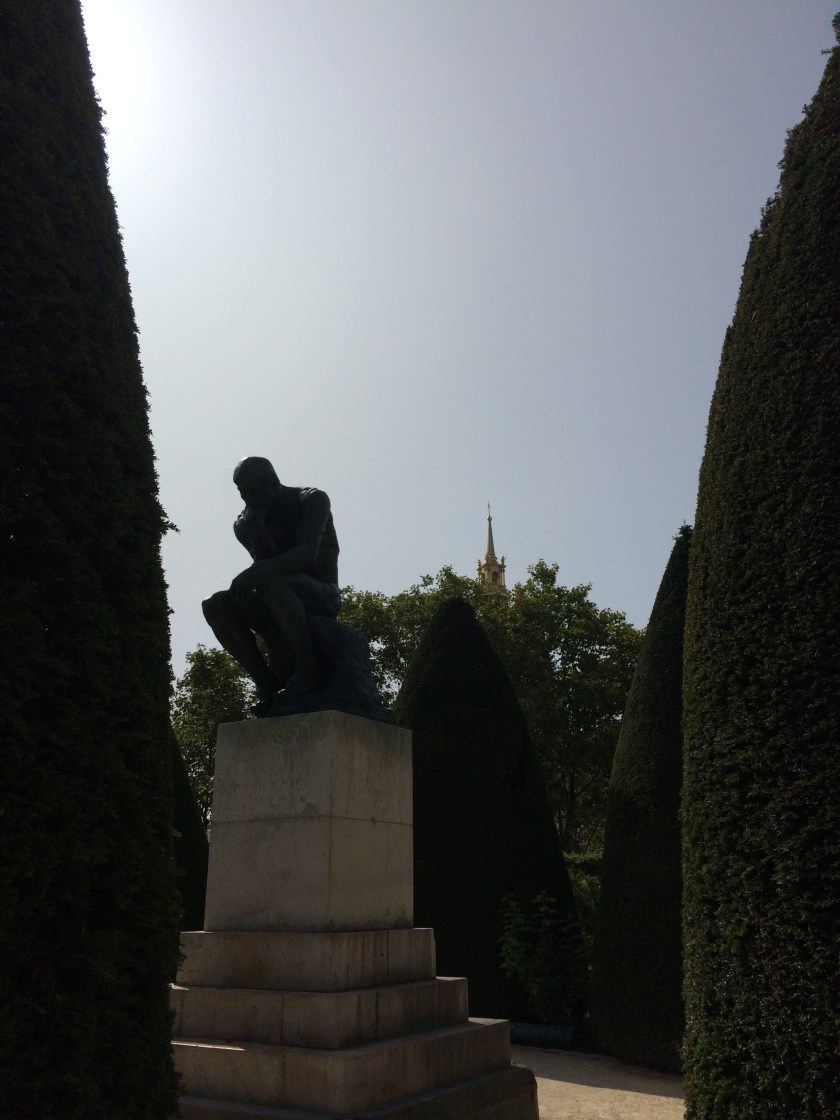
I finished up by walking in the gardens to visit old favorites, such as The Thinker.
P. S. I still need to write up the second exhibition I saw, on African Art at the Louis Vuitton Foundation, so stay tuned!
July 31st – the month is over, and so is the watercolor challenge. I’m happy to say I managed it, but then I tend to draw or paint most days anyway. There are many more art challenges to be had on the web – drawing 100 people in a week, or new prompts on Doodlewash for August – but I think I’ll give it a rest for now. At least until Inktober (making an ink drawing every day in October). We shall see.
Meanwhile, here is my output for the last week of July, much of which was taken up with my floral triptych.
Day 24
Started adding background to my floral paintings.
Day 25
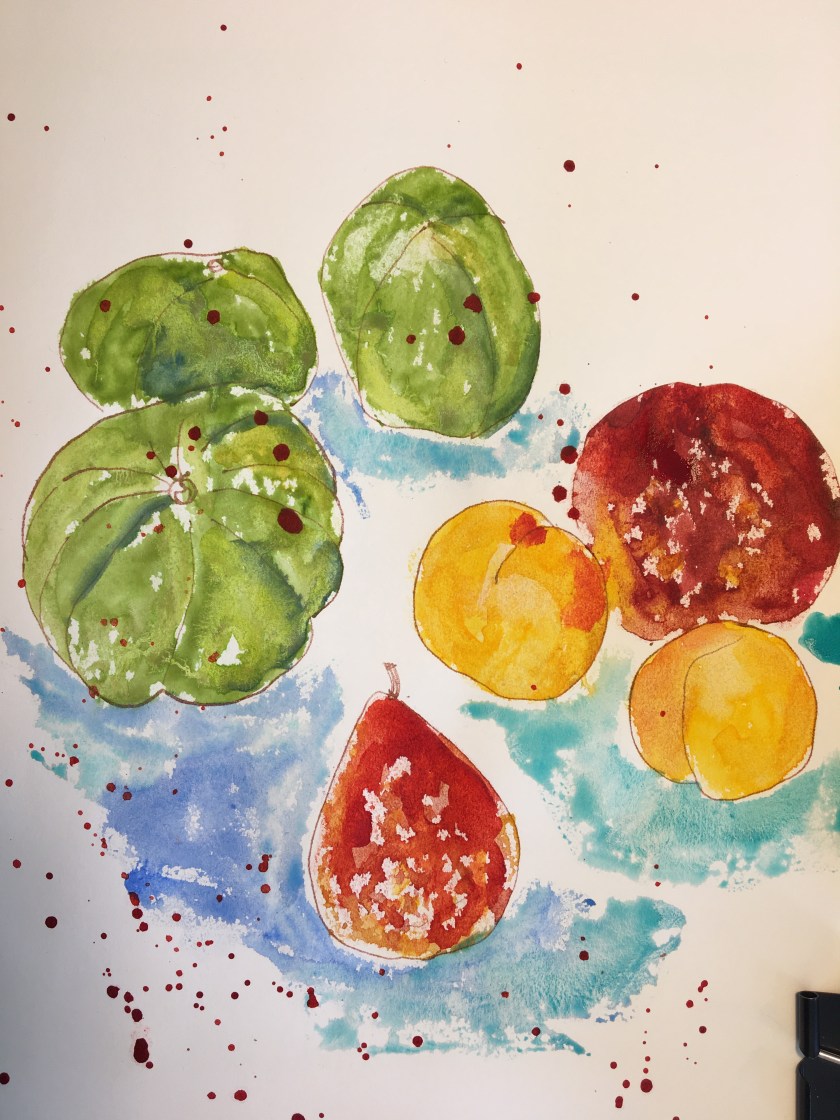
Fruit and veggies on the kitchen table – three green tomatoes, a nectarine, two apricots and a pear. I drew these in a Moleskin journal which has glossy pages that reject watercolor, which made for interesting effects. You can see the paint pooling on top of the paper instead of sinking in.
Day 26
Having picked this red cabbage in the garden, I was fascinated by the shape of the outer leaves curling around the central globe, and the subtle colors going from purple to blueish green. I made a quick sketch – on khadi paper this time, which absorbs color beautifully. Not very pleased with the result, but unfortunately I couldn’t start over, since it was time to cut it up for the salad!
Day 27
Artist Caroline Magerl posted a picture of her westie on Instagram. I loved the shape she made from the back, so I used her for today’s sketch. Looking at the photo, I now think the background needs to be darker.
Day 28
Today I felt like drawing a figure, and I came upon some origami paper, so I added collage. This is a small sketch in my khadi journal.
Day 29
I’m hard at work on my triptych, so no time for anything else today.
Day 30
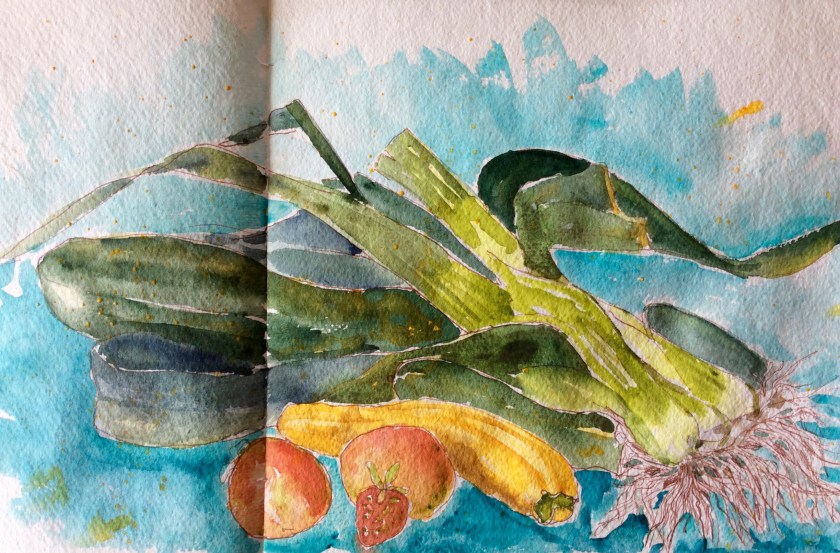
Today’s garden harvest: courgettes, some whiskery leeks, a couple of small and barely ripe tomatoes and a lone strawberry (actually there were a couple more, but I ate them). All begging to be painted.
Day 31
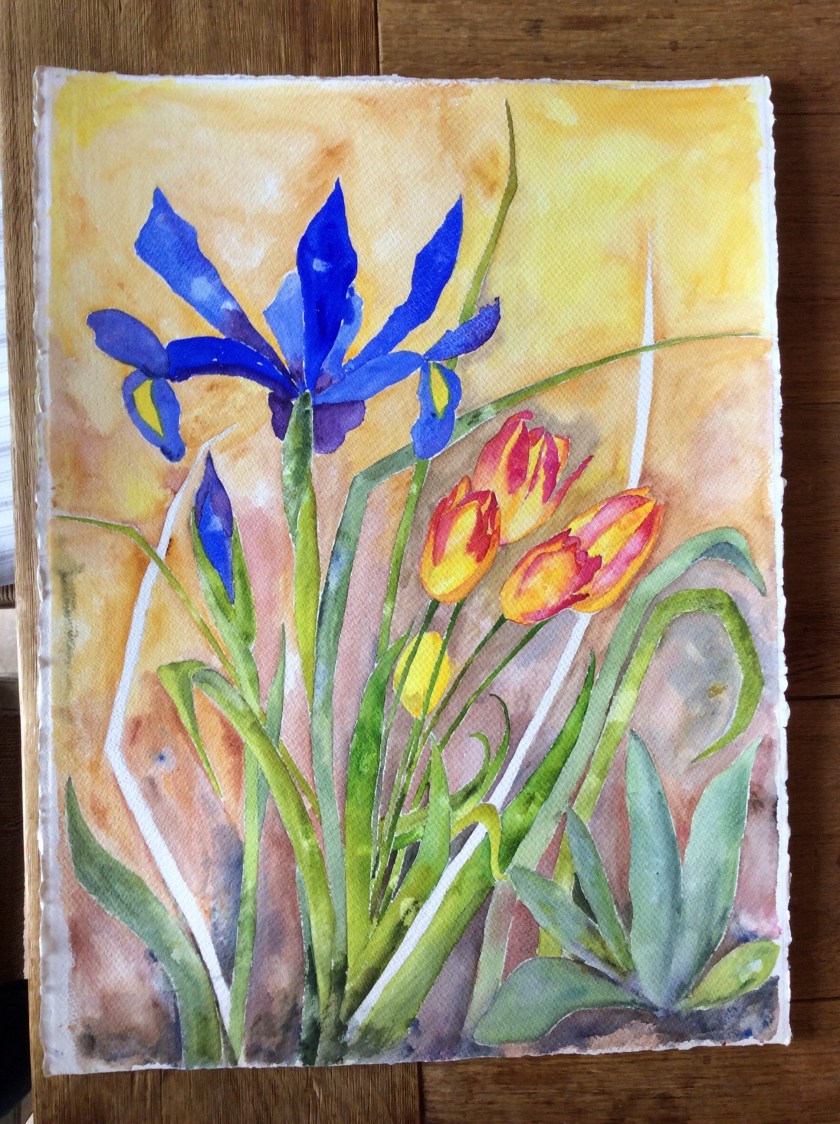
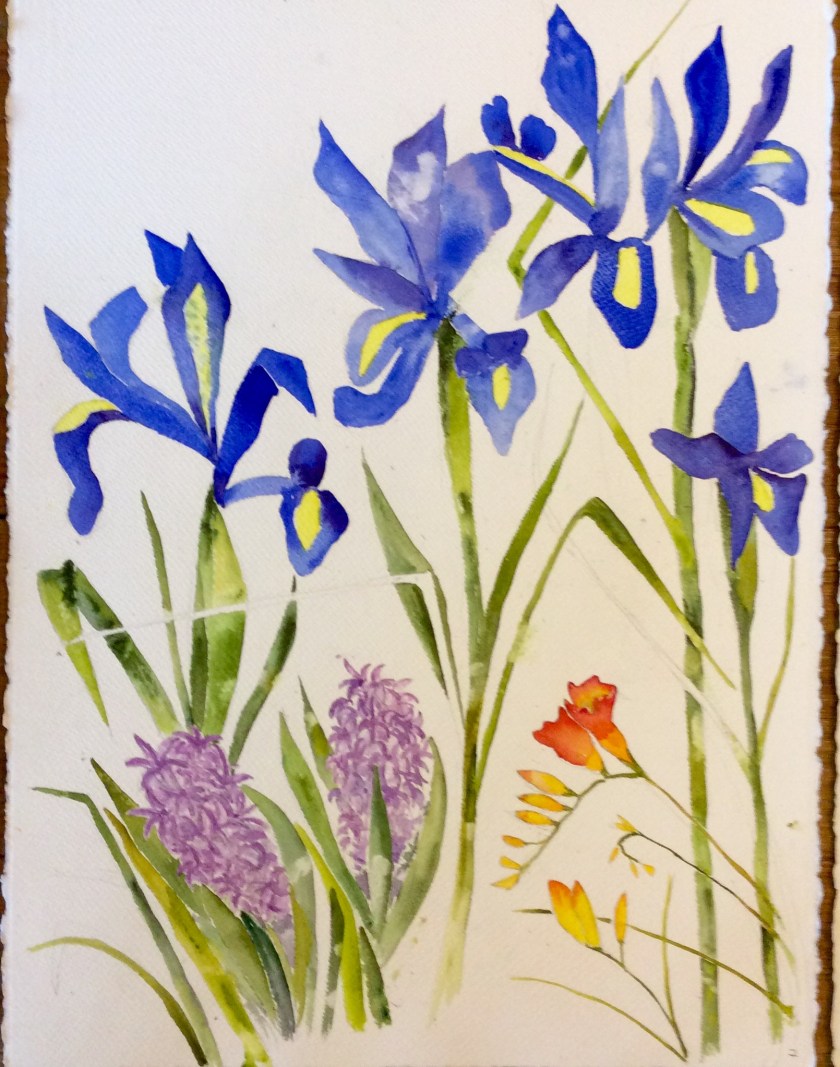
I think my floral triptych is finished. Here it is, propped up on the kitchen counter, since I don’t have an empty wall big enough. I’ll contemplate it for a day or two, in case I feel like making any changes, then I’ll pack it of to its new owners.
And that nicely concludes the challenge. New bird painting planned next.
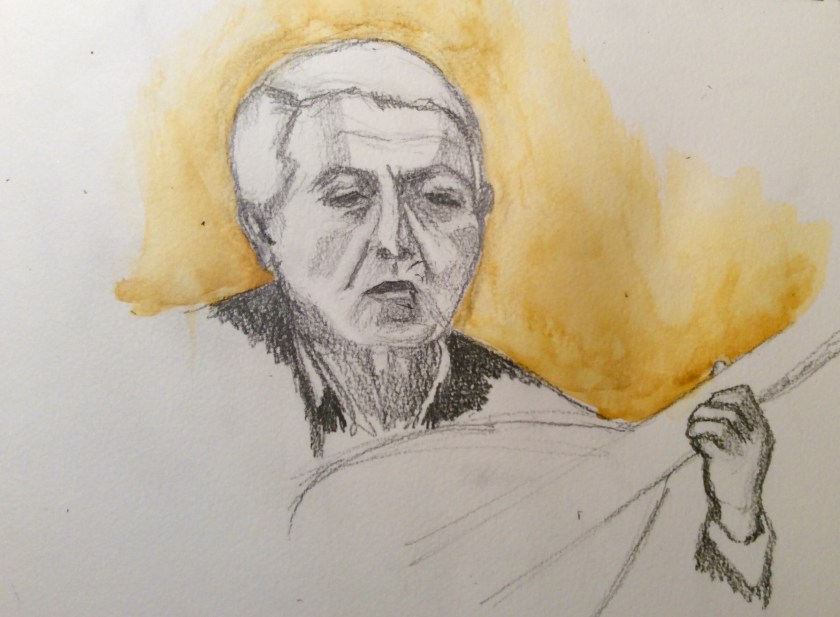
Day 16: Drawing people is not my strong point, and World Watercolor Month is all about trying new things, so I thought I’d challenge myself. I love Francesco Clemente’s watercolor portraits, and I used those as my inspiration. Still a long way to go…(sigh…). But they were fun to do, and I’ll definitely repeat the exercise.
Day 17: Everything possible went wrong with this drawing of a starfish – the masking fluid wouldn’t dry, the masking tape ripped the top layer of the paper off… I think it was all due to the heat. However, I still enjoyed playing with the stencils.
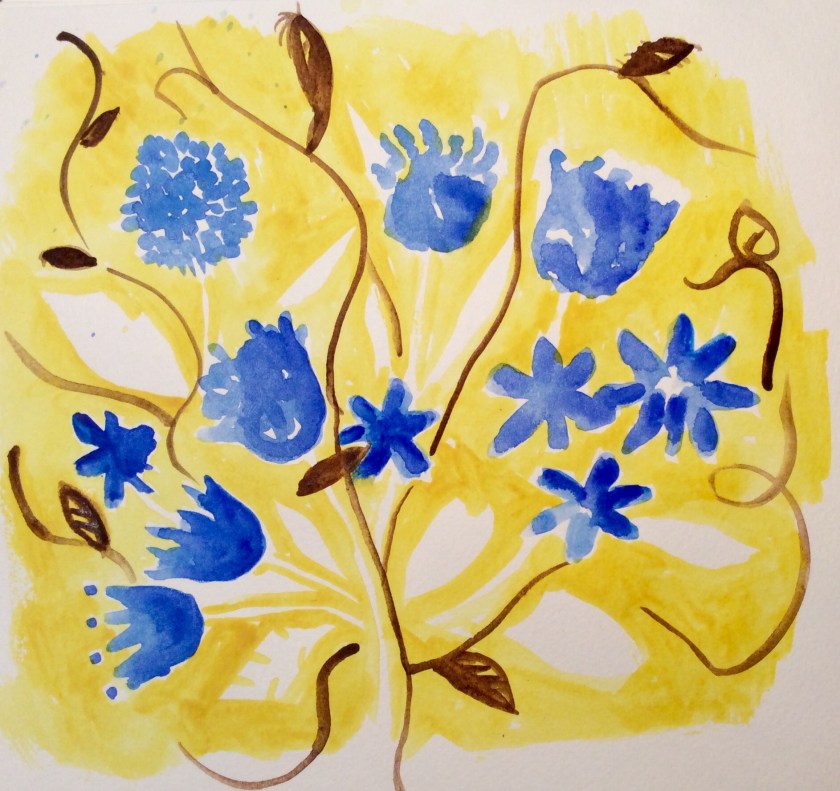
Day18: Very busy day, and I got back late, so I only had time to doodle these little blue flowers.
Day 19: More people drawing practice – this time inspired by a photo I took on my visit to Metsovo.
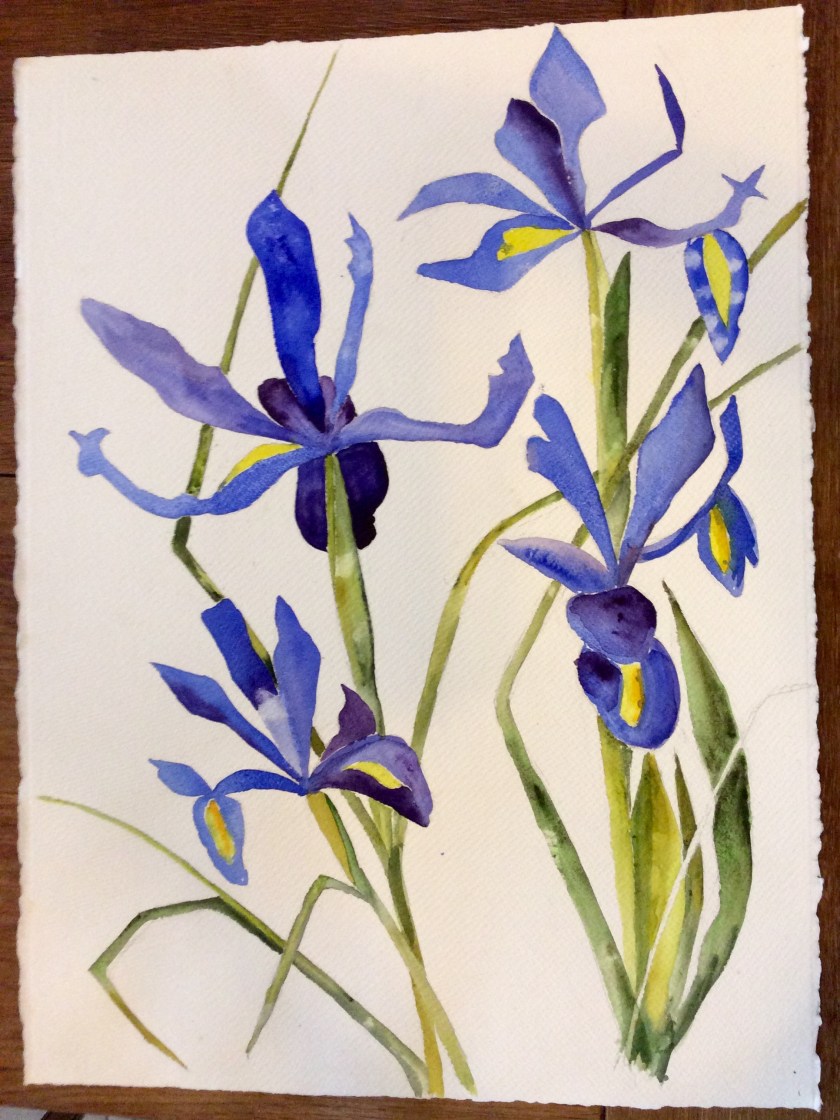
Day 20: Found time to start my new project, a floral triptych. I’ve been doing studies for this since the spring, when the irises were blooming in the garden. I find it really makes a difference to draw things from life, rather than from a photograph. It’s easier to distill the essence of your subject, rather than just its image.
Day 21: I’m now obsessed with this project , so just carrying on. I’m using Canson Watercolor paper, very thick (640msg). I’ve never used this before, and I find it very interesting. It absorbs the color, and leaves it very vivid. Good for wet-in-wet, but also for a hard edge, although the surface is very rough. The back of the paper is smooth, so maybe I’ll try that next time.
Day 22: Started on the leaves. I got interesting effects from lifting the paint with a paper towel, although it won’t lift with a rag. Still playing about, not sure what I’ll leave in and what I’ll paint over.
Day 23: This ‘week’ has eight days, since there are another eight to the end of the month. Here’s the next step to my painting.
I wonder if it’s cheating to post consecutive images of the same drawing? Who knows, and, more importantly, who cares?
For those who did not read my post last year, World Watercolor Month is the brainchild of Charlie O’Shields of Doodlewash fame. It’s a challenge designed to encourage anyone who joins in to post a watercolor painting each day of the month of July. It’s a fun thing, with very relaxed rules – there are no prizes, or obligation to post each day.
Day 1: Bunnies – Present for a child’s christening (part 1)
We do have a list of prompts, but nobody’s obliged to follow it, they’re only meant to help people with inspiration. The idea is to bring together artists of all levels, from all parts of the world.
Day 2: Ducks – present for a child’s christening (part 2)
WWM started in 2016 and proved a great success, prompting Charlie to greater efforts this year. The project, which has attracted sponsorship from various well-known art supply brands, has also teamed up with The Dreaming Zebra, a non-profit foundation that provides underprivileged schoolchildren throughout the world with art and music supplies.
Day 3: Mountain village – the view from the window. Quick evening plein air sketch.
I joined in last year, and the results were beyond my expectations. It got me into the habit of drawing or painting every day, which I’ve kept up since. It made me open an Instagram account, and inspired me to follow many artists from whom I’ve learnt so much. I’m self-taught, so the encouragement, tips, comments, ideas and support I’ve been getting have proven invaluable. I’ve met new people, improved my technique and, most of all, had so much fun. I’ve now started getting commissions, and am even thinking of opening an Etsy shop.
Day 4: result of a walk in the fields
I’m so grateful to Charlie, who has shown that you don’t need more than enthusiasm, new ideas and a lot of TLC to make a real difference. His site, Doodlewash, hosts watercolor artists from all over the world (I was extremely proud to be included, here) and every Saturday there is a post where artist Jessica Seacrest reviews art supplies that she has tested. We’re talking types of paper, brushes, paints – very addictive, although bad for the wallet! And, of course, Charlie never fails to post his own daily doodlewash, with an amusing story to accompany it.
Day 5: Starfish. Watercolor and oil crayon over comic strip glued in tiny sketchbook.
I’m getting stuck in again this year, even if some days it will mean just splashing some paint around for a few minutes. I will post my output at the end of each week, and you can tell me what you think. What you see today is this week’s output.
Day 6: Summer fields. Mini landscape in tiny sketchbook.
I urge any of you with a creative streak to join in. You can jump in at any time, post as little or as much as you like. Just tag your work #WorldWatercolorMonth
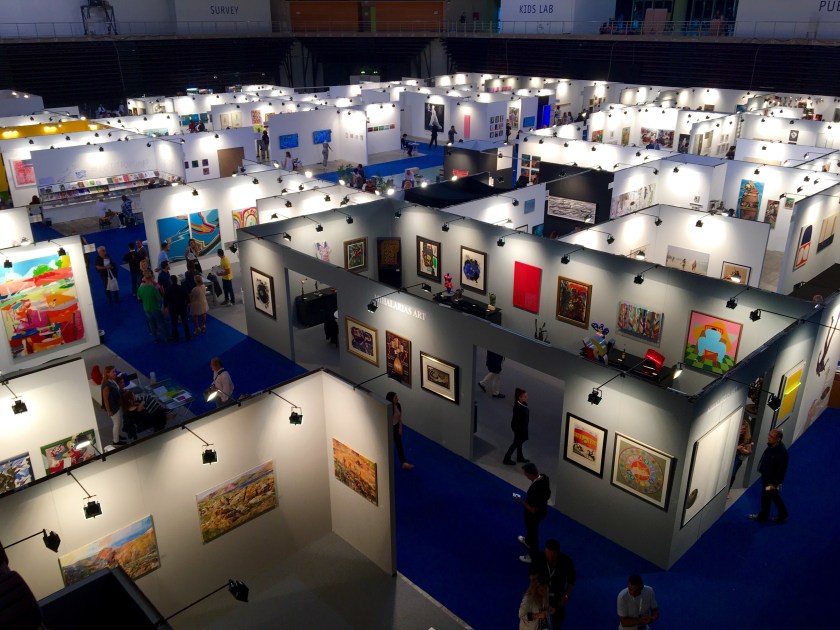
There is plenty of art on show in Athens these days. As well as the Documenta project, which is spread all over town, from May 26 to 28 there was also Art Athina, a three-day fair open to the public.
Fifty eight galleries, mostly from Greece but quite a few from abroad (Paris, Istambul, Vienna, Zurich, and even as far away as Dubai, Australia and Mexico) offered modern art for sale in a wide range of prices.
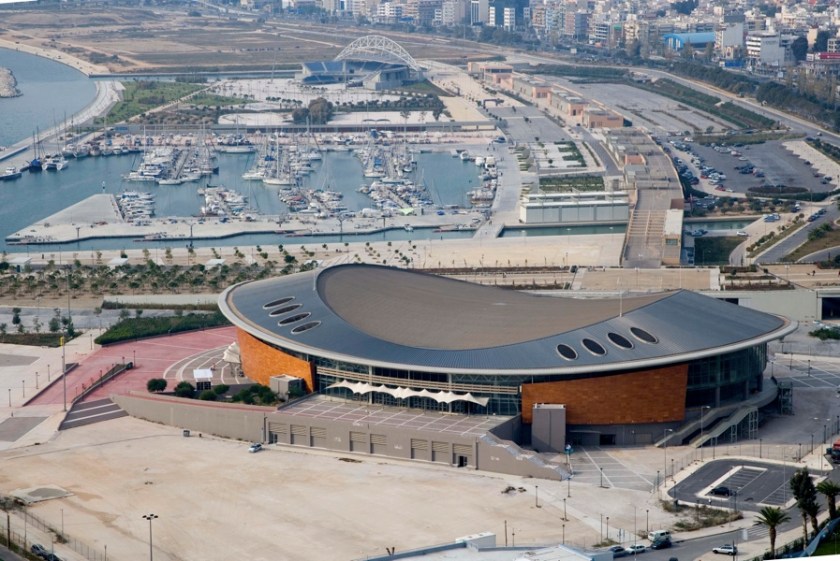
Art Athina venue: the Olympic Tae Kwon Do stadium (photo from Google)
The fair was held at the Tae Kwon Do Stadium in Faliro, on the coast not far from the center of Athens, a venue built especially for the 2004 Athens Olympics. It is a modern and spacious structure benefiting from a wonderful location next to a marina full of yachts. Nowadays it is used for various purposes, such as concerts, and even provided shelter to refugees at the worst of the crisis.
Inside, the galleries had set up their booths, and it was fun wandering around looking at the art on offer.
The view from the top floor
Sadly, I was extremely dismayed, if not disgusted, by the state of the building’s interior. I decided not to post any photos, thinking it too depressing. But I was aghast at the unpainted, stained walls, the dirty floor, the missing or broken fixtures… I don’t understand how some funds could not be raised to at least freshen it up a little.
Whimsical pen and ink drawing by Greek artist Leonidas Giannakopoulos
The whole issue of the Olympic venues is shameful. Most have been left to rot – and when I think of what Greek taxpayers forked out for them (they were grossly overpriced) it makes me grind my teeth. What’s more, the labyrinthine governmental system means that any attempt at exploiting them is resisted. Apparently the National Shooting Federation wanted to take on the Olympic Shooting complex and keep it functioning and upkept, but their offer was refused. The racetrack and equestrian centre have become totally decrepit, despite racing being a potentially profitable business. Etc, etc. – and we are talking about state-of-the-art, modern installations that could benefit Greek athletes who usually have to train in less than ideal conditions. It beggars belief.
Another by the same artist, called Sky Adventures
I can only console myself with the thought that, thanks to the Olympics, we have at least got a new, very functional airport, a good subway and a much improved road system. These had been planned for over twenty years (!) but had never materialized and would not have been finished but for the games. Part of the problem being that, wherever you dig, you find antiquities, and work has to stop until the Archaeological Society decrees what is to be done. A couple of museums were filled with what was found on these sites – but that is another story!
Outside, a band was tuning up for one of the performances on offer
If you are interested in more detail about Art Athina, pop over to the ArtinAthens blog, there is a very interesting article here.
An altered book by a Greek artist whose name, unfortunately, I did not note. I loved his work, though































 Letters from Athens