La rentrée is the French expression for the end of summer, when everyone returns from their holidays and the kids go back to school. An expression guaranteed to provoke annoyance if not anxiety in childish breasts. As a child in Greece, I remember being enervated by cliché talk of ‘the first rains’ (after months of drought) and ‘every rascal goes back to his desk’. It was the last thing we wanted to hear after running around barefoot and half-naked for three months. Back to ghastly leather shoes and blue overalls with white collars.
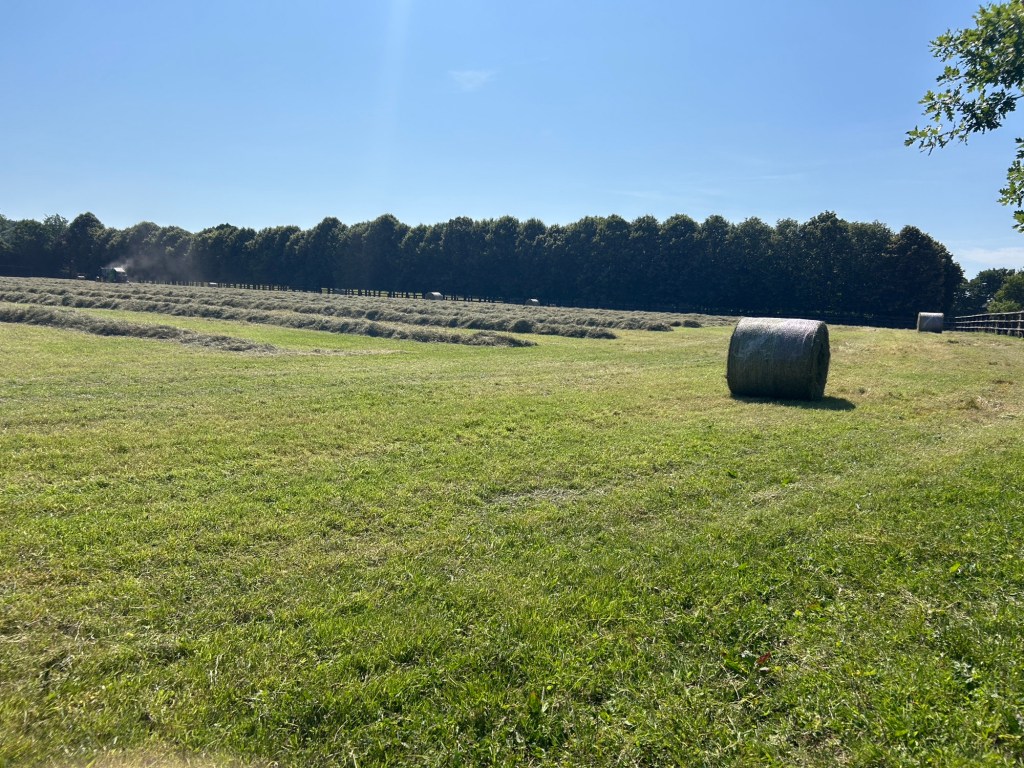
Autumn view of Normandy fields
Be that as it may, the days are drawing in and there is a chill in the air.
I have been painting a lot, inspired by summer bouquets. Peonies, watercolour on paper
After a very busy but pleasurable summer, with all the family here and meals for up to fifteen people (necessitating endless shopping, cooking and cleaning up!)—al fresco lunches and barbecue dinners—we are back to being à deux. The garden is, somewhat belatedly, providing us with plenty of tomatoes, courgettes, green beans and lettuce, so I am planning some healthy eating after the plethora of ice creams and chocolate eclairs.
Greek Interior. Oil on hardback book cover
I am determined to avoid the horrendous news as much as possible (why are most politicians so hideous?) and cocooning with painting, writing and reading. I have neglected the blog for weeks, due to lack of time and inspiration, but will now do some catching up on summer activities. Also resuming the puppy’s training, since he has become horribly spoiled by everyone.
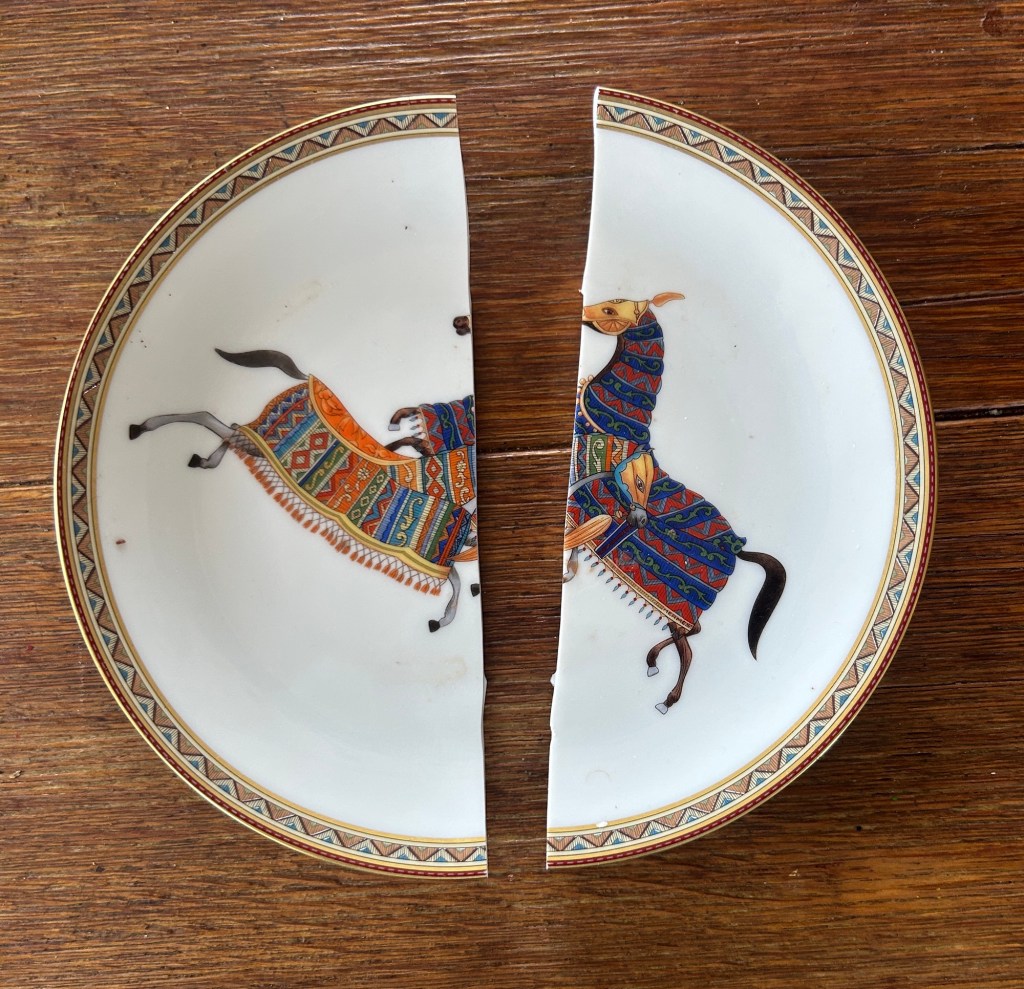
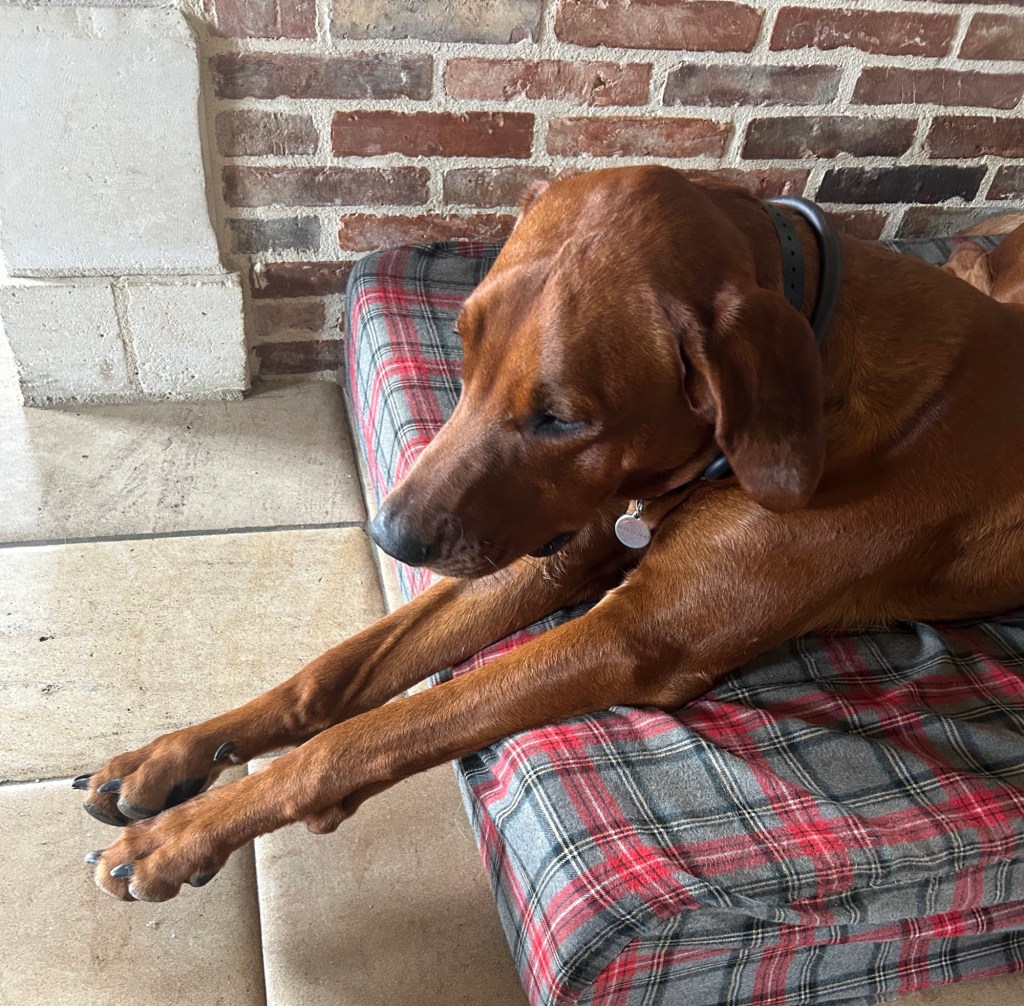
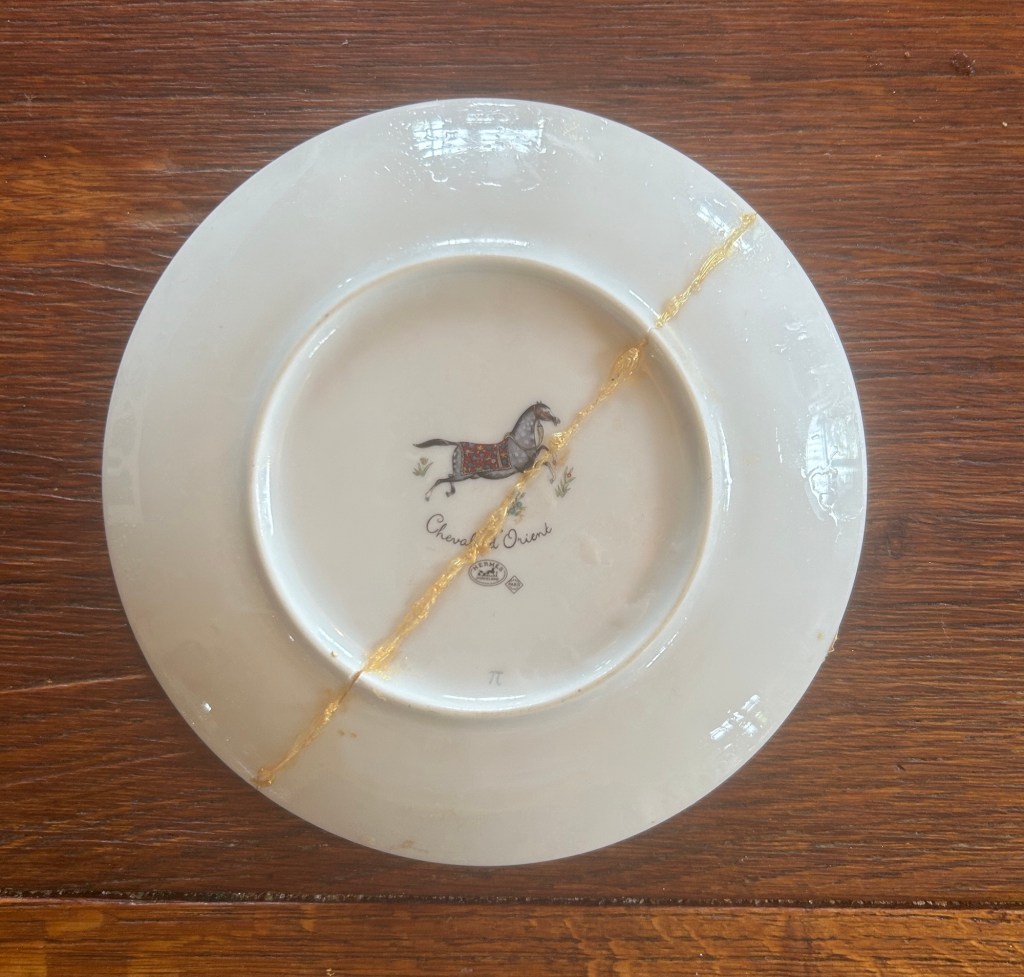
Meet Sanga, our overgrown and over enthusiastic puppy. In one day he ate my slippers, shredded my favourite pashmina and broke the lovely little plate above.
Butter wouldn’t melt…
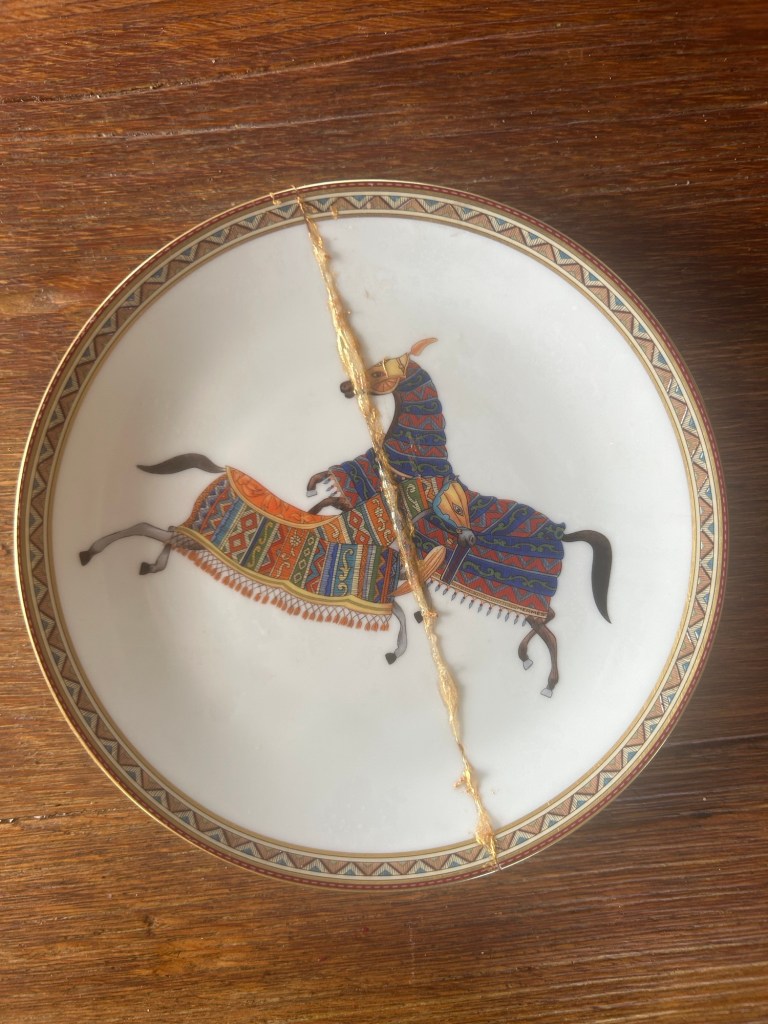
Having got over my extreme annoyance and digested the fact that both slippers and pashmina were shot, I thought it would be an opportunity to try something which has intrigued me for a while: the ancient Japanese art of Kintsugi.
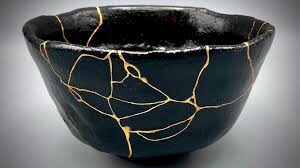
Kintsugi, which probably originated in the 15th century, is a method of repairing broken pottery by mending it with urushi lacquer dusted or mixed with powdered gold. People became so enamored of the new art that some were accused of deliberately smashing valuable pottery so it could be repaired with the gold seams of kintsugi. Sometimes a pottery piece was chosen for deformities then deliberately broken and repaired, instead of being discarded.
Kintsugi means “to join with gold” and it serves as reminder to stay optimistic when things fall apart and to celebrate the flaws and missteps of life.
Kintsugi encompasses a profound meaning and philosophy beyond mere repair, namely the idea of embracing imperfection and impermanence and transforming them into something valuable. It reflects an aesthetic perspective on the way people live, since from this perspective our life is like a vessel.
Not bad for a first try
A good Kintsugi vessel can be very expensive, because it requires months of intricate work. My plate was only broken neatly in two pieces, and I used glue mixed with gold powder (courtesy of YouTube) but I can assure you it is a messy and delicate procedure which ended in my kitchen looking as if a gold storm had hit it.
I am too impatient for the real thing, I’m afraid. Look at this:
Here we go again. The leaders of the free world bombastically beating their chests over the strikes in Iran, boasting that they were ‘A spectacular military success.’ As if Iran is going to take this lying down. The Ayatollahs immediately warned the attacks would have ‘everlasting consequences.’
Various countries are now taking sides, giving contradictory opinions, while bracing themselves against terrorist attacks in major cities.
This is not a political essay—there are others more competent that I to give a considered analysis of the facts, which can be read in the papers and news feeds. Opinion pieces abound, one of which bitterly—and accurately—states that the world is ruled by “three angry old men.”
As a layperson, though, I can but wonder—does nobody look at the facts before taking such decisions as politicians have been taking the last several months?
All the American wars of the past years have ended in disasters—think Vietnam, for example, or Afghanistan, where after twenty years the Americans fled, leaving tons of expensive military equipment behind, their Afghan collaborators in the sh*t, and all the improvements in daily life (especially for women) wiped out in one stroke as the Taliban instantly surged back into power.
And it’s not just America—half the world seems to be on a warpath as we speak.
I’m sure a lot of people in various industries benefit financially from all these wars, but who pays the highest cost? The boys drafted from US villages who were sent to the other end of the world to fight the Viet Kong, the unarmed civilians who see fire and hailstones rain over their hitherto peaceful homes, the mothers sending their kids off to war, the old and vulnerable, the healthy young people returning maimed and broken beyond repair.
It beggars belief. Where are the gains from all this? And is there a solution? Probably the only one is endless negotiation until one is hammered out.
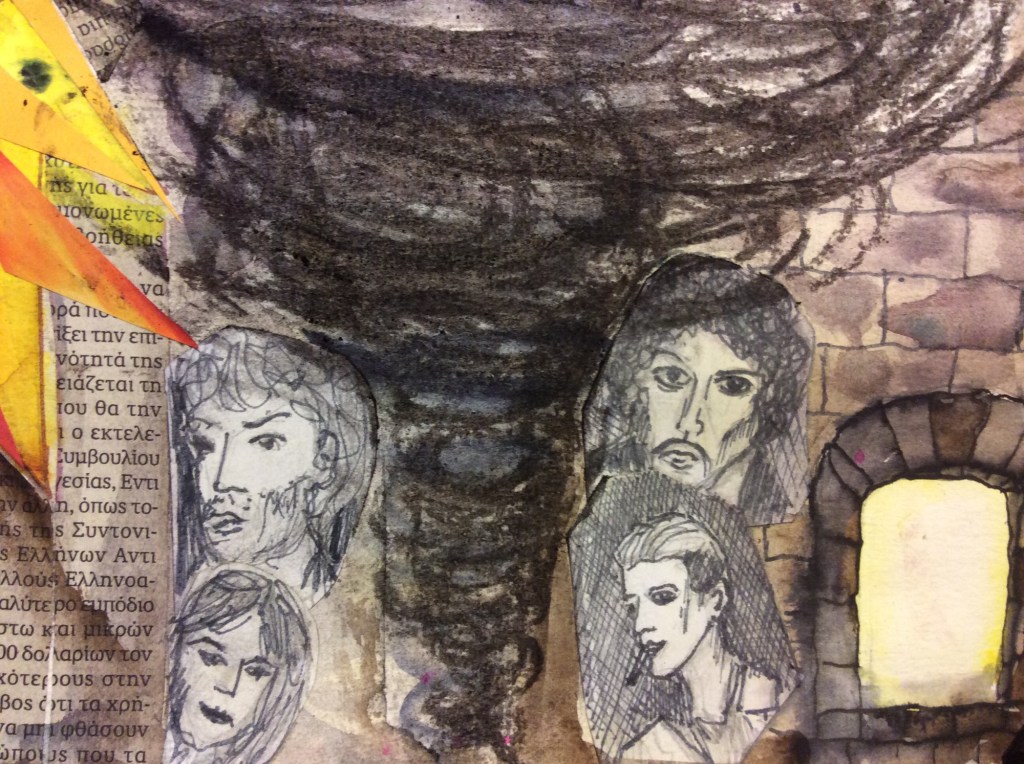
Art by AthensLettersArt
Do you remember this old song?
Where have all the husbands gone? Long time passing Where have all the husbands gone? Long time ago Where have all the husbands gone? Gone for soldiers, every one Oh, when will they ever learn? Oh, when will they ever learn?
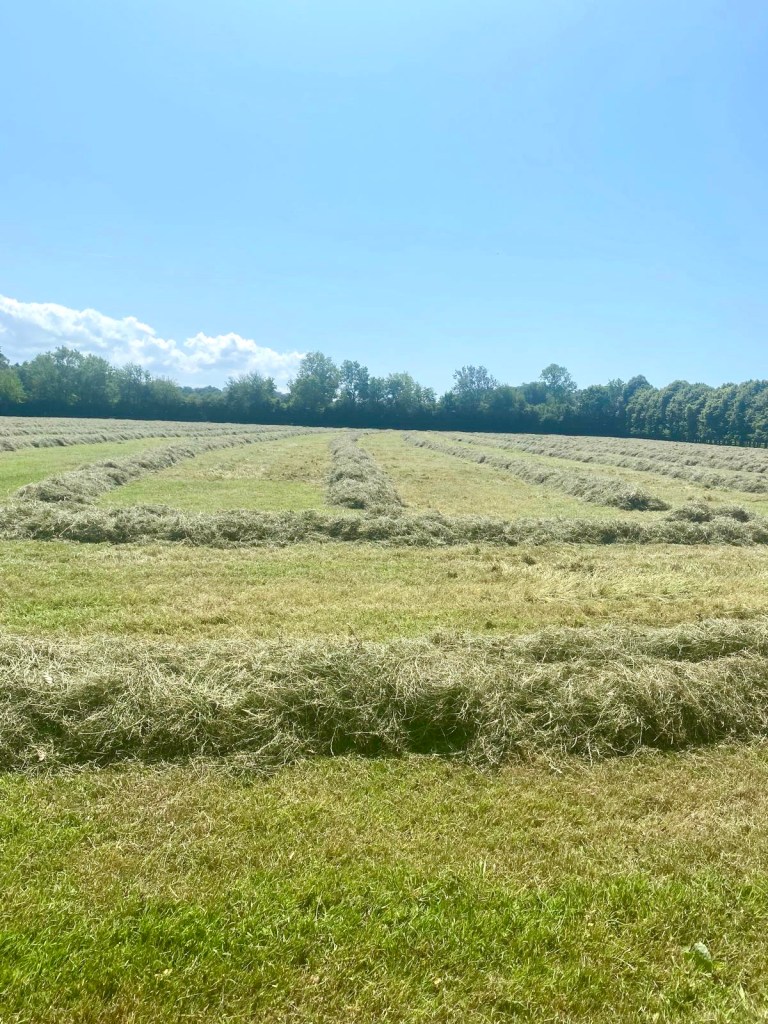
I must be in a poetic mood lately, because a countryside walk reminded me of this poem by James Cochran:
“Make hay while the sun shines” they say, and we do, circling the field while swallows
dive and swoop to feast on insects we kick up, inhaling the mingled sweetness of diesel fuel and honeysuckle. We cut, rake, and bale
till the sun goes down and the dew settles on the fields, then start again next morning once the dew burns off,
almost finishing as dark clouds build on the horizon
and fat drops of rain cut the dust on the Baler.
That’s the part no one says… Make hay while the sun shines,
but stop when it starts to rain.
Full confession: I only remembered the first bit, then looked up the rest. It is very evocative.
Is there anything more summer-like than the smell of cut grass? Sadly it cannot be conveyed to the page.
In older times, haymaking was done by hand and was backbreaking work. Everyone pitched in from dawn to dusk. Hay has to be brought in quickly, before the weather turns. But it has to be dry enough to stack or bale—it’s a tricky business.
Nowadays machines do the heavy lifting. They suck up the hay, roll it up, and spit out a bale.
It is mesmerising to watch.
Around here, the farmers who drive the harvesters are hired by neighbours as well, so they also work at night. It is fascinating watching them going up and down the field with their headlights on. This year the weather cooperated, so all is well.
A poem to read after watching the news or reading the papers.
Humans are really a race of hawks and warmongers—they have an inherent need to exterminate each other. History has taught us nothing—we have achieved huge improvements in technology, but none in human nature. Anyone who doubts that should read Herodotus’s Histories.
Of course not everyone fits into that category—humans are also capable of great feats of invention, creativity and cooperation. Sadly, the warmongers will usually prevail, since they are prepared to go to lengths peacemakers won’t. It is amazing how excessive power and wealth will corrupt almost everybody.
We are constantly bombarded with too much information, most of it of a disagreeable or horrifying nature. Corpses, ruins, starving children, shootings and stabbings, unspeakable politicians. I read the headlines, but avoid watching the news on television. One cannot take the whole world’s misery on one’s shoulders, and it is useless to worry about things one can do nothing about. But of course I do worry—it is impossible not to be anxious about the world we are leaving our descendants.
However, there is still so much beauty on this earth, it is good to seek it out as much as possible. Being lucky enough to live in the country, I revel in nature’s bounty. At this time of year, life is bursting out everywhere. Bees buzz, birds sing, cherries ripen on the trees.
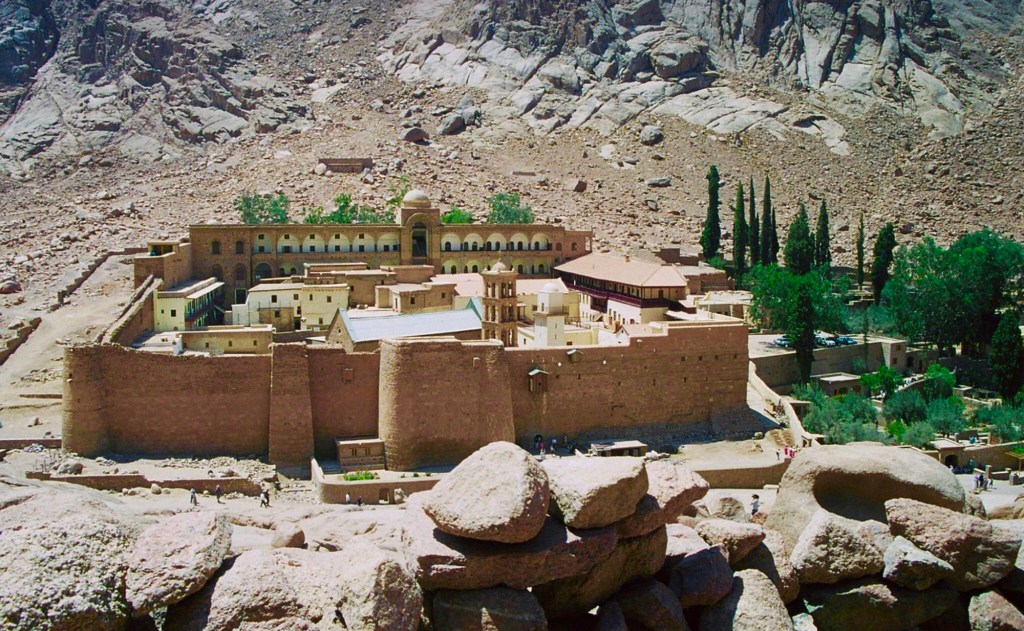
There is great alarm in the Greek Orthodox Church about the fate of Saint Catherine’s Monastery, which is situated at the foot of Mount Sinai, in Egypt.
The monastery, built in the 6th century by the order of the Byzantine Emperor Justinian the First, is the oldest monastery in Christendom. Continually inhabited by monks, it contains what is thought to be the Burning Bush seen by Moses and possesses numerous rare works, such as the Codex Sinaiticus and the Syriac Sinaiticus, as well as a wonderful collection of early Christian Icons and illuminated manuscripts.
The site is considered sacred by the three major Abrahamic religions: Judaism, Christianity and Islam. It became a World Heritage site in 2002.
Last week an Egyptian court ruling decided the lands around the monastery should revert to Egypt, and there were even rumours that Egypt intends to turn the monastery into a museum. These rumours were swiftly denied, however the uncertainty about the monastery’s status quo remains.
A delegation from Greece has met with their Egyptian counterparts and discussions are under way, which are delicate due to the many legal complications as well as the interests involved. The Church obviously wants to preserve the status quo, but the Greek government (heavily criticised by the opposition for delays in solving the issue which has been looming for a while) also wishes to preserve good relations with Egypt.
If the ruling stands, the monastery risks losing the lands around it which are essential to its daily functioning and, ultimately, its survival, including gardens with water springs, orchards and olive groves. Unfortunately, these lands are coveted for touristic expansion.
As in all such cases which have to deal with geopolitical issues as well as financial interests, much politicking will be going on, with each side trying to gain as many advantages as possible.
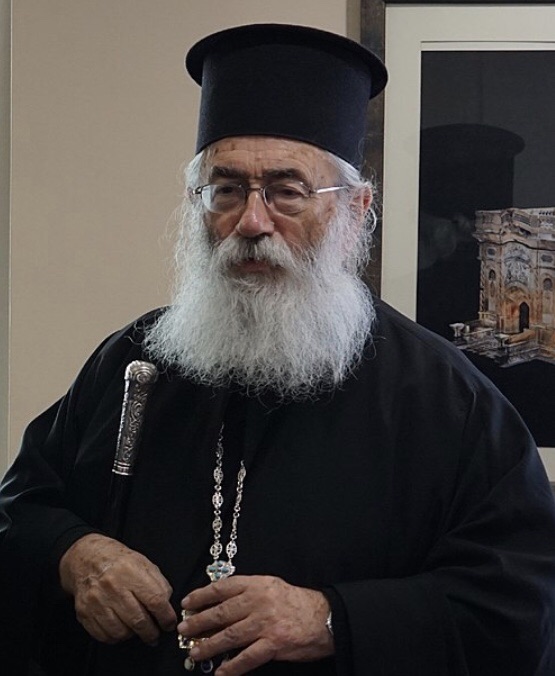
The hegoumen of Saint Catherine’s, Archbishop Damianos, has been very active in his leadership of the monastery, including organising a digital archive of the monastery’s manuscripts, establishing the first Greek University in Egypt, fostering interfaith dialogue and preserving the monastery’s rich spiritual and cultural traditions.
Archbishop Damianos (b. 1973)
In 2004, the Benaki Museum in Athens organised a wonderful exhibition of masterpieces from the monastery, including icons, mosaics and manuscripts. These were also later shown at the Metropolitan Museum in New York. After the opening of the exhibition, there was a small diner in an Athenian restaurant, where I had the honour to be seated next to Archbishop Damianos.
I have to confess I was a little overwhelmed at first. An Orthodox priest—long black robes, long black beard, long black hair tied in a bun, embroidered vestments and a gold cross. What on Earth would we find to talk about for the next two hours? Well, I soon changed my mind. He was the most wily, charming, educated, well-travelled and well-read man, as well as a superb raconteur. A dinner I will never forget. I hope he gets to keep his monastery.
Noted by his contemporaries for his powerful preaching, expert knowledge of scripture, and undying love and devotion to the poor and the sick, Saint Anthony of Padua (1195-1231) was one of the most quickly canonized saints in church history, being canonized less than a year after his death.
Born in Portugal of wealthy and noble parents, Anthony joined the Church early on and ended up in Italy after his ship was blown off course on a return journey from Morocco.
Although he died at 35, Anthony led a busy and varied life, preached in many places in Italy and France and performed many miracles. One can easily read about his life (there is a lengthy Wikipedia entry) but the reason I am writing about him is that I came, entirely by chance, upon this weird and wonderful detail of a mural in the Basilica di Sant’Antonio da Padova, of him preaching to a bunch of fish.
Just look at the expressions on those fish faces. Priceless
The story of Anthony “preaching to the fish” originated in Rimini, where he had gone to preach. When the Cathar heretics there treated him with contempt, Anthony was said to have gone to the shoreline, where he began to preach at the water’s edge until a great crowd of fish was seen gathered before him. The people of the town and even heretics flocked to see this marvelous thing and were moved to listen to Anthony’s preaching.
There are other paintings of this event, but this one has a special flavour to it.
There is an interesting exhibition on at the moment close to us in Trouville, at the Villa Montebello, a small museum housed in an old villa built in 1865 by the Comtesse de Montebello. After a chequered past, it was acquired by the city of Trouville and became a museum in 1972.
The exhibition is mainly devoted to the artist Charles Mozin (1806-1862), who was a Parisian but built a house and settled in Trouville in 1939.
He was one of many artists who left Paris (a polluted and stinking, overpopulated city) to seek cleaner skies and beautiful landscapes in Normandy. Why Normandy, and why Trouville? Well, it was close to Paris, a mere 4 days by the diligence (stagecoach) and there were beautiful beaches, wonderful light and fresh fish.
In the early 19th century, sea bathing became fashionable, starting in Dieppe, which had old ties with England where this activity began. And then Trouville was discovered, at the time a small, simple fishing village.
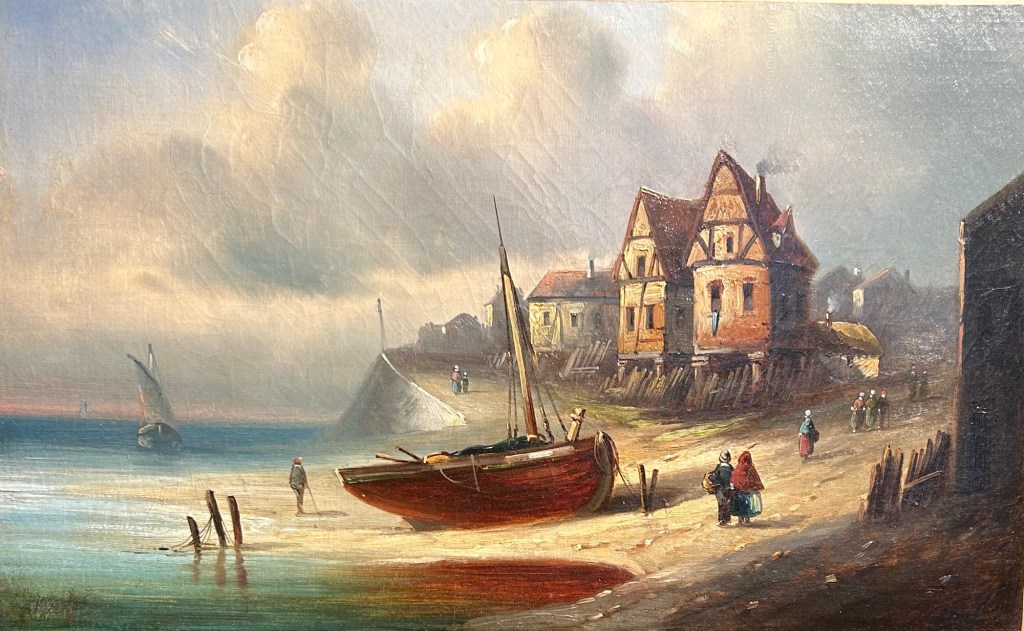
Early painting by Eugène Isabey
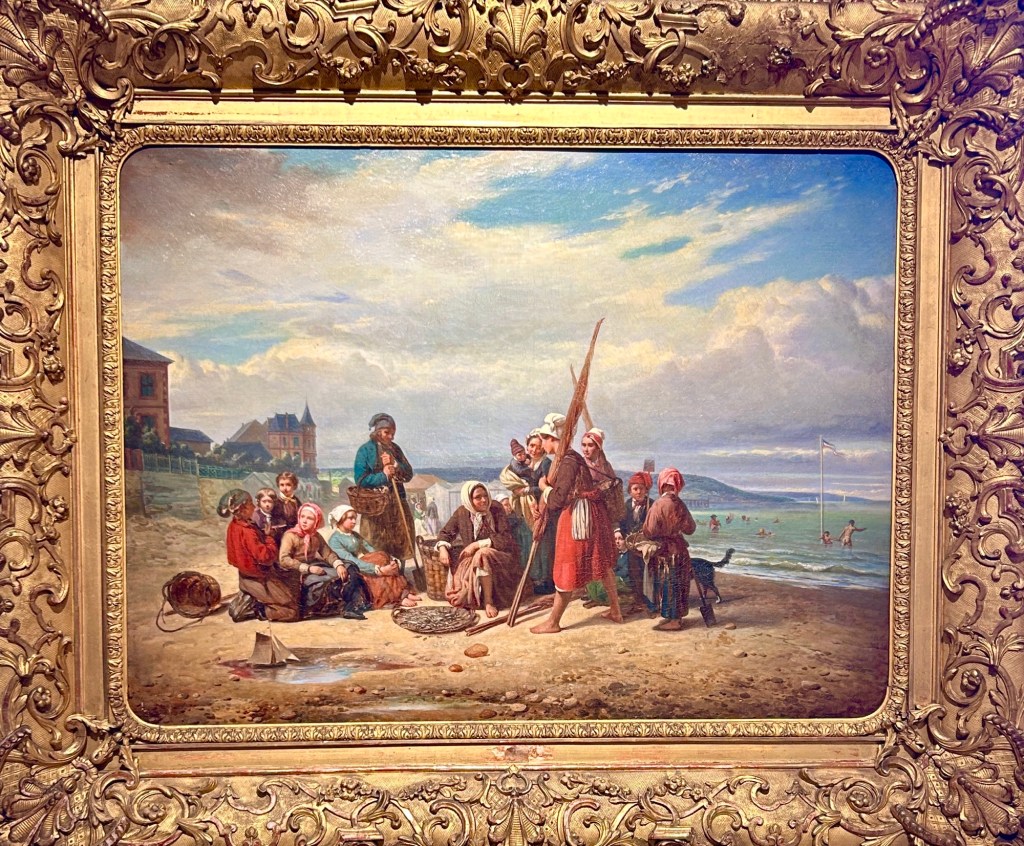
Around 1820, artists such as Eugène Isabey, Charles Mozin, Camille Corot and Richard Parkes Bonnington came to Normandy to paint and then exposed their works in grand Parisian exhibitions. People saw, were enchanted and came to visit. Rapid development followed and Trouville became a busy port as well as a station balnéaire. In the painting below, by Pierre Duval le Camus, one can see the juxtaposition of the old way of life with the new: a group of fishermen’s wives and their children are gathered on the beach, in a pause of their daily activities. It was a rough life—while the men were at sea, the women, aided by the children as soon as they were old enough, gathered mussels and sprats, mended nets, sold the fish their men caught in the market. They were hardworking and poor.
Pierre Duval le Camus, Trouville, Les Bains de Mer, 1851
Behind them to the right, one can glimpse bathers—people of a higher social class and better means, the tourists of the day.
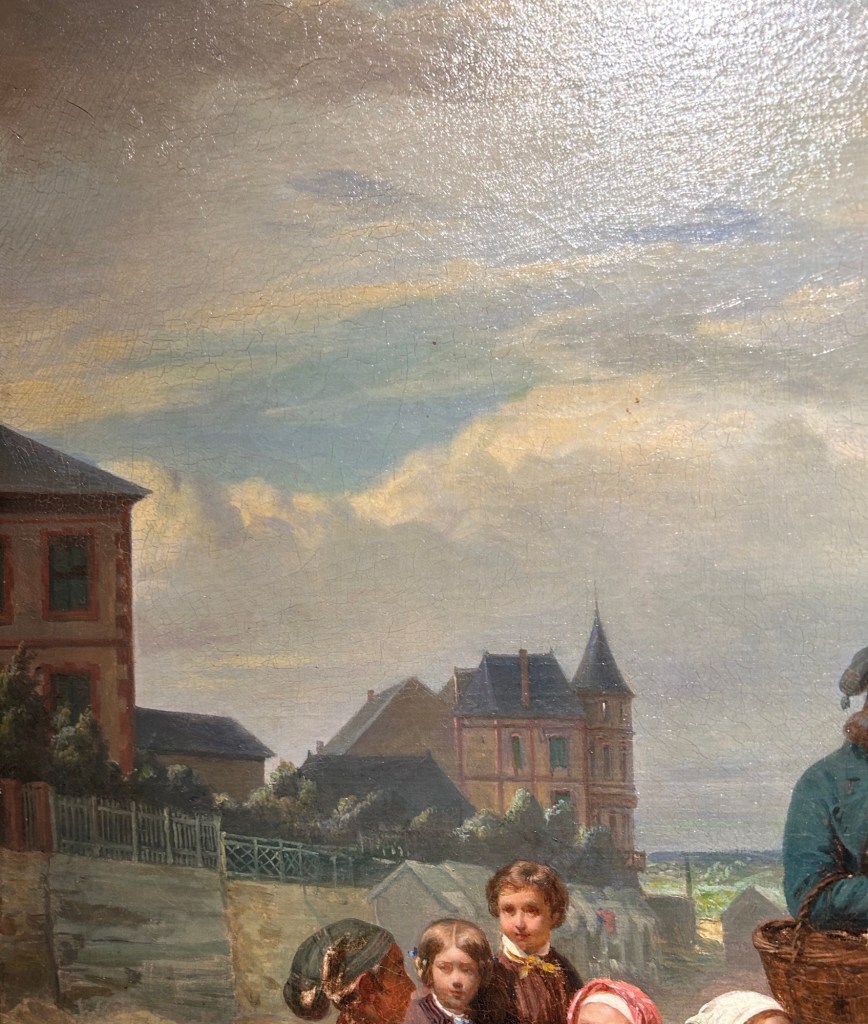
Detail
On the left, the buildings are not fishermen’s cottages, but vacation homes. The one on the right still exists, albeit in a very different setting.
Charles Mozin was the artist who best captured the progress of this development, about which he had very mixed feelings. He shunned society and much preferred the old, simple way of life. He was a very clever draughtsman, who captured details in his many sketchbooks and then went back to his studio in Paris to work on the large paintings.
In the background between the ships one can see the lights of the market, still busy at nightfall
A beautiful view of the Touque by moonlight. La Touque is the river which flows to the sea at Trouville. Ships sailed up the Touque to the port.
Above is an example of Mozin’s accurate and very detailed sketches.
Two ships entering the port
This huge painting shows how much sea traffic there was, and the difficulty of entering the port, especially in rough seas. The vessel on the left is a passenger ship, which sailed regularly from Le Havre and was the main way of reaching Trouville. On the right a fishing boat is trying to manoeuvre in the narrow passage. Sometimes there were accidents, and there is a story of a ship which, encountering strong winds and currents, floundered and sank, drowning everyone on board, despite people rushing to the rescue in small boats. Only a dog survived and, when it was fished out of the sea, it was found to have in its mouth its master’s jacket.
In this painting, also by Mozin, one can see the new bridge connecting Trouville with what was going to become Deauville. At the time the land was marshy, and the Trouvillais used to ford the river before the bridge was built to graze their cattle on the près salés (salt meadows). The small building on the right was a customs house.
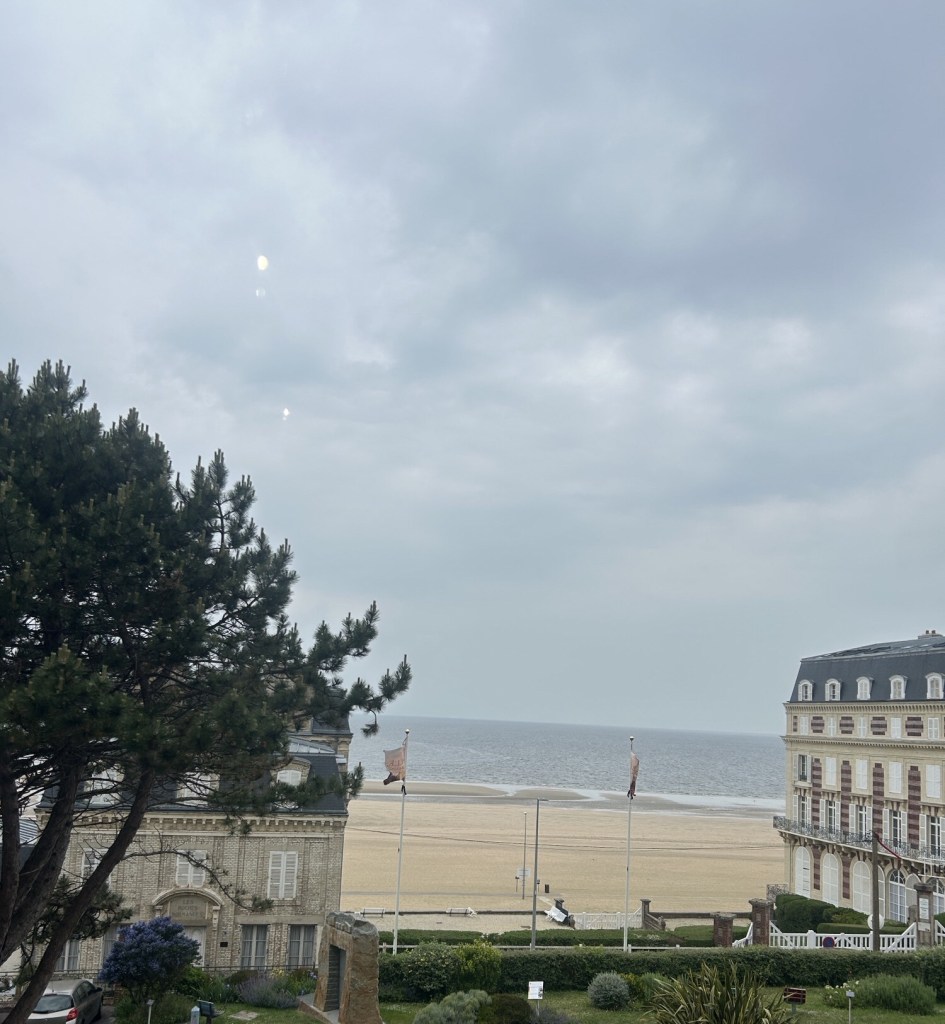
Below is a photo of the view from the Villa Montebello
And finally, a view of Trouville today, at low tide. A lovely place, well worth visiting.
“Reading the book is like watching a Komodo dragon eat a tethered goat. Paraguay, as Gimlette portrays it, is . . . completely bizarre. . . . Conquistadores and Nazis, whores and cannibals, all of them rather awful, all of them splendidly rendered. . . . Graham Greene would have approved.” –National Geographic Adventure
I seem to be on a roll of recommending favourite books. This one is in a category of its own, a crazed travelogue on Paraguay, one of the most exotic, captivating and eccentric countries in the world, according to writer John Gimlette. Even the title of the book is insane.
I have never been to Paraguay, nor are there any Paraguayans amongst my South American friends, so I cannot pretend to have a personal opinion on the veracity of his observations. I can only say the book enchanted me, with its descriptions of hellish jungles, Germanic villages, missionaries, utopian experiments and coups. Apparently the Paraguayans venerate Princess Diana and, if they deem it necessary, will call in Scotland Yard.
Here’s an excerpt from Chapter 1:
I had a room on the second floor. It was a vast, mildewed space that might once have been used for dancing classes. It had floor-to-ceiling louvred shutters that were so seized up with drifts of green paint that they’d become petrified in the open position, admitting scalding blasts of dust and roasted corn from the street below. I shared this great green tropical ballroom with two others, for whom it was, in its own way, heavenly. The first was an Englishman called Kevin Pluck who’d come to South America to give some long and careful thought to the question of whether or not he should ever get a job. He had an opening in the car factory at Luton, but the delicious, orange-blossomed lassitude that overwhelmed Asunción ensured that he wasn’t going to hurry the decision. He’d at least made up his mind to return to Luton with a suntan and so he spent a lot of time and effort trying to go brown. For some reason his skin remained determinedly cheesy.
I have given this book to various people as a gift, but I never followed up on whether they had read it and liked it, as I don’t believe in gifts with strings attached. I do however, consider it a fine aid to armchair travel. You will become lost in a world so exotic that it will make you feel like Alice in Wonderland.